
For sellers of USB chargers targeting the Brazilian market, the first common pitfall is immediately asking “how to get INMETRO certification” — in reality, many USB chargers for mobile phones need to obtain approval per ANATEL requirements, but you cannot arbitrarily rule out whether INMETRO rules also apply to the product. Many people waste money and delay shipment schedules because they cannot clarify the boundaries between these two systems.
First, Understand: Not All USB Chargers Require INMETRO Certification
Let’s first clarify the core conclusion: whether charging products in Brazil are subject to ANATEL or INMETRO requirements shall be determined based on the specific definitions of product categories, power supply methods, structures, and exclusions in the two sets of current regulations, rather than only looking at whether there is a USB port, whether it is connected to the mains, or only based on the core use promoted by the product. Battery chargers for mobile phones usually fall under the corresponding regulated categories of ANATEL; for other USB-powered products, the compliance path cannot be determined solely by “core use” or whether the charged device has cellular communication functions.
ANATEL (National Telecommunications Agency of Brazil) is responsible for the approval of its regulated telecommunications products. INMETRO (National Institute of Metrology, Quality and Technology of Brazil, ) manages corresponding products, components, or matters in accordance with various mandatory conformity assessment rules. If a product falls under ANATEL’s regulated category, it does not automatically exclude that its complete machine, components, or other applicable matters still need to comply with INMETRO rules; vice versa. The final compliance determination shall be subject to official regulations and written opinions from certification bodies with corresponding scopes.
Many people cannot clarify the division of roles in the two systems, which can be quickly understood through the following table:
| Role Type | ANATEL Path (Common Path for Mobile Phone Chargers) | INMETRO Path (When Applicable to Its Regulated List) |
| Core Regulatory Authority | Formulates compliance rules for telecommunications products, issues official approval certificates, and is responsible for market supervision | Formulates mandatory conformity assessment rules, accredits certification bodies and laboratories, and is responsible for market supervision |
| Accepting Certification Body | OCD (ANATEL-designated certification body): accepts applications, conducts pre-assessment, reviews documents, issues conformity certificates, and carries out follow-up supervision | OCP (INMETRO-accredited third-party certification body): accepts applications, issues certificates, and carries out supervision |
| Test Execution Body | ANATEL-accredited laboratory: conducts tests according to corresponding standards and issues reports | INMETRO-accredited laboratory: conducts tests according to corresponding standards and issues reports |
| Applicant’s Responsibilities | The manufacturer/brand owner provides technical documents and samples, and the local Brazilian responsible party acts as the compliance subject to interface with regulators | Same as left, only applicable rules differ |
| Front-end Verification Party | Customs and e-commerce platforms verify approval certificates | Same as left |
Two Most Common Entry-level Misconceptions
The first misconception is “All USB chargers require INMETRO certification” — battery chargers for mobile phones usually fall under the corresponding regulated categories of ANATEL, but it is still necessary to separately verify whether there are simultaneously applicable INMETRO requirements for the complete machine, components, or other matters. Whether one or more conformity assessments are required shall be subject to the product scope and exemption clauses of respective regulations.
The second misconception is “Having certification equals supporting all fast charging” — conformity assessment only indicates that the product complies with applicable Brazilian technical, labeling, and conformity assessment requirements within the scope covered by the certificate; USB-C requirements only apply within the product and time scope specified by regulations, and do not mean that all certified chargers have USB-C power supply capability. As for whether it can support a brand’s proprietary fast charging protocol, that is a technical compatibility issue between manufacturers and has nothing to do with access certification. For example, a 25W fast charger that has passed ANATEL may only be compatible with the fast charging of a certain brand of mobile phones, and can only charge slowly when used for other brands. This is normal and does not mean there is a problem with the certification.
Finally, a reminder: this guide is a general entry-level reference and does not constitute an official compliance determination. Before actual operation, be sure to check ANATEL’s latest technical list, the applicable official announcements () of INMETRO, and whether there are transition period policies. It is best to record the date and source of the regulation query for regulatory verification.
5-step Judgment: Does Your Product Follow ANATEL or INMETRO Path?
The regulatory attribution in Brazil cannot be judged solely by a general rule of “core use priority”. A more reliable approach is to verify product information one by one according to the following 5 aspects, and then compare with the specific definitions of regulated products, power supply methods, structures, and exclusions in ANATEL and INMETRO regulations:
1. Step 1: Product Category and Actual Use: First confirm whether the product falls under the category clearly specified by regulations. For example, battery chargers for mobile phones usually fall under the corresponding regulated categories of ANATEL; you cannot draw a conclusion directly just because the device has cellular function or the marketing materials say “suitable for mobile phones”.
2. Step 2: Power Supply Method: Confirm whether it is a wall charger plugged into household AC mains, a car charger plugged into a car cigarette lighter, or a wireless induction wireless charger? Different power supply methods may be subject to different technical requirements and test items.
3. Step 3: Integration Form: Check whether the charger is an independent product or integrated inside a complete machine such as a TV, computer, or car infotainment system. If it is a USB power port built into the complete machine (for example, the USB port on a TV is used to plug in a USB flash drive and charge a mobile phone by the way), it shall be confirmed whether it is managed together with the complete machine according to applicable regulations, rather than being treated as an independent charger by default.
4. Step 4: Supporting Cable Form: Is the charging cable fixed and non-detachable, detachable and included, or sold separately? Compliance requirements for different forms are different, which will be explained in detail later.
5. Step 5: Sales/Use Scenario: Is it a consumer-grade product sold to ordinary consumers, or for industrial use? Is it sold independently or bundled? For example, industrial built-in charging modules may not be within the scope of consumer-grade regulation and need to be confirmed on a case-by-case basis.
Boundary Judgment of Common Products
For your quick comparison, we have sorted out the regulatory attribution of typical products:
| Product Type | Regulatory Attribution Judgment |
| AC wall chargers, car chargers, wireless chargers for mobile phones | Usually fall under the corresponding regulated categories of ANATEL, and the specific regulatory scope shall still be verified |
| Independent USB interface products dedicated to power supply without data transmission | Need to be confirmed according to specific product definitions |
| USB power ports built into TVs, computers, and car infotainment systems | Shall be confirmed according to the complete machine and applicable regulations |
| Laptop power adapters, desktop multi-port charging stations | Need to be confirmed on a case-by-case basis |
| Industrial power supplies, built-in charging modules | Need to be confirmed on a case-by-case basis |
There are also clear rules on the boundary of supporting cables:
• Fixed non-detachable cables: for example, cables that are directly soldered inside the charger and cannot be pulled out, are evaluated together with the charger as a whole, and do not need separate compliance.
• Detachable included cables: detachable cables sold together with the charger in the packaging box need to be confirmed whether they are within the approval scope of the charger — for example, USB-C cables included with mobile phone chargers below 60W must comply with ANATEL’s connector requirements and be clearly listed in the scope covered by the approval certificate, otherwise they cannot be sold together with the charger.
• Independently sold cables: charging cables sold separately, whether USB-A to C or C to C, need to separately comply with corresponding regulations and cannot “rely on” the charger’s certificate.
If it is a multi-functional product (such as a desktop charging station with router function), it may fall under two sets of regulatory scopes at the same time, and it is necessary to cross-verify the requirements of ANATEL and INMETRO separately.
What If You Are Not Sure?
Do not judge by marketing names (for example, a product called “universal desktop charger” is not necessarily not regulated by ANATEL), but shall be subject to technical parameters, actual use, and product definitions and exclusions in regulations; multi-functional devices are evaluated as a whole product, and cannot only look at the charging function. The most reliable way is to prepare pre-assessment materials and submit them to an OCD with corresponding acceptance scope for written determination, and the final shall be subject to official regulations.
Information required for pre-assessment includes: basic parameters (input type/voltage, rated output power, number/type of USB ports, supported power supply protocols), product attributes (core use, whether integrated into the complete machine, cable form, whether it includes wireless charging/built-in battery), and other information (plug type, use scenario, brand and model, production factory address).
Core Verification Requirements for ANATEL Certification
Many consumer-grade USB chargers need to obtain approval per ANATEL requirements, and we will first talk about its core verification requirements. First, clarify a general principle: all requirements shall be subject to ANATEL’s current technical specifications, applicable product standards, and the OCD certification scheme you choose. Test items for different products may be different, and do not arbitrarily apply fixed thresholds found online. If the product is also subject to INMETRO rules, it shall be subject to the corresponding official announcements of INMETRO and the OCP scheme. When standard versions are iterated, old-version certificates have transition period restrictions, and the applicable version shall be subject to the regulatory interpretation.
The following explains the core requirements one by one, each part will clarify the applicable scope, verification focus, required submission materials, and the most common pitfalls:
Electrical Safety Requirements
Applicable to all charging products regulated by ANATEL, the core is to ensure no electric leakage and no injury to people. Test concerns include the safety distance between live parts and the enclosure, insulation performance, protection capability against abnormal conditions (such as short circuit), and output parameter stability. It is required to submit circuit diagrams, certificates of key safety components (fuses, transformers, etc.), and insulation material certificates.
Common Misjudgment Point: Products with USB output require additional evaluation of USB port safety, and cannot be directly replaced by the safety report of ordinary power adapters.
Thermal Safety and Material Requirements
Applicable to all charging products with enclosures, connected to mains or with high power, the core is to ensure that they will not overheat, catch fire, or melt during use. Test concerns include temperature rise under normal/overload conditions, heat resistance and flame retardant performance of the enclosure, and compatibility between plugs and cables (to avoid heating due to poor contact). It is required to submit flame retardant certificate of enclosure materials, description of heat dissipation structure, and plug specification sheet.
Common Misjudgment Point: Multi-port chargers must evaluate the temperature rise when all ports are fully loaded at the same time, and cannot be judged only by single-port parameters.
Electromagnetic Compatibility (EMC) Requirements
Applicable to all charging products with electronic circuits, simply put, the product must not randomly emit electromagnetic waves to interfere with other devices, nor can it be interfered by external electromagnetic waves so that it cannot work normally. The test is divided into two parts: electromagnetic disturbance (emission to the outside) and electromagnetic immunity (resistance to external interference). It is required to submit EMC test report and circuit shielding design description.
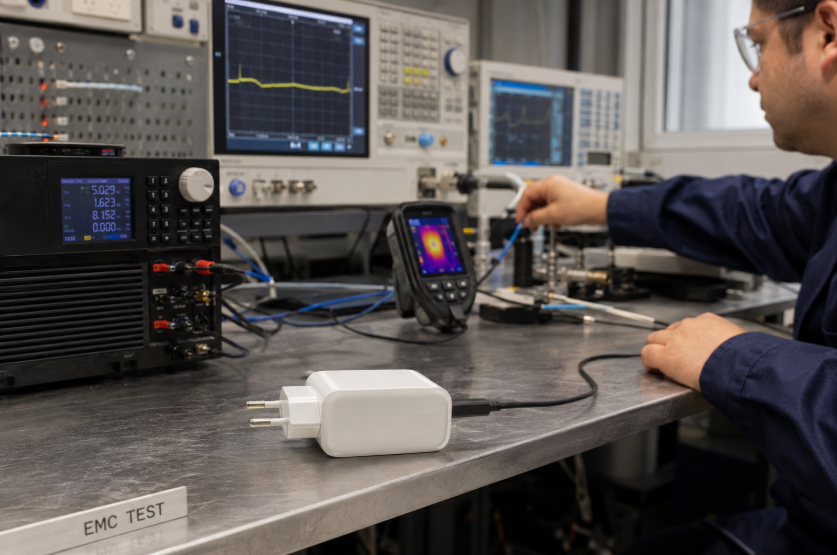
Common Misjudgment Point: Wireless chargers shall be evaluated according to applicable wireless charging, electrical safety, and EMC requirements; only when the product also contains radio functions such as Bluetooth, Wi-Fi, and cellular, shall the corresponding technical requirements for radio communication products be applied separately.
Labeling and Manual Requirements
Applicable to all products sold to consumers, the core is to make consumers understand and use them safely. Audit concerns include the conformity mark on the product body, approval registration number, rated parameters, Portuguese safety warnings, and content completeness of the manual. It is required to submit draft Portuguese labels/manuals and label abrasion resistance test certificate (the label cannot be wiped off easily).
Common Misjudgment Point: Technical symbols (such as USB logo, positive and negative pole symbols) do not need to be translated, only warnings and instructions for consumers need to be in Portuguese.
Production Consistency Requirements
Applicable to all certified products sold in batches, the core is to ensure that mass-produced products are consistent with the submitted samples, and it is not allowed that the submitted samples are qualified while the sold products are shoddy. Audit concerns include the consistency of the structure, material, key safety components, and parameters of mass-produced products with the submitted samples. It is required to submit bill of materials, list of key component suppliers, and production process documents.
Common Misjudgment Point: Changes involving safety, performance, controlled design, production location, or quality system shall be confirmed with the certification body before implementation; you cannot judge whether reporting is unnecessary solely by the name of the change.
Special Rules for USB-C and Fast Charging
Whether USB-C interface and related labeling requirements are applicable shall be confirmed item by item according to the product scope, rated power scope, and transition rules of ANATEL’s current regulations, and 15W shall not be used as a general dividing line. Audit concerns include the compliance of USB-C interface, accuracy of maximum power labeling, and specifications of fast charging-related labels. It is required to submit USB-C interface test report, fast charging function description, and label draft.
Common Misjudgment Point: Compliance cannot be judged by marketing names such as PD, PPS, and QC, but must be subject to ANATEL’s applicable technical requirements — for example, if it is marked as supporting PD3.0 but the actual test does not comply with ANATEL’s USB-C power supply specification, it still cannot pass.
Full Process of Certification Handling
After clarifying the requirements, let’s talk about how to handle it specifically. First, we will talk about the common ANATEL approval process, and then the possibly applicable INMETRO process.
ANATEL Main Path
Pre-preparation (4 Things That Must Be Done First)
1. Complete the classification pre-assessment to confirm that the product is indeed regulated by ANATEL.
2. Clarify the local Brazilian responsible party — overseas manufacturers cannot directly apply for ANATEL approval, and there must be a local Brazilian compliance subject to interface with regulators.
3. Select an ANATEL-accredited OCD. You can check the qualification and acceptance scope through ANATEL’s official website, and do not look for unqualified agents.
4. If the product is equipped with an AC power plug for connecting to Brazilian sockets, the applicable NBR 14136 and related mandatory rules shall be verified. Brazil commonly uses a two-pole or three-pole plug system with round pins, not flat pins, so special attention should be paid when purchasing accessories.
Documents and Samples to Be Prepared
• Technical documents (provided by the manufacturer): circuit diagrams, PCB layout diagrams, bill of materials and certificates of key safety components, transformer specification sheets.
• Compliance documents (provided by the brand owner/local Brazilian responsible party): brand certificate, draft Portuguese labels/manuals, factory quality system documents (if any, do not affect the basic application).
• Samples: the quantity depends on OCD requirements, and needs to cover the main model and variant models (for example, both 20W and 25W versions of the same series need to be submitted for testing).
Core Handling Steps
1. Submit pre-assessment materials to the OCD to obtain a written classification determination and certification scheme, and proceed only after confirming there are no problems.
2. Send samples to the laboratory accredited by the OCD to complete tests according to applicable standards.
3. If the test fails, retest after adjustment according to rectification suggestions. The rectification cycle depends on the severity of the problem: one or two weeks for minor problems, and longer if structural mold modification is involved.
4. After passing the test, submit the test report, label draft, etc. to the OCD for review to obtain a conformity certificate.
5. The OCD submits the application to ANATEL, and finally obtains (official approval certificate) — this is the final access credential for telecommunications products to enter the Brazilian market.
Certification Mode Selection (Advanced Decision-making)
The applicable certification mode, certificate validity period, maintenance frequency, and whether factory audit is required shall be determined by the ANATEL technical requirements and OCD certification rules applicable to the product. Before applying, you shall confirm with an OCD with corresponding scope, and shall not assume that mobile phone chargers can freely choose batch certification or annual supervision according to shipment scale.
Certification arrangements for different products may involve type testing, continuous supervision, sampling testing, document review, or other maintenance activities, and the specifics shall be subject to applicable regulations, certificate conditions, and the OCD’s written scheme.
Rules for Acceptance of Overseas Reports
Many people ask whether CE, FCC, UL, and CB reports can be used directly. The answer is they cannot automatically replace ANATEL requirements and can only be used as technical references. Only when three conditions are met can some tests be reduced or exempted: first, the qualification of the laboratory issuing the report is recognized by the OCD; second, the difference between the standards used in the report and the applicable Brazilian standards is acceptable; third, the product structure and key components are completely consistent with those in the report.
Special reminder: CE is a conformity file self-declared by the manufacturer, not an official test report, and cannot directly reduce or exempt tests. Do not be fooled by unreliable agents.
INMETRO Process
It is only applicable when the product clearly falls under the corresponding INMETRO mandatory conformity assessment rules. Even if the product also falls under ANATEL’s regulated category, it is still necessary to separately verify whether there are simultaneously applicable INMETRO requirements for the complete machine, components, or other matters.
The core process usually includes: classification pre-assessment → selecting an INMETRO-accredited OCP → sample testing → OCP review → certificate issuance → follow-up supervision. The certification mode, maintenance requirements, and whether factory audit is required shall be subject to the and OCP scheme applicable to the specific product.
Time, Cost, and Phased Deliverables
There is no unified standard for time and cost, and there are many influencing factors:
• Time influencing factors: regulatory path, certification mode, laboratory scheduling, rectification requirements, document completeness, review speed. It takes one or two months if fast, three or four months or even longer if slow.
• Cost influencing factors: number of models, test items, whether factory audit is required, whether existing reports can be used to reduce or exempt tests.
The deliverables of each stage are clear:
• Pre-assessment stage: written classification determination, certification scheme and quotation.
• Testing stage: test report, rectification suggestions (if any).
• Certificate issuance stage: conformity certificate/approval certificate, approved label draft.
Approval Maintenance and Change Rules
Obtaining a certificate is not a once-and-for-all matter. There are clear rules for follow-up maintenance, model expansion, and product changes, and a little carelessness may lead to certificate invalidation.
Validity Period and Supervision Requirements
The validity period of the approval certificate, maintenance frequency, and whether factory audit is required shall be subject to the ANATEL technical requirements applicable to the product, OCD certification rules, certificate markings, and regulatory rules. It shall not be assumed that all products are subject to annual supervision. Renewal shall be applied for in advance before expiration, and corresponding tests/audits shall be completed again to avoid product removal due to expiration and invalidation. The form of supervision may be factory inspection, sampling testing, or document review, depending on the OCD/OCP scheme.
Rules for Coverage of Same-series Models
For multiple same-series models to share one certificate, the premise is that the products belong to the same model family and have consistent core safety and performance designs. Difference items that need to be evaluated include: rated power, core circuit structure/PCB layout, key safety components (transformers, fuses, etc.). You only need to submit the model difference description to the OCD/OCP, and the body will determine whether it can be directly covered or supplementary testing is required.
Types of Changes That Must Be Reported in Advance
Any change that may affect the certificate coverage scope, controlled design, key components, production location/quality system, rated parameters, or statutory labeling content shall be submitted to the OCD/OCP for confirmation before implementation. Whether notification, certificate change, retesting, or re-audit is required cannot be generalized solely by the name of the change.
Changes that require special attention include:
• Circuit category: replacement of key safety components, adjustment of PCB layout, change of core circuit structure.
• Structure category: replacement of enclosure materials, modification of internal structure, replacement of plug/USB interface/cable.
• Parameter category: adjustment of rated power, output parameters, addition of new power supply protocols.
• Production category: replacement of production factory, or change of production process that may affect controlled production conditions and quality system.
• Labeling category: modification of labels that may affect statutory labeling content, traceability information, or brand information.
Even changes in color, packaging, or process may require confirmation or change handling if they also change product labeling, traceability information, materials, structure, or controlled production conditions. All changes shall be subject to written confirmation from the body.
Methods for Verifying the Authenticity of Certificates
Whether it is a certificate handled by yourself or provided by a supplier, you can verify its authenticity and validity through official channels, or you can first conduct a preliminary inspection through the label.
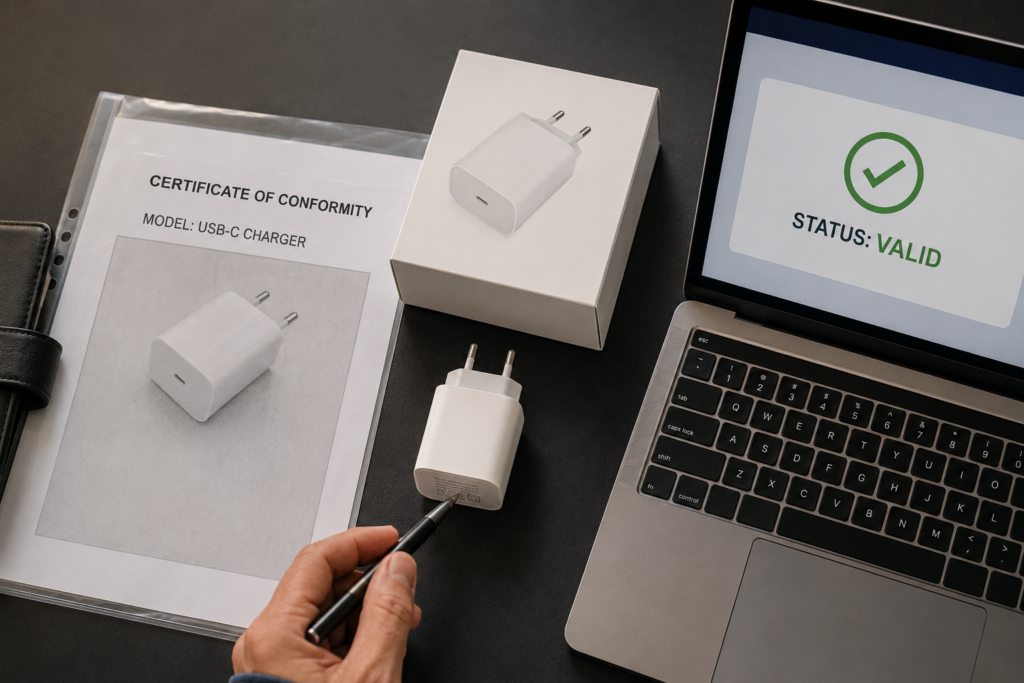
ANATEL Approval Query (Common Path for Mobile Phone Chargers)
The query entry is in the “” (product approval) section of ANATEL’s official website, and you can query by ANATEL approval number, product model, and brand.
Key points for result verification: the status is “valid”, the model specifications are within the coverage scope, the certificate holder/production subject matches the product label, and it is within the validity period.
If you are not assured, you can conduct a secondary verification through the query channel on the official website of the OCD marked on the certificate.
If no result is found, first verify the model spelling/suffix, confirm whether the wrong system is selected, and if there is still no result, you can contact the OCD to apply for written verification.
Filing Requirements: The query screenshot must include the query date, product model, and approval status for regulatory or platform verification.
INMETRO PRODCERT Query (When Applicable to Its Regulated Products)
The applicable premise is that the product has been confirmed to be within the scope of INMETRO mandatory conformity assessment. Even if the product is also subject to ANATEL requirements, it shall be verified separately according to respective rules. The query entry is in the “Product Conformity Assessment/Registration Query” section of INMETRO’s official website, and you can query by certification registration number, brand, and product model. The result verification, cross-verification, handling of no results found, and filing requirements are consistent with the ANATEL query logic.
3 Basic Characteristics of Initial Label Inspection
Quick initial inspection can be done through product labels. Compliant products generally meet three conditions: there is a conformity mark that meets regulatory requirements, the corresponding approval/registration number is marked (if applicable), and parameters and safety warnings for consumers are in Portuguese (if applicable).
But note: compliant labels do not mean that the approval must be valid, and counterfeit products can also print labels. The final must be subject to the verification results of the official database. Compliant product labels will clearly mark the ANATEL approval number, rated parameters, and Portuguese safety warnings, which can be seen by consumers and regulators at a glance.
10-item Self-inspection Checklist Before Shipment/Listing
To help you quickly identify risks, we have sorted out 10 self-inspection points. Checking them one by one can avoid most compliance pitfalls:
□ The product regulatory attribution is correctly determined, and no verification of ANATEL, INMETRO, and other potentially simultaneously applicable requirements is missed
□ A legal institution corresponding to the regulatory path has been selected (OCD for ANATEL / OCP for INMETRO)
□ The product model is within the scope covered by the approval/certification certificate
□ The certificate is in valid status with no suspension/revocation records
□ The product label complies with the approved draft, and parameters, brand, and language requirements are consistent
□ Mass-produced products are consistent with the submitted samples, and there are no unreported changes
□ Supporting cables are within the approval coverage scope or have been separately compliant
□ The local Brazilian responsible party matches the customs clearance/platform requirements
□ A full set of compliance documents is prepared to cooperate with regulatory or platform random inspections
□ Fast charging/USB-C related labels comply with ANATEL requirements
Frequently Asked Questions
Do independently sold mobile phone fast chargers require ANATEL approval?
Usually required. For battery chargers for mobile phones within the scope defined by regulations, whether sold independently or bundled, they shall be handled according to corresponding ANATEL requirements; the final still needs to be confirmed in combination with specific product definitions, structures, and applicable scopes.
How to judge the regulatory attribution of car chargers, wireless chargers, and multi-port desktop charging stations?
If car chargers and wireless chargers are battery chargers for mobile phones within the scope defined by regulations, they are usually subject to ANATEL requirements. Multi-port desktop charging stations need to be confirmed on a case-by-case basis in combination with product category, structure, interfaces, actual use, and exclusions; at the same time, it is also necessary to verify whether there are applicable INMETRO rules.
Must a 100W USB-C laptop power adapter be INMETRO certified?
Not necessarily. It is necessary to first verify separately according to the product scope, structure, power supply method, and exclusions in the respective regulations of ANATEL and INMETRO. You cannot directly default to the INMETRO path, nor can you automatically exclude other applicable INMETRO requirements just because it falls under ANATEL’s scope.
Will charging cables be automatically covered by the charger’s approval?
No. Fixed non-detachable cables are evaluated together with the charger as a whole; detachable included cables are considered covered only when clearly listed in the approval scope; independently sold cables need to be separately compliant and cannot share the charger’s certificate.
Can products with CE/FCC/CB reports be sold directly in Brazil?
No. Overseas reports can only be used as technical references. They can only reduce or exempt some tests after being evaluated and confirmed by the OCD/OCP to comply with Brazilian standards, and cannot be directly used as access credentials.
Final Summary
Compliance of USB chargers in Brazil looks complicated, but the core is actually clarifying four things: “who regulates, how to handle, how to query, how to maintain”. After reading this content, you should be able to independently complete 5 core judgments, and you don’t have to find an agent to waste money at the very beginning:
First, you can judge the Brazilian regulatory attribution of USB chargers against ANATEL and INMETRO regulations by combining product category, power supply method, integration form, cable form, and sales scenario, and will not blindly apply for INMETRO certification.
Second, you can clarify the roles of participants, core requirements, and handling processes of the ANATEL and INMETRO systems, and know what to do at each step.
Third, you can select the corresponding official database according to the regulatory path to verify the authenticity and validity of approval/certification, and will not be deceived by fake certificates.
Fourth, you can identify core risks in the links of handling, customs clearance, and e-commerce sales, complete self-inspection before shipment, and avoid common compliance pitfalls.
Fifth, you can master the basic rules of approval maintenance, model coverage, and changes, and avoid certificate invalidation caused by improper operation.