
Many sellers of charging products (charging cables, USB-C cables, chargers, power adapters, interface connectors, etc.) who enter the Saudi market for the first time most easily fall into the pit of “taking things for granted”: they assume that CE and CB certificates are sufficient for direct customs clearance, or that they can just find an intermediary to get a certificate and ship the goods, only to have the goods detained at the port, incurring high demurrage fees or even being returned.
This content is specifically for charging electronic products, helping you systematically sort out the certification requirements of the Saudi market from basic entry-level logic to practical pit avoidance. This article is for preliminary reference only; specific requirements shall be subject to the requirements displayed in the systems of SABER, SASO, CST, SFDA, ZATCA and other applicable competent authorities at the time of application.
First, Understand the Underlying Logic of Saudi Market Access
When many people first come into contact with Saudi certification, they regard “SABER” as a type of certification, which is the most common cognitive error. First, clarify the division of labor of the three core roles, and you can quickly understand the entire system:
• **SASO (Saudi Standards, Metrology and Quality Organization)**: Equivalent to Saudi Arabia’s “standard formulation + market supervision administration”, it formulates the access rules and safety standards for most consumer electronic products, and is also the competent authority for most certifications.
• **CST (Communications, Space and Technology Commission of Saudi Arabia)**: Specializes in regulating products with wireless, communication, and ICT functions; for example, chargers with Bluetooth require its compliance verification.
• **SABER Platform**: It is an online compliance processing system operated by SASO, equivalent to an “online service hall”. The vast majority of access certificates must be applied for, reviewed, and issued on this platform; it is not a certification itself.
Core Rules of Access Classification
For all products commercially imported into Saudi Arabia, the first step is not to rush to find an institution for testing, but to first confirm through the SABER Platform whether your product (corresponding to the HS code) falls into the “regulated” or “unregulated” category; the processing paths for the two categories are completely different:
• **Regulated products**: Require first obtaining a **Product Conformity Certificate (PCoC)** — you can think of it as the “Saudi compliance ID card” for this product, issued by model or for products of the same series, proving that this model meets Saudi Arabia’s basic standards; after obtaining the PCoC, before each shipment of goods, you must also apply for a **Shipment Conformity Certificate (SCoC)**, which is the “customs clearance pass” for this batch of goods, used for customs verification.
• **Unregulated products**: Do not need to apply for a PCoC; after submitting corresponding materials such as a self-declaration as required by SABER, you can directly apply for an SCoC for customs clearance.
Special reminder here: The HS code is only the starting point of regulatory classification; the final regulatory status is also affected by multiple factors such as product brand, model, function, plug type, whether it has a wireless module, and the importer’s declaration information. You cannot draw a conclusion solely based on the HS code.
Applicable Boundaries and Exceptions
Conventional commercially imported charging products all need to complete compliance in accordance with the above process. If you are sending a small number of items for personal use, or samples not for sale, there is no saying that they are “necessarily exempt from certification”. It is best to have the Saudi importer and customs broker confirm with the competent authority in advance, and do not ship with a fluke mentality to avoid detention.
In addition, for special categories such as charging products for medical use and electric vehicle charging accessories, in addition to basic access requirements, they must also comply with the additional rules of the Saudi Food and Drug Authority (SFDA) and the corresponding transportation competent authorities, and cannot directly apply the certification logic of ordinary consumer products.
4 Steps to Quickly Confirm Which Certificates Your Charging Product Needs
After understanding the underlying logic, you can follow the 4-step decision tree below to initially sort out the complete certification requirements for your product — remember a general principle: all certification requirements are based on the official query results of SABER and CST as the core basis, and do not blindly trust the “package deal” promises of intermediaries.
Step 1: First Check the Basic SABER Regulatory Status Corresponding to the HS Code
Why is the first step to check the HS code? Because the regulatory requirements for similar products can vary greatly: the function, structure, whether they constitute a combined product, and the actual use of similar products may all affect HS classification; a simple difference in rated power such as 20W vs. 100W usually does not automatically change the HS heading of the charger, but may affect the applicable technical requirements. HS classification shall follow tariff classification rules and be confirmed by the importer and customs broker.
The query path is very straightforward: you can use the HS code tool or knowledge center built into the SABER Platform to check; if you are unsure about HS classification, you can also entrust a local Saudi importer, a formal customs broker, or an authorized certification body to help verify.
The core of this step is to confirm whether the product is regulated or unregulated, as well as the basic access requirements, which is the prerequisite for all subsequent work.
Step 2: Split by Product Function Modules and Verify Special Requirements
Many charging products do not have a single function. For example, a wireless fast charger with Bluetooth has both an AC-DC power conversion module, a wireless charging coil, a Bluetooth module, and a USB-C interface — different functional modules may correspond to different special compliance requirements, and you need to split the core modules and check them one by one. The following are the key verification points for common modules of charging products:
1. **AC-DC power module** (core conversion part of wall-plug chargers and power adapters)
The triggered regulations mainly involve safety, electromagnetic compatibility (EMC), and energy efficiency-related requirements, but not all products with AC-DC conversion require energy efficiency certification or energy efficiency labels. The specific requirements shall be subject to the regulated product catalog and applicable technical regulations published by the SABER Platform and the energy efficiency competent authority. For charging products, if standby/off-mode power consumption or other energy efficiency-related technical regulations may apply, they shall be verified separately from the energy efficiency label system. The materials to be prepared generally include circuit schematics, BOM (Bill of Materials), rated parameter specifications, etc.
2. **USB-C / cable module with E-Marker chip**
The IECEE national recognition mandatory product list published by SASO includes cables and mobile phone charging cables. Whether a USB-C cable, data cable, or charging cable falls within the specific product scope shall be confirmed based on product use, structure, HS classification, and the results of the SABER and IECEE systems. The presence or absence of an E-Marker chip cannot be used as the sole criterion for judging whether IECEE national recognition is required. Verification can be done through the SABER Platform and SASO’s IECEE category catalog. The materials to be prepared include wire core specifications, E-Marker parameters, interface type descriptions, etc.
3. **AC plug/socket module**
Plugs that are directly plugged into the mains power supply involve technical regulations related to plug safety, SQM (Saudi Quality Mark), and IECEE, but not all plugs require both IECEE and SQM at the same time. The specific requirements depend on the plug standard catalog published by SASO and the SABER query results. The materials to be prepared include plug specifications and fuse parameters (if any).
4. **Lithium battery module**
If the product comes with a lithium battery (such as a wireless power bank with a battery), it will involve requirements for battery safety and transportation compliance, but it is important to distinguish: requirements such as UN38.3 belong to transportation link compliance, which is not the same as product market access certification. Do not confuse them. Verification can be confirmed through the SABER Platform and the requirements of the transportation regulatory authority. The materials to be prepared include battery specifications, UN38.3 report (if any), etc.
5. **Wireless charging transmitter coil module**
Wireless chargers that only have inductive power supply function should not be deemed to require CST approval by default just because of “wireless charging”. If the product has communication functions such as Bluetooth, Wi-Fi, cellular, NFC, or other ICT/radio functions that may be regulated by CST, it shall be verified through the CST Equipment Licensing System and the SABER Platform and processed according to the results. The materials to be prepared include coil parameters, control board schematics, function descriptions, etc.
6. **Bluetooth / Wi-Fi / NFC / cellular communication module**
As long as the product has such communication functions, it is necessary to verify the CST’s communication equipment approval requirements. Even if the module used already has certification, it cannot be directly assumed that the whole machine does not need CST approval; the verification result of the whole machine shall prevail. The materials to be prepared include module model, radio frequency parameters, existing certification certificates of the module (if any), etc.
7. **GPS receiver module**
For products with GPS function, it is necessary to separately verify the corresponding ICT equipment regulatory requirements in the CST Equipment Licensing System. The rules for ordinary wireless products cannot be directly applied for judgment. Materials such as module parameters and function descriptions need to be prepared.
Step 3: Verify Whether It Belongs to Special Regulated Categories
If your product falls into the following special categories, you need to additionally verify the requirements of the corresponding competent authority, and cannot directly apply the rules for ordinary consumer products:
• Medical supporting charging products: For example, chargers and charging cables for medical equipment need to be evaluated separately in accordance with the rules of the Saudi Food and Drug Authority (SFDA).
• Automotive / electric vehicle charging accessories: For example, car chargers, charging guns for new energy vehicles, etc., need to separately verify the requirements of corresponding technical regulations.
• Other special-purpose products: Just implement according to the special regulatory requirements prompted when querying on SABER.
Step 4: Compile a Preliminary Certification List and Confirm the Responsible Entity
After completing the first three steps, you can compile a preliminary certification list: first list the basic requirements (regulated products require PCoC + SCoC, unregulated products require self-declaration + SCoC), then list the special requirements (such as whether IECEE, SQM, energy efficiency, CST, RoHS, etc. are required).
At the same time, be sure to confirm the responsible entity in advance: many Saudi certifications require a local Saudi importer as the applicant entity, or require the brand owner to issue an authorization document to the importer/certification body. Clarify the relationship in advance to avoid application rejection later due to entity mismatch.
Core Certification Details: Understand the Function and Boundary of Each Certificate
Many certification names were mentioned earlier, and you may feel confused. Below, we sort out the common certifications for charging products by “basic layer” and “special layer” to help you understand the function of each certificate, when it is needed, and whether they can replace each other.
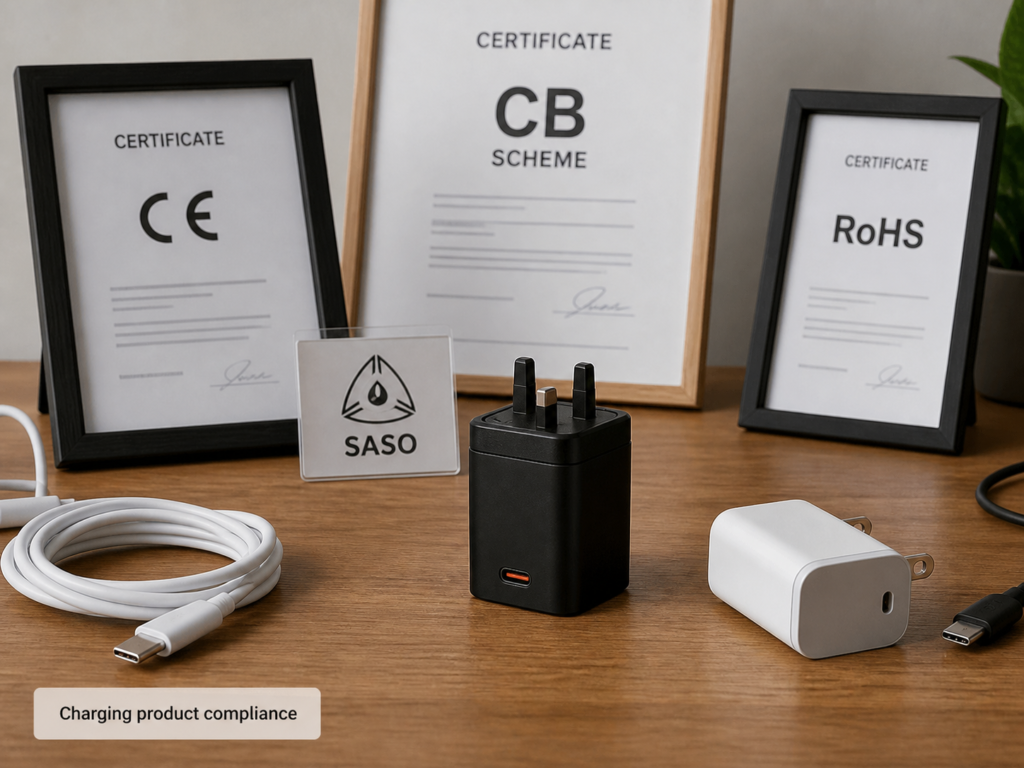
Basic Access Certificates: PCoC and SCoC
These two are the foundation of Saudi market access, involving all commercially imported products (except that unregulated products do not require PCoC), and both are processed through the SABER Platform.
• PCoC (Product Conformity Certificate): It is the model compliance certificate for regulated products, issued by model or for products of the same series, proving that this product meets Saudi Arabia’s basic technical requirements. Only after obtaining the PCoC can you apply for the SCoC for products of the same model.
• SCoC (Shipment Conformity Certificate): It is the customs clearance voucher for a single batch of goods. Each shipment must be applied for separately and cannot be reused. Unregulated products can directly apply for SCoC after submitting materials as required.
Regarding the acceptance of test reports, there are two common issues to explain:
1. **CB documents**: CB documents used for the IECEE/SASO route usually should include a CBTR (CB Test Report) issued by an accredited CBTL, and a valid CBTC (CB Certificate) issued by an accredited NCB; the report or supplementary documents should also cover the applicable standard version and Saudi national differences. If the national differences are not reflected in the original CBTR, supplementary compliance documents or supplementary test reports shall be submitted as required by SASO, and it is not necessarily necessary to redo all tests.
2. **Certificates/reports from other regions such as CE and FCC**: Can only be used as auxiliary reference, cannot be directly used to apply for Saudi access certificates, and need to supplement tests or materials as required.
Another reminder: There is no unified fixed value for the validity period and review cycle of PCoC. The final result shall be subject to the official approval of SABER. Do not blindly trust absolute promises from intermediaries such as “100% certificate issuance in 10 days, validity period of 1 year”.
IECEE National Recognition
Which specific products require it? It shall be subject to the IECEE mandatory catalog published by SASO and the SABER query results. The mandatory list published by SASO includes cables and mobile phone charging cables, so USB-C cables, data cables, and charging cables cannot be judged solely by whether they have an E-Marker chip. Wired chargers, wireless chargers, and car chargers within the scope of mobile phones and their accessories should also be subject to key verification for whether IECEE national recognition is required. It should be noted that IECEE is a special compliance requirement and cannot replace PCoC and SCoC; even if you have obtained IECEE, the basic access certificates still need to be processed.
Saudi Quality Mark (SQM)
This is a local Saudi quality mark certification, equivalent to a higher-level compliance assessment. Only products that fall within the corresponding technical regulations and product catalogs need to be processed, and separate query and confirmation are required.
Many people bind SQM and IECEE together, thinking that if you apply for one, you must apply for the other. In fact, the two are completely independent and have no fixed binding relationship. Whether they are required shall be subject to official query results. Similarly, SQM cannot replace PCoC and SCoC.
Energy Efficiency Certification and Labeling
Energy efficiency certification is an efficiency restriction requirement for high-energy-consuming products, aimed at preventing low-energy-efficiency products from entering the Saudi market.
Not all products with power conversion require energy efficiency labels. Only when a product is included in the SASO energy efficiency label regulated list is it necessary to apply for an energy efficiency label in accordance with corresponding requirements. For chargers, power adapters, wireless chargers, and car chargers, if standby/off-mode power consumption or other energy efficiency-related technical regulations may apply, they shall be verified separately from the energy efficiency label system. When verifying, pay attention to several key points: whether the product is in the energy efficiency label regulated list, whether standby/off-mode power consumption or other technical regulations apply, what the applicable test standards are, the label format and pasting requirements, and the requirements for the registered entity.
The validity period of energy efficiency certificates also varies by category, with no unified fixed value, and shall be subject to the approval of the competent authority.
CST Communication Equipment Approval
This is a communication compliance requirement for products with wireless/ICT functions, under the supervision of CST.
If the product contains regulated wireless/ICT modules such as Bluetooth, Wi-Fi, cellular, NFC, or falls within the CST regulated equipment catalog, it is necessary to query through the CST system and process according to the results. Wireless chargers that only have inductive power supply function should not be deemed to require CST approval by default just because of “wireless charging”; they should still be confirmed in combination with the CST system’s judgment on the specific product.
Like other special certifications, CST approval cannot replace SABER’s basic access certificate; the two are parallel.
RoHS Compliance
RoHS is a restriction requirement for hazardous substances in electrical and electronic equipment, such as restricting the content of lead, mercury, cadmium and other hazardous substances, to reduce environmental and health risks.
Not all electronic products need to comply with Saudi RoHS; only products that fall within Saudi Arabia’s hazardous substances restriction technical regulations/catalogs are required. It shall be processed in accordance with the applicable RoHS conformity assessment route: usually obtaining a conformity certificate issued by a SASO-accredited notified body; if supplied to the Saudi market by the manufacturer or its legal representative, the regulations allow a supplier’s declaration of conformity as the conformity assessment document. Regardless of the applicable route, product registration shall be completed, technical documents shall be kept, and applicable shipment procedures shall be processed in accordance with SABER requirements. A single material declaration cannot replace all compliance requirements.
Summary of the Relationship Between Certifications
You can divide these certifications into two layers:
• **Basic layer**: PCoC and SCoC are the foundation of SABER access, corresponding to model compliance and batch customs clearance, involving all commercially imported products.
• **Special layer**: IECEE, SQM, energy efficiency, CST, RoHS are additional requirements for products of specific categories and specific functions, and not all products require them.
There is no fixed binding combination between the two. For example, not all chargers require “PCoC + energy efficiency + IECEE”. The specific required certifications are all subject to official query results. Do not waste money on unnecessary certifications.
Quick Check of Charging Product Certification Matrix
To help you make a quick preliminary judgment, we have sorted out the key verification points for common charging products. Note that this is only a preliminary reference, and the final requirements shall be subject to official query results:
| Product Type | Core Features | Basic Verification Items | Special Verification Items | Boundary Reminders |
| Passive charging cables / data cables / ordinary adapters | No power conversion, no wireless transmission function | Whether it is regulated, whether PCoC is required | Whether it falls within the scope of the IECEE national recognition mandatory list such as cables or mobile phone charging cables, whether SQM is required | Applicability shall be confirmed based on use, structure, HS classification, and SABER/IECEE results, and the presence or absence of E-Marker shall not be used as the sole judgment condition; connecting cables with AC plugs require additional verification |
| Wall-plug chargers / power adapters | With mains input, AC-DC power conversion | PCoC requirements | Whether it falls within the scope of mobile phones and their accessories and requires IECEE national recognition (wired chargers should be subject to key verification), whether standby/off-mode power consumption or other energy efficiency-related technical regulations apply, whether SQM is required, whether RoHS compliance is required | Energy efficiency labels are only applicable when the product is included in the SASO energy efficiency label regulated list; products with wireless/communication functions require simultaneous verification of CST requirements; IECEE applicability shall be confirmed by SABER and IECEE systems based on specific product information |
| Wireless charging products | With wireless inductive charging function | Those connected to mains power need to verify PCoC requirements | Whether it falls within the scope of mobile phones and their accessories and requires IECEE national recognition (wireless chargers should be subject to key verification), whether standby/off-mode power consumption or other energy efficiency-related technical regulations apply, whether it contains communication or ICT/radio functions regulated by CST | Energy efficiency labels are only applicable when the product is included in the SASO energy efficiency label regulated list; products with only inductive power supply function should not be deemed to require CST approval by default; both IECEE and CST are subject to the system’s judgment on specific products |
| Car chargers / car charger adapters | DC input, no AC-DC conversion | PCoC requirements | Whether it falls within the scope of mobile phones and their accessories and requires IECEE national recognition (car chargers should be subject to key verification), whether standby/off-mode power consumption or other energy efficiency-related technical regulations apply | Energy efficiency labels are only applicable when the product is included in the SASO energy efficiency label regulated list; plug standards for ordinary wall-plug products do not apply; IECEE applicability shall be confirmed by SABER and IECEE systems based on specific product information |
| Multi-port fast chargers | Multiple output ports, supports fast charging | PCoC requirements, compliant power labeling | Whether standby/off-mode power consumption or other energy efficiency-related technical regulations apply, SQM, etc. (corresponding to functions) | Testing shall cover the working condition of simultaneous output from multiple ports |
| Medical supporting charging accessories | Used for power supply/charging of medical equipment | First confirm with SFDA whether it is a medical device accessory and its market access/import requirements; then separately verify whether SABER and other special requirements apply based on the product’s actual electrical, wireless, chemical substance, and HS attributes | SFDA special requirements | The ordinary consumer product route cannot be directly applied or directly excluded; it must be processed separately according to the medical category process |
Full Processing Flow: Key Nodes from Preparation to Customs Clearance
After understanding which certificates to apply for, next we sort out the complete process from preparation to customs clearance, what the core requirements of each node are, and what issues to pay attention to.
Pre-preparation: Freeze Product Information and Confirm the Responsible Entity
This step is the foundation of the entire process, and many later pitfalls are due to inadequate preparation in the early stage. You need to prepare product model parameters, brand owner qualifications, Saudi importer information, and existing test reports, and finally output a **frozen version of the product information package** — including the final versions of product parameters, structure, labels, packaging, and the authorization document of the responsible entity.
The participating roles are mainly the manufacturer, the Saudi importer, and the authorized certification body. There are only two core requirements: first, the product information must be completely consistent with the actual shipped version, and cannot be changed casually midway; second, be sure to select a certification body officially authorized by SABER and CST, and do not engage unqualified, unlicensed intermediaries.
Testing and Report Review
Submit the frozen version of product information, existing test reports (such as CB reports), and test samples to the certification body and accredited laboratory. They will review whether the existing reports meet Saudi requirements. If they do not (for example, the CB report does not cover Saudi national differences), corresponding supplementary tests are required. The final output is a valid test report that meets Saudi requirements, as well as supplementary test and rectification records (if any).
The core requirement is that the information on the report must be completely consistent with the applied product, and there must be no incorrect model or mismatched parameters.
PCoC Application (Only Required for Regulated Products)
If your product falls into the regulated category, you can apply for PCoC after obtaining a valid test report. The materials to be submitted include valid test reports, product information, importer qualifications, and authorization documents. The PCoC certificate is finally issued by the SABER Platform. If there are problems with the materials, you will receive a supplementary material notice.
The applicant entity is generally the Saudi importer (or an authorized entity), and the certification body assists in submission. The core requirement is that the application information must be completely consistent with the test report and the frozen product information.
Here is a cost-saving tip: if there are multiple models of the same series, same structure, and same core components, you can apply for PCoC jointly, which can reduce a lot of certification costs. In addition, there is no fixed review cycle for PCoC, so it is recommended to plan the time in advance and do not wait until the shipping date to apply.
SCoC Application
Whether it is a regulated or unregulated product, SCoC must be applied for before each shipment of goods. The materials to be submitted include commercial invoice, packing list, corresponding PCoC (for regulated products) or self-declaration (for unregulated products), and shipping details. The SCoC certificate is finally issued by the SABER Platform.

Generally, the Saudi importer or customs broker is responsible for the application. The core requirement is that the shipping information must be completely consistent with the coverage of the PCoC and the invoice and packing list.
Special reminder: SCoC is applied for separately for each batch of goods and cannot be reused; it must be processed before shipment. Do not wait until the goods arrive at the port to apply, otherwise high demurrage and storage fees will be incurred, which is not worth the loss.
Renewal Rules
After the PCoC or special certificate expires, renewal is required. The submitted materials include the expired certificate, the latest valid test report, and a product unchanged declaration. After passing the review, you can obtain the renewed valid certificate.
The core requirement for renewal is: the product’s parameters, structure, and key components must be consistent with the original certificate, with no changes, and the test report must be within the validity period; otherwise, direct renewal is not possible.
Key Component Change Judgment (Must Be Verified Before Change)
Many sellers replace parts during the production process, such as changing a power IC or an E-Marker chip, thinking it is a trivial matter and no re-evaluation is needed. Finally, when shipping, they are found to have inconsistent goods and certificates, resulting in detained goods and fines. It should be clarified here: as long as the key components of the product are changed, they must be submitted to the certification body for evaluation in advance to confirm whether supplementary testing, expansion of items, or re-application for a certificate is required.
Key components vary by category:
• Chargers: PCB, transformer, power IC, MOSFET, USB interface, rated power, AC plug
• Charging cables: Conductor specification, cable length, terminal type, E-Marker chip, maximum carrying current
• Wireless charging/communication products: Charging coil, control board, wireless communication module, radio frequency parameters
Do not take any chances. Even if you just change a plug of the same specification from a different supplier, it is best to confirm with the certification body in advance to avoid problems later.
Technical and Label Compliance: Don’t Let Small Details Ruin the Entire Batch of Goods
Many people think that once the certification is obtained, everything is fine. In fact, if the product labels and markings do not meet the requirements, they will also be spot-checked by customs, leading to customs clearance failure. The general requirement for all markings is: the information must be consistent with that on the certification certificate and test report. For products subject to the Gulf Low Voltage Electrical Equipment Technical Regulations, safety information must be provided with the product in Arabic, and the instruction manual must be provided in Arabic; English can be used as a supplement. Model, batch or serial number, trademark, and manufacturer/importer information shall be marked on the product, packaging, or accompanying documents as required by regulations. For other categories, the requirements of the corresponding special regulations shall prevail.
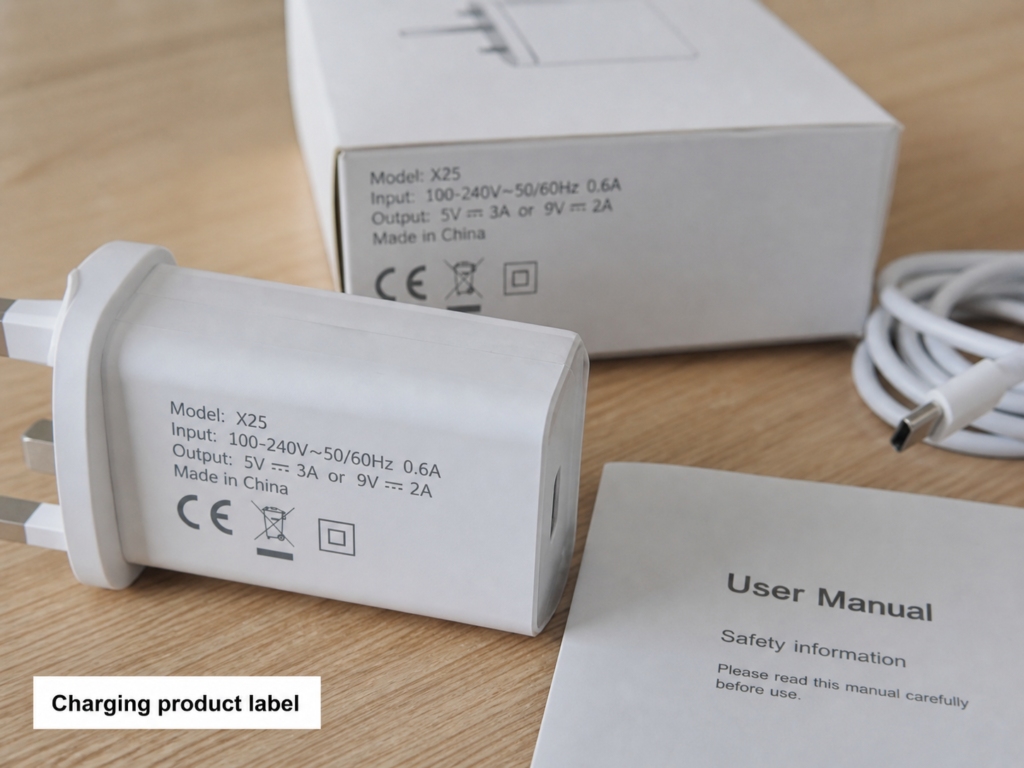
For products falling within the scope of the Gulf Low Voltage Electrical Equipment Technical Regulations, the manufacturer shall also affix the G-Mark (Gulf Conformity Mark) on each compliant product in accordance with applicable regulations, and accompany it with Arabic safety information and Arabic instruction manual. The G-Mark does not replace the product registration, PCoC or SCoC required by SABER.
The specific marking requirements include the following aspects:
1. **Product body nameplate**: Information such as brand, model, rated voltage/current/power, manufacturer, and place of origin shall be marked. The marking shall be clear and not easy to fall off, and stickers that are easy to wipe off shall not be used. For products falling within the scope of the Gulf Low Voltage Electrical Equipment Technical Regulations, the G-Mark shall also be affixed in accordance with applicable regulations.
2. **Plug marking**: Rated parameters and plug model shall be marked, and corresponding certification marks shall be marked if required. Plugs of retail wall-plug products shall comply with applicable Saudi plug standards. Common 13A plugs/sockets are subject to SASO 2203:2015, with a rated voltage not exceeding 250V and 60Hz; the product’s rated input and plug type shall be confirmed according to the actually applicable standards and SABER and certification results.
3. **Minimum sales packaging**: Core information such as model, parameters, plug version, and brand shall be marked. If functions such as “fast charging”, “PD”, and “65W” are advertised on the packaging, there must be corresponding technical basis, consistent with the actual functions of the product, and exaggerated publicity is not allowed.
4. **Product manual**: The content shall be consistent with the actual functions of the product, including instructions for use, scope of application, precautions, etc. Exaggerated functions or false publicity are not allowed. For products subject to the Gulf Low Voltage Electrical Equipment Technical Regulations, the manual must be provided in Arabic, and English can be used as a supplement.
5. **Safety warnings**: Warning content such as electrical safety and usage taboos shall be placed in a conspicuous position, meeting the requirements of corresponding technical regulations. For products subject to the Gulf Low Voltage Electrical Equipment Technical Regulations, safety information must be provided with the product in Arabic.
6. **Energy efficiency label (if applicable)**: It only needs to be pasted when the product is included in the energy efficiency label regulated list, and shall be pasted in a conspicuous position on the product or the minimum sales packaging in accordance with the specified size and format. Products that have not passed energy efficiency registration cannot be labeled privately, and the label information cannot be altered.
Pit Avoidance Guide: Common Misconceptions and High-Frequency Pitfalls
We have sorted out the most common misconceptions and pitfalls in the certification of Saudi charging products to help you avoid them in advance and reduce unnecessary losses.
Common Cognitive Misconceptions
1. **Having CE/CB/FCC certificates is sufficient for direct customs clearance**: Wrong. CB documents used for the IECEE/SASO route usually should include a CBTR issued by an accredited CBTL, a valid CBTC issued by an accredited NCB, and cover the applicable standard version and Saudi national differences; if national differences are not reflected in the original report, supplementary compliance documents or supplementary test reports shall be submitted as required. Certificates from other regions such as CE and FCC can only be used as auxiliary reference and cannot be directly used for customs clearance.
2. **SABER is a type of certification**: Wrong. SABER is an online compliance processing platform operated by SASO, equivalent to an online service hall, and is not a certification itself.
3. **All products with AC-DC conversion require energy efficiency certification**: Wrong. Energy efficiency labels are only applicable to products included in the Saudi energy efficiency label regulated list; if charging products may be subject to standby/off-mode power consumption or other energy efficiency-related technical regulations, they shall be verified separately and cannot be generally regarded as energy efficiency label certification.
4. **Passive charging cables only require basic SABER certification**: Wrong. The IECEE national recognition mandatory product list published by SASO includes cables and mobile phone charging cables. Whether USB-C cables, data cables, or charging cables are applicable shall be confirmed based on specific use, structure, HS classification, and the results of SABER and IECEE systems, and cannot be judged solely by whether they have an E-Marker chip.
5. **SQM/IECEE/GCC marks can replace SABER certificates**: Wrong. SQM, IECEE national recognition, and G-Mark belong to the quality mark use license, national recognition certificate, or regional conformity mark system respectively, and are not simple marking requirements. Whether they are applicable, whether they can be used as SABER application materials or meet a certain product conformity route shall be confirmed according to applicable technical regulations and SABER display results; in any case, the applicable product registration and shipment certificate procedures required by SABER cannot be skipped solely based on existing marks.
6. **Pure inductive wireless charging definitely does not require CST certification**: Not necessarily. If the product has communication functions such as Bluetooth, Wi-Fi, cellular, NFC, or other ICT/radio functions that may be regulated by CST, it shall be verified in the CST system and processed according to the results; wireless chargers with only inductive power supply function should not be deemed to require CST approval by default just because of “wireless charging”.
7. **IECEE and SQM must be processed at the same time**: Wrong. The two are independent special certifications with no binding relationship, and whether they are required shall be subject to official query results.
High-Frequency Pitfalls in Processing and Customs Clearance
1. **Finding unqualified institutions to issue fake certificates**: The consequences are very serious. Not only will goods be detained and fines imposed, but you may also be blacklisted by Saudi regulators, making it impossible to export in the future.
2. **For regulated products, only applying for PCoC but not SCoC**: PCoC is the model compliance certificate, and SCoC is the batch customs clearance certificate. If you only apply for PCoC, you cannot clear customs after the goods arrive at the port, which will incur high demurrage fees.
3. **Inconsistent goods and certificates**: For example, product parameters, plug type, model, and core components are different from those on the certificate. Once spot-checked, the goods will either be returned or penalized.
4. **Applying for SCoC only after the goods arrive at the port**: Customs clearance delays will incur additional storage fees and demurrage fees, sometimes the cost is higher than the value of the goods.
5. **Inconsistent responsible entities**: For example, if the importer, brand owner, and certificate holder do not match, the certification application will be directly rejected, and customs clearance will also fail.
Practical Pit Avoidance Tips
1. Freeze all product labels, packaging, and structure versions before applying for certification. Do not change them casually midway. Consult the certification body before making changes.
2. Before shipping, check the validity period and model coverage of the PCoC, and apply for SCoC after confirming there are no issues.
3. For multi-model products of the same series, same structure, and same core components, those that meet the requirements can apply for PCoC jointly to reduce certification costs.
4. Before launching new products, renewing certificates, or shipping in batches, double-check the latest Saudi regulatory requirements to avoid old certificates becoming invalid due to regulatory updates.
5. Verify the qualifications of the certification body directly in the official authorized lists of SABER and CST, and do not blindly trust the verbal promises of intermediaries.
Pre-Export Quick Checklist
Finally, we have compiled a pre-export quick checklist for you. Going through it before shipping can help you eliminate the vast majority of compliance risks:
Certification Requirements Verification
• The regulatory status and all certification requirements corresponding to the HS code have been confirmed through SABER query
• Regulated products have obtained valid PCoC certificates, which cover all shipping models
• Products requiring IECEE/SQM/energy efficiency/CST/RoHS have completed corresponding special certifications or applicable conformity assessment procedures
• Products with lithium batteries have prepared transportation compliance documents
• It has been confirmed that the Saudi importer’s qualifications are consistent with the certificate holder and authorization relationship
Technical and Label Verification
• Product power supply parameters and plug specifications comply with applicable Saudi standards and certification requirements
• The marking information on the product body and plug is completely consistent with the certification certificate and test report
• Products subject to the Gulf Low Voltage Electrical Equipment Technical Regulations have been affixed with the G-Mark as required, and are accompanied by Arabic safety information and Arabic instruction manual
• Minimum sales packaging, manuals, and safety warnings meet language and content requirements
• Energy efficiency labels (if required) have been pasted in conspicuous positions in accordance with the specified format
• The core parameters and function publicity on packaging, manuals, and online sales pages are consistent
Customs Clearance Document Verification
• The SCoC certificate for the corresponding batch has been applied for before shipment
• Commercial invoice, packing list, shipping details, and certification information are completely consistent
• All certification certificates and test reports are complete and traceable
• The latest regulatory requirements have been checked before shipment, and there are no new control items
Summary
By now, you should have a systematic understanding of the certification requirements for Saudi charging electronic products. The core takeaways can be summarized as follows:
First, you can distinguish the differences between the SABER Platform, PCoC, and SCoC, understand the classification logic of Saudi market access, and no longer regard SABER as a certification.
Second, you can initially split the product’s certification requirements through the 4-step decision tree, remember that everything is based on official query results as the core basis, and will not blindly trust the package promises of intermediaries.
Third, you can identify the triggering conditions and boundaries of special certifications such as IECEE, SQM, energy efficiency, CST, and RoHS, and will not default to multiple certifications being bound, wasting money unnecessarily.
Fourth, you can complete pre-export compliance self-inspection against the checklist, avoiding common certification and customs clearance pitfalls.
Fifth, you can judge whether certification requirements need to be re-evaluated when key components of the product are changed, avoiding major losses due to small changes.
Although the compliance requirements of the Saudi market seem cumbersome, as long as you sort out the logic, follow the process, and verify in advance, you can successfully complete market access and avoid unnecessary losses.