
Power sellers targeting the Mexican market, cross-border e-commerce practitioners, and even people who just want to buy a charger via overseas shopping have most likely heard of the term “NOM certification” — some say goods will be detained without it, some say low-power products don’t need it, and others say no separate certification is required if the complete device has certification. Do power adapters for Mexico really require NOM? Today we will explain this thoroughly from basic judgment to pitfall avoidance and verification, and you will be able to make the judgment yourself after reading.
Quick Conclusion: For Readers in a Hurry
First, here is a straightforward core conclusion to save time for readers in a hurry:
If your external AC/DC power adapters and chargers are intended for commercial circulation in Mexico — including regular sales, promotional giveaways, after-sales spare parts, and bulk import — you usually need to complete NOM conformity assessment. However, the final requirement shall be confirmed in combination with the product structure, rated parameters, import tariff code, and the regulated catalog in the current officially issued .
There are also some scenarios where you do not need to handle it directly according to commercial circulation requirements, but case-by-case confirmation is required: such as personal carry-on items for self-use, small quantities of items purchased via private overseas shopping, non-sale test samples, and temporarily imported repair parts. These shall be judged according to the import method, declared value, and customs rules at the time. But note: this kind of import facilitation is only a customs clearance policy for specific scenarios, which does not mean the product itself is permanently exempt from compliance. If you resell the charger you bought via overseas shopping, it is still non-compliant.
First, Understand What NOM Actually Is
If you want to understand the logic behind it, or even judge the requirement by yourself, let’s start with the most basic question: what is NOM?
You can think of NOM as the Mexican version of “3C Certification”. Its full name is , which is a statutory mandatory technical standard system formulated by the federal government of Mexico. Like the US FCC certification and Canadian IC certification we discussed before, it is a market access requirement, but they are independent of each other and cannot be used interchangeably. NOM covers multiple dimensions such as safety, energy efficiency, and commercial labeling. Different products correspond to different standards, and certificates must be issued by a third-party organization authorized by the Mexican government. Self-declared statements by enterprises and test reports from other countries cannot directly replace NOM.
It has two core functions: first, it serves as the access threshold for legal import and sales, adapting to Mexico’s local 127V/60Hz power grid environment; second, it controls product safety to reduce risks such as electric shock and fire. Without compliant NOM documents, in mild cases, goods will be detained by customs and products will be removed from platforms; in severe cases, you will also face fines.
3-Step Self-Judgment: Does Your Product Require NOM?
Now that you understand what NOM is, next we will use a 3-step decision-making method, so you can judge whether your product requires NOM by yourself, without asking an agent every time.
Step 1: First Confirm Whether the Product Falls Under the Category of External Power Supplies
Products directly covered by the NOM for external power supplies include ordinary external AC/DC adapters, USB-A/C port chargers, multi-port chargers, and brick-style adapters for laptops. There are three core judgment criteria: independent external design, converting alternating current (AC) to direct current (DC), and power conversion products without built-in batteries.
Products that do not need to be evaluated according to the NOM for external power supplies include passive USB cables, adapters, and built-in power modules inside devices — of course, if they are sold in combination with the complete device, they shall be separately evaluated according to the compliance requirements of the complete device, which does not mean they can be ignored.
There is another category that requires separate confirmation: external power supplies with a rated output power exceeding 250W are not within the scope of NOM-029-ENER-2017, and do not belong to this type of external power supply covered by NOM-001-SCFI-2018; however, whether other NOM or import requirements apply shall be separately confirmed according to the product’s intended use, structure, and tariff code. Outdoor use or use as a lighting accessory is not in itself an automatic exemption condition listed in NOM-029-ENER-2017, and you cannot directly determine that energy efficiency assessment is exempted solely based on the intended use. Power banks with batteries also need to be evaluated according to the requirements of the corresponding category, and are not exempt from compliance.
Step 2: Match the Corresponding NOM Standard
For ordinary external adapters, first check two core standards: NOM-001-SCFI (safety standard) and NOM-029-ENER (energy efficiency standard), to see whether the product is within the regulated scope of these two standards.
A reminder here: although special categories do not apply to the standards for ordinary external power supplies, this absolutely does not mean they do not need to comply with regulations. They just need to be evaluated against the corresponding special specifications, so do not try to take advantage of loopholes.
Step 3: Confirm in Combination with Import and Sales Scenarios
If it is a commercial circulation scenario — whether it is direct sales, free gifts with purchases, replacement as after-sales spare parts, or bulk import to Mexican warehouses — you usually need to complete the conformity assessment of the corresponding NOM.
If it is for non-commercial use, such as personal self-use, factory test samples, or temporarily imported repair parts, you need to confirm whether you can use the exception channel according to the current customs rules and declaration conditions. But as the saying goes: customs clearance facilitation does not mean the product itself is compliant, so do not use it for commercial purposes.
Special Case: How to Calculate Detachable Adapters Included with Complete Devices
Here we need to separately mention a situation where many people make mistakes: does the detachable adapter included with a complete device need separate NOM certification?
The core is to check the coverage of safety and energy efficiency certificates separately: if the NOM-001-SCFI-2018 safety certificate of the complete device explicitly covers the model and rated parameters of this adapter, it can be used as the basis for covering safety requirements; however, if this adapter falls within the scope of NOM-029-ENER-2017, it shall still have the product conformity certificate required by this standard even if it is supplied in the same package as the complete device. The main difference between separate retail and supply with the complete device is that separate retail will trigger additional requirements for energy efficiency labels and instructions.
If this adapter is to be sold separately, or if its model, plug, cable length, manufacturing factory, or output protocol is changed, it must be re-evaluated separately. Never assume that “if the complete device has NOM, the matching adapter must be compliant” — this is a common pitfall.
What Requirements Must Power Adapters Meet for NOM?
After confirming that NOM is required, next let’s talk about what requirements power adapters must meet for NOM. You don’t need to memorize them, just know what is generally regulated and which categories your product needs to cover.
Safety Requirements (NOM-001-SCFI)
It mainly applies to consumer-oriented independent external AC/DC adapters and detachable adapters supplied with complete devices, subject to the official catalog. The core controls are all hard indicators related to safety: such as electric shock protection, whether insulation and electrical clearance are sufficient, whether they can withstand the electric strength test, whether the shell is flame-retardant, whether the temperature rise is too high under abnormal conditions, whether there will be danger during abnormal operation, and whether the mechanical strength is sufficient to withstand drops.
There are exceptions: built-in power modules and some special industrial or medical power supplies are not within the scope of this standard, subject to the applicable scope of the standard.
A common misunderstanding to note here: ordinary external adapters do not have mandatory overcharge protection requirements. Overcharge protection is the responsibility of the charging management system of products with batteries (such as mobile phones and laptops), so don’t confuse the two.
Energy Efficiency Requirements (NOM-029-ENER)
Its applicable scope is narrower: independent external, AC-to-DC, single fixed DC output power supplies with rated power ≤ 250W. It controls two core indicators: whether the conversion efficiency is high enough during charging, and whether power is consumed during no-load operation. The essence is to urge products to be more energy-efficient.
Exceptions shall also be confirmed according to the standard scope: this standard does not apply to power supplies with AC output, as well as specific chargers that are physically connected to batteries or battery packs, with battery type selection and charging status display. External power supplies with a rated output power exceeding 250W are not within the scope of NOM-029-ENER-2017, and outdoor use or use as a lighting accessory is not in itself an automatic exemption condition listed in this standard, so you cannot judge that energy efficiency assessment is unnecessary solely based on the intended use.
A special reminder for fast-charging sellers: products like USB-C PD fast chargers that support negotiated voltage transformation and multi-port intelligent power distribution cannot directly apply the total power to the energy efficiency standard. You must find a certification body to predict the applicable scope in advance, and do not decide on your own that it is not required. We have previously given a special explanation on the certification requirements for USB-C PD fast charging, and the rules of different countries vary a lot, so you can compare them.
Commercial Information and Labeling Requirements
Labels and commercial information shall be confirmed separately according to the actually applicable standards, and a unified template cannot be applied.
For external power supplies subject to NOM-029-ENER-2017, the body shall at least be marked with the brand or manufacturer, model, input electrical parameters, V or VI energy efficiency grade, and output parameters; only when sold separately and directly to the public, the additional energy efficiency label specified in this standard shall also be provided.
For products subject to NOM-001-SCFI-2018, the official NOM mark shall be used in accordance with NOM-106-SCFI-2017 and the corresponding conformity assessment procedures. Importer, country of origin, instructions, warnings, etc. shall be checked item by item in accordance with NOM-024-SCFI-2013 and other actually applicable specifications; safety text must be in Spanish.
Of course, non-commercial goods that meet customs exceptions do not need to comply with this requirement.
Special attention should be paid: the form and printing position of the NOM mark must be confirmed according to the standard’s conformity assessment procedures, and it must not be printed privately — even if your product has passed the test, printing the mark without authorization is still non-compliant.
Certification Holding and Change Rules
These rules shall be subject to the Conformity Assessment Procedure (PEC) of the corresponding NOM standard and the requirements of the certification body. You don’t need to memorize them by rote, but you should have a concept:
For example, the certificate holder usually needs to be a locally registered enterprise in Mexico or an authorized agent. Some certification modes also accept overseas entities, depending on the organization and certification mode you choose.
The validity period of the certificate is not uniform, and varies according to the standard and certification mode. You should apply for renewal before it expires, and don’t wait until it expires to make up for it.
Mass-produced products shall remain consistent with the certified scope and certification materials. Changes to product specifications, design, key components, factories, or other changes that may affect conformity shall be notified to the issuing body before or at the time of implementation, and the issuing body shall determine whether they can be handled through document review, supplementary testing, and modification of the certificate scope, or whether re-certification is required; changes that have not been evaluated shall not continue to be sold or imported under the original certified scope.
Also, can products of the same family share one certificate? This also needs to be confirmed by the certification body, and you cannot judge that they can be shared solely based on similar appearance.
Full Process of NOM Compliance Handling
If you have confirmed that you need to apply for NOM, you can refer to these 6 steps for the handling process to avoid detours:
Step 1: First confirm your sales and import mode. Is it separate sales, free gift with complete device, after-sales spare parts, or temporary import? Different modes correspond to different compliance requirements. For example, temporary import may have a simplified process, and separate sales have the strictest requirements. Clarify the mode first, so that you can match the requirements later.
Step 2: Confirm the import tariff code and applicable NOM standards. The most accurate method is not to look at the product name, but to check whether your product’s import tariff code is within the regulated scope of the current , and then match the corresponding safety, energy efficiency, and labeling standards to avoid wrong or missing applications.
Step 3: Prepare product technical materials. Sort out the product’s BOM (Bill of Materials), specifications of key components, circuit schematic diagrams, and specification documents of plugs and cables in advance. These are all necessary for testing and auditing, and preparing them in advance can save a lot of time.
Step 4: Testing and certification. You must find a laboratory authorized by the Mexican government for testing. After passing the test, submit the full set of materials to the issuing body for review. Some organizations provide pre-assessment services, which can help you troubleshoot possible problems in advance and avoid rework during formal testing. You can choose according to your needs.
Step 5: Review of Spanish labels and materials. According to the actually applicable NOM requirements, check the product nameplate, packaging, instructions, additional energy efficiency labels and other information separately; safety text must be in Spanish, and commercial information such as importer and country of origin shall also be confirmed according to the corresponding specifications. Do not apply a unified label template.
Step 6: Mass production consistency and change management. Mass-produced products shall remain consistent with the certified scope and certification materials. Changes to product specifications, design, key components, factories, or other changes that may affect conformity shall be notified to the issuing body before or at the time of implementation, and the issuing body shall determine whether they can be handled through document review, supplementary testing, and modification of the certificate scope, or whether re-certification is required; changes that have not been evaluated shall not continue to be sold or imported under the original certified scope. Before each import, it is best to verify the validity of the certificate and the matching degree between the physical product and the certificate information to avoid problems at customs.
If you are planning to enter the Latin American or global market, you can also check the complete guide to power adapter export certification we compiled earlier, or compare the requirements of Brazil’s ANATEL certification, which can help you sort out the rules of different markets faster.
Common Misconceptions and Authenticity Verification
After talking about how to handle it, let’s talk about the 6 most common pitfalls and how to verify the authenticity of NOM, after all, there are many fake certificates on the market now.
6 Common Cognitive Misconceptions to Avoid
Misconception 1: Certifications such as CE, FCC, and UL can replace NOM. Wrong. These are certifications from other countries or regions and can only be used as technical references. NOM is a statutory mandatory requirement in Mexico, and certificates must be issued by a local authorized organization, just like you cannot use a domestic driver’s license to drive legally in Mexico directly.
Misconception 2: Power level determines whether NOM is required. Wrong. The mandatory scope does not only depend on power. Whether an ordinary adapter with less than 250W needs NOM depends on whether it falls within the applicable standards and import regulated scope; external power supplies with more than 250W are not within the scope of NOM-029-ENER-2017, and do not belong to this type of external power supply covered by NOM-001-SCFI-2018, but whether there are other NOM or import requirements still needs to be confirmed according to the product’s intended use, structure, and tariff code. Outdoor use or use as a lighting accessory also cannot be directly used as a reason for exemption from energy efficiency assessment.
Misconception 3: The NOM mark can be printed by yourself. Wrong. Products subject to NOM-001-SCFI-2018 must use the official NOM mark in the form and position specified in NOM-106-SCFI-2017 and corresponding procedures after passing the certification; products subject to NOM-029-ENER-2017 shall meet the requirements of body marking and additional energy efficiency labels for separate retail sales in accordance with this standard, and cannot print inapplicable marks or information on their own.
Misconception 4: If the complete device has NOM, the matching adapter must be compliant. Wrong. It is necessary to confirm separately whether the safety and energy efficiency requirements of the adapter are covered. Even if the safety certificate of the complete device covers the adapter, the adapter within the scope of NOM-029-ENER-2017 shall still have the product conformity certificate required by this standard when supplied in the same package as the complete device; if the adapter is sold separately, or the factory or parameters are changed, it also needs to be re-evaluated.
Misconception 5: Products with the same appearance can share one certificate. Wrong. You need to check whether the model, power, manufacturing factory, and key components are all consistent. Even if only the supplier of the plug is changed, re-evaluation may be required. You cannot use it directly just because the appearance is similar.
Misconception 6: Overseas shopping for personal self-use does not need NOM at all. Wrong. Small quantities of items for personal self-use may enjoy customs import facilitation, but this is a customs clearance policy for personal items, which does not mean that the product itself meets the Mexican market compliance requirements. If you resell it, you will still be punished, and customs rules will also be adjusted, so it is not always released.
It is precisely because of these misconceptions that many sellers have their goods detained and their listings removed. In summary, there are four high-frequency reasons: no valid NOM certificate or the certificate has expired; product markings, energy efficiency labels, or commercial information do not meet the actually applicable standards, such as incomplete information, wrong position, or unauthorized use of inapplicable marks; the information on the certificate does not match the physical product, such as different model, power, or manufacturer; the e-commerce page advertises “with NOM” but cannot provide a valid certificate to support it.
Triple Verification Method for NOM Authenticity
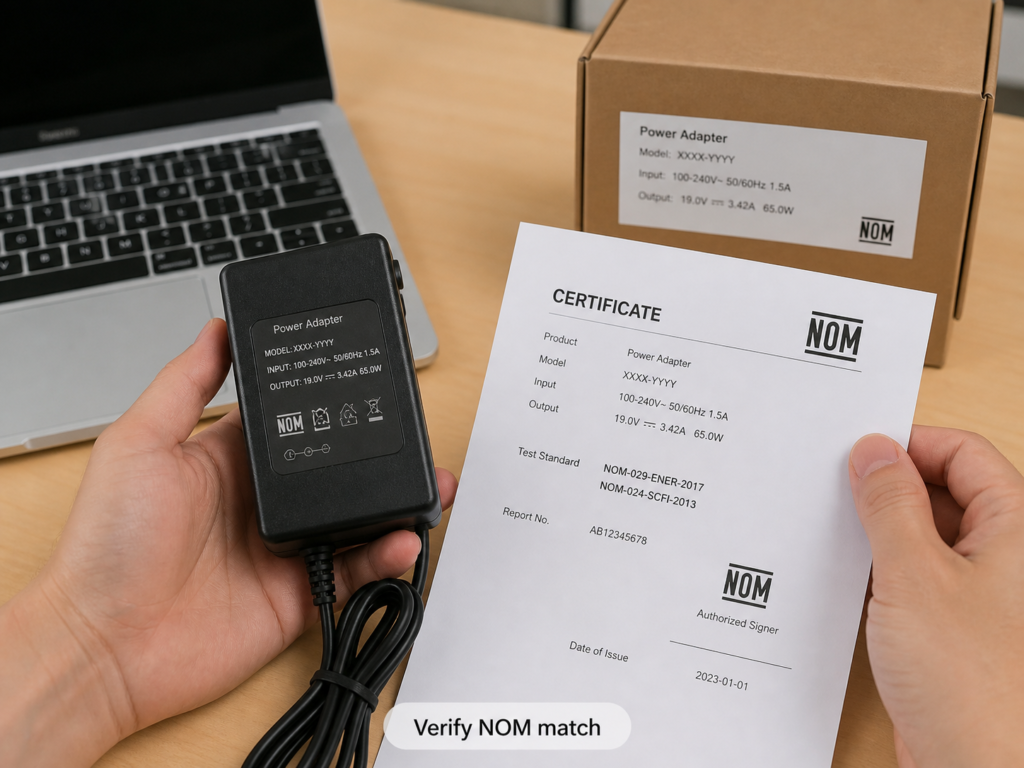
So how to verify the authenticity of a NOM certificate? Let me teach you a triple verification method, which can basically avoid 99% of fake certificates:
First level: First check the original certificate and its attachments, and confirm that the model, input and output parameters, manufacturer, production factory, validity period, and coverage scope are completely consistent with your product. Don’t just look at the cover of the certificate and believe it. Many fake certificates have a similar cover but the information in the attachments does not match.
Second level: You shall check the available Mexican official or customs NOM verification records; however, public query results cannot alone prove the certificate status. Ultimately, you shall verify the certificate number, certificate holder, certified model/factory, validity period, and whether it has been suspended or cancelled with the issuing Product Certification Body (OCP) specified on the certificate, and compare the results with the import declaration materials and the physical product item by item.
Third level: Compare whether the information of the import materials, the physical product, and the certificate is completely consistent. If there is any doubt, directly contact the issuing body for verification, which is the most reliable method.
1-Minute Quick Self-Check List
If you are in a hurry, you can directly check against the list below. If all the checked items are fine, you basically won’t fall into big pitfalls:
| Self-Check Category | Self-Check Items |
| Scenario and Import Check | □ Whether it is intended for commercial circulation in Mexico (sales/giveaway/after-sales spare parts/bulk import) |
| □ Whether the import tariff code and the regulated scope of the current have been confirmed | |
| Product Type Check | □ Whether it is an independent external AC/DC power adapter/charger |
| □ Whether it is a special product with >250W, outdoor/lighting accessory use, built-in battery, or radio frequency (applicable requirements need to be separately confirmed according to product use, structure, and tariff code) | |
| Compliance Status Check | □ Whether there is a valid NOM certificate for the corresponding applicable standard |
| □ Whether the certificate holder, labels, and packaging meet the corresponding NOM requirements | |
| □ Whether the mass-produced version is consistent with the certified sample |
In general, judging whether a power adapter for Mexico requires NOM can never be explained with a simple “yes” or “no”. It needs to be comprehensively judged in combination with the product type, usage scenario, and official catalog. After reading this article, you should be able to handle three things independently: first, accurately judge whether your product needs to apply for Mexican NOM in combination with the product type, import scenario, and tariff code regulated scope; second, distinguish the applicable boundaries of the three types of NOM requirements: safety, energy efficiency, and labeling, and avoid 6 common cognitive misconceptions; third, use the triple verification method to verify the authenticity of NOM, and complete compliance according to the 6-step process to minimize the risk of goods detention and listing removal.