
Sellers who export consumer electronics such as chargers and charging cables will almost always come across this question when they first enter the Vietnamese market. However, many people end up more confused after searching for a long time: some say all electronic products need it, some say only wireless products do, and others confuse it with Japan’s MIC. In fact, there is no unified answer to this question. The core is to first understand the two most easily confused prerequisites, and then make a judgment based on your products and export scenarios.
First Understand Two Key Ambiguities to Avoid Getting It Wrong the More You Read
First of all, we need to clarify two concepts that are most likely to cause pitfalls, otherwise all judgments will be biased.
The first is the ambiguity of “exporting to Vietnam”: when many people say “exporting to Vietnam”, they actually mean importing products into Vietnam for sale, but some people set up factories in Vietnam and export the products to third countries after production — the compliance requirements for these two scenarios are completely different.
The second is the ambiguity of “MIC”: the commonly referred to “Vietnam MIC certification” is only a market colloquial term, not a fixed certificate. It originally came from the communication and wireless access requirements of the Ministry of Information and Communications of Vietnam (MIC). Currently, the former MIC has been merged into the Ministry of Science and Technology of Vietnam (BKHCN), but the market still uses the name “MIC”. In addition, special attention should be paid: the radio certification of Japan’s Ministry of Internal Affairs and Communications is also called MIC, which is completely independent of Vietnam’s system and cannot be mutually recognized. Don’t confuse them.
The compliance scope of Vietnam’s communication and wireless access system is not limited to “certification”; it also includes Declaration of Conformity (DoC). For the publicized compliance of medium-risk products, self-assessment or certification can be used as the basis for conformity assessment according to regulations, but the test results used for this basis must come from laboratories that are accredited, designated by BKHCN, or legally recognized with corresponding capability scopes; specific documents, retention requirements and procedures shall be implemented in accordance with the list items, QCVN and applicable procedural regulations. The core basis for determining whether a product needs to be processed is the official control risk list, the product’s HS code, the actual function description, and the corresponding Vietnam National Technical Regulation (QCVN, Vietnam’s mandatory technical standard). The discussion in this article mainly focuses on charging products (chargers, charging cables, wireless chargers, power adapters, etc.). Electronic products in special industries such as medical and automotive have additional compliance requirements and are not within the scope of this discussion.
Quick Overview of Core Conclusions: Directly Match Two Mainstream Scenarios
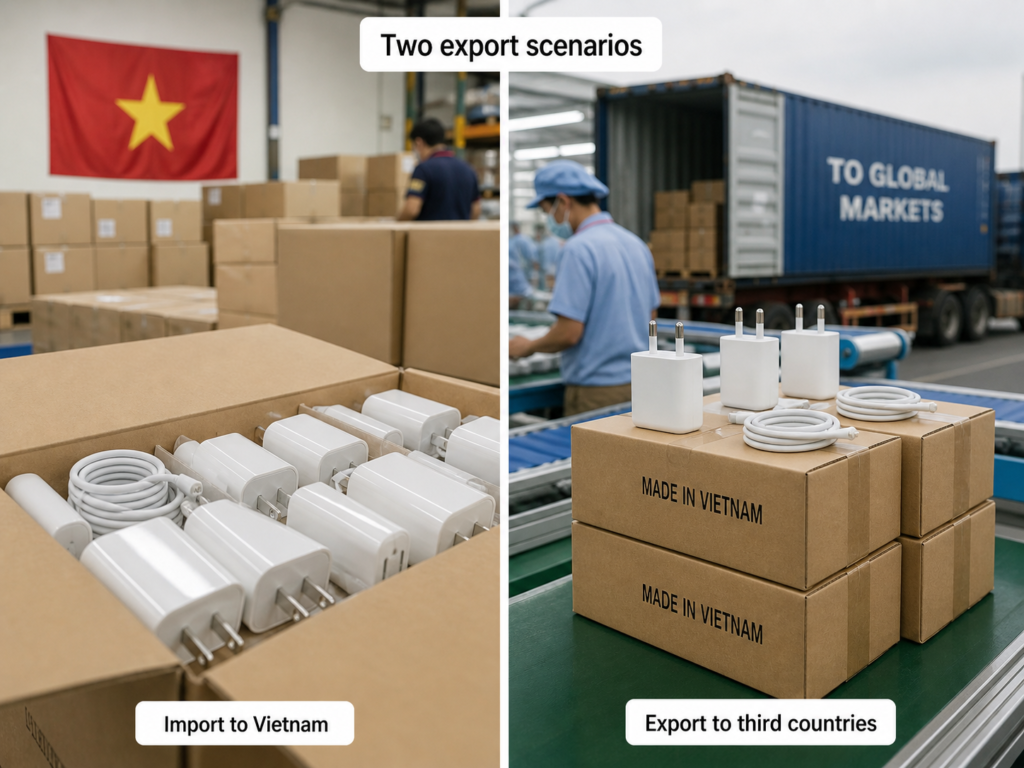
After understanding the basic concepts, we first present the core conclusions for the two most common scenarios to facilitate your quick judgment.
Scenario 1: Import to Vietnam for Commercial Sale
If products are imported into Vietnam in batches for local commercial sale — whether through offline stores, online platforms such as Shopee/Lazada, or shipping from overseas warehouses — they all fall into this category.
• Ordinary wired chargers, power adapters, and ordinary charging cables: usually not the focus of communication and wireless control, but still should be verified in combination with HS code, product description, actual technical characteristics and applicable QCVN.
• Wireless charging devices: need to check the requirements of Item 4.5 of the control list of which came into effect on July 1, 2026; those meeting the description need to complete the corresponding Declaration of Conformity (DoC).
• Charging products with active communication modules such as Bluetooth/WiFi/cellular/active NFC: need to additionally verify the corresponding wireless communication control items in the list.
Scenario 2: Vietnam Factories Exporting to Third Countries
If the factory is located in Vietnam and the produced products are only exported to third countries for sale, the market access of the destination country is usually the core of sales compliance, and the access requirements of the destination country should be met (for example, CE RED for export to the EU, Japan MIC for export to Japan, FCC for export to the US). However, this situation cannot be interpreted as automatic and complete exemption from Vietnam’s rules. It is still necessary to check the applicable product quality, production and export procedure regulations of Vietnam according to whether the product is produced in Vietnam, whether it enters the Vietnamese market, the export mode, and the requirements of the competent authority or customs.
Here we need to correct a common misunderstanding: “Made in Vietnam” products do not mean that you only need to pay attention to Vietnam MIC. Export compliance first depends on the requirements of the sales location, but the Vietnamese procedure requirements corresponding to the production location and export mode cannot be ignored.
Of course, the above are general conclusions, and the final judgment shall be subject to the latest rules of the Vietnamese competent authority.
30-Second Quick Preliminary Screening (Not Final Judgment)
If you are in a hurry and just want to make a preliminary judgment first, you can use three questions for quick screening:
1. Screen scenario: Is it batch commercial import and sale within Vietnam? If it is a Vietnamese factory exporting to other countries, the destination country access is usually the focus, but the applicable production and export procedure requirements of Vietnam still need to be checked.
2. Screen function: Does the product have wireless power supply or active communication modules? What are the parameters such as operating frequency band and maximum transmit power? These are all important preliminary screening factors, but not the only criteria; they should also be judged in combination with HS code, product description and applicable QCVN.
3. Screen boundary: Is it a product in special industries such as medical/automotive? If yes, additional compliance requirements of the corresponding industry need to be checked.
Basic Understanding of Vietnam’s Communication and Wireless Access
If you need a more accurate judgment, or want to understand the logic behind it to avoid pitfalls, we will first explain the basic rules of this access system clearly.
Current Regulatory System (As of September 2026)
At present, the competent authority for this communication and wireless access system is the Ministry of Science and Technology of Vietnam (BKHCN). The relevant functions of the former Ministry of Information and Communications (MIC) have been merged, so official documents are issued in the name of BKHCN, but the market is still used to calling it “MIC certification”.
The currently valid control list is , which officially came into effect on July 1, 2026. The previous old regulations No. 02/2024 and No. 29/2025 have become invalid, so do not use the old regulations as the basis.
The core function of this set of rules is to prevent wireless signals from interfering with each other and ensure the access compatibility of public communication networks, and it also covers other wireless devices listed in the list. To put it simply, you can’t just look at whether the product can connect to the public network; wireless power supply, wireless communication, frequency band, power and product category may all affect whether it is subject to control, which is not the same as the product’s charging performance or durability.
Compliance Processing Path
clearly divides controlled products into two categories: high-risk and medium-risk, which are subject to the management requirements listed in Annex I and Annex II respectively; specific products must also be judged in combination with HS code, product description, applicable QCVN and the conformity assessment method in the items.
For example, wireless charging devices are currently managed according to the corresponding items in the medium-risk catalog. Before imported products are placed on the market, they need to complete publicized compliance in accordance with regulations; self-assessment or certification can be used as the basis for conformity assessment according to regulations, but it cannot be based solely on the self-declaration of the responsible party. The test results used for self-assessment or certification must be issued by a laboratory that is accredited, designated by BKHCN, or legally recognized with a matching capability scope. Which documents need to be submitted, which materials need to be retained, and whether inspections are accepted must all be confirmed in combination with the corresponding QCVN and procedural regulations.
Matters This System Does Not Regulate
Special reminder: this set of communication and wireless items is not equivalent to full product compliance. Pure wired charging performance, general wired local data transmission, as well as applicable electrical safety, energy efficiency, environmental protection, labeling and other requirements shall be separately verified in accordance with corresponding product regulations.
But do not completely exclude “local data transmission”. For example, WiFi devices that meet the frequency band, power and product description may themselves fall within the management scope of . Therefore, completing communication and wireless compliance does not mean that the product is fully compliant; conversely, a product with local wireless functions cannot be automatically excluded just because it does not directly access the public network.
Easily Confused Access Requirements
There are several common confusing items that must be clearly distinguished:
• **Japan MIC**: Radio certification of Japan’s Ministry of Internal Affairs and Communications, completely independent of Vietnam’s system, with no mutual recognition relationship. Japan MIC cannot be used as a Vietnamese compliance document.
• **Other Vietnam access requirements**: For example, electrical safety, energy efficiency labels, etc., the applicable competent rules and control scopes may be different. Do not confuse them with “MIC certification”.
• **Overseas certifications such as CE/FCC/CCC**: They cannot automatically replace Vietnam’s statutory compliance documents. It is not that having FCC means you can directly enter Vietnam. As for whether test reports from overseas laboratories can be used as technical support materials, it depends on specific regulatory items, QCVN requirements and the laboratory’s mutual recognition qualifications, and cannot be generalized.
Compliance Judgment Logic and Boundary Cases for Charging Products
Returning to the charging products that everyone is most concerned about, we will specifically explain which ones usually do not require key verification, which ones must be processed, and the boundary situations that are easy to be uncertain about.
Products That Usually Do Not Require Key Verification
These products usually do not have controlled functions such as wireless power supply and wireless communication, but the final decision shall still be subject to the HS code, product description, actual technical characteristics and official mandatory list.
• Ordinary wired chargers and power adapters: only have wired charging function, no wireless power supply or communication module.
• Ordinary USB/USB-C charging cables and data cables: only used for power transmission or data transmission between local devices.
• USB-C fast charging cables with E-Marker: The E-Marker chip is only used for negotiating charging power and transmitting local data, and has no active wireless transmission function.
• Passive charging adapters, connectors, interface accessories: have no electronic transmission function themselves.
However, these are all general situations, and the final decision shall be subject to the actual product configuration and official mandatory list. For example, some adapters have built-in wireless modules, which need to be evaluated separately.
Core Products Requiring Mandatory Verification
There are two main categories:
• **Wireless charging devices**: Even wireless charging pads that only have wireless power supply and no Bluetooth or WiFi need to be checked against the control list. Those meeting the description need to complete the DoC corresponding to QCVN 96, which many people will ignore.
• **Charging products with active communication modules**: For example, wireless chargers with Bluetooth, smart chargers with WiFi, shared power banks with 4G modules. As long as they have modules that actively transmit communication signals such as Bluetooth, WiFi, 4G/5G, and active NFC, the corresponding control items must be verified.
Boundary Cases Most Prone to Misjudgment
These are the situations that sellers ask about the most and are most likely to misjudge:
1. **Wireless charging pads without Bluetooth/WiFi**: Many people think “if there is no communication module, there is no need to worry”, but this is actually wrong — as long as its HS code matches the description of “electromagnetic induction power/signal transmission” in the list, those meeting the requirements need to do QCVN 96 DoC, which has nothing to do with whether there is a communication module.
2. **Smart chargers with WiFi**: This type of product must meet both the control requirements for wireless charging and the control requirements for WiFi wireless communication. The two items are superimposed, and it is not enough to just do one.
3. **USB-C fast charging cables with E-Marker**: Many sellers are fooled into saying that “cables with chips are telecommunications equipment and need MIC”. In fact, they only do local power negotiation and data transmission, and have no active wireless transmission function. Under normal circumstances, this type of cable is not the focus of communication and wireless control, but it should still be confirmed according to HS code, product description, actual technical characteristics and applicable QCVN.
General Boundary Rules
No matter what charging product it is, these rules apply and can help you avoid many pitfalls:
• Products with wireless modules in hardware but with functions turned off through software still need to be evaluated, and exemption cannot be applied for solely based on “function turned off” — after all, the hardware exists, and it may be detected during customs or market spot checks.
• For products of the same series with multiple models, only models with wireless functions need to be evaluated, and models without wireless functions can be declared separately, without the need for compliance for the entire series.
• Products sold in sets/combinations (such as “charger + charging cable” gift boxes) are evaluated separately according to the import declaration unit and the function of each individual product, not the entire set as one product.
• Products with pure GPS/GNSS modules (such as power banks with positioning), even if they only receive satellite signals and do not transmit outward, cannot be automatically excluded solely based on “no transmission”. Wireless navigation devices may have corresponding items, which should be verified in combination with HS code, product description, actual technical parameters and applicable QCVN; those with backhaul functions need separate evaluation.
• Not all products with NFC functions are subject to control, nor are all of them not subject to control. It depends on the read/write/transmission capability of NFC and the definition of the list. If you are unsure, consult a professional institution for confirmation.
Applicable Rules for Different Export Scenarios
We mentioned two main scenarios in the core conclusion just now. Let’s explain the specific rules in more detail, including the handling of special situations.
Scenario 1: Import to Vietnam for Market Sale
The trigger condition is batch commercial import, and the products are sold or used within Vietnam — including sales on online platforms, shipping from overseas warehouses, and even supporting use for local enterprises, all count.
Many cross-border sellers will ask: “I run a Shopee cross-border store and ship by direct mail. Do I also need to comply?” The answer is yes: platform rules do not change statutory access obligations. As long as it is commercial sale, it needs to meet the requirements, but usually the responsibility is borne by the local Vietnamese importer or seller, and overseas manufacturers only need to provide technical support. If the product falls into the mandatory list but has not completed compliance, the most direct impact is customs clearance failure, or even return.
Scenario 2: Vietnam Factories Exporting to Third Countries
The core logic is: for products that are only exported from Vietnam and sold in third countries, the market access of the destination country is usually the core of sales compliance. You need to meet the access requirements of the destination country, such as Japan MIC for export to Japan and CE RED for export to the EU.
But it cannot be asserted that products do not need to consider Vietnamese rules at all. Whether Vietnam’s product quality, production or export procedure requirements are still applicable shall be checked item by item in combination with whether the product is produced in Vietnam, whether it enters the Vietnamese market, the actual export mode, and the requirements of the competent authority and customs.
Let me emphasize again: “Made in Vietnam” does not mean that Vietnam MIC is automatically required, nor does it mean that relevant Vietnamese procedures can be automatically ignored; the sales location, production location and export mode may all affect the items that need to be checked.
Special Scenarios Such as Non-Commercial/Entrepot Trade
In addition to the two mainstream scenarios, there are some special non-commercial or entrepot situations where the above rules cannot be directly applied. Don’t take it for granted. Be sure to confirm with the import agent, customs or competent authority, and it is best to obtain written evidence. There are four main types of scenarios that need to be confirmed case by case:
• Test/exhibition samples: require reasonable quantity and clear non-sales purpose.
• Maintenance spare parts: only used for after-sales service, not sold separately, with reasonable quantity.
• Small parcels for personal use: non-commercial use, quantity meets customs regulations for personal use.
• Entrepot trade products: only transshipped in Vietnam, not sold in the Vietnamese market.
6-Step Compliance Verification Path
If you have specific products and want to do a relatively accurate preliminary assessment by yourself, you can follow these 6 steps, and consult a professional institution for confirmation when encountering boundary problems.
Step 1: Confirm Sales Scenario and Responsible Entity
First clarify where the final sales location of the product is, and whether the export mode is commercial sale, sample or entrepot? In addition, confirm whether there is a clear local Vietnamese importer or responsible entity — most compliance procedures require a local Vietnamese entity to handle, and overseas manufacturers cannot handle them directly.
Step 2: Sort Out Core Technical Characteristics of the Product
First clarify the product functions: is it only wireless power supply? Or does it have active communication functions? Or only pure receiving functions? Then sort out the key parameters, such as operating frequency band, maximum transmit power, antenna form, whether there is a SIM/eSIM card slot, and parameters related to wireless power supply.
Special attention should be paid here: even if the wireless function is only an auxiliary function, it must be verified, and cannot be ignored just because the main purpose is charging — for example, a charger only has a Bluetooth remote control function, and this Bluetooth module is also within the control scope. Pure receiving functions should not be directly excluded solely based on “no transmission”; it still depends on whether they match the relevant product items in the list.
Step 3: Cross-Match with the Current Control List
The verification basis is the current List No. 36/2026 and the corresponding QCVN standards. When making a judgment, you cannot only look at the HS code, nor only the function description. You need to cross-compare the four dimensions: HS code, list product description, actual technical characteristics of the product, and applicable QCVN to reach a conclusion. The HS code is a necessary judgment item, but it cannot alone determine compliance requirements, because the same HS code may include products with completely different functions.
Be sure to use the latest version of the list officially released by the competent authority. If there is a dispute over the judgment result, it is best to consult a professional customs declaration person or compliance institution for confirmation, don’t handle it blindly by yourself.
Step 4: Confirm Applicable QCVN and Conformity Assessment Path
After finding the list item corresponding to the product, match the QCVN standard under the item, then confirm whether the conformity assessment type required by this standard is certification or DoC, what are the specific test requirements, and what are the qualification requirements for the handling institution.
Step 5: Check Consistency Between Product Version and Materials
Many sellers will fall into a pit here: they use engineering prototypes when applying for compliance, but change the hardware when actually shipping (such as replacing the wireless module, modifying the coil), so the previously completed compliance becomes invalid. Therefore, it is necessary to confirm that the product model, SKU, hardware version, PCB, coil, and wireless module version are all completely consistent with the actual shipping version. If the same product has multiple wireless versions (for example, some have WiFi and some do not), they should be evaluated separately according to the actual imported version, and cannot be mixed together.
Step 6: Conduct Professional Pre-Assessment for Boundary Products
If the product belongs to a boundary situation (such as with NFC, pure GPS, or relatively special functions), don’t draw conclusions casually if you are unsure. Prepare the product specification sheet, wireless module/coil materials, instruction manual, and pre-classified HS code, and find a compliance institution recognized by the Vietnamese competent authority to do a pre-assessment, and keep the written assessment result, which can be used as a basis for compliance during future customs clearance or market spot checks.
Basic Rules for Compliance Processing (Import to Vietnam Scenario)
If after evaluation, you confirm that the product needs to apply for Vietnam’s communication and wireless compliance, these basic rules can help you avoid detours and being cheated.
Pre-Confirmation Before Processing
If these two steps are not done well, everything later will be in vain:
1. Use the 6-step verification method to confirm again whether it is really necessary to apply for this set of communication and wireless compliance — don’t be fooled by bad institutions to apply for a bunch of non-mandatory certifications and waste money for nothing.
2. Confirm that the product model, hardware version and final shipping version are completely consistent. Even if only the batch of the wireless module is changed, as long as the parameters change, it needs to be re-evaluated.
Processing Procedure and Required Materials
Many people ask “how much does it cost and how long does it take to apply for MIC” as soon as they start. In fact, the correct logic is to first lock in the applicable list items and corresponding QCVN standards, then determine what materials are needed and what procedures to follow, and finally the cost and cycle.
The general required materials are roughly as follows: product model and hardware version description, core wireless/power supply parameters, bill of materials (BOM), label packaging and instruction manual, HS code pre-classification opinion. If it is a wireless charging product, you need to additionally complete the applicability verification of QCVN 96 first, and confirm that it is within the control scope before proceeding.
The processing entity is not an overseas manufacturer, but jointly handled by an institution with Vietnamese official recognized qualifications and the local Vietnamese import responsible party. As for labeling requirements, renewal rules, and change requirements, there is no unified answer, and shall be subject to the corresponding QCVN standards and the latest requirements of the competent authority.
For medium-risk catalog products such as wireless charging devices, DoC cannot be interpreted as “no testing required, just fill out a declaration”. Before being placed on the market, publicized compliance must be completed in accordance with regulations; the test results used as the basis for self-assessment or certification must come from laboratories that are accredited, designated by BKHCN, or legally recognized with corresponding capability scopes. Specific materials, submission methods and retention requirements shall still be subject to applicable items, QCVN and procedural regulations.
General Precautions
• All submitted technical materials must be completely consistent with the actual shipped products. This is a red line. Once the materials are found to be inconsistent, it will be directly deemed non-compliant.
• Test requirements depend on specific list items and QCVN. Some tests need to be completed in Vietnam-recognized laboratories, not just any laboratory.
• Compliance documents are kept by the local Vietnamese responsible party for inspection, and do not necessarily have to be affixed to the product (labeling requirements shall be implemented in accordance with regulations).
• When looking for a partner institution, be sure to verify the qualifications, ask the other party to show official authorization certificates, and it is best to be able to find them on the Vietnamese regulatory platform. Don’t look for unlicensed intermediaries.
• Don’t trust illegal promises such as “guaranteed pass” and “100% test-free”. Regular institutions will not say such things, and there is a high probability that they are cheating money.
Common Misconceptions and Risk Warnings
We have compiled the five most common misconceptions and the consequences of non-compliance to help you avoid pitfalls.
Misconception 1: All Charging Products Exported to Vietnam Need MIC
**Correction**: Only products that fall into the No. 36/2026 control list need it. Pure wired chargers and charging cables usually do not trigger it.
**Supplement**: Not needing to apply for communication and wireless compliance does not mean nothing needs to be done. You also need to check other access requirements such as electrical safety, energy efficiency, labeling, and environmental protection.
**Pitfall avoidance**: When consulting an institution, first ask the other party to show the corresponding list items. Don’t pay just because the other party says “all need to be done”.
Misconception 2: CE/FCC/CCC Can Directly Replace Vietnam Compliance
**Correction**: Overseas certifications cannot automatically replace Vietnam’s statutory certification or DoC documents, and customs does not recognize them.
**Supplement**: Whether overseas test reports can be used as technical support materials depends on applicable items, QCVN requirements and laboratory qualifications, not all can be used.
**Pitfall avoidance**: Don’t go directly to customs clearance with overseas certificates, there is a high probability that the goods will be detained.
Misconception 3: Module Certification Equals Whole Machine Compliance
**Correction**: Module certification can indeed reduce the cost and difficulty of whole machine testing, but the whole machine still needs to be evaluated — because the antenna, shell, and power supply will all affect the wireless signal transmission performance. Passing the module does not mean the whole machine meets the requirements.
**Pitfall avoidance**: Don’t claim that the whole machine is compliant solely based on the module certificate. Be sure to do a whole machine evaluation.
Misconception 4: Cables with Data Transmission Are Telecommunications Equipment
**Correction**: Cables that only transmit data between local devices and usually do not have wireless functions, such as USB-C cables with E-Marker chips, are generally not the focus of communication and wireless control; but “whether it can access the public network” or “whether it actively transmits” cannot be used as the only judgment standard. It should be verified in combination with HS code, product description, actual technical parameters and applicable QCVN.
**Pitfall avoidance**: When judging, it depends on whether the product has wireless power supply or communication functions, operating frequency band, power and actual configuration, not just whether it can transmit data.
Misconception 5: Small Batch/Cross-Border E-Commerce Does Not Need Compliance
**Correction**: As long as it is a commercial order continuously sold on platforms or overseas warehouses, even if the quantity is small, it is a commercial import and needs to meet access requirements.
**Pitfall avoidance**: Only non-commercial special situations with reasonable quantity may apply to the exception policy. Don’t take chances. Once the goods are detained, the loss will be greater.
Actual Risks of Non-Compliance
If non-compliant, you will mainly face two types of risks:
• **Customs risk**: If found during customs clearance, you may be required to supplement materials, or even be subject to administrative penalties and return of goods, delaying the sales rhythm.
• **Operation risk**: Vietnamese e-commerce platforms are gradually strengthening compliance audits. Compliance documents may be required when listing products, or if they are not available during after-sales market spot checks, it will lead to product removal, affect store operation, and even fines.
Self-Check List and Quick Check of Common Products
Finally, we have compiled a quick self-check method and conclusions for common products for your convenience to check at any time.
3-Minute Self-Check List
Just answer three questions to make a preliminary judgment:
1. **Product function self-check**: Is there a wireless power supply or active communication module? What are the operating frequency band, maximum transmit power, antenna and wireless module configuration? These are all important preliminary screening information, but pure receiving products cannot be directly excluded solely based on “no transmission”.
2. **Export scenario self-check**: Is it import to Vietnam for sale? Vietnam factory exporting to other countries? Or entrepot? Is it batch commercial import, or non-commercial special scenario?
3. **Material consistency self-check**: Are the product model, hardware version, label and packaging completely consistent with the compliance materials to be submitted?
Quick Check of Conclusions for Common Charging Products
| Product Type | Triggers Communication and Wireless Compliance | Supplementary Notes |
| Ordinary USB-C charging cable/data cable | Usually not triggered | Should still be checked in combination with HS code, actual configuration and other access requirements |
| Ordinary wired charger/power adapter | Usually not triggered | Need to check other access requirements such as electrical safety and energy efficiency |
| Wireless charging pad/charger | Need to verify the list | Those meeting the requirements of List No. 36/2026 need to complete QCVN 96 DoC |
| Smart charger with Bluetooth/WiFi | Need superimposed verification | Those meeting both wireless charging and corresponding wireless communication items have superimposed requirements |
| Produced in Vietnam and exported to Japan | Destination country access is usually the core | Need to meet local Japanese access requirements (such as Japan MIC), and at the same time check the applicable production and export procedure requirements of Vietnam |
In general, there is no one-size-fits-all answer to the question “Is MIC required for exporting electronic products to Vietnam”. The core depends on your export scenario and the actual function of the product. Active transmission, operating frequency band, EIRP, wireless power supply and communication functions are all important judgment factors, but the final confirmation still needs to be cross-checked with HS code, list description, actual technical parameters and applicable QCVN.
Don’t be overly anxious, and don’t take chances. Evaluate step by step according to the procedures, and if you are unsure, find a regular institution to do a pre-assessment, which can basically avoid most pitfalls.