
Friends who export consumer charging products mostly have a full set of EU CE compliance documents on hand. When planning to expand into the Australian and New Zealand markets, the first question is often: Can CE reports be used directly for RCM? After all, both sides require safety and electromagnetic compatibility testing, and their standards also reference internationally accepted universal versions, which seem to differ very little; being able to reuse them would save a lot of time and cost.
Let’s first lay out the core conclusion clearly to avoid detours: **There is no compliance path for direct conversion of CE to RCM, and CE documents cannot replace the requirements for local registration and local responsible entities in Australia and New Zealand; however, eligible CE test documents can be used as part of the technical evidence for Australia-New Zealand compliance, and the specific extent of reusability depends on filling gaps according to the selling country and different regulatory lines.** The credibility of CE documents depends on four core dimensions: laboratory qualification, standard equivalence, product consistency, and regulatory applicability.
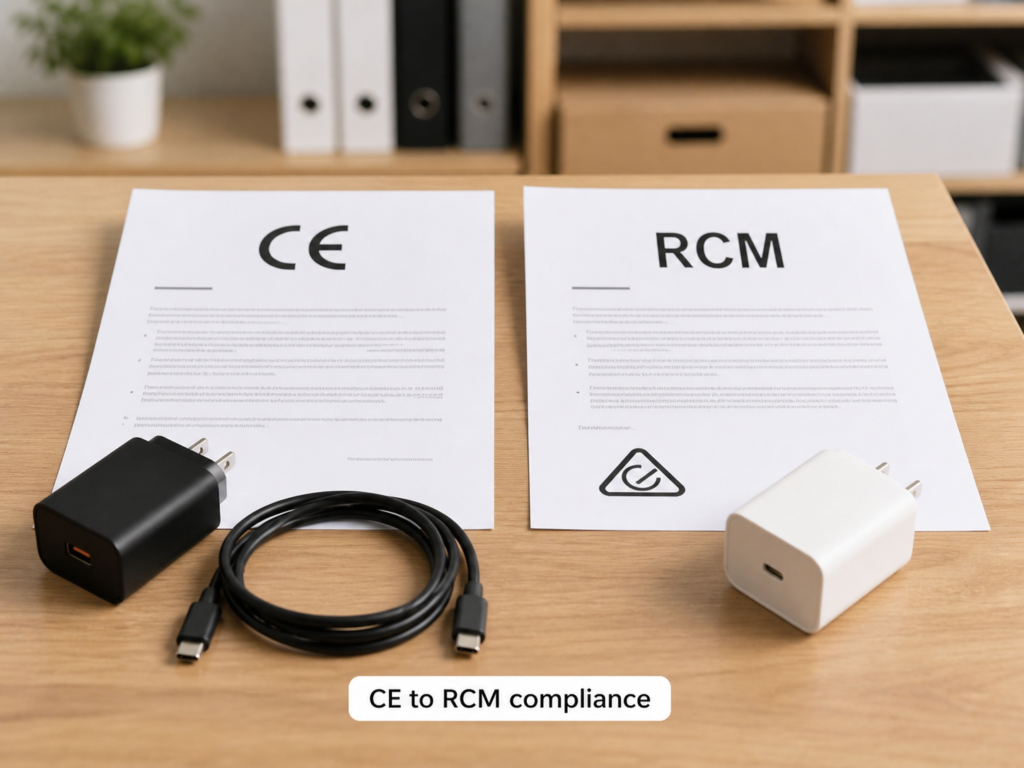
Let’s first clarify the scope of discussion: the following content only applies to consumer charging electronic products, such as wall chargers, power adapters, USB/USB-C charging cables, wireless charging devices, etc.; charging products for special industries such as medical and automotive, or charging accessories for toys and children’s products, have completely different regulatory rules and are not within the scope of this discussion. The applicable scenario is also clear: situations where you already have CE compliance documents and are preparing to apply for Australia-New Zealand market access, wanting to reuse existing documents.
First, Understand the Basics: What Exactly Are CE and RCM?
Many people confuse the two, essentially because they do not fully understand the regulatory rules and term definitions on both sides. Let’s first explain the most commonly used terms in plain language:
• **CE Report**: A test report supporting EU CE compliance, which is a technical supporting document for manufacturers to make self-declarations, not an officially issued certificate.
• **CE DoC (Declaration of Conformity)**: A declaration signed by the manufacturer itself stating that “this product meets CE requirements”. It has no actual test data on its own and is only useful when verified together with the technical documents it references.
• **RCM Mark**: A compliance mark recognized by both Australia and New Zealand. It is not a “certificate” issued by a single institution; it can only be used after meeting the corresponding regulatory requirements, and there is no single issuing authority.
• **Conformity Evidence**: Test reports, technical documents, etc. used to prove that a product complies with regulations. It is the basic material for compliance and needs to be kept by the responsible entity for inspection.
• **Equipment Registration**: The process of submitting product information to the regulatory authority and obtaining a filing number. It is a mandatory requirement for some regulatory lines and serves the purpose of traceability.
• **Responsible Entity**: The requirements for responsible entities need to be distinguished by regulatory line. The responsible supplier within the scope of Australia’s EESS must be a legal entity with a business presence in Australia or New Zealand; New Zealand’s electrical safety SDoC is issued by a New Zealand manufacturer or importer, and RSM’s supplier registration, marking and licensing requirements apply according to its own rules.
• **SDoC (Supplier Declaration of Conformity)**: A product compliance declaration issued by a New Zealand manufacturer or importer. It is a document usually required for medium-risk electrical products in New Zealand, but products that meet relevant EESS registration and statutory conditions may apply for corresponding exception arrangements.
What is the regulatory logic of CE?
CE is the EU’s market access rule, with the core logic of “manufacturer self-declaration as the mainstay” — for most ordinary products, manufacturers complete the applicable conformity assessment, compile technical documents, issue an EU DoC and affix the CE mark before placing them on the market. There is no unified official registration requirement for ordinary products (except for high-risk products). Test reports are usually one of the technical documents proving conformity, but whether testing is required, what kind of testing or third-party participation is required depends on the applicable regulations and product categories.
Which EU regulations apply to charging products depends on their structure and function. Mains-powered chargers usually need to be assessed against the Low Voltage Directive (LVD), Electromagnetic Compatibility (EMC) and RoHS; products with wireless communication or wireless energy transmission functions also need to be assessed against the Radio Equipment Directive (RED); the applicable regulations for products such as passive cables should be judged separately according to their actual functions.
RCM in Australia and New Zealand: Shared Mark but Separate Rules
Many people think that since Australia and New Zealand share the RCM, it is a single set of rules that applies all the way, but that is not the case. RCM is only a mark that can be shared. The applicable regulations, product classifications and procedures of Australia and New Zealand must be checked separately; compliance in Australia does not automatically mean compliance in New Zealand. However, there are also EESS alignment and Australia-New Zealand mutual recognition arrangements between the two countries, and some eligible registrations, approvals or labels may have specific effects, but it is still necessary to confirm item by item whether they meet New Zealand’s conditions.
Rules in Australia
Australia has three completely independent regulatory lines, which do not replace each other:
1. **EESS (Electrical Safety)**: Products are divided into three levels (Level 1/2/3) according to risk. Level 3 high-risk products require a certificate recognized by the regulatory authority plus equipment registration; Level 2 medium-risk products require equipment registration; Level 1 low-risk products only need to keep evidence on their own.
2. **ACMA (EMC/Radio)**: Supplier registration must be completed first, and compliance evidence must be kept; if the product involves specific frequency spectrum, an additional license application is required.
3. **GEMS (Energy Efficiency)**: It is necessary to check the current mandatory product catalog to see if the product is in the catalog; only if it is in the catalog, testing and registration are required.
RCM is a compliance mark shared by systems such as EESS and ACMA. Whether a product can use the mark and what preconditions it needs to meet must be judged separately according to the actually applicable electrical safety, EMC and radio rules; if a product is subject to multiple regulatory lines at the same time, it must meet all applicable requirements simultaneously. GEMS itself does not mandate the affixing of RCM.
Rules in New Zealand
New Zealand also has three independent regulatory lines, which are equivalent to most Australian standards, but the specific requirements cannot be directly copied:
1. **Electrical Safety (Energy Safety)**: Medium-risk products usually require an SDoC from a New Zealand manufacturer or importer; however, products that meet relevant EESS registration and statutory conditions may apply for deemed approval or SDoC exceptions. High-risk products must have WorkSafe approval, accredited certification or applicable deemed approval, and meet corresponding conditions such as marking.
2. **EMC/Radio (RSM)**: It is necessary to comply with corresponding standards and check specific requirements according to equipment rules.
3. **Energy Efficiency (EECA)**: Check the local current energy efficiency regulations and product list; only products on the list need to comply.
In New Zealand, marking requirements need to be judged according to regulatory lines and conformity levels: under electrical safety rules, RCM can be used as a voluntary mark indicating safety and EMC compliance; however, for EMC products regulated by RSM, and harmonized radio products with conformity levels 1, 2, and 3, RCM must be used according to the rules. Most non-harmonized radio transmitting equipment must use R-NZ instead of RCM.
Why Do People Easily Confuse CE and RCM?
There are three main reasons: first, the core test items overlap, as both sides require two basic types of testing: safety and EMC; second, the test methods have the same origin, as most standards reference internationally accepted standards such as IEC and CISPR, and the test logic is similar; third, the export scenarios overlap, as charging products often apply for EU and Australia-New Zealand market access at the same time, and some intermediaries will take the opportunity to say “CE can be directly converted to RCM”, which is easily misleading.
Core Differences: Why Can’t CE Documents Be Used Directly for RCM?
The test items seem similar, but they are essentially two completely independent regulatory systems, with the biggest differences in three aspects:
First: Different Regulatory Frameworks and Responsible Entities
CE is an EU regulation, for which the manufacturer or EU authorized representative is responsible, with self-declaration as the main method; there is no mandatory local registration requirement for ordinary products.
Australia has its own independent regulations. For products within the scope of EESS, the responsible supplier must be a legal entity with a business presence in Australia or New Zealand; overseas enterprises can establish an Australia-New Zealand entity, or have a local responsible supplier be responsible for import and sales, and the three regulatory lines each have their own requirements.
New Zealand also needs to be viewed separately by regulatory line. In terms of electrical safety, SDoC is issued by a New Zealand manufacturer or importer; for supplier registration, marking and licensing, RSM applies separately according to its product compliance rules.
Simply put: the responsible entity for CE is recognized by the EU, but not necessarily by Australia and New Zealand. You need to confirm who bears the compliance responsibility according to the locally applicable regulatory line; this is a hard requirement that cannot be bypassed no matter how many CE documents you have.
Second: Local-Specific Differences in Technical Standards
Although both reference international standards, there are many local requirements in the details:
• **Safety**: CE commonly uses EN/IEC series standards, while Australia and New Zealand commonly use AS/NZS series standards; specific standards and local differences need to be checked.
• **EMC**: It is necessary to check item by item according to the target country, product category and current mandatory standards. Australia and New Zealand may adopt AS/NZS standards, or may accept listed EN or IEC standards; whether items such as harmonics and voltage flicker apply shall be subject to specific product standards and regulatory lists.
• **Energy Efficiency**: CE has no mandatory unified energy efficiency registration requirement, while Australia requires checking the GEMS catalog and New Zealand requires checking EECA rules; only products on the list need to comply.
• **Radio**: There are local differences between the EU RED Directive and Australia-New Zealand requirements in terms of frequency bands, power limits, and equipment classification.
Third: Different Compliance Processes and Traceability Requirements
Most CE products do not require official review; they can be placed on the market after completing procedures such as conformity assessment, technical documentation and self-declaration, and there is no unified traceability code.
For Australia’s EESS, Level 2/3 products require equipment registration, with a unique registration code for traceability; ACMA requires completion of supplier registration and retention of compliance records, and additional applications are required for products involving specific frequency spectrum.
In New Zealand, medium-risk products usually require an SDoC from a New Zealand manufacturer or importer, but exceptions may apply when meeting specific EESS registration and statutory conditions; high-risk products can meet the requirements through WorkSafe approval, accredited certification or applicable deemed approval.
Here we would like to specially remind everyone of a judgment logic: **First determine the selling country, then judge one by one along the four lines of “electrical safety → EMC → radio communication → energy efficiency”**. The requirements of Australia and New Zealand cannot directly replace each other, but it should not be simply assumed that all processes and documents are completely incompatible; if EESS alignment or Australia-New Zealand mutual recognition arrangements are involved, the specific conditions need to be further confirmed.
Not being within the regulatory scope of one line does not mean that other lines can be ignored. For example, for charging products, as long as they are independent products with circuits, EMC requirements basically need to be assessed; for external power supply products directly connected to the mains, electrical safety basically needs to be assessed; for those with built-in communication or transmission modules, radio rules need to be additionally checked; for energy efficiency, it is necessary to check Australia’s GEMS catalog and New Zealand’s EECA rules respectively, which cannot be generalized.
How Much of CE Documents Can Be Reused? How to Check the Gaps?
Although they cannot be used directly, eligible CE documents can still save a lot of trouble. Whether they can be reused and how much can be reused depends on four core dimensions:
1. **Laboratory Qualification**: It is necessary to check whether the laboratory was accredited by an accreditation body that has signed the ILAC MRA at the time of testing, and whether the accreditation scope covers the corresponding test items; if claiming evidence under the CB system, it is also necessary to check whether the laboratory is an applicable CBTL and whether the report meets the requirements of the target regulatory line.
2. **Standard Equivalence**: Two core pieces of information need to be checked: first, the standards and version numbers cited in the CE report, and second, the corresponding current standards and version numbers in Australia and New Zealand, to see if the two are equivalent.
3. **Product Consistency**: Mass-produced products shall have provable representativeness and consistency with the products covered by the report. If there are differences in model, hardware BOM, key components, software, structure or test conditions, a change or coverage assessment shall be conducted; for substantive changes that may affect compliance, necessary tests shall be supplemented or re-assessment shall be conducted.
4. **Regulatory Applicability**: The test scope of the report must cover all mandatory requirements of the corresponding regulatory line in the target selling country.
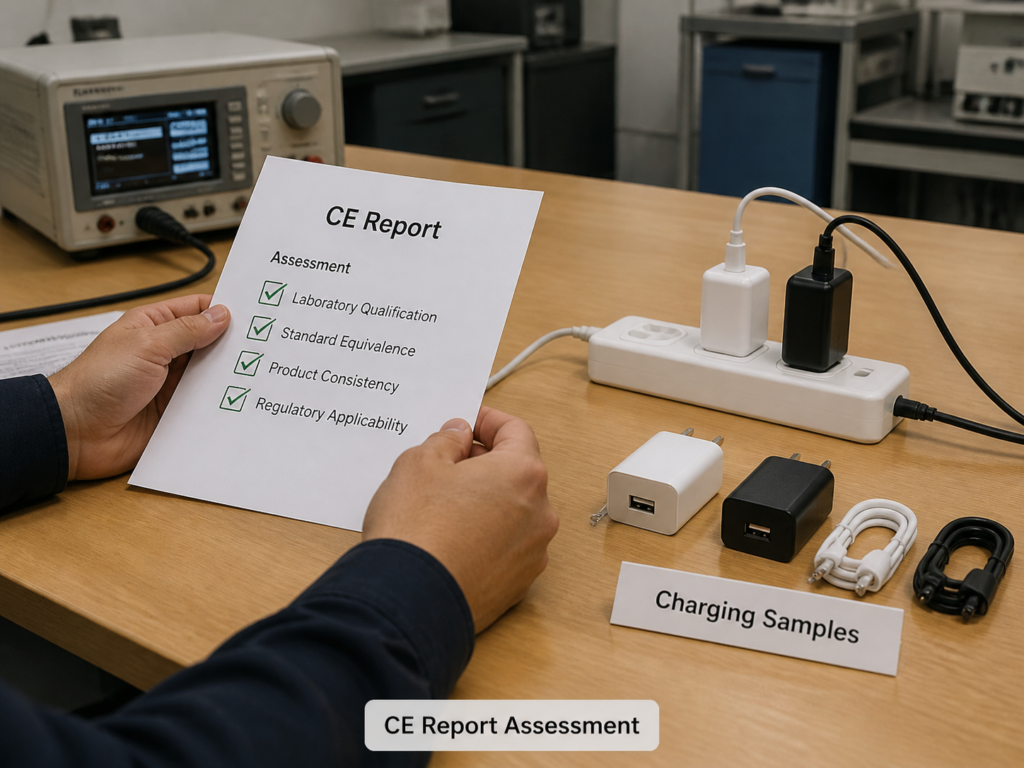
If all four dimensions are met, many general contents can be directly reused: for example, general items in EMC such as radiated disturbance, conducted disturbance, electrostatic discharge, and surge; general items in safety such as mechanical strength, insulation performance, material flame retardancy, and temperature rise test; as well as general technical documents such as product circuit diagrams, key component lists, and sample photos, all can be directly used as file references.
So what specific gaps need to be checked for charging products? We will sort them out for you by dimension:
• **Laboratory Qualification**: If the laboratory’s accreditation and accreditation scope at the time of testing meet the requirements of the target regulatory line, reuse is easier; if the form of evidence or accreditation scope does not meet the requirements, the responsible entity shall assess whether to accept it in combination with the specific regulatory line, and supplement testing or certification if necessary.
• **Product Consistency**: If mass-produced products have provable representativeness and consistency with the products covered by the report, they can be reused; if there are differences, a change assessment shall be conducted, and supplementary testing or re-assessment shall be carried out as needed.
• **Safety Standards**: If the standard versions are equivalent and cover local difference items, they can be reused; otherwise, supplementary testing of Australia-New Zealand exclusive safety difference items is required.
• **EMC Standards**: If the standard versions are equivalent and the limits meet local requirements, they can be reused; otherwise, applicable EMC items shall be supplemented, or re-assessed according to applicable limits.
• **Radio Requirements**: Only products with transmission/communication functions need to be checked. If the frequency band and power limits meet local requirements and no additional license is involved, they can be reused; otherwise, local radio frequency related items shall be supplemented, and licenses shall be applied for as needed.
• **Energy Efficiency Requirements**: If the product is not within the scope of mandatory energy efficiency regulation in the target country, no additional work is needed; if it falls within the regulatory scope, energy efficiency testing shall be supplemented and registration shall be completed.
Don’t Get It Wrong: CE Reports Do Not Have a Unified “Validity Period”
Many people ask “Is the validity period of a CE report 5 years?” Actually, it is not. **Report date, certificate validity period, and standard currency are three completely different things; CE test reports do not have a unified statutory validity period**. Whether it can be used depends on the following core points:
• Whether the standards cited in the test have been replaced or revoked, and whether there are transition period restrictions in the target market;
• Whether the product’s hardware BOM, key components, and functions have changed;
• Whether the laboratory that issued the report had the corresponding accreditation qualification at the time of testing (qualification only reflects the capability at the time of issuing the report);
• Whether the regulatory rules and mandatory catalogs of the target market have been adjusted.
There is a hard boundary to remember: when registering Level 2/3 products under Australia’s EESS, the currently applicable standards must be used; even if the old standard is only slightly different, it will not pass.
Don’t Classify Charging Products Only by Name
Many people only look at the product name when judging the regulatory scope, for example, “This is a charging cable, so it definitely doesn’t need to be managed”, which is wrong. Classification cannot only look at the promotional name, but must be based on the actual function of the product:
• Wall-plug USB chargers and external power adapters: those directly connected to the mains and sold independently are usually subject to electrical safety regulation;
• Travel adapter plugs with USB power supply: both plug safety rules and power supply requirements need to be checked at the same time;
• Multi-port PD chargers: it is necessary to determine whether they fall under energy efficiency regulation according to the definition of external power supply (EPS), power supply function, and exemption conditions;
• Passive USB/USB-C cables (just accessories, no electronic functions): usually not independent electronic devices, and the general EMC path is not directly applied;
• USB-C cables with electronic functions (such as those with E-Marker chips): the regulations applicable to electronic functions need to be assessed, and the regulatory list shall be checked first;
• Wireless charging products: cannot be automatically exempted from radio rules just because there is no communication module; confirmation shall be made according to operating frequency, transmission function, and equipment rules;
• Car chargers and power banks: the regulatory list of the target country shall be checked separately to confirm the regulatory scope.
Five Steps: From CE Documents to Australia-New Zealand Compliance Implementation
If you already have CE documents and want to achieve Australia-New Zealand compliance, you can follow the five steps below, with a clear logic:
Step 1: Clarify the Target Market and Product Attributes
First, you need to confirm whether you only sell to Australia, only to New Zealand, or to both. The applicable regulations, product classifications and specific procedures of the two countries need to be checked separately; compliance in Australia does not automatically mean compliance in New Zealand. However, if the specific conditions of EESS alignment or Australia-New Zealand mutual recognition arrangements are met, some registrations, approvals or labels may have specific effects.
Then, according to the charging product classification rules we mentioned above, clarify your product type and core parameters, and then initially check the regulatory scope of each regulatory line in the order of “electrical safety → EMC → radio → energy efficiency”.
Step 2: Verify the Credibility Basis of CE Documents
First check three core points: first, the accreditation scope of the laboratory at the time of testing, and whether the accreditation covers the test items in the report; second, the equivalence and currency of the standards, checked according to the four fields we mentioned; third, product consistency, whether the brand, model, hardware version, core configuration, and test conditions have provable representativeness and consistency with mass-produced products.
If there is no valid accreditation or other acceptable evidence, the standards are seriously inconsistent, or the existing report cannot cover the substantive differences of mass-produced products, it may be difficult to reuse. In this case, a difference and coverage assessment should be conducted first, and then necessary tests, certifications shall be supplemented or full compliance tests shall be re-conducted according to the results, instead of defaulting that all tests must be re-done as soon as a model difference is seen.
Step 3: Check Gaps in Local Regulatory Requirements Line by Line
Check the four regulatory lines one by one:
• Electrical safety: check the risk level of the target country, as well as the corresponding testing, registration, and declaration requirements;
• EMC: check applicable standards, limits, and supplier registration requirements;
• Radio: check equipment rules, frequency band/power requirements, and whether specific licenses are involved;
• Energy efficiency: check the GEMS mandatory catalog for Australia, and the current EECA rules for New Zealand;
In addition, it is necessary to confirm the arrangement of responsible entities under the applicable regulatory lines. Within the scope of Australia’s EESS, it shall be confirmed whether the responsible supplier meets the legal entity and registration requirements of Australia and New Zealand; for New Zealand, the corresponding obligations of manufacturers, importers or other suppliers shall be confirmed according to different regulatory lines such as electrical safety or RSM.
Step 4: Supplementary Testing of Gaps and Compilation of Complete Technical Files
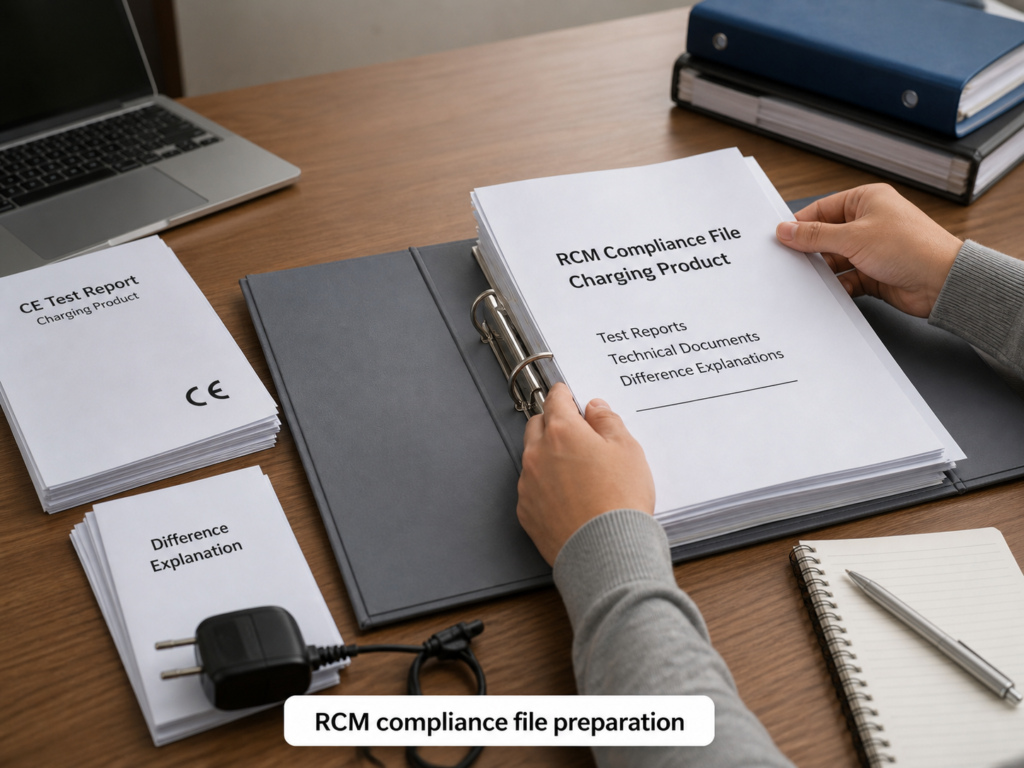
After the gaps are identified, just entrust a qualified laboratory to conduct supplementary difference tests. After the supplementary testing, organize all test reports, technical documents, and difference explanations together to form a complete compliance file, which will be used for subsequent registration and inspection.
Step 5: Complete Local Compliance Processes and Mark Use
After all documents are prepared, you can proceed with the local processes:
• Australia: The qualified responsible supplier shall complete the registration, filing or equipment registration of applicable regulatory lines, and use the RCM mark according to applicable rules after meeting the conditions;
• New Zealand: Complete processes such as SDoC, approval, accredited certification or applicable deemed approval according to risk levels and regulatory lines. The mark shall also be judged according to product rules: RCM can be used voluntarily under electrical safety rules, but EMC products regulated by RSM and harmonized radio products with conformity levels 1, 2, and 3 must use RCM; most non-harmonized radio transmitting equipment must use R-NZ.
As for the cycle, it depends on the product risk level and the workload of the regulatory authority, and there is no unified fixed duration.
Pitfall Avoidance Guide: Common Misconceptions and Document Value Judgment
There are many pitfalls in Australia-New Zealand compliance. We list the most common misconceptions so that you can avoid them:
Clarification of Common Misconceptions
1. **Misconception 1: Having a CE notified body report/CE DoC can be directly used as RCM compliance evidence**
Truth: The CE notified body number is only recognized by the EU and does not mean that it meets Australia-New Zealand standards; CE DoC is just a declaration signed by the manufacturer itself, with no actual test data, and cannot be used as evidence alone at all.
2. **Misconception 2: RCM, like CE, is a self-declaration and does not require official processes**
Truth: Not at all. In Australia, Level 2/3 electrical products require official equipment registration, and ACMA requires supplier registration; in New Zealand, medium-risk products usually require an SDoC issued by a New Zealand manufacturer or importer, but exceptions may apply when meeting relevant EESS registration and statutory conditions; high-risk products require WorkSafe approval, accredited certification or applicable deemed approval. If you violate the rules, the light consequence is goods detention and fines, and the serious consequence is entry ban and product recall.
3. **Misconception 3: All charging cables/data cables do not need RCM**
Truth: Whether a charging cable needs to be registered and whether RCM can be used must be judged one by one against the regulatory lines of the target country. Not all cables are the same; for example, cables with E-Marker chips have different rules from passive cables.
4. **Misconception 4: Changing the header/adding a difference page to a CE report can make it Australia-New Zealand compliance evidence**
Truth: Whether it can be used depends on product consistency, standard equivalence, and local deviation coverage. Just changing the header and adding a difference page without actual supplementary testing and verification is invalid.
5. **Misconception 5: Having a CB report means you don’t need to go through Australia-New Zealand compliance processes**
Truth: CB report is only technical evidence, which cannot replace local registration, responsible entity requirements and compliance declarations; the necessary processes still have to be followed.
Applicable Value of Different Compliance Documents
Many people can’t tell how useful the documents they have are. We have compiled a table for your reference:
| Compliance Document Type | Applicable Value Description |
| CB report with Australia-New Zealand national differences | Usually a relatively valuable supporting safety evidence, which can be used for local certification or compliance assessment; but it cannot replace the certificates, registrations or declarations required by applicable regulatory lines. For Australia EESS Level 3, a Certificate of Conformity issued by an EESS accredited certification body or regulatory authority must still be used to complete registration |
| Complete CE test report issued by a laboratory accredited by an accreditation body that has signed the ILAC MRA and whose accreditation scope covers the corresponding items, or a report issued by an applicable CBTL (when standards are equivalent and products are consistent) | Can prove that general safety and EMC items meet requirements, and can be used as core technical evidence; but it cannot cover local exclusive differences in Australia and New Zealand, and cannot replace registration and local responsibility requirements |
| CE test report issued by a non-accredited laboratory | Its probative force and acceptability shall be assessed on a case-by-case basis according to the target country, regulatory line, product risk level, report completeness and applicable standards. It may only be used as auxiliary material, or as supporting evidence in specific New Zealand SDoC scenarios; if it does not meet the document requirements of EESS certification, ACMA or RSM, supplementary accredited testing, certification or difference assessment shall be conducted |
| CE DoC (Declaration of Conformity) | Can only be used as an auxiliary document for product model and manufacturer information, proving that the manufacturer once declared the product meets CE requirements; it does not contain actual test data itself and cannot be used as Australia-New Zealand compliance evidence alone |
| Only report cover and CE mark real photos | Have no actual compliance proof value, and cannot be used as compliance evidence at all |
Frequently Asked Questions and Application Document Verification Checklist
The 9 Most Frequently Asked Questions
1. **Can CE DoC be directly used to apply for RCM?**
No. It is just a declaration signed by the manufacturer itself, with no actual test data, and can only be used as an auxiliary document; it cannot replace testing, registration and local responsibility requirements.
2. **Can CB reports be used for Australia-New Zealand compliance applications?**
CB reports with Australia-New Zealand national differences can be used as relatively valuable supporting technical evidence, but applicable local registration, declaration, certification or responsible entity arrangements still need to be completed, and they cannot directly replace these processes. For Australia EESS Level 3 products, a Certificate of Conformity issued by an EESS accredited certification body or regulatory authority is also required to complete registration.
3. **After replacing the EU plug with an Australian plug, can the original CE report still be used?**
A change assessment is required. If only the plug is replaced, affected items such as the plug, input cable, temperature rise, creepage distance, and whole machine abnormality need to be assessed, and it cannot be directly used as is.
4. **Do multi-port PD chargers need to register for Australia GEMS energy efficiency?**
It is necessary to determine whether they fall into the mandatory catalog according to GEMS’ definition of external power supply (EPS), power supply function and exemption conditions, which cannot be generalized.
5. **If I only sell to New Zealand, do I need to go through Australia EESS?**
There is no need to directly follow the Australia EESS process. When only selling to New Zealand, the applicable New Zealand requirements such as electrical safety, RSM, and EECA shall be met; but if the product meets the specific conditions of EESS alignment or Australia-New Zealand mutual recognition arrangements, relevant registrations, approvals or labels may have specific effects, and still need to be confirmed according to New Zealand rules.
6. **Do pure Qi wireless chargers need radio compliance?**
They cannot be automatically exempted just because there is no communication module; confirmation shall be made item by item according to operating frequency, transmission function, applicable equipment rules and category licenses.
7. **Is “Australian RCM certification” a single certificate?**
No. It is a complete set of processes of “testing + local responsible supplier registration + equipment registration (if needed) + meeting mark use conditions”, and there is no single “RCM certificate”.
8. **Can overseas manufacturers themselves become responsible suppliers for Australia EESS?**
They cannot directly become EESS responsible suppliers as purely overseas entities. EESS requires that the responsible supplier be a legal entity with a business presence in Australia or New Zealand and holding the corresponding ABN or IRD number; overseas manufacturers can establish a qualified Australia-New Zealand entity, or entrust a local responsible supplier to bear compliance responsibilities.
9. **With existing CB/CE reports, why might the EESS system not accept registration?**
There are several common reasons: the standards cited in the report are not the currently applicable version of EESS, they do not cover Australia-New Zealand national differences, the product is inconsistent with the description in the report, or the laboratory qualification does not meet the requirements.
Australia-New Zealand Compliance Application Document Verification Checklist
When preparing application documents, you can check against the list below to avoid missing anything:
1. **Basic Product Documents**: Need to provide model, specification sheet, circuit diagram, key component list, product photos, label design draft; the key verification point is that they must be completely consistent with mass-produced products, with no missing key parameters.
2. **Technical Evidence Documents**: Need to provide CE test report (including laboratory qualification certificate, standard pages, difference explanation), supplementary difference test report (if any); the key verification points are: the laboratory’s qualification at the time of issuing the report covers the corresponding standards, and the standard version meets the current requirements of the target country and covers local differences.
3. **Entity Qualification Documents**: Need to provide the registration certificate and authorization documents of the local responsible entity in the target country; the key verification point is that the entity has the registration qualification for the corresponding regulatory line, and the authorization relationship is clear.
4. **Declaration Documents**: Need to provide a draft declaration of conformity; the key verification point is that the content meets the regulatory requirements of the target country, and the referenced technical documents are complete.
Final Summary
Back to the original question: CE reports cannot be used directly for RCM, and there is no so-called “direct conversion” path. But as long as your CE documents meet the four conditions of laboratory qualification, standard equivalence, product consistency, and regulatory applicability, they can completely be used as part of the technical evidence, helping you save a lot of testing costs and time.
The core logic of doing Australia-New Zealand compliance is actually very simple: first determine the selling country, then check the requirements one by one in the order of “electrical safety → EMC → radio → energy efficiency”, confirm the responsible entity and processes under the applicable regulatory lines, fill in the gaps, complete the processes, and then use RCM or other required marks according to the applicable product rules. As long as you avoid pitfalls such as “direct conversion” and “only changing the header”, the reuse efficiency of CE documents is actually very high, and there will be no compliance risks.