
Sellers of charging products who are new to the Amazon US marketplace have most likely heard the claim that “UL certification is required to list products” — some spend tens of thousands of yuan on certification only to find their products don’t need it at all, while others take a chance and don’t prepare relevant documentation, only to face review, warehousing, or sales restrictions. Is UL certification really mandatory for the Amazon US marketplace? Which products require it? Are there more cost-effective alternatives? Today we will break this down thoroughly from basic rules to practical judgment. After reading this, you will be able to make accurate judgments on your own, without being misled by various claims.
Core Conclusion: No Mandatory Requirement Across All Categories; High-Risk Charging Products Require Safety Proof
First, the clearest answer: the Amazon US marketplace does not have a mandatory UL certification requirement for all product categories. Some electrical and charging products may be required to provide **safety proof**, and UL certification is just one of the more common types of such safety proof, not the only option. The specific documents to be submitted depend on the product type, sales category, model, and current notifications in the seller backend.
Many people think UL is a statutory certification required by the US government, but in fact, different scenarios need to be distinguished. US federal regulations generally do not uniformly mandate UL brand certification for all consumer electronics; however, specific product regulations, local electrical codes, workplace usage scenarios, or competent authorities may require certification by a Nationally Recognized Testing Laboratory (NRTL) accredited by the Occupational Safety and Health Administration (OSHA) in accordance with applicable standards. Whether Amazon requires the submission of safety documentation is separately determined by its platform rules.
UL itself is a US third-party safety science organization. The UL certification it initiated mainly targets the safety risks of electrical products, with common testing areas including electric shock prevention, fire, overheating, etc. UL brand certification has high market recognition, but it cannot be simply understood as a statutory certification that must be obtained in any scenario.
Amazon may require sellers to submit safety proof based on product safety, consumer protection, insurance, and internal risk control. The platform’s specific requirements may be more detailed than general market access requirements, and may also review documentation based on product risk, category, and individual cases.
For charging products, mains-powered products such as wall chargers and power adapters are usually subject to stricter product safety reviews, and Amazon may require submission of applicable NRTL certification, test reports, or other specified documentation; however, whether submission is mandatory and which documents are accepted should be confirmed based on the specific category and seller backend notifications. Products such as ordinary passive charging cables and simple adapters generally have lower risk, but this does not mean that no documentation needs to be prepared under any circumstances.
Here are two very important misconceptions to correct, which many new sellers and even experienced sellers get wrong: First, Amazon does not necessarily only accept official UL certification; other qualified NRTL certifications may also be accepted. Second, “requiring safety proof” and “must obtain UL certification” are completely different things; do not treat UL as the only option.
Basic Concept Clarification: Boundaries Between UL and Common Compliance Certifications
Many people cannot distinguish between certifications such as UL, FCC, and CE, often confuse them, and even waste money on the wrong certification. Let’s first sort out several most easily confused basic concepts.
Several Key UL-Related Terms: A Single Word Difference Results in Vastly Different Validity
First is UL Listed, commonly known as UL listing certification. This usually means that a specific model has passed UL listing certification under specified conditions, but it only proves that it meets the corresponding UL requirements. Whether it meets US sales, installation, and platform review requirements must be confirmed in combination with applicable regulations, local codes, product model, ratings, manufacturing location, and current certification status.
Formal UL Listed marks must be used in accordance with UL authorization requirements and cannot be printed without permission. The mark on the product label must also be consistent with the actual certification status and certification file.
Second is UL Recognized, also known as UL recognition certification. This is usually for components or semi-finished products, such as capacitors and transformers in chargers. A component having UL Recognized status does not mean the entire charger has completed whole-product certification, and cannot be directly used to prove that the whole product meets platform review requirements.
There is also the UL test report. It mainly indicates that the submitted sample has completed testing in accordance with a certain standard or test plan, but if there is no corresponding formal certification authorization, it is not equivalent to UL listing certification. Whether it can be used as the proof document required by Amazon must be confirmed based on the specific category and review notification.
There is another common misconception: many sellers write “compliant with UL standards” on their detail pages, but compliance with standards only means that the product design or test results are related to a certain standard, and does not mean that the product has obtained official UL certification. The two cannot be equated.
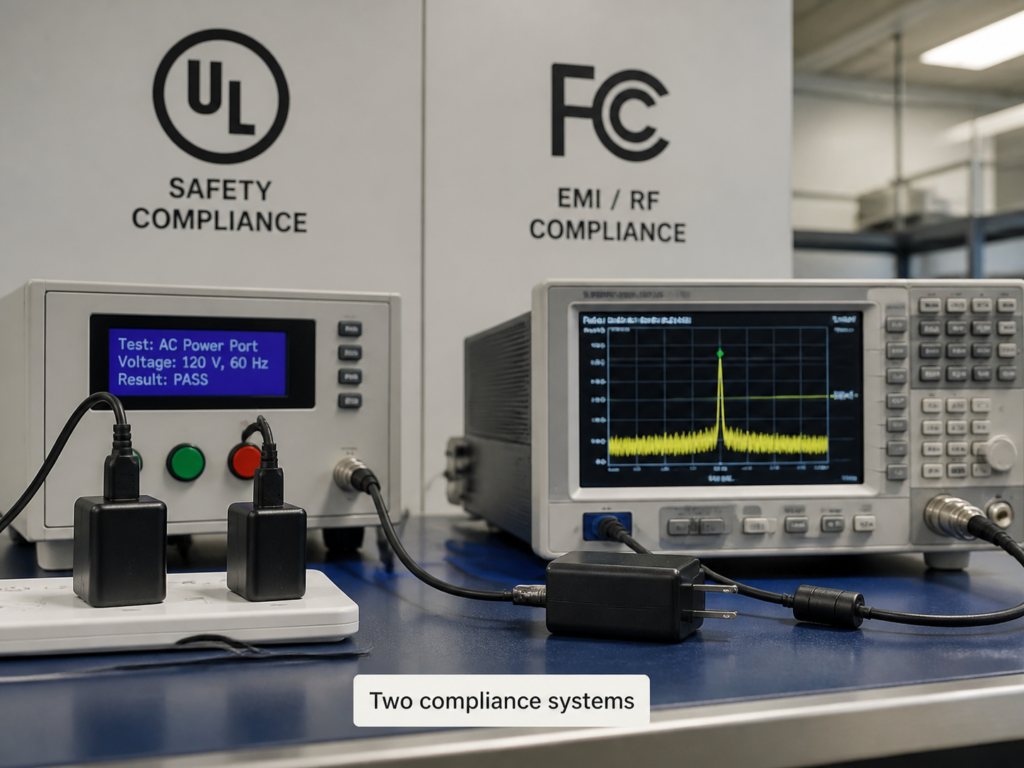
FCC Certification and UL Are Completely Separate Systems
FCC is the abbreviation of the Federal Communications Commission of the United States, which is mainly responsible for radio spectrum, radio frequency (RF) equipment, and related electromagnetic interference issues within the US. RF equipment and related digital equipment within the jurisdiction of the FCC must complete equipment authorization, Supplier’s Declaration of Conformity (SDoC), labeling, or other compliance requirements in accordance with applicable rules; equipment may be subject to SDoC, Certification, or other authorization methods, and cannot be collectively referred to as “all electronic products require FCC certification”.
FCC documentation also cannot be simply summarized as a unified certificate that all electronic products must submit when entering the US market or clearing customs. Whether a product is subject to FCC rules depends on whether it falls within the scope of relevant equipment, whether it has wireless transmission functions, how its digital circuits operate, and the applicable FCC Part.
Devices that intentionally transmit wireless signals, such as those with Bluetooth or Wi‑Fi, usually require equipment certification in accordance with applicable FCC rules, and will have an FCC ID when they meet Certification conditions. Wireless charging, digital circuits, and other wireless functions should be judged based on their operating methods and applicable FCC Part respectively, and it cannot be generally assumed that an FCC ID must be applied for.
In short, UL-type certifications mainly focus on personal and property safety, while FCC requirements mainly focus on RF, electromagnetic interference, and equipment authorization. The two are different systems and cannot replace each other.
There are several other certifications that are often brought up as makeweights, which cannot replace UL-type safety certification on the US marketplace: for example, CE certification is mainly used in the EU market and cannot be directly used as US electrical safety certification; RoHS certification restricts hazardous substances in products and is not the same as electrical safety; battery transport tests such as UN38.3 are mainly used to meet transport and hazardous material management requirements, and also cannot be used to prove that the product itself has completed whole-product safety certification.
To help everyone distinguish, we have organized the core differences between UL-type safety certification and FCC requirements into a table:
| Comparison Dimension | UL-Type Safety Certification | FCC Requirements |
| Governing or Implementing Entity | Third-party commercial organizations, such as UL and other NRTLs | Relevant rules are formulated and managed by the US Federal Communications Commission |
| Mandatory Nature | There is no unified mandatory UL brand requirement for all consumer electronics; specific regulations, scenarios, local codes, or platform rules may require safety documentation or NRTL certification | Equipment within the jurisdiction of the FCC must complete corresponding equipment authorization, SDoC, or other compliance requirements in accordance with applicable rules |
| Testing Focus | Personal and property safety, such as electric shock prevention, fire, overheating, etc. | RF transmission, electromagnetic interference, and related equipment authorization requirements |
| Core Purpose | Meet product safety review requirements of applicable regulations, customers, or platforms | Meet applicable US RF and electromagnetic compatibility rules |
4 Core Dimensions to Judge Whether Safety Certification Is Required
After understanding the basic concepts, you may still ask: does my own product need safety certification? In fact, you don’t need to memorize everything by rote; just judge from four dimensions to get closer to an accurate conclusion. However, the final standard shall still be based on applicable standards and current Amazon notifications.
The first dimension, and also the most important judgment factor, is the structure and usage risk of the product itself. Factors such as mains power supply, higher energy or power, built-in batteries, and active electronic functions usually increase safety review requirements. However, risk classification cannot be determined solely based on the three characteristics of “mains-connected, high power, and lithium battery included”; it must also be combined with product standards, intended use, and specific platform requirements.
For charging products, wall chargers, power adapters, power banks, and cables with active electronic functions or power negotiation functions are usually more likely to trigger safety documentation requirements than ordinary passive cables. Ordinary passive cables and simple passive adapters generally have lower risk, but a unified exemption conclusion cannot be drawn solely based on rated voltage or power. There is a practical rule: the higher the product power, the more complex the functions, and the more direct the relationship with mains power or batteries, the more you should check applicable requirements in advance.
The second dimension is the trigger scenario for review. Some products may be required to submit safety or hazardous material documentation before listing, sale, or warehousing; consumer complaints, product safety incidents, platform spot checks, or policy changes may also trigger supplementary reviews. Low-risk products do not mean that documentation never needs to be provided, and high-risk products do not mean that the same review process applies to all ASINs.
The third dimension is the fulfillment model. The specific review timing, documentation, and consequences for FBA and FBM depend on the product, marketplace, category, and Amazon notifications. FBA products may involve product compliance, hazardous material, labeling, transportation, and warehousing requirements; FBM also does not mean that product safety and platform rules can be ignored. Therefore, it cannot be simply asserted that all FBA high-risk products must complete UL review before warehousing, nor can it be assumed that FBM will definitely not be subject to spot checks.
The fourth dimension is the sales format. Many people tend to overlook this point and end up suffering losses. If selling set products, such as a “charger + charging cable” combination, you must confirm whether the safety documentation covers all components in the set and the actual sales configuration, and not just look at the component with lower risk.
If selling variant products, for example, three chargers of 20W, 45W, and 65W in the same listing, you should confirm that the certification documents or test reports explicitly cover the actually sold models, series, and their power and structural differences. Not all variants must appear on the certificate separately, but if the variant differences exceed the certification scope, you should confirm with the issuing agency or Amazon whether supplementary evaluation or separate documentation is required.
If the product is revised, such as changing the internal power chip, shell material, or rated power, the original certification may no longer cover the revised product, and re-evaluation is required; do not directly use the old documentation.
Specific Compliance Requirements for Each Charging Product Category
For the charging products that everyone most commonly sells, we have organized the specific compliance requirements for different categories. You can first compare with your own products, then check the backend notifications.
First are chargers and power adapters. Such mains-powered products are usually key products of concern for the platform, and may be required to provide NRTL certification or other safety documentation, but this cannot be summarized as “almost 100%”. The applicable standards are also not uniformly fixed: some information and communications technology (ICT) external power supplies may be subject to UL/IEC 62368-1, and other power supply or charger standards may apply depending on the product type, intended use, output method, and structure.
In addition to certification or test documentation, the platform may also focus on whether the product is suitable for the US usage environment, such as plug specifications, rated input voltage, output parameters, and English safety warning labels. Specific requirements shall be based on the applicable product standards and current Amazon notifications.
For adapters with detachable AC power cords, you should confirm whether the certification documents cover the specific configuration and rated parameters of the whole product, connectors, and power cords. If applicable standards require the use of qualified power cords or cable assemblies, components with corresponding certification status should be used; it cannot be simply assumed that all detachable power cords must obtain the same certification separately from the whole product.
Next are USB/USB-C charging cables, which cannot be judged solely by “whether there is an E-Marker” or “whether it reaches 65W”. E-Marker is mainly used for USB Type-C cable capability identification and power negotiation, and is not a unified safety certification threshold. Whether USB/USB-C cables require specific safety standards, testing, or platform documentation should be judged based on the cable’s rated voltage and current, structure, insulation, whether it contains active electronic components, applicable standards, and specific Amazon notifications.
Ordinary passive USB cables generally do not automatically get the conclusion of “no safety documentation required” just because their rating is below 5V2A. Whether UL or other documentation is specifically required should still be confirmed based on cable structure, rated parameters, sales category, and Amazon notifications. For special cables with signal conversion, active power supply, or other electronic circuits, such as USB-C to HDMI cables with video output and cables with expansion functions, it is even more necessary to separately check applicable standards and platform requirements.
Next are power banks and other battery-containing charging products. Such products may simultaneously involve battery safety, whole-product electrical safety, transportation, and hazardous material management requirements. Due to the built-in lithium battery, it may also be necessary to submit Amazon hazardous material review documentation, and there may be more warehousing and transportation restrictions.
A special reminder here: battery transport tests such as UN38.3 are mainly for logistics and hazardous material transportation requirements, and cannot replace the product’s own whole-product safety certification or other documentation required by the platform. The specific documentation required for battery products must be confirmed based on battery type, capacity, product structure, and transportation method.
Finally, charging accessories. For products that directly contact mains power, such as wall-mounted adapters and docking stations with power functions, it is usually necessary to focus on checking applicable safety certification or test documentation. For simple passive adapters, such as small USB-A to USB-C adapters without additional circuits, the risk is generally lower, but whether specific documentation is required is still subject to the specific category and Amazon notifications.
Types and Validity of Safety Proof Accepted by Amazon
After confirming that their product requires safety documentation, many people will struggle again: is it necessary to get the most expensive UL? Which proofs does Amazon actually accept? It should be noted here that the types of documents accepted by the platform may vary by category, product, and notification, and passing cannot be guaranteed solely by the certification name.
The first type is official UL certification. UL Listed generally has high market recognition, but whether it is accepted by Amazon still depends on the specific category, document content, model coverage, applicable standards, manufacturer information, and current review requirements; it cannot guarantee “universal for all scenarios” or “100% recognition”.
It should be noted that UL Recognized is usually a certification at the component or semi-finished product level, and cannot be directly used as proof of whole-product compliance. UL Listed, UL Recognized, and UL test reports have different scopes of application; before submission, you should first confirm whether the document corresponds to the whole product or components.
The second type is NRTL safety certification, which is another common option. Simply put, NRTLs are laboratories accredited by OSHA that can conduct testing and certification for specific product standards. If regulations or codes require NRTL certification, and the laboratory is OSHA-accredited, and the adopted standards and product scope are applicable, then NRTL certifications such as ETL and CSA may have regulatory recognition effects equivalent to UL certification.
However, NRTL certification does not mean that all certificates are automatically equivalent across all products, standards, uses, or Amazon reviews. ETL is a certification mark of Intertek; for CSA, it is necessary to further confirm whether the specific issuing entity is a corresponding OSHA-accredited NRTL and whether the certification scope covers your product. Whether it can be used for Amazon review must also be confirmed based on the specific platform requirements.
The third type is UL test reports. A test report is not equivalent to UL listing or NRTL certification. Whether it can be used as the proof document required by Amazon depends on the specific category, the issuing agency of the report, the adopted standards, and the review notification. If the notification explicitly requires formal certification, ordinary test reports cannot replace it; if the notification allows submission of test documentation, you must also confirm that the content and format of the report meet the requirements.
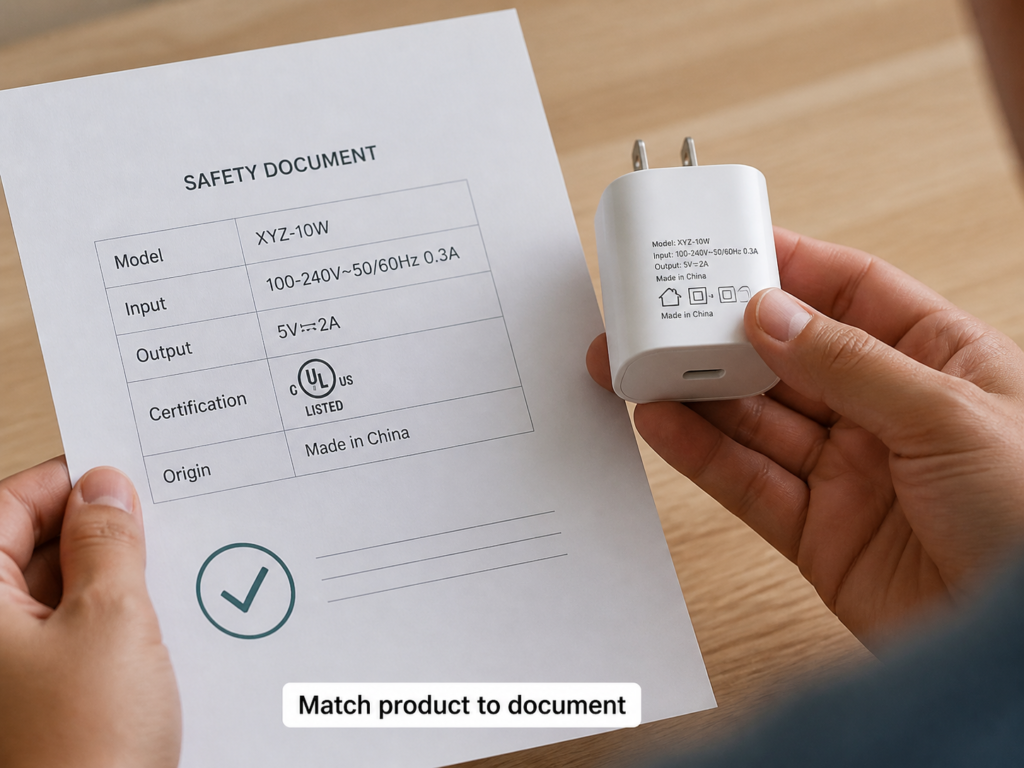
No matter which type of safety proof you use, you must check several key points to avoid mismatches between the documentation and the actual product:
First, confirm that the certification documents or test reports explicitly cover the actually sold models, series, and their power and structural differences. If variant differences exceed the certification scope, you should confirm with the issuing agency or Amazon whether supplementary evaluation is required.
Second, the brand, manufacturer, manufacturing location, and model on the certificate must be consistent with the actual product, and confirm that the seller has a legal authorization relationship with the brand owner and manufacturer; you cannot use someone else’s certificate casually.
Third, the applicable standards, rated parameters, and product configuration of the certificate must be consistent with the physical product. For example, if the actual output of the product is 65W but the document only covers the 45W configuration, it cannot be directly used to prove that the 65W version is compliant.
Fourth, you should check the current status through the official directory or certification files of the issuing agency to confirm that the certification has not been revoked, suspended, canceled, or had its scope reduced. If the document itself specifies a validity period, you must also confirm that it has not expired. UL Listed and many NRTL listing certifications do not necessarily have a unified expiration date, so you cannot only look at the date on the paper document.
Common Risks and Pitfall Avoidance for New Sellers
Every year, sellers encounter listing restrictions, supplementary document requests, or inventory disposal due to compliance issues. The specific consequences depend on the product, the nature of the violation, and individual cases. We have organized the pitfalls that new sellers are most likely to fall into; avoiding them in advance can reduce unnecessary losses.
First, let’s talk about the risks that may arise from not having valid compliance proof: the platform may require supplementary documentation, suspend sales, remove listings or inventory, require returns, destroy goods, restrict sales, and in severe cases, may take account-level actions. FBA goods may also be delayed, returned, or subject to other processing due to product compliance, hazardous material documentation, labeling, transportation, or warehousing requirements. Specific consequences and notification methods are subject to official Amazon notifications.
Be sure to remember the most common pitfalls for new sellers:
**The first is using fake UL certificates.** Organizations such as UL and Intertek usually provide official certification directories or inquiry channels. Amazon may verify documentation through document review, official directories, or other methods. Sellers should not use forged, tampered, or inapplicable documentation for their actual products.
**The second is using FCC, CE, or RoHS to replace UL-type safety proof.** These documents focus on different areas and cannot prove that the product meets electrical safety requirements. Whether they can be submitted and which type of document needs to be submitted should still be judged based on Amazon notifications.
**The third is using UL certificates from factories or other sellers.** The brand, manufacturer, model, manufacturing location, and parameters on the certificate usually have corresponding scopes. Even if the certificate is genuine, if it does not match the actually sold product or the authorization relationship, it may fail the review.
**The fourth is only getting a test report without formal certification.** A test report is not equivalent to formal certification. If the review notification for high-risk products explicitly requires certification, a test report cannot replace it; if the platform allows submission of test reports, you should also confirm that the issuing agency, standards, models, and format of the report meet the requirements.
**The fifth is printing UL marks without authorization.** Using the UL mark without UL authorization may constitute improper trademark use, misleading publicity, or other legal or platform violations, and may lead to complaints or law enforcement risks. Marks on products and packaging must be consistent with the actual certification status and authorization scope.
**The sixth is inconsistent parameters between the detail page or packaging and the certificate.** For example, if the document covers the 20W version but the detail page says 25W, or the actual plug, input voltage, or output protocol is different from the certification documentation, it may cause review issues. You should ensure that the information on the page, packaging, labels, manuals, and actual product are consistent.
**The seventh is thinking that no review means no preparation is needed.** Platform rules may change, and reviews may also be initiated based on products and individual cases. Not receiving a notification does not mean that the product does not need compliance documentation under any circumstances. For mains-powered, battery-containing, or active electronic function products, it is recommended to check applicable requirements before stocking up.
Practical Methods for Quick Self-Check
If you are still unsure whether your product needs certification, or don’t know if the certificate you have is valid, you can use the following four methods for self-check. Since backend menus, tool names, and review pages may vary by marketplace, account, category, and policy version, a fixed path cannot be treated as a permanent rule.
The first method is to look up current product compliance requirements in the seller backend. You can focus on pages such as Account Health, Product Compliance, Manage Your Compliance, or related compliance notification pages, and search for the product’s English name, model, and safety certification keywords. If you cannot find the corresponding entry, you should refer to the specific notifications issued by Seller Support and official help pages.
The second method is to use the platform compliance tools or product creation pages available to your current account. Some accounts or categories may display the documents that need to be submitted in product drafts, compliance pages, or review prompts, but the availability and displayed content of tools may vary, and it is not guaranteed that all accounts will have the same entry or results.
The third method is to consult official channels. You can contact the compliance team of Seller Support, submit specific product information, such as model, rated input/output, interfaces, wireless functions, battery configuration, manufacturer, and sales category, and ask the official to give a more targeted answer based on current notifications. Do not only provide general names such as “charger” or “data cable”.
The fourth method is to verify the authenticity and current status of existing certificates. You can query through the official websites or certification directories of issuing agencies such as UL and Intertek, check whether the model, brand, manufacturer, manufacturing location, rated parameters, applicable standards, and certification scope on the certificate are consistent with the actual product, and confirm that the current status has not been revoked, suspended, canceled, or had its scope reduced.
Summary: 3-Step Quick Judgment Method
Finally, we have condensed today’s content into a 3-step quick judgment method. Just follow it, and you can faster judge whether your product needs UL-type safety certification:
Step 1: First look at the product structure and usage risk. Products that are mains-powered, have higher energy or power, contain batteries, or have active electronic functions are usually more likely to trigger safety documentation requirements; however, absolute conclusions cannot be drawn solely based on voltage, power, or whether they contain lithium batteries.
Step 2: Confirm your sales scenario. FBA, customer complaints, or spot checks may trigger additional product safety, hazardous material, or compliance documentation requirements; the specific documents to be submitted depend on the product and Amazon notifications. For set and variant products, you must confirm whether the documentation covers the actual sales configuration and differences.
Step 3: Check the latest official rules. When certification is required, you can compare UL Listed with NRTL certifications such as ETL and CSA that meet the applicable scope; if the notification explicitly requires formal certification, do not use ordinary test reports as a substitute. At the same time, check the document status and coverage scope through the official directory of the issuing agency.
After reading this article, you should be able to independently judge whether your charging products may require safety documentation, select an appropriate compliance plan based on the product structure and platform notifications, and master basic certificate verification and pitfall avoidance methods. When it comes to compliance, it is not that the more expensive the certification, the better; rather, the documentation must match the product requirements — do not spend money unnecessarily on unneeded certifications, nor take a chance and ignore the requirements brought by mains power, batteries, and active electronic functions. Checking the rules in advance can reduce the risk of sudden reviews.