
Friends who sell charging products to the U.S. market are almost always asked the same question: “Does your product have UL certification?” Many people new to the industry default to the assumption: no UL = can’t enter the U.S. = can’t sell. But the actual situation is far from this black-and-white view — UL is neither a mandatory federal entry threshold in the U.S. nor a prerequisite for all scenarios.
Today we will clarify this matter thoroughly. This content only covers ordinary consumer electronic accessories such as charging cables, USB/USB-C data cables, chargers, power adapters, and related charging interfaces/connectors. Special regulated categories such as medical, children’s, fire protection, aviation, and lithium battery-powered power banks are not within the scope of discussion. Their rules are very different, so do not apply this content directly to them.
Core Conclusions and Boundaries for Entry-Level Users
Core Conclusion
The absence of a UL mark **does not automatically prohibit import into the United States**. Whether a product can be sold, installed, or accepted by channels in the U.S. requires simultaneous verification of FCC (electromagnetic compatibility), DOE (energy efficiency), safety requirements, local regulations, channel policies, and contractual agreements — it cannot be judged solely by whether it has UL certification.
First, Understand: Which Level of “Entering the U.S. Market” Are You Referring To?
Many people argue about “whether you can enter”, but in fact they have different definitions of “entering the market”. We break it down into 4 levels, with requirements increasing from low to high:
1. **Customs clearance**: That is, federal entry inspection, whether the goods can be transported into the U.S. territory.
2. **E-commerce/offline retail listing**: Whether they can be sold to ordinary consumers through public channels such as Amazon and Walmart.
3. **B2B wholesale/large customer procurement**: Whether they can be sold to enterprise customers and wholesalers for resale or own use.
4. **Commercial installation/public engineering projects**: Whether they can be used in installation projects of office buildings, shopping malls, and public facilities.
Simply put, being able to clear customs is only the first step. The further the scenario goes, the more requirements there are, and the higher the weight of safety certifications such as UL.
3 Most Common Entry-Level Misconceptions
Let’s correct the most common wrong perceptions first, so that the following content is not easy to be confused:
1. **Misconception 1: UL is a mandatory federal entry certification in the U.S.**
Correct answer: UL itself is a third-party safety testing organization. There is no unified mandatory safety certification requirement at the U.S. federal level, and UL is not a legal “entry ticket”.
2. **Misconception 2: You only need to complete either UL or FCC**
Correct answer: The two regulate completely different areas — UL covers electrical safety (electric shock prevention, fire, overheating), while FCC covers electromagnetic compatibility and wireless transmission. They are not substitutes for each other, and all required ones must be completed.
3. **Misconception 3: If you can clear customs, you can sell normally**
Correct answer: Customs clearance only passes the federal entry check. Sales and installation also need to meet more requirements from platforms, local authorities, and industries. This is why many products can clear customs but cannot be listed for sale.
Three Types of Core Requirements for U.S. Charging Product Access
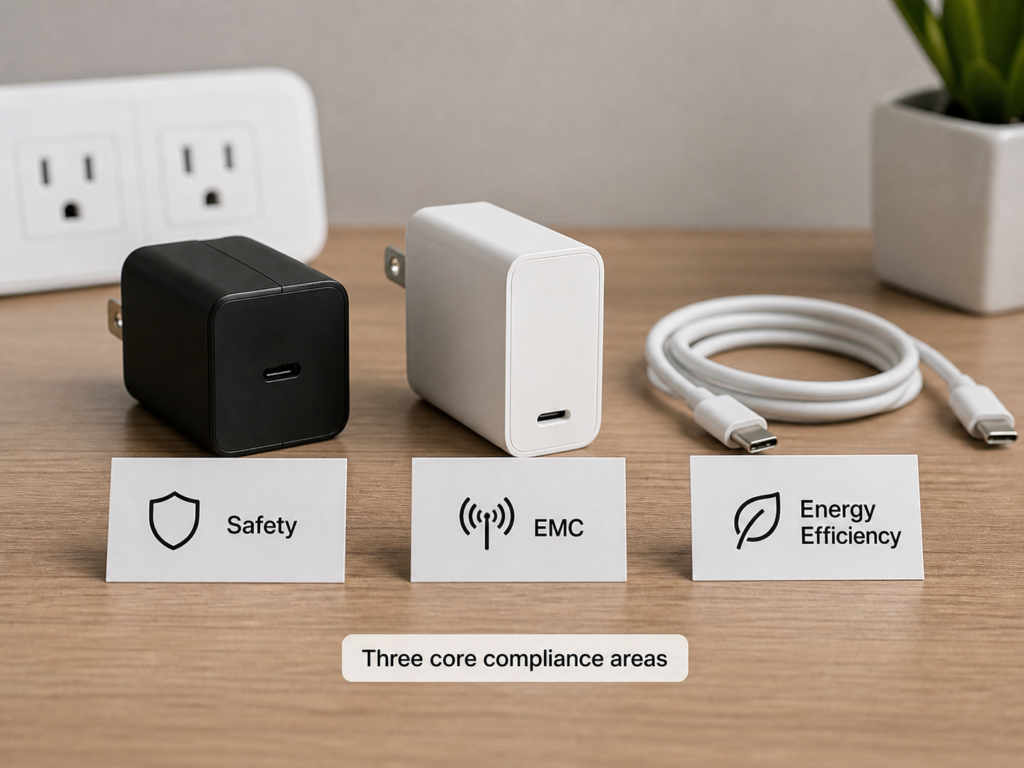
To judge whether you can operate without UL, you must first understand the three types of core requirements for charging products in the U.S. market, and UL is only one option in the safety category.
1. FCC Electromagnetic Compatibility Requirements
FCC is the abbreviation of the U.S. Federal Communications Commission, which regulates whether products will generate electromagnetic interference or illegally transmit wireless signals. It is a mandatory requirement at the federal level (as long as they are within the regulated scope).
How to Determine If Your Product Needs FCC?
• **Pure passive cables** (no chips or circuits inside, such as ordinary USB-A to C charging cables): usually not within the scope of FCC device authorization, and no device authorization is required as digital devices.
• **Products with active circuits**: Chargers usually contain switching power supplies or digital circuits, and usually need to be evaluated under FCC Part 15; USB-C cables with e-Marker should be judged separately based on their circuit functions and emission characteristics, and cannot be directly classified as unintentional radiators just because they “contain chips”.
• **Products with wireless modules such as Bluetooth/Wi-Fi**: Belong to “intentional radiators”, that is, actively transmit wireless signals, and usually need to obtain corresponding FCC authorization through Certification.
• **Wireless charging products**: Evaluated by frequency band and transmission method, applicable to Part 15 or Part 18 rules.
Two Compliance Paths
• **SDoC (Supplier’s Declaration of Conformity)**: For ordinary non-wireless unintentional radiators, the manufacturer can test by itself or find a laboratory to test, and issue a declaration. There is no need to apply to the FCC for a certificate.
• **Certification (FCC ID)**: Intentional radiators requiring Certification usually pass TCB certification and obtain an FCC ID. Products using already authorized wireless modules may not need to re-apply for an independent FCC ID for the whole device if they meet the module authorization conditions, but still must complete applicable requirements for the host, labeling, testing, and user instructions.
If non-compliant, you may face risks such as customs detention, platform delisting, and civil fines.
2. UL and NRTL Safety Certification
This is the part that everyone is most concerned about, and also the part with the most misunderstandings.
First Understand NRTL: UL Is Not the Only One
Many people think that UL is the official safety certification of the U.S., but it is not. The U.S. Occupational Safety and Health Administration (OSHA) has a system called NRTL (Nationally Recognized Testing Laboratory), which you can think of as the “scope of officially recognized safety certification bodies” — only when relevant institutions issue safety certifications within the recognized standards and product scopes can such certifications be used for corresponding OSHA/NRTL requirements.
UL, Intertek (ETL) and some CSA-related entities can act as NRTLs within their respective OSHA-recognized standards and product scopes. Their certifications usually meet corresponding OSHA/NRTL requirements, but whether they are accepted by specific AHJs, state regulations, platforms or customers still needs separate confirmation.
How to Distinguish Safety-Related Documents?
Laboratory reports, supplier DoCs and NRTL listings are compliance documents of different natures, and cannot be simply arranged into a unified “effectiveness level”.
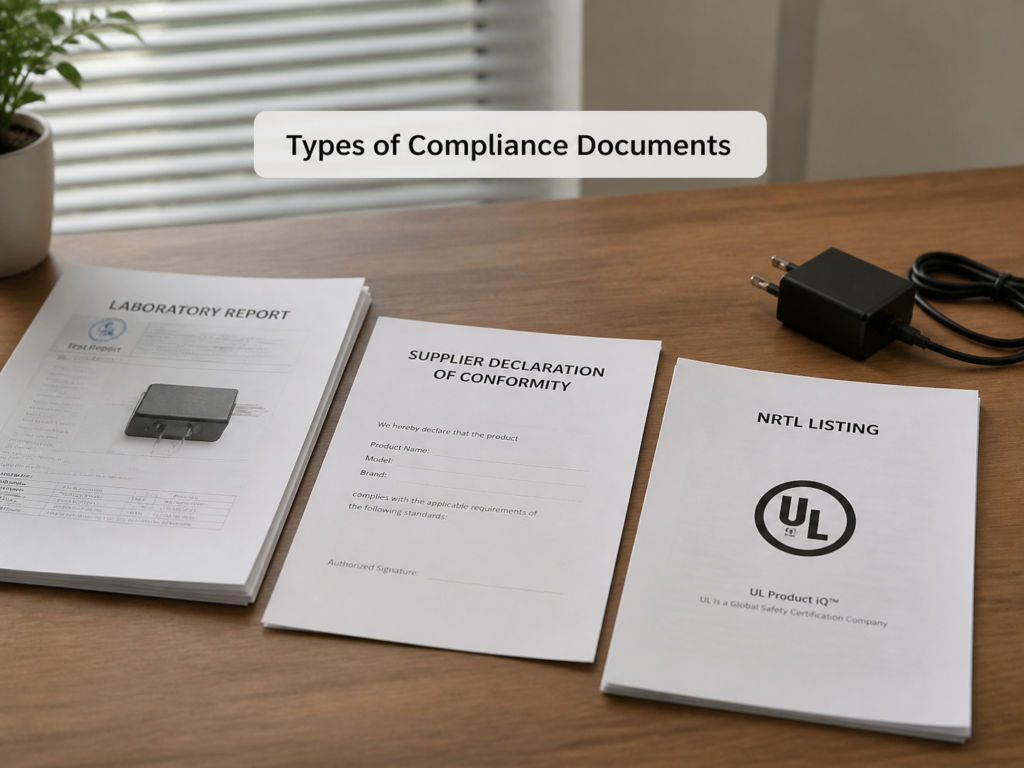
• **Laboratory test report**: Only proves that the submitted sample passed the test of a certain standard, and can be used as auxiliary material for some channels, but is not equal to certification.
• **Standard Declaration of Conformity (DoC)**: The manufacturer declares on its own that the product meets a certain standard, without third-party endorsement, and cannot replace applicable third-party certification.
• **NRTL Listing/Certification**: Approved by a recognized NRTL body, the product can bear the mark of the corresponding body, which is a common third-party certification method for workplaces and some installation scenarios.
• **UL Mark Authorization**: Only UL’s own listing certification allows the use of the UL mark; certifications from other NRTL bodies cannot use the UL mark.
• **Local, channel and customer requirements**: AHJ (that is, building, fire and other agencies with approval authority), e-commerce platforms, retailers or customers may separately specify accepted certification bodies, applicable standards and required materials, which need to be checked separately.
A special reminder here: many manufacturers will say “our products meet UL standards” or “use UL-certified materials”, these are all self-declarations, **not equal to the product having obtained UL certification**.
Common UL Certification Types
• **UL Listed**: Complete certification for the whole device. After passing, the UL mark can be affixed. For example, chargers and power adapters usually apply for this.
• **UL Recognized Component**: For components inside the product, such as transformers and interface components, it cannot replace the UL certification of the whole device. Don’t be fooled by “has UL” when buying accessories; the whole device still needs separate certification.
Common Safety Standards for Charging Products
Different products correspond to different safety standards. You don’t need to memorize them, just know that there are differences:
• Chargers/power adapters: Commonly use UL 62368-1, the specific one depends on product parameters and use.
• USB-C cables: Some USB Type-C cables and connectors are evaluated according to applicable requirements such as UL 9990; the specific standards, test scope and whether listing is required should be confirmed based on cable structure, rated parameters, electronic components and target channels.
• Car chargers: Car charging products should select applicable standards based on their input method, output function, installation method and use; some vehicle battery adapters apply to UL 2089, but this cannot cover all car USB chargers.
3. DOE External Power Supply Energy Efficiency Verification Requirements
DOE is the abbreviation of the U.S. Department of Energy, which regulates the energy efficiency level of external power supplies, that is, standby power consumption, conversion efficiency, etc. It is a federal mandatory requirement (must be completed within the applicable scope).
How to Determine If It’s Needed?
• Pure cables: No need to comply at all.
• Wall-mounted chargers, external power adapters: Need to be verified by specific model, check rated output, use, and whether they are within the exemption scope.
For external power supplies covered by DOE, applicable energy efficiency standards, test methods, manufacturer or importer report/record requirements and exemption conditions should be checked. Non-compliance may lead to DOE enforcement, civil penalties, sales restrictions or channel measures, and the specific consequences depend on the case and channel. States such as California may also have stricter state-level requirements, subject to the latest regulations.
Comparison Table of Three Core Requirements
To facilitate quick distinction, we have organized the three types of requirements into a table:
| Comparison Dimension | FCC (Federal Communications Commission) | UL/NRTL (Third-Party Safety Body) | DOE (Department of Energy) |
| Regulated Content | Electromagnetic interference, wireless transmission | Electrical safety (electric shock prevention, fire, etc.) | Energy efficiency level of external power supplies |
| Mandatory Attribute | Mandatory within regulated scope | Not federally mandatory, depends on scenario | Mandatory within applicable scope |
| Applicable Judgment Conditions | Whether with active circuits/wireless modules | Product risk, sales scenario, channel | Whether it is a wall-mounted external power supply |
| Main Risks of Absence | Detention, delisting, fines | Channel restrictions, high liability risk | DOE enforcement, civil penalties, sales restrictions or channel measures |
| Common Applicable Products | Charging products with circuits/wireless | All categories of charging products (by scenario) | Wall-mounted chargers, power adapters |
Limited Scenarios Where It Is Possible to Operate Without UL
After all that, are there cases where you can enter the U.S. without UL? Yes, but they are all **limited scenarios for non-mainstream commercial sales**, do not apply to ordinary retail.
Prerequisites for Only Meeting Customs Clearance
If you only want to ship goods into the U.S. (that is, pass the customs clearance stage), you cannot generalize that “it will definitely clear customs” just because the product is an ordinary charging category and has FCC documents.
Ordinary charging products usually do not have a unified federal UL entry requirement, but whether import is released still depends on applicable customs and other federal requirements, such as customs declaration, product labeling, intellectual property rights, recall or detention measures, and specific product attributes. Products subject to FCC should complete corresponding device authorization and records before import and sale. Customs release does not equal full market compliance; subsequent sales and installation still need to meet corresponding requirements.
Non-Scale, Non-General Sales Scenarios
Besides customs clearance, there are several niche scenarios where you can operate without UL:
1. **Small-batch direct mail for personal use**: That is, bought for own use, not for commercial resale. Of course, it must also comply with applicable regulations (for example, those with wireless functions still need FCC).
2. **Industrial/B2B targeted direct procurement**: If enterprise customers directly source from you in a targeted manner, customers may accept other technical documents such as test reports, and NRTL certification is not required. But note: contractual agreements cannot replace legal obligations. If a safety problem occurs, the liability that should be borne cannot be escaped.
3. **Offline personal second-hand transactions**: Not commercial sales behavior of enterprises, for example, individuals reselling used chargers. But this does not exempt statutory product liability. If the sold product has problems causing losses, compensation is still required.
Core Boundary Reminder
The above are all special limited scenarios, **not applicable to mainstream commercial retail, wholesale, engineering and other scenarios**. For specific level differences, you can refer back to the “4 levels of entering the U.S. market” mentioned earlier.
Why Has UL/NRTL Become a De Facto Threshold?
Since it is not federally mandatory, why does everyone say “you must have UL to do the U.S. market”? Because some commercial channels take UL/NRTL or specified test materials as conditions for listing, procurement or insurance, especially for products connected to mains electricity. But this is not a unified legal rule, and it cannot be generalized that all charging products, at all times and in all sales methods, must have UL/NRTL.
1. Mandatory Requirements of Mainstream Sales Channels
Some platforms, retailers, distributors and customers will put forward compliance requirements for specific categories, models or risk events. The policies of channels such as Amazon, Walmart, and Best Buy are dynamically adjusted with the platform, category, and period. Be sure to follow the current rules of the target channel.
Usually documents that may need to be submitted include: NRTL certificate, test report, label photos, declaration of conformity, supply chain information, etc. If you do not meet channel requirements, you may face delisting, supplementary document requests, sales restrictions, or even account penalties.
2. Pressure from Laws and Local Regulations
Besides channels, laws and local supervision also affect whether merchants need safety certification:
• **Product liability risk**: If a product has a safety accident (such as a charger fire), the absence of safety certification may affect the judgment of negligence or compensation liability in litigation, which also depends on the judicial jurisdiction and evidence.
• **Federal consumer product supervision**: CPSC (U.S. Consumer Product Safety Commission) has the right to launch investigations, recalls, and require corrective measures for consumer products with safety hazards. Even products with UL certification may be inspected, but without certification, it may be more difficult to prove that your product is safe.
• **Workplace supervision**: For workplace electrical equipment that OSHA standards require to be approved by an accredited body, employers usually need to use equipment that meets the corresponding approval requirements; whether NRTL listing is mandatory depends on the equipment category, installation method and applicable clauses. Enterprise procurement contracts may additionally require NRTL, but this cannot be generalized to all charging products for enterprise use.
• **Local regulations**: Electrical installation in public buildings and workplaces needs to meet the requirements of local AHJ (agencies with regulatory authority, such as building departments, fire departments). Many AHJs recognize corresponding NRTL certifications, but specific requirements vary by state, city, and building type.
3. Impact on Market Trust and Competitiveness
U.S. consumers have a very high awareness of the UL mark, and they feel more reassured when they see products with the UL mark. Products without safety certification usually can only be sold at low prices, and sales volume will also be limited.
If you do large customer procurement or engineering bidding, some customers or projects will take NRTL certification as an entry threshold. Without the required documents, you may not be able to enter the procurement or bidding process, which depends on the specific customer and project requirements.
Differences in Compliance Requirements for Different Charging Products
Not all charging products have the same requirements. It depends on several core variables: product form, power supply method, rated power, whether connected to mains electricity, whether containing active circuits/wireless modules, and sales scenario. We sort them by common categories:
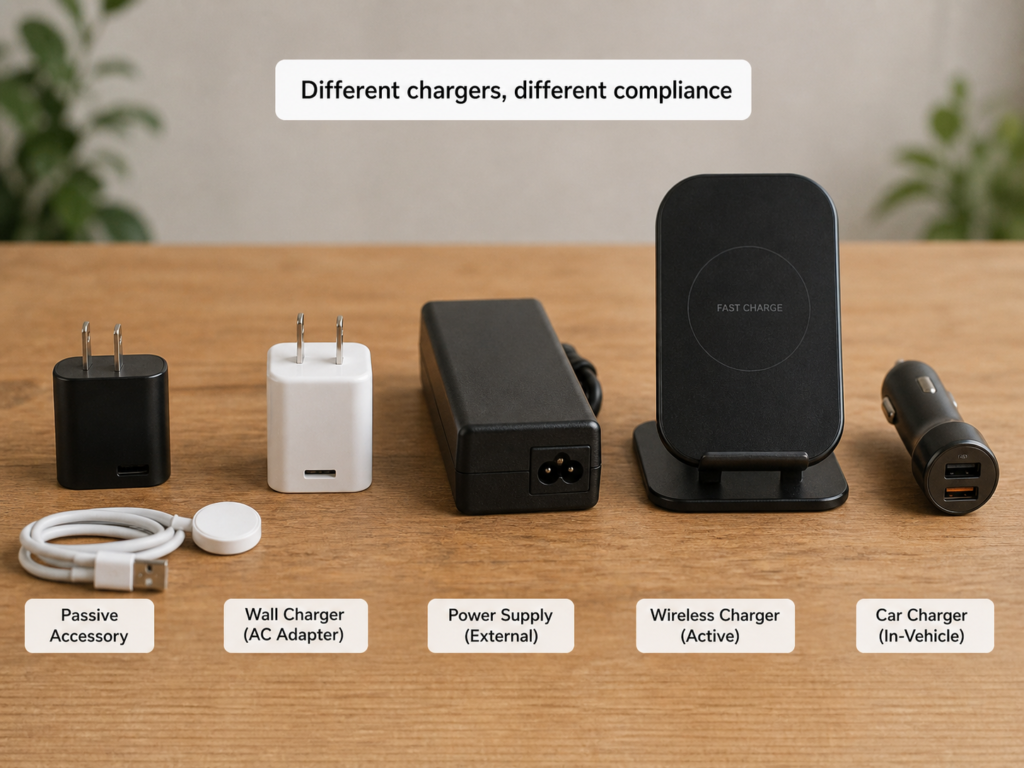
Wall-Mounted Chargers/Power Adapters
• **Risk level**: High (directly connected to mains electricity, risk of high-voltage electric shock and fire)
• **Mandatory compliance requirements**: Those within the FCC regulation scope must be compliant, and the applicability of DOE energy efficiency must also be verified.
• **Safety certification requirements**: Mainstream consumer channels and engineering scenarios usually require NRTL listing, and the specific applicable standards are evaluated by the certification body based on product parameters and use.
USB/USB-C Charging Cables/Data Cables
• **Risk level**: Medium-low (transmit low-voltage electricity, no high-voltage risk)
• **Mandatory compliance requirements**: Pure passive cables usually do not trigger FCC requirements; those with active chips (such as e-Marker chips) need to evaluate FCC applicability.
• **Safety certification requirements**:
• Pure passive cables: Some platforms only require safety test reports, there is no unified mandatory NRTL requirement.
• Cables with active chips: Requirements are relatively higher, specifically subject to channel policies.
• If sold as a set with a charger: Evaluate according to the risk of the whole device, and need to meet all compliance requirements of the charger.
Other Charging Products
• **Car chargers**: Use low-voltage vehicle power supply. Car charging products should select applicable standards based on their input method, output function, installation method and use; some vehicle battery adapters apply to UL 2089, but this cannot cover all car USB chargers.
• **Wireless chargers**: Need to evaluate FCC Part 15/18 and other applicable rules separately; if with wireless communication functions such as Bluetooth and Wi-Fi, it is usually also necessary to complete corresponding FCC authorization for the communication function. Whether DOE and NRTL are applicable should be confirmed respectively according to the coverage of external power supplies, product structure, installation scenarios and channel or customer requirements, and cannot be listed as a unified mandatory document for all wireless chargers.
• **Charging components (connectors, internal modules, etc.)**: Whether Recognized Component or other recognition is needed depends on the whole device standard, key component requirements and certification scheme; component certification cannot replace whole device certification, but it also cannot be generalized that all components must separately obtain UL certification.
Potential Risks and Pitfall Avoidance Methods Without UL
If you plan to enter the U.S. market without UL/NRTL certification, you must first understand the potential risks and avoid common cognitive pitfalls.
Four Types of Potential Risks
1. **Platform risk**: The most common, such as products being delisted, required to supplement documents, inventory restricted, funds withheld, specifically subject to platform policies.
2. **Legal risk**: May face CPSC investigation or recall; if products are sold to workplaces, it may also trigger OSHA-related enforcement; if a safety accident occurs, the liability judgment may be unfavorable to you.
3. **Commercial risk**: Losing large customers, increased returns and negative reviews, damaged brand image.
4. **Insurance risk**: The absence of safety certification may affect the underwriting and claim settlement of product liability insurance, specifically depending on the policy terms.
6 Common UL Cognitive Misconceptions
These are the most common pitfalls for beginners, must be avoided:
1. **Misconception 1: All charging products have the same UL standard**
Correct answer: Products of different categories, parameters and uses correspond to different safety standards. For example, chargers use UL 62368-1, USB-C cables may involve applicable requirements such as UL 9990, and automotive products also need to select standards according to specific structures — all are different.
2. **Misconception 2: UL is the only valid U.S. safety certification**
Correct answer: UL, Intertek (ETL) and some CSA-related entities can act as NRTLs within their respective OSHA-recognized standards and product scopes. Their certifications usually meet corresponding OSHA/NRTL requirements, but whether specific channels, local authorities or customers accept them still needs separate confirmation. It does not have to be UL.
3. **Misconception 3: Having a UL number means real UL certification**
Correct answer: Just giving a number is useless. You must verify the certificate status, model, parameters, factory address and other multi-dimensional information. Many fake certificates use real numbers, but the corresponding products and factories are completely wrong.
4. **Misconception 4: UL test report = UL listing certification**
Correct answer: A test report is only proof that the sample passed the test, and can be used as material for some channels, but it is not an official listing certification, cannot bear the UL mark, and does not have the validity of NRTL certification.
5. **Misconception 5: CE/ISO certification can replace UL**
Correct answer: CE is the EU entry requirement, ISO is a system certification. Neither applies to the safety access of the U.S. market, and cannot replace UL/NRTL certification.
6. **Misconception 6: Buying UL labels and pasting them on counts as having certification**
Correct answer: Forging certification marks is an illegal act, which may lead to consequences such as store closure and prosecution in serious cases. Never do this.
Practical Pitfall Avoidance Methods
Certificate Authenticity Verification
If the supplier says there is UL/NRTL certification, be sure to check it yourself:
• **Verification channel**: Directly go to the official website of UL or the corresponding NRTL body to query.
• **Verification dimensions**: Certificate status (whether valid, whether suspended/revoked), listing scope (whether it is your product category), product model, rated input and output parameters, factory address, key components, label information.
• Key reminder: **Absolutely cannot only verify the certificate number** — it is very common for fake certificates to use real numbers.
Low-Cost Compliance Solutions
If the budget is limited or you are just starting trial sales, you can consider more flexible solutions:
• Small-batch trial sales stage: First do a laboratory test report of the corresponding standard to meet the requirements of some channels. After sales are stable and you decide to do long-term business, then apply for NRTL listing certification.
• You can choose NRTL bodies with relatively lower fees such as ETL, but be sure to first confirm that they have OSHA accreditation qualifications for your product category, and that the target channel accepts the certification of this body.
Pay Attention to Product Consistency
After obtaining certification, you cannot modify the product at will: if you replace the plug, cable length, power, or key components, the original certification may become invalid. You need to find the certification body to re-evaluate. Don’t modify it yourself and sell directly, otherwise it is equivalent to no certification.
Quick Judgment: Can Your Product Operate Without UL?
We have compiled a four-step checklist, you can follow it step by step to judge, no need to guess blindly.
Step 1: Verify Federal Basic Entry Requirements
1. Is it an ordinary charging product covered in this article? Yes → continue, No → check the special rules for the corresponding category.
2. Evaluate FCC applicability. For those within the regulation scope, first complete the corresponding FCC compliance.
3. Is it an external power supply/wall charger? Yes → verify the applicability of DOE energy efficiency, and complete what is required.
Step 2: Match Product Risk Level
• **High risk** (mains-connected chargers, wireless chargers, high-voltage power products): Prioritize NRTL certification, the risk is too high.
• **Medium-high risk** (USB cables with active chips, car chargers): Judge combined with the requirements of the target channel.
• **Low risk** (pure passive charging cables, low-voltage passive accessories): First check the specific requirements of the target platform, NRTL is not necessarily needed.
Step 3: Match Sales Scenarios and Channels
• **Mainstream e-commerce/offline chain**: Strictly submit compliance documents according to the current category policy. If NRTL is required, it must be completed.
• **B2B large customers/engineering/public projects**: Provide documents according to the requirements of customers or tenderers, usually NRTL is required.
• **Small-batch private customization/industrial direct procurement**: You can negotiate the document type with the customer, but be sure to clarify the boundary of legal liability. Don’t ignore the risk just because the customer says it’s not needed.
Step 4: Evaluate Your Own Risk Tolerance
• If you cannot bear the potential compensation liability for safety accidents → it is recommended to complete NRTL certification.
• If you cannot accept the risks of low pricing, limited sales, and platform delisting at any time → it is recommended to complete NRTL certification.
Final Decision Reference Matrix
Combined with the results of the previous four steps, you can judge your compliance needs from the combination of these dimensions:
| Product Type | Mains-Connected | With Wireless | Target Scenario | Core Mandatory Documents | Main Risks |
| Wall-mounted charger | Yes | No | Mainstream e-commerce retail | Applicable FCC compliance + applicable DOE compliance + whether NRTL is needed confirmed by channel | Easy to be delisted without NRTL, high liability risk |
| Pure passive USB cable | No | No | Mainstream e-commerce retail | Safety test report (per platform) | Low risk, subject to platform requirements |
| C cable with e-Marker | No | No | Mainstream e-commerce retail | Evaluate FCC applicability according to circuit function and emission characteristics + safety test report (per platform) | Need to confirm FCC applicability |
| Wireless charger | Yes | Yes (if any) | Mainstream e-commerce retail | Compliance documents for FCC Part 15/18 and other applicable rules; communication modules authorized as needed; DOE and NRTL confirmed by applicable scope and channel | Many compliance requirements, easy to have problems without certification |
| Car charger | No | No | Auto parts channel | Applicable FCC compliance (per circuit) + safety report | Medium risk, subject to channel requirements |
This table is only a reference for common scenarios, and specific adjustments should be made according to your actual situation.
Summary and Quick Check of Frequently Asked Questions
Core Abilities You Can Gain from This Article
After reading this, you should be able to do the following:
1. Distinguish the regulatory directions and applicable conditions of FCC, UL/NRTL, and DOE, and no longer confuse them.
2. Distinguish the entry thresholds of 4 scenarios: customs clearance, retail, procurement, and installation, and no longer use “can clear customs” instead of “can sell”.
3. Judge the feasibility of operating without UL according to the type, parameters, and sales channel of charging products.
4. Avoid common cognitive misconceptions about UL, know how to verify the authenticity of certificates, and know that there are equivalent compliance solutions.
5. Apply the above checklist to formulate a basic compliance path suitable for yourself.
Quick Answers to Frequently Asked Questions
1. **Can you clear customs without UL?**
You cannot guarantee customs clearance just because there is no UL or there are FCC documents. Ordinary charging products usually do not have a unified federal UL entry requirement, but imports still need to meet applicable customs and other federal requirements; products within the FCC regulation scope should have corresponding device authorization and records. Customs release does not mean that legal commercial sales are allowed.
2. **Can ETL replace UL?**
Within the corresponding standards and product scopes recognized by OSHA for Intertek, ETL can be used as an NRTL certification method, and usually can meet corresponding OSHA/NRTL requirements. Whether it is accepted by the target channel, AHJ, state regulations or customers needs to be confirmed separately.
3. **Do pure USB charging cables need UL certification?**
Ordinary passive USB cables usually do not require FCC device authorization, and there is no unified federal UL listing requirement; but you should still check applicable cable safety, materials, labeling, state-level regulations and platform or customer requirements. Cables with electronic components should be separately evaluated according to circuit functions and emission characteristics.
4. **Do wireless chargers need FCC ID?**
It needs to be evaluated according to the frequency band of wireless charging, transmission method and whether it has communication functions: if it has intentional radiation communication modules such as Bluetooth and Wi-Fi, it is usually necessary to complete corresponding FCC authorization for the communication function; for wireless chargers only used for energy transmission, just evaluate the compliance path according to the corresponding FCC rules. Whether DOE or NRTL is needed also needs to be confirmed according to the coverage of external power supplies, product structure, installation scenarios and channel requirements.
Final Reminder
The rules of FCC and DOE, the NRTL recognition scope of OSHA, platform policies, and state/local requirements may all be adjusted over time. Before formal shipment, be sure to find a professional testing agency, compliance consultant, importer or target channel to confirm the latest requirements, and do not rely on old experience.
Compliance in the U.S. market is never a simple yes-or-no question of “whether there is UL”, but requires comprehensive judgment based on products, channels, and risk tolerance. You don’t have to be deterred from small-batch trial sales by the saying “must have UL”, nor can you take a fluke mentality to ignore safety compliance — after all, the foundation of long-term operation is always product safety and compliance.