
Friends who make products such as wired chargers, USB-C cables, and power adapters and want to enter the U.S. market have most likely heard of FCC SDoC. Many people’s first reaction is: Is this just something manufacturers can declare on their own? No need to obtain an official certificate?
The direct answer is: **If 3 prerequisites are met, the responsible party can indeed self-declare, and no prior FCC approval is required**. But this is absolutely not just writing a random statement. If you get the rules, qualifications, requirements, and risks wrong, you may face compliance dispositions in the import or sales process at best, and fines or sales suspension at worst. These 3 core prerequisites are: First, the product falls within the applicable scope of SDoC; second, there is a legal responsible party located within the United States that assumes responsibility; third, there are compliant test records and a full set of technical documents. Special reminder: The core of self-declaration is “self-assumption of responsibility”. The FCC adopts a regulatory logic of post-event spot checks, and will hold responsible parties accountable if non-compliance is found. If an overseas manufacturer does not have a responsible party entity located within the United States, it must designate an affiliated entity of the manufacturer, importer, or other qualified responsible party located within the United States.
Can Charging Products Use the SDoC Route? Judge by This Logic
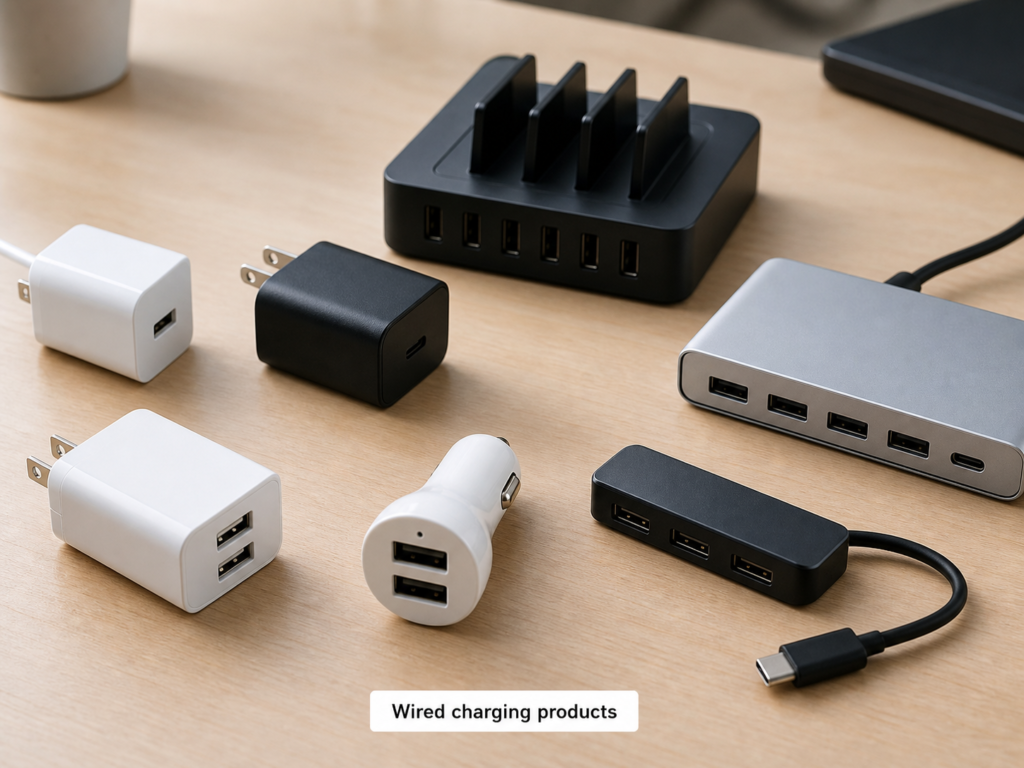
When making a judgment, you cannot only look at whether the product actively transmits wireless signals; the first step is to determine which part of the FCC rules applies to the device. Wireless functions such as Bluetooth and Wi‑Fi, which are intentional radiators under Part 15, usually require the Certification route and obtaining an FCC ID; however, wireless charging devices may be subject to FCC Part 18, and some consumer devices can use SDoC, so it cannot be generally assumed that an FCC ID is mandatory.
Therefore, the final judgment must be based on the product’s actual circuit, operating frequency, power, operating mode, and applicable rules. You cannot judge just by the product being named “charger”, nor can you draw a conclusion solely based on “having wireless functions” or “no wireless functions”.
Common Charging Products That Can Use the SDoC Route
Wired chargers, power adapters, charging docking stations, or hubs that do not contain wireless functions subject to Part 15 intentional radiator rules and are devices subject to Part 15B can usually be evaluated for SDoC. USB/USB-C cables, adapters, and other charging accessories with data transmission, control chips, simple LED indicators, or MCU control functions also need to be confirmed based on their specific circuits and functions.
In other words, whether these products can use the SDoC route cannot be judged solely by product names such as “charger”, “data cable”, or “docking station”. Instead, it is necessary to confirm whether they belong to the device categories that require authorization under Part 15B and are allowed to use SDoC.
Charging Products That Cannot Simply Use the SDoC Route
Smart chargers with Part 15 intentional radiation functions such as Bluetooth and Wi‑Fi usually need to obtain an FCC ID in accordance with the corresponding Certification requirements. Even if a product has both digital circuits and a wireless module, you cannot only do SDoC for the digital circuit part and ignore the authorization requirements for the wireless module.
Wireless chargers cannot be uniformly classified as requiring an FCC ID. Some wireless charging devices may be subject to FCC Part 18, and certain consumer devices can use SDoC, depending on conditions such as device category, operating mode, frequency, and power. Therefore, the authorization route cannot be directly judged solely by the name “wireless charger”.
Products That Do Not Require SDoC (Exempt)
Not all charging accessories require SDoC. For example, passive charging cables that only have a power cord, no data chip, and no electronic circuits, as well as purely passive charging accessories such as simple physical adapters, usually do not belong to products that require Part 15 device authorization.
But special attention should be paid: **not all charging cables can be directly regarded as exempt**. Cables containing E-Markers, signal converters, or other active circuits should be confirmed as to whether they are exempt devices or require device authorization based on their specific circuits, clocks, and functions. The E-Marker itself does not automatically determine that the product must undergo SDoC.
How to Judge Uncertain Edge Cases?
First, check the specification sheet or perform a teardown to confirm whether there are wireless transmission modules such as Bluetooth and Wi‑Fi, then confirm whether there are components that may affect electromagnetic compatibility, such as digital circuits, clock circuits, and switching power supplies. Then, based on the device’s actual operating frequency, power, interfaces, and purpose, confirm whether Part 15, Part 18, or other FCC rules apply.
If you are still unsure, directly check the official FCC Part 15 or Part 18 guidelines, or consult a professional compliance agency. Do not force a fit based solely on the product name, to avoid problems later.
A Valid SDoC Must Meet These 4 Conditions
A valid SDoC is not just a piece of paper with a signature. It must meet all of the following 4 conditions at the same time; missing any one may bring compliance risks.
1. The Product Itself Falls Within the Scope of SDoC Application
First, confirm that the device belongs to the category that requires authorization under FCC rules and is allowed to use SDoC. For digital devices, also confirm whether Part 15B applies, and whether they are simultaneously subject to other provisions of Part 15, Part 18, or other FCC rules. Some devices may be exempt, and some may require Certification. Not all unintentional radiators can be directly classified under SDoC.
In addition, the correct limit class must be matched:
• Class A: Applicable to products for industrial and commercial environments, with relatively lenient electromagnetic interference limits;
• Class B: Usually applicable to devices used in residential environments, with stricter limits.
Class A or Class B depends on the intended use environment of the device and FCC classification, and cannot be judged solely by “consumer grade” or the product name. Whether most ordinary consumer-grade chargers and data cables belong to Class B also needs to be confirmed based on the specific device category and applicable rules, and cannot be generally inferred.
2. Supported by Compliant Test Data
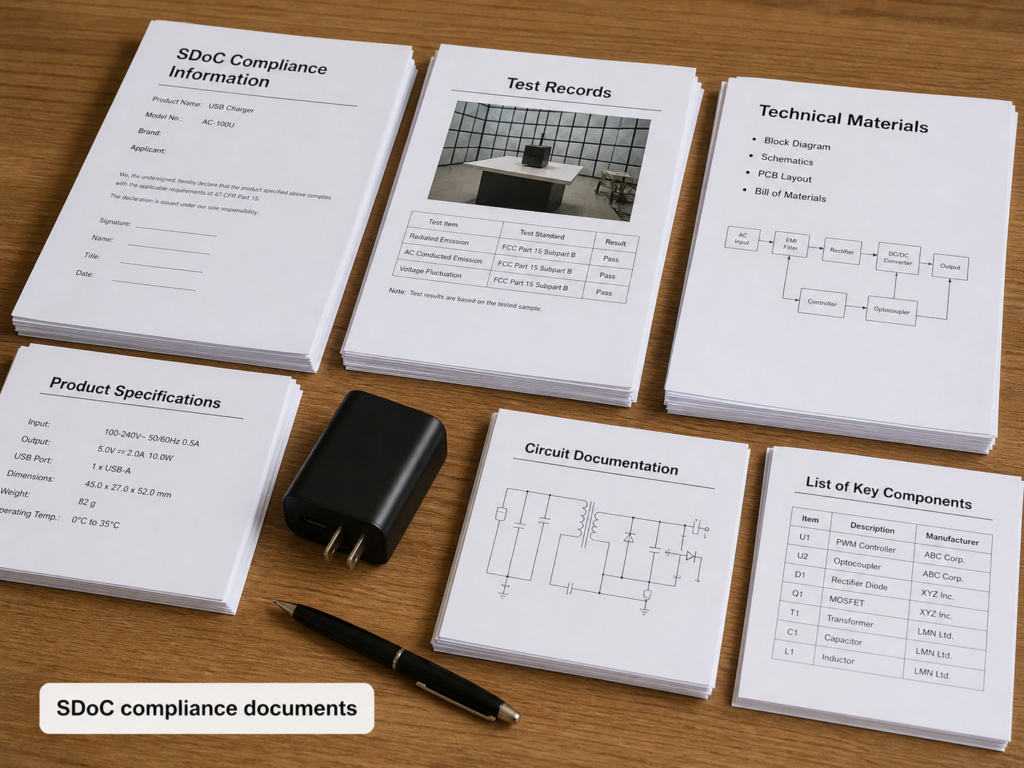
Self-declaration is not empty talk. There must be test data and technical records proving that the product meets the applicable FCC requirements. Testing can be completed by the manufacturer itself, or entrusted to a third-party laboratory with corresponding capabilities. Testing shall use applicable FCC measurement methods, and complete records sufficient to prove compliance shall be retained.
Unless otherwise required by specific FCC rules, SDoC does not require a report issued by an FCC-recognized laboratory as a necessary condition. Choosing a laboratory with corresponding capabilities and experience usually helps reduce risks related to test methods, report content, and subsequent data preparation, but “FCC-recognized laboratory” cannot be regarded as a unified prerequisite for all SDoC products.
Test items may include radiated emissions, conducted emissions, etc., depending on the rules applicable to the product and the device category. The test configuration should also cover representative usage states and situations that may produce greater emissions.
If key components or structures of the product change, such as replacing the main controller, power supply solution, shielding structure, or interface, you cannot directly use the report of the old model without evaluation. First, determine whether the change may affect radio frequency or electromagnetic compatibility performance. If necessary, conduct supplementary testing or retesting, and update compliance records.
3. Have a Complete Set of Traceable Compliance Documents
You need to prepare a complete set of compliance documents, including: formal SDoC compliance information, test records, technical materials, product specifications, circuit documentation, and a list of key components, etc.
The responsible party shall retain test results, technical materials, and other compliance records in accordance with applicable rules. Relevant records usually need to be retained for at least two years after the cessation of manufacturing or import, but the specific period shall be subject to applicable regulations, and cannot be simply understood as “uniformly retained for two years from the date of product discontinuation of sale”.
These documents do not all have to be physically stored within the United States. The key is that the responsible party can provide complete, accurate, and traceable materials within the time limit required by the FCC. Enterprises should determine in advance who manages the documents, where they are stored, and how to retrieve them in a timely manner in the event of a spot check or investigation.
4. Provide Product Compliance Information as Required
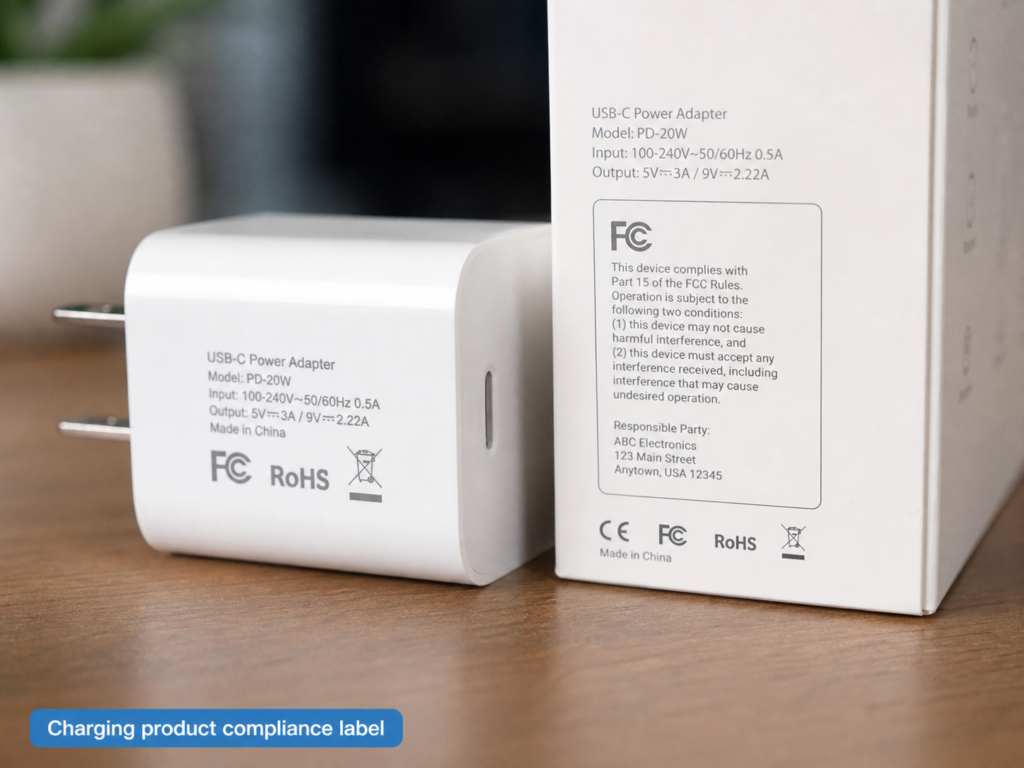
The product shall provide labels, user manuals, accompanying documents, or allowed electronic label content required by the FCC in accordance with specific device rules. The SDoC declaration usually needs to include the specified compliance statement and responsible party information, but it cannot be broadly stated that the responsible party’s name and address must be directly printed on the product or packaging under normal circumstances.
Similarly, it cannot be generally assumed that packaging can automatically replace all user document requirements. Whether a product needs to provide certain information on the device itself, packaging, instructions, or electronic labels depends on the applicable rules and the actual situation of the product.
SDoC does not require labeling with an FCC ID number, because SDoC itself is not FCC ID certification. However, products and promotional materials may not use marks or statements that could easily mislead consumers into thinking that a certificate has been officially issued by the FCC.
5 Most Common Pitfalls to Avoid
Many people conduct SDoC, but many also fall into pitfalls. These 5 most common misconceptions must be avoided:
• **Misconception 1: All manufacturers can directly conduct SDoC**. The SDoC responsible party must be located within the United States. If an overseas manufacturer does not have a responsible party entity located within the United States, it must designate an affiliated entity of the manufacturer, importer, or other qualified responsible party located within the United States.
• **Misconception 2: Self-declaration just means writing a statement**. Without test and technical records that can prove compliance, the statement lacks a basis. Even if testing is conducted by the manufacturer itself, it must be completed and records retained in accordance with applicable FCC rules and measurement methods.
• **Misconception 3: All charging products can use the SDoC route, or all wireless chargers must use the FCC ID route**. Part 15 intentional radiators such as Bluetooth and Wi‑Fi usually require Certification and obtaining an FCC ID; wireless charging devices may be subject to Part 18, and some consumer devices can use SDoC; purely passive ordinary charging cables may be exempt. Ultimately, all must be judged based on the specific device.
• **Misconception 4: Having a test report equals completing SDoC**. SDoC is a complete process. In addition to test records, it also requires judgment of applicable rules, a clear U.S. responsible party, specified compliance information, and technical materials consistent with mass production configurations. Mass-produced products do not have to be completely identical to test samples in every detail, but there must be no unevaluated changes that may affect compliance.
• **Misconception 5: SDoC is the same as CE self-declaration**. These two belong to different regulatory systems of the United States and the European Union, with different test standards, responsibility requirements, and regulatory logic. You cannot directly apply CE reports to SDoC, nor can you use CE declarations to replace the compliance information required by the FCC.
How to Judge Whether an SDoC Provided by Others Is Actually Valid?
If you source goods from suppliers and want to confirm whether their SDoC is reliable, you can check in these 4 steps:
1. First check the product type: If the product has Part 15 intentional radiation functions such as Bluetooth and Wi‑Fi but only uses SDoC to replace the corresponding Certification, there is an obvious problem; for wireless charging products, further confirm whether Part 18 or other FCC rules apply.
2. Then check the responsible party: The declaration should confirm the responsible party located within the United States and its valid contact information; it cannot only have an overseas address.
3. Then check the content of the declaration: It should include the product name or model, applicable FCC compliance statement, and responsible party information. If the content is incomplete, further verification is required. Signatures and dates can be used as enterprise management records, but the overall validity cannot be judged solely by whether there is a signature.
4. Finally check the test support: Verify the applicable rules, test records, and mass production configuration. If the responsible party cannot provide records sufficient to prove compliance when required by the FCC, or if there are unevaluated changes in the mass production configuration that may affect compliance, there is an obvious compliance risk. However, the fact that the supplier has not yet shown the complete report to the purchaser does not alone prove that it has violated the law.
The Risks of Improperly Conducting SDoC Are Greater Than You Think
Don’t think that no one checks self-declarations. If you encounter regulatory or import compliance problems, the losses may be significant:
• **Import dispositions**: Non-compliant products may face FCC or customs-related enforcement measures, including requiring supplementary materials, stopping imports, refusing entry, or other dispositions. The specific results depend on the circumstances of the case.
• **FCC penalties**: The FCC may impose fines based on the specific illegal act, duration, and applicable statutory maximum, and may also take measures such as stopping sales, stopping imports, and rectification. Whether further market restrictions are adopted depends on the legal procedures of each case, and cannot be generalized as being automatically added to a “blacklist”.
• **Platform delisting**: E-commerce platforms such as Amazon may review compliance materials according to their own policies and contract requirements, and take measures such as delisting product links, restricting sales, or handling funds; these are not certain consequences stipulated by FCC regulations for all cases.
• **Recall or other dispositions**: Serious or persistent interference violations may lead the FCC to require stopping sales, stopping imports, rectification, and taking recall or other measures if necessary. However, recall does not automatically occur in all cases of exceeding limits; it depends on the device type, degree of harm, and enforcement procedures.
Final Summary: 3 Things You Can Judge Right Now
After reading this article, you don’t have to memorize all the rules by rote. As long as you can judge these 3 things, you basically won’t fall into big pitfalls:
First, **Can your charging product use the SDoC route?** First confirm which part of the FCC rules applies to the product, then see whether it falls under SDoC, Certification, or exemption. Products with Part 15 intentional radiation functions such as Bluetooth and Wi‑Fi usually need to take the Certification route and obtain an FCC ID; wireless charging products cannot be generalized, and need to be judged according to Part 18 or other applicable rules.
Second, **Can you conduct SDoC yourself?** First check whether there is a responsible party located within the United States that assumes responsibility, then check whether you can produce test records and a complete set of documents that comply with applicable rules. Only when both aspects are met do you have the basis for self-declaration.
Third, **How to avoid pitfalls?** Remember that “self-declaration ≠ casual statement”. A statement without the support of test and technical records is very risky. Products with wireless functions cannot be forced to fit SDoC, and impact assessments must be conducted in a timely manner after product changes. Correctly identifying applicable rules, clarifying the responsible party, and keeping complete compliance materials are the key to being able to withstand inspections after entering the U.S. market.