
If you frequently purchase digital products, engage in EU cross-border business, or plan to live in Europe long-term, you have most likely heard the claim that “the EU will mandate unified USB-C charging”. However, many people only have a partial understanding of exactly when the mandate takes effect, which products it covers, and whether old chargers can still be used. In this article, we will clarify the timeline, scope of application, core requirements, and common misconceptions all at once, so that both ordinary consumers and small cross-border practitioners can understand.
Core Timeline and Boundaries: First Understand When Compliance Is Required
First, let’s talk about the core timeline that everyone is most concerned about: the EU’s unified charger requirement is not a one-size-fits-all measure, but is rolled out in phases for two categories of devices. The benchmark for determining whether compliance is required is **first placing on the EU market** — that is, the time when the product is first made available on the EU market, which has nothing to do with the production time or the time when consumers purchase it. “Placing on the market” is also not the same as simply entering the EU customs territory.
The first category is listed portable electronic devices other than laptops. It is required that from December 28, 2024, all products first placed on the EU market after the mandatory date must meet the requirements; the second category is laptop computers, with a slightly later date of April 28, 2026.
Many people confuse the effective date of the regulation with the product compliance date: as early as December 28, 2022, this directive named (EU) 2022/2380 officially came into effect, but this is only the legal effect of the directive, not a requirement for products to comply immediately. After the directive comes into effect, EU member states need to transpose it into their national laws, and then products will implement the requirements according to the two above-mentioned time points. Currently, the entire EU uniformly implements this set of rules, with no regional differences, and no extension plan has been announced.
Regarding inventory and transition, the rules are also clear: compliant products that have been first placed on the EU market before the mandatory date, including inventory that is still in circulation with agents, wholesalers, or retailers afterwards, can continue to be supplied until sold out; inventory that has not been placed on the EU market before the mandatory date does not automatically enjoy this transition treatment. Listed terminals first placed on the EU market after the mandatory date must meet the requirements. As for whether model revisions or repackaging trigger a new compliance judgment, it depends on whether a new product that has not been placed on the market is formed, and whether the relevant changes affect the applicable requirements.
In addition, second-hand devices that have been legally first placed on the EU market and are resold again usually do not trigger the first placing requirement stipulated in this directive due to the resale; second-hand devices first introduced from outside the EU and placed on the EU market need to be re-judged according to their product category and applicable regulations.
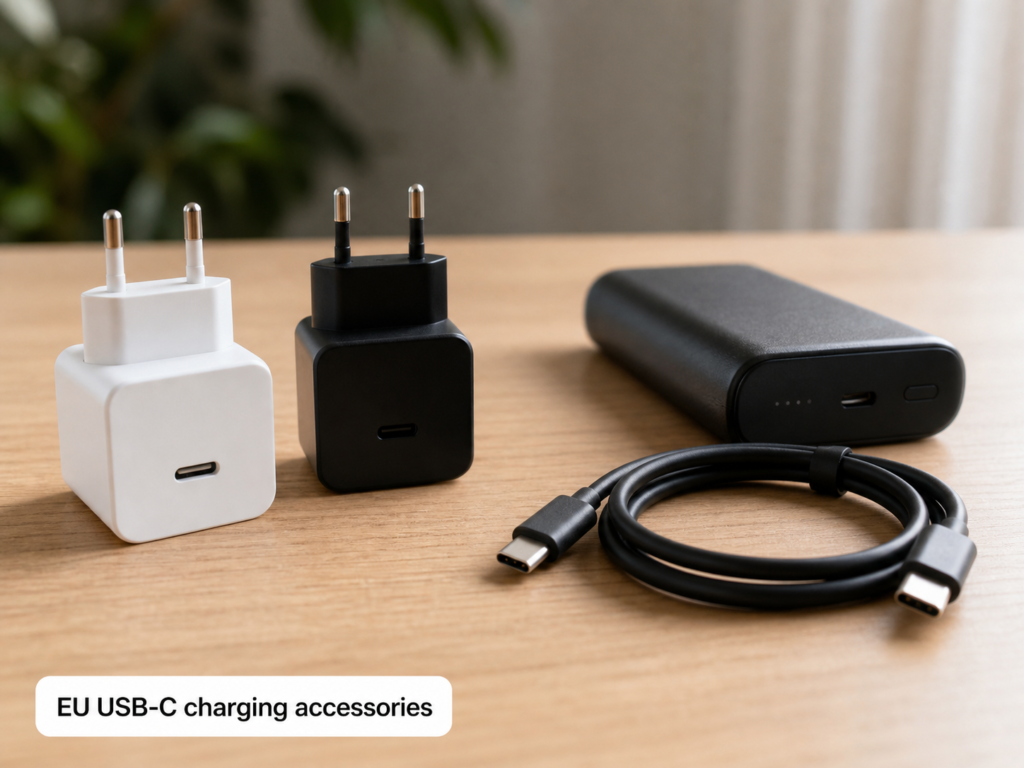
It is also important to draw an important boundary here: independently sold chargers, USB-C data cables, and power banks are not directly subject to this unified charger regulation. They need to comply with the corresponding EU CE regulatory requirements according to their own product attributes.
Regulatory Basis: Why Unify, and What Is Its Nature?
Many people may be curious: why does the EU spend so much effort unifying charging ports? What is the nature of this regulation? Let’s briefly sort out the logic behind it.
The core document of this unified charger is Directive (EU) 2022/2380, which is essentially an amendment to the EU’s Radio Equipment Directive (i.e., the RED Directive, numbered 2014/53/EU, which is the basic regulation governing most electronic devices with wireless functions). Its implementation process is “directive officially comes into effect → member states transpose into national laws → products comply in phases according to the timeline”, not that products need to be modified immediately as soon as the directive is issued.
Many people think there is a separate “USB-C certification”, but in fact there is not: the requirements for USB-C and USB PD are only one of the items for CE compliance of listed terminal devices. The CE mark that people often see is essentially a mark for manufacturers to self-declare that their products comply with relevant EU regulations, not a certificate issued by the EU official. Whether a product is truly compliant ultimately depends on whether the corresponding technical documentation is complete.
There are three core reasons why the EU is promoting the unification of USB-C: first, to reduce electronic waste. According to public data from the European Commission, about 11,000 tons of chargers are discarded in the EU every year, and a unified port can greatly reduce unnecessary accessory waste; second, to reduce user costs, so there is no need to buy a new set of chargers and cables every time you change devices; third, to improve convenience of use, one set of accessories can be adapted to most portable electronic devices, so there is no need to prepare a bunch of cables with different ports.
Before continuing to explain the requirements, let’s clarify the two most easily confused terms to avoid misunderstanding later:
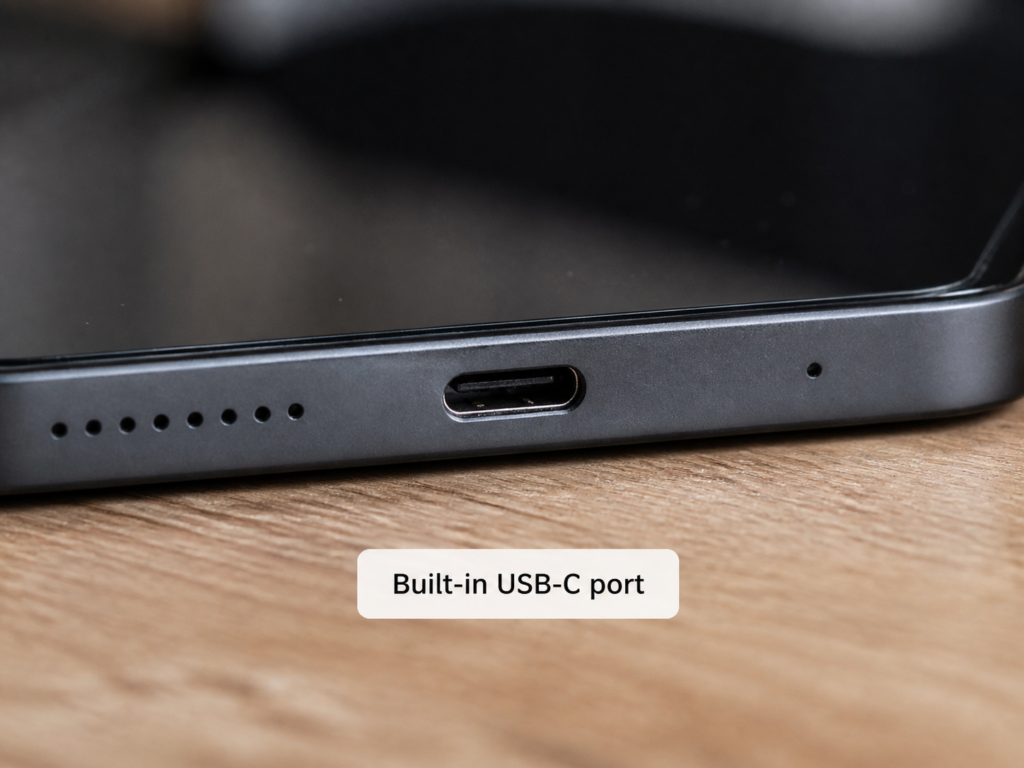
• **USB-C**: commonly known as “Type-C”, is an oval-shaped physical port that supports reversible insertion. It is not equivalent to fast charging itself — some USB-C ports only support slow charging, or even only data transmission. Whether fast charging is possible depends on the underlying protocol. You can think of it as a universal “socket shape”; a matching shape does not mean sufficient power supply capacity. You can check the charging port on the bottom or side of the device. The oval port that can be inserted either way is the USB-C female port, which must be directly built into the device body.
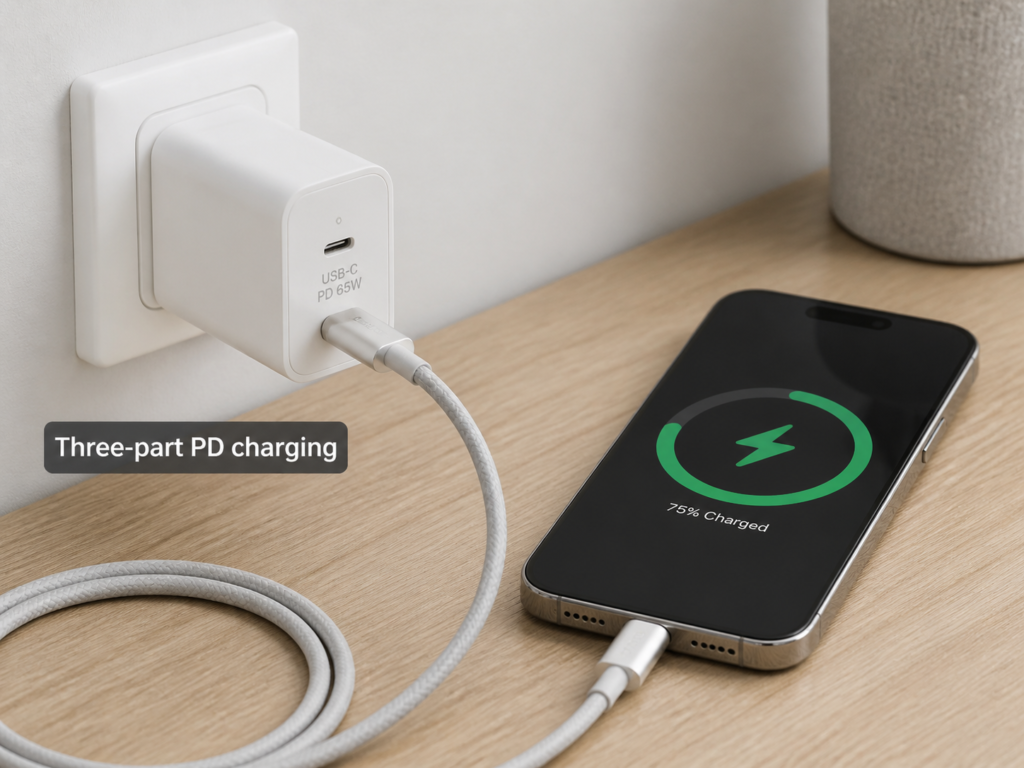
• **USB PD**: full name USB Power Delivery, is a set of universal charging negotiation protocols. As long as devices and chargers of different brands all support this protocol, they can negotiate with each other to match an appropriate power level, without requiring accessories from the same brand. However, note that the actual achievable charging power requires the device, charger, and data cable to all support the corresponding power level; none of the three can be missing.
Scope of Application: Which Products Need to Be Changed, Which Do Not
After clarifying the timeline and basic concepts, the most critical question comes: exactly which products need to use USB-C mandatorily? Which do not? We will draw the boundaries clearly.
Listed Terminal Devices Directly Subject to the Regulation
First of all, devices directly subject to this regulation are **terminal devices of listed categories, with rechargeable batteries, and supporting wired charging** — all three conditions are indispensable.
Specifically, there are two batches: 12 categories in total applicable from December 28, 2024, including familiar mobile phones, tablets, digital cameras, camcorders, headphones/headsets with wired charging support, etc.; only 1 category applicable from April 28, 2026, which is laptop computers. The two categories add up to a total of 13 categories of listed terminals.
Products Temporarily Not Included in the Mandatory Scope
The following types of products are temporarily not within the mandatory scope and do not need to meet the USB-C requirements of this regulation:
The first category is non-listed equipment in professional fields such as industry and medical care, such as professional industrial testing instruments and portable medical electronic devices. As long as they are not on the 13-category list, they are not required to switch to USB-C;
The second category is special cables that only support data transmission and have no charging function. They cannot charge devices themselves and are not subject to the regulation;
The third category is listed devices with pure wireless charging — for example, a certain model of wireless earbuds that only has wireless charging function and no wired charging port at all, even if it belongs to a listed category, does not need to comply with this regulation;
The fourth category is devices powered by disposable non-rechargeable batteries, which naturally do not need to comply;
Finally, all other electronic devices not in the regulation’s listed categories are not subject to this regulation.
Regulatory Application Boundaries for Charging Accessories
Next, let’s talk about the charging accessories that everyone cares about: independently sold chargers, power adapters, USB-C cables, and power banks are all not directly subject to this regulation, but they must comply with corresponding EU regulations according to their own product attributes:
• Independent chargers and power adapters: must meet the CE requirements of regulations such as Low Voltage (LVD), Electromagnetic Compatibility (EMC), RoHS, and Ecodesign;
• USB-C cables: not directly subject to the unified charger directive; depending on their product attributes, they may be covered by RoHS, applicable product safety requirements (consumer-facing products usually include the General Product Safety Regulation (EU) 2023/988), and relevant technical standards;
• Power banks: applicable regulations shall be determined based on their own functions, and the built-in battery must also comply with EU battery regulations and transportation safety requirements.
Judgment Logic for Boundary Products
Some products are on the boundary and are prone to ambiguous judgment. You can follow these logics:
First, listed devices with wireless charging function: as long as they still retain the wired charging function, they need to comply with this regulation; if they are purely wireless charging with no wired port at all, they do not.
Second, chargers sold bundled with listed terminals are not directly subject to the unified charger directive simply because of the bundling; listed terminals must still meet the USB-C and, where applicable, USB PD requirements, while the accompanying chargers shall comply with the EU regulations applicable to themselves.
Third, multi-port charging devices: compliance cannot be judged solely by the presence of a USB-C port. It is necessary to verify whether the safety standards, supported protocols, labeling information, etc. of all output ports meet the corresponding requirements.
Core Requirements: What Compliant Listed Terminals Must Meet
For the 13 categories of listed terminals that need to be compliant, what specific requirements must they meet? There are three core points, all targeting the terminal device itself, unrelated to accessories.
The first is **interface hardware requirement**: the device must have a built-in USB-C charging female port — that is, the device itself must have that oval USB-C port, which cannot be replaced by an adapter or an external USB-C cable. For example, a mobile phone that uses a different port but comes with a USB-C adapter in the package does not meet the requirements. Of course, the device can retain other charging ports at the same time, as long as the built-in USB-C port meets the general standard.
The second is **USB PD protocol requirement**: not all devices with a USB-C port need to support PD. Only when the device’s charging capability meets any one of the three conditions “voltage > 5V, current > 3A, power > 15W” must it support the universal USB PD protocol. Of course, the device can retain its own brand’s proprietary fast charging protocol, but when the threshold is reached, it must support USB PD and ensure that the full functionality of USB PD is available; proprietary protocols cannot replace USB PD.
Ordinary users can check the charging protocol and power parameters announced by the manufacturer, but the USB PD mark on the packaging is not sufficient proof; compliance assessment should also be combined with product technical specifications, technical documentation, test data, and the EU Declaration of Conformity.
The third is **packaging and sales information requirement**: the regulation does not mandate that devices must be sold bundled with chargers. Manufacturers can independently choose to sell bare devices or versions with chargers. The packaging and applicable remote sales pages shall indicate whether charging equipment is included, and provide information on the device’s charging capability, including the minimum/maximum power required to maintain operation and the maximum charging power acceptable to the device, with corresponding labels or information displayed as required by the regulation.
Common Misconceptions to Avoid
Due to scattered information and many boundaries, many people have quite a few misunderstandings about this regulation. We have compiled the most common types to help you quickly avoid pitfalls:
| Misconception Category | Common Misconception | Correct Explanation |
| Time and Inventory | After the end of 2024, all old chargers cannot be sold in the EU | This regulation only restricts newly placed listed terminal devices. Independent chargers are not limited by this regulation, and compliant terminal inventory can also continue to be sold until sold out |
| Time and Inventory | Products are required to be compliant as soon as the regulation takes effect in 2022 | 2022 is the effective date of the directive itself, and product compliance requirements are implemented in two phases in 2024 and 2026 |
| Product Scope | All electronic products with batteries are subject to mandatory USB-C | It only covers 13 categories of listed terminals with wired charging function. Professional equipment, pure wireless devices, etc. are not within the scope |
| Product Scope | Independent USB-C chargers and cables must comply with this regulation to be sold | Charging accessories are not directly subject to this regulation, and corresponding CE regulations apply based on their own attributes |
| Interface and Protocol | As long as a device has a USB-C port, it meets the requirements | Listed devices whose charging capability reaches the trigger condition also need to support the USB PD protocol and meet labeling requirements to be compliant |
| Interface and Protocol | A multi-port charger is compliant as long as it has 1 USB-C port | It is necessary to verify the safety, protocols, labeling and other requirements of all output ports, not just the presence of a USB-C port; moreover, chargers themselves are not subject to this regulation |
| CE Compliance | Having a CE mark is equivalent to complying with the unified charger regulation | CE is a self-declaration mark for multiple regulations. It is necessary to verify whether the technical documentation covers the corresponding USB-C/PD requirements |
| CE Compliance | Products produced outside the EU are not subject to the regulation | As long as it is a listed terminal first placed on the EU market, regardless of production location, it must comply with this regulation |
Compliance Practice: How to Quickly Judge Compliance
After understanding the rules and misconceptions, whether you are an ordinary consumer buying products or a cross-border practitioner handling compliance, you can quickly make a judgment using the following methods.
Shopping Guide for Ordinary Consumers
If you are an ordinary consumer buying digital products in the EU or buying products to bring to the EU for use, you can choose according to the following points:
First, prioritize products with a USB-C port, which have better adaptability and are more convenient whether you are borrowing a charger or connecting to other devices;
Second, if you need fast charging, be sure to check the product’s announced USB PD support and power levels, and confirm that both your charger and data cable support the corresponding power, otherwise you may only get slow charging;
Third, check the safety markings and rated parameters on the product, avoid “three-no” products without any compliance information, and prevent safety hazards.
Compliance Responsibilities for Cross-Border Practitioners
If you are a practitioner engaged in EU cross-border business, different roles have different compliance responsibilities:
As the primary responsible party for product compliance, manufacturers need to prepare complete technical documentation, sign the EU Declaration of Conformity (EU DoC), and ensure that listed terminals meet all applicable regulatory requirements;
Importers are the entities that introduce products into the EU market. They need to verify that the manufacturer’s qualifications, product markings, and conformity documents are complete, and ensure that the imported listed equipment is compliant;
Distributors (such as online sellers, offline retailers) need to verify that the product’s packaging and markings meet the requirements, and shall not sell listed terminals that are obviously non-compliant.
4-Step Compliance Judgment Method for Listed Terminals
If you want to judge whether a listed terminal complies with this regulation, you can follow these four steps:
Step 1: Confirm whether the product belongs to the 13 categories of listed equipment and has a wired charging function — both conditions must be met for it to be subject to the regulation;
Step 2: Match the corresponding mandatory timeline: for non-laptop devices, refer to December 28, 2024; for laptop computers, refer to April 28, 2026. Any product first placed on the EU market after this date needs to be compliant;
Step 3: Check hardware and protocol: the device must have a built-in USB-C female port; if the charging capability meets any of the conditions “voltage > 5V / current > 3A / power > 15W”, it also needs to support the universal USB PD protocol;
Step 4: Verify compliance documents: product packaging information, technical documentation, and CE declaration of conformity must all cover the corresponding requirements. It is not enough to just have a CE mark.
Quick Compliance Judgment for Charging Accessories
For charging accessories, you can quickly determine the compliance direction by category:
Independent chargers and power adapters: focus on verifying CE compliance with regulations such as Low Voltage (LVD), Electromagnetic Compatibility (EMC), and RoHS;
USB-C cables: focus on verifying RoHS, applicable product safety requirements, and the applicability of relevant technical standards;
Power banks: determine applicable regulations based on their own functions, and at the same time verify whether the built-in battery complies with EU battery regulations and transportation safety requirements.
Conclusion
In general, the core of the EU’s unified USB-C regulation is to regulate 13 categories of consumer electronic terminals with wired charging functions, rather than all digital accessories. It is implemented in two phases: non-laptop devices take effect at the end of 2024, and laptop computers take effect in mid-2026, and it only applies to listed terminal products first placed on the EU market after the mandatory date. “Placing on the market” refers to making products available on the EU market for the first time, rather than simply entering the EU customs territory. Compliant inventory that has been first placed on the EU market before the mandatory date can continue to be supplied normally until sold out.
For devices that reach a certain charging power, in addition to having a USB-C physical port, they must also support the universal USB PD protocol. These requirements are all part of CE compliance, and ultimately must be confirmed through complete technical documentation rather than a simple CE mark. Whether it is consumers choosing products or practitioners ensuring compliance, as long as you clarify the boundaries and judge step by step, it is not easy to fall into pitfalls.