
Sellers doing cross-border business in the EU, especially those selling chargers and charging cables, almost all share the same concern: Will my goods be detained by customs due to CE issues? Will EU customs actually check CE certification documents?
First, a partial reassurance: EU customs does not check CE for every shipment; it only verifies compliance during risk screening, random inspections, or when there are doubts about the goods. But this by no means means you can let your guard down — customs has the right to conduct risk screening on incoming goods, and if there is any doubt, it can directly suspend release and require relevant documents to be provided. Also note: Customs only conducts initial entry screening; the final compliance determination and post-market enforcement are the responsibility of EU market surveillance authorities.
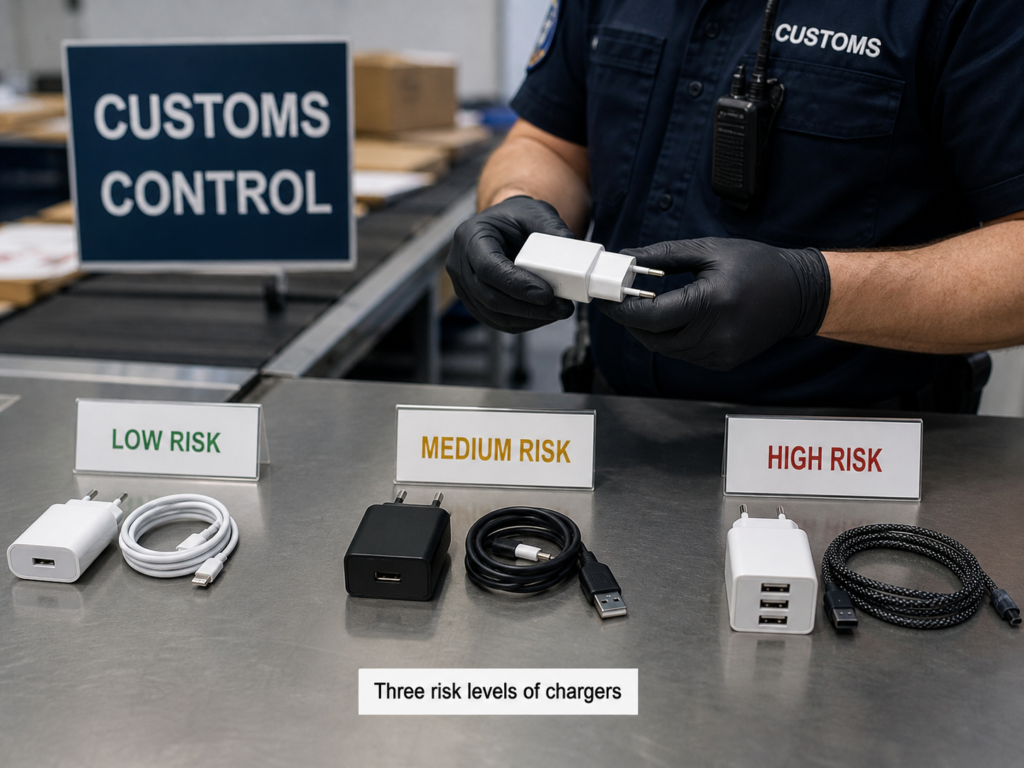
From practical experience, the probability of random inspection varies greatly for different charging products, which can be roughly divided into three risk levels (note that this is a summary of industry practice, not a unified official EU rule):
| Risk Level | Common Charging Products | Description |
| High Risk | Active chargers, power adapters | Live, with energy conversion, are the focus of customs random inspections |
| Medium Risk | High-power/fast-charging cables with active circuits, charging products with wireless functions | Have chips or wireless modules, involving EMC and other requirements |
| Low Risk | Ordinary passive non-circuit charging cables | Only passively transmit electricity; need to first determine whether they are within the mandatory CE scope |
Here we first correct two of the most common misconceptions: First, passing customs does not mean permanent compliance. Even if the previous batch of goods was released smoothly, the next batch or entry through a different port may be subject to random inspection. Second, if the product is revised, the supplier is changed, or key components (such as the power chip in the charger) are replaced, CE compliance must be re-evaluated, and previous documents cannot be directly used.
First, Clarify: The Division of Roles for CE Compliance
Many people run into trouble because they don’t figure out who has the final say on CE compliance, and what customs, market surveillance, manufacturers, importers, and EU authorized representatives are each responsible for. Only by clarifying the boundaries of roles can you know who to turn to and who is responsible when something goes wrong.
First, there are two core official roles: customs and market surveillance authorities. Customs is equivalent to the “first checkpoint” for entry, only conducting risk screening and intercepting obviously non-compliant goods. If they are unsure, they will refer the matter to the market surveillance department. The market surveillance authority is the final arbiter of CE compliance, responsible for determining whether a product is compliant or not; post-market random inspections, recalls, and fines are all within their scope of authority. Simply put: Customs does not conduct a comprehensive CE compliance review; the core enforcement power lies with the market surveillance department.
As for several market roles closely related to sellers, the responsibility boundaries must be clearly understood:
• The manufacturer is the primary responsible party for CE compliance, responsible for the product’s compliance assessment, signing the EU Declaration of Conformity (DoC), and retaining the full set of technical documents.
• The EU authorized representative (commonly referred to as EU AR) is an entity designated in writing by the manufacturer to perform compliance obligations on its behalf within the EU. It can sign the DoC on behalf of the manufacturer, provided there is formal authorization from the manufacturer.
• The importer’s responsibility is to verify the product’s compliance documents, ensure that the labeling meets requirements, and cooperate with regulatory investigations. Usually, the DoC is signed by the manufacturer or an EU authorized representative within the scope of authorization; importers generally do not sign the DoC in their capacity as ordinary importers. However, if the importer places the product on the market under its own name or trademark, or makes modifications to the product that affect compliance, it may be regarded as the manufacturer and assume manufacturer responsibilities including drafting and signing the DoC.
• Fulfillment service providers such as overseas warehouses and FBA, if they only provide warehousing and logistics services, usually do not automatically become manufacturers or importers as a result; however, when they meet the provisions of relevant regulations and there are no other responsible economic operators such as manufacturers, importers, or EU authorized representatives within the EU, they may assume corresponding obligations as responsible economic operators, and it cannot be generally assumed that they bear no compliance responsibility at all.
Here are two common pitfalls to remind you of: First, EU authorized representatives are not mandatory for all products. Whether you need to find an EU AR depends on the applicable regulations of the product and the way it is placed on the market; don’t spend money randomly right away. Second, for products imported from outside the EU, the packaging is usually mandatorily required to be marked with the importer’s information, so don’t miss this.
What Exactly Does Customs Check When Inspecting CE?
Now that we’ve clarified who conducts the inspection and who is responsible, the next thing everyone is most concerned about must be: What exactly does customs check when inspecting CE?
Core Document: EU Declaration of Conformity (DoC)
Many people think that CE is a “certificate” issued by the EU official, but this is completely not the case — for the vast majority of charging products, CE is a manufacturer’s self-declaration. The DoC is the written document of this self-declaration, equivalent to a letter of commitment signed by the manufacturer stating that “my product meets all relevant EU regulatory requirements.”
There are strict requirements for the signatory of the DoC: it is usually signed by the manufacturer or an EU authorized representative with written authorization from the manufacturer. A qualified DoC must include the following content: the scope of products covered, applicable EU regulations, the full name and address of the signatory, and the date of signing.
Many people ask: Can products of the same series share a single DoC? Yes, but the premise is that all covered models, power ratings, and key structures must be clearly written out. You cannot randomly share a DoC just because the appearance and brand are the same. For example, for two 20W chargers, one using a chip from Solution A and the other using a chip from Solution B, they cannot randomly share the same DoC.
Supporting Documents: Technical Documents and Test Reports
In addition to the DoC, there are two types of supporting documents: technical documents and test reports. Technical documents are the “full background” of a product, including design materials, a list of key components, risk assessment reports, etc., and are the basis for DoC compliance. Test reports are reports issued by third-party laboratories, such as tests for electrical safety, electromagnetic compatibility, and hazardous substances. These reports are only used to prove that the declarations in the DoC are well-founded, and cannot replace the DoC.
The competent authority may require the provision of DoC, technical documents, test reports, product photos, or other supporting materials. The specific materials required, the order of submission, and whether electronic or paper versions are accepted depend on the case situation, applicable product regulations, and the requirements of the competent authority.
Labeling and Instruction Manual Verification
In addition to documents, customs will also directly check the labeling on the product and packaging. First is the CE mark itself, which is required to be clearly visible, easy to read, and not easy to peel off. In principle, it must be printed on the product body; if it cannot be marked on the product body due to the nature, size, or technical conditions of the product, it can be marked on the packaging, accompanying documents, or other permitted locations in accordance with applicable regulations, and the small size of the product alone cannot be used as a natural reason.
The information to be marked varies for different products. Generally, there must be information about the manufacturer or importer, and the product model; for chargers, the rated input, output, and other necessary parameters required for safe use should be marked in accordance with applicable regulations and relevant standards. The specific items and marking methods shall be subject to the applicable product regulations, harmonized standards, and requirements of the target member state. Note here: It is not necessary to mark all relevant entities (manufacturer, importer, EU authorized representative); just follow the applicable regulatory requirements.
Another easily overlooked item is the product instruction manual. The manual must include safe use instructions and compliance-related prompts, and the language must meet the official language requirements of the member state where you place the product on the market. For example, if sold in France, there must be French instructions; if sold in Spain, there must be Spanish instructions. This is not a unified requirement, but depends on specific regulations and the provisions of the corresponding member state.
Regarding CE documents and labeling, there are three most common pitfalls to keep in mind: First, CE is not a certification certificate issued by the EU official, but a mark of the manufacturer’s self-declaration; the vast majority of charging products do not require official certification. Second, having a CE mark on the product does not mean it will definitely pass customs; the labeling must meet requirements, documents must be complete, and the product itself must truly meet the requirements. Third, test reports are only supporting materials and cannot replace the DoC; don’t use a test report as CE.
How to Judge the CE Regulatory Boundary of Charging Products?
Many friends who sell charging cables are most torn: Does my cable need CE? Some say yes, some say no. In fact, the core is to clarify the regulatory boundary of CE; not all charging-related products are within the mandatory CE scope.
CE Regulations That May Apply to Charging Products
First, let’s sort out the CE-related regulations that may apply to charging products. All of them apply conditionally, not all of them are relevant to every product:
• Low Voltage Directive (2014/35/EU): Covers electrical products with a voltage of 50-1000V AC and 75-1500V DC. For example, ordinary wall chargers fall within this scope.
• Electromagnetic Compatibility (EMC) Directive (2014/30/EU): Covers devices that generate electromagnetic interference. For example, chargers and data cables with active circuits must meet this requirement.
• RoHS Directive (2011/65/EU): Covers the restriction of hazardous substances in electrical and electronic equipment. This is linked to the CE mark and is part of CE compliance.
• Radio Equipment Directive (2014/53/EU, referred to as RED): Applies to devices with radio transmission and/or reception functions used for wireless communication or wireless determination. Charging products with Bluetooth, Wi-Fi, NFC and other functions usually need to be evaluated for RED; whether a simple wireless power supply function falls under RED needs to be judged in combination with its radio transmission or reception nature and specific product design, and all wireless chargers cannot be uniformly included or excluded.
Also note: WEEE (Waste Electrical and Electronic Equipment), REACH (Registration, Evaluation, Authorization and Restriction of Chemicals), ecodesign, etc., belong to other compliance obligations and do not directly correspond to the CE mark; don’t confuse them with CE.
Four-Step Judgment Method for CE Compliance of Charging Cables
As for the most concerned question of whether charging cables need CE, you can use these four steps to judge, just check step by step:
1. Check whether the product has active electronic circuits, such as fast charging protocol chips, E-marker chips, signal conversion circuits, etc. If yes, it is active; if not, it is passive.
2. Check whether it is placed on the market as an independent electrical and electronic equipment, that is, whether it is packaged separately, sold separately, and has an independent product model.
3. Check whether it falls within the scope of application of EU harmonized regulations, for example, whether it falls within the scope of the above-mentioned Low Voltage, EMC, RoHS directives.
4. Check whether it is only a passive connection component, that is, it has no active functions other than transmitting current and signals.
The final conclusion is: Whether a charging cable needs CE should first be determined by whether it falls within the scope of electrical and electronic equipment under applicable harmonized regulations such as RoHS, and then whether other regulations such as EMC and RED also apply. The presence or absence of active circuits is only a factor in judging the applicability of certain regulations, not a necessary condition for all CE obligations. Passive cables usually do not apply to the corresponding requirements under the Low Voltage Directive or EMC Directive, but it cannot be directly concluded that they do not need CE; cables within the scope of RoHS usually still need to complete RoHS compliance and affix the CE mark.
Common Product Judgment Cases
It may still be a bit abstract, so let’s give three common examples:
• An external 20W USB-C charger sold independently definitely falls within the mandatory CE scope, and must meet the requirements of the three directives: Low Voltage, EMC, and RoHS.
• An ordinary passive USB-A to C charging cable, without any chips inside, just a few wires, usually does not require corresponding evaluation under the Low Voltage Directive or EMC Directive; but as a cable, it usually falls within the scope of RoHS, and RoHS compliance should be completed according to the specific use, rated voltage, and product attributes, so it cannot be generally said that it does not need CE.
• A 100W USB-C fast charging cable with an E-marker chip, sold independently, cannot be generalized; it needs to be judged in combination with its circuit functions and whether it meets the scope of applicable regulations.
Here we correct three common misconceptions: First, not all charging cables have the same CE judgment, and ordinary passive charging cables cannot be directly deemed as not needing CE; a comprehensive judgment must be made based on whether the product falls within the scope of applicable regulations such as RoHS. Second, not all charging cables with chips necessarily need CE; it also depends on the sales method and the scope of applicable regulations. Third, certifications from other countries, such as UKCA, UL, FCC, etc., cannot replace CE, and can at most be used as a reference for compliance.
CE Regulatory Rules for Several Special Scenarios
In addition to regular commercial bulk goods, there are several special scenarios where many people are confused about whether CE is needed. Let’s talk about them one by one.
Sample and Gift Scenarios
If they are commercial samples, free gifts with goods, or free trial packs, as long as they enter the EU market for circulation, they cannot be exempted from CE compliance obligations. Don’t think that just because they are given away, you don’t need to worry about them. But if they are samples for exhibition display or R&D testing, which are not put into use or sold, exemption or simplified labeling requirements may apply, depending on the specific scenario.
Set Sales Scenarios
For example, for a set of a charger plus a charging cable, in this case, there is no need to make separate CE documents for each component, but your DoC and technical documents must cover the final configuration of the entire set. If the components in the set can be sold separately and fall under different regulatory scopes, then they must meet the corresponding compliance requirements respectively. For example, the charger in the set must also meet CE requirements when sold separately, and the cable, if it is active, must also meet CE requirements when sold separately.
Small Parcels for Personal Use
Whether CE-related obligations apply to personal non-commercial import for own use cannot be judged solely by the number of parcels or the value of the goods, but must also be confirmed in combination with specific product regulations, import purposes, and customs procedures. If the goods are actually used for sales, commercial supply, or other commercial activities, usually CE compliance must be completed in accordance with applicable product regulations.
But note: Regardless of whether it is a commercial import or not, customs may still check personal parcels for safety risks and whether the declaration is true. Excessive quantity, obviously belonging to a batch of similar goods, may also be a factor in judging its actual use.
Here are two pitfalls to avoid: First, personal small parcels and low-value parcels may also be inspected; you cannot take quantity, value, or “personal use” declaration as a natural exemption. Second, set products cannot randomly share a set of CE documents; the documents must cover the complete configuration and all regulated components.
What Situations Are Likely to Trigger Customs CE Inspection?
Since customs conducts random inspections, what situations are likely to be selected? Understanding these risk factors can help you avoid them in advance and reduce the probability of goods being detained.
First of all, it should be noted that the EU does not have a unified CE random inspection ratio. The enforcement intensity varies greatly among different member states and different ports. Whether it is express delivery, small parcels, air freight, or sea freight, it may be selected. From practical experience, high-risk live electrical categories, such as chargers, have a higher priority for random inspection.
The most likely trigger for inspection is problematic declaration information. For example, the product name is vague: obviously it is a charger, but you declare it as “electronic accessories”, “gifts”, or “samples of no commercial value”, which is obviously problematic at a glance. Another example is that the value and quantity obviously do not fall within the scope of personal use or samples; for example, a parcel containing 50 charging cables claimed to be for personal use is unbelievable to anyone. There are also cases where the declared parameters do not match the conventional characteristics of the product, such as an ordinary charging cable claiming to be 100W without compliance support. In addition, if the HS code, brand, and model are different from the actual goods, it is also easy to be inspected.
The second category is risk warning type. For example, if your product is already on the EU’s safety notification or high-risk recall list, it may increase attention in risk assessment and may lead to stricter inspection or follow-up supervision. Another example is that the consignor, consignee, or supplier has previous records of CE violations or goods detention, which may also become a factor in risk analysis. In addition, for large batches of goods from new brands or new suppliers imported for the first time, the probability of being selected is also higher in practice.
Friends who do cross-border e-commerce should also note that bulk goods in FBA and overseas warehouses are the key targets of random inspections in practice; in addition, if there are multiple small parcels of the same type, obviously for commercial sale, they are also easily judged as commercial imports and trigger inspections.
Of course, it should also be made clear that not all goods from new brands or shipped to overseas warehouses will definitely be inspected. These are just common risk factors. Whether to inspect, the scope and frequency of inspection, are ultimately determined by the competent authorities of the relevant member states based on specific risk information.
The Complete Process of Customs CE Inspection
If you are really selected, how will customs inspect? Understanding the process will prevent you from panicking. Generally speaking, customs CE inspection can be understood from the following four aspects:
Step 1: Verify basic declaration information. They will compare the product name, model, quantity, and value on the invoice, packing list, and transport documents to confirm whether the information of economic operators such as the importer is complete, and at the same time make a preliminary judgment on whether your product falls within the mandatory CE jurisdiction.
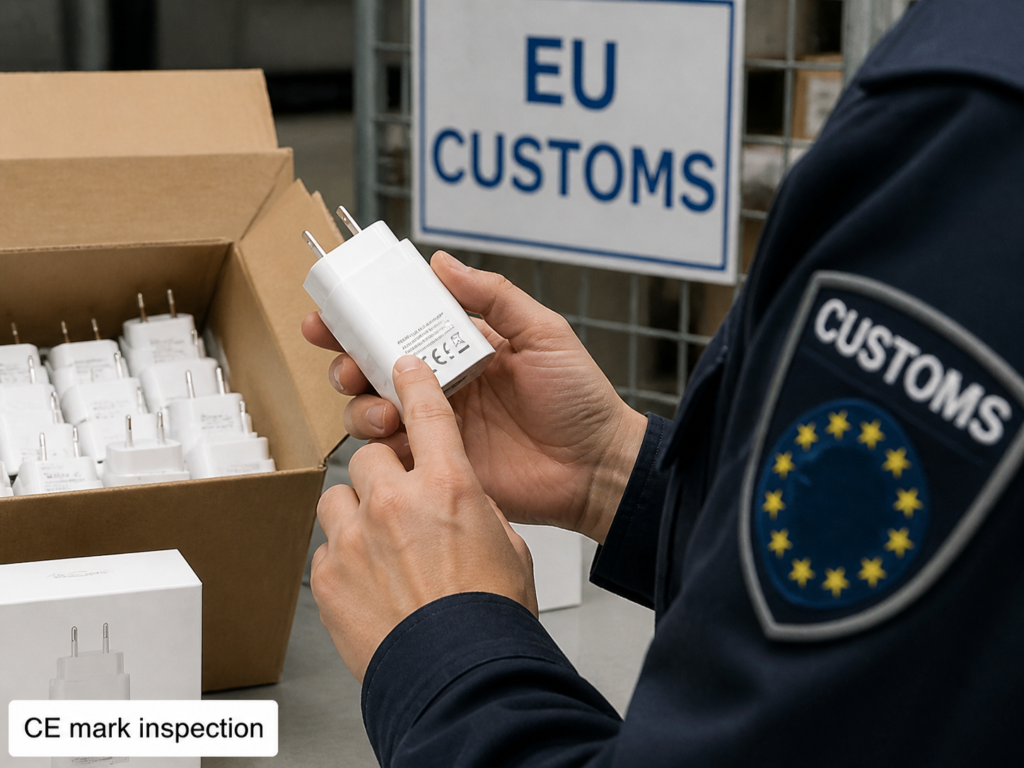
Step 2: Check the labeling of the product and packaging. They will check whether the CE mark meets the requirements of being clear and durable. For charging products, they will also focus on checking whether the rated input, output, and other necessary parameters of the charger are consistent with the declaration, and check whether there are obvious safety hazards in the plug, interface, and cable.
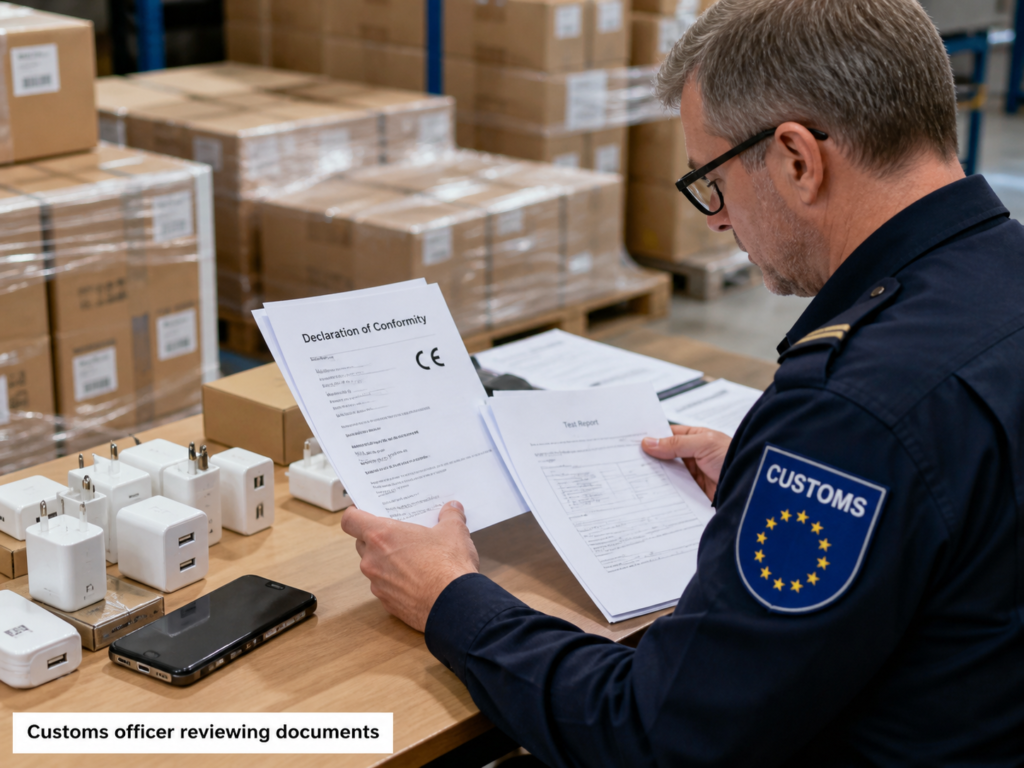
Step 3: Request compliance documents as needed. The competent authority may require the provision of DoC, product instruction manuals, information of the importer or authorized representative, or may directly require test reports, technical documents, product photos, product traceability certificates, or other materials. The specific materials, submission order, and electronic or paper form depend on the case, applicable regulations, and the requirements of the competent authority. The DoC shall be signed by an authorized entity; EU regulations usually do not take the corporate seal as a unified effective requirement.
Step 4: Conduct consistency check and risk determination. The core logic is: all documents, labels, and declaration information must match in terms of model, power, parameters, brand, manufacturer, and batch, and cannot contradict each other. Those with no problems will be released directly; those with doubts will have their release suspended, and you will be asked to supplement materials before re-examination; those with obvious violations will be directly transferred to the market surveillance department for handling.
A reminder here: Don’t think that having an electronic version of the DoC is everything. Whether electronic versions are accepted and whether paper materials need to be provided shall be subject to the requirements of the competent authority; the corporate seal is also not a unified effective requirement for the DoC under EU regulations.
Consequences of Failed Inspection and Emergency Handling
In case the inspection fails, what will be the consequences? How to deal with it? First of all, it depends on the severity of the violation.
If it is a minor violation, such as unclear CE mark, missing target country language in the manual, incomplete DoC information, and common ones in charging products include non-standard parameter labeling of charging cables and missing responsible party information on chargers, usually you will be given a time limit to correct the materials or re-label, and after the correction is qualified, the goods can be released — of course, this is not absolute, it depends on the handling of the specific port.
If it is a serious violation, such as no CE mark at all, forged DoC, or the product itself does not meet safety requirements, the most common serious problem in charging products is that the charger has no safety compliance documents, or products that do not originally fall within the CE scope are randomly affixed with the CE mark. The consequences are serious: goods may be detained, returned, or forcibly destroyed. After being transferred to the market surveillance department, administrative penalties may also be imposed. The specific amount of the fine varies among different member states, different natures of violations, and different levels of safety risks, and there is no unified standard.
In addition to direct penalties, there will be many chain effects: for example, additional storage fees, return shipping fees, and destruction fees will be incurred; safety notifications, recall records, or previous violations may increase attention in subsequent risk assessments, leading to stricter inspections or follow-up supervision, but it cannot be concluded that the inspection rate of each subsequent batch of goods will definitely increase significantly; it may also trigger removal from e-commerce platforms, and even follow-up accountability by market surveillance authorities.
If you really receive an inspection notice, don’t panic, follow these four steps to handle it:
1. First verify the core information of the notice: which department issued it, what documents are required, what is the deadline, and which batch of goods it corresponds to. Don’t get the wrong target.
2. Organize the corresponding materials by model, including DoC, label photos, instruction manuals, and test reports. Be sure to ensure that the information on all materials is consistent and there are no contradictions.
3. The importer, EU authorized representative, or manufacturer shall respond with a unified statement. Don’t just find someone to verbally say “we have CE”; a formal written response is useful.
4. If materials are missing, supplement them as soon as possible; if they really cannot be supplemented, evaluate the plan for rectification or return of goods. Don’t delay, otherwise storage fees will accumulate more and more.
Finally, there is a red line that must never be touched: It is strictly forbidden to forge or misappropriate compliance documents. You cannot forge or backdate DoC or test reports, nor can you misappropriate documents from other models, other brands, or other suppliers. Once fraud is discovered, the penalty will be much more severe, and you will be subject to long-term key supervision, which is not worth the loss.
CE Compliance Preparation Checklist Before Customs Clearance
In fact, the best response is to prepare in advance to minimize risks. Here we have compiled a CE compliance preparation checklist before customs clearance, just follow the steps.
Step 1: First confirm the CE regulatory attribute of the product. In accordance with the boundary judgment method we mentioned earlier, first figure out whether your product needs CE; if it is a set product, confirm the compliance requirements of the final placement configuration, and if the components inside are sold separately, check them separately. When purchasing, be sure to verify the DoC and test reports provided by the supplier. Don’t believe false promises such as “guaranteed CE pass” or “guaranteed release”; no one can give you a 100% guarantee.
Step 2: Standardize the labeling of products and packaging. The CE mark must be marked in accordance with regulatory requirements. In principle, it should be placed on the product body first; if it cannot be marked on the body due to the nature, size, or technical conditions of the product, it can be placed on the packaging, accompanying documents, or other permitted locations in accordance with applicable regulations; mark the full name and address of the manufacturer, importer, or authorized representative in accordance with applicable regulations; chargers must be clearly marked with rated input, output, and other necessary parameters and safety warnings required for safe use in accordance with applicable regulations and relevant standards; product model and batch information must be traceable.
Step 3: Prepare and retain compliance documents. Prepare a DoC with the corresponding model and correct coverage, and ensure that the signatory is compliant; the test report must cover the actual shipped power and configuration, and products with different circuits or structures cannot share the same report; if there is an EU authorized representative, retain compliance certificates such as the EU AR agreement, importer information, and technical document summary; all documents should be stored by model and batch, don’t mix them up.
Step 4: Standardize customs clearance declaration. The declared product name, model, and parameters must be completely consistent with the actual goods and the DoC. Vague declaration is prohibited; the information on the invoice and packing list must be true and accurate, do not undervalue the goods or falsely report the purpose.
Step 5: Establish a product compliance traceability mechanism. Record the DoC, test report version, and supplier information corresponding to each batch; if the product is revised, the supplier is changed, or key components are replaced, re-evaluate compliance and update the corresponding documents; also regularly pay attention to updates to EU regulations to ensure that your documents are always valid.
Finally, two common pitfalls in the preparation phase are reminded: First, it is not enough for CE documents to only be in English; user-facing instruction manuals must meet the official language requirements of the member state where the product is placed on the market. Second, not all documents must be accompanied by the full text along with the goods; it depends on the requirements of the competent authority. You can consult your customs clearance agent in advance. It is recommended to save the electronic versions of all documents so that they can be retrieved at any time.
Quick Check of Common Questions and Capability Summary
Finally, we have compiled the most frequently asked questions here for quick reference:
1. **Does EU customs check CE for every shipment?** No, it only verifies during risk screening, random inspections, or when there are doubts about the goods, and there is no unified random inspection ratio.
2. **Can the DoC replace the CE certificate?** There is no such thing as an “official EU CE certificate”. The DoC is the core declaration document for CE compliance, and third-party test reports are only supporting materials.
3. **Must test reports accompany the goods?** Not necessarily. The competent authority may require DoC, technical documents, test reports, or other supporting materials, depending on the case, applicable regulations, and port requirements.
4. **Do ordinary charging cables need CE?** Ordinary passive charging cables without any circuits usually do not apply to the corresponding requirements under the Low Voltage Directive or EMC Directive, but as cables, they usually fall within the scope of RoHS. It cannot be directly concluded that they do not need CE; the specific judgment should be based on product attributes and applicable regulations.
5. **Can personal use parcels be exempted from CE?** A unified judgment cannot be made solely based on reasonable quantity or non-commercial use; it must be confirmed in combination with specific product regulations, import purposes, and customs procedures; if actually used for sales, commercial supply, or other commercial activities, usually they should meet applicable CE-related requirements.
6. **What to do if inspected without CE documents?** First verify the requirements of the notice, sort out the available compliance materials as soon as possible, try to supplement the missing ones. If they really cannot be supplemented, evaluate the rectification or return plan in time, and absolutely do not commit fraud.
After reading this content, you should be able to do these three things: First, be able to judge whether your charging products fall within the CE regulatory scope and whether the risk of being randomly inspected by customs is high; second, be able to prepare the CE labels and documents required for customs inspection in accordance with requirements, reducing the risk of goods detention and delay; third, be able to avoid common CE compliance misunderstandings, and when you really receive an inspection notice, you can handle it in the correct steps.
CE compliance is not a one-time thing, nor is it a threshold where “everything is fine once you pass customs”. It is a requirement that runs through the entire sales cycle of the product. Only by making sufficient preparations in advance can you avoid fewer pitfalls.