
Many cross-border e-commerce sellers who have a batch of chargers and USB-C charging cables that have passed UL testing and are selling well in North America often have their first question when expanding to the EU market: UL also tests safety, right? CE is also the EU’s safety access requirement, so can I use the UL report directly as CE compliance? To save on testing fees and time?
First, let’s give a clear core conclusion: UL test reports **cannot alone replace the full set of CE compliance requirements**, nor can they be used directly to affix the CE mark for sale in the EU; for charging products such as USB cables and chargers, it is usually necessary to supplement and verify the applicable EU requirements and documentation; however, if the product itself, test standards, and test conditions match, part of the safety data in the UL report can be reused, and the specific amount of reusable content must be determined through a gap assessment.
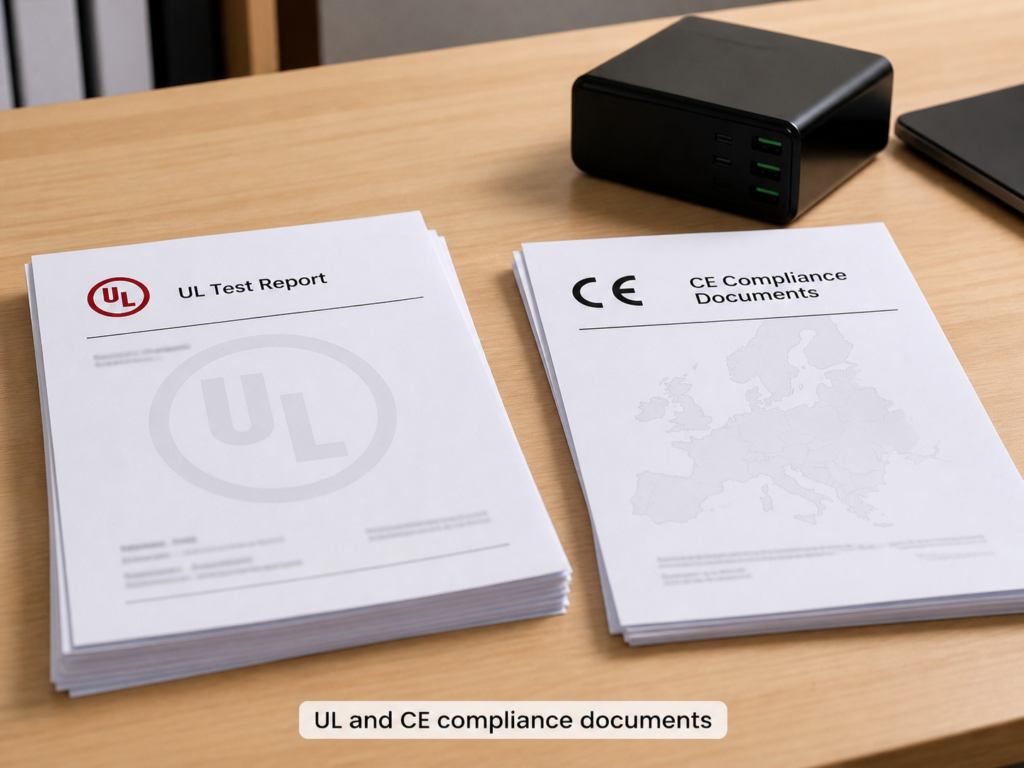
Next, we will first clarify a few basic concepts, then break down why they cannot be used directly, how to maximize the use of existing UL reports to save costs, and the specific operation steps.
What Exactly is CE Compliance? It’s More Than Just a Certificate
To understand why UL cannot be directly converted to CE, you must first understand the system composition of CE compliance — it has never been a single certificate. We have organized 5 types of core CE-related documents into a table for quick distinction:
| Document Type | What it is / Who issues it | Function |
| UL Test Report | Test results issued by a third-party laboratory | Proves that the product has passed tests corresponding to North American standards; it is only one of the compliance evidences |
| CE Mark | A visual mark affixed under the responsibility of the manufacturer | Indicates that the product declares compliance with all applicable EU harmonized regulations; it is not a “certification sticker” |
| Declaration of Conformity (DoC) | A document signed by the manufacturer or its authorized representative | Formally declares product compliance; it is the core document of CE compliance |
| Technical Construction File (TCF) | A full set of compliance materials compiled by the manufacturer | Evidence base supporting the DoC; must be provided when regulatory authorities conduct spot checks |
| Notified Body (NB) Documents | Documents issued by a third-party body officially recognized by the EU | Only required for high-risk products; generally not needed for ordinary charging products |
After reading the table, you will find that UL test reports are essentially just one type of “test evidence”, not even a core document of CE compliance, so naturally they cannot be a direct replacement.
How Do CE Regulations Apply to Charging Products?
Not all charging products require the same test items; we can match them according to the following logic:
First, **environmental protection, chemical, and producer responsibility obligations** must be separately verified. For products that fall within the corresponding EEE scope and have no exclusions, RoHS and WEEE obligations need to be assessed; REACH obligations must be judged based on specific circumstances such as substances in the product, SVHCs, and restricted substances. These matters cannot simply all be treated as CE test items:
• RoHS: Restricts hazardous substances in products. RoHS is usually an applicable harmonized regulation that needs to be included in CE conformity assessment; manufacturers need to prepare evidence of materials, supply chains, and technical documents, and conduct targeted verification when necessary;
• REACH: Chemical regulation, the focus may include information transmission of Substances of Very High Concern (SVHC) and restricted substance requirements; specific obligations depend on the product and supply chain situation;
• WEEE: E-waste recycling requirements. When applicable, it usually involves producer registration, recycling responsibilities, and recycling marks in each member state; it is not a test item corresponding to the CE mark itself.
Then there are **regulations and technical requirements differentiated by product type**:
• Ordinary chargers and power adapters: For products whose rated voltage falls within the scope of the LVD, it is usually necessary to assess safety (LVD) and electromagnetic compatibility (EMC); for ErP, specific regulations must be checked based on whether the product is an applicable external power supply, standby/off power consumption, or other ecodesign product categories;
• USB-C charging cables/data cables: Whether LVD and EMC apply must be judged based on the rated voltage, whether they contain active electronic circuits, whether they constitute independent equipment, and the specific scope of regulations. Ordinary 5V passive cables usually do not fall under the LVD, and usually do not require complete EMC testing as independent equipment; RoHS applicability still needs to be confirmed according to the EEE product scope;
• USB-C cables with E-marker: E-marker only indicates that the cable contains an electronic marking chip, which is not equivalent to an active cable, nor can it be concluded solely based on this that EMC is necessarily applicable;
• Active USB-C cables with signal conditioning, amplification, retiming, or conversion circuits: Safety, EMC, and other regulatory requirements should be further evaluated based on rated voltage, electronic circuits, independent equipment attributes, and product functions;
• Wireless chargers without communication functions: LVD, EMC, applicable ecodesign requirements, and whether there is a radio transmission function should be evaluated separately;
• Charging products with communication functions such as Bluetooth and Wi-Fi: Usually need to additionally meet the requirements of the RED Directive.
A special reminder here: The EU’s unified USB-C charging requirement that many people are concerned about only applies to chargers for specific categories of regulated radio equipment, not all USB-C chargers are mandatory. It must be judged in combination with the product category and sales time, do not apply it blindly.
Reuse Value of UL Reports: What Content Can Be Carried Over?
Although they cannot be used directly, UL reports are not waste paper. Their reuse value can be divided into three levels, with the degree of acceptance from high to low:
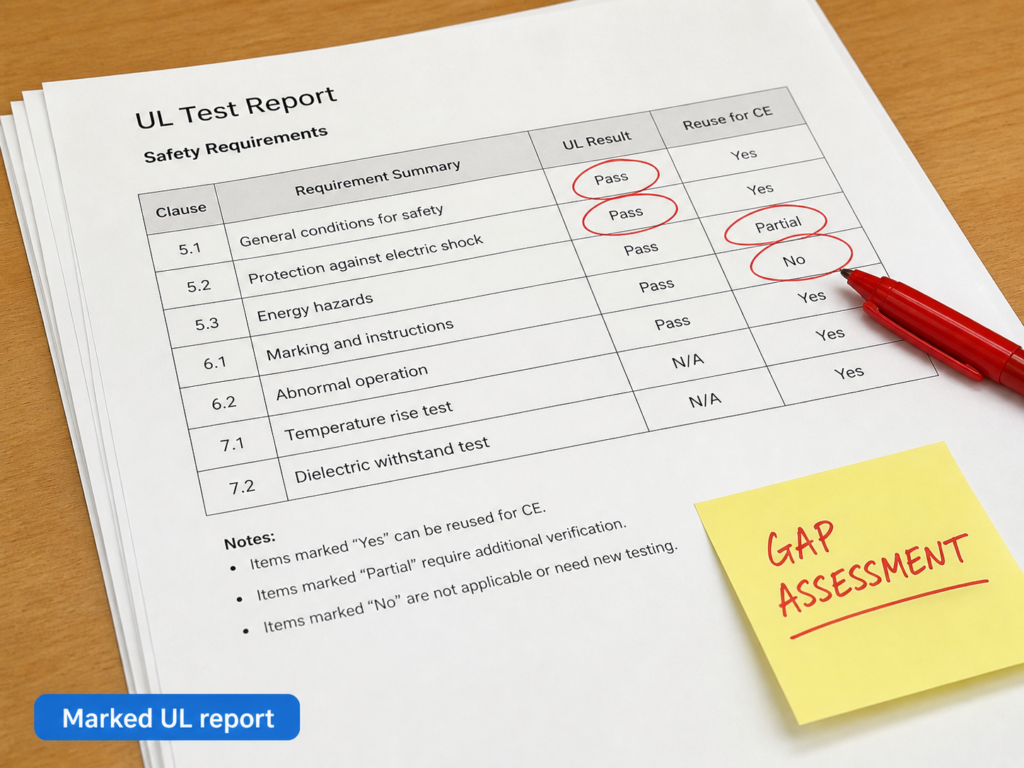
1. **Materials that can be directly used as design inputs**: For example, structural materials such as circuit diagrams, PCB layout drawings, bill of materials (BOM), and key component specifications, which are required for compliance in any market, can be completely reused directly.
2. **Safety test data that can be used as supporting evidence**: For example, temperature rise test, withstand voltage test, insulation resistance, flame retardant test, safety distance, etc. If the standards and test conditions match, these data can be used as safety evidence for the CE technical file, and repeated testing may not be required.
3. **Content that needs to be verified or supplemented item by item**: For example, the rated input range of EU products, plug or power cord configuration, operating modes, abnormal conditions, EMC, RoHS material evidence, applicable energy efficiency requirements, etc. Only items not covered by the existing report require supplementary testing or additional conformity evidence. It is not possible to uniformly judge that retesting is necessary just because the report name is UL, or only looking at a single 230V/50Hz test point.
3 Necessary Judgment Conditions for Test Data Reuse
Not all safety data from UL reports can be reused; at least three aspects must be focused on for verification:
• **Product consistency**: The product model, specifications, and core materials of the product applying for CE must be consistent with the UL test samples. After replacing core components such as power boards, interface chips, and conductor materials, the original conclusion cannot be directly applied;
• **Standard matching**: Whether the standard used for UL testing is close to the version of the EN standard applicable to CE, and whether there are significant differences in core clauses, need to be verified item by item, not just looking at the first half of the standard number;
• **Credibility of test evidence**: The technical capability of the laboratory, report completeness, accreditation scope, and the matching of samples and standards must be verified. ISO/IEC 17025 accreditation can improve the credibility of test evidence, but it is usually not an absolute legal prerequisite for reusing existing test data for ordinary CE self-declaration products. It should also be particularly emphasized: ISO/IEC 17025 is not equivalent to having CE notified body qualification, let alone that the report is automatically recognized by EU regulators.
Core Variables Affecting the Reuse Ratio
The specific amount of reusable content mainly depends on four factors: the more product modifications, the lower the reuse ratio; the more test items covered by the UL report, such as EMC or material verification content that matches EU requirements, the higher the reuse rate may be; the smaller the difference between UL and EN standards, the higher the reuse rate; the clearer the laboratory capability, report content, and accreditation scope, the higher the possibility that the data will be adopted.
Key Judgment Points for Charging Products by Category
The evaluation focus of different charging products is different. We have sorted out three categories of the most common products, so you can match them to your situation:
USB-C Charging Cables/Data Cables
First distinguish between ordinary passive cables, electronic marking cables with E-marker, and active cables with circuits such as signal conditioning and conversion. For ordinary 5V passive cables, the focus is on verifying structure, flame retardant test data, applicable RoHS materials, and multilingual labels; usually LVD does not apply, and there is no need for complete EMC testing as independent equipment.
For cables with E-marker, it is necessary to verify whether the USB-C interface specifications, current capacity, and E-marker parameters are consistent with product promotion and labeling, but the E-marker itself is not equivalent to an active cable. For active cables with signal conditioning, amplification, retiming, or conversion circuits, applicable safety, EMC, and other regulatory requirements must also be evaluated based on rated voltage, electronic circuits, independent equipment attributes, and actual functions.
Chargers/Power Adapters
The focus is on verifying the matching degree of safety standards, whether the rated input range covers the usage conditions of the EU market, and whether the plug or power cord configuration meets the requirements; the most common missing items are EMC testing, RoHS material compliance evidence, and applicable ErP ecodesign requirements. If it is a multi-port fast charger, it is also necessary to confirm whether the UL report covers tests of all output modes and all ports working simultaneously. Reminder again: The unified USB-C charging requirement only applies to specific categories of chargers, and must be confirmed in combination with product category and sales time.
Wireless Chargers and Charging Products with Communication Functions
For wireless chargers without communication functions, first confirm whether there is a radio transmission function; those without radio transmission function will not automatically be subject to the RED just because of the name “wireless charging”, but still need to evaluate LVD, EMC, and applicable ecodesign requirements separately.
Products with radio transmission or reception functions such as Bluetooth and Wi-Fi usually need to evaluate radio, spectrum use, EMC, and applicable human health or exposure requirements according to the RED. As for whether a notified body (NB) is required to participate, it must be determined according to Article 17 of the RED, the coverage of the adopted harmonized standards, and the conformity assessment module, and cannot be judged solely because the product has wireless functions.
Practical Steps: How to Complete CE Compliance More Efficiently with a UL Report
If you already have a UL report and want to complete CE compliance efficiently, you can follow these six steps to avoid detours:
Step 1: Organize Existing Materials
Organize the original UL test report, product BOM, circuit diagram, specification sheet, and laboratory capability or accreditation materials. At the same time, clearly mark the target EU countries, product model/version, modification records, and functional configuration, which can save a lot of time in subsequent assessments.
Step 2: Entrust a Professional Institution to Conduct a Gap Assessment
The selected institution must meet three conditions: familiar with charging products, have corresponding testing capabilities, and truly understand EU regulations. The assessment output must include a clear list of missing items, corresponding regulatory basis, quotation, and timeline. A pitfall to avoid here: There is no mechanism in the market to “directly convert” UL reports to CE. Be cautious of anyone who says they can do a direct conversion without supplementary testing or materials. CE compliance must have clear applicable regulations, missing items, and evidence basis; “direct conversion” is impossible.
Step 3: Supplement Missing Tests and Materials
Prioritize supplementing test-related missing items: such as EMC, safety difference items, RED (if applicable), ErP (if applicable); other obligations should also be verified simultaneously: such as RoHS material and supply chain evidence, REACH SVHC information, and WEEE registration and labeling when applicable.
Step 4: Build an Evidence Matrix and Compile the Technical File
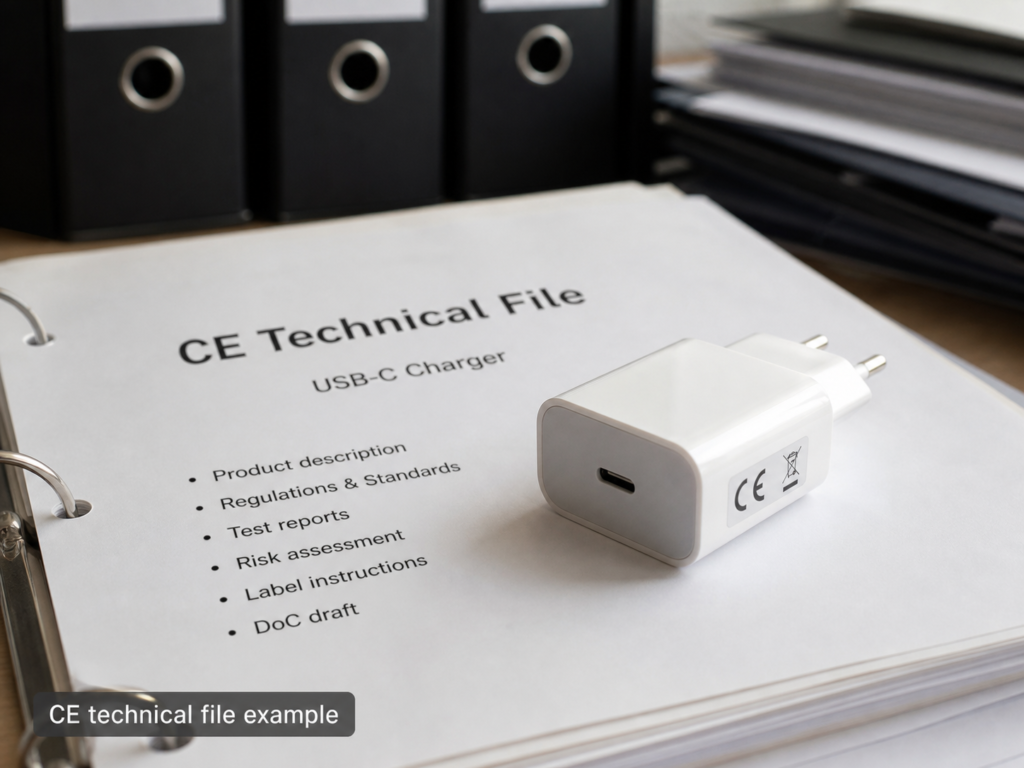
Simply put, it is to match each applicable regulation with corresponding evidence, such as adopted standards, corresponding test reports, component certificates, material declarations, etc., forming an evidence matrix one by one. The technical file usually includes product description, list of regulations and standards, test reports, risk assessment, label instructions, DoC draft, etc. It must be retained for at least 10 years after the product is placed on the EU market, and the specific duration depends on applicable regulations.
Step 5: Sign the Declaration of Conformity (DoC)
The EU DoC is in principle signed by the manufacturer or its authorized representative. Importers are responsible for fulfilling their compliance verification and document retention obligations; only when they place products on the market under their own name or trademark, or substantially modify products and thus become the manufacturer in the regulatory sense, do they assume manufacturer responsibility and sign the corresponding declaration. Ordinary charging products can usually complete the conformity assessment on their own, without needing to find a notified body to issue a certificate.
Step 6: Standardize Labeling and Go to Market
The height of the CE mark must not be less than 5mm, and it must be clear and not easy to wear; the model, rated parameters, manufacturer, and necessary importer information must be marked on the product according to specific applicable regulations. Only when the size or nature of the product does not allow it can it be transferred to the packaging or accompanying documents in the manner permitted by regulations. The WEEE mark is used when applicable; do not add non-existent general RoHS compliance marks, RoHS conformity is mainly proven through technical files and the DoC. The manual must include safety instructions and usage guidelines in the official language of the country of sale, and cannot only be in English.
Common Misconceptions to Avoid
Finally, we sort out a few of the most common pitfalls to help you avoid unnecessary losses:
1. **Misconception: UL reports issued by ISO 17025 accredited laboratories are directly valid for CE**. Correction: ISO/IEC 17025 helps prove the testing capability of the laboratory, but it is still necessary to verify product consistency, standard version, national differences, test scope, and report completeness. Only data that meets the requirements can be reused.
2. **Misconception: All CE compliance must be certified by a notified body**. Correction: Most ordinary charging products only require self-declaration, no NB certification is needed; whether products with wireless functions require NB participation must also be determined according to the applicable harmonized standards and conformity assessment procedures of the RED.
3. **Misconception: UL reports are equivalent to CB reports and have the same cross-market versatility**. Correction: CB reports are based on the IECEE international mutual recognition system, and their conversion recognition is higher than that of ordinary UL reports, but they still cannot be used directly as CE, and differences still need to be supplemented; if the UL report includes CB test results and certificates, the reuse rate will be higher.
4. **Misconception: After replacing the EU plug or changing the chip, the UL report can still be directly reused**. Correction: Plugs and interface chips are core materials, and changes will affect safety and EMC performance. The reuse ratio must be re-evaluated, and supplementary testing should be done if necessary.
5. **Misconception: All USB-C cables require EMC testing**. Correction: First, distinguish between ordinary passive cables, electronic marking cables with E-marker, and active cables with signal conditioning or conversion circuits. Ordinary 5V passive cables usually do not require complete EMC testing as independent equipment; E-marker is not equivalent to an active cable, nor does it alone determine whether complete EMC testing is necessary.
6. **Misconception: RoHS, REACH, and WEEE are all CE test items**. Correction: RoHS usually needs to be included in the applicable CE conformity assessment, requires material and supply chain evidence, and targeted verification when necessary; REACH must be judged based on SVHC, restricted substances, and supply chain information obligations; WEEE mainly involves producer registration, recycling marks, and waste responsibility, it is not a full product test, don’t be tricked into spending extra money.
Summary
Overall, regarding the relationship between UL reports and CE, you only need to remember three core judgments:
First, UL reports cannot directly replace the full set of CE compliance documents, but some eligible data can be used as supporting evidence for the technical file;
Second, to evaluate the reuse ratio of UL reports, use the six-step gap assessment method, combined with product type, standard matching degree, test conditions, product consistency, and report credibility to estimate, no need to guess blindly;
Third, when actually advancing CE compliance, follow the process of “organizing materials → gap assessment → supplementary testing and materials → building evidence matrix → signing declaration → standardizing labeling”, and proceed steadily to avoid major pitfalls.