
Ever since the UK’s Brexit, whether ordinary consumers who buy chargers via cross-border online shopping, or small cross-border sellers selling charging cables and chargers, have almost all been confused by the question “can the CE mark still be used”: some say it needs to be replaced with UKCA, some say the rules for Northern Ireland are different, and others say it is illegal for individuals to use chargers with the CE mark in the UK. Today we will clarify this matter thoroughly, sorting out everything from the most basic terms to practical judgment methods, so you don’t have to look up conflicting information everywhere.
Let me state this upfront: this content only covers the most commonly used ordinary consumer-grade charging products: charging cables for mobile phones and tablets, USB/USB-C data cables, wall chargers, and power adapters. Special charging equipment for medical devices, industrial equipment, and in-vehicle use are not within the scope of discussion, as their rules vary greatly. Whether you are an ordinary consumer buying for personal use, a small cross-border seller, or an importer, the content of this article is sufficient.
Core Conclusions for Readers in a Hurry
The outcomes for different scenarios can be explained in three sentences, and the logic and details behind them will be discussed later:
• Great Britain (England, Scotland, Wales, hereinafter referred to as GB): For ordinary charging products that are included in the recognition scope and meet relevant EU requirements, the CE mark can continue to be used; products that meet UK requirements can also use the UKCA mark, and the two marks can be placed side by side when necessary;
• Northern Ireland (hereinafter referred to as NI): The CE mark has always been the main access mark and is valid throughout the process;
• Charging products purchased or imported by individuals for their own use usually do not fall under the scenario of enterprises placing products on the market, but there is no general product mark exemption determined by a fixed quantity or customs duty-free quota.
Before going into details, let’s clarify the three most easily confused marks in plain language, so as not to get more confused when reading the rules later:
• **CE mark**: It is not a “quality certification” issued by an official institution, but a “declaration of conformity” affixed by the manufacturer itself, meaning “our product meets the relevant mandatory requirements of the EU”. It is a conformity mark for entering applicable EU markets.
• **UKCA mark**: A domestic conformity mark launched for the GB region after the UK’s Brexit, with a status similar to the CE mark, and it is a mark in the UK’s domestic product conformity system.
• **UKNI mark**: An auxiliary mark specifically used in specific scenarios in Northern Ireland, which must be affixed together with the CE mark. Ordinary charging products usually do not need it, so you just need to have a general impression of it.
Why Does the UK Have Two Sets of Access Rules?
Many people will ask: Isn’t it all the UK? Why are there two sets of rules? This starts with the Brexit arrangements.
Before Brexit, the entire UK was part of the EU single market, with rules basically consistent with the EU, and the CE mark was used throughout the UK. After Brexit, in order to avoid a “hard border” on the island of Ireland (that is, the establishment of regular border checks between Northern Ireland and the Republic of Ireland), the UK and the EU made arrangements through the and the subsequent : Northern Ireland continues to apply EU single market rules to some goods. This does not mean that Northern Ireland as a whole remains in the EU single market, nor does it mean that no customs or regulatory procedures are required for the movement of goods at all.
The Great Britain (GB) region left the EU single market, so the UK government launched its own UKCA mark as a domestic conformity mark. Originally, the CE recognition transition period in GB was scheduled to end in 2022, but as enterprises reported that the cost of changing marks was too high, the policy was continuously adjusted. On August 1, 2023, the UK government announced that it would indefinitely recognize the CE mark for products included in the recognition scope and meeting relevant EU requirements. Whether ordinary charging products are applicable still needs to be confirmed in combination with specific product regulations and lists.
Let’s correct one of the most common misunderstandings first: many people think that the mark requirements are uniform across the UK, but in fact, GB and Northern Ireland have two independent sets of rules. This is the basis for all judgments; remember this and you won’t get confused later.
To let everyone understand the mark requirements of the three regions at a glance, I have compiled a simple comparison table:
| Market of Placement | Usable Mark Combinations | Remarks |
| Great Britain (GB) | CE can be used when conditions are met, and UKCA can also be used; they can be placed side by side when necessary | Whether CE is applicable must be confirmed item by item according to product category and regulations |
| Northern Ireland (NI) | CE is the main mark; CE + UKNI in special cases | Products with only the UKCA mark cannot meet the Northern Ireland market requirements based on UKCA alone |
| EU Member States | CE | Neither UKCA nor UKNI can replace CE |
Detailed Explanation of Whether CE Can Be Used by Region
Great Britain (GB): CE Can Continue to Be Used, But Depends on Products and Conditions
Currently, GB recognizes the CE mark that meets relevant EU requirements for many products, and also allows products that meet UK requirements to use the UKCA mark. There is no general rule that the two marks must be chosen one or the other and cannot appear at the same time; when necessary, products can use both CE and UKCA side by side.
For charging products, most wall chargers and power adapters usually need to be checked for requirements such as electrical safety, electromagnetic compatibility (EMC), and RoHS. However, which specific regulations apply depends on the rated voltage, function, and product definition of the product. Ordinary USB cables usually mainly involve RoHS; whether low-voltage safety, EMC, or other regulations apply depends on their rated voltage, whether they contain active electronic circuits, and the specific design.
Of course, there are exceptions. For special products such as industrial high-power charging equipment and chargers dedicated to medical devices, you need to check the official list and specific regulations on the UK government’s official website separately, and you cannot directly apply the rules for ordinary consumer-grade charging products. The recognition scope and conditions may also be adjusted, and the final shall be subject to the current announcement of the UK government.
Northern Ireland (NI): CE Is the Mainstream Access Mark
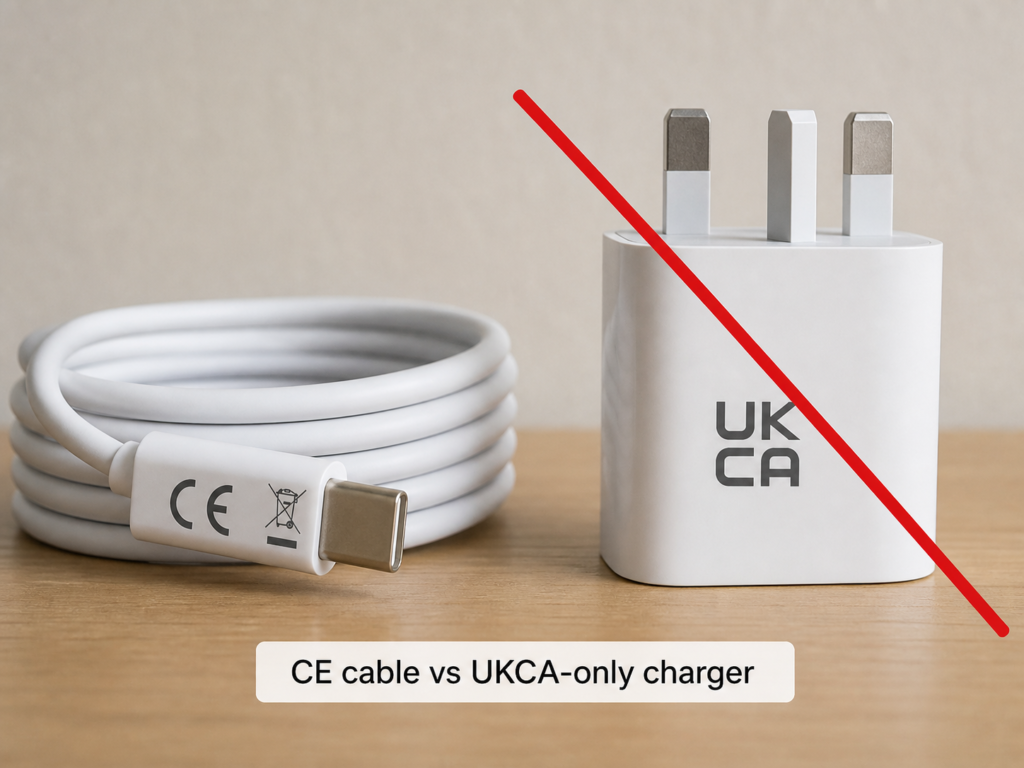
The rules for Northern Ireland are actually easier to understand. Because Northern Ireland continues to apply some EU single market rules to relevant goods, the CE mark is the main access mark.
UKNI may only need to be affixed in specific third-party conformity assessment scenarios: if the applicable EU regulations require third-party conformity assessment, and the conformity assessment is carried out by a UK-accredited notified body, it is usually necessary to use UKNI together with CE; if it is carried out by an EU notified body, CE is sufficient. Not all UK institutions are notified bodies, and not all third-party testing or certification will trigger the UKNI requirement.
Most ordinary charging products can be self-declared by manufacturers in accordance with applicable regulations, so UKNI is usually not needed. However, the specific situation depends on the product category and applicable regulations.
A special red line must be drawn here: products with only the UKCA mark cannot meet the access requirements of the Northern Ireland market based on UKCA alone, and sellers must not fall into this pit.
Personal Use Scenario: The Focus Is Not on Fixed Quantity
This is what ordinary consumers care about most. If you only buy or import a few chargers and cables for your own use, it usually does not fall under the scenario of an enterprise placing products on the market, so it is generally not judged according to the CE or UKCA obligations of enterprises selling products.
But this is not a unified exemption set by “small quantity”, nor can the duty-free quota for personal items of UK customs be used to judge whether products can fail to comply with mark rules. As long as the product is sold, supplied, or imported as part of a business activity, compliance obligations shall be fulfilled in accordance with applicable product regulations. Even for personal use, you should still pay attention to the quality and safety risks of the charger and cable themselves.
Core Conditions for CE Compliance of Charging Products
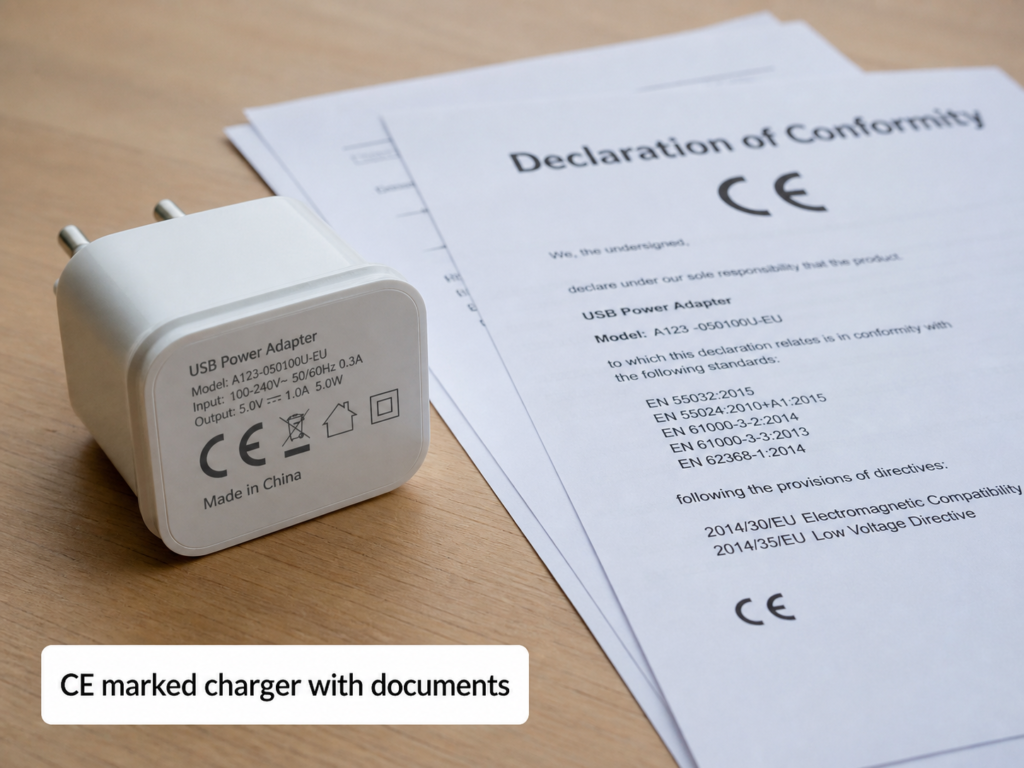
Speaking of this, some people may ask: does it mean that as long as the CE mark is printed on the product, it is compliant? Of course not, CE compliance is not just about printing a logo.
First is the requirement for affixing the mark: the CE mark should be preferentially affixed to the product or nameplate in a clear, visible, legible, and indelible manner. Only when the nature of the product does not allow or cannot achieve this, can the mark be placed on the packaging, label, or accompanying documents in accordance with specific regulations. It cannot be simply assumed that hard-shell products must have the mark on the body, nor that cables only with hang tags are necessarily compliant.
Then there are supporting documents: usually there must be a declaration of conformity, complete technical documentation, risk assessment, and other compliance evidence. Test reports are one of the common pieces of evidence, but not all products must have independent third-party test reports; what specific materials are required shall be determined according to applicable regulations and conformity assessment procedures. The product model, power, and version in the documents should also correspond to the actually sold products; mismatched ones are not valid.
Different charging products have different compliance focuses:
• Ordinary USB/USB-C cables usually focus on checking requirements such as RoHS; only when they reach the relevant voltage range or have other regulated functions, do they need to further check low-voltage safety, EMC, or other regulations. Cables containing active chips should also be checked for EMC and other requirements according to their electronic functions;
• Chargers and power adapters usually need to focus on checking requirements such as electrical safety, electromagnetic compatibility, and RoHS. If wireless charging products also have wireless communication or intentional radio transmission functions, they need to further check the relevant requirements for radio equipment;
• If you sell chargers and cables packaged as a set, you should assess whether the charger, cable, and the set as a whole respectively meet the applicable requirements. If components are placed on the market separately, they usually need to have corresponding compliance respectively; if placed as a fixed set, the combined product shall be assessed in accordance with applicable regulations, and relevant components and the overall configuration shall be covered in the technical documentation and declaration of conformity.
In addition to the requirements of CE itself, there are additional rules for selling to the UK: whether sold online or offline, applicable mark, documentation, and supply chain requirements shall be met. When selling in GB, information on economic operators such as manufacturers, importers, or UK responsible persons shall be marked in accordance with specific product regulations. The subject, content, location of the information, and whether it can be placed on packaging or accompanying documents shall be confirmed according to applicable regulations and the current guidance of the UK government, and cannot be generalized.
If selling to Northern Ireland, it is necessary to comply with applicable EU economic operator and information requirements; documents can usually be in English, but language requirements cannot replace other compliance obligations.
Three-Step Method to Judge Whether CE Can Be Used in Your Situation
After talking about so many rules, some people may still feel confused. I have compiled a three-step judgment method for everyone. Follow it and you can figure it out quickly without rote memorization.
Step 1: Confirm the Region Where the Product Is Finally Placed or Supplied
Is it GB, Northern Ireland, or the EU? Special attention should be paid here: the judgment standard is the market location where the product is finally placed, not where your company is registered, nor where it is shipped from. For example, if your company is registered in London, but the goods are sold to customers in Belfast, Northern Ireland, then you must follow the rules of Northern Ireland.
If an individual purchases or imports for their own use, it usually does not fall under the scenario of an enterprise placing products on the market, but product safety should still be paid attention to; if it is for sale, supply, or commercial import, the personal use scenario cannot be directly applied.
Step 2: Check Whether the Product Is Within the Recognition Scope
Ordinary civilian charging cables and chargers may belong to common product categories for which GB recognizes CE, but conclusions cannot be drawn solely based on the product name. For special charging products for industrial, medical, in-vehicle use, or with particularly high power, you need to check the regulation list additionally.
Here is a quick judgment tip for everyone: products for ordinary household use, powered by wall sockets, or using standard USB interfaces usually belong to more common regulated product categories, but this can only help judge the product category, and cannot prove that the product has met safety, EMC, RoHS, radio, or other requirements. In the end, actual compliance evidence must still be verified based on specific design, rated parameters, and functions.
Step 3: Check Whether the CE Is Truly Compliant
Just look at three points: first, whether there is a corresponding declaration of conformity, technical documentation, and other compliance evidence; second, whether the model, power, and version in the documents are consistent with the actual product; third, whether the mark is affixed in a standardized manner, and whether it is blurred, forged, or obscured.
Here is a money-saving tip for small sellers: if you operate in both the EU and GB markets, and your products are within the scope of GB’s CE recognition, CE compliance materials that meet EU requirements can usually be used as the basis for GB compliance. But this is not the so-called “one set of certifications” that automatically works everywhere; you still need to separately check the UK’s economic operator information, labeling, document retention, and supply chain obligations; special products cannot be directly applied either.
What about inventory that already has CE? Let me also clarify: in the GB region, compliant inventory that has already entered the UK can usually continue to be sold on the premise of meeting current requirements; products that have not been shipped yet can also enter the market according to regulations if they fall within the scope of GB’s CE recognition and meet relevant conditions. Inventory with CE in Northern Ireland can usually continue to be sold according to applicable rules, but it should still be confirmed that the documents and products actually meet the requirements.
Common Misconceptions and Pitfall Avoidance Guide
Finally, let’s sort out the most common pitfalls, divided into two parts for ordinary consumers and small sellers, so you don’t step into them without knowing.
5 Most Common Misconceptions for Ordinary Consumers
1. **CE is completely invalid in the UK after Brexit —** Wrong. GB continues to recognize CE for many eligible products, and Northern Ireland also continues to take CE as the main access mark;
2. **CE is an official quality certification, representing good product quality —** Incorrect. CE mainly indicates that the manufacturer declares that the product meets applicable mandatory requirements, and does not represent a performance level. For example, two compliant chargers, one charges fast and the other charges slowly, this is normal;
3. **UKCA must be used throughout the UK —** Wrong. Northern Ireland mainly uses CE, and GB also continues to recognize CE for eligible products, not all products must be replaced with UKCA;
4. **Charging cables are trivial items, no need to pay attention to compliance —** Inaccurate. Sold charging cables may be subject to electrical and electronic product regulations such as RoHS, and cables containing active electronic components may also involve EMC and other requirements; applicable regulations and corresponding mark obligations shall be confirmed according to specific models and functions;
5. **It is illegal for individuals to use chargers with CE marks in the UK —** This cannot be generalized. Items purchased or imported by individuals for their own use usually do not fall under the scenario of enterprises placing products on the market; but sale, supply, or commercial import must still comply with applicable regulations, and individual users should also pay attention to the safety risks of the product itself.
4 Common Pitfalls for Small Sellers
1. **Affixing only UKCA on Northern Ireland orders —** This not only fails to meet the CE access requirements applicable to Northern Ireland, but may also waste the compliance cost of UKCA. CE should usually be used in Northern Ireland, and CE + UKNI is only required in conformity assessment scenarios involving specific UK notified bodies;
2. **Using fake CE reports to cope with platform audits —** Don’t take chances. If found out, you may face consequences such as product removal, account suspension, and goods detention, which is not worth the loss;
3. **Failing to update CE documents after product revision (chip change, power change, shell change) —** In this case, the original assessment and documents may not cover the revised product, and it may be deemed unqualified during spot checks;
4. **Thinking that having CE means you can enter GB —** You also need to confirm whether the specific product falls within the scope of GB’s CE recognition, and fulfill applicable UK economic operator, labeling, documentation, and supply chain obligations; you cannot just look at one mark.
There are several easily confused mark boundaries, let’s emphasize again: UKCA cannot replace CE to enter the EU market; UKNI cannot be used alone and must be affixed together with CE; not all CE marks have a number after them. When a notified body is required to participate, the four-digit number after the CE mark is the identification number of the relevant notified body, not fabricated by the manufacturer; products self-declared by manufacturers usually do not have this four-digit number.
Final Summary
After reading this article, you can completely judge and make decisions on these matters by yourself, no need to ask people everywhere.
Ordinary consumers only need to understand three things: first, for charging products with CE marks sold or purchased in GB or Northern Ireland, the key is that the product truly meets applicable regulations, the CE mark is used correctly, and meets the economic operator and information requirements of the corresponding market; just having the CE pattern printed does not prove the product is legal; second, when shopping in Northern Ireland, look for CE that meets the requirements, products with only UKCA cannot meet the Northern Ireland market requirements based on UKCA alone; third, products purchased or imported for one’s own use are usually not judged according to the mark obligations of enterprises placing products on the market, but there is no general exemption determined by a fixed quantity or customs duty-free quota.
Small sellers can also make three types of decisions by themselves: first, whether their charging products can use CE to enter the corresponding region of the UK, just follow the three-step method; second, when UKCA is needed and when CE can continue to be used — for ordinary products sold in both the EU and GB and within the scope of GB’s CE recognition, CE compliance materials can usually be used as the basis for GB compliance, but the specific obligations of the UK market still need to be supplemented and checked; third, to check whether CE is compliant, just look at three core points: whether there is a declaration, technical documentation, and compliance evidence, whether the model matches, and whether the mark and market information meet the requirements.
Of course, there are some special situations that you are unsure about, which require further verification: for example, charging equipment for special purposes such as industrial, medical, and in-vehicle use, as well as customs declaration and compliance requirements for large-volume imports. In these cases, it is recommended to check the latest policies on relevant official channels of the UK government and the EU, don’t guess blindly.