
Sellers of charging products expanding into the EU almost always ask the same question before their first stock-up: Can products without the CE mark be sold in the EU?
This question seems simple, but there are many pitfalls hidden behind it. Some people think small-batch self-fulfillment doesn’t need attention, some think just sticking a label is enough, and others have suffered heavy losses from detained goods and fines because they didn’t understand the rules.
Let’s state the core conclusion first to help you quickly build an understanding, then break down the details step by step.
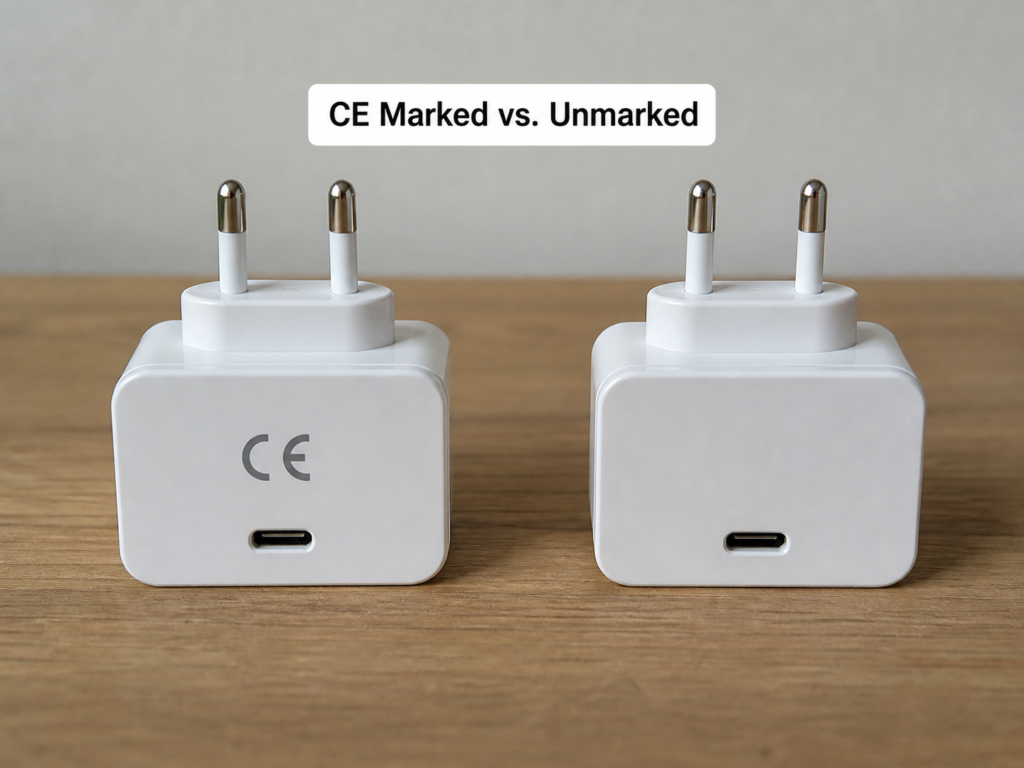
For charging products, the real criterion is not “whether it is a charging product”, but: **whether the product falls within the scope of one or more EU harmonized product regulations**. If it does, merchants must complete the conformity assessment required by the applicable regulations before placing the product on the EU market, and affix the CE mark as required.
Therefore, chargers, power adapters, devices with corresponding electronic functions, and products with radio functions usually require focused assessment of CE requirements; but ordinary passive cables, purely physical accessories, etc., cannot be directly determined to require CE solely based on the name “charging category”. For products that do not fall within the scope of CE regulations, the CE mark must not be affixed without authorization for the purpose of sales.
Sales scenarios also cannot simply bypass compliance requirements. When providing regulated products to EU customers through online, offline, B2B, overseas warehouses or FBA, it is usually necessary to comply with applicable EU product regulations. It should be noted that merely storing goods in overseas warehouses or FBA does not alone determine whether the product has been “placed on the market”; the key depends on whether the product has been first made available on the EU market, as well as the specific supply, import and fulfillment arrangements.
Here we must first clarify two most easily confused understandings: First, **not having the CE mark does not necessarily mean the product is completely non-compliant**; some products may not fall within the scope of CE, or the mark is just used incorrectly. Second, **having the CE mark does not necessarily mean it is legal**. If the product itself does not comply with applicable regulations, or there is no supporting conformity documentation, no matter how large the mark is, it may still be non-compliant.
Let’s clarify the applicable boundaries again: CE rules mainly apply to EU member states and relevant markets of the European Economic Area (EEA), including Norway, Iceland and Liechtenstein. The focus of judgment is whether the product falls under applicable EU harmonized regulations and whether it is first made available on the EU market. Imported products from outside the EU, even second-hand or refurbished products, may also trigger corresponding compliance responsibilities under certain circumstances.
The UK market needs to be checked separately. Great Britain of the UK continues to recognize the CE mark for many regulated products, but the specific product categories and policy periods are subject to the current regulations of the UK government, and cannot be generalized as all requiring UKCA. Different arrangements apply to Northern Ireland, which may involve CE or CE UKNI.
Finally, a heads-up in advance: there are indeed legal exceptions, and not all products without CE are banned from sale. But “small batch”, “shipping in the name of a private individual” or “self-fulfillment” themselves cannot circumvent compliance requirements. As long as regulated products are provided to the EU market, judgment should be made in accordance with the corresponding regulations.
Must-Know for Beginners: The Relationship Between CE and EU Market Access
To truly understand CE requirements and avoid pitfalls, we must start with the most basic concepts.
Many people think CE is a “quality certification certificate” issued by the EU, but it is not. In plain terms, the CE mark indicates that **the manufacturer declares that the product complies with the requirements of applicable EU harmonized regulations**. It is not a general “environmental compliance” mark, nor is it a general term for all product safety and environmental obligations.
Usually, the manufacturer, or the brand that places the product on the market under its own name or trademark, completes the necessary assessment and assumes responsibility, then uses the CE mark in accordance with regulations. Whether other obligations such as RoHS, WEEE, batteries, packaging and general product safety need to be fulfilled should be judged separately based on the product and specific regulations.
Why do many charging electronic products require CE? Because they usually fall within the scope of one or more EU harmonized regulations, but they still need to be judged item by item according to the specific product structure, input and output voltage, radio functions and other requirements.
The first is to prevent safety risks. Products such as chargers, power adapters, and power banks may directly come into contact with mains power, or store electrical energy internally. If improperly designed or manufactured, problems such as fire, electric leakage, and short circuit may occur, causing equipment damage and even personal injury.
The second is to prevent electromagnetic interference. Poor-quality chargers may interfere with the normal operation of nearby electronic devices, for example, causing noise in radios or affecting the stable operation of other devices. Relevant regulations usually require that equipment not cause unacceptable interference to other equipment, and at the same time have corresponding anti-interference capabilities.
The third is to unify market rules. The EU has multiple member states. If each country adopts completely different product access requirements, enterprises need to prepare multiple sets of plans for different countries. The CE system establishes a common market access framework through harmonized regulations, and only products that meet the requirements can circulate in the corresponding markets.
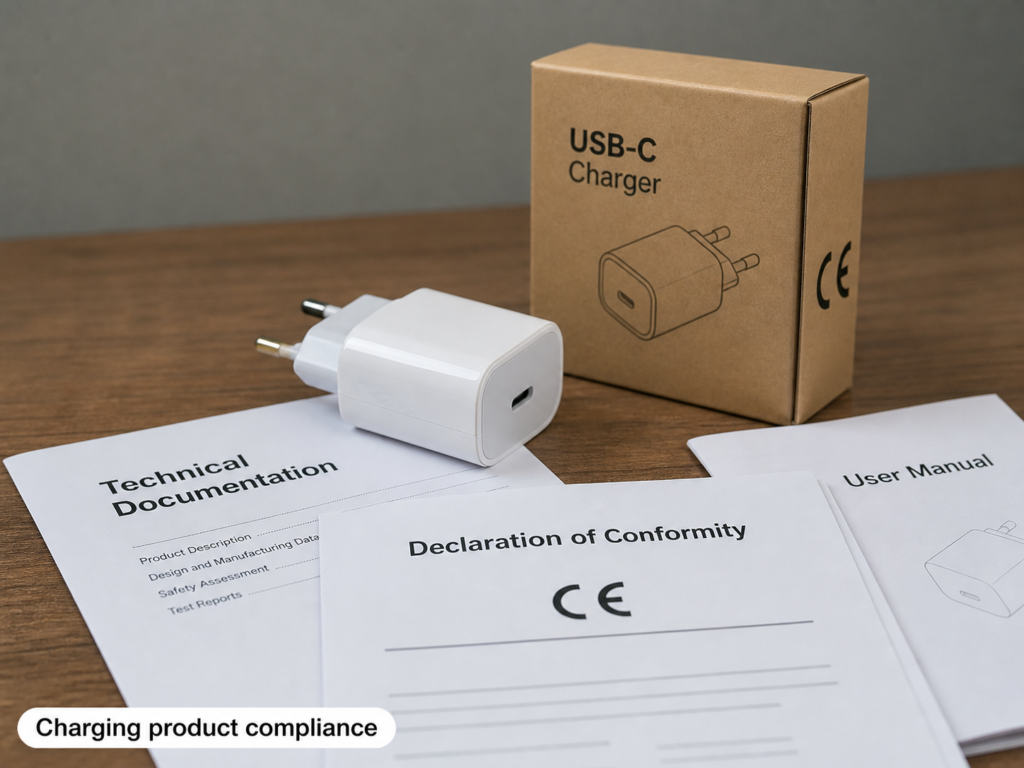
It must be remembered here: **CE compliance is not just about sticking a mark**. It is usually necessary to complete the conformity assessment, compile technical documentation, sign the declaration of conformity in accordance with applicable regulations, and affix the CE mark when required by regulations.
The specific content of technical documentation is determined by applicable regulations and conformity assessment procedures, and may include product design materials, risk analysis, applicable standards, material information, test or assessment records, etc. The law does not generally require that the technical documentation of all products must include test reports in a certain fixed format, nor does the declaration of conformity take “stamping” as a condition for validity.
Therefore, test reports may only form part of the technical documentation, and cannot be equated with CE compliance alone; a so-called “CE certificate” also cannot automatically replace the full compliance responsibility that the manufacturer should bear.
Exclusive for Charging Products: Quick Method to Judge CE Requirements
Now that you understand the basic concepts, what you care about most must be: Does the charging product I sell require CE at all?
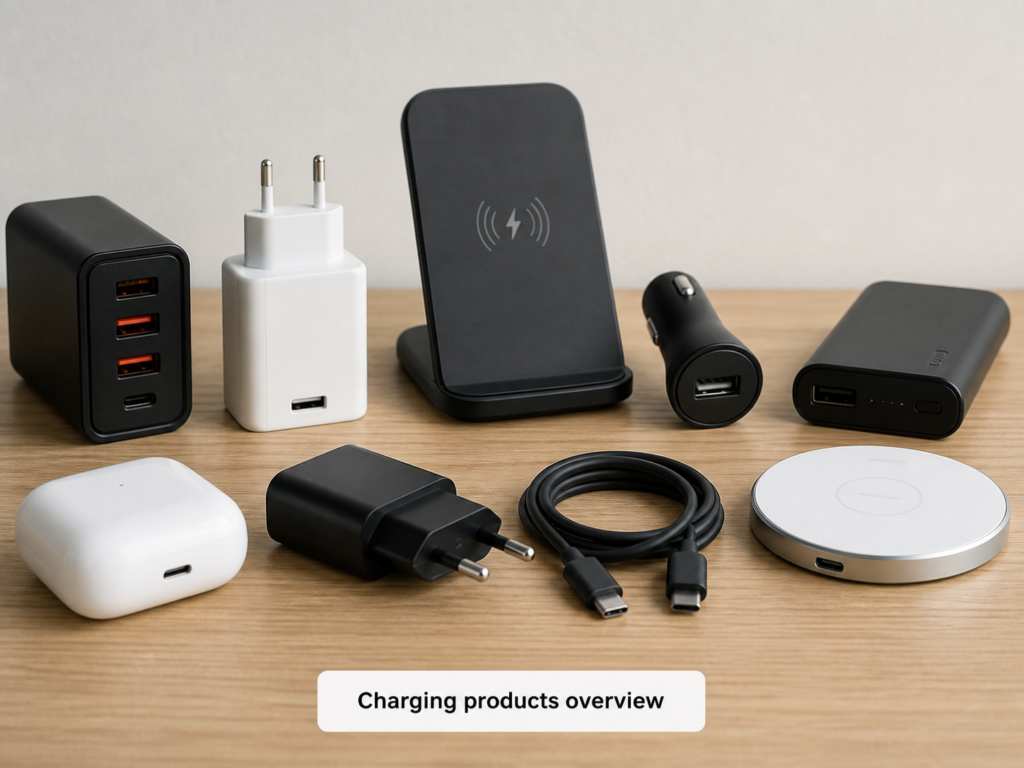
For preliminary judgment, don’t just look at whether the product has electronic components. A more reliable approach is: first confirm whether the product is an electrical, electronic or wireless device placed on the market independently, then check item by item the applicable EU harmonized regulations, product voltage range, radio functions and other mandatory requirements.
Electronic components can be used as a clue, but they cannot alone determine whether a product must have CE. Some electronic components are not end products placed on the market independently; conversely, some products without obvious electronic components may also be subject to other product regulations.
We have sorted out common charging-related product categories into a table for your preliminary judgment:
| Product Category | Is CE Required? | Supplementary Notes |
| Chargers/Power Adapters | Usually require CE | Independent mains chargers and adapters usually require assessment of low voltage, electromagnetic compatibility, RoHS and other requirements, which need to be confirmed by specific model |
| Charging/Data Cables | Need to be judged based on product attributes | Whether ordinary passive cables require CE should be judged based on product attributes, rated voltage and applicable regulations; cables with active circuits require further assessment |
| Wireless Chargers, Car Chargers, Power Banks | Usually require focused assessment | Products with Bluetooth, Wi-Fi, NFC or other radio transmission and reception functions usually also require assessment of the Radio Equipment Directive (RED); a simple wireless power supply function cannot be directly determined to be subject to RED solely based on the name “wireless charger”; power banks also need to check battery, transportation and other applicable regulations |
| Purely Physical Accessories (Storage Buckles, Ordinary Protective Cases) | Usually do not require CE | When there is no electronic circuit, they generally do not fall within the mandatory scope of CE, but may still be subject to general product safety, packaging or other rules |
If you encounter uncertain borderline cases, you can further judge from three dimensions.
The first is accessory attribute. If it is an independently sold accessory with a circuit, such as a separately sold replacement charging head or a data cable with an indicator light, it is necessary to further confirm whether it is an independent product under applicable regulations and whether it needs to be affixed with CE separately.
If the accessory is provided with the whole machine, whether it needs an independent CE mark cannot be concluded solely based on “not sold separately”. It should be judged based on the product attribute of the accessory, applicable regulations and the feasibility of marking. Even if regulations do not require the accessory to be affixed with CE separately, the whole machine manufacturer must include it in the compliance assessment and technical documentation of the whole machine.
The second is the voltage dimension, not the power dimension. The Low Voltage Directive (LVD) usually covers equipment with a rated input or output voltage in the range of 50 to 1000 volts alternating current, or 75 to 1500 volts direct current.
Products below this range are not subject to the LVD, but this does not mean that the product has no safety requirements, nor does it mean that electromagnetic compatibility requirements must apply or that CE must be required. It is also necessary to continue to check other potentially applicable requirements such as EMC, RoHS, batteries, and general product safety.
The third is the responsibility for customized/OEM products. If the brand places the product on the market under its own name or trademark, or makes substantive modifications to the product that affect compliance, it usually assumes manufacturer responsibility. At the same time, it is also necessary to check the statutory duties of importers, EU authorized representatives or other economic operators under specific regulations, and cannot fully rely on the OEM’s statement that “we have CE”.
Legal Exceptions: Situations Where Products Can Be Legally Sold Without CE
Of course, CE rules are not one-size-fits-all, and there are indeed some situations where products may not require the CE mark. But these situations must be judged based on the product scope, placement method and specific regulations.
The first category is that the product itself is not within the mandatory scope of CE. For example, the purely physical charging accessories mentioned earlier, such as storage buckles and ordinary silicone protective cases, which have no electronic components, usually do not require the CE mark.
But note: **not requiring CE does not mean there are no compliance requirements**. Such products may still need to comply with EU general product safety, packaging environmental protection and other rules, and cannot be interpreted as “nothing needs to be done without CE”.
The second category is products that are not already made available on the market, such as some R&D products for the manufacturer’s own use, or products that regulations allow to be displayed and tested under specific conditions. However, R&D or testing purposes do not automatically obtain CE exemption just by sticking a “not for sale” label.
The CE mark may not apply only when the product is indeed not placed on the market, is only used for the manufacturer’s own R&D, or falls under the display and testing situations explicitly permitted by applicable regulations. Labels alone cannot create exemptions, and the product must not be made available on the market or resold.
A small number of charging products carried into the EU for personal use, such as chargers or power banks carried by oneself when traveling to the EU, usually do not fall under the situation of commercial placement on the market. But if it is actually for sale, batch shipping or supply to customers, “in the name of a private individual” cannot be used as a reason for circumvention.
Second-hand products should also be carefully distinguished. Personal non-commercial transfer of second-hand products that have been legally placed on the EU market usually does not require re-assessment of first placement on the market due to re-transfer, but the original CE and safety requirements of the product cannot be ignored. When commercially selling, refurbishing, modifying or importing second-hand products from outside the EU, it is necessary to re-judge the responsibilities and applicable requirements.
The third category is certain special exemption situations. For example, relevant regulations may exclude equipment specially designed for military or national defense purposes. But military use is not a general CE exemption for all charging equipment. It cannot be concluded that the product is fully exempt from CE regulations just because the buyer is the military, or the product is used in military scenarios. It is also necessary to check whether the special purpose and exclusion conditions specified in specific regulations are met, and whether other regulations or member state rules still apply.
Exhibits that have not completed CE requirements can only be used for display under applicable conditions, but should be clearly marked as not for sale or put into use. If they are to be sold or put into use in the EU after the exhibition, the applicable conformity requirements must be completed first, and they do not have to be taken out of the EU uniformly.
There is a core criterion for judging whether it is truly an exception: **whether the product has been made available to the EU market, and whether relevant regulations explicitly allow this situation to be exempt from CE**. Reselling batch test samples as genuine products, or packaging chargers as “gifts” to be provided commercially with other goods, may still essentially constitute supplying regulated products to the market, and requirements cannot be circumvented by names.
Non-Compliance Risks: Consequences of Selling Charging Products Without CE
Some people may ask: What are the consequences if I take a chance and sell products without CE? The specific consequences depend on the product type, the circumstances of the violation, product risks and the law enforcement procedures of the country where it is located.
First is the risk in the customs clearance stage. If the imported products are regulated, customs or market supervision authorities may require the provision of true and complete compliance evidence. The goods may be suspended from release, and may subsequently face rectification, return or destruction, while incurring additional costs such as storage, return and disposal.
Overseas warehouses or FBA may also require merchants to provide compliance documents corresponding to the products during warehousing, fulfillment or platform review stages. But merely putting goods into the warehouse does not alone determine that the product has been placed on the market; whether it constitutes market supply should be judged in combination with actual transactions and fulfillment arrangements.
Then there are channel and platform risks. If you sell on third-party e-commerce platforms such as Amazon and AliExpress, the platform may require submission of CE-related documents according to its own rules, and take measures such as removing product listings, suspending sales, freezing funds or restricting account permissions. Distributors in offline channels may also refuse to accept relevant products.
If the competent authorities of member states find that the product has safety or compliance problems, it may also face measures such as sales ban, rectification, recall, administrative fines, and import restrictions. The specific amount and whether it involves criminal liability must be verified in accordance with the laws of the relevant member states, specific applicable regulations and the facts of the case. The EU does not have a unified “maximum fine of hundreds of thousands of euros” applicable to all CE violations.
Products with serious risks may be subject to measures such as removal from shelves, sales bans, and recalls by the competent authorities of member states, and notified to other member states through the Safety Gate system. Safety Gate is a rapid early warning and information exchange system for product safety, not a blacklist of enterprises; being notified does not necessarily automatically lead to a unified public recall across the EU. The specific measures and scope depend on the risk assessment and the decision of the competent authority.
If the product causes personal injury or property loss, the enterprise may also bear civil compensation liability. Whether it involves other legal liabilities depends on the specific case. Enterprises may be subject to sales bans, recalls, administrative penalties, import restrictions or platform disposal due to specific cases, but there is no unified “enterprise compliance blacklist” that automatically applies to the entire EU due to CE violations.
The level of risk cannot be simply judged by country or channel ranking. Products directly connected to mains power or containing batteries usually have higher safety risks, so they may become the focus of market supervision. Inspection arrangements vary across platforms, countries and periods, and it cannot be inferred that a certain channel or region can lower compliance requirements.
Practical Guide: Self-Inspection, Remedial Compliance and Pitfall Avoidance
Since compliance is so important, how should you conduct self-inspection before sales? If you have already found that the product does not have CE, how should you remedy it? You can check item by item according to the following process.
First is the 4-step self-inspection process before sales. It is recommended to go through it for each product before listing:
Step 1: Confirm whether the product falls within the scope of one or more EU harmonized regulations that require CE. It should be judged based on the product’s use, structure, input and output voltage, radio functions, and whether it is placed on the market as an independent product. Don’t just look at the product name.
Step 2: Check compliance materials: whether there is an EU Declaration of Conformity (DoC) corresponding to the product model, whether there is technical documentation compiled in accordance with applicable regulations, and whether RoHS compliance evidence has been included in the applicable EU Declaration of Conformity and technical documentation. Relevant evidence can include supply chain material information, analysis and testing, etc. Do not regard a so-called RoHS certificate as a sufficient condition for CE compliance.
Step 3: Check product marking. The CE mark should be clear and durable, with size and proportion conforming to specifications. It is also necessary to check information such as the name and address of the manufacturer, importer and, if necessary, the EU responsible economic operator in accordance with applicable regulations. The responsible entity may be an importer, authorized representative or fulfillment service provider. It cannot be uniformly written as authorized representative, nor can it be assumed that all information must be marked on the product body in the same form.
Step 4: Check consistency. The product model, parameters, brand and design should be consistent with the compliance documents and the description on the sales page. After changing the model, power, circuit design or key materials, you cannot take it for granted to continue using the old documents.
If you find that the product does not have CE, don’t panic. Just remedy it according to different situations.
If the goods have not been shipped yet, the safest approach is to first confirm the applicable regulations, complete the necessary conformity assessment, sort out the technical documentation, sign the EU Declaration of Conformity, and use the CE mark as required, then provide the product to the EU market.
If the goods have been suspended from release by customs, you should submit true and complete compliance evidence as required by customs and market supervision authorities and wait for the decision. There is no unified guarantee of release; if the product is substantially non-compliant, supplementary documents cannot replace rectification, and the goods may still need rectification, return or destruction.
If the product is already being sold on the platform, you must immediately remove it from the shelf, check the applicable regulations and complete the compliance qualifications. After confirming that the product and documents are consistent and meet the requirements, then re-list it. Do not continue to sell with a fluke mind.
In the process of CE compliance, there are several common pitfalls that must be avoided:
First, don’t buy fake CE certificates. Ordinary chargers subject to LVD, EMC and RoHS can usually adopt manufacturer’s internal production control, without the participation of a Notified Body (NB). Whether an NB is required must be confirmed according to specific regulations, product categories and conformity assessment modules. Third-party certificates of unknown origin cannot replace manufacturer responsibility, nor can they automatically prove product compliance.
Second, don’t just stick the mark without preparing documents. The CE mark is only the external manifestation of compliance. Regulatory verification also includes the declaration of conformity, technical documentation and the conformity of the product itself. Having only the mark without evidence may still be deemed non-compliant.
Third, don’t mix compliance documents. If the product has changed its model, power, circuit design or key components, you must re-assess compliance and cannot directly use the old documents. Even if the appearance looks similar, you must confirm whether the technical and regulatory scope is still consistent.
Fourth, when doing business in the UK market, note that Great Britain continues to recognize the CE mark for many regulated products, but the specific product categories and policy periods need to be checked against the current regulations of the UK government. Different rules apply to Northern Ireland, which may involve CE or CE UKNI. Do not confuse the rules of different regions of the UK.
Clarification of Common Misconceptions
Finally, we have sorted out 5 of the most common misconceptions to help you correct all the understandings you may have gotten wrong before.
**Misconception 1: Small batches, dropshipping, and self-fulfillment don’t need CE**
Correction: Small batches, one-time shipping or self-fulfillment methods cannot automatically exempt regulated products from compliance requirements. The key is whether the product falls within the scope of CE regulations and whether it is made available to the EU market. Only a small number of items that are truly for personal use and not for sale usually do not fall under the situation of commercial placement on the market.
**Misconception 2: CE is a quality certification issued by a third party**
Correction: CE is a compliance mark where the manufacturer declares that the product complies with applicable EU harmonized regulations, not a unified third-party quality certification. Ordinary chargers subject to LVD, EMC and RoHS can usually adopt manufacturer’s internal production control, without the participation of a Notified Body.
Whether a Notified Body must participate is not determined by the general concept of “high risk”, but by specific regulations, product categories and conformity assessment modules. Some medical devices, pressure equipment and other specific products may require a Notified Body, but this cannot be generalized.
**Misconception 3: Having the CE mark means you can definitely sell legally**
Correction: The CE mark is only the external manifestation of compliance. If the product itself does not comply with applicable regulations, has no supporting conformity documentation, or the mark is used in a way that does not meet requirements, it may still be non-compliant. Fake CE marks and incorrect use of the CE mark cannot produce effective market access effects.
**Misconception 4: Ordinary data cables and low-power products don’t need CE**
Correction: Ordinary passive USB cables, connecting wires or cables do not automatically become independent devices that must be affixed with CE just because they can transmit charging current. Whether CE is required should be judged based on product attributes, rated voltage and applicable regulations.
Cables with E-Marker, indicator lights, signal processing or other active circuits should be further assessed for EMC, RoHS and other requirements, as well as whether they need to be affixed with CE as independent products. Low power also cannot directly lead to the conclusion that “no compliance is needed at all”.
**Misconception 5: CE requirements are different in each EU country**
Correction: The EU harmonized regulations on which CE is based establish common market access requirements, but countries may have differences in inspection arrangements, law enforcement procedures and penalty measures. It cannot be concluded that the compliance threshold is lower in certain countries or regions, nor should you think that you can lower requirements when selling to Eastern European countries.
Summary: 3-Step Quick Judgment Method
After talking so much, finally we condense the core content into a 3-step quick judgment method:
Step 1: Confirm whether the product falls within the scope of one or more EU harmonized regulations that require CE. It should be judged based on the product’s use, structure, voltage, radio functions, and whether it is placed on the market as an independent product.
Step 2: Confirm whether there are regulatory exceptions such as not placed on the market, display or other applicable exceptions. R&D, testing, display, personal use and second-hand transfer cannot be judged only by labels or product names, but also by the actual supply method and specific regulatory conditions.
Step 3: Check the corresponding requirements for conformity assessment, technical documentation, EU Declaration of Conformity and CE mark. For products that require CE, you cannot only look at the mark; the mark, documents and actual product must be consistent with each other.
After reading this article, you should be able to more accurately judge whether your charging products require CE, distinguish the differences between having no CE mark, incorrect use of the CE mark, and truly completed compliance assessment, and also be able to stop sales in time, supplement documents or carry out rectification after finding problems. EU rules indeed need to be judged item by item by product, but as long as you first confirm the applicable regulations, then check the product, documents and responsible entities, you can avoid many unnecessary losses.