
Sellers of charging products on Amazon Japan site have most likely heard of terms like PSE and METI, but many people either cannot clarify the relationship between them, or have fallen into the trap of “thinking a certificate means everything” — at best, the Listing is taken down; at worst, goods are detained at customs and the account is banned. In fact, the logic of electrical compliance in Japan is not complicated: as long as you first sort out the core concepts and follow the steps, you can avoid the vast majority of risks.
Get Started First: Four Core Concepts and Consequences of Non-Compliance
When many people first come into contact with Japan site compliance, they are confused by the abbreviations DENAN, PSE, and METI. In fact, they have a top-down supporting relationship, each with its own role.
The important legal basis for electrical safety in Japan is the , abbreviated in the industry as DENAN. It mainly regulates business activities such as the manufacture, import, and sale of electrical appliances within the statutory catalog, and stipulates corresponding technical standards, business notification, inspection, and labeling obligations. Whether a product is regulated by this law shall be judged based on the statutory product categories and scope of application, and a conclusion cannot be drawn simply because the product is related to Japan’s mains electricity.
The commonly mentioned PSE is not a single “certification certificate” — it is the collective term for the safety requirements and compliance marks for regulated electrical appliances under the DENAN framework. Only after a product meets the corresponding safety requirements can it be marked with the PSE mark as required and sold in the Japanese market.
Japan’s Ministry of Economy, Trade and Industry (abbreviated as METI) is the competent authority of this regulation, responsible for formulating rules and supervising implementation; it is not a certification body itself. The commonly known “METI filing” in the industry is essentially **electrical appliance import or manufacturing business notification**, which is a statutory administrative registration procedure. Its core function is to clarify the local Japanese compliance responsible entity, so that regulatory authorities can find the corresponding responsible person when problems arise.
The logic of the three is very clear: DENAN is the legal basis → METI is the government department in charge of implementation → PSE is the specific compliance requirement and mark. A special reminder here: passing Amazon’s platform review only means that you meet the platform’s listing requirements, not that you fully comply with Japan’s statutory obligations. The ultimate compliance responsibility is always borne by the enterprise itself.
If non-compliant, the consequences will be reflected in two aspects: on the platform side, it may lead to new products being unable to be listed, Listings being taken down, accounts being restricted, and funds being frozen; on the legal side, more serious problems such as customs detention of goods, METI penalties, product recalls, and civil compensation may occur. The two most common entry-level pitfalls for beginners are: first, thinking that certifications from other countries such as CE, UL, and CCC can replace PSE; second, believing that low-power products do not need compliance. Both of these ideas are completely wrong.
Step 1: First Determine Whether Your Product Is Within the Regulation Scope and Which Type of PSE Is Required
Many people ask right away “Does my charger need PSE?”. In fact, there is a clear logic for the judgment, so there is no need to guess blindly.
Core Judgment Logic
Primary judgment criterion: Whether the product is directly connected to Japan’s 100V AC mains — if yes, it is most likely within the regulated scope.
Auxiliary judgment criterion: Whether it has an AC-DC power conversion circuit, that is, a circuit that converts alternating current to direct current — if yes, the probability of being regulated is higher.
Final judgment basis: It must be based on the DENAN electrical appliance product category list officially released by METI, confirmed in combination with the product’s structure, parameters, and use, and cannot be judged only by the product name. For example, both are called “charging cables”, but pure USB data cables and all-in-one charging cables with plugs are classified completely differently.
Reference for Classification of Common Charging Products
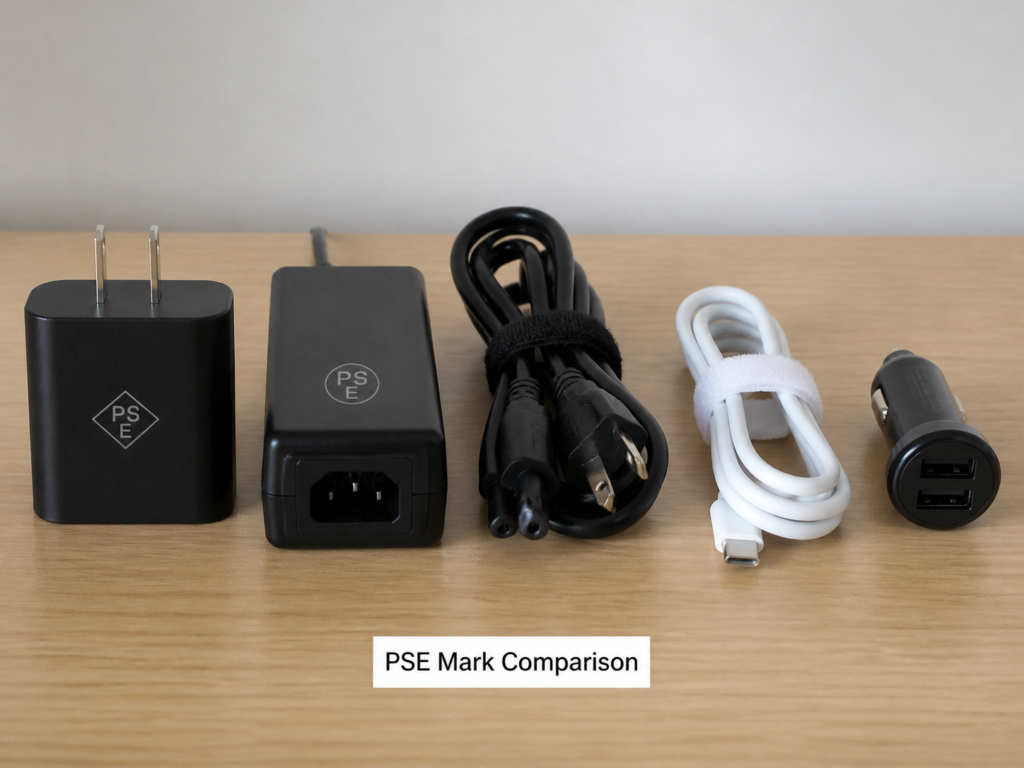
According to different risk levels, regulated electrical appliances are divided into two categories, corresponding to different PSE marks:
• **Specified Electrical Appliances (Diamond PSE Mark)**: High risk. For example, wall-plug AC-DC chargers, laptop power adapters and other DC power supply devices all fall into this category.
• **Non-Specified Electrical Appliances (Round PSE Mark)**: Relatively low risk, such as some AC power cord sets with simple structures.
• **Usually not regulated**: Pure passive USB/USB-C data cables, which only contain wires and have no power conversion circuit; car chargers with 12/24V DC input, which are not connected to Japan’s mains electricity.
• **Requires case-by-case confirmation**: High-power multi-port fast chargers, custom charging sets, and charging accessories with special circuits. Such products cannot be directly applied with conventional classification and need to be judged individually.
Detailed Boundary Judgment for Charging Cables
Charging cables are the category with the most questions from sellers. Their classification cannot be judged only by the product name, but also by whether they are connected to AC mains, and whether they include power conversion or other active circuits:
• Pure passive low-voltage data cables: Usually not regulated.
• USB-C cables with E-marker chip (no AC conversion): Usually not regulated, as long as it is confirmed that there are no active circuits such as active voltage boosting and power regulation.
• Cable sets with AC-DC power conversion, such as all-in-one wall-plug charging cables: Belong to regulated power supply products.
• USB cables sold in combination with AC power cords: All components need to be disassembled, and the classification of each component shall be judged one by one. Power cords, plugs or socket components connected to AC mains may fall into categories such as wires or wiring devices in the DENAN catalog even if there is no AC-DC conversion.
Three Real Business Judgment Cases
Just looking at the rules may still be vague, so we use three common scenarios as examples:
Case 1: Selling 65W USB-C Wall-Plug Chargers Separately
Core information to be confirmed: Input voltage range, whether it is an AC-DC DC power supply device, and whether the structure meets the product category requirements.
Most likely conclusion: It belongs to specified electrical appliances and requires a diamond PSE mark.
Special circumstances: Products for special purposes such as industrial supporting use or with special structures may be classified differently.
Required materials: Product specification sheet, circuit schematic diagram, product photos.
Case 2: Selling Charger + USB-C Cable Sets
Core information to be confirmed: Classification of the charger, whether the USB-C cable has active circuits, and whether the AC power cord in the set is compliant.
Conclusion: The charger requires corresponding PSE, and pure data cables do not need PSE, but if the AC power cord in the set belongs to a regulated category, it needs to be compliant separately.
Special circumstances: If the cable in the set has power conversion function, or a new category is formed after combination, re-judgment is required.
Required materials: Specification sheets of each component, packaging diagram of the set for sale.
Case 3: Selling Only USB-C Data Cables with E-marker
Core information to be confirmed: Whether it only transmits low-voltage DC/data, whether it has AC-DC conversion, and whether it has an active voltage boosting circuit.
Conclusion: Usually not regulated by PSE.
Special circumstances: If the cable has active power regulation function, or is sold in combination with an AC plug, it may be regulated.
Required materials: Specification sheet, circuit description, product photos.
3 Methods for Quick Self-Check
If you are unsure about the product classification, you can use these three methods to quickly confirm:
1. Directly check the official METI product category list and find the corresponding entry for charging products for verification;
2. You can consult METI-registered conformity assessment bodies, professional compliance consultants or competent authorities about product classification; whether pre-judgment is provided, service scope and charging standards shall be subject to the actual arrangements of each institution;
3. If it is a set or combined product, disassemble all components and judge them one by one, and cannot directly classify the entire set as a whole.
Core Differences Between the Two Types of PSE, Don’t Confuse Them
Many people think that diamond and round PSE can be chosen by themselves, and they choose the round one because it is cheaper. In fact, this is not the case at all — these two types are statutorily divided according to the product’s electric shock and fire risk levels. The DENAN product category list clearly specifies the category of each product, and enterprises cannot choose by themselves.
For easy comparison, we have sorted out the core differences:
| Comparison Item | Specified Electrical Appliances (Diamond PSE) | Non-Specified Electrical Appliances (Round PSE) |
| Division Basis | High risk of electric shock and fire, clearly listed in the DENAN product category list | Relatively low risk, clearly listed in the DENAN product category list |
| Mark Style | Diamond PSE mark + statutory identification information of the registered conformity assessment body | Round PSE mark |
| Compliance Requirements | Conformity assessment shall be completed by a METI-registered Conformity Assessment Body (CAB), which issues an inspection certificate (commonly known as PSE certificate) | No third-party certificate issuance is required. Enterprises shall ensure compliance with Japanese standards on their own, complete standard tests and factory outgoing inspections, and retain records |
| Typical Charging Product Categories | DC power supply devices such as wall-plug chargers and laptop power adapters | Some AC power cord sets with simple structures |
| Validity Period | No unified duration, depending on product category and institution requirements | No unified validity period, need to continuously ensure that products meet standards |
Correction of Common Classification Misconceptions
There are three most common cognitive errors, which are specially corrected here:
1. **Misconception: Low power means non-specified / no PSE required** → Correction: Classification depends on the product category, not power. Even a 5W wall-plug charger, as long as it belongs to the DC power supply device category, is still a specified electrical appliance.
2. **Misconception: PD/QC fast charging protocols change the classification** → Correction: Fast charging protocols are performance parameters and do not affect regulatory classification. Whether it is ordinary charging or PD fast charging, as long as the structure is a wall-plug AC-DC power supply, it belongs to the same product category.
3. **Misconception: CE/UL/CCC can replace PSE** → Correction: CE, CCC, general UL certification or other overseas certifications themselves cannot replace the conformity assessment, business notification, self-inspection and PSE labeling obligations stipulated by DENAN. However, whether existing overseas test data can be used as a reference for assessment shall be confirmed on a case-by-case basis by the registered conformity assessment body or relevant reviewing party according to applicable standards.
Actual Requirements for METI Business Notification (Commonly Known as METI Filing)
Many people cannot clarify the relationship between PSE and METI notification, and even think that “METI certification” is higher level than PSE. In fact, they are not the same thing at all.
Essence and Function
METI business notification is a statutory administrative registration procedure, not a certification, and should usually not be called “METI certification”. Its function is to register the local Japanese compliance responsible entity to ensure regulatory traceability, which is equivalent to finding a “local Japanese responsible person” for the product. After the notification is completed, there will be documents such as a copy of the notification and acceptance records, and there is no unified “filing letter”.
Responsible Entities and Notification Eligibility
First of all, the rights and responsibilities of several roles must be clarified:
• Manufacturer: Responsible for the compliance of the product itself;
• Importer: Bears the statutory compliance responsibility in Japan;
• Platform seller: Responsible for platform compliance of listed products;
• FBA: Only provides warehousing and distribution services, and does not bear any import or compliance responsibilities.
The notification is usually submitted by the local Japanese entity that bears import and statutory obligations. If overseas sellers do not have a local Japanese company, they need to confirm notification eligibility through a Japanese importer or compliance agent. Special attention should be paid here: the name or registered trademark of the business notifier marked on the product label shall be consistent with the notifying entity that actually bears the corresponding obligations; if there is inconsistency, it shall be verified and rectified in a timely manner, and it cannot be simply concluded that the notification is invalid on this basis.
Notification Timing and Preconditions
Business notification shall be handled after the commencement of relevant manufacturing or import business in accordance with DENAN regulations. At the same time, regulated products must still complete applicable obligations such as conformity assessment, self-inspection and PSE labeling before sale.
The items to be filled in and attachments for the notification shall be subject to the forms and guidelines currently used by the competent authority. The notification procedure cannot be confused with the product compliance requirements before sale: PSE certificates, test records, labels, specification sheets and Japanese instruction manuals can be used as product compliance, importer or Amazon platform review materials, but they are not statutory attachments for business notification in all cases.
Charging Product Notification and Compliance Materials
Notification items and product compliance materials vary slightly for different categories. Charging product sellers usually need to prepare and manage them separately:
• Conformity inspection certificates for specified electrical appliances;
• Technical documents such as compliance test reports and factory outgoing inspection records for non-specified electrical appliances;
• Product label samples and specification sheets, including model numbers, input and output parameters, etc.;
• Japanese instruction manuals and safety warnings;
• Qualification documents of the notifying entity.
It should be noted that the above materials are mainly used to prove that the product meets relevant requirements, or for platform, importer, customs and other review scenarios. The statutory items to be filled in and attachments for the business notification itself shall still be subject to the current forms and guidelines of the competent authority.
Statutory Obligations After Notification
Completion of notification is not a once-and-for-all matter. There are three statutory obligations that must be fulfilled:
1. **Document retention**: Technical documents, compliance certificates, and notification records must be retained as required. The specific period depends on the product category and regulatory requirements;
2. **Handle change notification when statutory items change**: When statutory notification items such as the notifier’s name, address, product category, and manufacturing factory change, the corresponding change notification shall be handled in accordance with DENAN requirements. When the product model, structure, key components or factory change, the compliance with technical standards, the coverage of the conformity inspection certificate, and whether the labels and technical documents need to be updated shall be evaluated first; if the change also involves statutory notification items, then handle the corresponding change notification;
3. **Cooperate with supervision**: Accept METI random inspections, accident investigations, and recall requirements.
Solutions for Those Without a Japanese Responsible Entity
If overseas sellers do not have a local Japanese responsible entity, they can choose the agent importer service from formal compliance service providers. But note: the agent importer needs to bear statutory compliance responsibilities, and you cannot just find any company to be a nominal one. You must verify the other party’s qualifications and sign a formal rights and responsibilities agreement to avoid being unable to find someone when problems arise.
Amazon Japan Site Review Rules and Submission Materials
Many sellers do compliance just to pass Amazon’s review. We have specially sorted out the platform’s review logic.
Review Trigger Scenarios
The specific situations shall be subject to the latest notice in Seller Central. Common trigger scenarios are:
• Category compliance verification when new products are listed, which is most likely triggered for charging products;
• Platform random compliance spot checks;
• Consumer safety complaints and peer compliance reports;
• Re-review after product information (model/photo/parameter) changes.
Common Required Materials for Charging Product Review
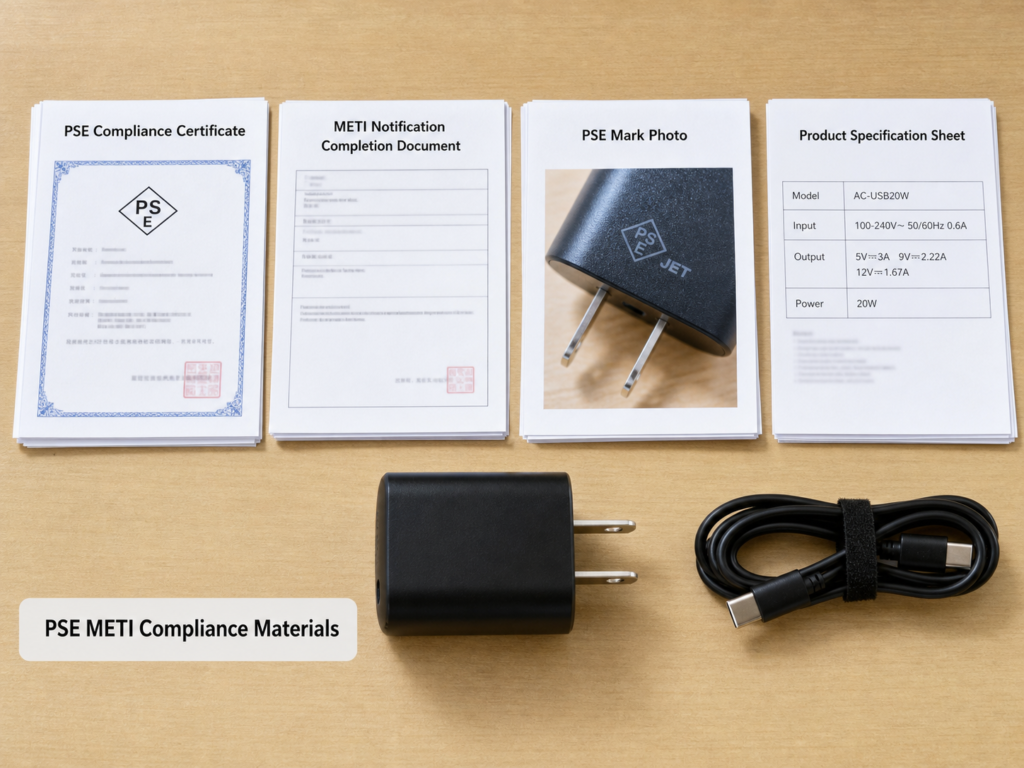
There are four types of materials that need to be prepared routinely:
1. PSE compliance certificate for the corresponding product category: For specified categories, provide the conformity inspection certificate issued by CAB; for non-specified categories, provide compliance test reports;
2. Documents proving the completion of METI business notification;
3. Clear photos of the PSE mark on the product body/nameplate;
4. Product specification sheet, marked with model number, input/output voltage/current/power.
Additional materials that the platform may require include: Japanese instruction manuals (including safety warnings, some requirements come from other regulations and platform rules, not all are PSE requirements), product key component lists, factory production qualification documents, responsible entity authorization letters, etc.
Document Consistency Is the Core of Passing the Review
**Inconsistent document information is one of the common reasons for review failure.** You need to check all information, including the ASIN corresponding model, product manufacturer, Japanese responsible entity, input and output parameters, plug specifications, and product photos, to ensure complete consistency. Common inconsistency problems include: the same ASIN includes multiple models but the compliance documents only cover some, the certificate model does not match the Listing, etc. These may lead to review failure or requests for supplementary materials.
PSE Marking Specification Requirements
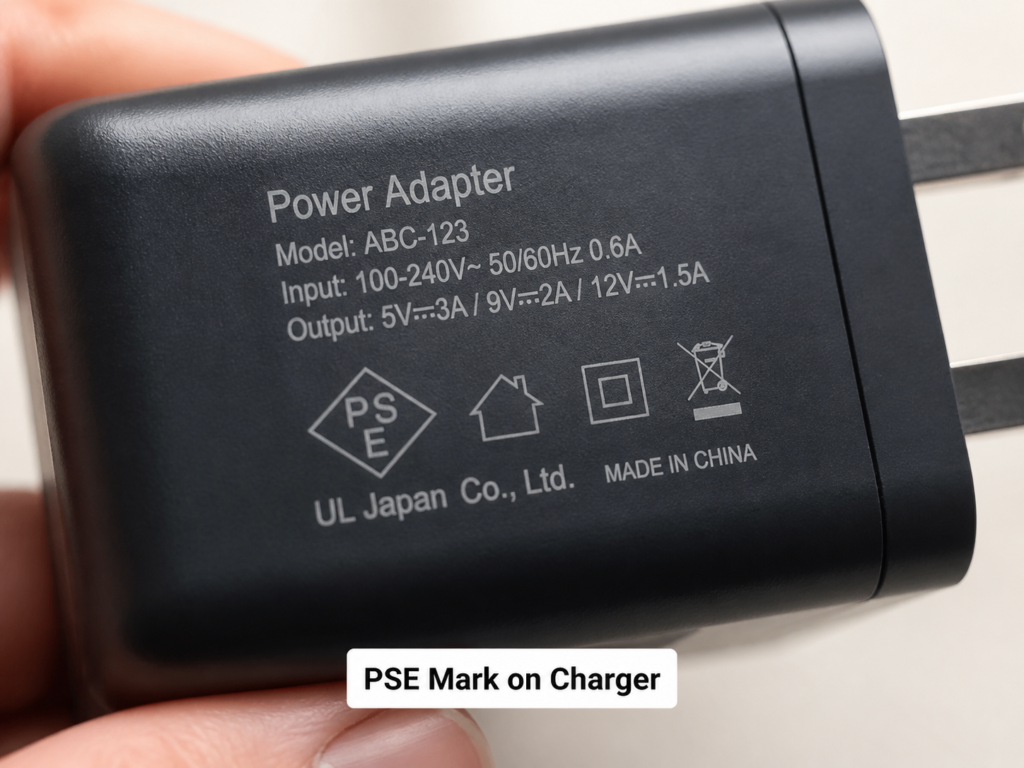
The specific requirements for marking shall be confirmed according to the rules of the corresponding product category. The general requirements are as follows:
• **Mark style**: Specified electrical appliances shall display the diamond PSE mark, the statutory identification information of the registered conformity assessment body, and the name or registered trademark of the business notifier in accordance with applicable product category rules; non-specified electrical appliances shall display the round PSE mark and the name or registered trademark of the business notifier in accordance with the rules;
• **Responsible entity marking**: The name or registered trademark of the business notifier shall be marked. The specific display items and name form shall be confirmed in combination with the product category and current implementation rules;
• **Rated parameter marking**: Rated input voltage, output power/current, rated frequency, etc. shall be marked, and it must clearly support Japan’s 100V mains electricity;
• **Position and method**: Usually, it shall be marked on the product body or fixed nameplate, and alternative positions are allowed for some product categories; the mark shall be clear, durable, and not easy to fall off. The general principle is: it cannot only be printed on the outer packaging or instruction manual (except for special product categories).
Final reminder: The final design of the mark should preferably be reviewed by a conformity assessment body, laboratory or Japanese professional consultant to avoid errors. In addition, the requirements for Japanese instruction manuals and safety warnings do not all come from PSE regulations, but also from other regulations and platform rules, so do not confuse them.
Full Compliance Practical Steps for Charging Products (From Product Selection to Listing)
After talking about so many rules, some people may still feel confused. We have sorted out the entire process from product selection to listing into 6 steps, and you can’t go wrong if you follow them.
Step 1: Classification Prediction in the Product Selection Stage
Action: Disassemble the product structure and make a preliminary judgment against the METI product category list (regulated/unregulated, specified/non-specified).
Checkpoint: When unsure, you can consult METI-registered conformity assessment bodies, professional compliance consultants or competent authorities about product classification; service scope and charging standards are subject to actual arrangements. For set products, all components must be disassembled and judged one by one.
Red line: It is forbidden to intentionally declare specified electrical appliances as non-specified or unregulated. Once found, the consequences will be serious.
Step 2: Complete PSE Compliance Assessment/Testing
Action: Send samples of specified electrical appliances to a METI-registered conformity assessment body for testing to obtain a conformity inspection certificate; for non-specified electrical appliances, entrust a qualified laboratory to test according to Japanese standards, complete factory outgoing inspections, and retain a full set of technical documents.
If there are multiple similar models, you can confirm with the registered conformity assessment body the model coverage of its certificate or assessment, the conditions for adding models, and the factory coverage conditions. Whether assessment can be combined and which test scopes can be reduced shall be decided by the institution on a case-by-case basis according to applicable standards, product differences and factory conditions, and cannot be directly regarded as “series assessment” just because the parameters of several models are similar.
Checkpoint: The model, manufacturer, and parameters of the compliance documents must be completely consistent with the mass-produced products.
Cycle reference: 4-8 weeks for specified categories, 2-4 weeks for non-specified categories, depending on product complexity and institution scheduling.
Step 3: Handle METI Business Notification
Action: In accordance with DENAN requirements, the relevant manufacturer or importer shall handle the business notification after the commencement of the relevant business; at the same time, prepare and manage PSE compliance documents, product labels, specification sheets, Japanese entity qualifications and other materials to complete pre-sale compliance and platform review.
Checkpoint: Check whether the notifying entity, statutory notification items, and the business notifier information on the product label are consistent. Whether materials such as PSE certificates, test reports, labels and instruction manuals need to be submitted as attachments shall be subject to the current forms and guidelines of the competent authority.
Step 4: Compliance Label Production and Mass Production Confirmation
Action: Design product marks and Japanese instruction manuals according to the marking rules of the corresponding product category.
Practical checkpoints for chargers: Input voltage covers Japan’s 100V, plug meets Japanese standards, insulation and temperature rise meet standards.
Checkpoint: After proofing, ask the compliance party to review the content, position, and durability of the mark, and then proceed to mass production after confirmation.
Red line: PSE marks cannot only be printed on the packaging (except where allowed by product category rules).
Step 5: Submit for Review in Amazon Seller Backend
Action: Check all materials and Listing information according to consistency requirements, sort them out and upload them.
Checkpoint: The uploaded photos are clear, and the submitted documents are consistent with the current product, model and platform requirements. For the conformity inspection certificates of specified electrical appliances, attention should be paid to the statutory validity period; for non-specified electrical appliances, test reports, inspection records and technical documents cannot be simply understood as having a unified “validity period”.
Follow-up: Check review feedback in a timely manner and supplement or correct materials as required.
Step 6: Continuous Compliance Management After Listing
Action: Establish a product change ledger (replacement of key components, power change, factory change, packaging change), and re-evaluate compliance before changes.
Checkpoint: Regularly check whether the inventory product marks are consistent with the compliance documents; models not covered by compliance documents cannot be mixed under the same ASIN.
Note: For specified electrical appliances, the statutory validity period of the conformity inspection certificate shall be managed, and the certificate shall be re-obtained as required before expiration. For non-specified electrical appliances, self-inspection records and technical documents shall be continuously kept, and when products change, applicable standards are updated, or required by the platform, evaluate whether supplementary testing or updated materials are needed.
Common Misconceptions and Risk Avoidance
Correction of High-Frequency Cognitive Misconceptions
Let’s emphasize 5 most common cognitive errors to avoid detours:
1. **Misconception: METI is a higher-level certification than PSE** → Correction: METI is the competent authority, and business notification is administrative registration, not certification. There is no hierarchy between the two.
2. **Misconception: Having a PSE certificate means you can pass Amazon’s review** → Correction: The review depends on a full set of materials, including business notification, marking specifications, information consistency, etc. A PSE certificate alone is useless.
3. **Misconception: Borrowing others’ PSE certificates is acceptable** → Correction: The certificate must correspond to the product model and manufacturer. Borrowing is a violation, which may lead to platform actions such as Listing removal and account restriction.
4. **Misconception: FBA warehouses bear import and compliance responsibilities** → Correction: FBA only provides warehousing and distribution, and compliance responsibilities are borne by the seller/importer.
5. **Misconception: Data cables either all need PSE or none do** → Correction: USB data cables that are purely low-voltage and have no mains input function are usually not within the scope of DENAN regulation; but all-in-one charging products with AC-DC conversion, as well as power cords, plugs or socket components connected to AC mains, shall be judged against the DENAN product category list respectively, and the presence or absence of AC-DC conversion cannot be used as the only standard.
Avoidance of Core Pitfalls for Charging Products
These 6 are the most common practical pitfalls for charging product sellers, which must be avoided:
1. **Unreliable agent importer losing contact** → Choose formal service providers, sign a compliance responsibility agreement, and clarify rights and responsibilities.
2. **Only the adapter is compliant in set products** → All regulated components in the set, such as AC power cords, need to be compliant separately.
3. **Product revision without re-evaluation** → Changing chips, power, plugs, or factories may cause compliance documents to become invalid. Be sure to re-evaluate before changes.
4. **Making up compliance only after goods arrive at the port** → Plan the cycle in advance to avoid customs detention and high port demurrage fees.
5. **Unclear responsibilities in OEM/ODM mode** → The contract shall clarify the provision of compliance materials, division of responsibilities, and recall obligations to avoid shifting blame to each other when problems arise.
6. **Mixing different models under the same ASIN** → Models not covered by compliance documents may cause the entire ASIN to be taken down.
Appeal Logic After Product Removal
If you really encounter product removal, don’t panic, handle it according to this logic:
Step 1: Verify the specific reason for removal, whether it is a PSE issue, business notification issue, marking issue, or information inconsistency issue. Do not blindly rectify;
Step 2: Carry out targeted rectification, including supplementary compliance assessment, supplementary notification, reprinting labels or correcting the Listing;
Step 3: Submit an appeal letter and complete compliance materials to explain the rectification situation.
**Absolute red line**: It is forbidden to submit forged or misleading compliance documents. Such acts may lead to ASIN removal, account restriction or other severe platform actions; specific measures shall be subject to Amazon’s notices, seller agreements and case-by-case review results.
Compliance Cost Optimization Methods
Compliance doesn’t have to cost a lot. These tips can help you reduce costs:
• Whether multiple models of the same series can be assessed together shall be confirmed with the registered conformity assessment body first; if the institution confirms that the applicable conditions are met, repeated testing can be reduced;
• Plan the compliance cycle in advance to avoid extra rush fees;
• Choose institutions with METI registration qualifications to avoid repeated testing;
• Confirm marking specifications before mass production to avoid batch rework.
Precautions for Long-Term Continuous Compliance
If you operate on the Japan site for a long time, you should also pay attention to these points:
• Pay attention to METI regulation updates, including adjustments to safety standards and changes to the product category list;
• For specified electrical appliances, regularly check the statutory validity period of the conformity inspection certificate; for non-specified electrical appliances, continuously keep self-inspection records and technical documents, and evaluate whether tests or materials need to be updated when products or standards change;
• Establish a consumer complaint handling mechanism, and promptly investigate and rectify when encountering safety problems.
Quick Self-Check and Competency Summary
Finally, we have sorted out two practical tools for daily quick judgment.
Japan Site Compliance Self-Check List for Charging Products
□ Product classification has been confirmed against the METI product category list (regulated/unregulated, specified/non-specified)
□ Regulated products have obtained the corresponding PSE compliance certificate (CAB inspection certificate for specified categories, full set of technical documents for non-specified categories)
□ Relevant business notification has been handled in accordance with DENAN requirements, and certificates or acceptance records have been retained
□ Product marks comply with the corresponding product category rules (mark, business notifier information, parameters, position)
□ Japanese instruction manuals and safety warnings comply with regulatory and platform requirements
□ All compliance documents are completely consistent with Listing information (model, manufacturer, parameters, responsible entity)
□ The rights, responsibilities and contact information of the local Japanese responsible entity have been clarified
□ A product change and compliance document management mechanism has been established
□ The validity period of specified electrical appliance certificates and the continuous retention requirements for non-specified electrical appliance materials have been distinguished
Product Classification Quick Decision Tree
When encountering new products, you can quickly predict along this logic:
1. Is the product directly connected to Japan’s 100V AC mains?
→ No: Usually not regulated
→ Yes: Go to the next question
2. Does it have an AC-DC power conversion circuit?
→ No: Check the corresponding categories of AC cords, plugs or sockets
→ Yes: Go to the next question
3. Does it belong to the DC power supply device category?
→ Yes: Most likely a specified electrical appliance (diamond PSE)
→ No: Check the corresponding product category
After learning these contents, you should be able to preliminarily judge whether common charging products may require PSE or METI-related compliance, distinguish the differences between specified and non-specified electrical appliances and choose an appropriate compliance path, sort out the basic process from product selection to listing and prepare platform review materials, identify the common compliance risks listed in this article, and respond to Amazon’s routine compliance reviews and basic removal appeals. Specific products shall still be subject to the METI product category list, applicable standards and case-by-case judgment of professional institutions.
Overall, the electrical compliance of the Japan site seems to have many clauses, but the core logic is very clear: first figure out which category the product belongs to, then complete compliance, business notification and marking as required, ensure all information is consistent, and don’t take chances. Only by doing compliance in advance can you avoid fewer pitfalls later and run your business stably.