
Amazon sellers who sell charging products have most likely heard of “California Proposition 65” — maybe their listing was suddenly required to supplement compliance documents, maybe a peer received a lawyer’s letter, or maybe a supplier mentioned in passing that “our products have passed Prop 65”. But when asked in detail what it is, whether they need to comply, and what they need to do, many people are unclear, and even fall into pitfalls without knowing why.
This article starts from the actual scenarios of charging product sellers, and thoroughly explains the requirements of California Proposition 65 (hereinafter referred to as Prop 65), from entry-level judgment to semi-proficient pit-avoidance practices, which you can use directly after reading.
I. First, Figure Out What Prop 65 Really Is
1. Its Essence is a “Right-to-Know Regulation”, Not a Sales Ban
Prop 65’s official name is the Safe Drinking Water and Toxic Enforcement Act, a local consumer right-to-know regulation in California, USA. The competent authority is OEHHA (California Office of Environmental Health Hazard Assessment), which is responsible for updating the list of toxic substances and formulating warning rules.
Its core logic is not to prohibit the sale of products containing harmful substances, but to require merchants to clearly inform California consumers of the risk of exposure to carcinogenic or reproductively toxic chemical substances that may exist in the product. In addition to official agencies, the enforcement subjects also include “citizen lawsuits” by private or lawyer groups — the latter is the main source of risk for cross-border sellers. Many professional lawyers specifically target cross-border products to find loopholes and profit through settlements or claims.
2. Why Charging Product Sellers Should Pay Special Attention
As long as the product is sold to California, it is necessary to comply with Prop 65, regardless of the seller’s location and warehouse location: even if you ship from China, even if you use FBA (Fulfillment by Amazon) to store goods in other states, as long as you open nationwide delivery and have California consumers place orders, you have compliance obligations. Amazon may also require sellers to submit compliance documents at any time, and missing documents will trigger platform actions such as delisting and traffic restrictions.
More critically, the charging category itself is a high-violation category for Prop 65: the PVC sheath of charging cables, lead in solder, and plating of metal terminals are all common high-risk clues that are easily targeted by law enforcement parties.
3. Don’t Confuse It with Other Regulations
Many sellers confuse Prop 65 with other material-related regulations, so let’s draw the boundaries first:
• There is no such thing as “Prop 65 certification”: its essence is an obligation to inform of exposure risks, not a mandatory certification like CE or FCC. Do not be misled by “certification services” from bad service providers.
• Compliance documents such as RoHS and REACH cannot automatically replace Prop 65 assessment. RoHS usually focuses on the concentration of restricted substances in homogeneous materials, while the specific obligations of REACH depend on registration, SVHC, authorization or restriction clauses; Prop 65 focuses on assessing whether California consumers are exposed to listed chemical substances at relevant levels.
• It only covers chemical exposure notification: Prop 65 does not replace other requirements such as electrical safety, EMC, and battery regulations. Do not think that completing Prop 65 means full category compliance.
4. 3 Basic Misconceptions That New Sellers Are Most Likely to Fall Into
Sellers who are new to Prop 65 can easily be led astray by misinformation. Let’s first clarify these misconceptions:
• **Misconception 1: Only California local/California warehouse sellers need to comply**: Overseas sellers only need to comply if they sell products to California. Even if you mark “no delivery to California”, as long as the logistics settings do not truly block California addresses and orders are shipped to California, it is a violation.
• **Misconception 2: Containing listed substances equals a violation**: When there is a reliable assessment proving that a specific listed substance is below the applicable safe harbor level under all relevant reasonably foreseeable exposure pathways, it is usually eligible for safe harbor protection from that Prop 65 warning obligation; this does not mean that the product is fully compliant with all regulations and platform requirements.
• **Misconception 3: Posting a warning completely exempts you from liability**: When the exposure level is higher than the applicable safe harbor level, safe harbor protection usually cannot be claimed, and a compliant warning should be provided; a warning cannot replace other electrical, product safety, or hazardous substance restriction regulations. If there is no warning, the warning is non-compliant, or the warning is misleading, there may still be Prop 65 litigation or enforcement risks.
II. Where to Check the Most Authoritative Rules? Don’t Trust Second-Hand Information
Prop 65 rules are constantly being updated dynamically, whether it is the substance list or warning requirements may be adjusted. Be sure to obtain the latest information from official sources, and do not directly apply old posts from a few years ago on the internet.
1. **OEHHA official website**: This is the core source of rules, where you can query the dynamically updated list of listed chemical substances, safe harbor thresholds (NSRL, MADL and product-specific values), warning rules and official examples (including long/short formats, display requirements, transition period arrangements).
2. **California Attorney General’s official website**: It provides records of Prop 65 60-day notices it has received and made public, which can be used to search for some similar products, listed substances and plaintiff information; the database should not be regarded as a complete list of all notices or all cases. The website also allows you to view enforcement announcements and settlement cases to reference the enforcement scale for similar products.
3. **Amazon Seller Central**: Two entries should be focused on: first, the Compliance Center in Seller Central, which has category filling requirements and document upload entrances; second, the charging product policy page, which has Amazon’s specific requirements for Prop 65 — platform rules may be stricter than regulations, and must be based on platform requirements.
All rules are subject to the latest official version on the day of product sale. It is recommended to check one by one before launching new products to avoid falling into new pitfalls with old information.
III. First Judge: Does Your Product Need to Comply with Prop 65?
You don’t have to do testing and labeling right away. First, screen step by step according to the three-level logic, and you can quickly judge your compliance obligations.
Level 1: Whether the product is offered to the California market
The following scenarios all belong to “offering products to the California market” and require compliance with the regulation: direct sales to California, self-shipping to California, participating in California-exclusive promotional activities.
There is an easily confusing point: FBA warehousing or interstate transfer itself does not equal a Prop 65 violation; but if the product can be delivered by Amazon to California consumers, or is actually sold or distributed in California, applicable warnings should be assessed and implemented in the product and online sales links.
Don’t think that writing “no shipping to California” on the detail page can exempt you from liability. You must confirm whether the logistics settings truly block California delivery addresses, as well as the actual sales and delivery scope.
Level 2: Whether it meets the small business exemption conditions
Prop 65 has exemptions for small businesses: businesses with fewer than 10 employees (subject to OEHHA’s latest rules) are exempt from warning obligations. However, it is usually necessary to verify whether the business employed fewer than 10 employees during the relevant period, and judge whether it belongs to the same employer in combination with affiliated entities, common control, agency relationships and the actual operation of the business; the conclusion cannot be drawn solely based on the number of companies under an individual’s name or a simple addition of employees.
Prop 65’s responsible subjects cover the entire supply chain: manufacturers, packagers, importers, distributors, and retailers may all be involved in corresponding responsibilities, not only factories are responsible. Special reminder: **Legal exemption does not mean that Amazon will not require submission of documents**. Platform rules are independent of regulations. Even if you meet the small business exemption, Amazon may require you to fill in compliance fields, otherwise sales will be restricted.
Level 3: Whether the product involves exposure risks that need to be notified
Even if the product is sold to California, not all situations require warnings. Two prerequisites must be met at the same time:
1. The product contains carcinogenic/reproductively toxic chemical substances listed by OEHHA;
2. In normal or foreseeable use, consumers have relevant exposure.
If the exposure level is below the safe harbor threshold, no warning is required; if there is no corresponding safe harbor value, or insufficient information to judge, an independent assessment is required.

Quick Check of High-Risk Components for Charging Products (Only for Screening Clues, Not Directly Equivalent to Violations)
You can first quickly check high-risk components against the following clues, instead of testing the entire product right away:
• Charging cable: PVC sheath (may contain phthalates), interface injection molded parts, metal terminal plating (may contain heavy metals)
• Charger: circuit board solder (may contain lead), plastic housing (may contain flame retardants), power cord sheath
• Connectors/adapters: metal terminal plating (may contain nickel, cadmium, lead), solder joints, housing soft rubber
• Set products: if any component has screening clues, the whole set needs to be assessed.
These are only preliminary screening directions. Whether a warning is ultimately required should be comprehensively judged based on the chemical form of the substance, releasability, and actual exposure level. You cannot directly determine a violation just by seeing PVC.
Common Situations Where Warnings Can Be Exempted
Those that meet the following conditions do not need to post Prop 65 warnings:
1. Meet OEHHA’s small business exemption standards (but Amazon platform rules may still require disclosure);
2. Have valid assessment/test basis proving that the chemical substance exposure level is below the corresponding safe harbor threshold;
3. Meet specific warning requirements subject to federal preemption (rarely applicable to charging products).
IV. How to Assess Whether a Warning Is Needed? A Tiered Method From Screening to Professional Assessment
The core of judging whether a warning is needed is “exposure level”, not the total content of the material. The assessment can be promoted in layers from easy to difficult, and you don’t have to spend a lot of money on full testing right away.
Step 1: Check Listed Chemical Substances
OEHHA’s list of listed substances is dynamically updated and must be based on the latest official version. When checking, you can’t just look at the substance name; you need to cross-verify with the chemical name, CAS number (unique number of chemical substances), component information, and supplier material declarations to avoid mistakes due to substance aliases.
Listed substances are divided into two categories: carcinogens and reproductive toxicants, and some substances belong to both categories.
What Exactly Are Safe Harbor Thresholds?
Many people have heard of NSRL and MADL but don’t know their meanings — these two are the core safety lines of Prop 65, **they are thresholds for daily human exposure, not limits on the total content of products**, and the unit is mostly micrograms per day:
• **NSRL (No Significant Risk Level)**: The safety line for carcinogens, meaning that lifelong daily exposure to this dose of the substance has negligible carcinogenic risk.
• **MADL (Maximum Allowable Dose Level)**: The safety line for reproductive toxicants, meaning that daily exposure to this dose will not cause harm to the reproductive system.
Here are two common reference values (specifically subject to the latest official version): the NSRL of lead is about 0.5 micrograms per day, and the MADL of DEHP (a common phthalate) is about 140 micrograms per day.
Safe harbor thresholds are not omnipotent: if a substance does not have a corresponding safe harbor value, the exposure pathway does not match the applicable scenario of the threshold, or the test results cannot support the conclusion, you cannot forcefully apply them, and a separate assessment is required.
Exposure Assessment Dimensions for Charging Products
When assessing exposure levels, all reasonably based exposure pathways should be identified based on the product structure and normal or reasonably foreseeable use. Skin contact may be the main pathway for charging cables, but if there are possibilities such as hand-to-mouth contact, wear and tear shedding, dust or volatiles, they should also be included in the assessment. It is not required to cover all hypothetical scenarios without basis.
• **Exposure pathways**: Select according to actual usage scenarios, such as skin contact, hand-to-mouth ingestion, material migration, inhalation of dust or volatiles, etc.
• **Product structure**: Exposed components are the focus of screening, such as charger housings and power cords; components sealed inside (such as circuit board solder) can be assessed later.
• **Usage scenarios**: Normal or reasonably foreseeable situations such as plugging and unplugging, bending, wear, and aging should be considered. Whether children’s biting, repeated bending and aging cracking are foreseeable scenarios should be judged based on product use and user groups; extreme scenarios such as incineration are usually not regarded as general use exposure.
• **Substance characteristics**: The releasability and migration rate of the substance will directly affect the actual exposure level. For example, metal terminals with firm plating have very low migration.
Four-Tier Method for Exposure Assessment
You can proceed in layers from low cost to high cost, and don’t have to do it all at once:
1. **Tier 1: Supply chain document screening**: Ask suppliers for BOM (Bill of Materials), material declarations, and compliance commitment letters to initially screen high-risk substances. But these are only clues and cannot be used as compliance conclusions. A supplier’s verbal promise of “no problem” has no legal effect.
2. **Tier 2: Chemical substance verification**: Confirm whether the screened substances are on OEHHA’s list of listed substances and whether their chemical forms are within the scope — for example, metallic nickel and nickel salts have different toxicities and cannot be confused.
3. **Tier 3: Adaptability testing**: The test method should match the actual exposure pathway and product usage scenario. Migration, release or wipe tests may be applicable to some exposed components; total content reports cannot alone prove that human exposure is below the safe harbor level, but can be used as evidence to identify listed substances, establish exposure ceilings or assess in combination with other data, and cannot be simply regarded as invalid.
4. **Tier 4: Exposure level assessment**: Combine test results, usage scenarios, and contact frequency to convert into the consumer’s daily exposure level, and then compare it with the safe harbor threshold. This step requires professional judgment, do not estimate on your own.
If the test is issued by a laboratory with ISO/IEC 17025 accreditation, the credibility will be higher, but the accreditation does not automatically equal compliance — the key depends on whether the test sample, method, and items match your product.
V. How to Post Warnings Correctly? Requirements for Format and Display
You can’t just write a “Warning” and stick it on. Prop 65 has clear requirements for the format and display position of warnings, and mistakes are also considered violations.
Decision Logic for Format Selection
Choosing long format or short format cannot be based on feeling, but should be judged in three steps:
1. Distinguish the display scenario: is it a physical product/package, or an online sales page (such as Amazon detail page);
2. Confirm available label space, product type, and point of sale;
3. Check the applicable conditions of OEHHA’s latest rules and select the corresponding format.
Do not expand the scope of application of the short format on your own. The transition period rules are implemented according to the point of sale, and the old version of the short format cannot be used after expiration.
Long Format Warning (Standard Safe Harbor Format)
• **Applicable conditions**: Sufficient label space, no special short format applicable circumstances.
• **Required elements**: Capitalized “WARNING” signal word, risk type (carcinogenic/reproductive toxicity), at least one corresponding listed substance.
• **Visual requirements**: Yellow triangle is a recommended element, not mandatory; but must meet font size, contrast, and readability standards, and cannot use light gray small print or be blocked by other content.
Short Format Warning
Whether the short format warning can be used should be judged according to 27 CCR §25603 and transition provisions applicable at the time of sale. The current rules do not generally require the product to be small in size or have insufficient label space; when using the short format, it must still include applicable risk categories, listed chemical substance names, and the specified website URL and other elements.
The short format is not a simple abbreviation of the long format. The specific chemical substance listing, risk statement and website URL requirements shall be subject to the official rules applicable at the time of sale.
Display Rules for Physical Products/Packages
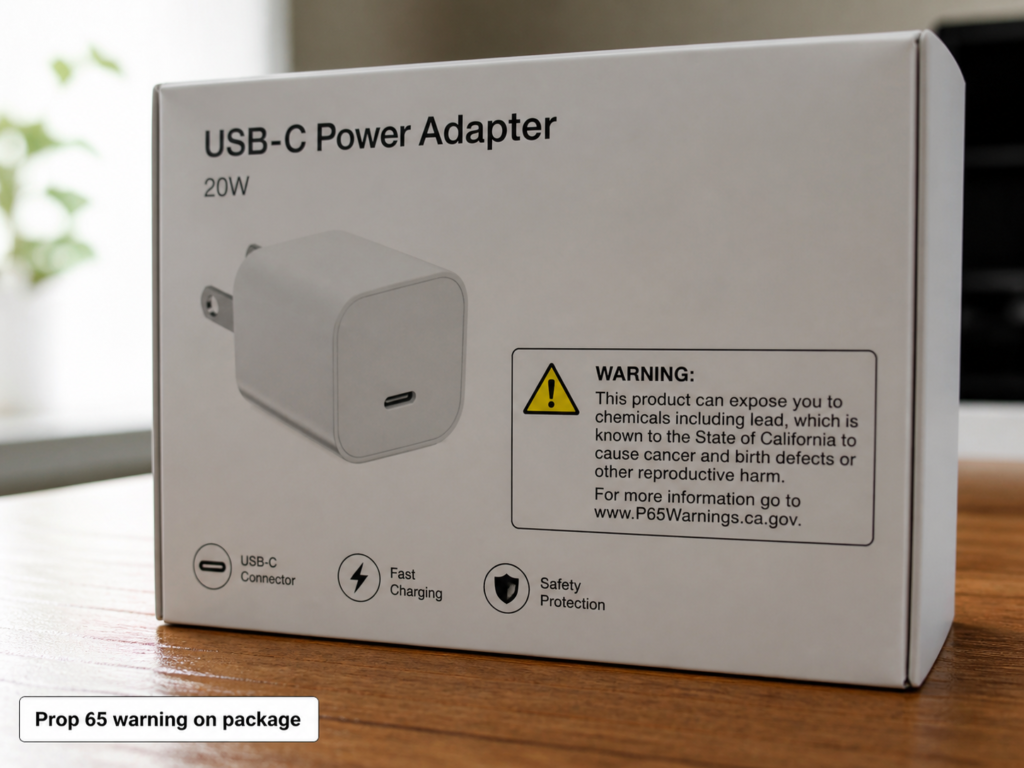
• It must be ensured that it is clearly visible when consumers receive and unpack the product, and cannot be hidden deep in the manual, nor can it be pasted in a position that will be covered by the express waybill.
• The posting position can be the product body, the minimum sales package, or accompanying materials, as long as it meets the requirements of the corresponding clauses.
• Small-volume products (such as mini adapters) do not need to be forcibly pasted on the body, and can be displayed in combination with packaging and accompanying materials to meet visibility requirements.
Display Rules for Online Sales (Including Amazon)
• On Amazon pages, warnings or compliant warning links should be displayed clearly and prominently before consumers complete their purchase, and warnings cannot be placed in positions that consumers usually cannot see, cannot access, or are displayed after purchase; specific page components should also meet Amazon’s current requirements.
• If the product has been provided with a product label warning, the online sales page should provide a corresponding warning, and ensure that the risk category, listed chemical substances and statutory elements do not conflict or are omitted.
• Amazon requires filling in the specified compliance fields/attributes in the backend, or uploading corresponding documents. The specific requirements are subject to the current backend and category policies, and you can’t just add a paragraph of text to the detail page yourself.
• Each sub-ASIN of variant products must be assessed separately. Sub-bodies with different materials and different suppliers cannot share the warning of the parent body — for example, under the same parent body, PVC cables and TPE cables have different risks, and the warning content may also be different. The backend fields are filled in according to Amazon’s current policy, and internal fields do not have to be exactly the same as the packaging word for word, but must not contradict the actual product warning.
Prohibited Rules for Warning Copy
• Do not use expressions that change the meaning of risk, omit elements, or cause misunderstanding. Prioritize the use of standard English copy issued by OEHHA, and do not modify or translate it yourself.
• Ordinary safety tips (such as “do not disassemble”, “keep away from children”) cannot replace Prop 65 warnings.
• Do not arbitrarily mark “Prop 65 Compliant” as a marketing claim. There must be corresponding test/assessment basis, otherwise it may be suspected of false publicity.
VI. Practical Decision-Making Tool: Quickly Determine Which Tier Your Product Belongs To
Faced with multiple SKUs, you can use the following tools to quickly classify and determine compliance priorities.
Three-Tier Risk Quick Decision Table
| Risk Tier | Judgment Conditions | Corresponding Actions |
| No Warning Required Tier | Meets statutory exemption, or has reliable assessment proving exposure level is below applicable safe harbor level | Retain assessment evidence, and fill in compliance information according to platform requirements |
| Recommended Conservative Warning Tier | Insufficient information to eliminate risks, or supply chain screening has high-risk clues but no assessment conclusion | First supplement documents or conduct professional assessment; before confirming the substance and risk category, do not directly produce warnings containing unconfirmed substance names |
| Immediate Review Required Tier | Received a 60-day violation notice, platform delisting/compliance notice, or confirmed that the exposure level meets or exceeds the applicable safe harbor level | Check whether corresponding warnings need to be provided, and check whether the warnings are compliant; if other product safety or hazardous substance restriction issues are involved, immediately suspend relevant sales and entrust professionals to handle them |
If there are many SKUs, you can also use the charging product Prop 65 decision matrix to further refine: match one by one according to dimensions such as sales scope, enterprise size, component screening level, material information completeness, existing compliance documents, and exposure risk level to determine the processing priority of each SKU.
Typical Case Reference (Charging Products)
The following 5 cases cover common charging products, you can directly compare your own products to judge:
Case 1: USB-C Charging Cable with PVC Sheath
Material: PVC cable sheath, nickel-plated terminals, ordinary solder (high screening clues), exposure pathway is mainly skin contact, need to assess the possibility of phthalates and heavy metal migration; only the supplier provides RoHS report, no phthalate/lead exposure test report.
• Judgment: High screening priority, priority assessment/testing is required, and specific warning content cannot be directly determined when information is insufficient.
• Implementation: First confirm the actual existing listed chemical substances, chemical forms and related exposure pathways, then select the corresponding warning format and copy. When information is insufficient, you can suspend California sales, supplement supply chain documents or conduct professional assessment, and cannot directly produce warnings with unconfirmed substance names.
Case 2: Braided Data Cable with TPE Sheath
Material: TPE cable sheath, gold-plated terminals, lead-free solder (low screening clues), exposure pathway is mainly skin contact, need to confirm the risk combined with material formula and releasability; only the supplier provides material declaration, no third-party exposure test report.
• Judgment: Medium-low screening priority, first check supplier documents, test if necessary.
• Implementation: If the test confirms that the exposure level is below the threshold, no warning is required; otherwise, post it as required.
Case 3: Power Adapter with Lead Solder
Material: plastic housing, built-in circuit board with lead solder, PVC power cord; exposure pathway focuses on the exposed power cord, internal closed solder joints need to assess foreseeable scenarios such as wear and high-temperature release, and exposure cannot be directly presumed; no phthalate report for power cord, no internal solder exposure assessment.
• Judgment: Medium-high screening priority, assess exposed and internal components separately.
• Implementation: If the consumer exposure caused by relevant exposed components reaches or exceeds the applicable safe harbor level, or the assessment shows that there is an exposure risk that needs to be notified, corresponding warnings should be provided; “exceeding the standard” cannot be determined solely based on the total content test results of components. Internal components should be assessed for whether notification is required in combination with structure and reasonably foreseeable usage scenarios.
Case 4: Metal Plated Adapter
Material: zinc alloy housing, nickel-plated terminals, lead-free solder; need to confirm the chemical composition of the plating and whether it is listed, nickel plating cannot directly presume cadmium content, conduct adaptability testing if necessary; no metal plating migration test report.
• Judgment: Medium screening priority, need to do metal release test to confirm.
• Implementation: If the test passes, no warning is required; if not, mark the corresponding substance.
Case 5: Charging Cable + Charger Set
Material: PVC charging cable + charger with lead solder (high screening clues for both components), assess exposure pathways for the two components separately; compliance documents for single components are incomplete, no overall assessment of the set.
• Judgment: High screening priority, assess each component separately.
• Implementation: Set a unified warning according to the applicable format and confirmed listed substances.
VII. Basic Compliance Implementation: 5 Steps Are Enough
Prop 65 compliance is not a one-time action, but a complete process. Follow the five steps below to cover basic compliance requirements.
Step 1: SKU-Level Risk Classification (Prioritization)
First count all SKUs sold to the United States, mark the material, supplier, and logistics mode (whether it can be delivered to California) of each SKU; sort by screening level from high to low, prioritize processing SKUs with high sales volume, large inventory, and nationwide delivery enabled — these products have the highest risk, handle them first before processing low-risk models.
Step 2: Collect Supply Chain Documents and Necessary Testing
Ask suppliers for material declarations (BOM), existing test reports, and compliance commitment letters for the corresponding batches. Note that reports are not omnipotent, and reports cannot be directly reused in the following scenarios: different suppliers, different material formulas, different wire diameters/terminals/circuit boards, different packaging, different set combinations.
Scenarios that require third-party testing: high-risk clues without valid reports, supplier documents cannot confirm risks, platform requirements for provision. If the documents are temporarily incomplete, you can first handle sales and assessment arrangements according to the conservative principle, but before the listed substances and risk categories are confirmed, you cannot directly produce warnings containing specific substance names.
After getting the report, focus on reviewing: whether the sample model/batch matches, whether the components are correctly split, whether the test method matches the exposure pathway, whether the detection limit is sufficient, and whether the result unit corresponds to the exposure level. Reports in total content units cannot alone prove that human exposure is below the safe harbor level, but can be used as part of screening and subsequent exposure assessment.
Step 3: Simultaneously Implement Warnings (Consistent Online and Offline)
Offline: New batches of products should be affixed with compliant labels in advance; for unlabeled inventory already in FBA, either arrange relabeling, or adjust the delivery scope to temporarily not ship to California to avoid risks.
Online: Fill in the backend compliance fields according to Amazon’s requirements, and update the warning content on the detail page.
After completion, a correspondence check must be done: the risk types, listed substances and statutory elements in the packaging, detail page, and backend cannot conflict with each other or be omitted. The backend fields do not have to be exactly the same as the packaging word for word, but must not contradict the actual product warning.
Step 4: Retain Compliance Evidence Chain
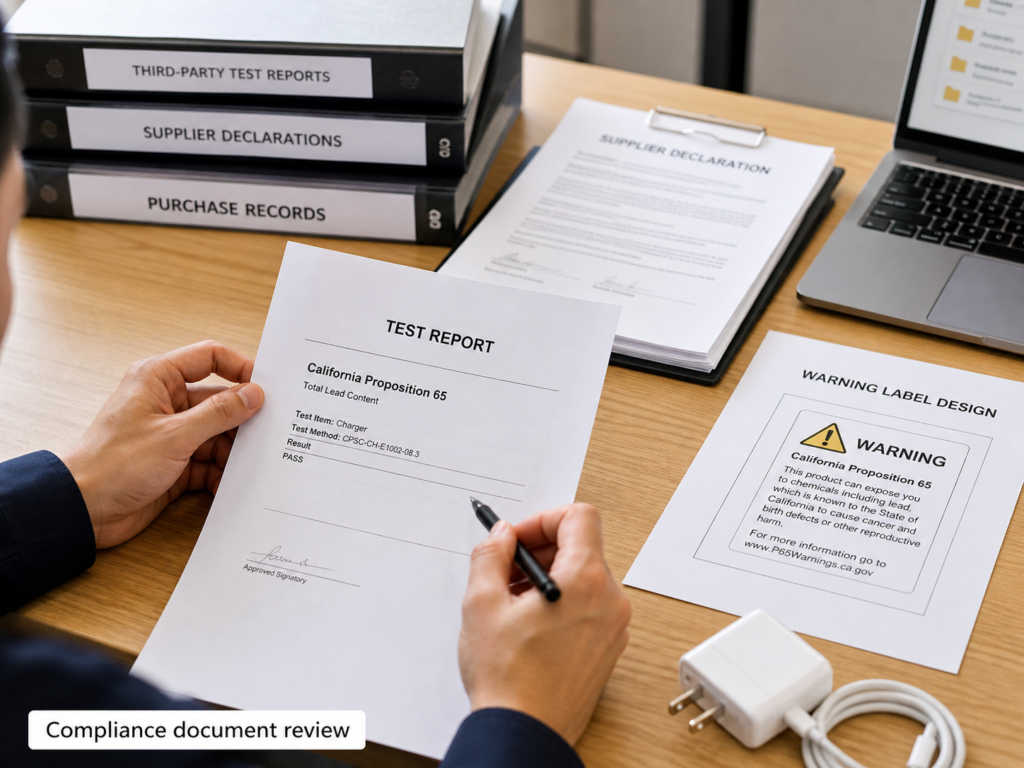
Don’t think that posting warnings is the end. Evidence retention is the core of responding to spot checks and lawsuits. Documents that need to be retained include: third-party test reports, supplier compliance declarations, warning label design drafts, backend filling screenshots, and purchase batch records.
The retention period is recommended to be 3-5 years after the product is discontinued, combined with the statute of limitations and platform policy adjustments; it is best to establish a dedicated file for each ASIN, associated with version, batch, supplier, and warning copy, for easy access at any time.
Step 5: Daily Compliance Maintenance
Prop 65 rules and products may change, requiring regular maintenance:
• Scenarios that trigger re-assessment: changing suppliers, modifying materials/processes, adjusting product structure/set combinations;
• Rule check frequency: Check OEHHA list and warning rule updates every six months, no need to check every day, but also can’t leave it alone for several years;
• Platform notification processing: Regularly check Amazon backend compliance notifications, update them in time as required, to avoid violations due to missing them.
VIII. Advanced Pit Avoidance: 90% of Sellers Have Fallen Into These Misconceptions
High-Frequency Practical Advanced Misconceptions
1. **Supplier’s “Prop 65 Free” declaration can be used directly**: Wrong. Declarations without corresponding batch test/assessment support are invalid. If something goes wrong, the seller is fined, not the supplier.
2. **Different sub-ASINs of the same series can share compliance reports**: Wrong. Only sub-bodies with exactly the same material, process, and supplier can be reused. For example, the same cable with only different lengths is okay, but PVC and TPE materials are absolutely not.
3. **Internal closed components do not need to consider exposure at all**: Wrong. It is necessary to assess foreseeable scenarios in normal use, such as charger aging and cracking exposing solder, substance volatilization at high temperatures, etc. You can’t directly think that it’s okay if it’s sealed inside.
4. **Filling in the platform compliance field equals compliance**: Wrong. Amazon only conducts formal review, and the legal responsibility is still borne by the seller. A complete evidence chain must be retained, otherwise you will still be responsible when sued.
5. **Supply chain contract agreement on responsibility can exempt one’s own legal obligations**: Wrong. Contracts usually cannot automatically eliminate external legal responsibilities, but obligations such as providing warnings, documents and compensation can be agreed within the supply chain. The specific responsibility still needs to be judged based on the actual role of each party.
Judgment of the Validity of Third-Party Test Reports
Don’t spend money but get useless reports, check according to these four points:
• **Look at matching degree**: Whether it corresponds to the actually sold SKU, model, material batch. Reports of other models and other batches are useless.
• **Look at test logic**: Whether it targets exposed high-risk components and adopts test methods corresponding to exposure pathways. Migration, release or wipe tests may be applicable to some scenarios; total content reports cannot alone prove that human exposure is below the safe harbor level, but it does not mean that they have no reference value at all.
• **Look at accreditation scope**: Whether the laboratory has ISO/IEC 17025 accreditation for the corresponding test items. It is not that having 17025 accreditation means all items can be done.
• **Look at authenticity**: You can verify by entering the report number on the laboratory’s official website to avoid getting fake reports.
Violation Risks and Costs
• **Enforcement subjects and procedures**: Private/lawyer group litigation is the main source of risk for cross-border sellers. The other party will first issue a 60-day violation notice, and can sue if no rectification or settlement is made after the expiration; government agency enforcement does not have a unified 60-day pre-requirement, and may directly initiate enforcement; Amazon platform measures are independent of judicial/administrative procedures and are implemented in accordance with platform rules.
• **Legal costs**: The statutory maximum penalty is $2,500 per violation per day. In practice, most cases are settled. The settlement amount is related to sales volume, number of SKUs, and duration of violation. It is not necessarily the maximum penalty, but it is usually not a small amount.
• **Platform penalties**: Mild ones are listing delisting and rectification within a time limit, severe ones may include account traffic restrictions, fund freezing, and banning.
If you receive a litigation or enforcement notice, be sure to entrust a local professional lawyer in the United States with Prop 65 experience to handle it. Do not reply on your own or ignore it.
Classification Handling Process for Violation Notices
• **Amazon platform notice**: First confirm the reason for the violation (missing label/excessive substance), rectify as required and submit corresponding documents.
• **Government agency notice**: Immediately verify the authenticity and scope of the incident, retain all evidence, and consult professional compliance personnel or lawyers.
• **Private party 60-day notice/lawyer’s letter**: First verify the subject’s qualification, involved products, listed substances, sales evidence, and notice date. Do not admit responsibility casually, nor ignore it. Entrust a professional lawyer to handle it as soon as possible.
Responsible Subjects and Platform Boundaries
• **Amazon**: Amazon usually requires sellers to provide documents and takes product measures based on its own platform policies, but whether it bears Prop 65 responsibility depends on its legal role in specific transactions, sales and distribution arrangements, and applicable regulations. Responsibility cannot be excluded in advance solely based on the “platform” identity. Platform measures also cannot replace sellers’ performance of legal obligations.
• **Brand owners/private label sellers**: Should bear corresponding obligations of document review, warning production, page disclosure and evidence retention according to their actual roles in supply, import, distribution, sales and warning provision.
• **Manufacturers/importers**: Bear corresponding obligations of product documents, material information and warning cooperation according to their actual legal roles.
• **Resale/distribution sellers**: Should request applicable compliance documents from brand owners or suppliers and retain them according to their actual sales and distribution roles, and cannot exclude their possible obligations solely based on contracts or supplier verbal promises.
• **Dropshipping sellers**: Cannot exempt obligations on the grounds of third-party shipping. They need to verify the supplier’s compliance qualifications in advance and clarify the responsibilities of all parties in warning and document provision.
General rule: According to the actual role of each subject in supply, import, distribution, sales and warning provision, 27 CCR §25600.2 shall be applied to judge responsibility and safe harbor obligations. Contracts usually cannot automatically eliminate external legal responsibilities, but can allocate obligations of providing warnings, documents and compensation within the supply chain; it cannot be generally determined that the brand party bears the main responsibility or all roles automatically bear the same responsibility.
IX. Full-Link Compliance Checklist: Check One by One Without Omission
Pre-Launch Checklist
□ Confirmed product California sales risk (logistics mode, delivery scope)
□ Sorted out all high-risk screening components
□ Obtained supplier’s corresponding batch compliance documents
□ Completed necessary third-party testing or risk assessment
□ Confirmed whether the enterprise meets the statutory small business exemption conditions
□ Checked Amazon’s current category compliance requirements
Warning Implementation Checklist
□ Physical warning content and format comply with OEHHA’s latest rules
□ Physical warning position meets the requirement of being visible when consumers receive/unpack
□ Online warnings or compliance warning links are clear, prominent and accessible before consumers purchase
□ Amazon backend compliance fields have been filled in as required
□ Online warnings correspond to physical warnings, and risk categories, listed substances and statutory elements do not conflict or are omitted
□ All sub-ASINs/variants have been set with corresponding warnings individually
Daily Maintenance Checklist
□ Re-assessed when materials/processes/suppliers/products change
□ Regularly checked OEHHA list and rule updates
□ All compliance documents have been classified and retained as required
□ Established emergency handling process for violation notices
Final Remarks
Reading this, you should already be able to independently judge whether Amazon charging products need to comply with Prop 65, check the latest rules through official channels, use risk classification tools to determine compliance priorities, complete online and offline warning implementation, and avoid common practical misconceptions and respond to basic violation notices.
Prop 65 seems to have complicated clauses, but its essence is a consumer right-to-know regulation. Don’t be overly anxious, nor take it lightly. Proceed step by step from risk screening to implementation and maintenance according to the steps, and you can minimize the risk — after all, the charging category is a high-violation category, spending a little time on compliance in advance is much more cost-effective than remedying after receiving a lawyer’s letter.