
Many sellers of charging heads, car chargers, data cables, and power adapters are always confused by the two terms EPR and WEEE when they first settle on Amazon EU sites: Are they the same thing? Do I still need this if I have CE compliance? Do self-fulfilled shipments not need to be taken care of? Once you step into a pit, the light consequence is listing removal and goods being unable to enter the warehouse, while the heavy consequence is fines or even store closure. This article will clarify the WEEE and EPR requirements that charging product sellers need to know, from introductory concepts, applicability boundaries, platform requirements, national differences to practical steps, to help you go from beginner to being able to independently complete basic compliance.
Note first: This article is an introductory popular science piece for cross-border sellers of charging products, and does not constitute formal legal advice. For specific requirements, please refer to the official regulations of the target country and the announcements in Amazon Seller Central.
Introductory Basics: First Understand Core Concepts and Risks
Let’s first talk about the actual impacts of non-compliance, which are divided into two sides: platform and regulatory. The impact on the platform side is the most direct: Products without uploaded compliance vouchers may have their listing display restricted, encounter FBA warehousing obstacles, and in severe cases, have their sales permissions adjusted; in applicable sites and product streams, if you never submit the vouchers, the platform may also take measures such as performance on behalf of sellers, collection of relevant ecological contributions, or other measures in accordance with policies. The risks on the regulatory side are more serious: Local EU environmental authorities can impose fines on non-compliant sellers, and goods may also be detained during customs or market supervision spot checks.
So what is the relationship between EPR and WEEE? Put simply, EPR is the major environmental protection framework of “Extended Producer Responsibility” implemented by the EU — whoever places products on the EU market must bear the recycling and treatment costs after the products are scrapped. Instead of taxpayers paying for discarded products after use, sellers and brand owners themselves pay for waste disposal. This framework covers several product streams such as electrical and electronic equipment, packaging, and batteries. WEEE is a special regulation under this major framework specifically targeting the recycling of waste electrical and electronic products, governing the standardized recycling and treatment of e-waste.
It should be noted that the EU only issues overarching framework rules, and the specific implementation is carried out by each country through registration bodies and Producer Responsibility Organizations (PRO for short, which are institutions specifically responsible for recycling and treatment and helping sellers implement compliance). There is no EU-wide EPR registration number; if you sell in the markets of several countries, you need the compliance number of the corresponding country. For charging product sellers, the most common compliance obligations are WEEE plus packaging EPR. If the product comes with a battery (such as power banks, portable charging devices with batteries), you also need to complete battery EPR additionally.
Many new sellers tend to confuse several concepts, so let’s clarify them all at once:
First, EPR numbers and WEEE numbers are not the same thing. EPR is the general term for the entire environmental protection framework. The WEEE number is only a registration number exclusive to electronic products. In addition, there are packaging EPR numbers and battery EPR numbers, all of which are numbers for different product streams under the EPR framework.
Second, CE and WEEE belong to different compliance systems. The CE mark indicates that the manufacturer has completed the conformity assessment in accordance with applicable EU harmonized legislation and issued an EU Declaration of Conformity; for charging products, applicable requirements may include electrical safety, electromagnetic compatibility, radio equipment, and restriction of hazardous substances, etc., depending on product functions and applicable regulations. CE compliance does not replace WEEE registration, recycling financing, and labeling obligations; both must be fulfilled separately.
Third, VAT numbers and EPR numbers are not interchangeable. VAT is a tax number used to pay value-added tax to the EU; EPR is an environmental compliance number used to bear recycling responsibilities. The two are completely independent systems, just like ID cards and social security cards — both are documents but have completely different uses.
Applicability Boundary: How to Judge Whether You Need to Comply?
The first question that many sellers care about most is: Do I have to bear this responsibility? You can judge by yourself using a four-step method:
Step 1: First confirm whether you are the product placing entity. If you are an OEM producer of charging products, the first to import products into the EU, or a non-EU distance selling seller (that is, a Chinese seller selling directly to EU consumers), you may be considered a “producer” as defined in the regulations and must bear responsibility.
Step 2: Check whether there is an existing responsible party. If an importer or brand owner within the EU is legally the producer of this product stream, or an authorized representative that meets the requirements of the target country has already handled the relevant obligations on their behalf, the responsibilities of each party shall be confirmed in accordance with the target country’s laws, registration status, and contractual division of labor. Commercial agreements can clarify the division of internal work and costs, but they cannot automatically change the statutory producer responsibility borne to the competent authority. It is also necessary to retain registration materials, authorization documents, and other proofs to confirm whether the relevant entities actually bear the obligations.
Step 3: Don’t be misled by the sales model. Whether you use FBA to ship to overseas warehouses or FBM to ship directly from China, you are not automatically exempt from obligations. The specifics depend on the distance selling rules of the target country; it is not the case that self-fulfilled shipments definitely require no attention.
Step 4: Check exemption thresholds. Most EU countries do not have a general exemption threshold. It is not that you don’t need to comply just because you sell small-sized, low-value mini charging cables; small products may also require fulfillment of obligations.
It is also particularly important to note that sellers outside the EU should check country by country whether it is mandatory to appoint a local authorized representative or other local responsible entity. Some countries and product streams, such as German WEEE, have authorized representative requirements for overseas producers; however, whether direct registration is possible, what qualifications the authorized representative must have, and whether other entity qualifications are required are all subject to the rules of the target country, and are not exactly the same across all EU countries and all EPR product streams.
After clarifying the responsible entity, the next step is to judge whether your charging products fall within the scope of WEEE:
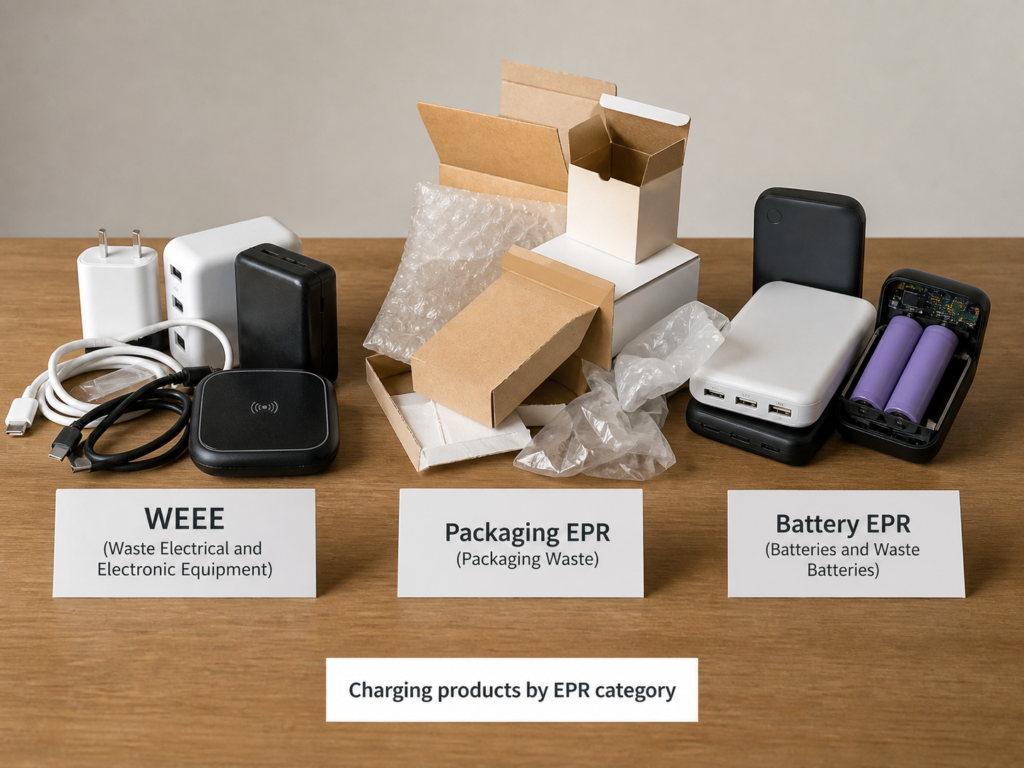
First, clarify the products that need to be evaluated: wall chargers, car chargers, fast charging heads, and independent power adapters — these basically all belong to the electrical and electronic products covered by WEEE, and definitely require compliance assessment.
There are also two categories that need to be judged in combination with the rules: One category is cables with electronic components, such as data cables with fast charging chips. Whether they are counted depends on the rated voltage of the product and the classification catalog of the target country; not all cables with chips are within the scope. The other category is purely passive cables without electronic components, such as ordinary USB-C charging cables. Whether they are counted depends on whether they are sold independently and the rules of the competent authority of the target country; in some countries, independently sold purely passive cables also require compliance.
For sets or combo packs, accessories sold separately must be evaluated as independent products. For example, if you sell fast charging heads separately and data cables separately, you need to evaluate them respectively. If the cable is a free gift with the purchase of a charging head, it must be judged according to the rules of the target country; in some countries, accessories given away with the main product do not require separate compliance, while in others they do. If you are unsure, it is recommended to directly consult the competent authority of the target country or an authorized PRO institution to avoid pitfalls.
In addition to WEEE, you also need to evaluate other EPR obligations:
First is packaging EPR. All products placed on the EU market with packaging need to be evaluated, whether it is the inner packaging of the product (such as the color box of a charging head), outer packaging, or the outer carton for logistics shipping — all are included. The core is to see whether you are the entity that places packaged products on the market.
Then is battery EPR, which is only triggered for charging products with built-in or external batteries. Ordinary wall chargers and power adapters do not contain batteries themselves, so they do not need battery EPR.
There are also small items such as paper manuals and labels. Whether they are counted depends on the rules of the target country, to judge whether they involve other EPR categories such as printed matter. These have little impact on charging products, so a basic understanding is sufficient.
You can use the quick decision table below for preliminary assessment, but the final conclusion shall still be subject to official rules:
| Assessment Dimension | Content to Confirm (Reference for Charging Products) |
| Product Type | Wall charger / car charger / data cable with chip / purely passive cable / power bank, etc. |
| Target Country | EU countries where sales have been launched or are planned |
| Selling Entity | Chinese cross-border seller / EU-based importer / brand owner |
| Sales Model | FBA / FBM / Pan-European Program |
| Battery Included | No battery (ordinary wall charger) / built-in / external battery (power bank) |
| Packaging Level | Inner packaging only / inner + outer packaging / including logistics packaging |
| In-Country Responsible Party | Existing responsible entity / none |
After organizing the information through this table, you can initially draw three conclusions: the EPR categories that require compliance (such as WEEE + packaging EPR), the countries that require registration, and the entity qualifications that need to be supplemented (such as EU authorized representative).
Amazon Platform Compliance Requirements
After clarifying whether you need to comply, let’s talk about the specific requirements of the Amazon platform.
First are the vouchers to prepare and the upload entry: The essential item is the EPR registration number for the corresponding country and corresponding product stream, such as the German WEEE number and the French packaging EPR number. Numbers for different product streams must be prepared separately; in some scenarios, you also need to supplement cooperation certificates from recyclers or PROs, and sample diagrams of compliance labels. The upload entry is in the “Extended Producer Responsibility (EPR)” section under the “Compliance” tab in Seller Central.
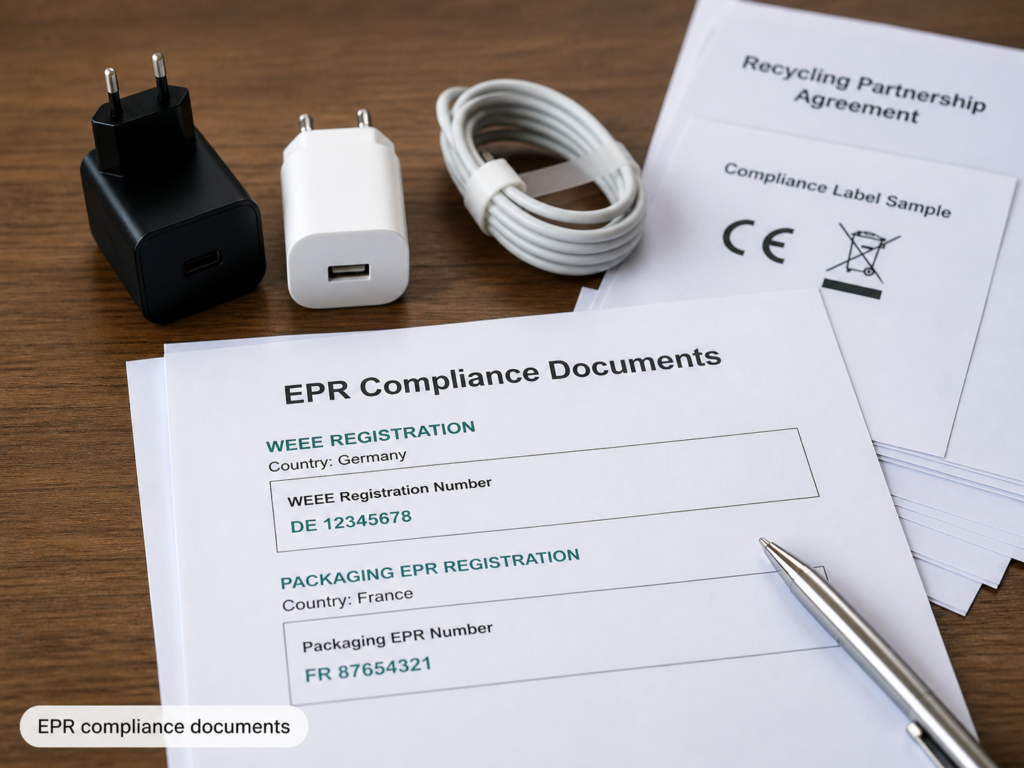
Next, let’s talk about the platform’s audit logic and when checks occur: The platform does not only check whether your registration number is real or fake, but conducts matching verification along three dimensions: “country + product category + selling entity/brand”. For example, if you use another company’s WEEE number, even if the number is real, if the entity does not match your store, you will not pass. Amazon may request or review EPR information during its compliance reviews and policy enforcement; the audit time and trigger conditions are subject to the notifications issued by Seller Central for specific sites, product streams, and accounts. Do not arrange or promise based on fixed working days.
Many sellers tend to confuse the boundary between platform requirements and legal obligations. It must be clarified here: Platform requirements only verify whether you have compliance vouchers, and do not bear legal responsibility on your behalf; while your legal obligations as a producer, including registration, periodic declaration, payment, and product labeling compliance, must all be fulfilled by yourself.
Fees and platform measures also cannot be generalized. When valid EPR information is not provided, Amazon may restrict the sale of relevant products in accordance with applicable site policies, or charge sellers corresponding fees in countries and product streams where it provides performance on behalf of sellers and collection of ecological contributions. The specific applicability, fee range, and account measures are subject to the current EPR policy of the site and backend notifications. Platform measures do not replace the seller’s legal obligations; even if the platform performs on behalf of the seller or collects fees, it does not mean that the seller has completed all registration, declaration, payment, and labeling obligations.
In case of non-compliance, the platform may take measures such as restricting display, removing listings, suspending sales, or requiring supplementary materials for relevant products. The specific consequences depend on the site, product stream, violation situation, and current policy. Penalties from regulatory authorities may also occur concurrently. You cannot simply judge based on a unified EU-wide “mild – moderate – severe” grading, nor can you regard fund freezing as a fixed penalty for EPR violations.
Compliance Differences Among Major EU Countries
Many sellers ask: Isn’t the EU a union? Why can’t one number be used universally? A core principle must be clarified here: The EU only issues framework directives, and each country implements them independently. You must register separately according to the target countries where you actually sell. A registration number from one country can only be used in that country and cannot cover the entire EU. Even if you have activated the FBA Pan-European Program, that is only a logistics service and does not replace your compliance obligations; you need to register in as many countries as you sell in.
Below are the key differences among several major countries to help you prepare accordingly:
First is Germany, where verification requirements are relatively strict. German WEEE registration is managed by Stiftung EAR (German Foundation for Registration of Electrical and Electronic Equipment) in accordance with the German Electrical and Electronic Equipment Act. The core voucher is the WEEE-Reg.-Nr., which must correspond one-to-one with the producer, brand, and equipment category, and cannot be used interchangeably.
German packaging compliance usually includes two parts: First, complete registration in the LUCID Packaging Register of the German Central Packaging Register Office (ZSVR) and obtain a packaging registration number; for packaging that requires system participation, you must also separately complete system participation with a dual system operator and declare the packaging volume as required. LUCID registration and system participation are two independent obligations and cannot replace each other.
For labeling, the crossed-out trash bin symbol is required, and its size, durability, and placement must comply with German rules. For example, it should preferably be printed on the product body and be wear-resistant and not fall off. For official verification, you can query through the Stiftung EAR system, but some information is only visible to producers or authorized representatives, not everyone can check it.
Next is France, where labeling requirements are relatively detailed. French producers shall complete registration in ADEME’s SYDEREP system according to the applicable product stream and obtain the unique identification code IDU (identifiant unique). The way to fulfill producer responsibility, whether to join the corresponding PRO, and whether there are other available methods must be confirmed according to the specific product stream and current French rules. It cannot be simply understood that in all cases you must first join a PRO and pay fees before obtaining an IDU.
France’s Triman and Info-tri are also not universally applicable to all electronic products and all packaging. They shall be set in accordance with France’s current rules on applicable household sorted disposal products, packaging, and related exemptions; for electrical and electronic products, you must also separately verify independent labeling requirements such as the WEEE crossed-out trash bin symbol. Official verification can be done by querying the registration status through ADEME or the corresponding PRO system.
Several other major countries also have their own requirements: In Spain, the responsible entity is the producer or importer that places products on the market, who registers through the corresponding PRO institution and needs to upload the corresponding registration number; in Italy, WEEE producers shall complete registration in the National AEE Producer Register and obtain the corresponding number, and fulfill the obligations of the recycling system in accordance with applicable rules. For packaging, you must also separately verify requirements such as CONAI membership, declaration, and payment; joining a collective recycling system does not automatically replace statutory registration; the Netherlands and Sweden have both established EPR registration systems, and you join PRO institutions separately for different product streams, with declaration cycles and labeling requirements subject to their own national rules. A special reminder: After Brexit, the UK no longer applies the EU’s WEEE/EPR framework. Amazon UK requires separate compliance, and EU numbers cannot be used.
Finally, a unified reminder: The rules of each country are dynamically updated, so be sure to refer to the latest official announcements of the target country.
Full-Process Compliance Practical Steps
After finishing the rules, let’s talk about how to do it specifically, in five steps:
Step 1: First Conduct Preparatory Information Sorting
First is product sorting: List all the charging products you are selling or plan to sell clearly, including model, weight, whether it has electronic functions, whether it has a battery, and how many layers of packaging it has. For example: 20W wall charger, weight 50g, has electronic functions, no battery, packaging is color box plus outer carton.
Then is country sorting: List clearly the EU countries where you have launched or plan to launch sales, and prioritize markets with stricter verification such as Germany and France. Next is category sorting: Confirm the EPR product streams you need to comply with. Generally, for charging products, it is WEEE plus packaging EPR, and for products with batteries, add battery EPR.
Finally is entity sorting: Confirm whether you have a responsible party or authorized representative within the EU. Sellers outside the EU should check country by country whether it is mandatory to appoint a local authorized representative or other local responsible entity, and cannot treat this requirement as a unified condition that is exactly the same for all countries and all product streams.
Step 2: Choose the Appropriate Method to Complete Registration
There are currently two compliance paths: One is self-registration, which is suitable for sellers with strong language skills, who only operate in 1 to 2 countries, and have simple product categories. For example, if you are good at German, only sell on the German site, and only have fast charging heads as products, you can register with the German EAR by yourself. The other is to register through an authorized service provider, which is suitable for sellers with multi-country layouts, tight schedules, and many product categories. For example, if you operate on four sites: Germany, France, Italy, and Spain, and your products include fast charging heads, data cables, and power banks, it is more convenient to find a service provider.
When choosing a service provider, you should verify the service provider’s entity identity, whether it has the authorized representative qualification required by the target country (if applicable), the actual cooperation authority with PROs or registration bodies, the scope of services, and whether it can provide official registration or declaration vouchers. Do not equate general commercial service publicity with authorization from competent authorities, nor judge whether a service provider is reliable solely based on claims such as “guaranteed pass” or “has official channels”.
The materials required for registration generally include: store entity information, brand information, product category/weight/estimated annual sales volume, and authorized representative information (if required). Fees generally consist of three parts: registration fee, annual management fee, and recycling fee charged by weight or number of items. They vary by country, category, and sales volume, and there is no unified pricing.
Registration processing time varies greatly depending on the country, product stream, completeness of materials, authorized representative, and guarantee requirements. You should confirm the schedule with the target country’s registration body, PRO, or qualified authorized representative as early as possible before planning to sell or warehouse goods. Do not make promises based on a unified “2 to 8 weeks”, nor wait until the goods are about to be shipped to start preparing.
Step 3: Make Product-Side Compliance Adjustments
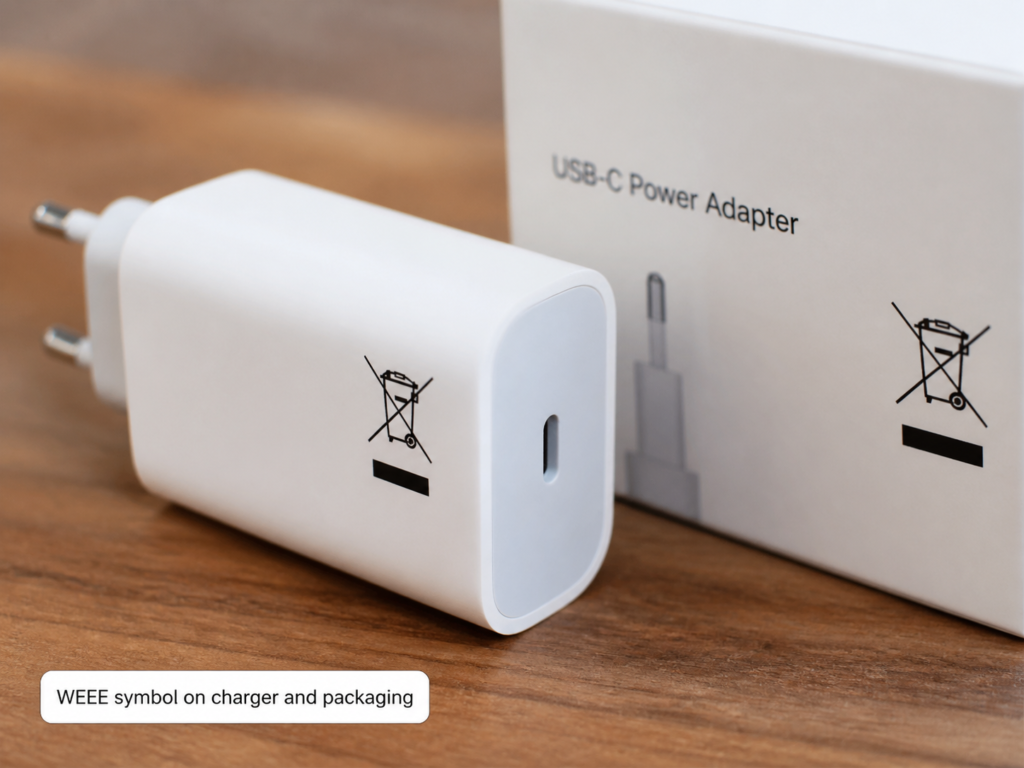
First is the WEEE crossed-out trash bin symbol, which shall be marked in accordance with the requirements of the target country, preferably on the product body. For example, it can be on the bottom or side of a fast charging head. For small products that are too small to be labeled, such as thin data cables and mini chargers, they can be printed on the packaging or manual in accordance with the rules.
Material codes, sorted disposal information, and other labels on packaging shall be checked country by country. You cannot default to all countries requiring unified labeling of material information. Applicable products in France usually must comply with the Triman/Info-tri rules; for other countries, whether material labeling is required, the label content and placement shall be subject to their own national packaging regulations.
Labels shall use processes that meet the target country’s requirements for clarity, visibility, and durability. Silk screening or fixed labels that meet durability requirements may both be applicable. The key is to control wear resistance, adhesion, and readability in practice to prevent the label from falling off or becoming unrecognizable under normal use conditions.
Step 4: Upload Vouchers to Amazon Seller Central
When uploading, note that registration numbers for different countries and different product streams must be uploaded separately. For example, the German WEEE number and the German packaging EPR number must be uploaded separately, do not upload them together.
Before uploading, check carefully: whether the entity, brand, and product category corresponding to the registration number are consistent with your store information, otherwise it is easy to fail the audit. After uploading, save the upload records and audit result notifications properly for future verification.
Step 5: Do a Good Job of Subsequent Continuous Compliance Maintenance
First, do a good job of data ledger management. Count the product category, unit weight, packaging material and weight, whether it contains a battery, and sales volume in the target country for each SKU according to the declaration cycle, otherwise it will be a mess when declaring.
Then is periodic declaration: Declare according to the cycle required by the target country (quarterly, semi-annual, or annual), and the declaration scope must comply with local rules. Here are a few common pitfalls: FBA cross-border inventory transfers and cross-border returns cannot be uniformly deducted arbitrarily by yourself; you must confirm whether they can be deducted according to local rules.
Whether B2B transactions can be excluded, deducted, or have recycling responsibility borne by other entities must be handled in accordance with the specific rules and proof requirements of the target country for professional equipment, packaging, and battery product streams, and cannot be deducted on your own solely based on contracts. Relevant transaction materials and proof of responsibility division shall be properly retained.
Underreporting or omission may result in retroactive collection of fees and fines. Be sure to declare according to actual data. After declaration, pay fees on time, pay recycling and treatment fees according to the declared volume, and keep official payment vouchers properly.
When there are new countries, new products, or new brands, you must supplement registration or update information in a timely manner. Finally, all vouchers for registration, declaration, payment, and platform notifications must be kept properly. The retention period shall be implemented in accordance with the statutory requirements of the target country. Don’t throw them away casually, as it will be troublesome when checked later. The consequences of non-declaration or non-payment are subject to the target country’s system, which may include retroactive collection, fines, suspension or revocation of registration, and other measures.
Pitfall Avoidance and Validity Judgment
In the process of compliance, many sellers tend to fall into various pitfalls. We have sorted out the 10 most common misconceptions to help you avoid them by type:
First are three common mistakes in entity cognition. The first is thinking that self-fulfilled sellers don’t need to comply. In fact, FBM does not automatically exempt you. The core of whether you need to comply is whether you are the “producer” in the regulations. As long as you are the entity placing products on the EU market, even if you ship directly from China, if you meet the requirements of the target country’s distance selling rules, you must bear responsibility.
The second is thinking that borrowing the registration number of a supplier or factory is enough. You should know that registration numbers are usually bound to a specific placing entity, brand, or product stream. The factory’s WEEE number is registered by the factory as a producer. If you sell under your own brand and in your own store, you need to confirm whether you are the placing entity, and whether there is legal authorization and applicable responsibility arrangements. Using the factory’s number without authorization may not only fail the platform audit, but also may not be considered compliant if actually checked by regulators.
The third is confusing VAT and EPR. Many people think that having a VAT number can be used as EPR. In fact, the two are completely independent systems. VAT is for tax payment, and EPR is for environmental protection recycling. Just like ID cards and social security cards, both are documents but have completely different uses and cannot be used interchangeably.
Next are four misconceptions about product classification. The first is that with CE compliance, you don’t need to do WEEE/EPR. The CE mark indicates that the manufacturer has completed the conformity assessment in accordance with applicable EU harmonized legislation and issued an EU Declaration of Conformity, and applicable requirements may include electrical safety, electromagnetic compatibility, radio equipment, and restriction of hazardous substances, etc.; WEEE involves the registration, recycling financing, and related labeling of electrical and electronic products. The two belong to different systems, and CE compliance cannot replace WEEE/EPR obligations.
The second is that cables with chips necessarily belong to WEEE. In fact, whether they are counted depends on the rated voltage and the classification catalog of the target country; not all cables with chips are within the scope.
The third is that purely passive cables definitely do not belong to WEEE. This is also wrong. It depends on whether they are sold independently and the rules of the competent authority of the target country; in some countries, independently sold purely passive cables also require compliance.
The fourth is that only registering WEEE is enough, and you don’t need to care about packaging EPR. In fact, all products placed on the EU market with packaging usually need to evaluate packaging EPR obligations. You can’t ship charging heads naked; color boxes and outer cartons are all considered packaging, and basically all need to be done.
Then is the misconception about country scope: Many people think that one registration number can be used to sell across the entire EU. In fact, the EU only issues framework rules, and each country implements and registers independently. A registration number from one country can only be used in that country and cannot be used universally across the EU. Even if you have activated the FBA Pan-European Program, that is only a logistics service and does not bear compliance obligations on your behalf; you need to register in as many countries as you sell in.
Finally are two misconceptions about compliance itself. The first is that passing the platform audit equals full compliance. The platform only checks whether you have uploaded compliance vouchers. As for whether you have declared periodically, labeled as required, or paid fees — these legal obligations are not managed by the platform, and you must fulfill them yourself. Passing the audit does not mean you are fully legal.
The second is that after registration, you don’t need to care about it anymore. Registration is only the first step; you still need to declare and pay fees periodically later. The consequences of non-declaration or non-payment are subject to the target country’s system, which may include retroactive collection, fines, suspension or revocation of registration, and other measures. Some sellers also think that Amazon’s collection of relevant performance-on-behalf or ecological contribution fees equals compliance. In fact, platform measures cannot replace the seller’s obligations to complete registration, declaration, payment, and labeling in accordance with the law.
So how to judge whether the compliance you have done is really valid? You can verify it from three aspects:
The first is registration number verification. The verification channel is querying through the official registration system of the target country or the system of the PRO institution. But note that in some countries, query permissions are only open to producers and authorized representatives. The service provider’s own database is not equivalent to official proof. Don’t just believe the service provider’s claim that it is valid. When verifying, focus on checking: whether the entity name, brand, product category, registration status, effective date, and declaration coverage match your actual situation.
The second is product labeling verification. Against the current rules of the target country, check whether the type, size, clarity, and placement of the label meet the requirements. Common non-conformities include insufficient size, blurry printing, wrong position, and lack of sorting instructions. These small problems may also lead to non-compliance.
The third is declaration record verification. Confirm that each declaration has an official receipt, the fees have been paid on time, and there are no overdue records. The specific materials that need to be saved and the consequences of being overdue shall be subject to the target country’s system.
If the platform audit fails after uploading the voucher, you can troubleshoot in order from easy to difficult: First, check whether the country and product stream category corresponding to the registration number match the site and products you sell. For example, if you sell on the French site but upload a German WEEE number, you will definitely not pass. Then check whether the entity and brand corresponding to the registration number are consistent with your store’s registration information. For example, if your store is registered by Company A and the number belongs to Company B, the entity mismatch will also cause failure. Next, check whether the registration certificate is within the validity period, whether its status is normal, and whether key pages are missing. Then check the product labeling and product information on the detail page to see if they conflict with your declared content. For example, if you declared an ordinary wall charger without a battery, but the detail page says it is a power bank with a battery, the information mismatch will also result in rejection. If all of the above are fine, then contact platform customer service or the registration body to verify the specific reason.
Overall, charging product sellers on Amazon EU sites can complete basic compliance and avoid most pitfalls as long as they understand the logic, applicability boundaries, platform requirements, country differences, and practical steps of EPR and WEEE. Things you can complete independently include: preliminarily judging the EPR categories you need to comply with, using the four-step method to confirm the responsible entity and the countries that require registration, completing the basic operations from information sorting, registration to platform upload step by step, and also verifying the validity of compliance by yourself and troubleshooting common reasons for platform audit failures. Of course, the rules of each country are dynamically adjusted. Pay more attention to the official announcements of the target country and the latest notifications from Amazon Seller Central in normal times, and consult official or qualified professional institutions in time when you are unsure, so you can avoid detours.