
Friends who do cross-border charging-related businesses have more or less encountered situations where goods are detained at EU customs — you clearly ship wireless chargers with batteries, declare them as “electronic accessories”, and end up being found to have concealed the battery, resulting in not only the goods being detained but also possible follow-up actions. After the official implementation of the EU’s new battery regulation, customs inspection rules for battery-containing products are clearer, but many sellers still do not understand which products are subject to inspection, what documents to prepare, and what to do if goods are detained. This article explains in detail the customs inspection rules under the EU’s new battery regulation from basics to practical operation, and also compares the differences with the US and Southeast Asian markets. It can be directly used by new sellers, importers, and logistics practitioners alike.
First, Get the Basics Right: Fundamental Knowledge and Common Misconceptions
First of all, a core premise must be clarified: customs inspection is an independent law enforcement act of the importing country. Battery compliance is only an important condition to be considered during customs clearance and market entry. It does not mean that compliance will definitely avoid inspection, nor that passing customs means everything is fine. This guide focuses on the relevant requirements of the EU’s new battery regulation (EU 2023/1542), mainly covering common product categories such as power banks, wireless chargers, battery-powered charging accessories, chargers, data cables/connectors, and will conclude with a comparison of differences with the US and Southeast Asian markets.
Core Terms You Must Understand
Before explaining the specific rules, let’s clarify a few commonly heard but easily confused concepts, so that you won’t be confused when reading the following content:
• **UN38.3 Test**: This is the transport safety test for lithium cells and lithium batteries specified in Section 38.3 of Part III of the , covering conditions that may occur during transport such as vibration, shock, high and low temperatures. Lithium cells and batteries shall meet the applicable UN38.3 test requirements and provide a UN38.3 test summary in accordance with applicable transport rules. Whether a full test report and SDS/MSDS need to be submitted depends on the carrier, mode of transport, destination country, and case-specific regulatory requirements.
• **CE + DoC**: Basic compliance content for EU market access. CE is the mark affixed by the manufacturer after completing the applicable conformity assessment; DoC is the EU Declaration of Conformity signed by the enterprise, equivalent to the enterprise’s “compliance guarantee”, and the enterprise shall be responsible for the product’s compliance with applicable EU regulations.
• **Battery Passport**: A digital identity file for the entire life cycle of batteries. It will apply to electric vehicle batteries, LMT batteries, and industrial batteries with a capacity exceeding 2 kWh from February 18, 2027. Ordinary consumer power banks and wireless chargers are usually not within this scope.
• **UN Code (Dangerous Goods Classification)**: Classification number for lithium battery transport. Lithium-ion batteries transported alone are usually UN3480; lithium-ion batteries contained in equipment, or packed with equipment but not contained in equipment, are usually UN3481. The specific UN number, lithium battery mark, and Class 9 dangerous goods label shall be determined in accordance with the packing instructions of the mode of transport such as air and sea transport.
• **Recycling Mark (crossed-out trash bin)**: Commonly found on batteries or electrical and electronic products, indicating that they cannot be disposed of with household waste and shall be recycled separately in accordance with applicable rules. Whether it should be affixed to the battery itself, the whole product, or the packaging needs to be checked separately against the battery regulation, WEEE rules, and member state requirements.
Three Most Common Misconceptions That Lead to Pitfalls
Many sellers violate regulations due to cognitive errors. Here we first correct the three most common ones:
First, **Passing customs ≠ permanent compliance**. Entry is only the first hurdle. After products enter the EU market, member state market surveillance authorities may still conduct random inspections. If non-conformity is found, member states may take measures such as fines, sales restrictions, and recalls in accordance with their own penalty rules; the specific penalty amount and calculation method vary by member state.
Second, **It is not only pure batteries that need to pay attention to battery requirements**. Wireless chargers with built-in batteries, magnetic charging docks, even spare button batteries given away with goods, and small batteries in luminous charging cables may all fall within the scope of corresponding battery, transport, or product safety rules.
Third, **Not all “rechargeable” products are regulated by the battery regulation**. Pure plug-in chargers without batteries, power adapters, as well as ordinary charging cables and adapters without batteries, usually do not fall within the scope of batteries under the battery regulation; but they may still need to comply with other product regulations such as low voltage, electromagnetic compatibility, and RoHS, which cannot be interpreted as “no compliance required at all”.
First, Judge: Is Your Product Within the Regulatory Scope?
After clarifying the basic concepts, let’s make the first judgment: whether your product is affected by the EU battery regulation and related customs requirements.
The entry process is the responsibility of EU and member state customs, and post-market entry supervision is the responsibility of each member state’s market surveillance authority. The relevant legal bases include the EU’s new battery regulation, EU customs rules, transport dangerous goods rules, and other applicable product regulations. The EU battery regulation applies in principle to all types of batteries placed on the EU market or put into use; goods entering the EU may also be bound by customs, transport dangerous goods rules, product safety rules, and member state implementation measures.
Bulk cargo by sea, direct mail parcels, and free samples are not automatically exempt from applicable requirements, but special situations such as temporary admission, transit, and repair circulation shall be judged according to the actual customs procedures and product use. The consequences of violations also vary by stage: during entry, release may be suspended, supplementary information may be required, or other dispositions may be taken; after market entry, you may face recalls, removal from shelves, sales restrictions, or fines prescribed by member state laws.
For your quick reference, we have compiled the situation of common charging products into a table:
| Category | Specific Product Examples | Is It Usually Necessary to Pay Attention to EU Battery Regulation and Related Requirements? |
| Requires attention (built-in battery category) | Power banks with batteries, wireless chargers, magnetic charging docks | Yes |
| Requires attention (batteries included with goods category) | Spare lithium batteries for chargers, button batteries in luminous charging cables | Yes |
| Requires attention (independently sold category) | Replacement lithium batteries for charging devices, separately sold button batteries | Yes |
| Not within the scope of batteries under the battery regulation (pure passive accessories) | Ordinary charging cables, data cables, non-powered connectors, adapters | Usually no, but other product rules may still apply |
| Not within the scope of batteries under the battery regulation (pure plug-in category) | Battery-free chargers, power adapters, car chargers | Usually no, but other product rules may still apply |
| Requires case-by-case judgment | Second-hand, refurbished, bulk, button batteries | Shall be judged according to specific product safety, transport dangerous goods, waste, and member state market access rules; there is no unified list of prohibited entry goods |
Customs and Transport Declaration: The First Hurdle for Goods to Enter
After confirming that the product requires attention to relevant requirements, let’s first talk about the frontmost transport and declaration stage — if this step is not done well, the goods may not even be arranged for transport smoothly, and may even be rejected by airlines, freight forwarders, or shipping companies.
In addition to EU customs, the competent authorities for this stage also include transport carriers, such as airlines, shipping companies, and freight forwarders. Relevant rules include EU customs law, IATA DGR dangerous goods rules for air transport, and IMDG rules for sea transport. Battery-containing products shall be handled in accordance with applicable rules during transport and entry declaration; violations may lead to rejected declarations, rejection by transport companies, suspension of release, detention of goods, or other penalties.
Information and Documents to Prepare for Declaration
When declaring customs, first of all, the correct commodity classification shall be used, and the goods shall be truthfully described. You cannot vaguely write battery-containing products as “electronic accessories” to muddle through.
Information such as battery chemistry, quantity, and rated energy is not a unified fixed field on all EU general import declaration forms, but shall be accurately provided when required by the carrier’s dangerous goods review, transport documents, or customs case-specific requirements.
Common contents that need to be prepared or available at any time include:
• **Basic declaration information**: Correct HS code, true goods description, and information such as battery type, quantity, and rated energy when requested.
• **Transport safety documents**: Confirm that lithium cells or batteries meet the applicable UN38.3 test requirements, and prepare the UN38.3 test summary. Whether to submit the full test report and MSDS/SDS shall be subject to the requirements of the carrier, mode of transport, destination country, and specific case.
• **Air transport documents**: Whether a shipper’s declaration of dangerous goods, lithium battery mark, hazard label, and specific packaging are required cannot be judged solely by whether the battery reaches 100Wh, but also by the battery type, UN number, whether it is transported alone or with equipment, the quantity per package, and the applicable IATA packing instruction.
How Does Customs Select Your Goods? The Logic of Inspection Deployment
Many people think that customs inspects every shipment, but that is not the case. Inspections are usually carried out in combination with random sampling and risk management. Customs will decide whether to conduct inspection based on factors such as declaration information, nature of goods, past records, intelligence, or market surveillance cooperation.
Concealing the battery attribute, inconsistent declaration parameters, obviously unreasonable commodity classification, and safety risks of goods may all increase the possibility of further inspection. Products such as removable batteries, button batteries, and high-capacity batteries are not automatically classified as “high-risk categories” uniformly stipulated by the EU, but due to their more complex transport and product safety conditions, operators shall pay special attention to the consistency of documents and packaging.
What Is Checked During On-Site Inspection?
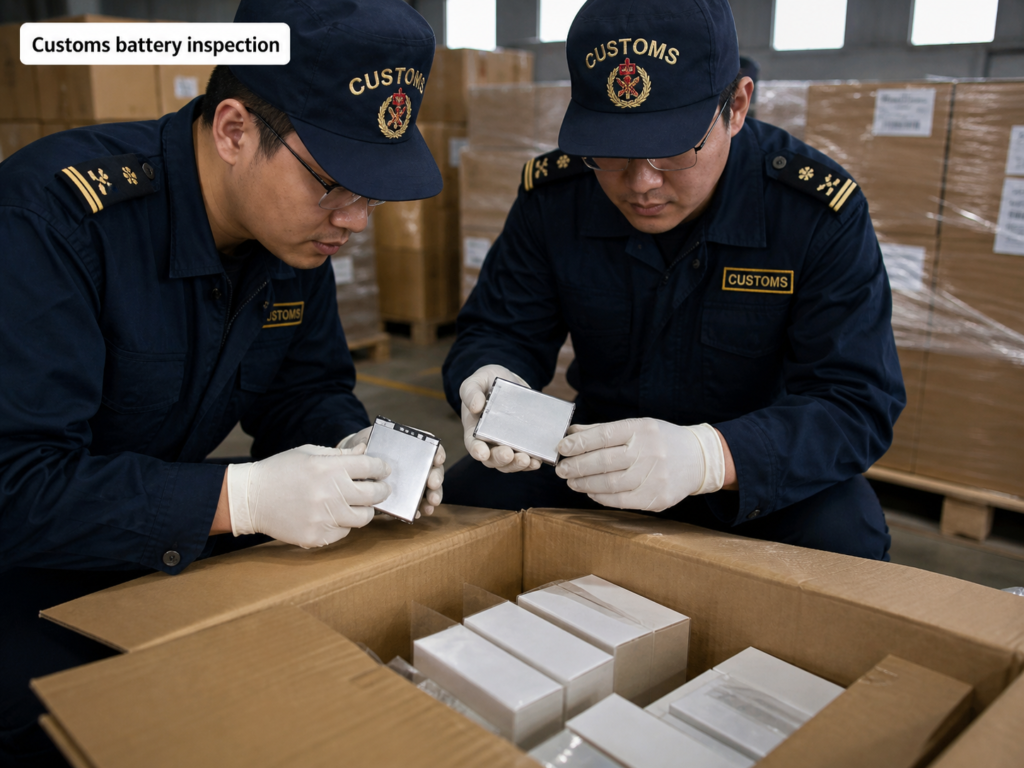
If selected for inspection, the competent authority may focus on verifying the following contents:
First is **appearance safety inspection**: check whether the battery is damaged, leaking, or bulging, whether the terminals are exposed, and whether there is a short circuit risk;
Second is **declaration consistency check**: verify whether the physical information such as battery type, quantity, and capacity is consistent with the declaration, transport documents, or product materials;
Third is **packaging inspection**: check whether short-circuit prevention and anti-extrusion protection are properly done, and whether transport marks, labels, and packaging comply with applicable transport rules. Lithium-ion batteries transported alone usually involve UN3480; those contained in equipment or packed with equipment usually involve UN3481, but the specific marks and labels cannot be mechanically judged solely by the UN number.
If the competent authority suspects that the product is non-conforming, it may suspend release in accordance with applicable procedures, and the relevant competent authority shall take verification, sampling, or other measures. Whether to send for inspection, who conducts the inspection, how the cost is borne, and how long it takes shall all be subject to member state laws, customs decisions, and case-specific notifications.
Several Handling Methods for Inspection Results
The handling method after inspection depends on the nature of the problem and the decision of the competent authority. Common situations include:
• **Meets requirements**: Can be released normally.
• **Document or labeling issues**: The competent authority may allow supplementary documents, explanation of the situation, or other corrective measures, but whether correction is allowed and the specific costs shall be subject to case-specific notifications.
• **Serious safety risks or major declaration issues**: Release may be suspended, goods may be returned or destroyed, or the competent authority may take further law enforcement measures.
• **Objection handling**: If you have objections to the inspection result, you shall apply for review or relief in accordance with the procedures, time limits, and material requirements notified by the local customs or competent authority.
It should be noted that for customs risk management, follow-up inspection frequency, and enterprise risk assessment, there is no unified “EU customs high-risk list” rule that this article can generalize. The specific situation still depends on the member state and case-specific procedures.
Market Access Compliance: You May Still Be Fined After Passing Customs
Many people think that passing customs means everything is fine. In fact, customs may exercise control under the framework of market surveillance cooperation during entry; even if no problems are found at the time, penalties may still be imposed if the market surveillance authority finds non-conformity after market entry.
The competent authority for this part is the market surveillance authority of EU member states, and customs may cooperate in control during entry. As long as a product is placed on the EU market, it needs to meet the regulatory requirements applicable to the product and its battery. The consequences of violations may include product recall, fines, removal from platform shelves, sales restrictions, or market access prohibition, subject to the implementation rules of each member state.
Labeling Requirements Shall Be Viewed Separately
Labeling requirements for batteries, whole products, and packaging cannot be lumped together. Different products may be subject to the battery regulation, WEEE, general product safety rules, as well as other regulations such as low voltage and electromagnetic compatibility at the same time.
Operators shall confirm separately:
• What information is required on the battery itself;
• What labels are required on the battery-containing whole product;
• Whether there are separate requirements for packaging;
• Whether the CE mark is required;
• Whether there are requirements for battery chemistry, capacity, QR code, recycling mark, etc.;
• Whether it involves safety, warning, or packaging requirements for button or coin battery products.
Most battery labeling information in Article 13 of the EU battery regulation, including requirements for partial capacity, chemistry, manufacturer information, and QR codes, shall be implemented in accordance with the effective dates specified in the regulation, and are not fully applicable to all products starting from 2024.
Anti-ingestion safety measures, warnings, and packaging requirements related to button or coin batteries should also not be simply interpreted as “uniformly affixing anti-ingestion warnings starting from 2024”. They shall be confirmed item by item in accordance with applicable product safety regulations, harmonized standards, and member state requirements.
Text information shall be in a language required by the member state and easily understood by consumers, and should not be generally interpreted as all labels must use a certain “official language of the country of sale”.
Required Compliance Documents
Market access documents cannot be summarized by a single “CE test report”. EU regulations do not uniformly stipulate that all battery-containing charging products must issue a “CE test report” with a fixed name, let alone a general rule that “the whole product report must include battery test data, otherwise it is invalid”.
A more reliable approach is:
1. **Identify applicable regulations**: Batteries and whole products may be subject to different regulations. In addition to the battery regulation, battery-containing products may also be subject to low voltage, electromagnetic compatibility, radio equipment, RoHS, or general product safety rules.
2. **Retain technical documents and test evidence**: Technical documents shall be able to support the conformity assessment. What test evidence is required depends on the product type, applicable regulations, and actual risks.
3. **Sign the EU Declaration of Conformity (DoC)**: The manufacturer shall sign the Declaration of Conformity in accordance with applicable regulations.
4. **Affix the CE mark**: The CE mark shall only be affixed after the product meets applicable requirements and the corresponding conformity assessment is completed.
5. **Prepare information on the responsible person within the EU**: Where applicable, there shall be information on traceable economic operators or responsible persons within the EU.
Don’t Confuse: Transport Documents and Market Access Documents Cannot Replace Each Other
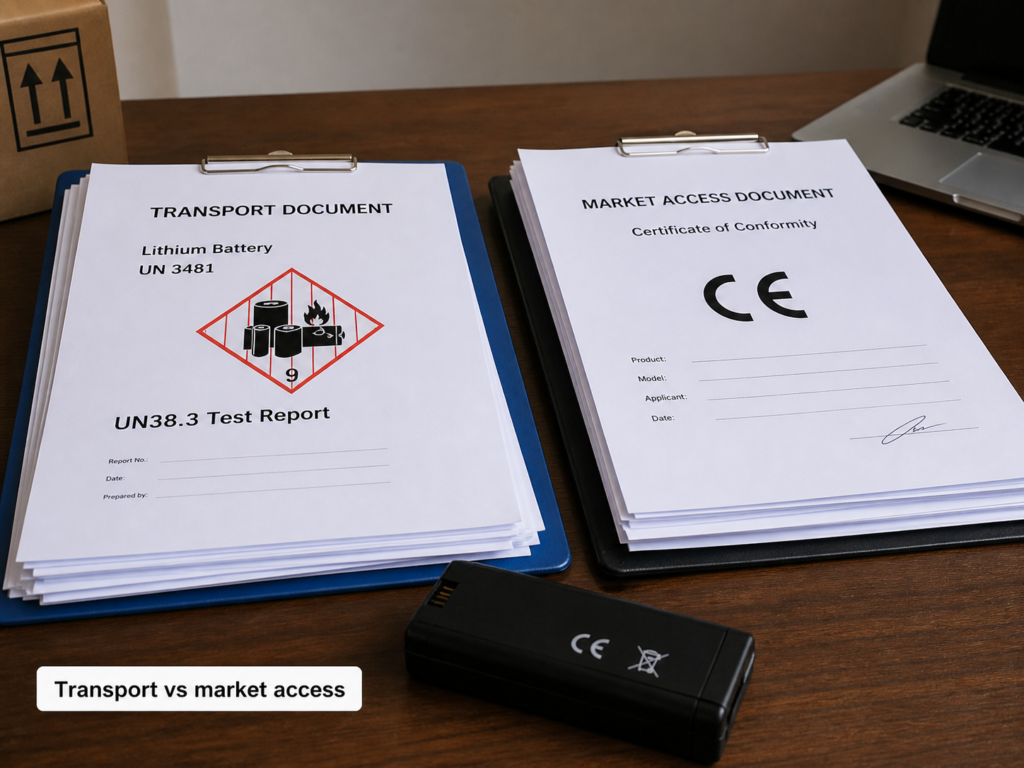
Many sellers confuse transport documents with market sales documents, thinking that with UN38.3 they don’t need CE, or with CE they don’t need to consider transport rules. In fact, these two types of requirements are completely different things and cannot replace each other:
| Document Type | Common Documents or Materials | Purpose | Can It Replace the Other Type? |
| Transport safety category | UN38.3 test summary, dangerous goods documents required by the carrier, SDS/MSDS (if applicable) | For use by carriers, freight forwarders, or transport audits | Cannot replace market access documents |
| Market access category | EU Declaration of Conformity, technical documents, applicable test evidence, information on EU responsible person | For verification by market surveillance, platforms, or economic operators | Cannot replace transport safety documents |
The quick judgment method is very simple: see whether the document is prepared for transport safety and carrier review, or for product placement on the market and conformity assessment. Both types of requirements may need to be met, but the required documents shall be determined according to the product and transport scenario.
Producer Responsibility and Recycling: Cannot Only Look at the Product Itself
In addition to safety requirements, another key focus of the EU’s new battery regulation is producer responsibility and recycling. Many sellers only prepare transport documents but ignore the registration and recycling obligations in the country of sale, and may still encounter platform or market surveillance problems later.
The recycling link involves the competent authorities of EU member states, producer registration systems, and producer responsibility organizations that may participate in fulfilling obligations. As long as it is a “producer” that places batteries or battery-containing products on the EU market, it usually needs to fulfill its responsibilities in accordance with the implementation system of the country of sale. Specifically, who is a producer, whether the importer bears the responsibility, and whether it is necessary to fulfill responsibilities through a PRO depend on the member state’s system and the actual sales model.
Current Recycling Requirements to Pay Attention To
Mainly include the following contents:
1. **Producer registration and EPR obligations**: Producers placing batteries on the market of a member state shall complete registration and fulfill extended producer responsibility in accordance with the implementation system of the country of sale.
2. **Recycling fees**: The fee calculation method, paying entity, and implementing agency vary by country, and cannot be simply understood by a unified capacity standard.
3. **Recycling mark**: Marks such as the crossed-out trash bin shall be determined in accordance with the regulations applicable to the battery itself, the whole product, and the packaging respectively. It cannot be generally required that both the product and the packaging be affixed with the same label.
Customs may cooperate in control under the framework of market surveillance cooperation, but whether to suspend release, what certificates are required, and how to dispose must be decided in accordance with applicable procedures and specific notifications. There is no unified mechanism where all goods are routinely inspected for PRO registration certificates and goods are directly detained if problems are found.
Phased Implementation Requirements
There are also some requirements that are implemented in phases. Ordinary consumer charging products usually do not need to be prepared according to high-capacity battery standards immediately, but you should understand future changes:
• **Battery Passport**: From February 18, 2027, it applies to electric vehicle batteries, LMT batteries, and industrial batteries with a capacity exceeding 2 kWh.
• **Carbon footprint declaration**: Applicable categories include electric vehicle batteries, LMT batteries, and rechargeable industrial batteries with a capacity exceeding 2 kWh, and shall be implemented in accordance with the phased dates of the regulation and supporting acts.
• **Recycled material content**: Relevant minimum ratio requirements apply to industrial, SLI, and electric vehicle batteries, and do not apply to portable consumer lithium batteries; among them, the 16% recycled cobalt target applies from 2031.
Two Common Misconceptions About Recycling
First, **Recycling is not only related to environmental protection departments**. Market surveillance, platforms, producer registration agencies, and customs cooperation mechanisms may all be involved, but the specific law enforcement methods depend on the system of the country of sale and case-specific procedures.
Second, **Direct mail parcels do not automatically exempt from recycling responsibilities**. As long as products are placed on the EU market, usually you cannot skip applicable producer registration and EPR obligations just because the logistics method is direct mail parcels.
Pre-Shipment Self-Inspection: Core Method to Avoid Goods Detention
Having talked about so many requirements, in fact, as long as you do a good job of self-inspection before shipment, most basic risks can be discovered in advance.
First Prepare Three Types of Documents
Before shipment, sort out the documents by purpose first:
• **Transport declaration category**: UN38.3 test summary, accurate goods and battery information, as well as SDS/MSDS, dangerous goods documents, etc. required by the carrier or freight forwarder.
• **Market access category**: Technical documents under applicable regulations, EU Declaration of Conformity, test evidence supporting conformity assessment, and information on the EU responsible person where applicable.
• **Recycling compliance category**: Producer registration or EPR fulfillment documents required by the country of sale, as well as design and confirmation records of applicable labels.
Beginner 3-Step Self-Inspection Method
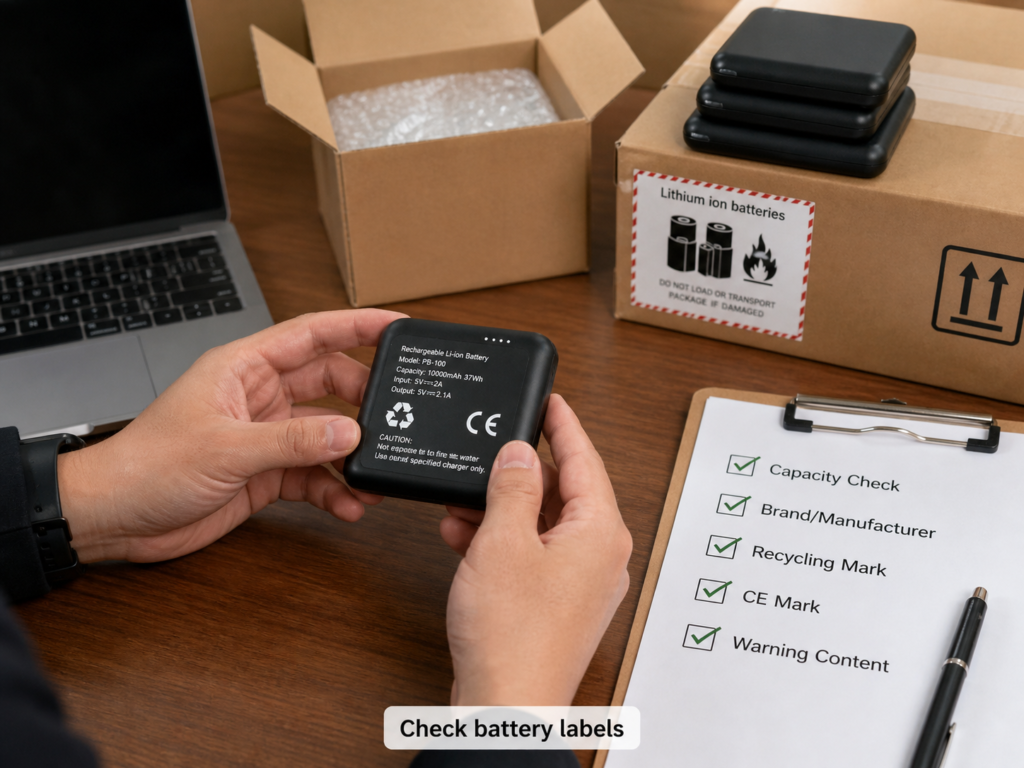
Friends who are new to the industry can remember these 3 steps to solve most basic problems:
1. **Check labels**: Check the capacity, brand or manufacturer information, applicable recycling mark, CE mark, and necessary warning content against the product. Note that different products have different labeling requirements. Do not force inapplicable requirements, and do not miss required content.
2. **Check documents**: Compare customs declaration information, physical labels, product specifications, and transport documents together to ensure there is no contradiction in battery type, capacity, quantity, and product model.
3. **Check packaging**: Confirm that the battery has been properly insulated and protected against short circuits in accordance with transport rules, the terminals are properly protected, and the outer packaging marks, labels, and anti-extrusion measures comply with the carrier and applicable transport rules.
Advanced: Compliance Validity Judgment (Semi-Proficient)
If you have been in the business for a while and want to further confirm whether the compliance documents are valid, you can look at these three points:
• **Test document coverage**: Confirm that the UN38.3 test summary covers the type of cells or batteries actually transported, as well as the corresponding manufacturing and design status. Whether product variants can share technical documents or test evidence shall be judged based on model differences, applicable standards, and the manufacturer’s technical assessment. It cannot be uniformly denied just because of different capacities, nor can they be used arbitrarily.
• **HS classification judgment**: Independently sold batteries, battery-containing whole products, and battery-free accessories shall be classified separately according to the actual goods, and cannot all be declared as “electronic accessories”, otherwise it is easy to cause declaration inconsistency problems.
• **Special goods circulation**: Exhibition samples and repaired goods may use customs procedures such as temporary admission and repair as appropriate, but the importer or customs declaration entity shall confirm the corresponding authorization, guarantee, re-export, and declaration conditions. Transport dangerous goods rules and applicable product safety requirements must still be met separately.
Three Tips to Reduce Compliance Risks
If you want to reduce the probability of problems, remember three core principles:
First, **Declare truthfully**. Declare what it is, clarify whether the goods contain batteries, and accurately provide the capacity, type, and quantity when requested. Concealment is one of the most serious behaviors in terms of consequences.
Second, **Submit documents according to the process**. If the carrier, customs broker, or member state electronic system requires pre-submission of specific data or documents, they shall be submitted according to their process. Do not assume that there is a general customs declaration system in the EU that can uniformly enter all document numbers such as CE, DoC, and UN38.3.
Third, **Standardize packaging**. Strictly follow applicable transport requirements for protection to ensure that marks and labels are clearly identifiable. This does not guarantee that you will not be inspected, but it can significantly reduce problems caused by obvious transport non-compliance. Inspection selection is still determined by the competent authority’s risk management.
In Case of Inspection: Common Non-Conformity Situations and Responses
If you are really found to be non-conforming, don’t panic. First check what type of problem it is, and then handle it according to the notification. Common problems include:
1. **Document category**: Unable to provide applicable UN38.3 test summary, inconsistent declaration parameters, incomplete market access documents or responsible person information.
2. **Label category**: Missing applicable labels, blurred capacity labels, text language not meeting member state requirements, or button battery products not meeting applicable safety and warning requirements.
3. **Safety category**: Battery damage, leakage, bulging, or short circuit risk.
4. **Declaration category**: Concealing battery attributes, wrong HS classification, battery quantity inconsistent with declaration.
Different problems have different response methods. Don’t act blindly:
• **Document or label issues**: Confirm as soon as possible whether the competent authority allows supplementary documents, explanation of the situation, or corrective measures, and complete them within the specified time limit.
• **Declaration classification error**: Submit a situation explanation and correct classification basis, and correct the declaration as required; if tax adjustment is involved, it shall be paid in accordance with the law.
• **Serious safety issues**: Prioritize evaluating the cost of return, rework, or destruction. It is not recommended to try to bypass safety requirements and force entry into the market.
• **Non-conformity after inspection or verification**: Handle according to the decision of the competent authority, and retain communication records, test conclusions, and disposal documents for subsequent review or rectification.
Exclusive Risk Reminders for Cross-Border E-Commerce Sellers
Friends who do cross-border e-commerce should also pay attention to three exclusive pitfalls:
First, **Platform product pages, transport documents, customs declarations, and physical parameters shall be consistent**. Regulatory authorities may require relevant materials during investigations or market surveillance cooperation, but whether to obtain or compare platform page information depends on the specific procedures and cases. In any case, if the page says 20000mAh but the actual product or declaration is 10000mAh, it will cause obvious risks.
Second, **Direct mail parcels do not automatically exempt from compliance obligations**. Don’t think that splitting bulk goods into small parcels can avoid supervision; transport safety and market access requirements may still apply.
Third, **Verify the full set of documents before warehousing in overseas warehouses**. Otherwise, if problems with documents, labels, or recycling responsibilities are discovered after the entire batch of goods enters the overseas warehouse, the handling cost is usually higher.
Inspection Differences in Other Mainstream Markets
In addition to the EU, many sellers also operate in the US and Southeast Asian markets. Here we only compare the basic ideas related to batteries, based on common consumer-grade lithium battery products. Different countries and product categories vary greatly, and you cannot directly apply the rules of one market to another.
US Market
The US market involves CBP, CPSC, and other applicable federal or state regulatory requirements. The transport stage still requires attention to applicable UN38.3 requirements and IATA rules, but there is no unified “CPSC certification” requirement applicable to general lithium batteries, power banks, wireless chargers, or chargers in the US.
Consumer products containing button or coin batteries shall comply with applicable performance, packaging, warning, and instruction requirements in Reese’s Law and 16 CFR Part 1263. For other products, CPSC, FCC, state law, carrier, and market platform requirements shall also be confirmed by category.
Southeast Asian Market (Thailand/Malaysia/Philippines)
Thailand, Malaysia, and the Philippines cannot be regarded as having the same system. The competent authorities, import licenses, label languages, mandatory certifications, communication regulations, and consumer protection requirements of the three countries may all be different.
In actual operation, verification shall be carried out separately by product category:
• Whether local standard certification or license is required;
• Whether there are requirements for importers, agents, or local responsible entities;
• Whether labels need to be in the local language;
• Whether wireless functions involve communication certification;
• Whether batteries, chargers, or power adapters are in the regulated catalog;
• Whether there are local safety, warning, or packaging requirements for button or coin battery products.
Low-value parcels may enjoy tariff treatment in some countries, but this does not mean that transport safety requirements are automatically exempted.
Rules Common to All Markets
No matter which market you operate in, three basic principles are worth remembering:
1. Whether air transport requires a dangerous goods declaration form, labels, and specific packaging must be judged based on battery type, Wh or lithium content, UN number, whether transported alone or with equipment, quantity, and IATA packing instructions. 100Wh cannot be used as the sole unified standard.
2. Safety, warning, and packaging requirements for products containing button or coin batteries shall be confirmed separately according to the regulations of the destination country. You cannot simply conclude that Europe and the US are stricter than Southeast Asia.
3. Cross-border direct mail parcels usually still need to meet applicable battery transport safety requirements. Low value may affect taxes and fees, but it does not mean exemption from all product and transport compliance obligations.
Practical Tools and Tips
Finally, we have compiled a few tools and tips that can be used for daily compliance, so you don’t have to look for them yourself.
Required Items for Battery Information Collection
Whether it is for transport review, declaration, or product compliance, first collect these basic information: product model, battery type (lithium-ion/lithium polymer/button), nominal voltage, nominal capacity, number of batteries, and whether they are installed in the equipment. This information is the basis for judging transport and market access requirements.
Wh Conversion Formula
Many people are confused about mAh and Wh, while air transport and some product materials often need to refer to Wh. The conversion method is very simple:
Wh = Nominal voltage (V) × Nominal capacity (Ah)
1Ah = 1000mAh
For example: a common 3.7V, 10000mAh power bank converts to 3.7V × 10Ah = 37Wh.
37Wh only indicates that the rated energy of this lithium-ion battery is less than 100Wh; the declaration, packaging, marking, and whether exceptions apply for air transport must still be determined according to the UN number, mode of transport, whether transported with equipment, quantity, and IATA packing instructions. It cannot be directly interpreted as “no need to be handled under dangerous goods rules”.
Compliance Document Matching Rules
Many sellers fall into this pit: can products with the same appearance but different capacities use the same set of documents?
The correct understanding is: it shall be confirmed that the UN38.3 test summary covers the type of cells or batteries actually transported and their manufacturing and design status. Whether product variants can be covered by the same test or technical document shall be determined based on applicable standards, model differences, and the manufacturer’s technical assessment.
You cannot take “each product must have a unique UN38.3 report” as a unified rule, nor can you take “each product must have a unique CE test report” as a statutory requirement of the EU. The key is that the actual product, technical documents, conformity assessment, and transport documents can correspond to each other and have a reasonable basis for coverage.
Pre-Customs Clearance Checklist for the EU
You can go through it before shipment, and ship only if there are no problems:
1. Declaration information is completely consistent with the physical goods and documents;
2. Confirm that the UN38.3 test summary covers the type of cells or batteries actually transported;
3. Prepare applicable transport documents according to the carrier and mode of transport;
4. Technical documents, DoC, and responsible person information required for market access are fully prepared according to the applicable regulations of the product;
5. Labels meet applicable requirements such as the battery itself, whole product, packaging, and the language of the country of sale;
6. Applicable producer registration and EPR fulfillment arrangements have been completed in accordance with the system of the country of sale.
Regulation Update Reminder
The EU battery regulation is implemented in phases, and the requirements for consumer batteries and other categories of batteries will gradually change. It is recommended to regularly pay attention to the official text and amendments of the regulation on EUR-Lex, official notifications from the European Commission’s Directorate-General for Environment and Directorate-General for Internal Market, member state market surveillance or producer registration agencies, destination country customs, and carriers; when chemical substance restrictions are involved, also pay attention to ECHA information at the same time.
In general, battery compliance seems complicated, but the core is “truthful declaration, complete documents, standardized labels, and fulfilling responsibilities according to the system of the country of sale”. As long as you do a good job of self-inspection in advance and handle transport requirements and market access requirements separately, most risks can be discovered and avoided in advance.