
Friends who sell charging products overseas often encounter two “multi-country universal” regional certifications: one is the G Mark for Gulf countries in the Middle East, and the other is the EAC certification for countries including Russia. It seems that sticking a logo allows access to multiple countries, but in reality the rules are very different — mixing them up can lead to customs detention at best, or e-commerce platform delisting and market penalties at worst.
In this article, we will start from the most basic concepts, cover specific compliance judgment for charging products, common pitfalls to avoid, and quick decision-making, to thoroughly explain the differences between G Mark and EAC. Whether you are a new entrant to the industry or a seller looking to expand into both markets at the same time, you can use this directly.
Basic Introduction: Core Positioning and Boundaries
First, let’s clarify the most easily confused underlying logic to avoid getting more confused as we read on.
Core Positioning: Two Types of Regional Technical Regulation Conformity Marks
The essence of G Mark and EAC is the same: both are product conformity assessment marks launched by regional economic alliances — simply put, they are proof of “complying with the unified technical requirements of the alliance”, and one assessment can cover multiple countries within the alliance.
But first, remember two core principles:
First, there is no conclusion of “mandatory for all categories”. Whether to do it and which type to do depends entirely on the product type, parameters, functions, and the specific rules of the target country, and cannot be generalized.
Second, distinguish several concepts that are often confused:
- Certification mark: The logo printed on the product or packaging, such as the G-shaped mark and EAC letter mark, is only the external manifestation of compliance.
- Conformity assessment certificate/self-declaration: The legal document behind the mark, proving that the product actually meets the requirements.
- National registration: Additional filing required by some countries, such as radio, importer or market supervision procedures, which is not the same as certification.
- Customs documents: Other materials required for customs clearance, which cannot be replaced by certification.
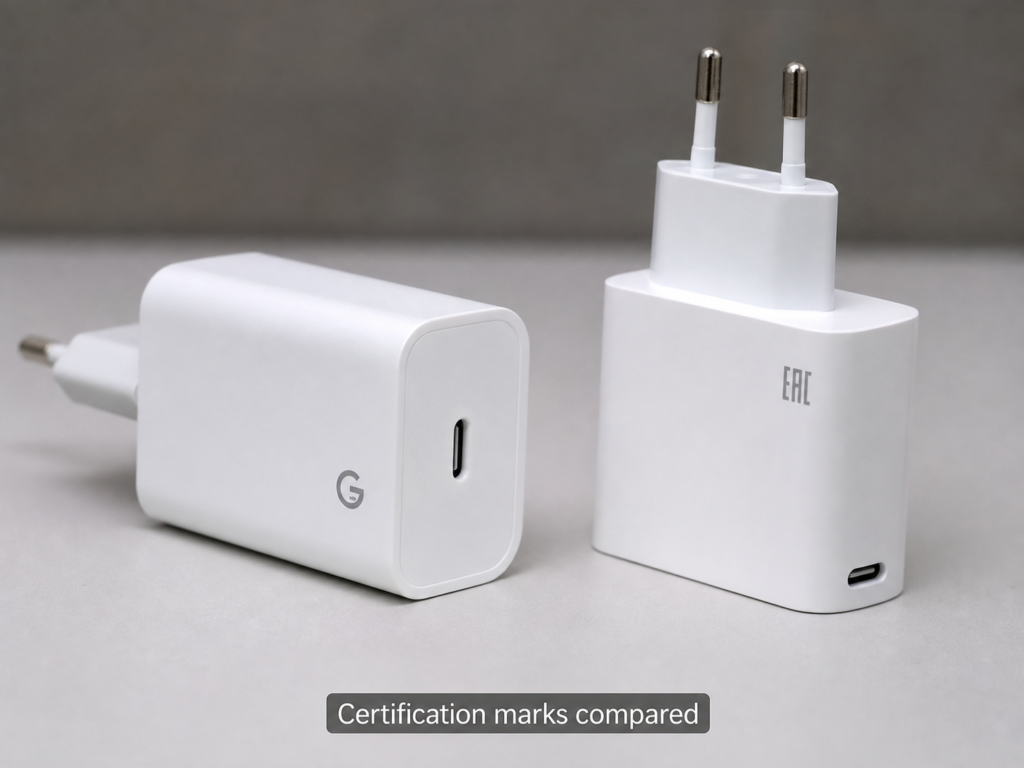
G-Mark (Gulf GCC Conformity Mark)
The G Mark is the unified conformity mark of the Gulf Cooperation Council (GCC), covering six countries: Saudi Arabia, the United Arab Emirates, Qatar, Kuwait, Bahrain, and Oman. The Gulf Standardization Organization (GSO) coordinates the formulation of technical regulations, and the customs and market supervision departments of each country are responsible for implementation.
Pay attention to two boundaries:
- It is not applicable to all Gulf or Middle Eastern countries: Non-GCC countries such as Yemen and Iraq do not automatically apply the G Mark, and local rules need to be verified separately.
- The G Mark is a unified Gulf mark, but each country has its own national system, such as Saudi Arabia’s SASO system and the UAE’s ECAS system, which are local requirements at different levels. Some products may also require SABER product registration, ECAS registration or other importer, radio, and market supervision procedures in the target country; whether it is required should be confirmed separately according to the product category and the latest regulations of the target country, and cannot be generalized as registration is necessarily required after obtaining the G Mark.
EAC (Eurasian Economic Union EAEU Conformity Mark)
EAC is the unified conformity mark of the Eurasian Economic Union, covering five countries: Russia, Belarus, Kazakhstan, Armenia, and Kyrgyzstan. The Eurasian Economic Commission coordinates the unified technical regulations, and third-party institutions recognized by each country or domestic applicants complete the conformity assessment.
Here are a few common misunderstandings to clarify in advance:
- EAC is not “Russian certification”: it is a union mark common to five countries, not a separate certification of Russia.
- The role of EAC has boundaries: it only proves that the product complies with the technical regulations of the EAEU, and cannot replace other obligations such as radio licenses, metrology certification, national registration, and local language labels.
- For products already covered by EAEU technical regulations, GOST/GOST R certificates usually cannot replace the corresponding EAC conformity declaration or certificate; for products not covered by EAEU technical regulations, there may still be GOST, GOST R or other national requirements, which need to be verified separately according to the product and target country.
Practical Scenarios (Charging Products Going Overseas)
For sellers of civilian charging products, the most common scenario where they encounter these two certifications is when expanding into the Gulf and Eurasian Union markets at the same time, and need to evaluate compliance costs and cycles. First, draw a core red line here: the two systems are completely independent, and their rules are not mutually applicable. You cannot say that “having a G Mark can offset part of the EAC process”, you can only say that test data may have room for reuse, which will be explained in detail later.
Comparison Benchmark: Unified Caliber and Regulatory Basis
Many people ask “how much does this certification cost and how long does it take”. In fact, there is no unified answer — different products and different scenarios lead to very different results. To make the comparison clearer, we first set a unified reference benchmark. All subsequent conclusions are based on this benchmark. If your situation is different, you need to adjust accordingly.
Unified Comparison Caliber
- Benchmark products: Civilian 20W-65W USB-C wall chargers, conventional USB-C charging cables
- Excluded categories: Industrial power supplies, on-board high-voltage charging equipment, medical-grade charging products
- Benchmark scenario: Bulk import under general trade, formal entry into mainstream e-commerce platforms
Key Variables for Conclusion Changes
If your product or scenario meets the following conditions, the certification requirements, cycle, and cost will all change:
- Product attributes: For example, whether it has active circuits, whether it has wireless transmission functions, and what the power is.
- Target country: The additional requirements and supervision intensity of different countries within the alliance are different. For example, Saudi Arabia’s supervision is stricter than Bahrain’s, but the specific requirements should still be verified according to the product and period.
- Sales channels: There are differences in compliance requirements between general trade and cross-border self-shipping, and between offline and e-commerce.
- Applicable regulation version and conformity assessment mode: Requirements will change with regulation updates and different assessment modes.
Core Regulation Mapping
The core requirements of both types of certification come from their respective technical regulations. The most commonly involved ones for charging products are:
- GCC side (G-Mark): The core applicable regulation is the Technical Regulation for Low-Voltage Electrical Equipment. Some products also need to comply with special regulations such as electromagnetic compatibility (EMC, simply put, the product does not interfere with other devices when working, and is not easily interfered with by other devices) and radio.
- EAEU side (EAC): Chargers usually need to be verified against TR CU 004/2011 (low-voltage safety) and TR CU 020/2011 (electromagnetic compatibility), and further verified against TR CU 037/2016 and other potentially applicable EAEU regulations according to the product category; a complete conclusion cannot be drawn solely based on low voltage and EMC. Products with wireless functions also need to verify radio-related requirements.
Note: The regulation numbers and scope of application are subject to the latest official version. It is best to verify before handling.
Item-by-Item Comparison of Core Dimensions
To help everyone quickly understand the core differences, we first compiled a comparison table, and then explain the details in detail.
| Comparison Dimension | G-Mark (Gulf GCC) | EAC (Eurasian Economic Union EAEU) |
|---|---|---|
| Coverage | Six GCC countries; not applicable to non-GCC countries | Five EAEU countries; not applicable to non-union countries |
| Universal Premise | One assessment covers six countries, requiring falling under the same regulations, matching certificate scope, and meeting additional requirements of the target country | One assessment covers five countries, requiring falling under the same technical regulations, matching declaration/certificate scope, and meeting additional obligations of the target country |
| Mutual Recognition Rules | The two systems are completely independent and not mutually applicable | The two systems are completely independent and not mutually applicable |
| Mark Style | Official G-shaped logo, must comply with specified size and proportion | Official EAC letter logo, must comply with specified size and proportion |
| Labeling Position | In principle, it should be affixed to the product body; if it cannot be affixed due to product nature or size, it should be marked on the packaging and/or accompanying documents in accordance with corresponding regulations | In principle, it should be affixed to the product body; if it cannot be affixed due to product nature or size, it should be marked on the packaging and/or accompanying documents in accordance with corresponding regulations |
| Label Language | Requirements for Arabic, English and warning texts vary by country, implemented in accordance with target country rules | Must meet local language requirements of the target country, such as Russian |
| Traceability Information | Mark registration number/notified body number in accordance with regulations, no unified format | Mark registration number/notified body number in accordance with regulations, no unified format |
| Validity Period | No unified fixed term, depends on applicable regulations, assessment mode, and certificate type (single batch/series) | No unified fixed term, depends on applicable regulations, assessment mode, and certificate type (single batch/series) |
| Change Requirements | Changes in product specifications, key components, or models require re-reporting or certificate replacement | Changes in product specifications, key components, or models require re-reporting or certificate replacement |
| Supervision Rules | There are random market spot checks; annual factory audits/supervision sampling depend on the assessment plan and requirements of the issuing body | There are random market spot checks; annual factory audits/supervision sampling depend on the assessment plan and requirements of the issuing body |
Conformity Assessment Modes and Responsible Entities
The overall process logic of the two types of certification is similar: first determine the applicable regulations, then select the corresponding assessment mode, complete testing and document preparation, and finally obtain the certificate or complete the declaration. But the specific rules are quite different.
G-Mark Side
The conformity assessment method of the G Mark is specified by the applicable GSO technical regulations and their annexes, which may include manufacturer’s internal production control, conformity declaration, or assessment procedures involving notified bodies; it cannot be inferred whether third-party certification is mandatory solely based on the product risk level.
In terms of responsible entities, manufacturers and importers bear corresponding responsibilities in accordance with regulations, and the role of the certificate holder needs to comply with specific regulations and national requirements — for example, some countries require the importer to be the certificate holder.
EAC Side
EAC assessment modes are divided into two categories, and which one to use is determined by applicable regulations, product type, and assessment plan:
- Self-declaration (DoC): It is not something that enterprises can just write a piece of paper on their own. Instead, a full set of conformity evidence must be prepared, including test reports, technical documents, risk assessments, etc. Enterprises bear corresponding legal responsibility for the authenticity of the declaration.
- Conformity certification: When certification is required, a conformity certificate shall be issued by a certification body recognized by EAEU member states and included in the corresponding unified register, in accordance with applicable technical regulations; self-declaration shall be made by the specified applicant. The document name specified in specific regulations shall prevail.
EAC has a hard requirement: the applicant must be a legal person or authorized representative registered within the EAEU territory, and overseas enterprises cannot apply directly. Even if you find an institution to complete the testing, if the applicant entity does not meet the requirements, the relevant documents may not be used for customs clearance and sales. This is a common pitfall.
Processing Cycle and Cost (Exemplary Reference)
The following are only reference ranges based on benchmark products, not official pricing. The actual price will be affected by many factors: number of models, power levels, number of test rectifications, completeness of data, whether factory inspection is required, translation and registration fees, certificate type, etc.
Benchmark conditions: 20W single-port USB-C wall charger, excluding wireless testing, national registration, factory inspection, and sample shipping fees.
- G-Mark reference: Cycle 4-8 weeks (complete data, one-time test pass), cost 500-2000 USD (adjusted according to number of models and power)
- EAC reference:
- Self-declaration mode: cycle 2-4 weeks, cost 300-1000 USD
- Third-party certification mode: cycle 4-6 weeks, cost 1000-3000 USD
Note: The actual cycle and cost are subject to the official quotation of the authorized body.
Supervision Strictness and Consequences of Violation
Saudi Arabia, the United Arab Emirates, and Russia all have relatively common product compliance, customs or platform audit requirements, but a fixed ranking of “strictest spot checks” cannot be made based on this. The supervision intensity of each country changes with products, sales channels, supervision periods, and special actions. The actual requirements should be verified according to the announcements of the competent authorities of the target country, product categories, and sales channels.
Common consequences of violations include: customs detention/return of goods, e-commerce platform delisting, and market fines. The specific penalties are subject to the latest rules of the authorities and platforms. In addition, the audit strictness of e-commerce channels will be dynamically adjusted with platform rules. For example, when the platform carries out special compliance inspections, the audit will become significantly stricter. Don’t think that passing the audit before means there will always be no problems.
Exclusive Compliance Boundary Judgment for Charging Products
The above are general rules. When it comes to specific charging products, how to judge whether certification is required? We will explain one by one according to common product types.
Mandatory Judgment Logic for Three Types of Charging Products
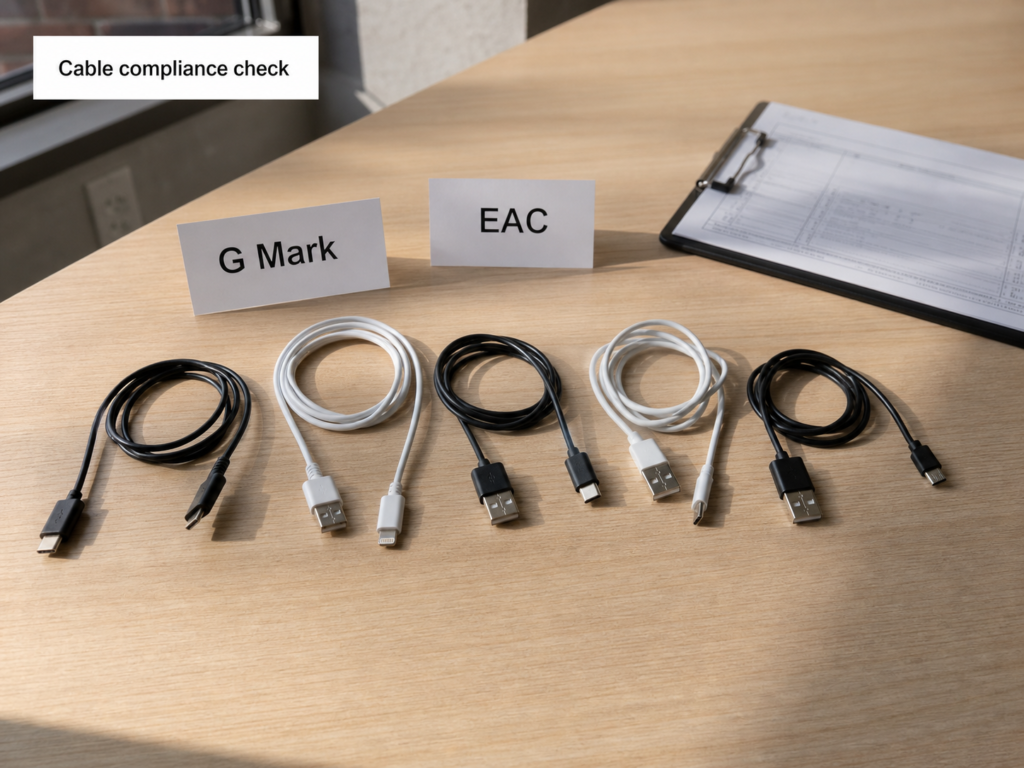
1. AC/DC Wall Chargers, Power Adapters
This type of product usually requires key verification of low-voltage safety and EMC requirements, but an absolute conclusion cannot be drawn solely based on the product name or power.
- G-Mark side: If it falls within the scope of applicable low-voltage electrical regulations, it is necessary to complete the corresponding conformity assessment in accordance with the regulations, and verify safety, EMC and other potentially applicable requirements.
- EAC side: It is usually necessary to verify TR CU 004/2011 and TR CU 020/2011, and further verify TR CU 037/2016 and other potentially applicable EAEU regulations according to the product category; whether to use a conformity declaration or a conformity certificate shall be determined by the assessment mode in accordance with regulations.
Taking 20W or 65W wall chargers with mains input as an example, they usually fall within the scope of corresponding low-voltage and EMC technical regulations, and may also require verification of RoHS, hazardous substances, labels, and target country import procedures; whether G-Mark, EAC declaration or EAC certificate is ultimately required shall be confirmed according to product structure, rated input and output, regulation list, and assessment plan.
2. Pure Passive USB Charging Cables
These are ordinary charging cables with no chips, no active circuits, and a passive shielding layer. The judgment of this type of product is the most ambiguous, with no unified answer. It depends on four conditions: rated voltage, whether it is sold separately, whether it is used as a device accessory, and the customs classification of the target country.
- G-Mark side: In most cases, it is not mandatory, and some countries manage it as low-voltage accessories.
- EAC side: You cannot use “rated voltage ≤ 1000V” to judge whether pure passive cables are included in EAC low-voltage regulations. First, check the voltage range and product list of TR CU 004/2011; a pure passive USB-C cable with a rated voltage of 20V usually cannot be deemed to require EAC solely based on this voltage condition. When sold separately or as a charger accessory, it needs to be confirmed in combination with product classification and target country requirements.
For example: an ordinary USB-C charging cable with a rated voltage of 20V sold separately in Russia cannot be deemed to require EAC solely because “20V is lower than 1000V”; if it is a matching accessory sold with a charger, it cannot be simply assumed that it must follow the charger’s certification. Both cases should be confirmed in combination with product definition, regulation list, sales form, and target country rules.
3. Cables with Active Circuits
These are cables containing active components such as E-Marker chips, identification chips, and conversion circuits, such as 100W fast charging cables and multi-functional cables with adapters.
Because of the active circuits, both product classification and EMC assessment will change, which needs to be judged in combination with the parameters, functions, and regulatory definitions of the entire cable:
- G-Mark side: Classified and assessed as electrical and electronic products.
- EAC side: Need to verify the scope of low voltage, EMC and other potentially applicable regulations.
Simply put, the compliance judgment of cables with active circuits is more complicated than that of pure passive cables, and they cannot be directly treated as ordinary cables.
Special Judgment Branch for Wireless Charging Products
For the judgment of wireless chargers, a key distinction must be made first: a wireless charger with only inductive power transmission is not the same as a wireless charger with radio transmission function, and the requirements for the two may be different.
- Inductive wireless chargers without radio transmission: Verify safety and EMC regulations according to ordinary charging equipment.
- Wireless chargers with radio transmission function: For products with Bluetooth, Wi-Fi or other wireless transmission functions, in addition to applicable safety and EMC requirements, specific obligations such as radio frequency, equipment conformity assessment, encryption notification or registration of the EAEU and target countries should also be verified; it cannot be generalized that Russian radio registration is mandatory.
Whether additional licenses, registrations or notifications are required should be judged in combination with the wireless module, frequency band, transmission power, purpose, and the import and use methods of the product.
Certification Rules for Set/Series Products
If there are multiple models of the same series, or set products, the rules are as follows:
- G-Mark side: Products of the same series need to have the same structure, circuit, and key components to share one certificate (must comply with regulatory requirements).
- EAC side: Products of the same series need to be covered under the same assessment plan, and products with different plugs and different powers need to be assessed separately.
There is another common boundary: if accessories in a set are sold separately, they need to meet compliance requirements separately. For example, if you sell a “charger + charging cable” set, if the charging cable is also listed for sale separately, the charging cable itself must also meet the corresponding certification requirements, and cannot rely solely on the charger certification in the set.
Common Misconceptions and Pitfall Avoidance List
In cross-border compliance, falling into one pit may cost the profit of a batch of goods. Here we have compiled the most common misconceptions and pitfall avoidance methods.
Cognitive Misconceptions
| Wrong Statement | Factual Basis | Avoidance Method |
|---|---|---|
| G-Mark is a mandatory pass for all Gulf countries | G Mark is only applicable to the six GCC countries, and not applicable to non-GCC countries such as Yemen | First confirm whether the target country is a full member of the GCC. If not, check local rules separately |
| With G-Mark, you can enter all Middle Eastern countries | The scope of the Middle East is much larger than the GCC, and countries such as Iran and Iraq have their own certification requirements | Don’t confuse “Gulf” with “Middle East”, verify each country separately |
| EAC is Russian certification and can cover the whole of Europe | EAC is a common mark for the five countries of the Eurasian Union and has nothing to do with the EU CE system | Don’t confuse the Eurasian Union with the European Union. CE certification is required for the European market |
| CE/CB certificates can be directly converted to G-Mark/EAC | CE/CB reports can only be used as technical references and cannot be directly converted to certificates | Submit existing reports to the authorized body to assess test items that can be reduced or exempted. Don’t believe the claim of “direct certificate conversion” |
Pitfall Avoidance for Certificates and Entities
- Fake certificate verification: Don’t just look at the paper certificate given by the institution. Be sure to check the authenticity in the official database: for G Mark, check the GSO official database; for EAC, check the unified certification database of the Eurasian Union. When verifying, check: whether the product model and parameters match, whether the manufacturer information is consistent, and whether the applicant/certificate holder meets the requirements.
- Entity compliance pit: The EAC applicant must be a legal person or authorized representative registered within the EAEU territory, otherwise the relevant documents may not be used for customs clearance and sales. Many sellers seek cheap prices and find informal institutions to issue certificates, where the applicant is an overseas company or the entity information is non-compliant. As a result, the goods are detained during customs clearance, which is not worth the loss.
Pitfall Avoidance for Labels and Maintenance
- Label pit: Common problems include non-compliant mark position and size, language not meeting target country requirements, and missing traceability information. Avoidance method: Design labels in accordance with official labeling specifications. It is best to have the issuing body review them in advance to avoid finding mistakes after printing.
- Maintenance pit: For example, continuing to use the certification after it expires, or failing to report major product changes (replacing key components, modifying circuits, adding new models), will result in the certificate being directly deemed invalid if spotted in a spot check. Avoidance method: Plan renewal in advance, and consult the issuing body whether certificate replacement or reporting is required before product changes.
Quick Decision-Making and Final Checklist
After reading the above content, you may still be a little confused. It doesn’t matter. Follow these 4 steps to quickly judge your own situation.
4-Step Decision Tree (Quickly Judge Certification Type)
Step 1: Confirm the Target Market
- Export to six GCC countries → assess G-Mark applicability
- Export to five EAEU countries → assess EAC applicability
- Export to both regions at the same time → assess separately, no mutual recognition
- Not the above regions (Yemen, EU, etc.) → separately verify corresponding compliance requirements
Step 2: Confirm Product Type and Parameters
- Wall chargers/power adapters → most likely need to complete corresponding conformity assessment, need to further confirm regulation applicability
- Pure passive charging cables → judge in combination with rated voltage, sales form, and target country rules
- Cables with active circuits/products with wireless transmission functions → need additional assessment of EMC, radio or other regulation applicability
Step 3: Confirm Sales Form
- Non-commercial import for personal use → may be eligible for customs exemption (subject to the customs rules of the destination country, no fixed quantity threshold)
- Bulk import/e-commerce sales → need to complete compliance as required
Step 4: Confirm Reusability of Existing Documents
- CB/CE and other reports → submit to the authorized body to assess test items that can be reduced or exempted
- Already have one of the certifications → test data can be tried for reuse, cannot be directly converted to the other certificate
Cost Reduction Method for Dual Certification
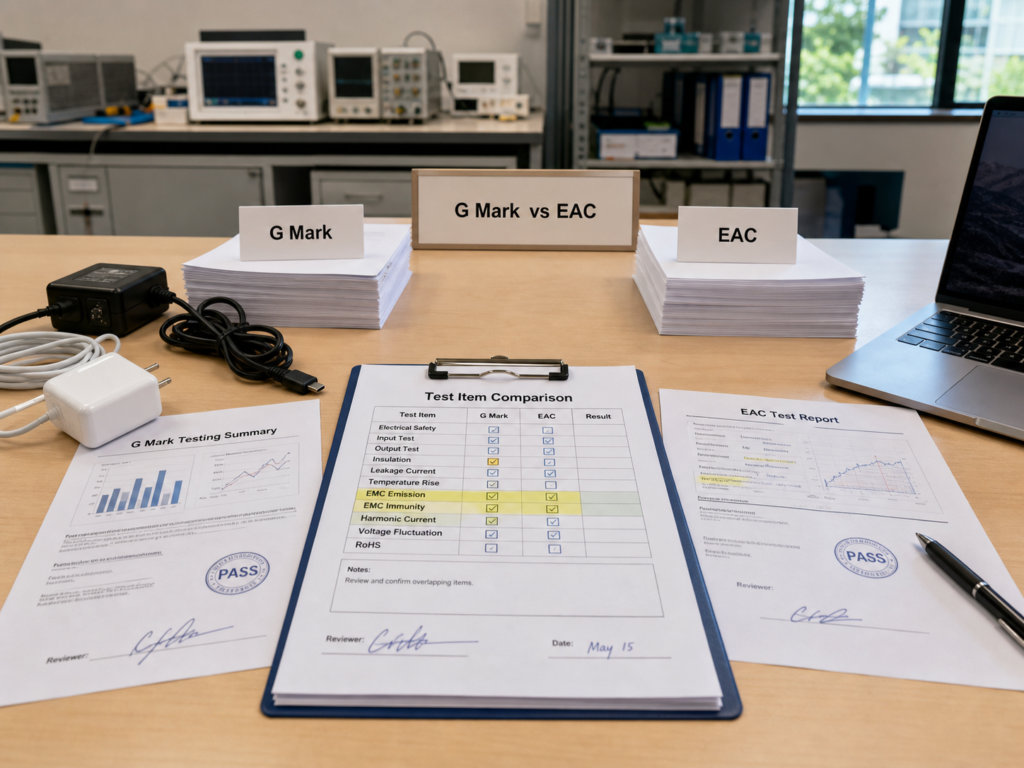
If both G Mark and EAC are required, you can try to save part of the test cost. The core logic is: some safety and EMC test items of the two types of certification may have shared space, but it needs to be confirmed item by item by the accreditation bodies on both sides.
Shared test items can be arranged according to the two sets of regulations and standards during the design stage, but the laboratory accreditation scope, report format, standard version and acceptability must be confirmed with the GSO notified body and the EAEU accredited certification body respectively. It is not guaranteed that one test or one report will be fully accepted by both sides, nor can it be asserted that reports from non-“dual-accredited” laboratories are necessarily invalid.
Typical Case Comparison
The following cases are for reference only, and the actual situation is subject to official judgment:
- 20W single-port USB-C wall charger: Usually falls within the scope of corresponding low-voltage and EMC technical regulations, and may also require verification of RoHS, hazardous substances, labels, and target country import procedures; whether G-Mark, EAC declaration or EAC certificate is ultimately required shall be confirmed according to product structure, rated input and output, regulation list, and assessment plan.
- 65W multi-port GaN charger: Usually requires verification of low-voltage and EMC requirements, and may involve hazardous substances, labels, and target country import procedures; different output structures and power configurations need to be assessed in combination with specific regulation lists and assessment plans, and an absolute conclusion cannot be drawn solely based on “65W”.
- Chip-free pure passive USB-C charging cable: Judge whether it is mandatory in combination with rated voltage, whether it is sold separately, and target country rules. It cannot be deemed to be included in EAC low-voltage regulations solely based on “rated voltage ≤ 1000V”.
- 100W fast charging cable with E-Marker: It should be verified whether it constitutes an electrical device with independent active functions, and based on this, judge whether low-voltage, EMC and other regulations are applicable; it cannot be directly concluded that EMC certification is mandatory solely based on “with E-Marker” or “100W”.
- Wireless charging base with Bluetooth function: In addition to basic safety and EMC, specific obligations such as radio frequency, equipment conformity assessment, encryption notification or registration of the EAEU and target countries should also be verified. It cannot be generalized that only a certain “Russian radio registration” is required.
Final Competence Checklist
After learning this content, you should be able to do the following:
- Able to distinguish the applicable regions, regulatory basis and core differences between G-Mark (GCC) and EAC (EAEU).
- Able to quickly judge whether your own charging products need to apply for the corresponding certification.
- Able to verify the authenticity of certificates and whether core information matches, and avoid common compliance pitfalls.
- Know the cost reduction logic of dual certification, and the verification path when in doubt — find an authorized body for pre-classification, check official lists, consult importers or platforms.
Summary
Although both G Mark and EAC are conformity marks of regional economic alliances and seem to be “one certification, universal for multiple countries”, they are essentially two completely independent compliance systems, with considerable differences from applicable regions, applicant entities to assessment modes.
For sellers of charging products going overseas, there is no need to memorize all rules by rote. As long as you follow the 4-step decision tree to check step by step, distinguish between union technical regulations and additional obligations of the target country, avoid common problems such as fake certificates, entity and label issues, and verify with formal authorized bodies when in doubt, you can control compliance risks more steadily.