
Friends who export charging products or engage in cross-border e-commerce have most likely encountered pitfalls with market access certification: after finally shipping goods to Brazil or Japan, they are detained due to lack of certification, and even face fines, sales suspension, or recalls. Many people easily confuse the two core access systems, Brazil’s INMETRO and Japan’s PSE, either missing required procedures or wasting money unnecessarily.
This article focuses on common charging products such as chargers, USB-C cables, and power adapters, and explains the two systems in terms of positioning, requirements, processes, and pitfall avoidance methods. Beginners can directly refer to it to judge whether their products need further verification and how to prepare, while experienced sellers can also find practical tips for optimizing costs and cycles.
Prerequisites for Comparison: Unified Criteria to Avoid Confusion
Many people get more confused the more they read certification comparisons, mostly because the products compared and the premises are different. All conclusions in this article have a clear scope of application, which we will clarify first to avoid misapplication.
Fixed Product Scope for Comparison
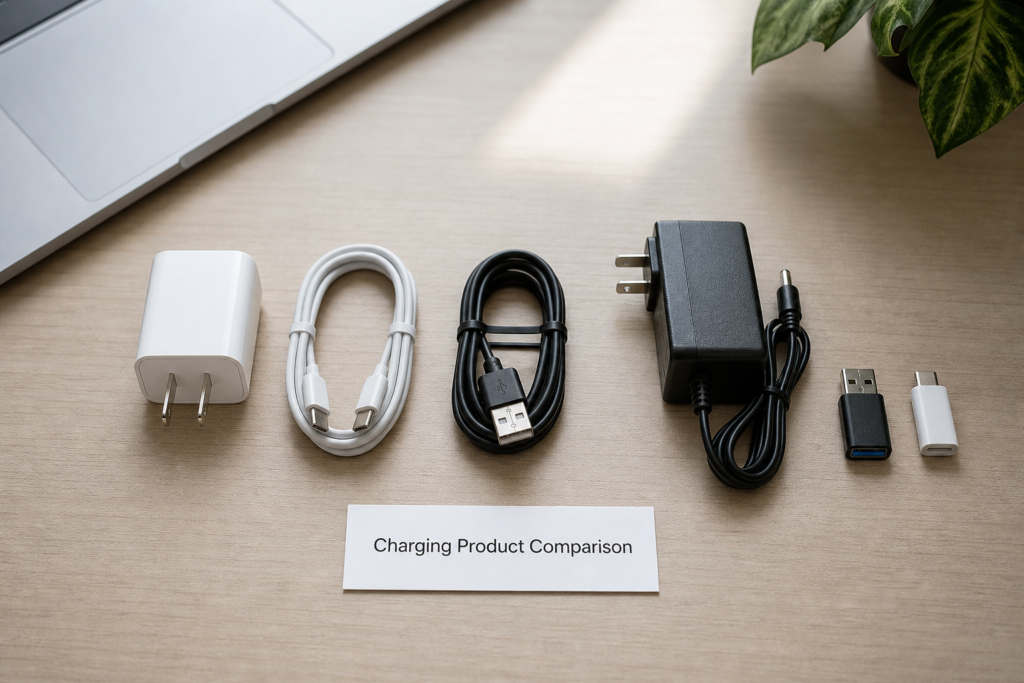
All our comparisons revolve around core charging products: wall-plug chargers, USB-C/USB-A charging cables, AC/DC power adapters, and USB interface connectors. Non-charging products such as home appliances, toys, and industrial equipment are not within the scope of discussion, as their certification requirements are completely different.
It should be clarified first that these products are not automatically within the scope of mandatory certification in both Brazil and Japan. Wall-plug chargers and some AC/DC power adapters usually require key verification of INMETRO or PSE requirements; whether pure low-voltage cables, connectors, and set accessories are regulated shall be confirmed based on specific regulations, product definitions, input voltage, structure, intended use, and applicable lists.
Unified Judgment Parameters
Whether judging whether certification is required or comparing the requirements of the two systems, we uniformly use the following core parameters for measurement:
- Whether the product is directly connected to AC mains power (i.e., household wall socket power);
- What the rated input/output voltage and power are;
- Whether the product has internal power conversion circuits such as voltage transformation and rectification;
- Whether the product is sold independently or as an accessory to other products;
- Whether it is equipped with a dedicated power plug for the target market.
Clarifying these points can basically give a rough judgment, but the final conclusion still needs to be checked against the current regulations and specific product lists of the target market.
Unified Understanding of Key Terms
This article provides the following simplified explanations for the two common marks of Japan’s PSE:
- Diamond PSE: Usually corresponds to “Specified Electrical Appliances and Materials”; the specific classification must be judged based on the Electrical Appliance and Material Safety Act and its related statutory product categories, rated values, and product structure;
- Circle PSE: Usually corresponds to “Non-Specified Electrical Appliances and Materials”, but not all low-voltage accessories or products with electronic components fall into this category;
- OCP: Product certification bodies accredited by INMETRO. The specific testing, audit, and certification issuance they are responsible for depends on the conformity assessment scheme for the corresponding product;
- CB Report: International electrical product safety test documentation formed based on the IECEE CB system, which can be used as a reference for technical documentation in some projects, but cannot automatically replace local compliance requirements in Brazil or Japan.
Applicable Boundaries of Conclusions
This article is based on current regulations and systems, but product lists, technical standards, and conformity assessment schemes may be adjusted. Actual exports should be rechecked against official requirements before shipment. Several special situations require separate confirmation:
- Special categories such as car chargers, wireless chargers, and smart chargers with Bluetooth/Wi-Fi require additional confirmation of other requirements such as wireless and telecommunications;
- Personal imports for own use may be subject to different procedures than commercial imports, but there is no “1-2 pieces exemption from certification” rule applicable to all charging products. Import method, product category, whether for sale, as well as customs and product safety regulations will all affect the judgment. Confirmation should be made with customs, competent authorities, or compliance agencies before import;
- This article focuses on commercial import for sale and online sales scenarios.
Quick Check by Product: Certification Requirements for Common Charging Categories
After explaining the overall rules, we have sorted out the requirements for the most common types of charging products. You can directly check against your own products, but the final conclusion shall still be subject to specific regulations and certificate scope.
1. Pure USB/USB-C Charging Cable/Data Cable
- Brazil: Pure low-voltage charging cables with USB interfaces on both ends usually do not automatically require separate INMETRO certification just because they are sold with chargers; if they fall within the scope of a specific mandatory product, or the set certification scheme explicitly covers the entire set of products, they shall comply with corresponding requirements;
- Japan: Pure passive low-voltage charging cables, if they have no AC terminal and no electronic components within the statutory regulatory scope, usually do not fall under PSE mandatory product categories; however, whether they are regulated by PSE shall still be confirmed based on specific product definitions and statutory lists;
- Key judgment points: Check whether there is AC input, whether it contains power conversion or other regulated structures, and whether the product falls into the statutory list of the target market. For sets, also confirm whether the certification document covers the cable, the entire set configuration, and the actual sales model.
2. Wall-Plug Charger/Power Adapter
- Brazil: They are key targets for INMETRO verification, but whether certification is mandatory and which safety or energy efficiency requirements apply shall be confirmed based on the specific product model, rated values, structure, and current Portaria;
- Japan: AC adapters or DC power supply devices that meet the definition of Japan’s statutory product categories may fall under Specified Electrical Appliances and Materials and require Diamond PSE; whether they belong to this category cannot be judged solely by “having AC input”;
- Note: Power, number of ports, output mode, and internal structure may affect test configuration and compliance assessment, but 65W is not a unified certification threshold for the two countries.
3. Multi-Port/High-Power Fast Charger
- Brazil: Assessment shall be conducted based on the total power, temperature rise, protection functions, and internal structure when all ports output simultaneously. For products of the same series with different numbers of ports or different output configurations, it is necessary to confirm whether they can be included in the same certification scope;
- Japan: The PSE category shall be judged based on whether the product falls under the statutory product categories listed in the Electrical Appliance and Material Safety Act, rated input and output, port combination, and structure, and the multi-port simultaneous operation state shall be evaluated according to the requirements of the certification body;
- Key judgment points: Check whether the total power, maximum load of all ports outputting simultaneously, port combination, key components, and internal structure are consistent.
4. Travel Charger with Interchangeable Plugs
- Brazil/Japan: Each plug and interchangeable component must meet the requirements of the target country;
- Note: Whether a new model, change assessment, or re-certification is required depends on the certification scheme, detachable structure, accompanying configuration, and specific technical requirements, and shall be confirmed by the OCP or registered conformity assessment body based on the certificate scope. A conversion plug only changes the shape of the plug and cannot replace the safety compliance requirements that the product itself must meet.
5. Charging Set (Charger + Charging Cable)
- Brazil: When a cable is sold as part of a set, it is necessary to confirm whether the certification certificate covers the cable, the entire set configuration, and the sales model. It cannot be automatically assumed that the cable must be certified separately just because it is sold together with the charger, nor can it be replaced at will;
- Japan: Whether the charger in the set requires PSE shall be judged based on whether the charger itself is a statutory electrical appliance and material; whether a pure low-voltage cable requires separate PSE shall also be confirmed based on the specific product category;
- Note: If the cable model, plug configuration, or charger version in the set is changed, it is necessary to reconfirm whether it is still within the coverage of the original certification or technical documentation.
Intermediate Practical Guide: Judgment, Inquiry, and Cost Optimization
If you already understand the basic rules and want to further improve efficiency and reduce costs, you can look at the practical tips in this section.
Quick Judgment of Certification Type (3-Step Method)
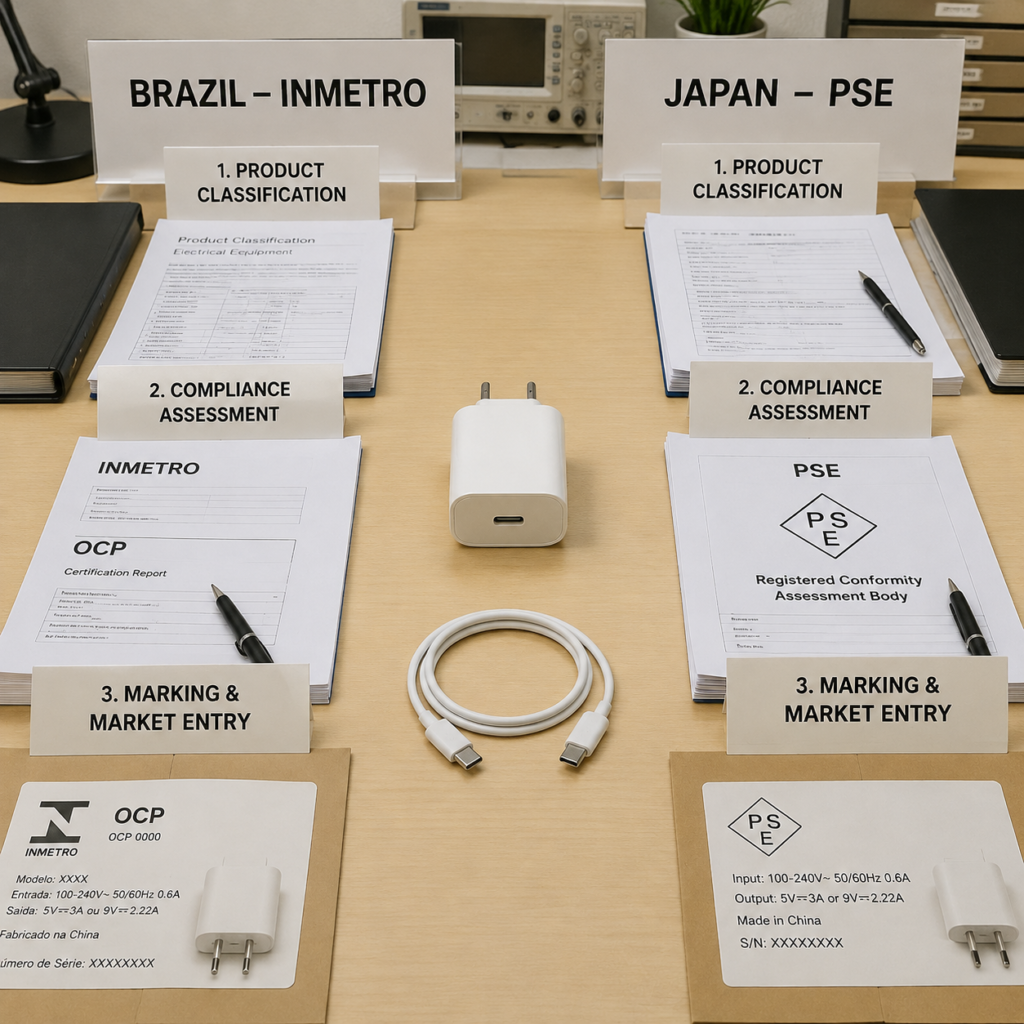
You don’t need to memorize complex lists first; follow these 3 steps to quickly narrow down the judgment scope:
- Step 1: Look at the target market: If entering Brazil, check INMETRO’s relevant mandatory lists and product schemes; if entering Japan, check the statutory product categories listed in the Electrical Appliance and Material Safety Act and PSE requirements.
- Step 2: Look at product attributes: First check whether there is AC input, then check input and output voltage, power, number of ports, internal circuits, and sales configuration.
- Brazil: Chargers, power adapters, and power components with AC input are key verification targets, but whether INMETRO certification is mandatory shall be confirmed based on specific models and current mandatory lists; pure low-voltage data cables also cannot be concluded solely based on whether they are sold as part of a set;
- Japan: Products with AC input cannot be automatically classified as Diamond PSE; first confirm whether they fall under statutory product categories such as “DC power supply devices”, then judge whether they are Specified Electrical Appliances and Materials or Non-Specified Electrical Appliances and Materials. Low-voltage accessories also need to first be checked against statutory product categories.
- Step 3: Look at sales nature: Personal imports for own use may be subject to different procedures, but there is no “1-2 pieces exemption from certification” rule applicable to all charging products. Commercial sales, imports, and platform store opening must be prepared in accordance with product safety obligations of the target market.
For special products such as car chargers, wireless chargers, and smart chargers with Bluetooth, additional confirmation of other requirements such as wireless and telecommunications is required, and the rules for ordinary wall-plug chargers cannot be directly applied.
Methods to Verify Certification Authenticity
Fake certificates are a rampant issue in the cross-border business sector; paying for them and still being unable to clear customs will result in heavy losses. When inquiring, do not only look at a scanned certificate or a mark, but check whether the product, responsible entity, and document scope are consistent.
INMETRO Inquiry Steps
- Locate the conformity assessment mark, certificate information, and corresponding OCP information on the product or its packaging;
- Verify the certification status through INMETRO’s public system and the issuing OCP;
- Check whether the product model, manufacturer, certificate coverage, label information, and validity are consistent with the actually sold version.
The specific inquiry fields and level of public disclosure are subject to the current system. Typical characteristics of fake certificates or out-of-scope use include: information cannot be verified in the official system or with the issuing body, the actual model is not within the certificate scope, the manufacturer does not match, the certificate status is abnormal, or the label information is inconsistent with the documentation.
PSE Inquiry Steps
- First confirm the mark type: for Diamond PSE, focus on verifying the indicated registered conformity assessment body and conformity inspection certificate; for Circle PSE, focus on verifying the responsibility information of the manufacturer or importer;
- Confirm specific requirements with the indicated registered conformity assessment body, responsible entity, or competent authority;
- Check whether the product model, rated values, structure, technical documentation, self-inspection records, business notification, and labeling match.
Do not assume that there is a public model-by-model database covering all Circle PSE products. For Circle PSE, filing or business notification information is not equivalent to a product certification certificate uniformly issued by METI.
Tips for Optimizing Certification Cost and Cycle
Certification can also save money and time, but the savings ratio should not be regarded as a fixed commitment:
- Evaluate CB documentation first for multi-market certification: If you need to do both INMETRO and PSE, you can first prepare a CB report or other complete test documentation. Relevant bodies may use it as technical documentation to reduce some repeated testing, but whether it is accepted, which national difference tests need to be supplemented, and how much can ultimately be saved must be confirmed item by item;
- Plan the cycle in advance: The processing time for both INMETRO and PSE depends on product classification, body arrangement, documentation completeness, and number of rectifications. Confirm the time with relevant bodies before design finalization and stock preparation, do not wait until the goods are produced to start;
- Choose the right body: For Brazil, choose an INMETRO-accredited OCP that meets corresponding requirements; for Japan, when involving Specified Electrical Appliances and Materials, confirm the qualification of the registered conformity assessment body. Do not only look at the “fast certification” advertised by bodies;
- Reduce costs through series applications: If products are of the same platform and same internal structure, only differing in power, number of ports, or output configuration, you can apply for series or model family assessment with the certification body. However, whether reports or certificates can be shared depends on structure, key components, rated values, and applicable schemes, and written confirmation must be obtained in advance.
Pre-Market Compliance Checklist
Before shipping, check against this list to avoid most compliance issues:
- Classification verification: Confirm whether the product falls into the mandatory or non-mandatory category of the target market, and find a clear regulatory basis;
- Documentation verification: Test reports, certification certificates, conformity inspection certificates, declarations, and technical documentation are all valid and cover the actually sold models and configurations;
- Marking verification: The mark style, position, number, or responsible entity information complies with specific rules, do not apply a template separately from the product category;
- Label verification: Instructions, warning statements, and product information comply with local language, consumer information, and specific technical requirements, with correct parameter labeling;
- Change verification: The final version launched on the market is consistent with the evaluation sample and technical documentation, with no unreported changes to plugs, power, components, PCB, ports, or housing structure.
Summary
Let’s go through the core conclusions again for quick recall:
Core Differences
- INMETRO is Brazil’s conformity assessment system for multiple categories of products. Whether chargers, power adapters, etc. require mandatory certification, energy efficiency labels, or other requirements shall be confirmed based on specific product regulations, mandatory lists, and conformity assessment schemes;
- PSE is a product safety system under Japan’s Electrical Appliance and Material Safety Act, which distinguishes between Specified Electrical Appliances and Materials and Non-Specified Electrical Appliances and Materials according to statutory product categories. The category cannot be judged solely by “having AC input”, “low voltage”, or “containing electronic components.”
Applicable Scenarios
- To enter the Brazilian market, first check INMETRO’s latest product list and applicable Portaria to confirm whether the product falls within the mandatory scope and what kind of conformity assessment and labeling requirements need to be fulfilled;
- To enter the Japanese market, first check whether the product falls under the statutory product categories listed in the Electrical Appliance and Material Safety Act, then judge whether Diamond PSE, Circle PSE, or other regulatory requirements apply;
- If the product is sold to both markets, plugs, input conditions, test standards, responsible entities, labels, and document scope shall be checked separately, and documentation from one market cannot be directly used as a pass for the other market.
Skills You Have Mastered
After reading this article, you should be able to:
- Preliminarily judge which certifications or compliance requirements need to be verified for common charging products in Brazil and Japan;
- Verify relevant documents through INMETRO’s public system, OCPs, registered conformity assessment bodies, and responsible entities;
- Avoid the common misconception of treating CE, FCC, and CB reports as automatic mutual recognition credentials;
- Reasonably plan certification costs and cycles based on product structure, power, ports, and sales configurations;
- Complete basic compliance verification before product launch.
One final reminder: charging products involve safety risks such as electric shock, overheating, and fire. Specific requirements may change with product structure, rated parameters, regulation versions, and certification schemes. Before shipping, be sure to confirm the corresponding requirements in accordance with the latest regulations of the target market to avoid detention, sales suspension, recall, or other penalties due to lack of certification, incorrect labeling, out-of-scope sales, or failure to declare.