
For those engaged in the cross-border business of products such as charging cables, USB-C cables, and chargers, the first type of compliance many people come into contact with is “safety” — for example, whether there is a risk of electric leakage or device explosion, and it seems that everything is fine once CE and FCC certifications are obtained. However, in recent years, more and more sellers have encountered such troublesome issues: failure to fulfill packaging EPR obligations may lead to market regulatory penalties, sales restrictions, platform delisting in member states, or affect cargo release under specific circumstances; when goods fall within the scope of application of the Uyghur Forced Labor Prevention Act (UFLPA) or there are grounds for forced labor enforcement, U.S. CBP may implement detention, exclusion, or confiscation, and importers need to submit evidence as required; an Amazon store that was operating normally is suddenly required to provide a RoHS report, otherwise it may be delisted. These issues all fall under the category of “supply chain sustainability compliance”, which is a completely different set of rules from product safety. Many new sellers and even small and medium-sized sellers are confused: what exactly is sustainability compliance? Who needs to be responsible for it? What needs to be done? Will it cost a lot of money?
This article focuses on charging electronic products (mainly charging cables, USB-C cables, chargers, and power adapters; products with batteries and wireless charging products will be explained separately), and clarifies the core logic of sustainability compliance, requirements of major global markets, practical operation steps, and pitfall avoidance tips from introductory cognition to implementation, and then to advanced supplier management. Whether you are a small cross-border seller who has just entered the industry, or a brand owner or importer who wants to build a system, you can find corresponding action methods.
2. Real Risks and Value of Compliance
Many people think that compliance is a costly matter and can be delayed as much as possible. In fact, they have not calculated the cost of non-compliance, nor have they seen the actual benefits brought by compliance.
Typical Risks of Non-Compliance
• **Customs and market regulation side**: The most serious situations may include detention, exclusion, or return of goods, or being required to make rectifications, pay back fees, and bear administrative fines. Penalties for packaging EPR violations are stipulated by the laws of member states, which may include administrative fines, sales bans, back payment of fees, platform restrictions, or ordered rectification; the amount of penalties and whether further enforcement measures are taken shall be judged according to the specific country, violation behavior, and case circumstances. There is no unified EU fine standard or unified “blacklist” system.
• **Platform side**: Product delisting, store traffic restriction, cancellation of activity eligibility, inability to create shipments, and in severe cases, it may also affect store operations. Specific measures depend on the platform, site, category, and the authenticity and completeness of submitted materials.
• **Client side**: For B2B businesses, if they fail the supplier audit of large customers, they will directly lose orders. Especially for overseas leading electronic brands, the requirements for supply chain sustainability are very strict.
Specific to charging products, there are two high-risk scenarios that must be noted: first, **failure to fulfill member state packaging EPR obligations may lead to market regulation, platform audits, or sales restrictions; it may also affect cargo release under specific enforcement arrangements, but it cannot be asserted that all unregistered goods will be detained by EU customs**; second, **enforcement measures are taken by U.S. CBP due to forced labor risks in the supply chain**. For goods produced wholly or partially in Xinjiang, or involving entities listed on the UFLPA Entity List, the UFLPA requires the application of a forced labor presumption; if an importer applies for an exception, it must submit clear and convincing evidence as required by CBP. Specific measures may include detention, exclusion, or confiscation, depending on the case and procedures.
Actual Benefits of Compliance
Compliance is not only about costs, but also has tangible benefits:
1. Meet the basic access requirements of large platforms such as Amazon and Walmart, so that products will not be delisted due to compliance issues and can be sold normally.
2. Meet the basic supplier threshold of leading electronic brands, and can obtain larger B2B orders.
3. Enhance the trust of overseas consumers. Nowadays, many overseas consumers are willing to pay a premium for environmentally friendly and compliant products. If eligible, they can also participate in platform green support programs and obtain additional traffic.
4. Rectifications such as packaging reduction and material optimization cost money in the short term, but can reduce procurement and logistics costs in the long run. For example, lighter packaging saves freight costs, which is more cost-effective instead.
How to Judge the Risk Level?
You can compare your own situation to judge how high the risk is, without blind anxiety:
• **Market dimension**: Europe and the United States have strict inspections and heavy penalties. Requirements in emerging markets such as Southeast Asia and the Middle East are gradually escalating. Currently, some requirements are relatively lenient, but preparations should also be made in advance.
• **Scale dimension**: Sellers with annual sales of one million or more usually have a higher probability of being inspected than small sellers, because their large cargo volume gives them more chances of being noticed by customs, platforms, or large customers.
• **Channel dimension**: The requirements of large B2B customers are usually stricter than those of ordinary retail. Many large customers will require additional compliance documents, and even conduct factory audits.
• **Product dimension**: Chargers with circuits have more compliance requirements than passive charging cables, involving more content such as energy efficiency and electrical safety, and the risk is also higher.
4. Entry-level Implementation: 5 Steps to Build a Compliance Solution (Adapted for Charging Products)
Having talked about so many requirements, where exactly should we start? Follow these 5 steps, and you can build a basic compliance framework to meet the basic management requirements of customs and platforms.
Step 1: Sort out the Supply Chain and Product Classification
First of all, you must figure out what your products are and what your supply chain looks like, otherwise you can’t talk about compliance at all.
The typical supply chain for charging products is: **copper/plastic material supplier → connector factory → assembly foundry → packaging factory → logistics provider**. You can sort out your suppliers according to this chain, and then distinguish them by level:

• Tier 1 suppliers: those you cooperate with directly, such as foundries and packaging factories.
• Tier 2 suppliers: upstream of Tier 1 suppliers, such as cable factories and connector factories.
• Tier 3 suppliers: those at the raw material end, such as copper smelters and plastic particle suppliers.
Next, classify the products according to the previous classification matrix, mark the regulation trigger items corresponding to each product, and at the same time mark high-risk points (for example, connector factories correspond to conflict mineral risks, and foundries correspond to labor risks).
After completing this step, you will get two outputs: a simple supply chain map and a product classification list.
Step 2: Match Applicable Regulations and Prioritize
With the sorted out market, product, and supplier information, screen out the mandatory requirements that must be followed according to the three dimensions of “market-product-scale”, and exclude the voluntary items that are not needed for the time being. Don’t do the whole chain at the beginning, which is a waste of money.
Then sort them according to “veto → important → bonus”, and clarify the responsible entity and deadline for each item, for example, by when the packaging EPR registration must be completed and who is responsible.
The output of this step is your own **list of applicable regulations**, which is clear and will not miss the confirmed items.
Step 3: Implement 6 Core Compliance Items
We have sorted out 6 core compliance items, each with clear trigger conditions, operation methods, and required evidence. You can use them in combination with actual products:
1. **Hazardous Substance Compliance**
• Trigger condition: Sold to markets with regulations on the restriction of hazardous substances, such as the European Union, some jurisdictions in the United States, and the United Kingdom.
• Operation: For RoHS, prepare test or material evidence according to homogeneous materials and applicable restricted substances; for REACH, respectively check SVHC information communication, SCIP, Annex XVII restrictions, and other applicable obligations. A general REACH report cannot replace a complete judgment.
• Evidence: Third-party laboratory test reports, supplier declarations of conformity, material information, and supply chain documents.
• Validity judgment: Check whether the test object corresponds to the specific model and material, whether the test method and regulation version are applicable, and whether the material or supplier has changed; re-evaluation is required when changes occur.
2. **Product Safety Technical Documentation (Related Compliance, Only Applicable to Products That Meet the Corresponding Definitions)**
• Trigger condition: Products with circuits such as chargers are sold to markets with electrical safety and electromagnetic compatibility requirements.
• Operation: Check the Low Voltage Directive for equipment that meets the applicable voltage range and product definition; at the same time, check EMC requirements according to whether the product generates or is affected by electromagnetic interference, and prepare corresponding technical documents and declarations of conformity respectively. The Low Voltage Directive is not applicable to all products with circuits, and its applicable voltage range is 50—1000V AC or 75—1500V DC.
3. **Energy Efficiency Compliance**
• Trigger condition: Adapters that meet the definition of external power supplies are sold to markets with energy efficiency requirements, such as the European Union and the United States.
• Operation: Complete energy efficiency testing, registration or filing as required, such as U.S. DOE/CEC and EU ErP.
• Evidence: Energy efficiency test reports, filing certificates, and technical materials corresponding to specific models.
4. **EPR and Packaging Compliance**
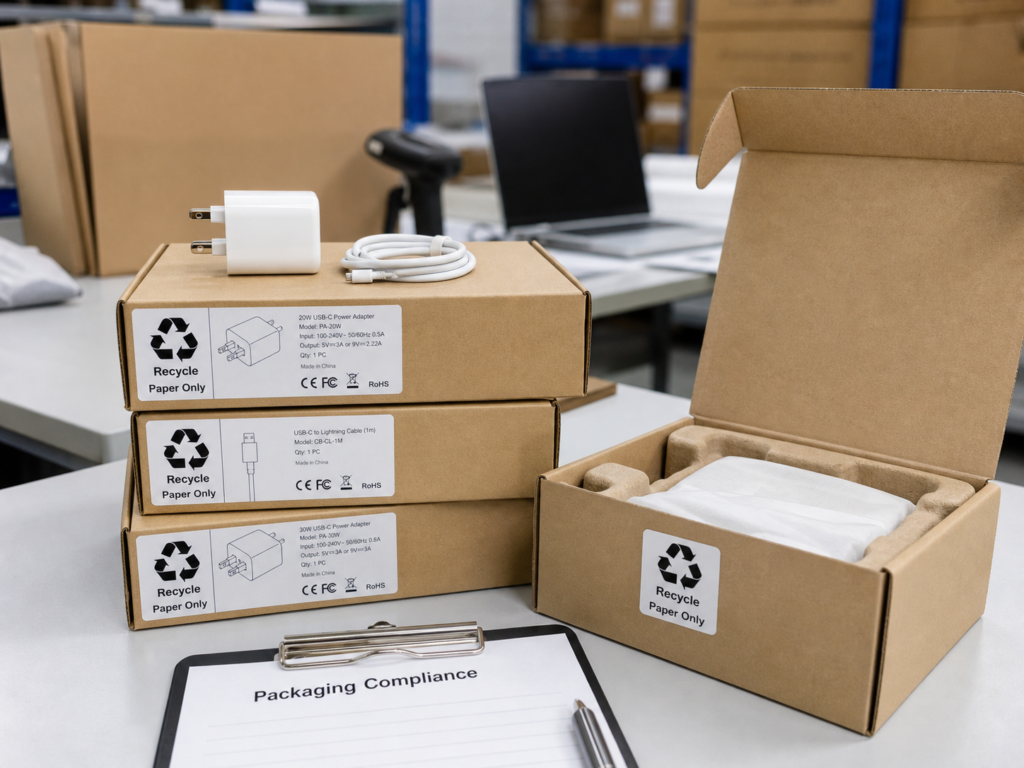
• Trigger condition: Products with packaging or falling within the scope of electronic waste control are sold to markets that implement EPR, such as EU member states.
• Operation: Optimize packaging according to the EPR, material restriction, labeling, and recyclability requirements of the target market; fulfill obligations such as EPR registration, declaration, and payment (if required), and confirm the local responsible entity. Some countries require a local registered entity, and you may need to cooperate with a service provider or importer.
• Evidence: EPR registration certificates, declaration records, packaging material information, label samples, and other compliance certificates.
5. **Supply Chain Human Rights and Forced Labor**
• Trigger condition: Sold to markets with supply chain human rights regulations, such as the United States, or large customers put forward relevant requirements.
• Operation: Require foundries and core raw material suppliers to provide declarations of no forced labor, and sort out supply chain traceability records.
• Evidence: Supplier declarations, supply chain traceability records, smelter lists, procurement and transportation records, etc.
6. **Environmental Claims and Carbon Data**
• Trigger condition: There is a demand for green promotion, or customers or platforms put forward requirements.
• Operation: Prepare supporting materials as needed. Voluntary items such as carbon footprint shall be carried out according to requirements, and there is no need to do them in advance.
• Evidence: Carbon accounting reports, recyclability certificates, third-party verification certificates.
Step 4: Prepare and Retain Self-certification Materials

Compliance is not something that is done and then finished. The most important thing is to keep the evidence well so that it can be provided when customs, platforms, or customers request it.
• **Materials that need to be retained with priority**: Supplier declarations, test reports, supply chain traceability records, packaging compliance certificates, energy efficiency filing documents.
• **Retention requirements**: Keep readable and traceable electronic or paper records according to the requirements of each regulation. It is not necessary to require both electronic and paper archives. For EU RoHS, REACH, etc., they shall be implemented in accordance with specific provisions, and the 3-5 years recommended by enterprises cannot replace the legal time limit.
• **Key requirement**: All materials correspond to specific product models and batches to ensure traceability. A general report cannot be used to deal with all products.
• **Review trigger conditions**: When new models are launched, materials, suppliers or processes change, regulations are updated, customers put forward requirements, or abnormal complaints occur, compliance must be re-evaluated. Do not keep using reports from several years ago.
Step 5: Establish a Dynamic Update Mechanism
Regulations and supply chains are dynamically changing. Compliance is not a one-time thing that lasts forever. You need to establish a simple dynamic update mechanism:
• Subscribe to official notifications and platform announcements to track regulation updates. For example, EU EPR rules and platform policies are frequently adjusted.
• Before expanding into new markets, changing suppliers, changing materials, or changing product parameters, conduct a compliance assessment first. Don’t wait until problems occur to make up for it.
After completing this step, you will have a basic compliance file that can be used to respond to ordinary customs spot checks, platform audits, and customer requirements. However, the specific results still depend on the target market, products, and actual enforcement requirements.
6. Pitfall Avoidance Tips and Cost Control
You don’t have to waste money on compliance. Many people spend a lot of money but still fall into pitfalls because they don’t find the right method.
6 Most Common Practical Pitfalls for Charging Products
1. **Only check finished products, not upstream raw materials**: Many people think that asking the foundry to provide a finished product test report is enough. As a result, upstream copper materials involve forced labor, which may also lead to detention or other enforcement issues. Pitfall avoidance: Require Tier 1 suppliers to provide compliance declarations for upstream raw materials, such as source certificates for copper materials and plastic particles.
2. **Treat voluntary certifications as mandatory regulations**: Many service providers trick you into doing this or that certification, saying you can’t sell without them, but in fact many are voluntary. Pitfall avoidance: First clarify the mandatory requirements, then do voluntary certifications as needed.
3. **Small batches and free gifts do not need compliance**: Platforms may also put forward requirements such as packaging and hazardous substances for small sellers. Whether free gifts are subject to specific obligations shall be judged in combination with the target market, product nature, and sales method. Pitfall avoidance: Do not directly assume that compliance is unnecessary just because the quantity is small or the product is a free gift. At least check the basic mandatory requirements and platform rules.
4. **Falsifying documents and using altered templates**: Directly doctoring test reports or modifying others’ templates is the most foolish act. Falsification may lead to more severe penalties, entry denial, store closure, or contractual liability. Pitfall avoidance: All materials must be authentic and traceable. Even if you don’t have them for the time being, don’t falsify them; you can make up for them slowly.
5. **Only do compliance once and then ignore it**: RoHS reports done a few years ago are still being used even though regulations have been updated and suppliers have changed. If inspected, it may be impossible to prove that current products meet the requirements. Pitfall avoidance: Conduct regular reviews according to trigger conditions. Re-evaluation is required when regulations are updated, suppliers change, or materials change.
6. **Casually using “green, recyclable” publicity**: Writing “100% recyclable” or “eco-friendly material” casually on the detail page without evidence is very easy to be complained about. Pitfall avoidance: All environmental claims must be supported by evidence, and absolute expressions should be avoided. For example, you can say “the packaging uses recyclable paper materials”, but you still need to ensure that this statement has corresponding evidence; do not directly use expressions that cannot be clearly verified such as “100% eco-friendly”.
4 Tips for Low-cost Compliance
1. **Prioritize high-risk mandatory items**: First address the requirements of hazardous substances, packaging, and supply chain sources that are the focus of customs, market regulation, or platforms. Self-check low-risk items first. Don’t start with high-cost items such as full-chain audits and carbon footprints; proceed step by step.
2. **Reuse test data**: When products, materials, suppliers, test methods, and regulation versions all meet the requirements, and the target market or platform accepts the evidence, some test data can be reused; before reuse, it is still necessary to check the responsible entity, declaration, registration, and additional requirements market by market. Especially for REACH, a general test report cannot cover all obligations.
3. **Small sellers jointly request documents**: Small sellers can unite to ask suppliers for compliance declarations, or pool orders for testing to improve bargaining power. However, they still need to confirm that the documents actually correspond to their own products and materials, and cannot simply share inapplicable reports.
4. **Prioritize low-cost modifications**: Optimize packaging according to the EPR, material restriction, labeling, and recyclability requirements of the target market. Reduction or material replacement may reduce costs or improve compliance performance, but it does not guarantee that all EPR obligations are automatically met; paper packaging may also fall within the scope of packaging EPR.
Compliance Self-check Matrix
You can use a self-check matrix to regularly check the compliance level. The dimensions of the matrix are: **market → product → obligation → responsible person → evidence → deadline → status**. Fill in all compliance items, and it will be clear at a glance.
You can refer to these for inspection items by link:
• Raw material end: Hazardous substance test reports or material evidence for copper materials and plastic particles; non-conflict mineral declarations for connector metals (if required).
• Production end: Foundry labor rights and interests certificates, production waste treatment records, charger energy efficiency test or filing documents.
• Packaging and logistics end: Packaging materials meet the requirements of the target market, recycling labels are correctly affixed, and meet platform packaging reduction requirements (if required).
• Market end: Products meet the hazardous substance restriction requirements of the target market, and EPR or energy efficiency declarations have been completed (if required).
Pay attention to common self-check misunderstandings: missing core materials, expired evidence not updated, suppliers refusing to disclose information, and product or material changes not triggering a review. These are the most prone places for problems, so focus on them during self-checks.
7. Phased Implementation Roadmap: Gradually Improve from 0 to 1
If you still don’t know where to start, you can follow this roadmap step by step, and don’t try to accomplish everything at once.
Phase 1 (0–1 Month): Current Situation Inventory and Gap Analysis
• Action: List all sales markets, product SKUs, and core suppliers.
• Action: Compare with the regulation list, and sort out existing materials and missing items.
• Action: Select best-selling products or high-risk markets as pilots, and start with the most urgent ones first.
• Output: Prioritized rectification list (do veto items first).
Phase 2 (1–3 Months): Basic Rules and Contract Construction
• Action: Issue internal sustainable procurement requirements, clarify core prohibited items and necessary materials, so that procurement and operation teams are clear about the rules.
• Action: Add compliance requirements to procurement contracts and supplier access conditions to control from the source.
• Action: Supplement mandatory compliance materials for core products, such as RoHS reports and packaging labels.
• Output: Supplier compliance document package template, basic compliance file.
Phase 3 (3–6 Months): Key Suppliers and Product Rectification
• Action: Prioritize handling compliance issues of high-risk suppliers, such as connector factories and foundries. Rectify those that need rectification, and replace those that need replacement.
• Action: Establish complete material traceability files for best-selling chargers and USB-C cables to ensure they can respond to inspections.
• Action: Promote low-cost rectifications such as packaging reduction and material replacement, and do the easy ones first.
• Output: High-risk supplier rectification records, product compliance files.
Phase 4 (Over 6 Months): Continuous Monitoring and Optimization
• Review mechanism: Establish an event-triggered review mechanism — immediately review when regulations are issued or take effect, products, materials or suppliers change, platform notifications are received, customs detentions occur, or consumer complaints are received. It is not necessary to redo all products in full every time, but confirm the affected models and obligations.
• Monitoring indicators: Just track a few simple indicators, such as compliance rate, material completeness rate, and rectification closure rate. There is no need for overly complicated KPIs.
• Action: Gradually improve the compliance system according to business expansion and regulation changes. For example, add corresponding requirements when expanding into new markets, and there is no need to do it for all markets in advance.
• Output: Quarterly compliance report, annual improvement plan.
Finally: Abilities You Can Master and Official Inquiry Channels
After learning this, you can already independently complete these core matters:
1. You can use the “market-product-scale” three-dimensional method to quickly match the cross-border sustainability compliance requirements of your own charging products, without having to ask around “do I need to do XX”.
2. You can build a basic compliance management framework in 5 steps, and identify main gaps according to the requirements of the target market, products, and platforms; whether access requirements are met and whether goods will be detained or delisted still depends on specific regulations, platform audits, and actual enforcement situations.
3. You can identify and avoid 6 common practical pitfalls, reducing unnecessary fines and business losses.
4. You can use the self-check matrix to quickly check the current compliance level, find gaps, and know what to make up for.
5. You can conduct basic risk classification for suppliers, formulate corresponding management strategies, and control risks from the source.
6. You can promote compliance implementation according to the phased roadmap, reasonably control costs, and don’t have to spend a lot of money at once.
If you want to query the latest regulations by yourself, you can go to these authoritative official channels:
• European Union: EUR-Lex official website, European Commission Directorate-General for Environment official website, official websites of EPR competent authorities of each member state.
• United States: CBP (U.S. Customs and Border Protection) official website, SEC (Securities and Exchange Commission) official website, EPA (Environmental Protection Agency) official website, California Energy Commission official website.
• United Kingdom: UK Government official website, Environment Agency official website.
• Cross-border platforms: Seller policy center of the corresponding site.
This guide is for introductory reference. Regulations and platform rules are dynamically updated, and specific obligations shall be subject to the latest official announcements. For compliance judgments involving specific products, it is recommended to consult professional institutions in combination with actual parameters.