
Anyone working with products like charging adapters and USB-C cables will almost certainly come across the terms UL and KC certification when dealing with the US or South Korean markets. Many people’s first thought is: Aren’t they both safety certifications? Since they both test for electric shock and fire risks, can’t one certification work for both markets?
In reality, the differences between these two certifications—from their underlying logic and mandatory enforcement to testing requirements—are far greater than you might think. Today, we will use the most commonly encountered 65W external USB-C power adapters and standard USB-C charging cables as reference samples to thoroughly explain the safety certifications of UL (US) and KC (South Korea), from basic concepts to practical pitfalls to avoid. Whether you are a cross-border merchant or an ordinary user looking for a reliable charger, you will be able to understand and apply this information.
Entry-Level Basics: First Understand the Essence of the Two Certifications
UL Safety Certification (United States)
Many people think UL is a mandatory certification of the US federal government, which is the most common misconception. The essence of UL-related certification is third-party safety conformity assessment of products. UL Solutions is one of the Nationally Recognized Testing Laboratories (NRTLs) recognized by the US Occupational Safety and Health Administration (OSHA), and can conduct certifications within its recognized product categories and standard scopes, in accordance with applicable UL/ANSI standards.
Put simply, the UL mark typically represents the result of third-party certification services provided by UL Solutions, but it is not a unified license issued by the US federal government. OSHA is responsible for the NRTL recognition program and the management of recognition scopes; specific product regulations, local building codes, and workplace requirements are usually enforced by competent authorities, local law enforcement agencies, or Authorities Having Jurisdiction (AHJs).
UL/ANSI standards are usually developed or maintained through corresponding public consensus standard procedures, which may involve public proposals, industry reviews, and consensus processes. Not all standards are solely developed by UL Solutions. For products we commonly encounter such as chargers, USB-C cables, power adapters, and connectors, whether a certain UL standard applies depends on the specific product structure, intended use, and certification scope.
UL certification is mainly used for the US market. Whether Canada accepts a certain UL certification depends on whether the product meets applicable Canadian standards, certification scope, and corresponding mark requirements; for Mexico, separate confirmation should be made in accordance with local regulations, NOM requirements, and rules of accreditation bodies. It cannot be generally assumed that these regions will automatically recognize all US UL certification results.
The mandatory force of UL often comes from commercial and local rules: building codes in some US states or localities may require NRTL-certified products for specific locations. Large e-commerce platforms, offline retailers, insurance companies, and corporate customers may also take UL or other NRTL certification as a condition for listing, procurement, or underwriting. To put it plainly, it is not necessarily federal law that requires you to obtain UL certification, but you may be required to obtain the corresponding certification due to local rules, customer, or sales channel requirements.
KC Safety-Related Certification (South Korea)
Many people think KC is a single certificate corresponding to UL, which is also a common misconception. KC safety-related certification is a complete set of compliance systems under South Korea’s Electrical Appliances and Household Goods Safety Management Act, and cannot be summed up by a single certificate.
South Korean electrical appliances usually apply the paths of safety certification, safety confirmation, or supplier’s declaration of conformity (also often called supplier suitability confirmation) respectively according to the regulatory catalog. You cannot subjectively judge the “risk level” of a product; the specific path must be determined based on the current product category classification, rated parameters, intended use, structure, and applicable standards.
Generally speaking, safety certification usually involves testing by a designated certification body, necessary factory inspections, and issuance of a certificate; safety confirmation requires obtaining a test report as required and completing the corresponding declaration; the supplier’s declaration of conformity is self-declared by the supplier in accordance with applicable standards and bears corresponding responsibilities. The names, declaration procedures, certificate and marking requirements of each path shall be subject to the current South Korean regulations, KATS announcements, and the Safety Korea system.
KC safety-related requirements apply to the South Korean market, but whether power adapters, chargers, and USB-C cables are subject to mandatory electrical safety items in South Korea and which KC path applies should be confirmed item by item according to the specific product structure, rated parameters, intended use, and the current KATS catalog. It cannot be judged solely by the name “charging product”.
Two common misconceptions need to be corrected here: First, only products that fall within the relevant mandatory items and regulatory scope need to complete mandatory safety compliance in accordance with the corresponding path; whether import and sale are allowed depends on the product classification and all applicable regulations. Second, the KC safety mark mainly corresponds to electrical safety requirements, and does not automatically cover other obligations such as electromagnetic compatibility (simply put, the product does not excessively interfere with other devices when operating, nor is it easily interfered with by other devices, abbreviated as EMC), radio, and energy efficiency. Having the KC mark printed does not mean that all compliance items have been completed.
First Unify the Comparison Caliber to Avoid Talking Past Each Other
To avoid deviations in the following comparison, we first clarify several premises:
First, all core comparisons use the two most common types of products—65W external USB-C power adapters and standard USB-C charging cables—as reference samples; special products will be explained separately.
Second, the “UL certification” mentioned later refers by default to UL Safety Listing, which is certification for finished whole products, not the recognition mark for components; the “KC safety certification” mentioned refers generally to different compliance paths in South Korea’s electrical safety system. Items such as EMC and radio will only be explained for boundary purposes and will not be included in the core comparison.
Third, the comparison scope is only targeted at the core safety access requirements for charging products; energy efficiency, wireless communication, battery certification, etc. are not within the scope of discussion.
Core Attribute Comparison: Essential Differences in Access Rules
First, here is a brief comparison table of core attributes for quick reference:
| Comparison Dimension | UL Safety Listing (United States) | KC Safety-Related Compliance (South Korea) |
|---|---|---|
| Mandatory Attribute | There is no unified federal mandate for all related products; local rules and commercial requirements may form access conditions | Products within the catalog complete the corresponding safety path in accordance with regulatory requirements |
| Core Coverage | Mainly electrical safety, such as fire protection, electric shock prevention, overheating, etc. | Mainly electrical safety, such as fire protection, electric shock prevention, overheating, etc. |
| Regulatory Logic | Third-party conformity assessment; OSHA manages the NRTL recognition scope, and regulations are enforced by the corresponding competent authorities | Led by government regulations and product catalogs, implemented by designated bodies or suppliers according to the path |
| Applicable Regions | Mainly used in the United States; other countries and regions must be confirmed separately | South Korean market; the specific applicable scope is subject to South Korean regulations and catalogs |
Mandatory Attribute: One Is Biased Toward Commercial Constraints, the Other Is Bound by Regulatory Catalogs
This is the most core difference between the two. UL is not a mandatory certification uniformly stipulated by the US federal government for all electronic products. US local governments, building codes, workplace requirements, e-commerce platforms, retailers, insurance companies, or corporate customers may all take UL or other NRTL certification as an access condition.
If you only do B2B OEM and your products are not for end retail, whether you need to obtain UL certification may be negotiable with customers; but if the target channel, installation scenario, or insurance terms clearly require NRTL certification, you still need to meet the corresponding requirements. Which NRTL, which mark, and which standards are accepted may also vary by customer and scenario.
For KC, you first need to check whether the product falls within the relevant mandatory items in South Korea. As long as it is within the regulatory scope, you must complete the corresponding path such as safety certification, safety confirmation, or supplier’s declaration of conformity in accordance with the catalog regulations, and you cannot directly bypass it just because it is a B2B product. If the product is not within the relevant mandatory items, you cannot conversely simply infer that KC safety certification is definitely required.
Coverage Content: Both Mainly Cover Safety, Do Not Confuse with Other Items
The two are similar in this regard: UL Safety Listing and KC electrical safety paths mainly focus on electrical safety, that is, fire protection, electric shock prevention, abnormal temperature rise, insulation, and corresponding mechanical risks, etc. EMC, energy efficiency, and radio frequency are usually independent compliance items that need to be judged separately based on the product and destination regulations.
Many people confuse UL safety certification with the EMC testing services provided by UL, and also think that the KC mark means all compliance has been passed. These are common misconceptions—the safety certifications of both are only part of the compliance system, not the whole.
Regulatory Logic: Third-Party Assessment Coexists with Government Regulatory Catalogs
UL belongs to the third-party conformity assessment system. UL Solutions is one of the NRTLs recognized by OSHA, and can issue corresponding certifications within its recognized product categories and standard scopes. Other NRTLs recognized by OSHA may also conduct assessments within their respective recognition scopes.
However, NRTL recognition is not unconditional recognition for all products, all standards, and all uses. For scenarios where OSHA regulations apply, NRTL certification obtained within the recognition scope can usually meet the corresponding requirements, but local competent authorities, purchasers, retailers, and insurers may still impose additional conditions. Therefore, it cannot be simply summarized that any NRTL certificate has the “same effect” in all scenarios in the United States.
KC is a system led by South Korean regulations, KATS rules, and product catalogs. Designated certification bodies are responsible for testing, factory inspections, or certificate issuance in the corresponding paths; safety confirmation and supplier’s declaration of conformity also have corresponding testing, declaration, and responsibility requirements respectively. Different categories cannot all be summarized as “government filing and certificate issuance”.
Three-Layer Logic of Compliance for Charging Products in the US and South Korea
We can divide the compliance requirements for charging products in the two countries into three layers for easy understanding:
- Legal Mandatory Layer: The United States has no federal safety mandatory certification uniformly applicable to all related products; South Korea first determines whether the product is a regulated mandatory item and completes the corresponding safety path according to the catalog.
- Regulatory Mandatory Layer: Some US state or local building codes and workplace rules may require NRTL certification; South Korea determines applicable obligations such as KC safety, EMC, energy efficiency, and radio according to product categories.
- Commercial Requirement Layer: Some US retailers, e-commerce platforms, insurers, or corporate customers may require UL or other NRTL certification; South Korean importers, platforms, or channel merchants may also require KC and applicable compliance materials such as EMC, radio, and energy efficiency, depending on the product and channel requirements.
Different products, such as adapters, USB-C cables, car chargers, and wireless chargers, have different requirements corresponding to these three layers, and cannot be generalized.
Universality Conclusion: Cannot Directly Replace, But Can Try to Reduce Costs
There is no universal official mutual recognition between UL and KC, and one country’s certification cannot be directly used as proof of mandatory compliance in the other country. However, the statement that “products with UL cannot enter South Korea, and products with KC cannot enter the United States” should not be interpreted too absolutely: whether KC, NRTL, or other certifications must be obtained still depends on the specific product, destination country regulations, local rules, and sales channels.
If the product really needs to meet the requirements of both countries, you can choose a compliance institution that serves both regions and try to reuse some overlapping safety test data. However, whether data can be reused must be confirmed in advance by the target certification body. You cannot guarantee that testing can be reduced just because a certain laboratory provides services for both regions.
Technical Requirement Comparison: Different Emphases by Product Form
Now that we have clarified the underlying rules, let’s move on to the technical requirements of specific products. Charging products of different forms have very different certification logics.
Correspondence of Certification Logic for Different Products
First, we must clarify the classification of different products, which directly determines the testing requirements:
- 65W external USB-C power adapters are finished whole products. Whether UL Listing or South Korea KC safety path is required should be judged according to target market regulations, product structure, and sales channels; if it is a wall-plug charger with a fixed plug, additional requirements such as plug, pin, socket fit, and mechanical strength must also be considered.
- USB-C cables cannot be simply divided into passive and active cables only by “whether there is an E-marker”. Passive cables, active signal cables, and whether they have an E-marker should be distinguished. E-marker is an electronic marker chip that may appear in passive cables, mainly used to report cable capabilities and related parameters; active cables usually also include signal conditioning or re-driver circuits. Specific testing and certification should be determined based on cable structure, USB speed, rated voltage and current, and whether there is power conversion or other electronic functions.
- Car chargers are used in vehicles, so they need to adapt to the electrical environment of the vehicle, and their classification is different from ordinary household adapters.
- Wireless chargers have wireless transmission or short-range wireless energy transmission functions, so requirements such as radio frequency, EMC, and human electromagnetic exposure must also be judged according to frequency, power, and specific functions. The rules are different from wired products.
An important boundary must be remembered here: USB-IF PD protocol certification cannot replace UL or KC safety certification—one mainly manages protocol and interoperability, the other mainly manages product safety, and the two belong to different systems.
Common Basic Safety Requirements
Whether it is UL or KC, both systems usually set corresponding requirements around electric shock, fire, abnormal temperature rise, insulation, and mechanical risks. However, specific protection functions, insulation distance, flame retardancy, mechanical strength, and cable test items are not exactly the same for all products and all certification paths, but must be determined according to applicable standards, rated parameters, product structure, and certification category.
Therefore, whether items such as overcurrent, overvoltage, short circuit protection, shell temperature resistance, and cable tensile resistance apply and what the test levels are cannot be judged solely by the product name. The core purpose is still to reduce risks such as electric shock, fire, overheating, and structural failure.
Test Differences for Power Adapters/Chargers
When it comes to test focuses, the two are not simply a fixed dichotomy. Both UL and KC may involve items such as insulation, abnormal operation, temperature rise, flame retardancy, mechanical strength, and plugs or pins. The specific items are determined by applicable standards and product structure.
If the product has a South Korean power plug, it also needs to meet South Korean plug, socket, and related dimensional and mechanical requirements; applicable requirements may differ for external adapters, products with replaceable plugs, and products without a power plug.
The specific applicable standards shall be subject to the applicable UL/ANSI standards in the United States, the standards designated by South Korea KATS, and the current product catalog at the time of application, as standards, catalogs, and transition arrangements may be adjusted.
Test Differences for USB/USB-C Charging Cables
The differences in test rules for cables are more obvious:
- UL Side: UL 9990 can be used as a reference standard for some USB cable assemblies, but it is not a unified standard for all USB-C charging cables. The specific applicable standard must be determined by the certification body based on cable structure, rated parameters, intended use, connectors, and whether electronic components are included. Different products may also involve UL 758, UL 62, or other applicable standards. Test items may include current-carrying capacity, insulation, temperature resistance, mechanical strength, bending, or connector-related safety requirements, and cannot be generalized.
- KC Side: Cables are classified according to their rated parameters, intended use, whether they contain electronic components, specific structure, and whether they are in the mandatory catalog, corresponding to different safety compliance paths. EMC requirements should also be judged according to product categories, and it does not mean that all cables must have electromagnetic shielding.
Test Differences for Special Charging Products
The rule differences for special products are even greater:
- Wireless Chargers: UL safety assessment mainly targets electrical safety requirements within the applicable scope. Whether radio frequency and EMC need to be handled separately should be judged according to product functions and related rules. In South Korea, requirements such as safety, EMC, radio frequency bands, and human electromagnetic exposure must be judged separately according to frequency, power, and specific functions. These items may belong to different systems and competent authorities.
- Car Chargers: The UL side will focus on safety requirements in the vehicle electrical environment; in South Korea, it is first necessary to distinguish whether it is a cigarette lighter adapter, built-in vehicle power supply, or other types. Different products are subject to electrical safety, EMC, and vehicle-related regulations respectively, and cannot be lumped together.
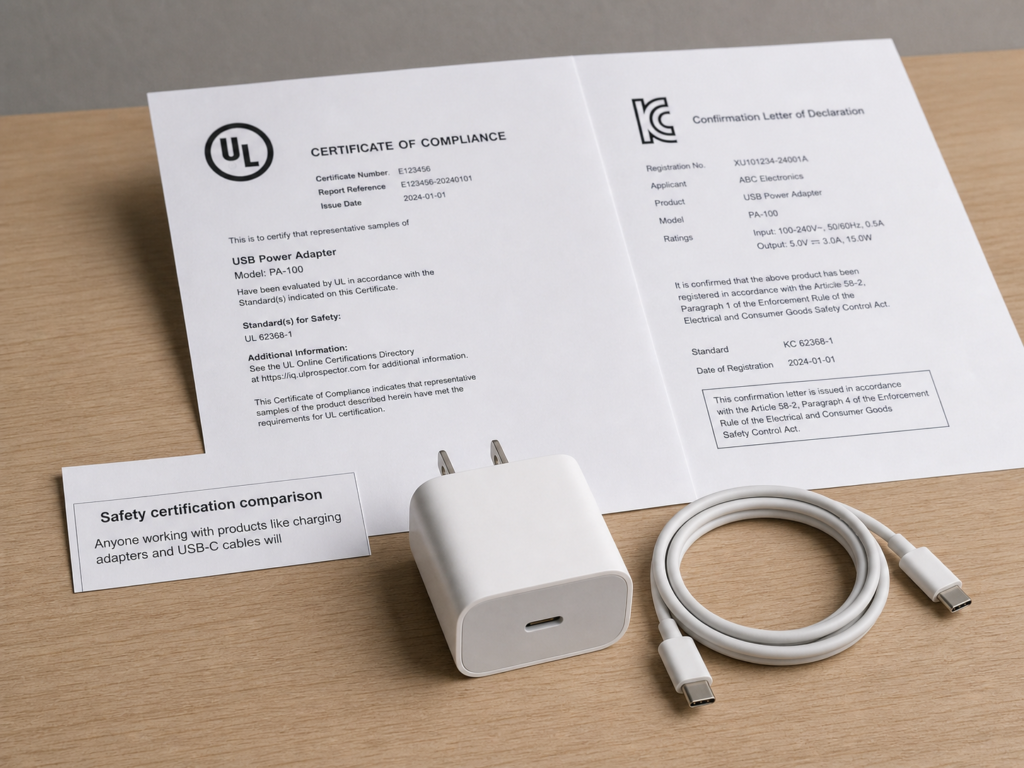
Differences in Standard Update Rhythm
The standards, certification scopes, and product catalogs of both countries will be updated. For the specific effective date and transition arrangements, you should check the information released by UL/ANSI, as well as the current KATS announcements, product catalogs, and designated standards respectively. You cannot presuppose that a certain system will necessarily update faster, nor can you judge that current products must meet the latest requirements based solely on old version reports.
Certification Process, Cycle, and Cost
Now that we have clarified the technical requirements, what everyone is most concerned about must be: How to do it? How long does it take? How much does it cost? Let’s explain step by step.
Pre-Steps: First Choose the Right Certification Path
The first step is always to classify the product and choose the right certification path. Don’t go the wrong way at the beginning.
- UL Side Paths: There are two main types. One is UL Listing, which is usually applicable to finished whole products. It requires whole product testing and factory audit. After obtaining authorization, the mark can be used on end products according to the rules. The other is UL Recognition, which is for components, such as power ICs in chargers. It can only prove that the component itself meets the corresponding requirements and cannot replace the UL Listing of the whole machine.
- KC Side Paths: Usually include paths such as safety certification, safety confirmation, and supplier’s declaration of conformity (supplier suitability confirmation). Safety certification usually involves testing by a designated certification body, necessary factory inspections, and issuance of a certificate; safety confirmation requires obtaining a test report as required and completing the declaration; the supplier’s declaration of conformity is self-declared by the supplier in accordance with applicable standards and bears responsibility. Which specific category to do depends on the classification of the product in the current KATS catalog, and cannot be subjectively judged solely by the level of risk.
Application Process and Mark Usage Rules
The process of UL Safety Listing is roughly: determine applicable standards → submit materials and send samples → sample testing → first factory audit → complete certification and mark authorization → maintain certification according to follow-up service requirements.
The processes of different KC paths are not exactly the same. Safety certification usually includes testing by a designated body, necessary factory inspections, and certificate issuance; safety confirmation requires obtaining the required test report and completing the corresponding declaration; the supplier’s declaration of conformity is declared and marked by the supplier in accordance with applicable standards. The specific procedures are subject to the current South Korean regulations, KATS announcements, and the Safety Korea system.
There are also differences in mark usage: the UL mark must be authorized before use, and must be printed in accordance with UL’s follow-up service and mark usage rules; randomly printed marks are invalid. The mark and label requirements for different KC categories are also different, and should be used in accordance with official specifications. Marks of other categories cannot be substituted for each other.
Certification Cycle Estimation (For Early Reference Only)
The cycle can only be confirmed by the specific certification body based on product standards, number of samples, factory inspection, data completeness, number of rectifications, report reuse, and declaration path. For 65W adapters or USB-C cables, it is not appropriate to use a fixed 4–8 weeks or 5–9 weeks as a universal commitment.
In actual projects, product complexity, number of factories, whether factory inspection is required, number of test rectifications, quality of data preparation, and whether existing CB/IEC reports can be accepted by the target body will all affect the cycle. During early planning, you can request project scheduling and written quotations from the certification body, and do not only refer to the unified number of days on the Internet.
Certification Cost Estimation (For Early Reference Only)
Neither UL nor KC fees are unified charging standards applicable to all products. The specific cost needs to be quoted separately by the certification body according to product category, applicable standards, test items, number of samples, number of factories, inspection arrangement, report reuse ratio, and subsequent maintenance requirements.
Therefore, “UL costs thousands to tens of thousands of dollars” or “KC costs thousands to more than ten thousand dollars” cannot be regarded as universally applicable single-product prices. Annual follow-up services, factory inspections, rectifications, supplementary testing, report conversion, and other EMC or radio items may also be billed separately.
A pitfall to avoid here: don’t believe the so-called “unified one-price”. Costs are affected by product complexity, laboratory quotations, the reuse ratio of existing reports, and additional test items, and each situation is different.
Certificate Maintenance and Change Rules
UL Listing usually does not have a unified fixed certificate expiration date, but must continuously meet applicable standards, follow-up service, and mark authorization requirements. The frequency and method of factory inspection depend on the specific follow-up service agreement, product category, and factory arrangement; if standards are revised or products change, supplementary assessment or transition requirements may also be triggered.
The certificates, test reports, declarations, and subsequent maintenance requirements of different KC paths are not the same, and should be confirmed according to specific items and regulations. You cannot apply the same validity period or renewal rule to all KC paths.
When the product structure, key components, rated parameters, production location, model, or label changes, an assessment should first be conducted in accordance with the change procedures of the corresponding certification body and regulations. If necessary, handle certificate changes, supplementary testing, or re-certification. You cannot directly continue to use the original certification without assessment; however, not every label or model change necessarily requires a complete re-test.
Practical Identification: How to Check the Authenticity and Validity of Marks
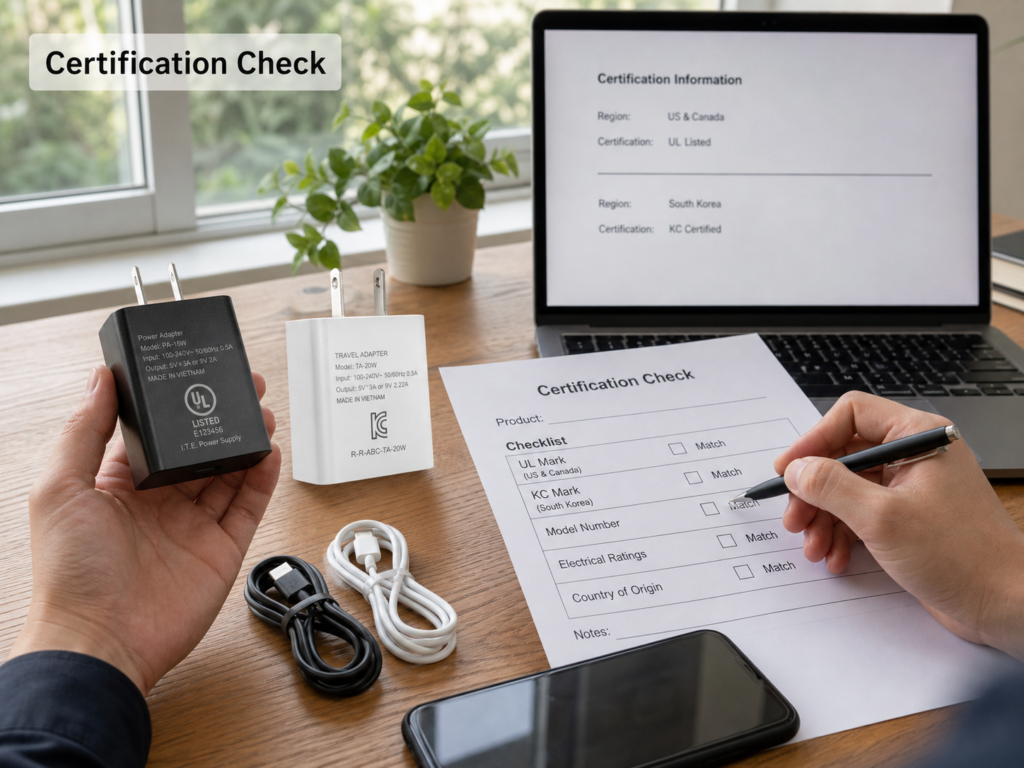
Whether you are a merchant purchasing goods or an ordinary user buying a charger, learning to identify the authenticity of UL and KC marks and confirm whether the product matches the certification information is a very practical skill.
UL Mark Identification and Verification
The UL mark may correspond to different certification categories such as Listing and Recognition. The UL Listing mark is usually used for finished whole products, and the UL Recognition mark is usually used for components. They cannot be mixed.
When verifying the UL mark, you should cross-check: mark style, file number or control number, product category, product model, rated parameters, and manufacturer or factory information. File numbers starting with E are more common, but not all UL certifications use the E-starting format; the display methods of file numbers, control numbers, models, and factory information also vary by certification category.
A more reliable method is to verify through UL’s official certification database or with UL Solutions, and compare the query results with the product markings. The query scope and access rights of Product iQ may vary by account or subscription, and it is not guaranteed that any product model can be directly retrieved publicly.
Common fake UL marks include: only the two letters UL are printed, no mark style that meets official specifications, the number cannot be found, or the product model, rated parameters, and production location in the query results do not match the actual product.
KC Mark Identification and Verification
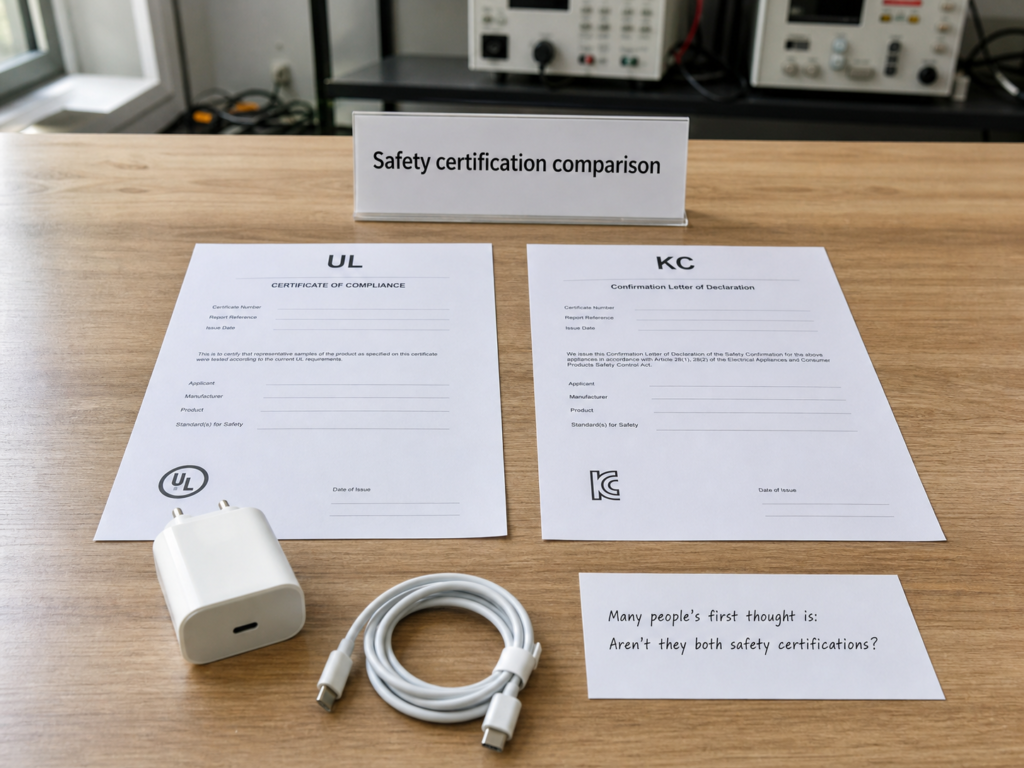
KC mark and label requirements depend on the specific safety path. Safety certification, safety confirmation, and supplier’s declaration of conformity may correspond to different marking, numbering, and document requirements. You cannot assume that the product has completed all compliance just by seeing the two letters “KC”.
When verifying the KC mark, you should cross-check: mark style, certificate or declaration number, product model, manufacturer information, rated parameters, and whether the product category and safety path match.
You can check the number, manufacturer, model, and product status through the relevant product safety query systems of South Korea KATS and Safety Korea. Common suspicious situations include: only the KC word but no verifiable number, the product corresponding to the number does not match the actual product, or the label information required by law for the product is missing.
Quick Inspection Checklist for Charging Product Certification
We have compiled a three-step quick inspection method for your reference in preliminary judgment:
- First confirm whether the mark is required: According to the product category, destination country regulations, and sales channel requirements, confirm whether the product needs the corresponding certification mark according to law or channel requirements. The mark may appear on the product body, packaging, nameplate, or accompanying documents, and the authenticity cannot be judged solely by the position of the mark.
- Check the category: The certification category must match the product type. For example, the UL Recognition mark for components cannot be used as whole product Listing; marks and documents of different KC safety paths cannot be substituted for each other.
- Verify parameters: Information such as model, rated power, input and output parameters, manufacturer, and production location in the certification or declaration should be consistent with the actual product.
Applicable Boundaries and Pitfall Avoidance Guide
Boundary Cases for Two Common Scenarios
We use two real scenarios to help everyone understand the boundaries:
- Case 1: 65W adapter sold in both the US and South Korea Misconception: Having UL allows entry into South Korea, and having KC allows entry into the United States. Correct logic: There is no universal official mutual recognition between UL and KC. Whether a product needs to obtain relevant certifications separately must be judged according to the specific regulations, product classification, local rules, and sales channel requirements of the two countries. To reduce costs, you can choose a compliance institution that serves both regions, but you must separately verify its OSHA NRTL recognition scope and South Korea KATS recognition or designation qualification, and confirm in advance whether the target certification body accepts existing test data. Data reuse is only a possible cost reduction measure and does not guarantee that testing will be reduced.
- Case 2: Charger + USB-C cable sold as a set Misconception: One certification for the set is valid for all. Correct logic: Adapters and cables may belong to different certification categories. Set certification does not necessarily cover all accessories, and the product scope, models, and certification documents must be checked separately.
Five Most Common Cognitive Misconceptions
- Certified products will never break: Wrong. Certification only proves that the product meets the corresponding safety requirements within the applicable scope, and does not guarantee performance, lifespan, or never-failure. Products may still be damaged due to aging, dropping, water ingress, misuse, or other reasons.
- Government-led KC is more reliable than UL: Wrong. The two belong to different regulatory and conformity assessment systems, and specific requirements depend on product standards and certification paths. UL is highly recognized in the North American market, and you cannot simply say which is more reliable than the other.
- Using UL-recognized components = the whole machine has UL certification: Wrong. Component recognition cannot replace whole product Listing, and the whole machine must be evaluated separately according to applicable standards.
- All have USB-C interfaces, so certification requirements are the same: Wrong. Different power, protocols, intended uses, speeds, cable structures, and whether electronic components are included may lead to very different testing requirements. 240W high-power cables and ordinary low-power passive cables cannot be directly compared.
- Having USB-IF PD certification means no need for safety certification: Wrong. Protocol compliance and safety certification are different systems and cannot replace each other.
Hard Boundaries That Cannot Be Broken
There are several boundaries that must never be ignored:
- Geographical Boundary: UL is mainly used in the US market, and whether other countries and regions accept it must be confirmed separately; KC mainly corresponds to the South Korean market. You cannot default to one certificate being valid for both markets.
- Category Boundary: US compliance requires distinguishing between NRTL safety requirements, FCC Part 15 or Part 18 and other rules, and state and local rules; South Korea’s safety, EMC, radio, and energy efficiency must also be judged separately by product category.
- Special Product Boundary: For vehicle-mounted, wireless, and high-power USB-C products, standards should be confirmed according to specific structure, wireless function, rated parameters, and applicable regulations. There is no unified “special certification” for 240W PD cables that can replace the safety requirements of all ordinary cables.
Certification Selection Decision Guide
If you are planning to enter the US or South Korean market and don’t know how to choose certification, you can refer to the following logic.
Single-Market Certification Selection Logic
- Only for the US market: First confirm the special requirements of sales channels and customers. For end products that clearly require UL Listing, evaluation should be carried out according to the UL Listing path; if customers accept it, other OSHA-recognized NRTLs can also be considered, but you must check the specific recognition scope of the body and whether local competent authorities, purchasers, or channels accept its mark.
In addition, it is also necessary to judge whether FCC Part 15, Part 18 and other rules apply according to product functions and equipment categories, and adopt corresponding conformity assessment methods such as certification, verification, or supplier’s declaration of conformity. FCC compliance does not mean uniformly applying for a “FCC EMC certificate”, and UL Safety Listing does not automatically cover FCC obligations. - Only for the South Korean market: The first step is to check whether the product is in the relevant mandatory catalog of KATS and determine the applicable safety path; then judge whether other obligations such as KC safety, EMC, radio, and energy efficiency apply according to product categories. You cannot default to all charging products needing to handle exactly the same items.
Cost Reduction Logic for US-South Korea Dual Markets
The core principle must be remembered: whether it is necessary to meet the requirements of the two countries separately must be judged according to specific products and regulations, and “one certificate for all” cannot be taken as the default solution.
To reduce costs, you can choose a compliance institution that serves both regions, but you should separately verify whether it has the corresponding OSHA NRTL recognition scope and South Korea KATS recognition or designation qualification, and confirm with the target certification body in advance whether existing test data is acceptable. Test data reuse can only be used as a possible cost reduction measure, and does not guarantee that testing will be reduced or the cycle will be shortened.
It is best to take into account the differences between the two regions at the product design stage, such as pin specifications, label language, EMC design, and structural requirements, and reserve them in advance to avoid spending more money on later rectifications.
Pre-Certification Decision Checklist
Follow these four steps, and there will basically be no major mistakes:
- Confirm the target market, sales channels, and whether customers have special requirements. This is the premise of all decisions.
- Clarify the product type, rated parameters, whether it has electronic components, and whether it has wireless functions. These directly affect the certification classification.
- Check whether the product is in the mandatory catalog of the corresponding market, and determine the certification category to be done and other applicable obligations.
- Confirm several key issues with the certification body: whether the product classification is correct, whether the whole machine and accessories need to be tested separately, whether existing CB/IEC reports can be reused, and whether the testing body has the recognition or designation qualification required by the target market. These will directly affect cost and cycle.
Final Summary
At this point, the core differences between UL and KC safety certifications have been mostly explained. After reading this article, you should be able to do the following: distinguish the differences in applicable regions, mandatory attributes, and core coverage content between the two, and no longer confuse them; be able to preliminarily judge whether UL and KC marks match the product through cross-checking of marks, numbers, models, parameters, and manufacturer information; be able to judge the required safety and other compliance requirements according to the target market and product type, and avoid common misconceptions; be able to know that the certification cycle and cost must be confirmed by the specific body according to the project, and formulate a basic US-South Korea dual-market certification plan.
Whether you are a merchant doing cross-border business or an ordinary user looking for reliable charging products, understanding the underlying logic of these certifications will help you avoid many pitfalls.