
Sellers of chargers, USB-C cables, and power adapters who want to enter the UAE market will most likely hear the term “ESMA certification”. However, many people either cannot figure out whether it is required, or assume that a CE or CB report is enough for direct access, only to end up stuck in customs clearance or penalized by market spot checks. This guide is specifically for charging electronic products, covering from the most basic regulatory logic to practical pitfall avoidance, helping you go from beginner to being able to make independent preliminary judgments and avoid unnecessary detours.
First, Clarify: ESMA Is Not the Current Official Regulatory Body
First, a common misconception needs to be corrected: the commonly mentioned “ESMA certification” is a historical colloquial term. The former Emirates Standards and Metrology Authority (ESMA) has been merged into the UAE Ministry of Industry and Advanced Technology (MoIAT), which is the current regulatory authority. However, the industry still habitually uses ESMA to refer to relevant market access requirements.
In addition, two core premises shall be stated in advance:
First, this article only targets charging products such as chargers, USB-C cables, and power adapters. Rules for other categories (such as home appliances and medical devices) vary greatly and require separate assessment.
Second, whether a product requires mandatory certification shall be comprehensively determined in combination with its model, HS Code, purpose, structure, and sales scenario. There is no single judgment standard such as “all chargers must be certified”. The final conclusion shall be subject to applicable regulations, official requirements, and the assessment of accredited bodies.
Must-Know for Beginners: Regulatory Logic and Core Terms of the UAE Market
Core Logic of the Regulatory System
The market access of electronic products in the UAE can be summarized in one sentence: top-level authorities set rules, third parties conduct assessments, systems manage services, additional requirements depend on product attributes, and local responsibilities are determined according to specific schemes.
• Top-level rules are uniformly issued by MoIAT, including technical regulations, mandatory control catalogs, and process requirements for conformity assessment. All market access actions shall be carried out around these rules.
• Conformity assessment is usually completed by third-party testing and certification bodies within MoIAT’s accredited scope. The professional term is Conformity Assessment Body, abbreviated as CAB. CABs can carry out testing, auditing or conformity assessment within their accredited scope.
• ECAS is MoIAT’s conformity assessment service platform. Whether a specific product needs to apply for conformity services, registration or submit relevant documents through this platform depends on corresponding regulations, product categories and customs clearance requirements.
• In addition to MoIAT’s basic requirements, some products are also subject to other rules: for example, low-voltage electrical appliances may require GCC G-Mark certification; products with Bluetooth, Wi-Fi or other regulated radio frequency functions need to check TDRA requirements; products with built-in lithium batteries must meet corresponding transportation safety requirements, etc. The specific requirements depend on product attributes.
• For products that need to apply for conformity assessment or import customs clearance in the UAE, it is usually required to be handled by importers with corresponding UAE business qualifications, manufacturer’s local representatives or other qualified entities. Importers usually assume important responsibilities in the import and market supply links, but this arrangement cannot be generalized as the only statutory responsibility model for all products.
7 Commonly Heard Terms, Explained Clearly at Once
Many beginners are confused by various abbreviations. Here are the most common terms explained in plain language:
1. **ECAS**: ECAS is a conformity assessment service platform managed by MoIAT, used to apply for or manage conformity services for applicable products. It is not equivalent to a universally applicable product filing system; specific requirements for certificates, registration and customs clearance documents shall be confirmed in accordance with product regulations and customs rules.
2. **CoC (Certificate of Conformity)**: CABs are responsible for implementing testing, auditing or conformity assessment within their accredited scope; the application, issuance and electronic document process of the Certificate of Conformity shall be implemented in accordance with the corresponding MoIAT/ECAS scheme, and it cannot be generally assumed that all CoCs are directly issued by CABs. If mandatory products are required by relevant regulations to obtain a Certificate of Conformity, they must be handled in accordance with applicable procedures, but the certificate cannot replace other special permits or customs requirements.
3. **EQM (Emirates Quality Mark)**: EQM is usually a voluntary quality conformity mark, but whether it is mandatory depends on the applicable technical regulations and product categories; it cannot be determined solely based on the product being a charging product that it must or need not be obtained.
4. **UAE RoHS**: This is the UAE’s restriction of hazardous substances requirement for electronic and electrical products. Electronic and electrical equipment within the applicable scope of UAE RoHS must comply with requirements on restricted substances, limit values and applicable exemptions; the specific product scope shall be checked against current regulations, and conclusions cannot be drawn solely based on the attribute of “electronic product”. Usually, there is no need to obtain a separate so-called RoHS access certificate, but materials such as supply chain declarations, test reports and technical documentation shall be kept for inspection.
5. **CB Report**: The CB report is an international mutual recognition safety test report under the IECEE system, equivalent to a general safety test basis. It can be used to apply for CAB assessment on whether to waive repeated local tests in the UAE, but it cannot be directly used as a market access credential, and still needs to be assessed in accordance with local procedures.
6. **GCC G-Mark**: This is a mandatory certification mark for low-voltage electrical appliances jointly implemented by Gulf countries, and is not unique to the UAE. If the product is within the GCC control catalog, it is necessary to check both the G-Mark requirements and MoIAT’s local rules; the two are parallel, not an either-or choice.
7. **TDRA Permit**: TDRA mainly regulates telecommunications, radio equipment and their wireless functions. Products with Bluetooth, Wi-Fi or other regulated RF transmit/receive functions need to check TDRA type approval, registration and labeling requirements; products with only near-field induction charging and no regulated radio transmit/receive functions usually do not fall within the scope of TDRA radio equipment access, but the final conclusion shall still be subject to the TDRA catalog and product technical characteristics.
Don’t Confuse: Standards Are Not Equal to Market Access Certificates
Many sellers will say, “I have a test report of IEC 62368-1, can I enter the UAE?” The answer is not necessarily.
Common reference standards such as IEC 62368-1 (safety of information technology equipment), IEC 61347 (power supply safety), and BS 1363 (plug standard) are only technical bases, not market access credentials. On the one hand, the UAE will add local differences on the basis of international standards (such as plug specifications and voltage adaptation requirements); on the other hand, even if there is a test report that meets the standards, it is not considered compliant without corresponding conformity assessment and necessary system processes. Which version of the standard is specifically applicable and whether there are local differences need to be confirmed by a CAB within MoIAT’s accredited scope, and conclusions cannot be drawn by checking the standards on your own.
5 Common Cognitive Misconceptions for Beginners
Here are the most common misconceptions listed to help you avoid pitfalls in advance:
1. **Having CE/FCC/CB certification allows direct market access**: Wrong. These reports can only be used as technical references. The UAE has local difference requirements, which must be evaluated and confirmed by corresponding institutions, and cannot be used directly.
2. **All charging accessories require mandatory certification**: Wrong. Only products that fall into the official mandatory catalog and meet control conditions are required. For example, ordinary passive USB-C cables usually do not automatically trigger mandatory safety certification just because they are “electronic accessories”, but other applicable requirements still need to be checked.
3. **Having GCC G-Mark equals UAE market access**: Wrong. Some products need to meet both G-Mark and MoIAT’s local requirements (such as system processes, local difference tests or other document requirements). Getting G-Mark does not mean everything is fine.
4. **All wireless charging products require TDRA permit**: Wrong. Wireless chargers with Bluetooth, Wi-Fi or other regulated RF transmit/receive functions need to check TDRA requirements; whether pure near-field induction products fall within the scope of TDRA shall be confirmed in combination with whether they contain regulated radio functions and the current catalog.
5. **All USB-powered products do not need certification**: Wrong. USB chargers with mains input (i.e., wall-mounted chargers) are a key screening category, and their compliance must be assessed in accordance with applicable regulations and catalogs.
Quick Self-Check: What Access Requirements Your Charging Products Need to Meet
5-Step Screening Logic for Preliminary Judgment
Judging product compliance requirements shall be done in order, without skipping steps, and there is no single decisive condition:
1. **Confirm basic attributes**: First clarify the product type (charger/cable/wireless charger), purpose (civil consumer-grade or industrial use), HS Code, and sales scenario (local sales/free zone re-export).
2. **Check input voltage**: If the product has mains input, with rated input voltage exceeding 50V and not exceeding 1000V (AC), or exceeding 75V and not exceeding 1500V (DC), it shall be used as a screening condition for the scope of GSO low-voltage electrical appliances; it is also necessary to check the product type, exclusions, applicable technical regulations and catalogs. The voltage range itself cannot constitute a final certification conclusion.
3. **Check functional modules**: Check whether the product has RF communication, built-in lithium battery, or belongs to external power supply or plug accessories, which will determine whether additional requirements need to be superimposed.
4. **Check official catalogs**: Compare with MoIAT’s latest mandatory catalog and GCC G-Mark catalog for preliminary matching to see if the product is within the control scope.
5. **Professional confirmation**: Finally, find a CAB within MoIAT’s accredited scope for pre-assessment and obtain a written judgment conclusion. This is a relatively reliable way to avoid errors in self-judgment.
Classification Assessment of Typical Charging Products
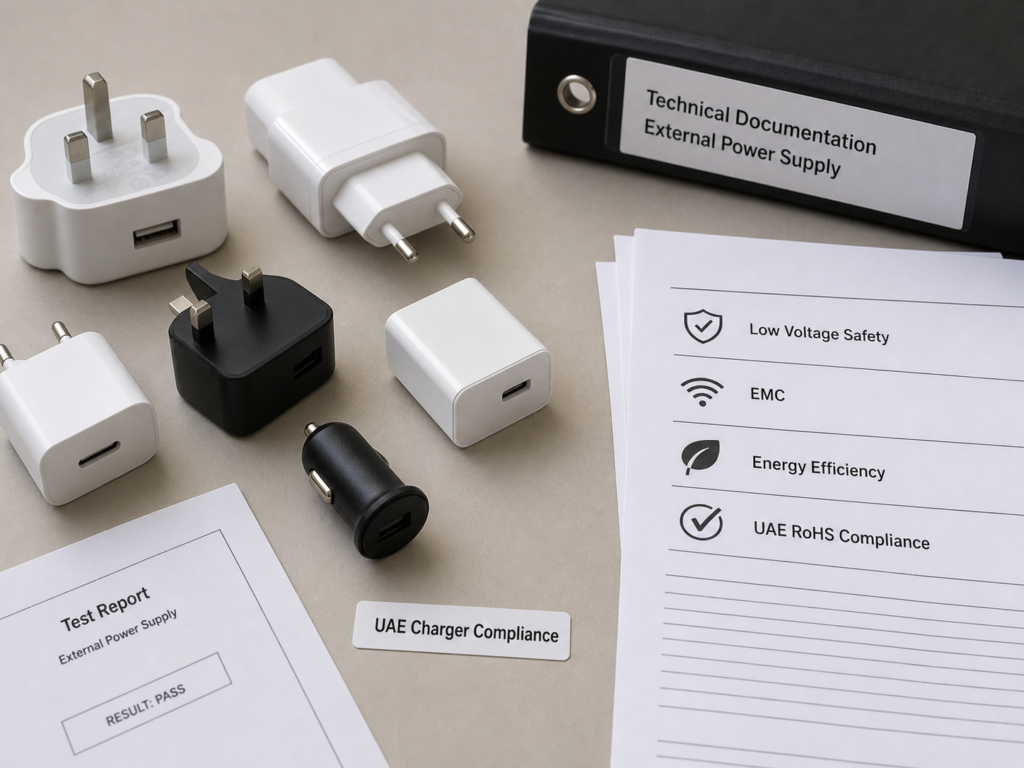
For the charging products that sellers commonly sell, we have sorted out the preliminary assessment directions for your quick reference:
USB-C/Charging Cables Are Divided into Three Categories
• **Passive charging cables/data cables**: Ordinary cables without active circuits or chips inside usually do not belong to equipment that requires independent electrical safety or EMC assessment, but it shall be checked whether they fall within the applicable scope of UAE RoHS and other labeling regulations. All requirements cannot be determined solely based on “passive” nature.
• **USB-C cables with E-Marker chips**: That is, cables that support high-power fast charging and have power identification chips require additional assessment of circuit characteristics. Whether they trigger safety and EMC requirements shall be determined according to functions and regulations, and conclusions cannot be drawn directly.
• **USB-C cables with active circuits**: For example, cables with signal conversion, hub, or signal amplification functions (such as USB-C to HDMI extension cables) shall be assessed for safety, EMC and other requirements as active electronic equipment.
Wireless Chargers Are Divided into Two Categories
• **Pure Qi near-field induction wireless chargers (no Bluetooth/Wi-Fi/other regulated RF functions)**: Shall be checked for potentially applicable requirements such as low-voltage safety, EMC, energy efficiency, and UAE RoHS in combination with their power supply method, product category, applicable catalog and technical regulations. All items cannot be directly determined solely based on “pure Qi”.
• **Wireless chargers with wireless communication functions (Bluetooth/Wi-Fi/App control)**: In addition to potentially applicable low-voltage safety, EMC, energy efficiency and UAE RoHS requirements, TDRA type approval, registration and labeling requirements shall also be checked.
Preliminary Judgment of Other Common Categories
• **Wall chargers/USB chargers/power adapters**: Belong to the external power supply category, and usually need to be checked for low-voltage safety, EMC, external power supply energy efficiency, UAE RoHS and other applicable regulations respectively. The specific requirements shall be subject to the current catalog and product parameters.
• **Charging devices with built-in lithium batteries (such as power banks)**: If they have mains input (that is, they can be plugged into the wall for charging), in addition to checking lithium battery safety transportation requirements, it is also necessary to assess whether low-voltage electrical appliance and other related requirements apply.
• **Charging kits (charger + cable + plug)**: Each component must be split and assessed for compliance requirements separately. It cannot be assumed that the entire kit only needs one certification.
Typical Product Compliance Matrix
For a more intuitive comparison, we have sorted out the compliance requirements and common misjudgment points of 7 types of common charging products. The requirements in the table are only preliminary screening directions, and cannot replace the confirmation of current catalogs, technical regulations and specific models.
| Product Type | Core Attributes | Main Compliance Requirements | Involved Responsible Parties | Common Misjudgment Points |
| 65W USB-C wall charger | Mains input/no wireless function/no battery | Check safety, EMC, external power supply energy efficiency, UAE RoHS and other requirements according to the current catalog | CAB, importer, customs, etc. | Assuming that a CE report is sufficient for direct market access |
| Passive USB-C charging cable | Rated voltage/current, no active circuit/no RF/no battery | Check UAE RoHS and labeling requirements according to the current catalog; usually does not automatically trigger整机 safety or EMC assessment due to passive nature | Importer, customs, and CAB when necessary | Overdoing full set of mandatory safety certification, wasting cost |
| USB-C cable with E-Marker | With chip/used according to rated voltage and current/no RF | CAB assesses whether it triggers safety, EMC and other requirements, and checks UAE RoHS and other applicable requirements | CAB, importer | Either directly counted as passive cable, or directly counted as active device |
| Pure Qi wireless charger (15W) | Mains input/no wireless communication/no battery | Check safety, EMC, energy efficiency, UAE RoHS and other requirements according to the current catalog and product parameters | CAB, importer, customs, etc. | Assuming all wireless chargers require TDRA permit |
| Wireless charger with Bluetooth | Mains input/with Bluetooth/no battery | Check safety, EMC, energy efficiency, UAE RoHS, as well as TDRA type approval, registration and other requirements | CAB, TDRA, importer | Missing TDRA related requirements |
| Power bank with mains input | Mains input/no wireless function/with battery | Check safety, EMC, UAE RoHS, lithium battery transportation and other applicable requirements | CAB, importer, transporter | Only counted as power bank, missing potentially applicable low-voltage electrical appliance requirements |
| Charger + cable kit | Mains input (charger)/no wireless function/no battery | Split components for separate assessment, and check kit sales and labeling requirements | CAB, importer, customs, etc. | Only doing one certification for the entire kit |
Core Compliance Requirements: 5 Types of Rules Under MoIAT’s Jurisdiction
Next, we will specifically explain the core compliance requirements within MoIAT’s jurisdiction. Products with different control levels have different requirements, and not all requirements need to be applied.
Electrical Safety Requirements (Only for Mandatory Control Products)
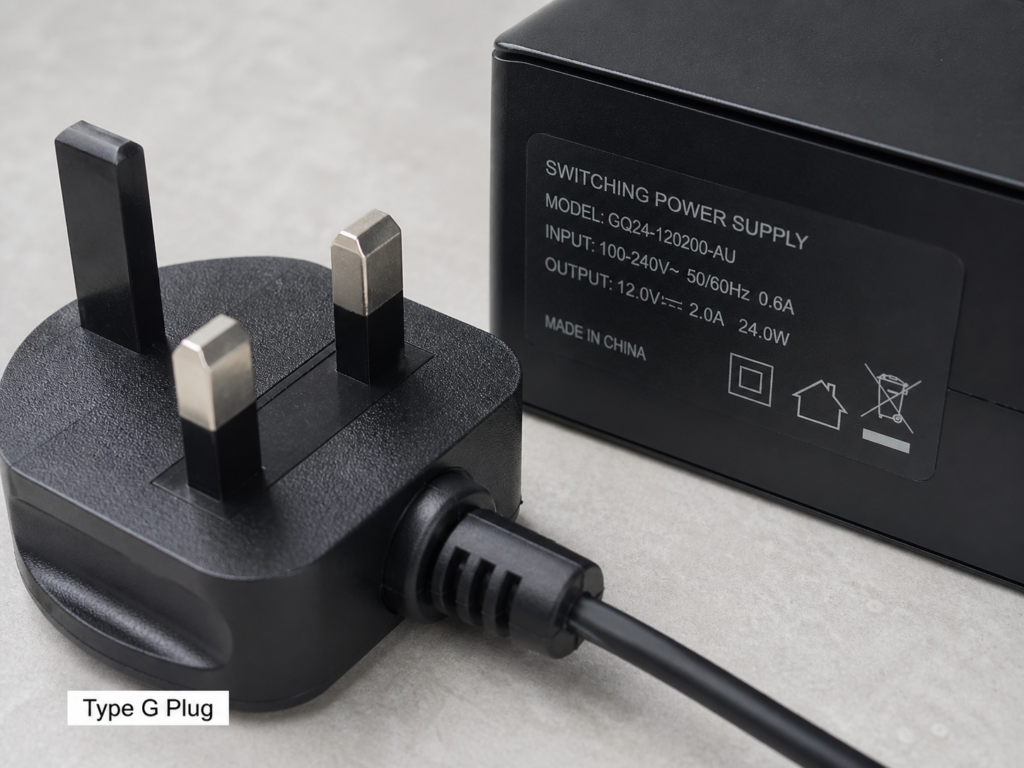
The core of electrical safety is to prevent risks such as electric shock, short circuit, fire, and abnormal heating. For charging products, key inspection items include insulation performance, overcharge/overcurrent/short circuit protection, plug compatibility, and shell flame retardant grade.
Civil plug-in products sold in the UAE usually need to adopt Type G configuration that meets the UAE’s applicable requirements; plugs and related accessories may involve BS 1363 or corresponding GSO/UAE standards, but the specific standard version, fuses, pin protection and test items must be confirmed in accordance with applicable regulations and CAB.
The safety standards are generally aligned with IEC international standards, but there are local differences such as plugs and voltage. The specific applicable standards and test items need to be confirmed by CAB.
Electromagnetic Compatibility (EMC) Requirements (Only for Some Mandatory Products)
EMC is simply two requirements: first, your product must not interfere with the normal operation of other electronic equipment; second, your product must be able to resist external electromagnetic interference and will not malfunction easily.
Typical applicable products include chargers, power adapters, USB-C cables with active circuits, and wireless chargers. Passive cables usually do not belong to equipment that requires independent EMC assessment, but whether it is required in the end shall still be subject to applicable regulations, product circuit characteristics and CAB judgment.
UAE RoHS Compliance Requirements (Electronic and Electrical Products Shall Be Checked According to Scope)
Electronic and electrical equipment within the applicable scope of UAE RoHS must comply with requirements on restricted substances, limit values and applicable exemptions. The specific product scope shall be checked against current regulations, and conclusions cannot be drawn solely based on the attribute of “electronic product”.
The verification logic is: first check the list of restricted substances, then check the limit value requirements, then see if there are applicable exemption clauses, and finally prepare compliance certification materials. There are 6 classic controlled substances: lead, mercury, cadmium, hexavalent chromium, polybrominated biphenyls, and polybrominated diphenyl ethers. The latest list shall be subject to current regulations.
UAE RoHS usually does not require separate certification, but materials such as supply chain material declarations, third-party test reports, and technical documentation shall be kept for inspection. It should be noted that the test report only represents the submitted sample and the material state at that time. Re-assessment is required when materials are changed, suppliers are replaced, or regulations are updated, and there is no fixed validity period.
Energy Efficiency Requirements (Only for External Power Supplies in the Catalog)
Energy efficiency requirements are mainly for external power supplies included in the current MoIAT energy efficiency technical regulations or catalog, that is, some chargers and adapter products. The specific scope shall be subject to the latest catalog.
The core control indicators may include no-load power consumption and average operating efficiency. Products included in relevant regulations or catalogs must meet corresponding energy efficiency indicators, and confirm whether energy efficiency labels, registration or other conformity documents are required according to specific regulations; it cannot be preset that all external power supplies must be affixed with the same energy efficiency label.
Labeling and Packaging Requirements (Vary According to Control Level)
The general principle of labeling and packaging is: only marks explicitly permitted by regulations or certificates can be used, and the style, size, position, and language must meet official requirements, and cannot be added casually.
• **Mandatory products**: The body usually needs to be marked with model number, rated parameters, place of origin, and applicable compliance marks. The specific items shall be subject to corresponding regulations and certificate requirements.
• **Non-mandatory products**: Need to comply with applicable UAE RoHS, consumer protection and other labeling rules.
• **Prohibited acts**: Falsely marked power, falsely marked high fast charging protocols, use of wrong plug type markings.
Full Process: 6 Key Nodes from Product Finalization to Market Launch
Many people think that certification is just “submitting samples and getting certificates”. In fact, the complete process starts from product finalization and continues to be maintained after listing. We sort out the core actions, outputs and precautions of each node in order:
1. Preparatory and Finalization Stage
This is the most basic stage. Do not start certification before the product is finalized, otherwise every change will require retesting, wasting money and time.
Core actions include: determining the final version of the product, preliminary classification of HS Code, preliminary screening of control catalogs, and determining the UAE local importer, manufacturer’s local representative or other qualified applicant entity.
Outputs are product parameter sheet, HS Code preliminary judgment form, and entrustment or authorization documents of relevant entities.
Special attention shall be paid: for products that need to apply for conformity assessment or import customs clearance in the UAE, it is usually required to be handled by entities with corresponding UAE business qualifications. Specifically, whether the application is made by the importer, manufacturer’s local representative or other qualified entities, and how the responsibilities of each party are allocated, shall be confirmed according to product regulations and service schemes.
2. Gap Analysis and Institution Selection
Choosing the right CAB is the key to avoiding pitfalls. It is necessary to check whether the institution is within MoIAT’s accredited scope for corresponding products and assessment items, otherwise documents issued beyond the accredited scope may not be used for corresponding processes.
Core actions include: screening CABs within MoIAT’s accredited scope, submitting product materials for pre-assessment, and determining compliance gaps and handling schemes.
Outputs are pre-assessment report, handling scheme, and quotation issued by CAB.
The method to verify institution qualifications is very simple: log in to MoIAT’s official website to directly query the qualifications and accredited scope of CABs, don’t just listen to what the institution says.
3. Testing and Document Review Stage
This stage is the actual testing and document review, and problems shall be rectified in time.
Core actions include: submitting samples to a suitable testing institution or CAB for testing, submitting technical documents (user manual, nameplate, packaging design, etc.) for review, and rectifying non-conforming items.
Outputs are test reports and reviewed technical documents.
If you already have a valid CB report, you can apply for CAB to assess the local difference coverage. If it meets the requirements, part of the testing can be waived, saving time and cost. However, whether it can be used and which items can be waived still need to be confirmed in writing by the relevant CAB based on the accredited scope and specific product.
4. Acquisition of Conformity Documents and System Operations
After testing and document review are completed, it is also necessary to handle conformity documents and system processes in accordance with the corresponding scheme.
Core actions include: CAB implements testing, auditing or conformity assessment within its accredited scope; the application, issuance and electronic document process of the Certificate of Conformity shall be implemented in accordance with the corresponding MoIAT/ECAS scheme; if applicable, then handle relevant services in ECAS or submit other documents.
Outputs are Certificate of Conformity or other applicable conformity documents, ECAS related records or numbers (if required).
ECAS is not equivalent to a universally applicable product filing system. Whether ECAS conformity certificate, registration, enrollment or batch documents are required shall be subject to the regulations corresponding to the product, system rules and local customs requirements, and there is no need to do redundant operations in advance.
5. Customs Clearance and Pre-Market Verification
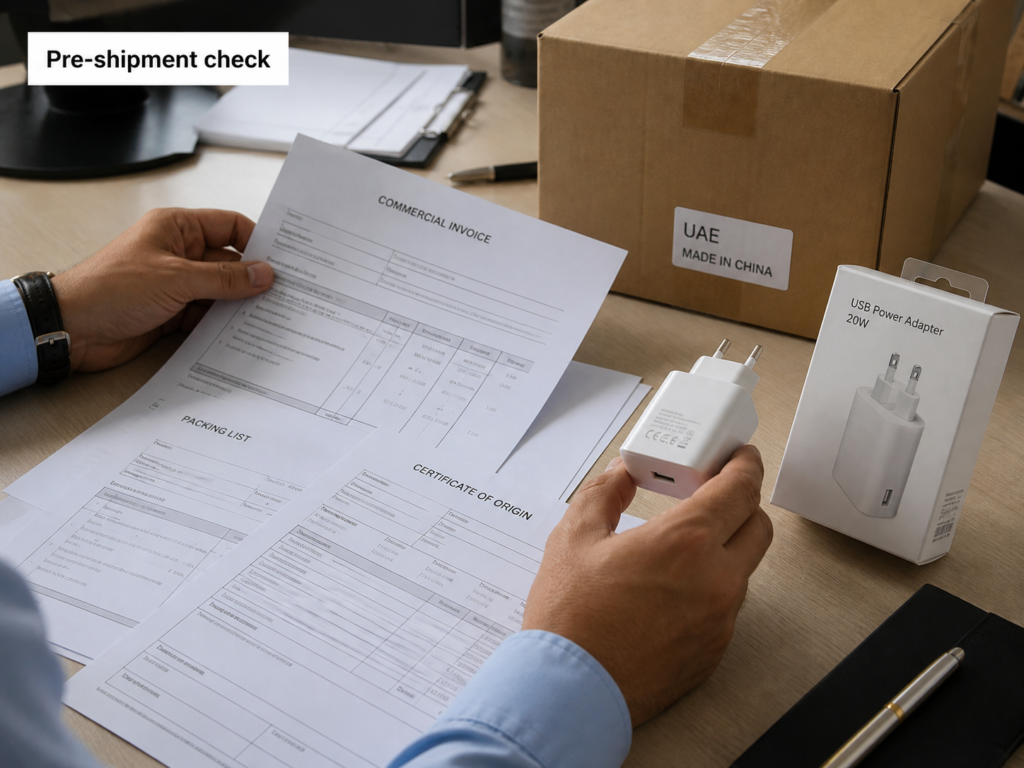
Be sure to do a final check before shipping, otherwise if problems are found at the port, the detention fees will be very high.
Core actions include: checking the consistency of all documents, submitting customs clearance materials, and doing labeling inspection before listing.
Outputs are full set of customs clearance documents and pre-market inspection records.
It should be noted that the compliance requirements for free zone re-export goods and local sales goods may be different. Be sure to confirm in advance and do not prepare according to the same set of standards.
6. Continuous Compliance and Change Management
Obtaining conformity documents is not the end, and subsequent maintenance is equally important, otherwise the documents may become invalid or you may be penalized by spot checks.
• **Certificate renewal**: Submit a renewal application to the relevant institution before the certificate expires. How far in advance shall be subject to the corresponding scheme and institution requirements. It is best to set up a ledger to record the validity period.
• **Change management**: Before product modification, replacement of key components, or brand change, be sure to submit to CAB for assessment first to confirm whether retesting or certificate update is required. Do not secretly modify and ship goods on your own.
• **Response to spot checks**: Full set of test reports, technical documents, and certification materials shall be kept properly to cooperate with market supervision spot checks.
• **Problem handling**: If there are complaints or recall risks, contact the local importer, relevant institutions and CAB immediately, and handle them in accordance with regulatory procedures, do not delay.
Cost and Cycle: How to Estimate Without Being Cheated
Many sellers only look at the total price when making inquiries, and finally find that there are many hidden costs, or the cycle is much longer than expected. Here we teach you how to estimate and make inquiries.
4 Components of Certification Cost
When making inquiries, confirm whether each item is included one by one to avoid hidden costs:
1. **Testing fees**: Safety, EMC, energy efficiency, RoHS testing, etc. The specific items depend on what the product needs to do, not all items are required.
2. **Service fees**: Report review fees, conformity assessment or certificate service fees, label review fees, agency service fees, local importer service fees, etc.
3. **System and official fees**: ECAS system related service fees (if required), other official charges.
4. **Other fees**: Sample fees, international courier fees, rectification and retest fees, customs clearance and storage fees. These are easily overlooked and should be calculated in advance.
When it is necessary to issue or implement conformity assessment, it shall be verified whether the institution is within MoIAT’s accredited scope. Testing, consulting and agency services can be provided by different entities, but the final test report, assessment and certificate must comply with corresponding regulations, accredited scope and MoIAT/ECAS processes. Do not accept quotations from unqualified entities that issue official certificates on their own.
4 Core Factors Affecting the Cycle
The certification cycle is not fixed, and is mainly affected by the following factors:
• **Document preparation**: If the documents are complete and meet the requirements, the cycle is shorter; repeated supplementary documents will slow down the progress.
• **Testing situation**: Products with good quality that do not require supplementary testing and rectification have a short cycle; rectification and retesting will extend the cycle.
• **Institution scheduling and shipment arrangement**: Institution scheduling, importer cooperation and market shipment arrangement may affect the cycle. The specific situation shall be subject to the CAB’s current scheduling and written quotation.
• **Entity cooperation**: If the local importer or other applicant entity has complete documents and high cooperation level, the process will be promoted faster.
4 Practical Methods to Reduce Cost and Speed Up Progress
Here are several methods that can be used to plan compliance costs and cycles. Whether they are applicable shall still be subject to the assessment of relevant institutions:
1. **Prioritize preparing CB reports**: The CB report is a safety test basis under the international mutual recognition system, which can be reused when applying for assessment in other countries or regions later. In the long run, it helps reduce repeated testing costs.
2. **Apply for series/model coverage assessment**: For same series models, you can apply to CAB for series or model coverage assessment. However, whether merging is allowed, which representative models need to be tested, and whether reports can be shared must be confirmed in writing by CAB based on applicable regulations, structural differences, key components and rated parameters. Power change itself may also affect the test coverage scope.
3. **Do pre-testing and pre-review in advance**: Before formal sample submission, do sample pre-testing by yourself first, and let CAB review the labeling and packaging design first, to avoid rectification due to small problems during formal testing, wasting time and money.
4. **Arrange certification in advance**: Do not start certification when shipment is approaching. Reserve buffer time according to CAB’s current scheduling, importer cooperation and market shipment arrangement.
3 Precautions for Inquiry
1. When it is necessary to issue or implement conformity assessment, inquiries shall be made to institutions within MoIAT’s corresponding accredited scope, and their specific qualification scope shall be verified. Testing, consulting and agency services can be provided by different entities, but entities without corresponding qualifications cannot be regarded as official certificate issuers.
2. Provide complete product information (model, parameters, structure, existing reports). The more complete the information, the more accurate the quotation, to avoid additional items and fees in the later stage.
3. Confirm the service items included in the quotation, validity period, system fees, test items, retest fees, etc. Don’t just look at the total price, ask clearly about all details.
Practical Pitfall Avoidance: 5 Types of High-Frequency Pitfalls and Avoidance Methods
We have sorted out the most common pitfalls in practice, each with a clear avoidance method to help you avoid unnecessary detours.
Product Classification Pitfalls
• **Common mistakes**: Counting charging cables with mains plugs as ordinary cables without certification; doing unnecessary mandatory safety certification for passive cables, wasting cost; not splitting components of charging kits, only doing one certification.
• **Avoidance method**: Strictly judge according to the logic of “attribute → input → function → catalog → CAB confirmation”. Kits must split components for separate assessment.
• **Fallback solution**: When in doubt, directly find a CAB with appropriate accredited scope for pre-assessment. Do not judge by yourself, and obtain written opinion first.
Certificate Conversion and Testing Pitfalls
• **Common mistakes**: Applying for certificate conversion with CE report directly and being rejected; applying test reports of other models, assuming that similar structure is enough; using expired report versions.
• **Avoidance method**: Prioritize using CB reports to apply for relevant assessment; let CAB confirm the applicability of the report in writing in advance, don’t use it if you think it is usable on your own; the report must cover all key components and functions of the applied product, missing items are not allowed.
Labeling and Packaging Pitfalls
• **Common mistakes**: Civil plugs do not meet the UAE’s applicable Type G configuration or relevant standard requirements (such as no fuses, pins without insulation protection); no required Arabic labeling; non-standard use of compliance marks (wrong size and position); parameters and plug pictures on e-commerce product detail pages are inconsistent with actual products and certificates.
• **Avoidance method**: Let CAB review the labeling and packaging design and plug structure before sample submission, and make samples after there is no problem; prepare bilingual (Arabic + English) materials in advance; carefully check the mark use rules; for e-commerce, all parameters and pictures on the online detail page must be completely consistent with the actual product and applicable conformity documents.
Certificate and Customs Clearance Pitfalls
• **Common mistakes**: Shipping goods when the certificate has expired; product modification without updating the certificate; invoice model inconsistent with the certificate; shipping before completing applicable ECAS or other system processes, resulting in customs clearance failure.
• **Avoidance method**: Establish a certificate validity ledger and arrange renewal in advance; assess the compliance impact before product modification, and confirm whether the certificate needs to be updated; check the model and brand of all documents one by one before shipping to ensure complete consistency.
• **Customs clearance tips**: Complete all necessary system operations before the goods arrive at the port to avoid port detention fees; confirm the latest document requirements with local customs in advance, do not act based on old experience.
Market Supervision Pitfalls
• **Common mistakes**: Replacement of key components without reporting, secretly replacing components such as power IC and transformer; unable to provide full set of technical documents during market spot checks, resulting in penalties.
• **Avoidance method**: Before changing key components, CAB shall first assess whether it affects the validity of the certificate. If retesting is required, do retesting; if certificate update is required, update the certificate; all compliance technical documents shall be kept for a reasonable period after the certificate expires, don’t throw them away after getting the certificate.
Practical Tools and Competency Summary
Official Information Verification Channels
All rules may be updated. The following are important information query channels. When in doubt, always refer to the latest official release:
• **MoIAT official website**: Query the latest technical regulations, mandatory certification catalog, list of accredited CABs, and energy efficiency requirements.
• **ECAS system and MoIAT service pages**: Query conformity services, application procedures and related document requirements for applicable products.
• **TDRA official website**: Query wireless telecommunication equipment control catalog, type approval, registration and labeling requirements.
• **GCC Standardization Organization (GSO) official website**: Query GCC G-Mark applicable product catalog, low-voltage electrical appliance rules and related standards.
• **Local customs/local importer**: Confirm the latest customs clearance document list and special cargo requirements.
3-in-1 Practical Checklist
We have sorted out the checklists for three stages, you can directly check them one by one to avoid omissions:
Pre-Certification Preparation Checklist
□ Product finalization completed, parameter sheet, user manual, and nameplate design drawing sorted out
□ HS Code, product purpose and control category preliminarily confirmed
□ UAE local importer, manufacturer’s local representative or other qualified applicant entity determined
□ Existing test reports (such as CB, RoHS) sorted out
□ Qualifications and accredited scope of intended CAB verified through MoIAT’s official website
Pre-Shipment Verification Checklist
□ Certificate of Conformity or other applicable conformity documents are within the validity period
□ Product model, brand and parameters are completely consistent with the conformity documents
□ Product labeling, packaging and user manual meet regulatory requirements
□ Applicable ECAS or other system processes completed (if required)
□ Customs clearance documents (invoice, packing list) have consistent information with the conformity documents
□ Latest document requirements confirmed with local customs
Post-Market Maintenance Checklist
□ Establish a certificate validity ledger and plan renewal in advance
□ Submit to CAB for assessment before product modification/key component replacement
□ Keep full set of compliance technical documents for spot check
□ Regularly pay attention to MoIAT regulation updates and assess the impact on existing products
Competency Level After Learning
• **Beginner level**: Able to clearly explain the UAE’s regulatory authority and core logic, able to preliminarily judge the compliance direction of common charging products, and will not make low-level cognitive mistakes.
• **Semi-proficient level**: Able to complete preliminary product judgment according to the screening logic, know when to confirm with a CAB within MoIAT’s accredited scope or local importer, able to understand quotations and processes, and reduce the risk of being misled by bad institutions.
Readers can master the regulatory authority, preliminary screening ideas for common products, and know when to confirm with a CAB within MoIAT’s accredited scope or local importer; this article cannot replace formal conformity assessment or legal advice.
Overall, the market access of charging products in the UAE is not as complicated as imagined. The core is to first clarify the product attributes, check the applicable catalog and technical regulations, find the right institution with corresponding accredited scope, implement the qualified application or import entity, and then follow the process step by step. Do not judge by yourself based on experience. When in doubt, finding a CAB within MoIAT’s accredited scope for pre-assessment is a relatively reliable way to avoid pitfalls. Compliance is the first step to enter the market and the foundation of long-term operation.