
If you are an overseas merchant selling chargers, USB-C charging cables, or wireless charging devices and want to sell your products in the Chinese market, you must first confirm whether your products fall under the current . For products such as chargers and power adapters included in the catalogue, CCC is a mandatory market access requirement that must be noted during import, sale, or use; whether USB cables and wireless charging devices require certification shall be judged item by item in accordance with the latest catalogue and implementation rules. Many newcomers either think “having CE/FCC is enough”, or cannot figure out whether their products need certification and how to get it, ending up with goods detained by customs or removed from platforms and fined. This guide is specifically tailored to the import scenarios of charging-related electronic and electrical products, explaining the entire CCC certification process from basic knowledge to practical pitfall avoidance, to help you avoid unnecessary detours.
First, it should be clarified that the CCC import rules mentioned in this article mainly cover three categories of charging-related electronic and electrical products: first, chargers and power adapters; second, USB/USB-C charging cables, data cables, and charging connectors; third, wireless charging devices and related charging electronic products. If your products fall into these categories, you can continue reading.
Two Prerequisites That Must Be Memorized First
Before explaining specific rules, there are two very important preliminary notes that you must keep in mind first, otherwise it is easy to go off track:
First, CCC rules are dynamically adjusted. Both the certification catalogue and implementation rules are updated irregularly. Therefore, to judge whether a product requires CCC certification, the latest official documents shall prevail. You cannot rely on old experience from several years ago, nor can you directly use the HS code (customs commodity code) for judgment — the HS code is only used by customs for tax classification, and its classification logic is different from that of CCC, so the two cannot be confused.
Second, all information must be verified through official channels. Do not casually trust scattered statements on the Internet. The correct inquiry paths are: for the catalogue, implementation rules, and designated certification bodies, go to the official certification supervision platform of the State Administration for Market Regulation; for certificate authenticity or self-declaration filing information, go to the official system of the National Certification and Accreditation Administration (CNCA); for specific requirements for exemption certificates and customs clearance, go to the China International Trade Single Window (the official online declaration platform of customs) or consult the local customs.
Basic Understanding of CCC: First Figure Out What It Is
Many people’s first impression of CCC is “China’s certification”, but they may not be clear about what it is, what it regulates, and what it is used for. Let’s first explain the basic concepts in plain language.
Core Definition and Functions
The full name of CCC is China Compulsory Product Certification. You can understand it as a statutory market access requirement that products in the catalogue must meet, mainly conducting conformity assessment for safety, EMC (Electromagnetic Compatibility), or other applicable risks specified in the corresponding implementation rules. Specific test items vary by product category and implementation rules; not all CCC products uniformly cover electrical safety and electromagnetic compatibility.
It should be noted that CCC is one of the mandatory market access requirements for products in the catalogue. Obtaining a CCC certificate or completing the applicable self-declaration does not mean that the product has met all market sales, labeling, energy efficiency, radio, and other regulatory requirements. It does not mean the product is of good quality or high grade, let alone a brand endorsement; it is only the qualification threshold for corresponding mandatory requirements.
Composition of the Regulatory System
The competent authority for CCC is the State Administration for Market Regulation and its subordinate certification supervision agencies. Specific certification review and testing work are undertaken by officially designated certification bodies and testing laboratories. There are two main links for CCC verification: first, customs will inspect during import customs clearance; second, market regulation authorities will conduct random inspections when products are sold in the domestic market, covering both e-commerce platforms and offline stores.
Consequences of Non-Compliance Without Certification
When products in the catalogue fail to meet CCC requirements, they may be suspended or refused customs clearance, ordered to be returned, or handled in accordance with the law; in the sales link, they may face penalties such as ordered correction, confiscation, fines, and removal from shelves. Whether it affects credit and the specific disposal depend on the facts of the violation, regulatory procedures, and relevant credit management rules.
A special reminder here: whether a product falls under the CCC catalogue first depends on the product scope; however, the import purpose, quantity, trade mode, and whether it meets exemption conditions will affect specific compliance obligations. When products in the catalogue are used for commercial sale, they usually cannot be exempted solely on the grounds of small batches or samples.
Relationship with Overseas Certifications
This is the most frequently asked question by overseas sellers: I have CE, FCC, and UL certifications, can I use them directly as CCC? The answer is **they cannot be directly substituted**. At present, there is no full mutual recognition of compulsory certifications between China and overseas countries/regions.
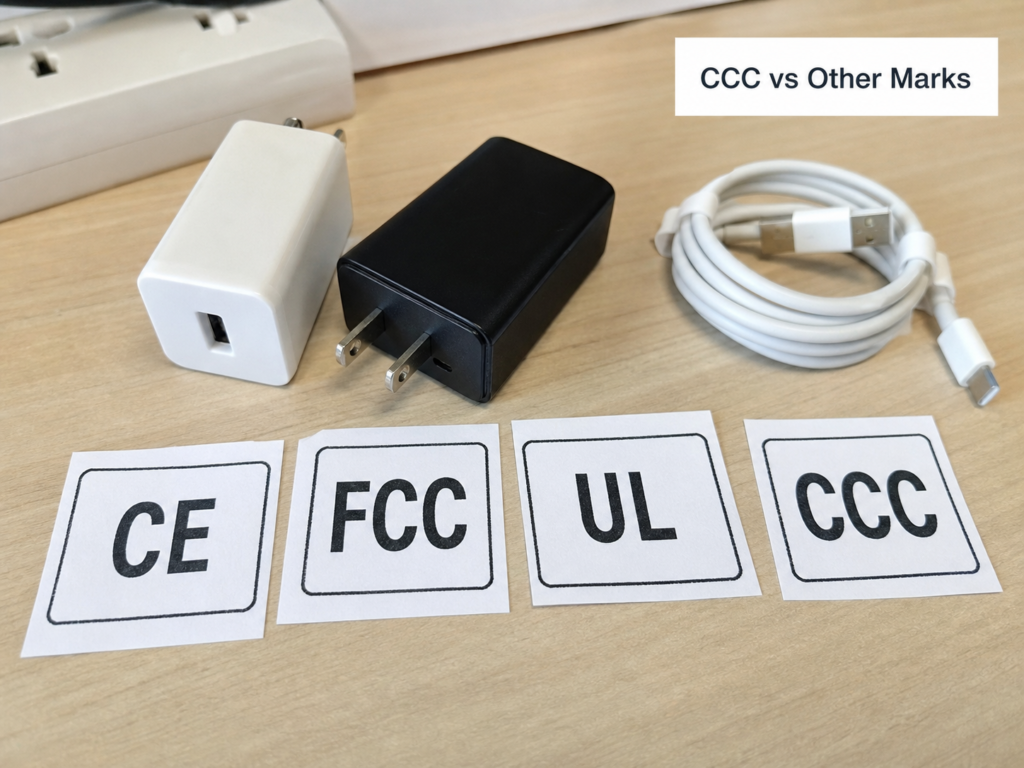
However, you don’t have to redo everything completely: if your test data and factory quality system documents meet CCC requirements, part of the content can be accepted by the certification body, which can save some time and cost. As for several overseas certifications that people often ask about, the differences from CCC are also obvious:
• EU CE: CE is a conformity mark of EU regulations, and the specific assessment method depends on applicable regulations and product risk levels. The CCC certification mode is also determined by China’s current catalogue and implementation rules, which may include third-party certification or self-declaration. The two cannot be generally compared, nor can they be directly used interchangeably.
• US FCC: It mainly controls radio frequency emission, electromagnetic interference, and spectrum-related requirements, and does not replace product electrical safety and other requirements involved in China’s CCC.
• US UL: Most are voluntary certifications from private institutions, not mandatory requirements of the US government, which is completely different from the mandatory nature of CCC.
Certification Requirement Judgment: Does Your Product Need CCC?
After understanding the basics of CCC, the core question arises: does my product need CCC certification? This step is the starting point of all compliance work; if the judgment is wrong, all subsequent efforts will be in vain.
Core Basis for Judgment
First, remember one sentence: **the only basis for judging whether a product needs CCC is the latest version of the *Catalogue of Compulsory Product Certification* and the corresponding implementation rules**.
Product name, HS code, and “industry practices” can only be used as references, not as a basis. For auxiliary judgment, you can look at the product’s actual functions, rated parameters, power supply mode, and whether it is sold separately or as a matching set, but the final judgment must be based on official documents.
Four-Step Method for Catalogue Judgment
For newcomers to judge whether certification is required, they can follow these four steps, which are less prone to errors and can leave evidence to avoid future disputes:
Step 1: First collect all physical information of the product. You can’t just say “this is a charging cable”; you need to sort out nameplate parameters, interface type, actual functions (data transmission only or charging capable, maximum current), and sales form (sold in independent packaging or sold with a charger as a set). It is best to have physical photos and specifications.
Step 2: Compare with the latest CCC catalogue to see which category the product roughly belongs to. For example, whether power adapters are classified as IT products or audio-visual products, first outline a general scope.
Step 3: Find the implementation rules corresponding to this category, carefully check the applicable standards and certification modes, and confirm whether the product is really within the mandatory scope. For example, although some cables can be charged, if they are small-current models for pure data transmission, they may not be in the catalogue.
Step 4: Save the judgment process of the previous three steps, the supporting documents, and product materials as written files. If customs or regulatory authorities have questions in the future, you can take them out to explain clearly and avoid unnecessary trouble.
Preliminary Screening of Charging Product Categories
For the charging products that everyone often deals with, we have sorted out the core judgment points for each category. You can do a preliminary screening first, then confirm against official documents:
• **Stand-alone power adapters/chargers**: For chargers plugged into household AC power and sold independently or as a matching set, the core judgment depends on output parameters, product use, and corresponding catalogue category. Focus on verifying whether they belong to IT power supplies or audio-visual power supplies, as different categories have different implementation rules.
• **USB/USB-C charging cables/data cables**: Whether passive or active power supply, sold independently or as a matching set, the core judgment depends on product functions, rated parameters, and implementation rules. Focus on verifying whether they are independently sold charging cables.
• **Charging connectors/adapters**: Whether passive (without circuit) or active (with circuit), sold independently or as a matching set, the core judgment depends on structure, function, and whether they are sold independently. Focus on verifying whether they have circuits and whether they fall within the catalogue scope.
• **Wireless charging bases/devices**: Whether connected to mains power or battery-powered, sold independently or as a matching set, the core judgment depends on transmission power, functions, and whether they have a power adapter. Focus on verifying whether they fall under the CCC catalogue and whether they involve radio type approval.
• **Charging products with built-in batteries**: For independently sold products with batteries + external power supply, the core judgment depends on battery capacity, product functions, and catalogue category. Focus on verifying whether they need to meet battery safety/environmental protection requirements.
Judgment Details for Key Products
There are several categories of products that people are most likely to confuse, so we will explain them separately:
First, chargers/power adapters: you cannot judge that CCC is required just because they are plugged into mains power. The judgment must be made in combination with functions, parameters, power supply mode, and the catalogue. For example, power supplies specially used for industrial equipment may not be in the mandatory catalogue for consumer products.
Then are the USB/USB-C cables that everyone is most concerned about:
• Those with pure data transmission and no high-current charging function are usually not in the mandatory catalogue;
• For independently sold charging cables, the judgment shall be made in combination with parameters, structure, and implementation rules. **It is not that CCC is mandatory as long as the current is ≥3A or the cable has an E-Marker chip**; there is no such general standard;
• For cables sold as a matching set, if they are covered by the whole machine certification, there is no need to apply separately; if sold separately, separate judgment is required.
There are also charging connectors/adapters: those sold independently are judged according to the catalogue; those sold as a matching set need to confirm whether they are within the coverage of the whole machine certificate. For example, some adapters are standard accessories of chargers and are already included in the charger certification, so there is no need to apply separately.
Statutory Exemption and Exemption Scenarios
Of course, not all products entering China need to apply for formal CCC, but the applicable procedures for special scenarios are not exactly the same.
Eligible goods such as test samples, exhibition items, and repair parts can apply for CCC exemption or exemption-related certificates in accordance with regulations; personal use items and goods re-exported after bonded processing shall be handled in accordance with customs rules for personal items, bonded supervision, and relevant CCC regulations respectively, and cannot be generalized.
Test and exhibition samples usually have quantity and use restrictions, cannot be sold, and must be re-exported as required after use; repair parts can only be used for repairing already imported old products, and also have quantity restrictions. Items carried by overseas personnel shall be judged according to personal item rules, and products all re-exported after processing in bonded areas shall also comply with corresponding bonded supervision requirements.
It should be noted here that exemption certificates or other exemption arrangements correspond to specific batches and specific scenarios, and can only be used for the purposes stated in the application, and cannot be used to import goods for sale. The application procedures, materials, and processing time shall be subject to current regulations and requirements of local customs.
Common Judgment Misconceptions
Finally, let’s talk about several judgment pitfalls that newcomers are most likely to fall into, which must be avoided:
First pitfall: judging certification requirements by HS code. To emphasize again, the HS code is used for customs tax classification, and its classification logic is different from that of CCC, so it cannot be used as a basis for judgment.
Second pitfall: thinking that small batches/samples/personal items are naturally exempt. Only those that meet statutory conditions can apply for exemption or other special supervision arrangements. It is not that you don’t need to apply if you only send 10 samples; those that do not meet the conditions may still be intercepted.
Third pitfall: thinking that cross-border e-commerce/online sales do not need CCC. As long as the product is sold to Chinese consumers, whether on e-commerce platforms or offline, as long as it is in the catalogue and belongs to commercial sales, it needs to meet corresponding compliance requirements. There is no inherent difference between online and offline.
Fourth pitfall: thinking that cables with E-Marker necessarily need CCC. E-Marker is just a power identification chip in USB-C cables, not a CCC judgment standard. Whether certification is required still depends on product functions, classification, and implementation rules.
Compliance Paths and Subject Responsibilities
After confirming that the product requires CCC, the next step is to choose the right compliance path and figure out who is responsible, otherwise problems are prone to occur.
Differences Between Three Types of Compliance Paths
At present, there are three main CCC compliance paths, with completely different applicable scenarios:
The first is **third-party certification**: the officially designated certification body conducts reviews in accordance with applicable rules, including testing, factory inspection, and other links. After obtaining the certificate, you must also accept corresponding supervision.
The second is **self-declaration**: enterprises make a conformity commitment in accordance with applicable rules, complete the required product evaluation and testing, can use their own laboratories allowed by the rules or qualified third-party laboratories, and submit the self-declaration and relevant materials on the official platform as required. This path only applies to specific categories, not all products can choose it.
The third is **exemption**: that is, the statutory special scenarios mentioned earlier, no formal certification is required, but exemption certificates or other relevant procedures must be handled in accordance with applicable regulations, and it must never be used for commercial sales.
Path Selection Logic
Choosing a path is not based on which is cheaper or faster, but on official rules and your actual situation:
• If the product is in the mandatory third-party certification catalogue, imported in large quantities for a long time, and requires strong compliance endorsement, choose third-party certification;
• If the product is in the self-declaration applicable catalogue, imported in small and medium batches, and has a tight launch cycle, choose self-declaration;
• If the product is only temporarily imported for non-commercial sales purposes and meets statutory special scenarios, choose exemption.
Remember: the path is determined by official rules. You cannot choose a path that does not meet the requirements on your own. For example, if a product clearly belongs to the third-party certification catalogue but you insist on doing self-declaration, you will still suffer the loss if customs clearance fails in the end.
Responsibilities of Each Participating Party
CCC certification is not the matter of one party. Different roles have different responsibilities, which must be clarified in advance:
• **Certification applicant**: the party that submits the certification application, responsible for the authenticity of the materials, and cooperates with the inspection of regulatory authorities;
• **Manufacturer**: the product design party, responsible for product design quality and production consistency;
• **Production factory**: the factory that actually produces the product, responsible for mass production quality control, and cooperates with factory inspection;
• **Importer/domestic agent**: the party responsible for domestic customs clearance and cooperating with market compliance. Usually, a domestic entity is required as the contact person or responsible subject, which shall be subject to the certification implementation rules and requirements of the certification body.
Whether overseas enterprises can act as certification applicants, and whether domestic contacts, agents, or responsible subjects are required, shall be handled in accordance with specific certification implementation rules and requirements of the certification body. Importers or domestic entities usually need to cooperate with customs clearance, market supervision, and after-sales responsibilities.
Certificate Rules for OEM/ODM Modes
Many overseas sellers find foundries for OEM/ODM. Special attention should be paid to the certificate rules here, otherwise it is easy to fall into pitfalls:
CCC certificates are bound to “manufacturer + production factory + model scope”. **You must never borrow other people’s certificates or test reports**, even if the same factory produces the same product for another brand, you cannot directly use their certificate.
If it is private labeling at the same factory, that is, the factory has a ready-made certificate and you want to put your own brand, you must first confirm whether the certificate covers your brand and model. If not, you need to apply for certificate change or re-do the certification.
In addition, if there are core changes to the product, such as replacing key components or changing the power, you must re-evaluate the validity of the certificate and cannot directly use the original certificate. It is recommended that when signing a contract with the supply chain, clauses such as certification cost bearing, change declaration responsibility, and violation consequences be clearly written to avoid future disputes.
Full CCC Application Process
After choosing the path, you can start applying for CCC. We will explain the key nodes of the entire process clearly so that you have a clear idea.
Pre-Application Preparation
Before the formal application, doing these things well first can save you a lot of detours:
First, you must finalize the product model and core parameters. Do not change them halfway. Each change requires re-testing or modification, which is both costly and time-consuming.
Then, prepare the required materials: product specifications, circuit diagrams, nameplates, Chinese manuals, and list of key components. These are all necessary for testing and review, and they must be accurate and consistent with the actual product.
Finally, choose a qualified certification body or agency, first confirm with the other party the applicable standards and test scope of the product. Do not choose an unqualified institution, as the certificate obtained in the end will be invalid.
Sample Testing Requirements
After the application is submitted, the first step is to send samples for testing. Here are several key points:
The samples sent must be exactly the same as the future mass-produced version. You cannot use “optimized versions” or “special versions” for testing. Otherwise, if the mass-produced products are different, they will fail the factory inspection and the certificate will be invalid. The number of samples to be sent shall be in accordance with the requirements of the certification body, which varies for different products.
There are three main types of core test items:
• **Electrical safety**: such as electric shock protection, insulation performance, withstand voltage, overheat protection, and safety under abnormal conditions, all of which are basic safety requirements;
• **Electromagnetic compatibility**: under the requirements of applicable product implementation rules, evaluate whether the product will cause undue interference to other equipment during operation, and its immunity to common electromagnetic interference;
• **Labeling specifications**: the product’s nameplate and warning statements must meet Chinese labeling requirements, such as manufacturer information, rated parameters, and warning signs.
The most common reasons for non-conformity of charging products are insufficient insulation, excessive electromagnetic radiation, false marking of output parameters, and non-standard labeling. It is best to check by yourself before sending samples to avoid wasting time on rectification.
Factory Inspection Requirements
After passing the test, the third-party certification mode may also require factory inspection. The core is to see whether the factory can ensure that the mass-produced products are exactly the same as the test samples, for example, whether incoming materials are inspected, whether finished products are randomly inspected, and whether the production process is controlled.
Factory inspection requirements vary for different certification modes: the initial factory inspection requirements for third-party certification, as well as the post-certification supervision inspection, supervision frequency, and sampling requirements, are determined by the specific product implementation rules and the certification body, and cannot be uniformly summarized as once a year. The self-declaration mode does not require a unified initial factory inspection; enterprises only need to do a good job in quality control according to the rules, but if they are randomly inspected, they must also provide corresponding records.
If the factory is overseas, you can also apply for overseas factory inspection, but the cost and cycle need to be confirmed with the institution according to the actual situation.
Certification Obtainment and Mark Use
After all reviews are passed, you can get the compliance certificate:
For third-party certification, you will get a CCC certificate with a unique number, whose authenticity can be queried on the official system of the CNCA; within the scope of the catalogue and implementation rules applicable to self-declaration, completing a valid self-declaration can be used as a compliance certificate for fulfilling CCC requirements. Its specific submission, verification, and platform requirements shall still be implemented in accordance with the rules of customs, market regulation authorities, and platforms.
After obtaining the certificate, there are also rules for the use of the CCC mark: the pasting position, specifications, and method of the mark must comply with management regulations and implementation rules, and cannot be pasted casually; without certification, the CCC mark shall not be printed or pasted on products or packaging, and others’ marks shall not be fraudulently used or transferred; products that have completed self-declaration also need to affix the CCC mark as required, it is not that self-declaration does not require pasting.
Factors Affecting the Application Cycle
Many people ask “how long does it take to apply for CCC”. In fact, there is no unified fixed cycle, and there are many influencing factors: product complexity, data completeness, number of test rectifications, factory inspection arrangements, and institution scheduling will all affect the final duration. Therefore, you must plan in advance, don’t wait until the goods are about to be shipped to remember to apply for certification, and don’t believe promises such as “get the certificate in three days” or “guaranteed pass”, they are all pitfalls.
Customs Clearance Compliance by Trade Mode
After obtaining the certificate, the final step is customs clearance. Different trade modes have different customs clearance compliance requirements. We will explain them separately.
General Trade Import
General trade is the most common import mode, and its compliance requirements are also the clearest:
First, products in the catalogue must obtain a valid CCC certificate or complete the applicable self-declaration, which is the prerequisite.
Then, when declaring, prepare materials in accordance with customs requirements, and provide certificate information and basic trade documents, such as contracts, invoices, and packing lists.
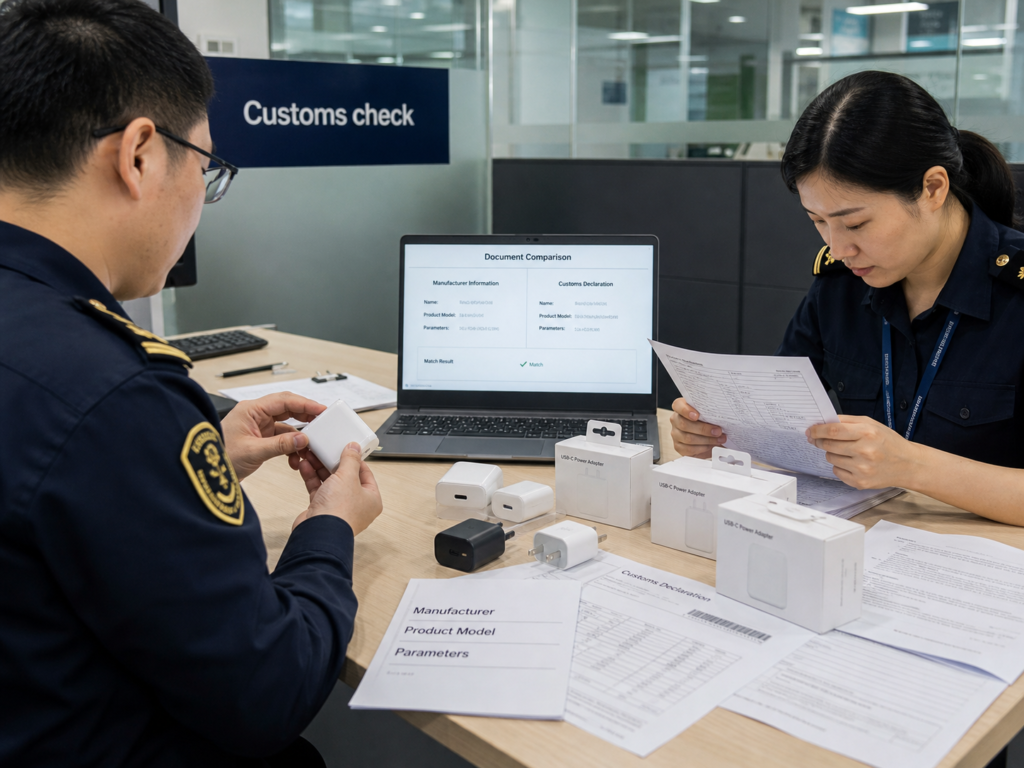
The focus of customs verification is that the manufacturer, product model, and parameters in the certificate or self-declaration information must be consistent with the customs declaration form and product nameplate. Verification methods include system comparison, document review, and on-site inspection. High-risk products may also be subject to random testing.
Cross-Border E-Commerce Import
Cross-border e-commerce is divided into two main modes, with different requirements:
One is the **bonded stocking mode**: that is, goods are first placed in domestic bonded warehouses, and when someone places an order, they are sent from the bonded warehouse to consumers. Under this mode, products in the catalogue sold to Chinese consumers usually need to meet corresponding CCC requirements, and many e-commerce platforms also require uploading certificates or other compliance certificates before listing.
The other is the **retail direct mail mode**: goods are sent directly from overseas to domestic consumers. Retail direct mail does not automatically exempt from CCC. Only goods that meet personal use, reasonable quantity, or other statutory exemption conditions and are handled in accordance with applicable regulatory procedures may not require formal CCC; commercial batch sales to Chinese consumers still need to meet the CCC requirements for catalogue products.
A reminder here: requirements may vary between different ports and different regulatory lists. You must verify the rules of local customs in advance, and do not take it for granted.
Special Scenario Import
If it is an import under special scenarios, follow the corresponding requirements:
For temporary import for testing/exhibition, you need to apply for a CCC exemption certificate or go through relevant procedures in accordance with regulations in advance. The products cannot be sold and must be re-exported upon expiration;
For import of repair parts, those eligible for exemption can apply, but they can only be used for repairing the corresponding imported products, have quantity restrictions, and cannot be sold;
Personal use items shall be declared in accordance with customs personal item rules; whether CCC is exempted and whether relevant certificates are required shall be confirmed in combination with the commodity catalogue, purpose, quantity, and current regulatory provisions, and cannot be directly exempted solely on the basis of “personal use”.
Common Customs Clearance Blockages and Disposal
When clearing customs, you are most likely to encounter these problems. Knowing how to deal with them will prevent you from panicking:
First, the certificate information is inconsistent with the goods. For example, the model is written incorrectly or the parameters do not match. In this case, customs clearance will be suspended. First check the coverage of the certificate. If it is only a minor problem that can be changed, go through the certificate change; if it cannot be changed, either return the goods or make up the certification.
Second, certification has not been applied for in advance. If it is indeed a statutory exemption scenario, you shall submit the application and obtain the applicable exemption certificate or complete the corresponding procedures as required before import declaration; before obtaining the certificate, the goods shall not be directly imported as exempted goods. If they are for sale, there is no other way but to make up the formal certification.
Third, catalogue judgment disputes. For example, you think the product is not in the catalogue but customs thinks it is. In this case, do not argue forcefully. You can find a certification body, customs, or a professional compliance consultant to verify, and handle it according to official feedback.
Irreplaceable Supporting Access Requirements
Finally, a special note: CCC is not the only access requirement. There are several supporting requirements that are independent of CCC and cannot replace each other:
• **SRRC Radio Type Approval**: Devices with Bluetooth, Wi-Fi, or other radio transmission functions shall judge whether SRRC is required according to the radio transmission equipment type approval catalogue and technical requirements. Whether wireless charging devices involve this requirement shall also be verified with the industry and information technology department or local regulatory authorities in combination with their frequency band, power, and device attributes;
• **Energy efficiency label**: Some products such as power adapters need to be pasted as required, otherwise they cannot be sold;
• **China RoHS**: applicable to electrical and electronic products included in the catalogue, controlling the use of hazardous substances, and is two independent systems from CCC;
• **Lithium battery related requirements**: products containing lithium batteries need to meet relevant regulations on transportation safety and environmental protection recycling.
These requirements must be implemented in advance. Don’t think that everything is fine with CCC.
Post-Certification Maintenance and Pitfall Avoidance
Obtaining a CCC certificate is not a once-and-for-all matter. Post-maintenance is also very important, otherwise the certificate may become invalid and you may be punished.
Certificate Validity Period and Renewal
The validity period varies for different certification modes:
The validity period of third-party certification certificates is usually 5 years, subject to the marking on the certificate. You should evaluate the renewal in advance, don’t wait until the certificate expires to remember to renew, which will affect customs clearance.
Self-declaration has no fixed validity period, but it is necessary to continuously ensure that the product meets the latest standards. After the standard is updated, the compliance shall be re-evaluated, and non-compliant products shall be adjusted in time.
Product Change Reporting Rules
During product sales, it is inevitable that there will be model changes and material replacements. At this time, you must judge whether to report to the certification body.
Any changes involving product model, key components, rated parameters, structure, production factory, brand, nameplate, safety information in the manual, or certification scope shall be confirmed with the certification body according to the implementation rules before mass production or import, whether change, expansion, filing, or re-evaluation is required. Even changes in packaging or ordinary text shall be filed or confirmed according to the requirements of the institution.
If you fail to report what should be reported and are found out, it may cause the certificate or self-declaration to no longer cover the actual product, customs clearance will be rejected, and you may also face regulatory penalties. Don’t be careless.
Response to Market Regulation Random Inspections
When products are sold domestically, they may be subject to random inspections at any time. There are many triggering scenarios: import port verification, e-commerce platform patrol inspections, offline store random inspections, and consumer complaints may all trigger random inspections.
The high-frequency non-conformity items of charging products are mainly false marking of output power, unqualified insulation, unclear labeling, abnormal heating during fast charging, and insufficient cross-sectional area of cable conductors (that is, the wire core is too thin, marked 5A but cannot actually carry it). These are the key points of random inspections.
If you are an overseas supplier, you must entrust a domestic entity to cooperate with random inspections in advance, and provide certification materials in a timely manner. Do not ignore it, otherwise it will be directly judged as unqualified and the product will be removed from the shelf.
High-Frequency Compliance Pitfalls
Finally, let’s talk about several compliance pitfalls that people are most likely to fall into. They are all lessons learned by predecessors at a cost, and must be avoided:
First, affiliating/borrowing other people’s CCC certificates. Inconsistency between goods and certificates is an illegal act. If found out, not only will the goods be detained and fined, but it will also affect credit;
Second, one certificate arbitrarily covers all models. Only products that meet the series model difference requirements can be included in the same certificate. Not all chargers can use one certificate;
Third, arbitrarily pasting the CCC mark without certification is an act of counterfeit certification, and the penalty is very heavy;
Fourth, product model change/core replacement is not reported. Inconsistency between mass-produced products and test samples may lead to certificate invalidation;
Fifth, products imported with exemption certificates are used for sale, which violates exemption regulations, will be punished, and will also affect future exemption applications;
Sixth, credulously believing promises of “guaranteed pass” and “quick certificate acquisition”. Compliance certification has a fixed process. Even if non-compliant certificates are obtained, they will be revoked, and the money spent will be useless.
Typical Product Compliance Cases
After talking about so many rules, let’s use several common charging products as examples to help you connect the previous knowledge.
The first is **independently sold 65W GaN USB-C power adapter**: this product is connected to 220V household AC power, with output covering 5-20V/3.25A, and is sold in independent packaging to domestic consumers. Compared with the CCC catalogue, it belongs to power adapter products in the mandatory catalogue, and needs to choose the compliance path of third-party certification or self-declaration according to the rules. When imported through general trade, a valid certificate or applicable self-declaration certificate must be provided, and the relevant information must be consistent with the goods and customs declaration form. The product itself must also be pasted with the CCC mark as required. This type of product is most prone to problems of false output parameter marking and unqualified insulation in random inspections, so quality must be controlled in advance.
The second is **chip-free USB-C data cable (independently sold)**: this cable has a rated current of 2A, focuses on data transmission, is compatible with ordinary charging, and is sold in independent packaging. Compared with the latest catalogue and implementation rules, small-current cables for pure data transmission are usually not in the mandatory catalogue and do not need CCC; but if it actually supports high-current charging and is only declared as a data cable, it may be judged as a certification-required product and need to apply for certification. When clearing customs, prepare the product’s judgment basis to cooperate with customs verification.
The third is **240W USB-C charging cable with E-Marker (independently sold)**: this cable has an E-Marker chip, a rated current of 5A, focuses on high-power charging, and is sold in independent packaging. When judging, a comprehensive judgment shall be made in combination with product classification and implementation rules. E-Marker is not the only judgment standard. If it falls within the mandatory catalogue scope, certification shall be applied for according to the corresponding mode. When clearing customs, the parameters in the certificate or filing information must be consistent with the product, and the CCC mark must be affixed as required. The most common non-conformity items of this type of product are insufficient conductor cross-sectional area and false parameter marking, which require special attention.
The fourth is **15W wireless charging base (independently sold)**: this base is connected to USB-C power input, outputs 15W wireless charging, also has Bluetooth pairing function, and is sold independently. When judging, it is necessary to consider the power supply part and wireless function together. If it falls within the CCC catalogue scope, CCC must be applied for. If the Bluetooth function belongs to radio transmission equipment requiring type approval, it shall be handled or the applicable type approval arrangement shall be confirmed in accordance with regulations; whether the wireless charging part has other radio regulatory requirements also needs to be judged separately in combination with technical parameters, and cannot be replaced or directly presumed solely by CCC. When clearing customs, corresponding CCC, self-declaration, or radio approval materials shall be provided as required by customs to cooperate with verification.
Quick Self-Check List for Import CCC Compliance
To facilitate everyone to quickly check their compliance status, we have compiled a self-check list. You can check item by item:
| Check Category | Check Content |
| Certification requirement judgment self-check | 1. Complete product information has been collected according to the four-step method, and judgment is not based solely on HS code/product name<br>2. Whether certification is required has been confirmed against the latest catalogue and implementation rules<br>3. For those eligible for exemption/exemption handling, the application requirements have been confirmed |
| Path selection self-check | 1. The applicable certification mode (third-party/self-declaration/exemption) for the product has been confirmed<br>2. The certificate coverage has been confirmed under OEM/ODM mode<br>3. The responsibilities of each participating party have been clarified |
| Pre-application self-check | 1. A qualified certification body/agency has been selected<br>2. Product technical documents, Chinese nameplates/manuals have been fully prepared<br>3. The sample sent is exactly the same as the mass-produced version |
| Pre-clearance self-check | 1. The certificate/filing certificate/exemption certificate is within the validity period<br>2. The product model, parameters, and manufacturer information are completely consistent with the certificate/customs declaration form<br>3. The CCC mark is affixed as required<br>4. Supporting access requirements (SRRC, energy efficiency, RoHS, etc.) have been implemented |
| Post-certification maintenance self-check | 1. Certificate renewal has been planned in advance<br>2. Whether reporting is required has been evaluated before product changes<br>3. Production, inspection, and import records have been kept for future reference |
After reading this guide, you should have a comprehensive understanding of CCC import compliance for charging products: you can initially judge whether your product needs CCC according to the four-step method, choose the appropriate compliance path according to the import mode and product type, complete pre-clearance inspections under different trade modes, judge whether product changes need to be reported, and identify common compliance pitfalls. Of course, CCC rules are relatively detailed and dynamically adjusted. If you encounter uncertain situations, you must consult official channels or professional compliance consultants in a timely manner, do not act based on experience, to avoid unnecessary losses.