
Many charger sellers entering the South Korean market for the first time tend to directly apply compliance experience from the EU and the US—for example, assuming that CE or CB certification is sufficient for customs clearance. In fact, CE, FCC, and CCC cannot directly replace applicable KC safety or RRA electromagnetic compatibility and radio compliance in South Korea; if product classification, documents, or declarations do not meet requirements, goods may still be inspected, detained, even returned or subject to penalties after arriving at the port. CB reports or foreign test reports that meet South Korean rules and recognition conditions can be used as a basis for safety compliance for some products and items, but the applicable statutory procedures in South Korea still need to be completed. South Korea has its own set of logic for electrical product supervision, especially chargers that are closely contacted by consumers in daily life, which are key regulated categories. This checklist will help you sort out the compliance requirements for charger imports in South Korea from entry-level judgment to detailed pitfall avoidance, so even beginners can follow step by step for self-inspection.
First, Figure Out Whether Your Product Falls Within the Regulatory Scope
Before checking certifications, spend 2 minutes doing a preliminary screening of the product to avoid wasted effort. We have compiled common applicable and non-applicable products:
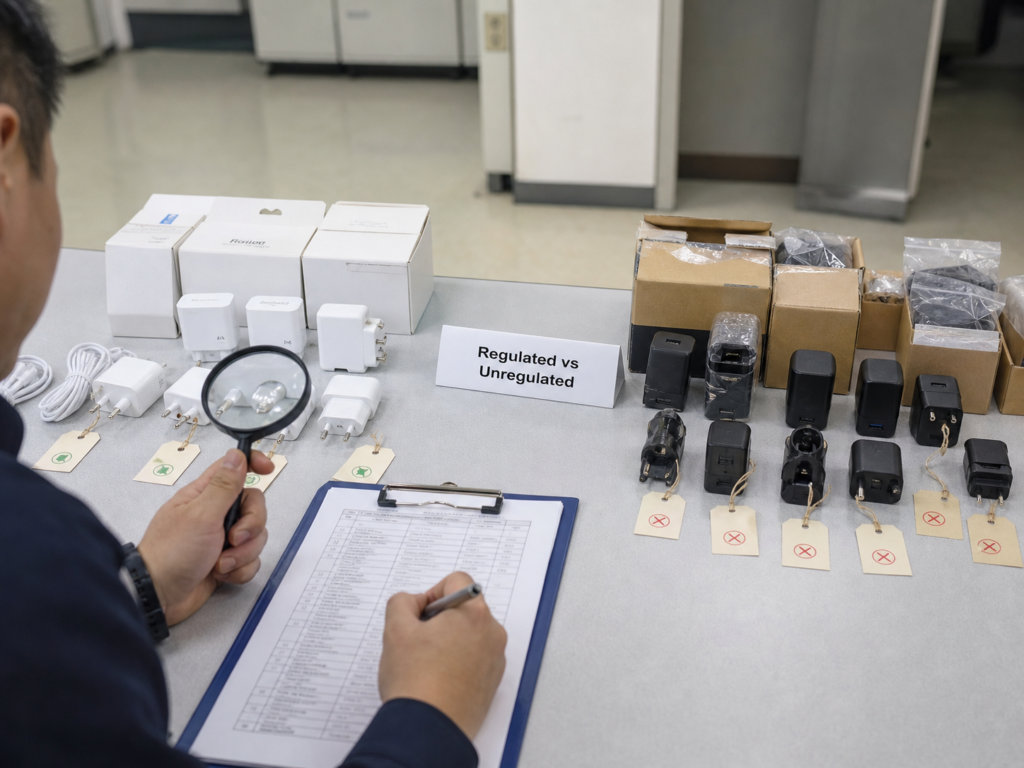
| Typical Regulated Products | Products Not Covered by This Checklist |
| Wall-plug USB-A/C chargers | DC-input car chargers |
| Laptop power adapters | Built-in power modules for devices |
| Multi-port desktop charging stations | Special power supplies for industrial/medical use |
Judgment shall not be made mechanically based solely on the three conditions of “whether it is connected to mains electricity, whether it charges, and whether it is sold separately”. Factors such as whether it is directly connected to AC mains, whether it is an external power supply or charger, rated parameters, intended use, structure, and whether it is sold as an independent product will affect the regulatory classification. The final determination shall be subject to the official South Korean electrical product regulatory catalog and specific product classification. Even if a power adapter does not directly charge a battery, it may be subject to relevant safety management system requirements as an external power supply.
After confirming that the product falls within the relevant regulatory scope, it is necessary to further classify it, as different types of chargers have different levels of compliance requirements:
• Ordinary wired AC chargers: These are the most common wall-plug single-port/multi-port wired chargers, which usually require verification of safety procedures and EMC (Electromagnetic Compatibility) procedures, and are the most prevalent type.
• Chargers with wireless/smart functions: For example, chargers with active wireless transmission functions such as Bluetooth and Wi-Fi, in addition to safety and EMC, shall also be subject to judgment under the RRA system on whether additional radio conformity assessment is required. For Qi wireless charging and NFC, confirmation shall be made based on operating frequency band, transmission method, power, and official device classification, and a conclusion shall not be drawn solely based on “having wireless functions”.
• Detachable adapters/multi-port charging stations: For example, desktop charging stations with detachable AC power cords, not only the main unit must be compliant, but also it is necessary to verify whether the AC power cord meets applicable requirements and whether it is covered by the certification or assessment scope of the complete product set.
• Sold as a set (charger + data cable/accessories): Do not assume that only the charger needs to be inspected; each regulated component in the set must be verified for compliance separately.
Common Cognitive Misconceptions for Beginners
Here we specifically remind of several high-frequency cognitive pitfalls that many people fall into before they even start:
First, **CE, FCC, and CCC cannot directly replace applicable KC safety or RRA electromagnetic compatibility and radio compliance in South Korea**. CB reports or foreign test reports that meet South Korean rules and recognition conditions can be used as a basis for safety compliance for some products and items, but whether supplementary testing is required, whether safety confirmation declaration or other procedures are needed depends on the product category, report scope, and applicable South Korean standards. It cannot be generally assumed that having a CB report will definitely simplify testing or directly complete South Korean registration.
Second, compliance exemptions for small-batch samples and personal use have strict quantity and use restrictions. As long as the product is for sale, regardless of the quantity sold, the compliance procedures must be completed in accordance with applicable rules; there is no such thing as “no certification needed for small-batch trial sales”.
Third, South Korean electrical products are subject to statutory procedures such as safety certification, safety confirmation, or supplier conformity confirmation respectively, and the specific path must be determined based on official product category classification. Ordinary external power supplies or chargers are commonly classified as safety confirmation category, but this cannot be determined solely based on “ordinary”, “low power” or intuitive risk assessment, nor can enterprises choose the path on their own.
Fourth, wide-voltage products (for example, labeled 100-240V) only mean they can be used in the South Korean power grid, which does not mean they have passed South Korean compliance certification; these are two different things.
If non-compliant, the impact will run through the entire import and sales cycle: during the customs clearance stage, goods may be detained, returned, or subject to penalties; during the sales stage, products may be removed from platforms, required to be rectified or recalled, and incur civil liability; in the long run, it may also affect subsequent import and market supervision records.
Core Logic of South Korean Charger Regulation
Many people like to memorize inspection items by rote, but in fact, if you understand the underlying logic, you can make judgments on your own when encountering unfamiliar situations.
First of all, it should be clarified that **the commonly referred to “KC certification” is not a single certificate, but a general term for South Korea’s mandatory compliance requirements**, which includes several different parts:
• KC safety-related procedures: These cover direct safety risks such as electric shock and fire. For products listed as safety management objects of South Korean electrical products, corresponding statutory procedures such as safety certification, safety confirmation, or supplier conformity confirmation must be completed.
• EMC (Electromagnetic Compatibility): This ensures that products do not interfere with other electronic devices during operation and are not interfered with by other devices, specifically subject to the RRA’s electromagnetic wave conformity assessment system.
• Radio compliance: Products with active wireless transmission functions, or products listed in the relevant radio equipment scope in the official catalog, need to be judged according to RRA rules on whether additional procedures are required.
• Additional requirements: For example, special requirements such as energy efficiency, environmental protection, and labeling shall also be verified based on whether the product falls under the corresponding management catalog.
South Korea’s supervision is divided among different systems and departments. Electrical product safety matters are mainly subject to the KATS system and the ; EMC and radio conformity assessment are mainly subject to the , implemented by the National Radio Research Agency (RRA); the Customs Service is responsible for import declaration and inspection. The responsibilities of the actual import entity, manufacturer, importer, and radio conformity assessment applicant shall be confirmed according to the specific system and sales model. Cross-border sellers usually need a South Korean import entity, local agent, or partner to handle import and local compliance, but it cannot be simply asserted that no overseas seller can absolutely import or clear customs and sell in their own name.
There are three concepts that many people confuse, and clarifying them in advance can save a lot of detours:
First, electrical product safety procedures and RRA’s EMC conformity assessment are different systems, and one document cannot be used as another. Whether a product requires safety confirmation, RRA registration, certification, or supplier conformity declaration shall be judged according to the corresponding catalog respectively.
Second, compliance of wireless modules does not equal compliance of the complete machine. Even if the wireless module you use has completed relevant assessment, it does not mean that it will definitely be compliant after being installed on a charger—because changes in installation position, antenna, firmware, and overall structure may affect wireless performance and assessment scope, and the complete machine still needs to be confirmed whether it meets applicable requirements.
Third, having a KC mark or other conformity marks on the product does not mean it is fully compliant. Labeling is only part of the compliance system; requirements such as energy efficiency, environmental protection, documentation, parameter consistency, and advertising must also be met, and sticking a label does not mean everything is fine.
The entire compliance process can be summarized into three steps: First, complete safety procedures and RRA’s EMC and radio procedures (if applicable) according to product classification; second, ensure that the product is consistent with declaration, test, or registration materials through consistency inspection of documents and labeling; third, complete import declaration and launch the product, after which it is still subject to market spot checks—passing one assessment does not mean it is a once-and-for-all matter.
Inspection Item 1: KC Safety-Related Procedures (Core Mandatory Access)
For AC-input chargers or external power supplies listed as safety management objects of South Korean electrical products, corresponding safety procedures usually need to be completed. Many ordinary products may fall into the safety confirmation category, but the specific items and applicable procedures must be subject to the official South Korean catalog and product technical parameters.
Basic Knowledge: 3 Access Paths
South Korean electrical products are subject to statutory procedures such as safety certification, safety confirmation, or supplier conformity confirmation respectively, with different requirements:
| Access Path | Main Features | Applicability to Chargers |
| Safety Certification | Usually involves requirements such as factory inspection, laboratory testing, and official certification | Subject to judgment based on the official product catalog; applicable to some high-risk products |
| Safety Confirmation | Complete testing, declaration, or confirmation procedures in accordance with regulations | May be applicable to many ordinary external power supplies or chargers |
| Supplier Conformity Confirmation | The supplier confirms that the product meets requirements in accordance with regulations and retains relevant materials | Only applicable to products listed in the corresponding catalog |
The specific path to take shall be subject to the electrical product regulatory catalog officially issued by South Korea, while referring to the product’s rated parameters, intended use, structure, and sales form. Ordinary mobile phone chargers and laptop power adapters may follow the “safety confirmation” path, but this cannot be directly determined solely by product name or power. The processing time will also vary depending on product complexity, test items, completeness of materials, and whether recognized foreign reports are used, and a fixed cycle cannot be universally promised.
Certification Document Validity Inspection (Must-Know for Beginners)
If you have already obtained relevant safety materials, first perform these basic inspections, which all beginners must master:
First, confirm whether the institution issuing the test report, certificate, or handling the procedure meets the recognition requirements of the applicable South Korean system. Not all documents issued by any laboratory can be used directly.
Second, verify the declaration, test report, certificate, or registration status required by the specific procedure, as well as applicable change, renewal, and revocation rules. For safety confirmation and supplier conformity confirmation, the unified validity period of safety certification cannot be applied, nor can only the date on a single certificate be checked.
Third, verify the models, input/output power, number of ports, and product structure covered by the documents to confirm consistency with the actually imported products. For example, if the materials state 2 USB-C ports, but the actual product has 3 ports (2C1A), it cannot be automatically assumed that the same set of materials is valid.
Fourth, the manufacturer and production factory indicated on the certificate or declaration materials shall be consistent with the entity actually producing the product. Documents from Factory A cannot be used for products from Factory B, nor can it be assumed by default that ODM factory materials automatically cover your brand and model.
Product Consistency Inspection (Must-Know for Beginners)
Having consistent documents alone is not enough; the product itself must also be consistent with its state during testing, declaration, or certification:
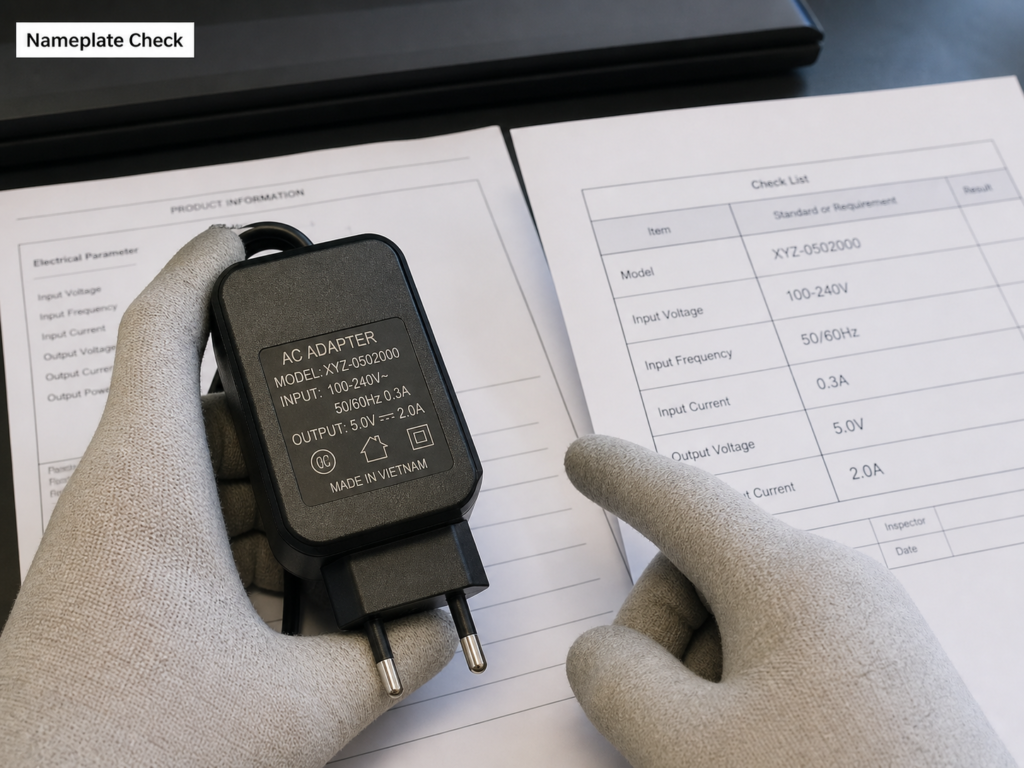
First, the model and rated parameters on the product nameplate shall match the content of relevant documents, and not a single number can be changed arbitrarily.
Second, the key safety components, structure, input and output parameters, and model range listed in the certification documents shall be verified. When replacement of key components such as transformers, isolation capacitors, and power chips is involved, it is necessary to confirm whether the replacement parts are within the allowable range, or whether re-assessment is required.
Third, when changes involve insulation, creepage distance, housing structure, pin structure, circuit, or heat dissipation method, it shall be confirmed before mass production whether change assessment or re-testing is required. Changes that do not affect safety and certification scope, such as mere color changes, shall not be directly deemed non-compliant, but appearance changes cannot be completely regarded as requiring no confirmation either.
Exemptible Special Scenarios (Semi-Proficient Judgment)
Are there cases where relevant safety procedures do not need to be performed? Only a few special scenarios may be eligible for exemption:
Applicable scenarios are small quantities of samples for non-sales purposes, such as for testing, exhibition, or repair parts. The premise is that the requirements of the customs and product safety authority regarding quantity, use, and application procedures must be met, and exemption must be confirmed or applied for in advance; it is not enough to just call them “samples” on your own.
Here we emphasize again: as long as the product is for sale, regardless of quantity, it cannot obtain personal use exemption solely in the name of small batch or samples. Special scenarios shall be confirmed separately according to specific regulations and declaration methods.
Common Pitfalls and Verification Methods
Here are the most common pitfalls in safety compliance, which must be avoided:
The first is certificate misappropriation, which means using documents of other models to impersonate, with mismatched parameters, appearance, or structure.
The second is forged documents, which are not issued by formal institutions or recognized procedures at all, and cannot be found in the official system.
The third is the problem with ODM products. For example, if you get a public mold product from a factory and stick your own brand on it, you need to confirm whether the certificate, declaration materials, or test report cover your brand and model. Many factories’ documents only have their own brand, and after you stick your own brand, the original documents may not automatically apply.
The fourth is that after replacing core components, the validity of certification or declaration is not re-assessed. For example, if a factory replaces the power chip, transformer, or insulating material with another model, it may change the safety characteristics of the product.
The verification method is to check the authenticity of documents, product classification, model coverage scope, and current status through South Korean official product safety query and related handling systems such as Safety Korea, instead of only listening to service providers or suppliers.
Inspection Item 2: EMC and Wireless Function Compliance (Easy-to-Miss Mandatory Items)
Many people know they need to do safety compliance, but miss EMC (Electromagnetic Compatibility). Ordinary wired chargers also need to complete applicable EMC procedures in accordance with the RRA electromagnetic wave conformity assessment system, which may involve test reports, certification, registration, or supplier conformity declarations from designated testing institutions, depending on the device classification.
The processing cycle will vary depending on test items, prototype status, completeness of materials, and product changes. It cannot be fixed as 1–4 weeks, nor can the EMC procedure be simply understood as a single “KC EMC Registration Certificate” uniformly issued by KATS-accredited institutions.
EMC Inspection for Ordinary Wired Chargers (Must-Know for Beginners)
For ordinary wired chargers, the following points shall be checked for EMC:
First, confirm whether the product is subject to RRA electromagnetic wave conformity assessment, and whether procedures such as certification, registration, or supplier conformity declaration shall apply.
Second, verify the product models, power range, port configuration, and operating modes covered by the test report, registration certificate, certification materials, or declaration to confirm consistency with the actual product.
Third, check the registration or certification status in the relevant RRA system, and confirm whether there are applicable requirements for changes, revocation, or supplementary materials. Do not treat all EMC documents as certificates with a unified validity period.
Special attention should be paid to multi-port chargers here: testing or assessment shall cover the actual working scenarios that the product will be advertised and used for, including the situation where multiple ports work simultaneously. It cannot be assumed that all requirements are met when multiple ports output simultaneously solely based on single-port test results.
Additional Compliance Requirements for Chargers with Wireless/Smart Functions (Semi-Proficient Judgment)
If your charger has active wireless transmission functions such as Bluetooth and Wi-Fi, it is usually necessary to judge whether additional procedures are required in accordance with the RRA radio equipment conformity assessment system. The judgment shall be based on operating frequency band, transmission method, power, antenna, and device classification.
For Qi or other wireless charging devices and NFC devices, this cannot be generalized. It shall be confirmed whether additional radio certification or registration is required based on the specific frequency band, transmission method, power, and official South Korean device classification, while verifying EMC and safety requirements.
If a ready-made wireless module is used, it is necessary to confirm whether the assessment scope of the module can cover the usage scenarios of the complete machine. For example, if the original assessment condition of the module is for use in earphones, and the antenna position, housing structure, or firmware changes after being installed on a charger, it may no longer be fully covered and re-assessment is required.
Here we correct two common misconceptions: First, “low-power chargers do not need EMC procedures”—this judgment is incorrect. Whether assessment is required depends on whether the product is a relevant regulatory object and its device classification. Second, “wireless functions only require safety procedures”—this is also inaccurate. Active wireless transmission functions such as Bluetooth and Wi-Fi usually require verification of RRA requirements; for Qi, NFC, etc., confirmation shall be made based on specific technical characteristics and official classification.
Inspection Item 3: Additional Requirements and Product Adaptation (Details That Easily Cause Customs Clearance Delays)
Many people complete safety and EMC-related procedures, only to fail due to some small details, which is very regrettable. Although these additional requirements are not as prominent as core certifications, they are also items that need to be verified during customs clearance and sales.
Energy Efficiency and Standby Power Consumption Requirements
First is energy efficiency and standby power consumption. Do not generalize energy efficiency labels, minimum energy efficiency limits, or standby power consumption requirements as unified mandatory conditions for all chargers and external adapters.
First, confirm whether the product is a management object according to the latest product catalog of South Korea’s energy efficiency management and standby power consumption management, then verify applicable declaration, testing, minimum efficiency, standby power consumption, and labeling requirements. The specific situation depends on the product type, rated power, and catalog provisions, and a conclusion cannot be drawn solely based on “having a standby function”.
The basis for judgment is the relevant systems and latest catalog of the Korea Energy Agency. Please note that **do not directly apply EU ErP or other regional energy efficiency rules**. South Korea has its own catalog, limits, and processing requirements, which cannot be taken for granted.
Resource Recycling and Environmental Protection Requirements
Whether chargers need to bear South Korea’s resource recycling or environmental protection obligations depends on the specific product category, identity of the producer or importer, import and sales scale, and applicable catalog.
It shall be confirmed whether chargers are included in South Korea’s resource recycling catalog for electrical and electronic products, waste battery catalog, or other environmental protection management catalogs, and combined with the identity of the importer/producer and applicable scale, judge the obligations of recycling, declaration, fees, and labeling. It cannot be generalized that most chargers automatically belong to the same set of EPR objects, nor can all obligations be unconditionally attributed to the importer.
Also note: do not directly apply EU RoHS and REACH requirements; South Korea has its own environmental protection regulations. EU documents cannot automatically replace South Korean requirements, but it cannot be concluded from this that all chargers bear exactly the same South Korean EPR obligations.
South Korean Power Grid and Plug Adaptation Inspection
Next is power grid and plug adaptation, which is easily overlooked. South Korea’s mains specification is 220V/60Hz, and the rated input of your product shall cover this voltage and frequency; otherwise, it cannot even meet basic use requirements, let alone compliance.
In terms of plugs, it is necessary to confirm whether the plug or detachable power cord meets applicable South Korean standards, whether it is within the product certification or assessment scope, and whether the equipped converter has corresponding South Korean compliance documents and is covered by the product certification or set assessment. South Korea adopts round-pin socket and plug forms compatible with some European plugs, and it cannot be generally deemed that all European round-pin plugs are non-compliant in South Korea.
However, **physical compatibility does not equal compliance**. Unapproved conversion plugs cannot be used to evade certification; if a converter or detachable power cord is used, it shall be confirmed that it itself meets South Korean requirements, and that its combination with the charger is within the applicable certification or assessment scope.
Output Parameter and Advertising Compliance Inspection
Last is the compliance of output parameters and advertising, which is prone to complaints mainly during the sales stage. When multiple ports are used simultaneously, the total power, port combinations, power reduction conditions, and test basis shall be clearly stated to avoid consumers mistakenly thinking that any port combination can simultaneously reach the nominal maximum value.
For example, the total rated power of the product is 65W, but when two ports are used simultaneously, it can only output 50W depending on the port combination, which does not automatically mean that 65W cannot be advertised; the key is to clearly state “total power 65W” and “power distribution when two ports are used simultaneously”, so as not to cause misunderstanding among consumers.
Advertising of fast charging protocols such as PD, PPS, and QC shall have corresponding test basis, and support cannot be marked casually. Advertisements such as “maximum power” and “fast charging speed” shall not be exaggerated, and shall be consistent with the actual product capabilities, certification materials, and applicable conditions; otherwise, it may cause problems of false or misleading advertising.
Inspection Item 4: Required Customs Clearance Documents and Consistency (Prepared by Scenario)
After all certification or assessment procedures are completed, the next step is to prepare customs clearance documents. The required documents are not exactly the same for different safety procedures, RRA conformity assessment procedures, and customs declaration scenarios. Therefore, a certain set of documents cannot be listed as a unified “indispensable” list for every shipment of all chargers during customs clearance.
Core Document List (Must-Know for Beginners)
The following materials shall usually be prepared, and the specific submission form shall be confirmed according to product classification and customs clearance scenarios:
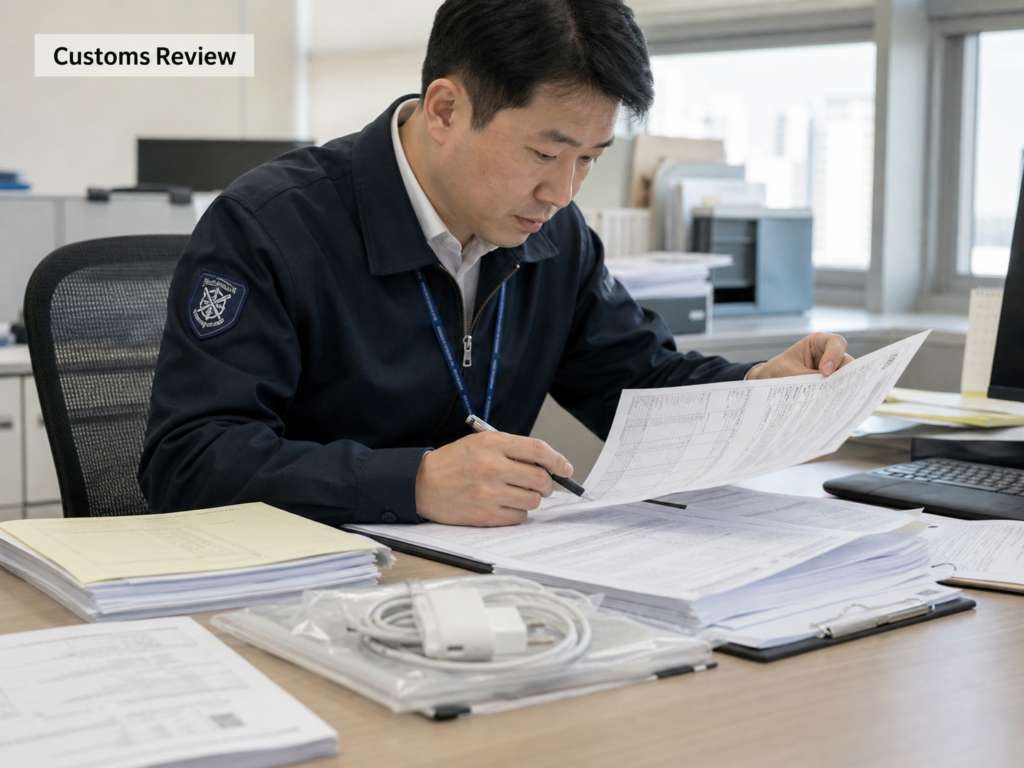
1. Materials related to safety confirmation, certification, or supplier conformity confirmation, such as certificates, test reports, declaration materials, or conformity declarations.
2. Materials related to RRA electromagnetic wave conformity assessment, such as test reports, certification or registration certificates, supplier conformity declarations, etc. (if applicable).
3. Product labeling, packaging, and manual materials, to facilitate verification of model, parameters, and labeling requirements.
4. General trade documents, including commercial invoice, packing list, bill of lading/waybill, and HS code declaration information.
5. Prepare information on the import entity, manufacturer, agent, or other responsible entities according to the specific import mode.
Whether to submit copies, original documents, or other proofs during customs clearance shall be confirmed according to the specific requirements of South Korean Customs and the competent authority. Not all scenarios require a copy of the certificate with the official seal of the certification body, nor does every shipment need to submit a separate DoC or local qualification certificate in the same form.
Document Consistency Inspection (Must-Know for Beginners)
Having complete documents is not enough; the information on all documents shall be consistent, which is where many people tend to make mistakes:
• The product model, brand, quantity, and parameters on all documents shall correspond to each other; it cannot be that the invoice shows Model A while the test or registration materials show Model B.
• The manufacturer name indicated on the invoice shall be consistent with the entity in the safety or RRA-related materials.
• Information on entities such as importer, manufacturer, and agent shall match the actual declaration and applicable regulatory requirements.
• The HS code shall be consistent with the actual attributes and regulatory category of the product. Do not falsely declare the HS code to avoid tax, otherwise you may be penalized if found out.
Document Requirements for Special Import Scenarios (Semi-Proficient Judgment)
For special import scenarios, the document requirements will be different. Here are several common ones:
• Sample import: It is necessary to submit a use description and quantity certificate, and confirm or apply for exemption in advance according to applicable rules; simple declaration as ordinary sales goods is not allowed.
• Repair product import: Original export certificates and repair agreements shall be submitted, and declaration shall be made according to the special process for repair products.
• Cross-border e-commerce small parcels: Personal use imports and commercial sales imports shall be judged according to the rules of South Korean Customs and the product safety authority respectively. Products for sale cannot obtain personal use exemption solely because they are sent in small parcels or in small quantities. Whether formal product compliance procedures are required shall also be confirmed in combination with the use, import entity, product classification, and applicable exemption clauses.
• Set import: If it is a set such as charger + data cable + wireless charging base, each regulated component must be verified for compliance documents separately, not just the charger.
Inspection Item 5: Product Labeling, Packaging, and Manual (Easy-to-Fail Items for Rectification)
The last item is labeling, packaging, and manual. Many people think this is a trivial matter, but in fact, it is an item that is easy to be inspected and easy to rectify. The specific content and position of labeling shall be confirmed separately according to electrical product safety rules, RRA conformity assessment rules, product safety labeling regulations, and consumer information regulations. Exactly the same fixed format cannot be applied to all chargers.
Mandatory Inspection Items for Product Body Labeling (Must-Know for Beginners)
For the labeling on the product body, the following items shall be verified according to applicable regulations and product categories:
1. Applicable KC mark, safety declaration or certification number, and RRA conformity assessment mark or number (if applicable). Not all products have a so-called unified “KC EMC certification number”, nor do all chargers need to have three types of numbers (safety, EMC, and radio) printed on the body at the same time.
2. Rated information such as rated input voltage/frequency, output parameters, and product model.
3. For information on the manufacturer, importer, or other responsible entities, whether the name and contact information need to be marked shall be confirmed according to corresponding rules.
4. Applicable Korean safety warnings and consumer information. The specific content and carrier shall be subject to the official regulations for the product category.
5. Country of manufacture information and other applicable origin labeling requirements.
Mandatory Inspection Items for Packaging and Manual Labeling (Must-Know for Beginners)
Packaging and manuals shall also meet corresponding requirements:
• According to specific product rules, mark the product model, place of origin, and applicable safety or conformity assessment information on the outer packaging.
• Prepare Korean manuals or Korean safety use information according to applicable regulations, and confirm whether they are mandatory requirements for this product category.
• Multi-port products shall specify power limits, port combinations, and power reduction conditions when used simultaneously.
• The brand and model on the packaging and manual shall be consistent with the test, declaration, certification, or registration documents. It cannot be that the packaging shows the sales model while the materials show another model.
Here are several common labeling mistakes that must be avoided: the KC mark or other statutory marks are too small, blurry, or their position and format do not meet requirements; lack of Korean information required by regulations; parameters on the label are inconsistent with safety or RRA materials and actual product parameters; original safety information is covered by stickers, or the certification model is inconsistent with the sales model; mixing the KC mark, RRA mark with certification marks of other countries, causing consumer misunderstanding.
Practical Improvement: Self-Inspection Process and Pitfall Avoidance Decisions
After covering all inspection items, some people may feel a bit confused. Here we have sorted out self-inspection methods and pitfall avoidance tips that can be directly applied, to help you connect the previous content.
5-Step Quick Self-Inspection Method
Regardless of the type of charger, these 5 steps can be used for preliminary self-inspection, but this process cannot replace official compliance confirmation conducted by product classification:
1. Compare with the applicable scope and product classification, first determine whether your product is an ordinary wired charger, external power supply, product with wireless functions, or set product, and confirm the applicable safety and RRA procedures.
2. Verify the authenticity, current status, and coverage scope of safety-related materials and RRA conformity assessment materials through the South Korean official query system, instead of only listening to suppliers.
3. Check the labeling on the product body, packaging, and manual to confirm whether statutory marks, Korean information, models, and parameters meet specific product rules.
4. Verify the information of all customs clearance documents to ensure that information such as model, brand, parameters, manufacturer, and importer are consistent with each other.
5. Confirm that the arrangements of the actual import entity, manufacturer, agent, or other responsible entities comply with the specific import mode and applicable regulations. Do not handle it only when it is time to ship.
Common Compliance Risk Judgment Methods (Semi-Proficient)
If you have already done several orders and want to further improve your judgment ability, you can master these risk judgment methods:
• Judge whether it is certificate misappropriation: directly compare the model, parameters, appearance photos on the documents with the actual product. As long as one item does not match, it is necessary to further confirm whether the documents cover the product.
• Judge whether exemption is possible: make a preliminary judgment from dimensions such as use (whether for sale), quantity, import entity, product classification, and applicable exemption clauses. If you are not sure, be sure to consult South Korean Customs or the product safety authority in advance, do not guess on your own.
• Judge whether a service provider is reliable: confirm whether they are familiar with the applicable KATS and RRA systems, and whether they can provide officially verifiable processing materials. Avoid service providers who promise “one certificate covers everything” or “no South Korean procedures needed at all”.
• Judge the compliance capability of the supplier: see if it has a change notification mechanism—that is, if core safety components are replaced, whether it will notify you in advance and re-assess the validity of certification, declaration, or conformity assessment. Factories that secretly replace components and never tell you have high compliance risks.
Guide to Avoiding High-Frequency Pitfalls
Several of the most high-frequency pitfall scenarios and corresponding avoidance methods:
• Due to lack of Korean information required by regulations or non-compliant labeling: conduct labeling review before shipment, and confirm the content of the body, packaging, and manual according to specific product rules.
• Return due to mismatched document models: verify the coverage scope of safety and RRA materials before import, do not wait until the goods arrive at customs to find out something is wrong.
• Failure to declare smoothly due to unclear arrangement of import entities: confirm the responsible entities required for South Korean import declaration and local compliance in advance, do not handle it temporarily only when it is time to ship.
• Inspected due to missing wireless function assessment: when the product has active wireless functions such as Bluetooth and Wi-Fi, confirm RRA radio requirements in advance; when it has Qi or NFC functions, also judge based on frequency band, transmission method, power, and official classification, do not take it for granted.
It is not that everything is fine after the product is launched; compliance maintenance must also be done well: pay attention to the deadlines and status of specific declaration, registration, or certification procedures, and handle change, renewal, or supplementary procedures in accordance with applicable rules; if there are changes in the product’s design, core components, model, antenna, firmware, or port configuration, be sure to re-assess the validity of relevant procedures, and do not sell after random changes; cooperate with South Korean local importers or other responsible entities to handle market spot checks, complaints, and recall processes to avoid risk expansion.
Overall, the compliance logic for charger imports in South Korea is not complicated; the core is “classify first, then verify, check details, and ensure consistency”. After reading this checklist, you should be able to quickly determine which safety, EMC, or radio procedures may apply to your charger, and also complete a preliminary compliance self-inspection against the 5 major categories of inspection items, verify the authenticity and coverage scope of relevant materials, and avoid common import pitfalls. If you are unsure about special scenarios, be sure to consult local South Korean compliance service providers, customs, or competent authorities in advance. Do not ship with a fluke mentality to avoid unnecessary losses.