
Many overseas sellers selling charging products are always confused by “KC certification” when they first enter the South Korean market: some say it is a certificate, some say it is a mark, and others say CE can replace it. In fact, KC is neither a single certificate nor a casually printed logo. It is a complete access system for electronic and electrical products in South Korea, which manages the whole process of product safety from import to market launch. In this article, we will explain South Korea’s KC compliance clearly, from entry-level judgment to practical pitfall avoidance.
First, Understand: What Exactly Is KC, and Who Regulates It
Core Concepts and Regulatory Boundaries
KC is a statutory safety and radio wave access mark for electronic and electrical products in South Korea, not a single certificate. Only products included in the KC coverage scope can be imported and sold after meeting access requirements and affixing the mark as required. Its core function is to prevent safety risks such as electric shock, fire, and radio wave interference, which is equivalent to a “safety pass” for products entering the South Korean market.
There are two main official institutions in charge of KC in South Korea:
• Korea Agency for Technology and Standards (abbreviation: KATS): Responsible for the formulation and supervision of the electrical safety system, managing safety issues such as whether products will cause electric shock or fire;
• National Radio Research Agency (abbreviation: RRA): Responsible for conformity assessment of radio wave transmission, electromagnetic compatibility (EMC, simply put, products do not randomly generate radio waves that interfere with other devices, nor can they be interfered with by other devices to the point of being unable to work normally), and wireless products, managing radio wave-related compliance issues.
The entire KC-related access supervision operates on four parallel tracks, each managing a separate area, which you can understand as passing four checkpoints:
1. **KATS Electrical Safety Track**: Regulates electronic and electrical products in the mandatory list, divided into three systems according to risk: safety certification, safety confirmation, and supplier’s declaration of conformity. Corresponding procedures such as certification, confirmation, or reporting must be completed before the product can be launched on the market after compliance;
2. **RRA Conformity Assessment Track**: Regulates wireless transmission, EMC, and broadcast communication products. Corresponding RRA conformity assessment must be completed, and corresponding vouchers must be obtained or retained before the product can be launched on the market;
3. **Special Requirements Track**: Regulates products with batteries, high-power products requiring energy efficiency labels, and products with recycling responsibilities. Additional requirements such as battery safety, energy efficiency, and producer recycling responsibility need to be met, which are applied叠加 according to product type;
4. **Customs Clearance Track**: All imported products must go through this. Customs declaration materials and corresponding access documents need to be prepared, and the product can enter the country only after customs clearance is passed.
Core Differences Between the Three Types of Electrical Safety Regulatory Systems
KATS’ electrical safety regulation is divided into three categories according to product risk level, with different intensity, requirements, and vouchers. Many beginners are easily confused. Here is a table to clarify:
| Regulatory System | Regulatory Intensity | Core Requirements | Compliance Document | Applicable Objects |
| Safety Certification | Highest (mandatory) | Testing by designated institution + factory inspection + regular supervision | Officially issued certification certificate | High-risk electrical products |
| Safety Confirmation | Medium (mandatory declaration) | Testing by designated institution + document declaration and review, no factory inspection required | Confirmation document (no unified official certificate format) | Medium-risk electrical products |
| Supplier’s Declaration of Conformity (SDoC) | Lower (self-confirmation and reporting, post-market spot checks) | The manufacturer or importer completes conformity confirmation and product testing in accordance with applicable safety standards, prepares and retains the conformity declaration and test materials, and submits the conformity declaration report in accordance with applicable rules | Conformity declaration, report and test materials; no certificate is issued in the form of a safety certification certificate | Low-risk electrical products |
Special attention should be paid: which category a specific product belongs to is not decided by oneself, and must be based on the mandatory product list and the latest version of regulations currently issued by KATS. Although SDoC does not issue certificates in the form of safety certification certificates, it does not mean that products can be sold only by keeping test documents internally. The specific test methods, submitted materials, and labeling requirements also depend on the product category and current rules.
3 Easily Confused Concepts Beginners Must Distinguish
People who are new to KC are most likely to fall into these cognitive pitfalls. Here we explain them thoroughly at once:
1. **KC safety requirements ≠ RRA requirements**: The former regulates electrical safety (electric shock, fire, etc.), while the latter regulates radio wave transmission, EMC, etc. Even if a product has no wireless transmission function, it does not mean it is exempt from RRA requirements; it is still necessary to verify whether it falls within the scope of EMC or broadcast communication equipment. For example, some wired chargers may also require EMC assessment.
2. **KC ≠ Overseas certifications (CE/FCC/CB/UL)**: Overseas certifications have no direct legal effect in South Korea and cannot replace KC. CB reports cannot directly replace South Korea’s statutory compliance procedures, but they can be used to reduce duplicate testing or support applications after evaluation by the accepting institution. Whether it is necessary to supplement South Korean national deviation items, additional samples or documents depends on the applicable standard version, the coverage of the CB report, and the evaluation result of the accepting institution.
3. **KC ≠ All market access requirements**: KC only regulates safety and radio wave-related market access. Products with batteries or high-power products requiring energy efficiency labels also need to comply with additional special regulations, which are not within the scope of KC itself. Do not assume that obtaining KC means everything is settled.
How to Determine If Your Charging Product Requires KC
First Check: Whether KC Requirements Can Be Exempted
First of all, it must be clear that only products **for non-sales purposes, complying with official regulations, and not resold into the market** may be exempt from KC requirements; all commercially imported products are not exempt.
Common exemption scenarios are as follows, you can check against them:
• Personal use: Must be for non-sales purposes and in reasonable quantities for personal use; excess quantities will be deemed commercial imports and cannot be exempted;
• Samples/for testing and research: For non-sales purposes, declared as required, must be returned or destroyed afterwards, and cannot enter the market;
• Temporary import for exhibitions: For non-sales purposes, reported as required, and disposed of in accordance with regulations after the exhibition;
• Built-in accessories for complete machines: For example, if a complete machine that has passed KC is imported, and the charging cable included is not sold separately but imported together with the complete machine, the accessory does not need to apply for KC separately.
⚠️ Misjudgment is prohibited: Exemption cannot be determined solely by HS code, exemption conclusions of other countries, or product voltage level; it must be based on official South Korean regulations.
Next, Determine: Which Type of Electrical Safety Regulation It Falls Under
If it is confirmed that exemption is not applicable, the next step is to determine which category of KATS regulation the product falls under. The first step is to fully understand the product information, which mainly includes three aspects:
• Electrical parameters: Input/output voltage/current/power, whether it is alternating current (AC) or direct current (DC);
• Structure and function: Whether it contains a transformer/rectifier/protection circuit, number of ports, whether it has wireless/battery/E-marker chip;
• Sales attributes: Whether it is sold independently, brand, manufacturer.
There are four core bases for judgment: whether the product is included in the KATS mandatory list, product structure and parameters, function type, and sales form.
For common charging products, you can first have a general reference direction:
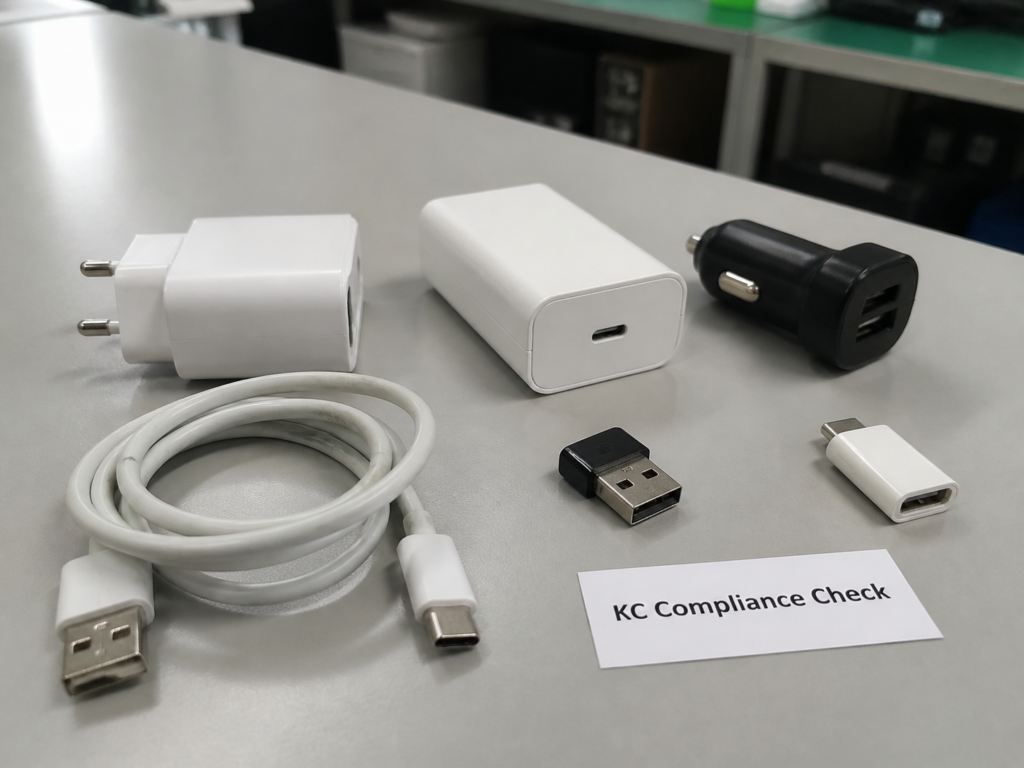
• Wall chargers, power adapters, car chargers: Determined as safety certification or safety confirmation based on parameters and structure;
• Passive charging cables, independently sold connectors: Verify whether they fall within the scope of safety confirmation;
• Very low-power accessories: May fall within the scope of SDoC.
⚠️ Misjudgment is prohibited: Classification cannot be determined solely by product name. For example, you cannot assume a “charging cable” is subject to safety confirmation; it must be verified in combination with the official list and the actual structure of the product.
Don’t Miss: Whether Additional Special Requirements Apply
In addition to KATS electrical safety, it is also necessary to determine whether other regulatory requirements apply, which is a link many beginners easily miss:
RRA-related Requirements
The same principle as before: No wireless transmission function does not mean no RRA requirements are needed; it is necessary to verify whether it falls within the scope of EMC or broadcast communication equipment. Here are a few examples of typical charging products:
• Wired wall chargers: Need to verify whether they fall within the scope of RRA EMC assessment;
• Wireless charging bases: Need to verify KATS electrical safety and RRA conformity (wireless power transmission/radio wave transmission/EMC/communication functions) separately;
• Chargers with Bluetooth function: Need to add RRA wireless transmission + EMC assessment.
Charging Cables with E-marker Chips
There is no unified classification rule for such products. The determination must be made in combination with the product structure, the current KATS list, and applicable safety standards. If in doubt, you must apply for written confirmation from a designated certification institution, and cannot default to the assumption that “having a chip equals safety certification”.
Products with Batteries
If the product has a battery, corresponding special requirements also apply:
• Power banks: Need to add battery safety and producer recycling responsibility requirements;
• Electronic products with built-in batteries: Need to add complete machine battery safety requirements;
• Lithium battery cells: Subject to separate battery safety, transportation, and recycling requirements;
• Complete machines with batteries: Regulated according to the complete machine category, and the battery must meet corresponding supporting requirements.
High-power/Fast-charging Products
Power, input voltage, number of ports, fast charging protocol, and power supply architecture all affect the applicable standards. The commonly mentioned 65W and 100W are just common business check points, not legal classification thresholds; regulatory categories cannot be determined solely by power.
Products Sold in Sets
Each individual product must be compliant separately, and the set labeling must also meet corresponding requirements. You cannot assume that “if individual products have certificates, the set must be compliant”.
4-Step Quick Judgment Method for KC Access
If you find the content too complicated, you can make a preliminary judgment according to these four steps, which is simple and less prone to error:
1. First check whether the statutory exemption conditions are met, by checking the current announcements of the customs/KATS;
2. Check the KATS electrical safety regulatory category against the mandatory product list + product parameters/structure;
3. Confirm whether additional special requirements such as RRA, battery, and energy efficiency apply;
4. If in doubt, apply for written confirmation from a certification institution designated by KATS/RRA, and do not guess blindly.
Judgment Reference for Common Boundary Products
To help you understand better, here are 6 preliminary judgment cases of common charging boundary products. Note that the final conclusion must be based on the official list and the institution’s judgment:
1. **65W USB-C PD wall charger (sold independently, no wireless function)**: Falls within the scope of KATS regulation. It is necessary to confirm whether it is subject to safety certification or safety confirmation, and whether RRA EMC assessment is required. It cannot be determined as safety certification solely by power;
2. **Passive USB-C charging cable (sold independently)**: Need to confirm whether it is included in the safety confirmation list; not all passive cables require safety confirmation;
3. **100W charging cable with E-marker chip (sold independently)**: Need to confirm whether it has circuit conversion function, and whether it is subject to safety certification or safety confirmation. It cannot be assumed that having a chip equals safety certification;
4. **Wireless charging base**: Need to confirm the KATS electrical safety category and RRA conformity assessment category. You cannot only apply for safety-related KC;
5. **Power bank with built-in lithium battery**: Need to confirm the KATS electrical safety category and special battery requirements. You cannot only apply for KC safety;
6. **Charger + charging cable set**: Need to confirm the set labeling requirements and the certification coverage of individual products. You cannot assume that if individual products are compliant, the set will necessarily be compliant.
What Responsibilities Do Importers Bear, and How to Choose a Certificate Holding Plan
Compliance Responsibilities of Each Party
After clarifying the product category, you also need to understand the responsibilities of each role to avoid passing the buck when problems arise:
• Manufacturer: Provide true product information, and cooperate with certification, rectification, and factory inspection;
• Certificate holder: Responsible for the authenticity of certification application materials and the validity of the certificate;
• South Korean domestic importer: Bear the obligation of import declaration, and cooperate with market spot checks and recalls;
• Seller: Verify the product’s compliance qualifications, must not sell non-compliant products, and cooperate with spot checks and recalls;
• South Korean domestic responsible entity: Act as the regulatory liaison and bear corresponding domestic responsibilities;
• E-commerce platforms: Verify the KC qualifications of merchants operating on the platform according to platform rules.
The statutory responsible entities and obligations under different systems shall be subject to applicable laws, rules of competent authorities, and registration status. Contracts may stipulate mechanisms for material provision, cost bearing, compensation, and recourse, but they shall not oppose regulatory authorities, nor shall they exempt the statutory responsible entities from mandatory obligations.
Application Entity and Domestic Liaison Requirements
Many overseas sellers are most concerned about “can I apply for KC if I don’t have a South Korean entity?” The answer is: not necessarily. The eligibility of the application entity and whether a South Korean domestic liaison is required vary by product category and regulatory system: some categories allow foreign manufacturers to apply directly, while others require a South Korean domestic liaison. The specific rules need to be verified with the certification institutions designated by KATS/RRA for current requirements, and do not readily believe one-sided statements from third parties.
How to Verify the Certificate Authorization Chain
If you use a certificate from a supplier or third party, you must verify the registration information and commercial authorization, otherwise the customs or platform may not recognize it. First of all, it must be clear that only valid documents recognized by the South Korean government count as KC certificates; overseas CE/CB/self-test reports are not regarded as KC certificates.
You should first confirm the requirements for statutory applicants and domestic agents according to KATS safety certification, safety confirmation, SDoC, and RRA conformity assessment respectively. The official query system is mainly used to verify public information such as registered certificate or report numbers, applicants or holders, manufacturers, factories, models, and status; brand authorization, distribution authorization, and importer authorization are commercial documents, which should be verified separately with the right holder, and cannot be regarded as KC fields verifiable by the official system.
For safety certification products, “holding the certificate by a South Korean importer or agent entity” should not be taken as a naturally optional option; it should be handled by manufacturers, foreign manufacturers, or application entities permitted by law that meet the statutory qualifications of the system.
How to Choose Among Three Common Certificate Holding Plans
There are three common certificate holding and compliance arrangements, which you can choose according to your own business situation, provided that you first confirm the application entities allowed for the product category:
1. **Use the manufacturer’s existing valid KC documents**
• Applicable scenarios: Small-batch trial sales, suppliers already have compliant KC documents;
• Requirements: Verify official registration information, model coverage, brand and sales authorization documents;
• Risks: The supplier can revoke the authorization, and document changes depend on the manufacturer’s cooperation, resulting in low initiative.
2. **Participate in certificate holding or compliance management through your own South Korean entity**
• Applicable scenarios: Medium and large importers with registered South Korean legal persons;
• Advantages: Facilitates control over import declaration, document maintenance, market spot checks, and recall communication;
• Requirements: First confirm whether the regulatory system allows South Korean entities to act as applicants, holders, or domestic responsible entities, and bear corresponding compliance maintenance, change, and follow-up management responsibilities.
3. **Entrust a formal authorized South Korean entity to assist in handling or undertake permitted domestic responsibilities**
• Applicable scenarios: Small and medium-sized sellers without a South Korean entity;
• Requirements: Verify the agency’s qualifications, confirm what responsibilities it can undertake under the specific regulatory system, and clarify the scope of materials, fees, changes, recalls, and authorization;
• Risks: Insufficient agency qualifications or non-compliant services may lead to problems in declaration, market communication, or ongoing compliance.
Suggestions for Division of Responsibilities with Overseas Manufacturers
No matter which plan you choose, the responsibilities with overseas manufacturers must be specified in the contract to avoid verbal promises. It is recommended to clarify the following points: obligation to notify product changes, sharing of certificate maintenance costs, division of recall responsibilities and costs. At the same time, keep the original certification materials, key component list, and change commitment letter provided by the manufacturer, and do not only save a screenshot of the certification.
The division of responsibilities in the contract can only handle the cost, compensation, and recourse relationship between the two parties, and cannot change the statutory responsible entity stipulated by South Korean law, nor can it exempt the mandatory obligations borne to the regulatory authorities.
How to Apply for KC Certification: Process, Costs, and Cost-Saving Tips
Preparations Before Application
After deciding to apply for certification, completing these preparations first can save you a lot of detours:
• Organize complete product information and preliminarily determine the regulatory category;
• Prepare basic application materials: Product specification sheet, circuit diagram, key component list, appearance/label draft, test samples;
• Verify the current list of designated certification institutions and select a qualified institution;
• If there is a CB report, consult the institution in advance whether part of the testing can be reduced or exempted.
Consistency Requirements for Materials and Samples
When submitting an application, there is a core principle that must be followed: all submitted materials and samples must be truly consistent, and must not be concealed or tampered with.
The technical materials to be submitted include: circuit schematic diagram, PCB diagram, BOM list, compliance certificate of key safety components; samples must be consistent with the mass-produced version, with Korean labels and instruction drafts attached. If the materials and samples do not match, the light consequence is rectification, and the serious consequence is direct rejection, which may even affect subsequent applications.
Application Processes for the Three Types of Systems
The application processes for different regulatory categories vary greatly, so don’t confuse them:
• **Safety certification type**: Submit application → sample testing → factory inspection → rectification (if any) → certificate issuance → regular supervision. Factory inspection mainly focuses on quality control, incoming material inspection, production control, finished product inspection, and change management, which is not just a casual formality.
• **Safety confirmation type**: Submit application → sample testing → document declaration and review → rectification (if any) → obtain confirmation document, no factory inspection required.
• **SDoC type**: The manufacturer or importer completes conformity confirmation and product testing in accordance with applicable safety standards, prepares a conformity declaration and retains test materials, then submits the conformity declaration report in accordance with applicable rules before placing the product on the market. Note that this does not mean no responsibility; rather, certificates are usually not issued in the form of safety certification certificates; effective reports, declarations, and test materials must still be provided during spot checks.
Factors Affecting Cost and Cycle
Many people ask “how much does KC cost and how long does it take to get the certificate?” In fact, there is no unified official standard, and all are subject to the official quotation and actual progress of the designated institution.
• Factors affecting cost: Number of test items, number of samples, whether factory inspection is required, number of rectifications, number of series models;
• Factors affecting cycle: Test pass rate, number of rectifications, factory inspection scheduling, complexity of series model review, regulatory changes.
Do not readily believe propaganda such as “guaranteed pass, get certificate in 15 days”, which is most likely a scam.
Legal Methods to Reduce Certification Costs
Of course, there are also some compliant cost-saving tips you can refer to:
1. **Combined application for series models**: Multiple models with the same structure, same core materials, and same safety performance can be applied for jointly, which can save a lot of testing fees, but it must be reviewed and confirmed by the certification institution, and cannot be combined arbitrarily by yourself.
2. **Use CB reports to reduce duplicate work**: CB reports cannot directly replace South Korea’s statutory compliance procedures, but they can be used to reduce duplicate testing or support applications after evaluation by the accepting institution. Whether it is necessary to supplement South Korean national deviation items, additional samples or documents depends on the applicable standard version, the coverage of the CB report, and the evaluation result of the institution.
3. **Pre-test optimization**: Conduct internal pre-tests before large-batch applications, rectify problems in advance, and reduce the rectification cost of failing formal tests.
Core Verification Requirements After Certificate Issuance
Getting the document does not mean everything is settled. First, check item by item in accordance with compliance requirements to ensure the product is consistent with the certification or declaration content; then properly keep materials such as certificates, test reports, confirmation documents, declarations, and reports, and effective versions must be provided during market spot checks; for SDoC products, complete test reports, conformity declarations, and report materials must be retained by yourself for future reference.
Practical Requirements for Labeling, Customs Clearance, and Market Spot Checks
Compliance Requirements for KC Labeling and Korean Language MaterialsMany people pass the certification but finally fail on labeling, which is very regrettable. KC or RRA-related labels are not just a casually printed logo; the specific content and position must be confirmed according to the applicable system and product rules:
• Label content applies as needed, which may include KC/RRA marks, certification or registration/report numbers, product model, rated input and output parameters, manufacturer or importer information, and warning matters;
• Marks, numbers, parameters, manufacturer or importer information, and warning matters shall be marked on the product, packaging, or other permitted positions in accordance with the provisions of the applicable system and product-specific safety standards;
• If the product size or structure is not suitable for marking on the body, packaging or other permitted methods shall be adopted in accordance with applicable labeling rules;
• Whether it is necessary to submit or attach Korean instructions, specific warning content, and language requirements shall also be confirmed according to the product category and applicable standards.
Common labeling errors include: blurred and easily peeling labels, inconsistent information with certification or declaration content, missing warning information, incorrect use of KC or RRA marks. These must be avoided.
Labeling ≠ Customs Clearance Documents: Differences in Documents for Different Scenarios
There is another common misunderstanding: thinking that the KC label is a customs clearance document, but it is not. The KC label is printed on the product or its permitted positions for consumers and spot checks, and cannot replace various compliance documents. Different scenarios require different documents:
• Product body label: For consumers and market spot checks;
• Packaging/instruction label: For consumers and usage instructions;
• Import declaration materials: For declaration to customs and regulatory systems;
• Platform qualification documents: For e-commerce platform entry review;
• Market spot check materials: For on-site inspection by regulatory authorities.
There is no so-called unified “KC customs clearance document”; specific requirements depend on the HS code, product classification, and import purpose.
Key Points of South Korea Customs Clearance Verification
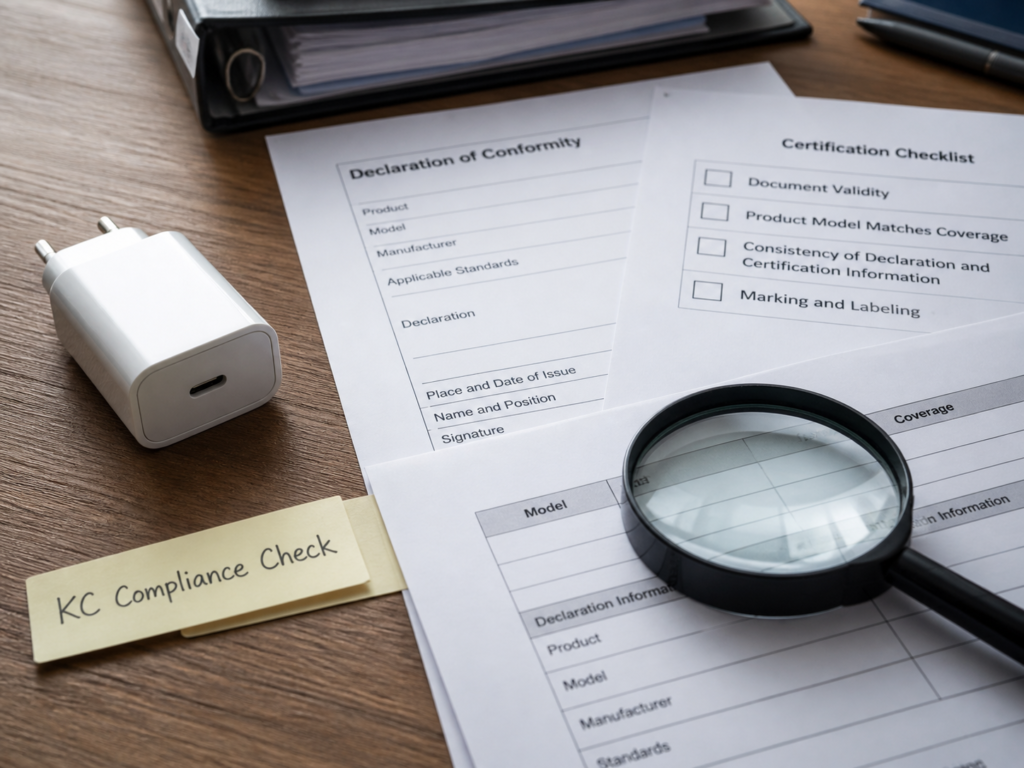
Customs clearance is the most troublesome part for many sellers. Preparing these in advance can reduce delays:
• Confirm before customs clearance: HS code, product regulatory classification, customs clearance system declaration requirements, whether it triggers safety management declaration;
• Common verification documents: Corresponding KC/RRA compliance documents, import declaration form, product conformity statement;
• Verification focus: Whether the compliance document is valid, whether the product model matches the coverage, and whether the declaration information is consistent with the certification information.
Practical suggestion: Check the declaration data fields with the customs broker and certification institution in advance to ensure that the invoice/packing list is consistent with the certification materials. ⚠️ KC obligations cannot be determined solely by HS code; incorrect classification may lead to customs clearance delays or even cargo detention.
Compliance Differences for Different Import/Sales Channels
Different import and sales channels have different compliance requirements:
• **General commercial import (B2B/bulk cargo)**: Complete compliance documents shall be prepared according to product categories and applicable rules, and confirm whether Korean instructions, warning materials, or other accompanying documents are required;
• **South Korea local warehouse e-commerce (such as Coupang, Naver)**: The platform will verify KC qualifications, and products must meet applicable labeling and material requirements;
• **Platform procurement/consignment sales**: Provide compliance documents as required by the platform. The statutory responsible entities and mandatory obligations shall be subject to applicable laws and rules of competent authorities. Contracts can only stipulate commercial arrangements such as material provision, cost bearing, compensation, and recourse, and cannot exempt statutory obligations;
• **Personal use parcels**: Those meeting reasonable quantity/non-sales purposes can be exempted. It is prohibited to split orders, underdeclare, or disguise personal parcels to evade compliance; penalties are severe if caught.
All thresholds and rules are subject to the current announcements of South Korea Customs and platforms.
Market Circulation Regulatory Rules
After the product is launched, it will also face market spot checks. You need to know who checks, what they check, and what the consequences of non-compliance are:
• Regulatory entities: South Korea Customs is responsible for customs clearance verification, KATS and local governments are responsible for electrical safety spot checks, RRA is responsible for radio wave spot checks, consumer protection agencies are responsible for complaint verification, and e-commerce platforms are responsible for in-platform compliance review;
• Spot check focus: Labeling compliance, core safety/radio wave performance, consistency between product and certification;
• Consequences of non-compliance: May face rectification, sales restrictions, recalls, administrative penalties, customs clearance or platform disposal, depending on the illegal facts and regulations.
Most Common KC Compliance Misconceptions and Pitfall Avoidance Methods
6 Common Cognitive Misconceptions
Many pitfalls are caused by wrong initial cognition. Here they are listed so you can avoid them by comparison:
1. **Misconception: Overseas certifications can directly replace KC**
Reason for error: South Korea does not recognize the direct legal effect of overseas certifications. CB reports cannot directly replace South Korea’s statutory compliance procedures, but they can be used to reduce duplicate testing or support applications after evaluation by the accepting institution; whether it is necessary to supplement South Korean national deviation items, additional samples or documents depends on the applicable standard version, the coverage of the CB report, and the evaluation result of the institution;
Consequences: Cargo detention, fines, forced removal from shelves;
Rectification: Apply for KC certification or conformity procedures in advance, and confirm the usable scope of the CB report with the accepting institution.
2. **Misconception: All charging products require factory inspection**
Reason for error: Only safety certification types require factory inspection; safety confirmation and SDoC do not;
Consequences: Unnecessary cost waste or missing factory inspection;
Rectification: First determine the system category before preparing corresponding application materials.
3. **Misconception: KC certificates are valid for life, or all need to be renewed upon expiration**
Reason for error: All types of KC documents cannot be generally understood as valid for life or automatically renewed after a fixed period expires. The ongoing management focus of different systems may include product and factory consistency, regular factory inspections or follow-up management, change declaration, suspension or cancellation status, and document retention period;
Consequences: Ignoring follow-up management, change declaration, or document status leads to problems in customs clearance, sales, or market spot checks;
Rectification: Verify document status, product and factory consistency, supervision or inspection requirements, change records, and document retention period according to the applicable system. Renewal or update shall be handled according to the period only when the specific system or document does have a period requirement.
4. **Misconception: Low-voltage USB products definitely do not need KC**
Reason for error: Whether KC is required depends on product function, sales form, and whether it is included in the mandatory list, and has no absolute relationship with voltage;
Consequences: Missing certification leads to cargo detention;
Rectification: Judge one by one according to the 4-step method, and consult the designated institution if in doubt.
5. **Misconception: Products without wireless transmission function definitely do not need RRA requirements**
Reason for error: Some wired products may fall within the scope of RRA EMC or broadcast communication equipment assessment;
Consequences: Missing RRA assessment leads to cargo detention;
Rectification: Simultaneously verify RRA requirements when determining the KC category.
6. **Misconception: RRA conformity assessment is electrical safety KC**
Reason for error: The two belong to different regulatory systems, with different control contents, and cannot replace each other;
Consequences: Missing corresponding access requirements;
Rectification: Verify KATS and RRA requirements separately.
5 High-Frequency Practical Pitfalls
In addition to cognitive misconceptions, these pitfalls are also common in practice:
1. **Product model is inconsistent with the registered model on the certificate**: Direct cargo detention and fines. Evaluate the compliance impact before changes and update the certificate in time;
2. **Using unauthorized/forged/borrowed KC certificates**: Deemed non-compliant, with fines and recalls. Verify the authenticity, registration status, and coverage of the certificate through the official system;
3. **Failure to re-evaluate after core component changes**: The certificate or declaration status may be affected, and spot checks may fail. Submit to the certification institution for evaluation before changes, and conduct supplementary testing or updates as required;
4. **E-commerce page exaggerates KC certification scope**: Triggers platform penalties and removal from shelves. Page information must be strictly consistent with the models and parameters covered by registration or reports;
5. **Korean copy is inconsistent with actual parameters**: Failed spot checks and consumer complaints. Korean materials must be strictly consistent with certified or declared parameters.
Methods for Verifying Certificate Authenticity and Validity
To verify the authenticity of a certificate or report, you should check the registration information such as number, applicant or holder, manufacturer, factory, model, and status through the KATS/RRA official certification query system. Brand, distribution, and import authorizations shall be verified separately through commercial documents such as authorization letters and contracts.
Note: Test reports provided by suppliers cannot directly replace KC certificates, confirmation documents, or conformity declaration reports that should be handled according to law. Don’t be fooled.
What to Do When Products Change? Management Methods for Ongoing Compliance
Which Changes Require Compliance Impact Assessment
Getting a certificate is not a once-and-for-all solution. Any change to the product may affect compliance and must be re-evaluated. Common changes that require assessment include:
• Electrical parameter changes: Changes in input/output power, number of ports, fast charging protocol;
• Core structure changes: Changes in power modules, PCBs, key safety components, wire conductors, insulation/ housing flame-retardant materials;
• Production-related changes: Changes in manufacturer, production address, brand holder;
• Function/use changes: Adding wireless/battery functions, changing from independent sales to set gifts;
• Labeling/packaging changes: Changes in silk screen printing, packaging copy, instruction content.
⚠️ Changes involving power, core circuit design, key safety components, production address, wireless modules, and product use must be prioritized for assessment. Do not change them arbitrarily, otherwise you may not even know that the certification or declaration status is affected.
General Process for Change Compliance Handling
If changes are indeed necessary, following this process will not go wrong:
1. Suspend the shipment/import of products involved in the change to avoid non-compliant products entering the market;
2. Sort out the change details, compare with the original certification materials, and preliminarily assess the impact;
3. Submit the change description and related technical materials to the original certification institution;
4. Execute according to the institution’s written judgment result (re-certification/supplementary testing/filing/no adjustment needed);
5. Retain all change records and institution opinions, and update the compliance file.
Daily Certificate Maintenance Requirements
Doing these three points well in daily maintenance can avoid many unexpected problems:
• **Regular verification**: Verify product and factory consistency, regular supervision or factory inspection, follow-up management requirements, change declaration requirements, and whether the document is in a suspended or cancelled status according to the applicable system; prepare for renewal or update in advance only when the specific system or document does have a period requirement;
• **Regulatory tracking**: Regularly monitor updates to KATS/RRA regulations and product lists, and adjust product compliance plans in a timely manner;
• **Document retention**: Certification certificates, test reports, change records, supplier materials, etc. shall be retained in accordance with regulations and institution requirements.
Regulation Version Control and Evidence Archiving
You must develop the habit of keeping evidence, that is, regulation version control. Evidence that needs to be retained includes: regulation query date, screenshot of KATS/RRA product list version, written opinions of designated institutions, change decisions, etc.
These evidences help prove the compliance judgment process, support communication with institutions and responsibility recourse, but they cannot replace statutory compliance requirements, nor do they automatically exempt the responsibilities that may be borne when products are unqualified, declarations are wrong, or labeling and change obligations are violated.
Compliance Tools and Plan Selection for Different Business Scenarios
Full-Process Compliance Verification Master Table
To help you sort out the full-process compliance work, here is a verification master table that you can directly apply to your own business:
| Verification Module | Core Check Fields | Evidence to Retain | Main Responsible Person | First Verification Timing | Review Frequency |
| Product Information | Parameters, structure, function, sales form | Specification sheet, BOM list, circuit diagram | Product/Purchasing | New product project initiation | When product changes |
| Regulatory Judgment | KATS regulatory category, RRA requirements, special requirements, exemption judgment | Official list screenshot, institution written opinion | Compliance post | Before certification starts | Every six months/when regulations are updated |
| Certificates and Declarations | Certificate number, holder, coverage, status, follow-up management/supervision requirements, change records and valid period when applicable, authorization | Original certificate, authorization letter, official query screenshot | Compliance post | Before purchasing/importing | Every quarter |
| Labeling and Marking | KC mark, parameters, warning text, Korean materials | Label draft, final instruction manual | Quality Control/Operations | Before mass production | Spot check per batch |
| Import Customs Clearance | HS code, declaration information, document consistency | Customs declaration form, declaration materials | Customs Broker/Compliance | Before customs clearance | Per batch |
| Sales Operations | Page information, platform qualifications | Page screenshot, platform review record | Operations | Before listing | Monthly |
| Change Management | Change content, institution opinion, execution result | Change application, institution reply, execution record | Compliance/Product | Before change implementation | Per change |
| Recall Emergency | Emergency process, contact person, rectification plan | Emergency plan, rectification record | Compliance/Operations | Before business launch | Annually |
You can adjust the responsible person according to the team size. The core is that every link has someone in charge and evidence retained.
Compliance Plan Selection for Different Business Scenarios
Suitable compliance plans vary for different business stages. You can choose based on the number of SKUs, sales channels, whether there is a South Korean entity, supplier stability, recall risk tolerance, and inventory scale. Here are references for several common scenarios:
• **Small-batch trial sales scenario**: Prioritize using valid KC documents authorized by suppliers, and verify official registration information, authorization scope and status;
• **Medium and large-batch stable sales scenario**: It is recommended that your own South Korean entity participate in import, document maintenance and ongoing compliance management, or entrust a long-term stable formal entity to undertake domestic responsibilities permitted by law; but the specific qualifications of applicants and holders must be confirmed according to the product system;
• **Multi-model new product layout scenario**: First apply for certification of core models, then expand to other models that meet series requirements, which can save a lot of certification fees;
• **Cross-border e-commerce scenario**: Verify platform KC requirements in advance, and page information must be strictly consistent with the certification or declaration scope.
Regulatory Basis and Official Query Portals
All compliance judgments must be based on the latest official information. Here are the core regulatory bases and query portals:
• Core regulatory basis: , , and special regulations on batteries, energy efficiency, producer responsibility, etc.;
• Systems and standards: Official website of Korea Agency for Technology and Standards (KATS), Korea National Legal Information Center;
• Radio wave requirements: Official website of National Radio Research Agency (RRA) of South Korea;
• List of designated certification institutions: List currently published on the official website of KATS/RRA;
• Customs rules: Current announcements on the official website of Korea Customs;
• Platform rules: KC qualification requirement page of the corresponding e-commerce platform.
⚠️ South Korea’s KC-related regulations and product lists are regularly updated. All compliance judgments must be based on the latest official rules on the day of query. Do not use old experience from several years ago to make judgments.
Practical Case: Full-Process Compliance for a 65W USB-C PD Wall Charger
After talking about so much theory, let’s go through the full process with a very common 65W USB-C PD wall charger to help you connect the knowledge points.
Basic Product Information
This wall charger has an input of 100-240V~50/60Hz, output of USB-C PD 65W, AC to DC; its structure includes a transformer, rectifier circuit, protection circuit, single C port, no wireless module, no battery, no E-marker chip; sold independently, own brand of cross-border seller, manufactured by a Chinese factory.
Preliminary Judgment of Regulatory Category
First, the product is commercially imported and sold independently, so exemption is not applicable; second, it is an electronic and electrical product, which is definitely within the scope of KATS electrical safety regulation. Whether it is specifically safety certification or safety confirmation needs to be determined by checking the current KATS mandatory list; in addition, although it has no wireless transmission function, it is necessary to confirm whether it falls within the scope of RRA EMC assessment; since there is no battery, special battery requirements and wireless transmission RRA requirements are preliminarily excluded.
Certificate Holding Plan Selection
Assuming the seller is a small and medium-sized seller without a South Korean legal entity, but plans to sell stably in medium and large batches, it is suitable to entrust a formal South Korean entity to assist in handling or undertake domestic responsibilities permitted by law. You cannot make a decision solely based on the statement of “agency certificate holding”; you should first confirm the statutory application entity, holder, and domestic liaison requirements under the product’s regulatory system.
When selecting products, focus on verifying official registration information, agency qualifications, certificate or report holder information, brand and model coverage, and clarify the authorization scope and responsibility division. Brand, distribution, and import authorizations should also be confirmed separately through contracts or authorization letters.
Labeling and Material Preparation
Design KC/RRA-related labels and Korean materials according to the corresponding regulatory system and product-specific rules, including applicable rated parameters, safety warnings, etc.; confirm that all label fields meet the permitted positions and forms. If the product body is not suitable for marking, packaging or other permitted methods shall be adopted in accordance with applicable labeling rules, and confirm whether it is necessary to submit or attach Korean instructions.
Customs Clearance and Listing Preparation
Confirm the HS code and regulatory classification in advance, and check that the declaration information is consistent with the certification materials (the model and parameters on the invoice and packing list must match the certificate); submit KC qualification documents to the e-commerce platform in advance to ensure that the page information is consistent with the coverage of the certificate or report.
Change Management Example
If you plan to replace the power IC solution later, handle it according to the change process: first suspend shipment → sort out change materials → submit to certification institution for evaluation → conduct supplementary testing or filing as required → resume shipment. You cannot directly sell after privately replacing core components.
Case Summary
For this product, **content that can be preliminarily judged by yourself** includes: falls within KATS regulatory scope, no wireless transmission function, exemption not applicable; **content that must be officially confirmed** includes: specific regulatory category, whether RRA EMC assessment is required, application entity arrangement, whether changes require supplementary testing. The core principle is always: all final conclusions must be based on the current official list and written opinions of designated institutions.
Overall, South Korea’s KC compliance seems to involve multiple institutions, multiple systems, and multiple links, but as long as you follow the steps, first make a preliminary judgment, choose the right application and certificate holding plan that meets the system requirements, handle certification or reports according to the process, and do a good job in subsequent labeling, customs clearance, and ongoing maintenance, you can avoid the vast majority of pitfalls. For beginner sellers, you don’t need to pursue full understanding at the beginning. The core is not to take chances. If you are unsure, verify with the official designated institution — compliance is the foundation of long-term operation.