
If you often buy chargers or USB-C charging cables in North America, or run a small business selling charging products, you have definitely seen the UL and ETL marks on packaging or products. Many people wonder: are both of these safety certifications? Which one is more reliable? Is UL the standard for high-end products, and ETL just a “copycat certification” that doesn’t really count?
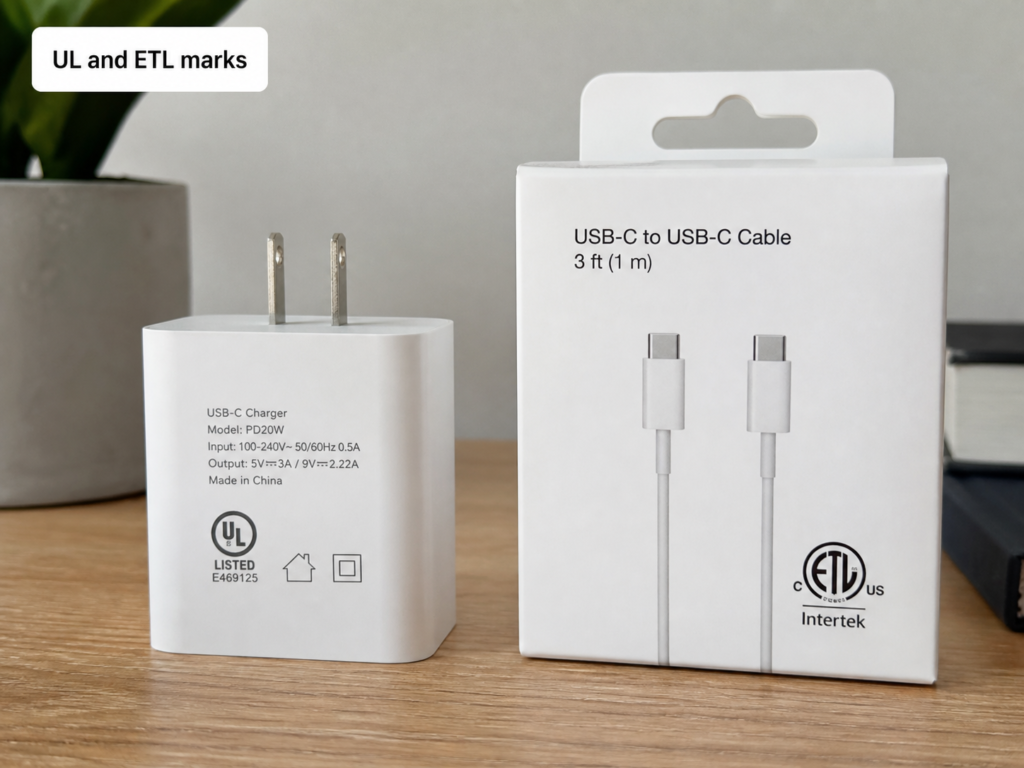
Today we will thoroughly explain these two certifications in one go, covering their basic identities, core differences, how to verify authenticity, and how to choose. Whether you are an ordinary consumer worried about buying counterfeit products, or a small seller looking to enter the North American market, you can use this information directly after reading.
First, Understand the Basics: What Exactly Are UL and ETL?
Before the comparison, let’s clarify the scope first: this article only covers consumer-grade USB/USB-C charging cables, chargers, power adapters, and interface connectors. Charging products for special fields such as industrial, medical, and automotive are not within the scope of discussion, because their certification rules are completely different. All conclusions we draw are targeted at North American market access and ordinary consumer purchasing scenarios.
Basic Identities of the Two
UL certification is a product certification service provided by UL Solutions, a long-established North American safety organization. Its core function is to evaluate product safety in accordance with applicable standards, helping to reduce risks such as electric shock and fire. UL Solutions also participates in the development or maintenance of some product safety standards, but certification still requires independent testing and conformity assessment based on applicable UL, ANSI, CSA or other recognized standards. It cannot be simply understood as “both the rule-maker and the referee”.
ETL certification is one of the product certification marks and certification services provided by Intertek. Intertek conducts testing, factory assessment, and follow-up supervision in accordance with applicable standards. That is to say, ETL is not just a one-time laboratory test, but provides complete conformity assessment services for specific products and certification programs.
Core of Validity: Both May Fall Under Recognized NRTL Certification
Many people think ETL is “less formal than UL”, which is actually inaccurate. The North American market often involves an important concept: NRTL (Nationally Recognized Testing Laboratory). Simply put, NRTL is a laboratory system recognized by the U.S. Occupational Safety and Health Administration (OSHA), with recognition scope covering specific product categories and applicable standards.
For products subject to requirements of relevant regulations, building codes, competent authorities, or purchasers, NRTL certification is usually an important condition for U.S. market compliance and project access; however, whether certification is legally mandatory must be judged in combination with product category, intended use, and state and local requirements. Not all consumer electronic products automatically take NRTL certification as a unified legal prerequisite for entering the U.S. market.
Relevant certification services of both UL and Intertek may be carried out within their respective recognition scopes. For Canada, judgment must be made in combination with the recognition scope, certification marks, applicable standards of the Standards Council of Canada (SCC), as well as local competent authority or project requirements.
Therefore, a more accurate conclusion is: Under the premise of the same applicable standard, the same certification scope, and valid certification marks, the corresponding certifications of UL and Intertek are usually acceptable to relevant competent authorities; specific projects should still be checked against regulations, local competent authorities, and customer requirements. It cannot be simply summarized as automatically and completely equivalent in all U.S. and Canadian legal scenarios.
3 Most Easily Confused Sets of Concepts
Beginners are most likely to be confused by merchants’ promotions. Here we first clarify 3 common sets of easily confused concepts:
- Certification mark vs test report: A separate test report is usually not equivalent to a listing or certification service with a certification mark, nor does it automatically grant the product the right to use the UL/ETL mark. Some regulations or platforms may accept specific laboratory reports, test reports, or supplier declarations of conformity, but whether they can be used for compliance depends on specific regulations, products, and channel requirements. The UL/ETL product certification we usually refer to depends on whether it includes the corresponding certification scope, mark usage rights, and follow-up supervision arrangements.
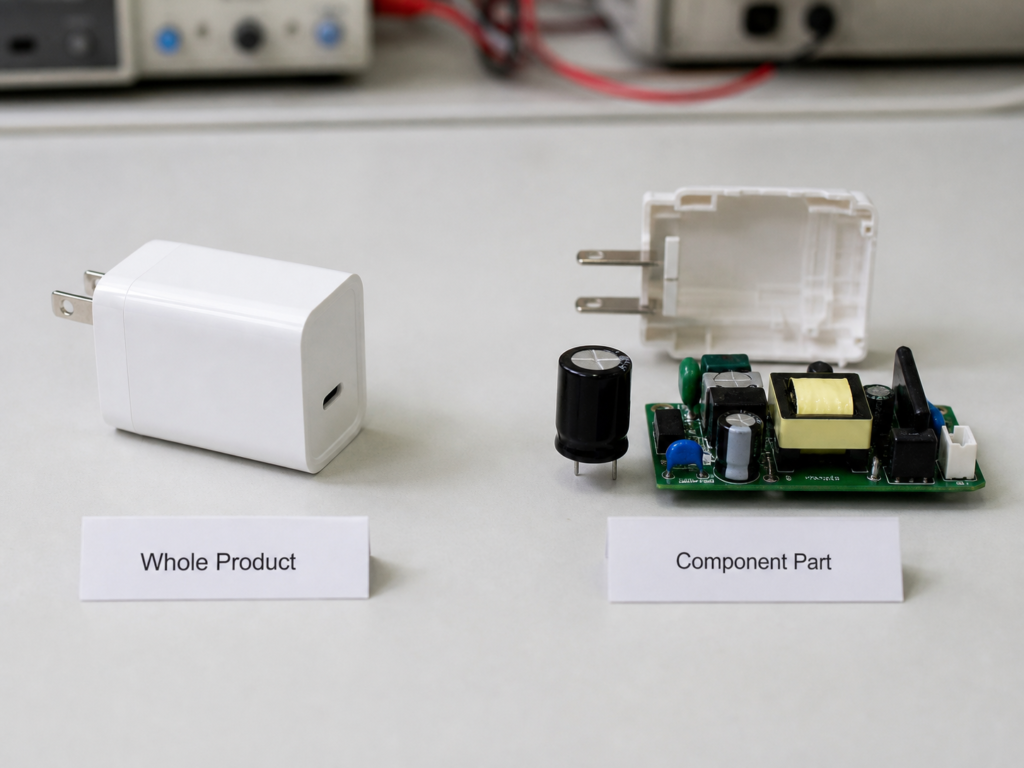
- Product listing, classification certification vs component recognition: Product listing, classification certification, and component recognition should be distinguished according to the specific certification body and certificate scope. Product listing is usually for complete products, but must still comply with the intended use, installation conditions, and applicable regulations specified in the certificate; component recognition is usually for components used as parts of other products. The fact that capacitors, transformers, or circuit boards inside a charger have component recognition does not mean the entire charger has obtained whole-product certification.
- Compliant with UL standards vs obtained UL certification: “Compliant with UL standards” may only be a company’s own statement, and does not necessarily mean it has been certified by UL or other recognized bodies; “obtained UL certification” should correspond to the certification body’s product records, applicable standards, and valid certification scope. The two are completely different things.
Let’s Agree Before Comparison: Different Premises Lead to Completely Different Conclusions
Many online disputes arise because the premises of comparison are different. All the differences we discuss later are based on three default benchmarks: the same charging product, adopting the same set of North American safety standards, and targeting both the U.S. and Canadian markets. If these three premises change, the conclusion may be completely different.
Specifically, there are three core variables that affect the actual difference between the two:
- Product dimension: The certification scope, test items, document requirements, and costs may differ between a high-power GaN charger above 65W and an ordinary USB-C charging cable that costs a few dollars. When power increases, power density increases, or complex multi-port/GaN topologies are used, thermal, insulation, abnormal condition, and structural assessments may be more complex, but certification cost or cycle cannot be directly judged solely by “above 65W”.
- Channel dimension: Access requirements may differ between large North American retailers like Walmart and Best Buy, and independent sites or small community mobile phone stores. Large retailers and e-commerce platforms may also designate certification bodies or documents for specific categories, suppliers, or projects.
- Regional dimension: The U.S. and Canada each have their own regulations, certification scopes, and local competent authority requirements; for Mexico, other Latin American countries, as well as Europe, Asia and other regions, it is also necessary to check local regulations country by country and product by product, and cannot judge whether sales are allowed solely by the UL or ETL mark.
Core Differences Explained Item by Item: What Exactly Is the Difference for the Same Product?
For your convenience to quickly grasp the core differences, we have first compiled a quick reference table, and will elaborate on the details later:
| Comparison Dimension | UL Certification | ETL Certification |
|---|---|---|
| Recognition and Legal Acceptance | Depends on applicable standards, certification scope, mark status, and local requirements | Depends on applicable standards, certification scope, mark status, and local requirements |
| Core Safety Requirements | When adopting the same standards and scope, main safety requirements are comparable | When adopting the same standards and scope, main safety requirements are comparable |
| Factory Inspection and Supervision | Subject to specific products, certification programs, and contracts | Subject to specific products, certification programs, and contracts |
| Certification Cycle | No unified fixed cycle | No unified fixed cycle |
| Certification Cost | Quoted based on specific projects | Quoted based on specific projects |
| Channel Acceptance | Some channels may specify or prefer it | Some channels may specify or accept it |
| Consumer Awareness | High popularity in North America, strong user familiarity | Relatively low familiarity among ordinary consumers |
1. Legal Effect and Market Acceptance
In actual projects, you cannot only look at the brand name of UL or ETL, but also consider several conditions: whether the certification body is recognized within the relevant scope, what standards the product adopts, which countries the certification covers, whether the mark is valid, and whether local competent authorities or customers have additional requirements.
For products subject to NRTL or similar third-party certification requirements, if both UL and Intertek certifications cover the same applicable standards and product scope, they are usually acceptable to relevant competent authorities. However, different U.S. states, local building authorities, government projects, and purchasers may have their own document or certification preferences. Canada also needs to be checked against SCC recognition scope and local requirements.
Channel acceptance also cannot be generalized. Large North American offline chains, mainstream e-commerce platforms, and other sales channels may designate certification bodies, test reports, brand authorizations, or other compliance documents for specific categories, suppliers, or projects. Sellers must follow the current channel’s written access requirements, and cannot judge that they can definitely settle in or list products solely by the UL or ETL mark.
In terms of consumer awareness, UL has a longer history in North America, and ordinary consumers are usually more familiar with the UL mark; ETL has relatively lower public popularity. However, the level of popularity does not equal the safety performance of a specific product. Ultimately, the certification scope and actual product quality must still be verified.
2. Testing Requirements and Strictness
This is the most misunderstood point: many people think ETL testing is lenient and UL testing is strict. A more accurate statement is that if both bodies adopt the same applicable standards, standard versions, and certification scope, the main safety requirements are usually comparable.
But actual certification does not only depend on the name of the body. Different products may be subject to different standards, and the certification scope may also include different rated parameters, structural limitations, component requirements, and supplementary conditions. Specific test items, engineering assessments, factory inspections, and follow-up supervision shall be subject to the certification program, reports, and certificate scope. It cannot be asserted that every test of the two bodies is exactly the same, nor can ETL be simply summarized as having lower supervision intensity.
Simply put: Do not directly treat the UL or ETL brand as a “safety level ranking”. What really matters is the applicable standards, certification scope, production consistency, and whether the product is continuously produced in accordance with certification conditions.
3. Certification Process and Cycle
The common certification processes for both may include: submitting product documentation, sending samples for testing, factory assessment, issuing certification documents, and follow-up supervision or maintenance. But specific steps will vary depending on product category, certification program, and body requirements.
There is no unified ranking of UL and ETL in terms of cycle. The actual time is affected by factors such as applicable standards, product complexity, completeness of documentation, whether samples need rectification, number of models, factory audit arrangements, certification scope, and the body’s scheduling. Instead of making judgments based on “a few weeks” or “a few months” online, it is better to directly confirm the project plan and quotation with the specific certification body.
4. Certification Cost
Certification fees, annual fees, factory inspection fees, and follow-up supervision fees are usually determined by product category, applicable standards, number of models, factory location, certification program, and contract. Therefore, it cannot be generally asserted that UL is definitely more expensive than ETL, nor can it be assumed that the higher the product power, the more fixed the price difference between the two will be.
Product power, topology, number of interfaces, whether multiple outputs are supported, model range, factory audits, and number of rectifications will all affect the final total cost. Project quotations for ordinary USB-C charging cables, single-port basic chargers, and multi-port high-power chargers may vary greatly, and inquiries should be made separately according to specific designs.
5. Mark Style and Regional Coverage
The mark systems of UL and ETL are not completely the same. UL has different types such as product listing, classification certification, and component recognition; ETL product certification usually uses the ETL Listed Mark, and Intertek also uses corresponding marks according to the certification scope.
Product listing is usually for complete products, but must still comply with the intended use, installation conditions, and applicable regulations specified in the certification documents. Component recognition is usually for components used as parts of other products, and cannot be directly regarded as whole-product certification.
The combination of U.S. or Canadian identifiers in the mark usually indicates that the certification covers the applicable requirements of the corresponding country. But seeing the corresponding prefix does not mean that the product is automatically applicable to all regulations, uses, and locations in that region. It is also necessary to verify the complete mark, adopted standards, product use, certification status, certificate scope, and local competent authority requirements.
The UL or ETL mark mainly corresponds to the U.S. or Canadian requirements covered by its certificate. Whether other countries accept it requires checking local regulations, certification systems, and importer requirements country by country and product by product, and cannot be generalized as all recognized or all not recognized.
Special Attention Points for Certification of Charging Products
The above are general rules. When it comes to the charging cables and chargers we most commonly contact, there are several exclusive points to note:
Key Certification Points for Chargers/Power Adapters
The core test directions of chargers include input insulation, output overvoltage/overcurrent/short circuit protection, abnormal temperature rise, and shell flame retardancy, all of which are items directly related to safety.
If product power increases, power density increases, or more complex designs such as multi-port and GaN are adopted, thermal management, insulation, abnormal condition, and structural safety assessments may be more complex. However, whether to increase test items, certification cycle, and costs must still be determined according to specific design, input and output configuration, model range, and applicable standards, and 65W cannot be used as a unified dividing line.
Key Certification Points for USB/USB-C Charging Cables
The core test directions of charging cables include conductor current-carrying capacity, insulation layer withstand voltage, sheath flame retardancy, and connector insertion and extraction life, mainly to ensure that the cable will not catch fire due to overcurrent heating, will not break easily, and will not leak electricity.
A special reminder here: Ordinary electrical safety certification does not automatically prove USB power level, data transmission rate, or PD/QC fast charging protocol compatibility. To confirm fast charging capability, in addition to looking at product parameters, you also need to check the specific certification scope and relevant compliance information such as USB-IF. Different certification projects may include different performance or interface requirements, and cannot be judged solely by the UL or ETL mark.
Certification Model Coverage Rules
Many merchants take advantage of this loophole: they only certify the cheapest and simplest model in the same series, then claim the entire series is certified. In fact, certification is only valid within the model series, rated range, structure, components, and use conditions specified in the certification documents.
Other models in the same series cannot automatically share the certification. Only when the model series or variants are clearly covered by the certification scope, or approved by the certification body, can they be considered as within the certification scope. For example, for 30W and 65W chargers of the same series, even if they look similar, you need to check whether the certification documents cover the corresponding power, internal structure, and use conditions.
Don’t Miss Other North American Compliance Requirements
UL/ETL is only electrical safety certification, not all compliance requirements for the North American market. It is also necessary to determine the equipment authorization method applicable to FCC Part 15, and whether energy efficiency regulations such as those of the U.S. Department of Energy (DOE) and California Energy Commission (CEC) apply, according to product functions and sales regions.
Specific requirements depend on product category, rated parameters, whether it is an external power supply or battery charger, sales state, and product functions. Charging cables, chargers, and power adapters are not necessarily automatically subject to all these requirements at the same time, and cannot be deemed to comply with all North American regulations solely by the UL/ETL mark.
Practical Guide: How to Check the Authenticity of UL/ETL Certification
Whether consumers are buying products or sellers are looking for suppliers, learning to check the authenticity of certification is a necessary skill. Ordinary users can do it in 3 steps:
Step 1: Check the Mark
The complete certification mark on the product and its necessary identification information should be checked. The mark of a charger may be located on the side of the prongs, the bottom of the product, or the shell label; for a charging cable, it may be located on the connector shell, packaging, or label.
Do not take “model, rated parameters, and UL file number must all appear” as a unified rule for all products. The necessary constituent elements of a certification mark vary by certification body, mark type, and product category; the UL file number is also not something that must appear when verifying all products.
Step 2: Check the Official Website
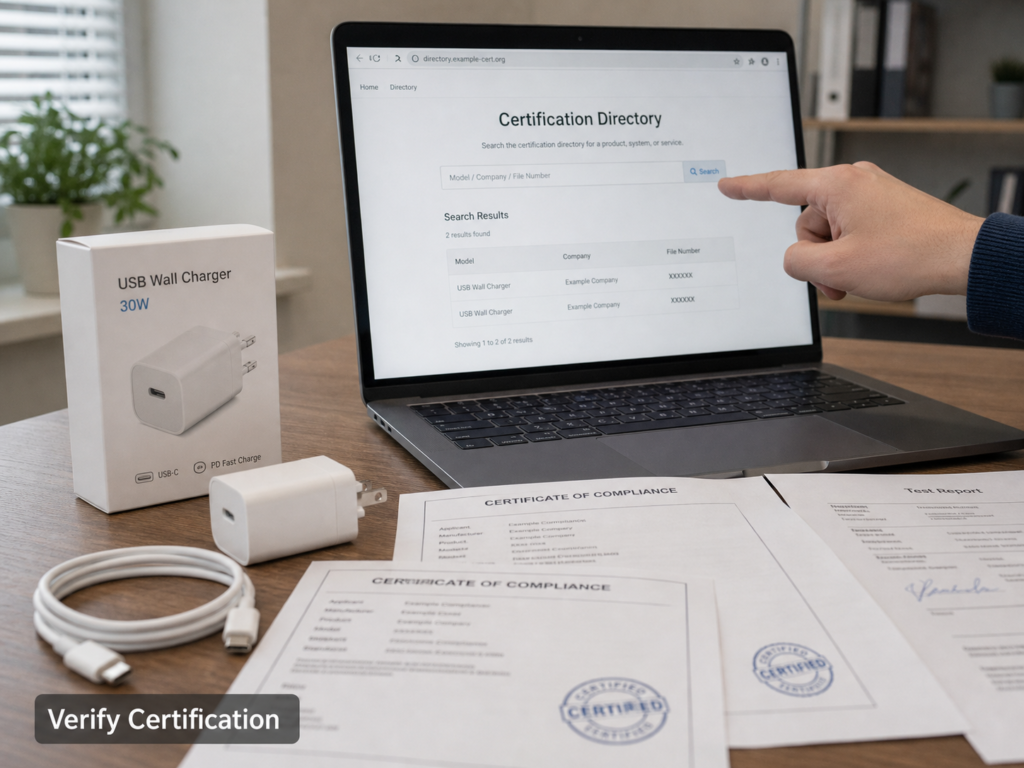
Directly open UL’s Product iQ page or Intertek’s official certification directory, and enter the model, company name, or relevant file information on the product to query. Note that you must check on the official website, and do not click unfamiliar links provided by merchants.
Step 3: Verify the Information
After finding the result, you need to verify three pieces of information: first, whether the product category is correct. For example, if you are checking a charger but the result is a wire, it is definitely wrong; second, whether the model, parameters, and structural scope are consistent with the actual situation of the product; third, whether the certification status and certification scope cover the current product.
Authenticity cannot be judged solely by the appearance of the mark, whether there is a file number starting with E, or a screenshot of a report provided by the merchant.
How to Check Certification Status
The status names of different certification bodies and directories are not completely consistent, and UL Product iQ and Intertek directories cannot be simply summarized as having exactly the same four statuses.
Generally, it can be understood as follows: if the directory shows that the certification is currently valid, you can further verify its product scope and mark usage conditions; if it shows suspended, withdrawn, ceased maintenance, expired, or other non-currently valid statuses, the product cannot continue to be promoted as having valid certification, nor can the corresponding mark continue to be used. If necessary, you should directly confirm the specific status with the certification body, as well as whether it can be restored, re-applied for, or transferred.
Common Counterfeiting/Misuse Situations
There are 4 common counterfeiting methods in practice, so pay special attention when checking:
- Purely forged marks: No certification was applied for at all, and a UL/ETL mark is printed on the product by the seller, with no corresponding record found in the official directory.
- Model misappropriation: Using the certification of a low-power, simple model on a high-power, complex model, for example, using the certification of a 30W charger for a 65W one.
- Component passed off as whole product: Using component recognition of internal components to impersonate whole-product listing certification. For example, if the PCB board inside a charger has UL component recognition, it is claimed that the entire charger has UL certification.
- Reuse of invalid certificates: The certification is no longer currently valid, but the mark is still printed on the product or it is still promoted as having valid certification.
Advanced Decision-Making: Choose UL or ETL for Charging Products?
If you are in sales or procurement of charging products, you will definitely struggle: should you choose UL or ETL? Don’t struggle, just judge according to this 4-step framework:
- Step 1: Confirm the legal requirements of the target market: First find out whether the target market has local regulations, government projects, or certification requirements specially designated by competent authorities.
- Step 2: Confirm the access requirements of sales channels: Large retailers and e-commerce platforms may designate certification bodies, test reports, certification documents, or other compliance materials for specific categories, suppliers, or projects. The current channel’s written requirements shall prevail.
- Step 3: Evaluate budget and launch cycle: Confirm applicable standards, test scope, project scheduling, and quotations with specific certification bodies respectively. Do not presuppose that UL is definitely more expensive and slower, or that ETL is definitely faster and cheaper.
- Step 4: Combine product positioning and target users: Also consider target users’ awareness of the mark, channel preferences, product design complexity, and subsequent maintenance capabilities.
Specifically, you can focus on these situations:
- If you want to enter a specific North American retail channel, you should first check the current written requirements of that channel, instead of defaulting that all large chains require UL;
- If the product is high-end positioned with high premium, and target users are more sensitive to safety and quality marks, you can evaluate whether UL’s brand awareness is helpful;
- If budget and launch time are tight, you can compare the quotations and plans provided by the two bodies for the same product and the same certification scope, and choose the one that better meets the project requirements;
- If the key components of the product have obtained UL component recognition, when their use conditions are met and accepted by the whole-product certification program, some repeated assessments may be reduced. However, whether testing can be simplified, the process shortened, or costs reduced must be confirmed by the certification body.
There are two special situations to note:
- Dual certification: In most cases, there is no need to do both UL and ETL, because whether dual certification is required depends on customer, channel, or project requirements. Dual certification is only considered when different customers specify different marks respectively, or there are indeed other commercial reasons.
- Cross-regional sales: UL/ETL cannot automatically cover the global market. If you also want to sell to Europe, Asia, or other countries, you have to check local certification, regulations, and import requirements country by country, and cannot directly assume they are universally applicable.
Common Misconception Pitfall Avoidance Checklist
Finally, we have compiled several most common misconceptions to help you avoid 90% of the pitfalls:
Cognitive Misconceptions
- ❌ Misconception: ETL is a “copycat UL”, and its validity is not officially recognized
✅ Correct: Both UL and Intertek can provide product certification services within their respective recognition scopes. Whether it is specifically accepted depends on applicable standards, certification scope, mark status, local competent authorities, and customer requirements, and cannot be judged solely by brand name. - ❌ Misconception: UL is definitely safer than ETL
✅ Correct: If the same applicable standards, versions, and certification scope are adopted, the main safety requirements of the two are usually comparable. The actual difference depends on the specific certification program, product scope, factory supervision, and production consistency, and the product safety level cannot be judged solely by the UL or ETL name.
Validity Misconceptions
- ❌ Misconception: Products with UL/ETL marks are definitely absolutely safe
✅ Correct: Certification is based on sample testing and corresponding production supervision or maintenance requirements, aiming to reduce safety risks, not to guarantee that every product is 100% problem-free. Production defects, changes outside the certification scope, and improper use by users may all lead to safety problems. Certification is the bottom line, not an absolute guarantee. - ❌ Misconception: UL/ETL covers all North American regulatory requirements
✅ Correct: UL/ETL mainly solves product safety compliance issues within a specific scope. The North American market may also involve FCC Part 15 equipment authorization, DOE/CEC energy efficiency requirements, and other regulations. It cannot be deemed to comply with all North American regulations solely by UL/ETL. - ❌ Misconception: UL/ETL is globally applicable
✅ Correct: The marks of both mainly correspond to the U.S. or Canadian requirements covered by the certification documents. Whether other countries accept it requires checking local regulations, certification systems, and importer requirements country by country and product by product, and cannot be generalized as all recognized or all not recognized.
Usage Misconceptions
- ❌ Misconception: Certification is valid for life once obtained
✅ Correct: Certification usually comes with continuous supervision or maintenance requirements, and specific fees and cycles are implemented according to the certification program and contract. When products, key components, production locations, or applicable standards change, the certification body should be notified in advance, and it will decide whether document changes, supplementary testing, or re-evaluation are needed. - ❌ Misconception: All models in the same series share one certification
✅ Correct: Certification is only valid within the model series, rated range, structure, components, and use conditions specified in the certification documents. Models of the same series with different powers and different structures cannot be assumed to share the certification by default. It must be confirmed whether they are clearly covered by the certification scope or approved by the certification body. - ❌ Misconception: Having UL/ETL certification means supporting fast charging
✅ Correct: Ordinary electrical safety certification does not automatically prove charging speed, transmission rate, or fast charging protocol compatibility. Fast charging performance depends on product parameters, specific certification scope, and relevant protocol compliance information, and should not be confused.
Final Summary
The core comparison between UL and ETL cannot be simply summarized as “UL is stricter, more expensive, and slower, ETL is faster and cheaper”. Both bodies can provide corresponding product certification based on applicable standards. The actual test scope, supervision plan, cycle, cost, and channel acceptance will all vary with product design, standard version, model range, factory audit, rectification situation, target market, and contract requirements.
After reading this article, you should be able to do three things independently:
First, when buying charging products, you can check the certification mark, manufacturer, model, certification scope, and status in UL Product iQ or Intertek’s official directory, and avoid products with forged, misappropriated, or invalid certification;
Second, if you are in sales or procurement of charging products, you can make a project-based comparison between UL and ETL based on target market, local requirements, sales channels, budget, and product positioning, instead of just listening to the promotion of “which one is more high-end”;
Third, you can distinguish various rumors about UL and ETL online, and will not be misled by statements such as “ETL is useless” or “UL is definitely safer”.
Finally, a reminder: whether it is UL or ETL, it is only part of product safety and compliance, not the whole of quality. When choosing charging products, in addition to looking at the certification, you should also verify the certification scope and status, and try to choose formal channels and well-reputed brands, so as to minimize the risk of use.