
For trading charging products in the UK market, whether via e-commerce platforms or local wholesale, UKCA is an important compliance requirement that must be understood. However, UKCA is not the only market access mark for all products in the GB market. Many newcomers to the industry either overcomplicate it — thinking they have to spend a lot of money to get a certificate issued by an institution — or take it too lightly — thinking they can sell freely with a CE mark. In the end, they either waste money unnecessarily, or panic only when their goods are detained by customs or removed from platforms. This guide will explain UKCA clearly from an importer’s perspective, from basic knowledge to practical implementation, and key points to avoid pitfalls. Even if you are entering the UK market for the first time, you can follow it step by step.
First Things First: What Exactly is UKCA
UKCA stands for UK Conformity Assessed. Simply put, it is one of the UK conformity assessment marks used in the GB market. For applicable product regulations, enterprises can use UKCA in accordance with specific regulations and the UK’s current recognition rules; when conditions are met, CE can also be used. Its function is to indicate that the product meets the requirements of applicable UK product regulations or relevant product regulations recognized by the UK, following the corresponding conformity assessment path.
Here we first correct several most common misconceptions: First, UKCA is not a quality grade certificate. It only means that the product meets the applicable minimum compliance requirements such as safety and environmental protection, and does not represent the quality level; Second, it is not a customs duty payment certificate, and has nothing to do with whether you pay tariffs or how much you pay; Third, it is not a “sticker” that can be bought with money. It requires complete compliance documents to support it, and those who falsify or are non-compliant shall bear legal responsibility.
Many people think UKCA is valid across the whole UK, but that is not the case. Its coverage is only **Great Britain (GB)**, that is, the three regions of England, Scotland and Wales. Due to its special arrangement with the EU, Northern Ireland (NI) applies CE, and in some cases where mandatory third-party assessment is carried out by a UK accredited body, CE+UKNI is also required. This guide mainly focuses on GB.
It should be noted that regulated products sold to GB must comply with the applicable UK product regulations, and use marks such as UKCA or CE recognized by the UK in accordance with applicable rules. Whether a product requires a certain mark depends on the product category, applicable regulations, intended use and sales method; products not governed by specific product regulations may also be subject to requirements such as general product safety. Therefore, it cannot be simply understood as “as long as the product is sold to GB, it must be affixed with UKCA”.
For importers, the importer is one of the important responsible entities in the GB market, but it does not replace the manufacturer’s primary responsibility for manufacturing compliance. Manufacturers are usually responsible for product design, conformity assessment, technical documentation and Declaration of Conformity (DoC); importers must fulfill obligations such as verification, information marking, document retention and corrective measures as stipulated in applicable regulations.
If a product is non-compliant, it may face problems such as delays in customs or market supervision, platform removal, rectification, recall, and fines. On the other hand, if the wrong compliance path is chosen at the beginning, for example, if CE compliance materials could have been reused but a full set of UKCA tests was paid for again, costs are increased unnecessarily; or conversely, thinking that having CE means everything is fine, only to find that it does not meet the UK’s current recognition conditions and delays the launch cycle, are very common losses.
Who Bears the Responsibility: Don’t Confuse Importers and UKRP
After clarifying the basic concept of UKCA, the first question to figure out is: who is responsible for this? Many people’s first reaction is “the factory is responsible, I just sell goods”, but the division of responsibilities in UK regulations usually means that manufacturers, importers, distributors and other responsible entities each bear corresponding obligations, and all responsibilities cannot be simply shifted to one party.
How to Determine Whether You Are an Importer
Generally, enterprises or individuals established in the UK that import products from outside the UK and place them on the GB market are importers, but the specific determination still needs to be based on the applicable product regulations. “First placing on the market” is not a necessary expression for determining importer status in all regulations.
For example, a local UK trader that purchases chargers from China and sells them locally after customs clearance usually bears importer responsibilities; a UK distributor that places orders directly with overseas factories and is responsible for sales after the goods arrive in the UK may also be considered an importer.
Overseas manufacturers cannot be exempted from manufacturer responsibilities just because they do not have a UK entity. A UK entity that actually undertakes import, places products on the market, or sells products under its own name or trademark may constitute an importer or manufacturer. You cannot determine whether an entity is an importer solely based on whether it has a UK online store. For entities such as logistics transit, warehousing and drop-shipping, and platform consignment sales, the determination should also be based on whether they have obtained control of the product, whether they place the product on the market in their own name, and specific regulations, and cannot be generally deemed as having no responsibility at all.
Four Core Obligations of Importers
As an important responsible entity, importers usually need to fulfill the following types of obligations:
First is the **compliance verification obligation** — you cannot sell goods solely relying on a CE certificate provided by the factory. You must verify whether the product complies with applicable UK regulations, whether the conformity assessment is correct, and whether the technical documents and DoC are authentic and complete.
Second is the **information marking obligation** — mark the name of the UK importer and a contactable UK address or single contact point on the product, packaging or permitted accompanying documents in accordance with applicable regulations, and comply with the corresponding transition period. The address of an overseas entity cannot be used to replace the UK importer information.
Third is the **document retention obligation** — keep compliance files as required, and be able to provide them within the specified time limit when required by the regulatory authority.
Fourth is the **problem correction obligation** — if a product is found to be non-compliant, appropriate measures must be taken immediately, such as suspending supply, rectification, withdrawal or recall, and you cannot use “this is the factory’s problem” as an excuse to shirk responsibility.
What is UKRP, and Can It Replace an Importer
Many overseas manufacturers or sellers without a UK entity may have heard of the term “UK Responsible Person” (UKRP). Its full name is UK Responsible Person. Simply put, it is the compliance liaison entity designated by an overseas manufacturer in the UK.
However, whether a UKRP must be designated depends on specific product regulations and sales arrangements. It is not a universal requirement for all charging products in GB to designate a UKRP. When designation is required, the UKRP shall perform the duties stipulated in the corresponding regulations, such as keeping the required documents, providing materials when required by the regulatory authority, and cooperating with market supervision and law enforcement.
Special attention should be paid: UKRP cannot generally replace a manufacturer or importer. The manufacturer still bears corresponding responsibility for product design and manufacturing compliance, and the importer cannot automatically be exempted from its obligations of verification, marking, document retention and corrective measures just because there is a UKRP.
Do You Need It: Judge Whether Your Product Is Within the Scope in 3 Seconds
Next is what everyone cares about most: do the charging products I sell need UKCA? When judging, you cannot only look at whether the product has a chip, nor can you simply classify all charging products into the same category. Instead, you should judge based on the sales region, product definition, input voltage, function, intended use and currently applicable regulations.
These Charging Products Usually Require Key Compliance Attention
First are **mains-powered products** — that is, products that are directly plugged into the wall, such as wall chargers, power adapters, travel chargers, and charging devices with UK standard plugs. These products usually involve requirements such as electrical equipment safety, electromagnetic compatibility, RoHS, and possibly applicable ecodesign requirements.
Second are **electronic products** — even if they are not directly plugged into the mains, but have electronic components, such as car chargers, wireless chargers, fast-charging USB/USB-C cables with E-Marker chips, and docking stations with electronic functions, also need to have applicable regulations verified based on their voltage, function and intended use.
Last are **set products** — for example, when a charger and a cable are sold as a set, you cannot only check the charger; the cable must also be verified separately based on its product definition and function, especially fast-charging cables with chips.
These Situations Cannot Be Simply Deemed as Exempt
Pure passive cables usually do not apply to EMC technical requirements, but they still need to have requirements such as electrical equipment safety, RoHS, general product safety, as well as marking and documentation requirements verified based on product definition and sales method. Whether a cable falls within the scope of a certain electrical equipment regulation depends on the voltage range, product definition and whether it is sold as an independent product. It cannot be determined as fully exempt solely based on “no chip”.
Products for non-commercial sale, such as samples brought in for personal use, and exhibition exhibits temporarily entering the country, may not be subject to some market placement requirements on the premise that they are not used for commercial sale. However, the specific situation still depends on the product’s intended use, import arrangement and applicable regulations.
A special reminder here: even products given as gifts or used to attract traffic cannot be automatically deemed as exempt as long as they are part of a commercial activity. For example, if you buy a charger and get a free fast-charging cable, that cable still needs to have its applicable product regulations and compliance requirements verified.
3-Second Quick Judgment Method
If you are still unsure, you can first use the following three questions for a preliminary judgment:
1. Is the product sold to the GB region?
2. Is it part of commercial sales or commercial promotion?
3. Does the product have electrical or electronic functions, or is it a regulated electrical product or accessory?
These three conditions cannot directly replace regulatory judgment, but as long as regulated products are involved, they should not be treated as ordinary products with no requirements. The safest method is to check the specific product categories and regulations on official government websites such as the UK Department for Business and Trade (DBT), or consult a professional compliance service provider.
Choose the Right Path: Don’t Misuse UKCA, CE, UKNI
After confirming that the product requires compliance, the next step is to choose the path. Many people say “I need to do UKCA” right away, but that is not necessarily the case — the UK currently still recognizes eligible CE products within the scope of some product regulations in the GB market. Choosing the right path can reduce the cost of repeated testing and label redesign.
| Mark | Applicable Region | Standards Basis | Core Responsible Entities | Special Notes |
| UKCA | England, Scotland, Wales (GB) | UK designated standards and UK conformity assessment rules | Manufacturers, importers, UKRP, etc. bear corresponding obligations in accordance with specific regulations | Only applicable to the GB market |
| CE | European Union, Northern Ireland (NI) | EU harmonized standards and EU product regulations | Manufacturers bear primary manufacturing compliance responsibility; EU importers, authorized representatives, etc. bear corresponding obligations in accordance with specific regulations | For the GB market, can be used when meeting the UK’s current recognition conditions |
| UKNI | Only Northern Ireland (NI) | EU product rules | Used when EU regulations apply and mandatory third-party assessment is carried out by a UK accredited body | Must be used together with CE, cannot be affixed alone |
How to Use CE in the GB Market Exactly
For regulations already included in the UK’s CE recognition scope, such as electrical equipment safety, EMC, RoHS, and ecodesign, CE products that meet the conditions stipulated by the UK government can continue to be placed on the GB market. The latest recognition rules should be checked according to specific regulations, and December 31, 2027 should not be regarded as the unified deadline for CE recognition of all charging products.
When using CE to enter GB, it should be confirmed that the product regulation falls within the scope of CE recognized by the UK, and meets the corresponding EU regulations, harmonized standards and conformity assessment requirements. Only when using UKCA is it necessary to check UK designated standards and UK conformity assessment procedures. The UK’s recognition arrangements for different product regulations may vary, so a unified “CE transition period” rule cannot cover all products.
The requirements for conformity assessment bodies for the CE route and the UKCA route should be judged separately according to specific product regulations. If UK regulations clearly require a UK body to participate in UKCA assessment, a UKCA self-declaration cannot be used as a substitute; but this does not mean that all products requiring third-party assessment cannot use CE. The CE route involves notified bodies or other conformity assessment requirements stipulated by EU regulations, and “whether a UK body is required” cannot be simply used as the judgment standard.
Compliance Choices for Different Sales Scenarios
Compliance paths vary for different sales scenarios, so you don’t have to do a full set of UKCA right away:
• If you **only sell to the GB market**, you can first check whether the applicable product regulations fall within the scope of CE recognized by the UK. CE can be used when conditions are met; if CE is not applicable, then adopt UKCA in accordance with specific regulations. For long-term layout, you can also evaluate whether to proactively adopt UKCA to reduce the impact of future rule changes.
• If you **only sell to Northern Ireland**, CE is usually used. If EU regulations require third-party conformity assessment and the assessment is completed by a UK accredited conformity assessment body, then use CE+UKNI; if it is completed by an EU notified body, use CE without UKNI.
• If you **sell to both the EU and GB markets**, you can first judge whether CE meets the applicable conditions of both the EU and GB at the same time. If so, CE may cover both regions; if the GB market requires or wishes to use UKCA, you can additionally adopt UKCA according to specific regulations, but you cannot ignore the CE requirements of the EU market as a result.
Three Most Common Path Misconceptions
Here we correct three more common misconceptions:
First, “UKCA covers the whole UK” — wrong. It is mainly applicable to GB, and Northern Ireland applies CE and CE+UKNI in specific situations.
Second, “With CE you can enter GB” — wrong. It must be confirmed that the product regulation falls within the scope of CE recognized by the UK and meets the recognition conditions stipulated by the UK.
Third, “UKNI can be used alone” — wrong. UKNI must be used together with the CE mark, and is only applicable to the Northern Ireland market, and cannot be used in GB.
Core Requirements: Charging Products Must Pass Four Checks
After choosing the path, it is necessary to implement specific compliance requirements. For charging products, it is usually necessary to focus on verifying electrical safety, EMC, RoHS, and ecodesign or energy efficiency requirements, but which regulations ultimately apply still needs to be judged based on the specific situation of the product.
First Check: Electrical Safety
The core of electrical safety requirements is to prevent risks such as electric shock, overheating, fire, and mechanical injury. For mains chargers and external power adapters that fall within the applicable voltage range and product definition, electrical equipment safety regulations should be verified; for other charging products, applicable regulations should be verified separately based on their voltage, function and intended use.
When verifying, focus on two aspects: first, whether the rated input voltage meets the UK’s mains requirements, and second, whether the plug form meets the applicable UK requirements. The compliance of UK standard plugs cannot be judged solely by appearance. It should also be verified whether the plug meets the applicable BS 1363 requirements, pin insulation, and BS 1362 fuse configuration.
Common fuse ratings are 3A or 13A, and the specific value shall be subject to the product’s rated current and applicable standards. “Having a fuse” cannot be simply taken as a compliance conclusion, nor can 5A be taken as a common example of general UK standard plugs.
Second Check: Electromagnetic Compatibility (EMC)
To put it simply, electromagnetic compatibility is about two things: the product must not generate excessive electromagnetic interference that affects the normal operation of other electrical appliances; at the same time, it must be able to withstand basic electromagnetic interference in the daily environment and not fail easily.
Such requirements usually involve switching power supply chargers, fast-charging cables with chips, wireless chargers, charging devices with smart functions, and car chargers, etc. Pure passive cables usually do not apply to EMC technical requirements, but this does not mean they are automatically exempt from other product regulatory obligations.
The key point of verification is to have EMC conformity evidence corresponding to the actual structure and function of the product. Reports of other structures, other power levels, or other chip solutions cannot be used to make up the numbers.
Third Check: Restriction of Hazardous Substances (RoHS)
The function of RoHS requirements is to restrict the use of hazardous substances such as lead, mercury, and cadmium in products, and reduce the impact of products on the environment and human health. Chargers, cables, connectors, and accessories with electronic components should all have their RoHS applicability verified based on product definition.
When verifying, be sure to ask the supplier to provide a written material conformity declaration, and make a judgment combined with the bill of materials, supply chain information or necessary testing evidence. You cannot just trust verbal promises. Otherwise, if something goes wrong, it will be difficult for the importer to prove that it has fulfilled its reasonable verification obligation.
Fourth Check: Energy Efficiency (ErP)
Energy efficiency requirements mainly focus on the conversion efficiency and standby power consumption of certain energy-related products, with the goal of reducing energy waste. However, UK ecodesign and energy efficiency requirements are determined according to specific product categories and applicable regulations, and not all independently sold chargers automatically apply to the same set of ErP requirements.
Products such as external power adapters may be subject to UK ecodesign regulations and the minimum energy efficiency requirements of the corresponding product category. When verifying, make a judgment combined with the specific product definition, power and applicable regulations, and confirm that the relevant energy efficiency parameters are true and complete. All independent chargers cannot be uniformly classified into the same requirement, nor can performance be falsely labeled.
What Compliance Documents Need to Be Prepared
In addition to the product itself meeting the requirements, complete compliance documents must also be prepared, which is the key focus during regulatory spot checks.
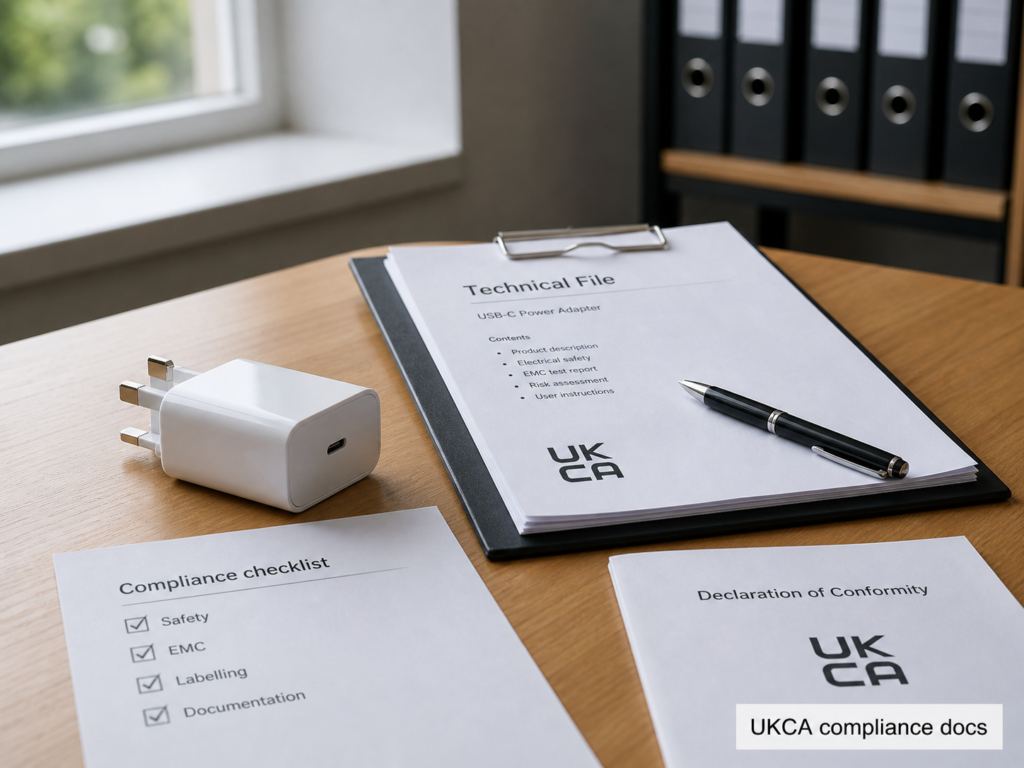
First is the **technical file**, which usually should include:
• Product description;
• List of key components;
• Circuit schematic diagram;
• Test report;
• Risk assessment materials;
• List of applicable UK or EU standards;
• Label draft;
• English instruction manual;
• Supplier and product traceability information.
The technical file does not need to be fancy, but the content must be consistent with the actual product, and be able to explain how the product meets applicable regulations.
Then is the **Declaration of Conformity (DoC)**. Many people think the DoC is a certificate issued by a third-party institution, but in essence it is a compliance commitment letter signed by the manufacturer or other legally responsible entity, and the signatory shall bear legal responsibility for the content on it.
The DoC usually needs to include:
• Product model;
• Information of the manufacturer, importer or other applicable responsible entity;
• Applicable regulations and standard numbers;
• Signatory information;
• Date of signing.
Special attention should be paid here: you cannot directly use the CE DoC to deal with UKCA. According to the chosen path and specific regulations, it should be confirmed that the DoC lists the corresponding UK or EU regulations, standards and conformity assessment information.
Last is the document retention rule. Compliance documents should be kept in accordance with applicable regulations and provided within the time limit required by the competent authority. There is no unified “10 working days” submission deadline applicable to all charging products in relevant UK product regulations, so 10 working days cannot be taken as a fixed rule for all products. The specific retention period and provision period depend on the applicable regulations and the requirements of the regulatory authority.
How to Affix Product and Packaging Markings
After the documents are complete, the markings on the product and packaging must also be correct, which is a part that is often focused on in platform review and market supervision.
For products that require a conformity mark under specific regulations, UKCA or CE should be affixed according to the chosen path. Usually the height of the mark shall not be less than 5 mm, but shall be subject to the special provisions of applicable regulations. The mark should also be clear, legible, and maintain corresponding visibility and durability during the normal use of the product. Marks that are easy to fall off or unrecognizable cannot be used.
Importer information should also be handled in accordance with applicable regulations. Usually, the name of the UK importer and a contactable UK address or single contact point should be marked on the product, packaging or permitted accompanying documents, and the corresponding transition period should be complied with. The address of an overseas entity cannot be used to replace the UK importer information. Whether the specific information is placed on the product, packaging or accompanying documents should be judged according to product regulations.
The product model must also be consistent with the DoC, test report and technical file. It cannot be that the report says model A but the product is printed with model B.
Then are the **exclusive markings for charging products**:
First, input and output parameters, that is, voltage, current and power, must be consistent with actual performance, and cannot be falsely labeled.
Second, electrical safety warnings should be in English, such as “for indoor use only”, etc., and cannot only be in Chinese.
Third, for products with UK standard plugs, it should be verified whether the plug meets applicable UK safety requirements, including pin insulation and fuse configuration. Common fuse ratings are 3A or 13A, and the specific value shall be subject to the product’s rated current and applicable standards, and cannot be generally marked or applied indiscriminately.
If the product is too small to affix complete information on the body, the information can be placed on the packaging or permitted accompanying documents according to applicable regulations, but it must be ensured that consumers can see it clearly when purchasing, and it cannot be hidden in a position that cannot be normally viewed.
Practical Implementation: Complete the Compliance Process in Six Steps
After talking about all the requirements, some people may feel a bit confused. We break the entire process into six steps, from preliminary confirmation to post-launch monitoring. Following them step by step can reduce omissions.
Step 1, **Confirm the scope and responsible entities**. First, judge whether the product is a regulated product, not just based on “whether there is a chip”; then confirm whether you are an importer defined by regulations, and whether there is a manufacturer, UKRP or other responsible entity; finally, clarify whether the sales region is GB or Northern Ireland to avoid using the wrong mark.
Step 2, **Sort out applicable regulations and reuse existing reports**. According to the product’s voltage, function, intended use and structure, sort out applicable safety, EMC, RoHS, ecodesign and other regulations. Pure passive copper cables usually do not apply to EMC, but other potentially applicable requirements still need to be verified.
Car chargers usually do not fall within the voltage range of the mains low-voltage equipment safety regulations, but this does not mean that no safety assessment is required. EMC, RoHS, general product safety and other applicable regulations still need to be verified, and corresponding safety risk assessments must be completed.
Then see if existing CE materials can be reused. Check whether the product regulation falls within the scope of CE recognized by the UK, and whether existing test and conformity assessment materials cover the actual situation of the product. If the UKCA route is chosen, then check UK designated standards and UK conformity assessment procedures.
Step 3, **Prepare compliance documents and declarations**. Organize a complete technical file as required, then draft a DoC that matches the chosen path, and verify whether the regulations, standards and assessment information in it are applicable to the current product. Also confirm that the technical file covers all models to be sold, and don’t miss any SKU.
Step 4, **Select a testing institution (if required)**. Some regulations for many charging products allow manufacturers to self-declare, but whether third-party conformity assessment is required should be judged according to specific regulations, product categories and risks.
If third-party assessment is required, first confirm whether the specific regulation requires self-declaration, assessment by a UK approved body, or assessment by an EU notified body. Whether the testing laboratory needs UKAS accreditation should be judged based on specific regulations, standards, and regulatory or customer requirements. UKAS cannot be taken as the unified statutory threshold for all test reports.
The testing cycle for ordinary charging products is generally 4 to 8 weeks, and the specific time depends on product complexity, test items and the institution’s schedule.
Step 5, **Affix markings and conduct consistency verification**. Affix the UKCA or CE mark and necessary importer information in accordance with applicable regulations and the chosen path.
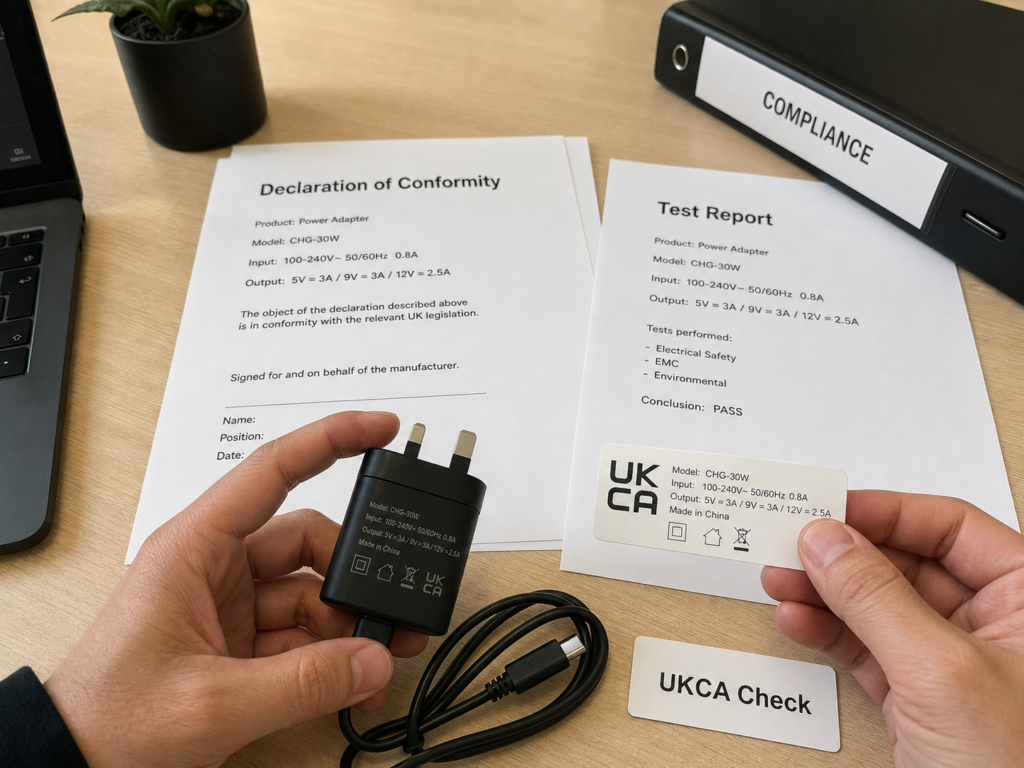
After affixing, be sure to conduct a consistency verification — compare the actual product, label, DoC, and test report together. The model, parameters, and structure must correspond to each other.
Focus on verifying three points: whether the charging power is accurate, whether the plug type meets UK requirements, and whether the chip and conductor specifications of the cable are consistent with the test sample in the documents.
Step 6, **Archive for future reference and post-launch monitoring**. All compliance files should be archived uniformly to ensure that they can be provided within the time limit required by the competent authority. Supplier information and sales channel records for each batch should also be kept for traceability.
After launch, product complaints should be collected regularly, especially safety-related complaints, and it should also be verified whether the supplier has replaced key components. If transformers, chips, plugs or other components that affect safety and EMC are changed, compliance needs to be re-evaluated, and you cannot default that the original test report still covers the changed product.
Common Pitfall Avoidance: Stop Making These Mistakes
The process looks clear, but there are pitfalls everywhere in actual operation, especially for charging products which have many categories and complex parameters, and it is easy to step on a mine if you are not careful. Avoiding these risks in advance can reduce subsequent rectification and recall costs.
Three Most Common Pitfalls on the Procurement Side
The first pitfall is inadequate verification of supplier documents. Many people only ask “Do you have UKCA/CE?” when purchasing, and believe it when the supplier says yes. As a result, the report they get either has the wrong model, incomplete applicable regulations, the testing institution and assessment body do not meet the requirements, or even the report is forged.
The correct approach is to not only ask if they have it, but also verify the product model on the report, applicable regulations, the identity of the testing institution or conformity assessment body, the signing entity, and whether the documents cover the products you actually purchase. In addition, low-priced products without a brand or model have particularly high traceability risks, so try not to purchase them. Otherwise, if something goes wrong, you may not even be able to confirm the responsibility chain.
The second pitfall is the exclusive pitfall of fast charging and cables — this is also the one that charging product sellers step on the most. First of all, remember: power claims, such as 20W, 65W, 100W, are just performance parameters, not compliance conclusions. Marking 65W does not mean it is compliant; there still needs to be technical and test evidence matching the actual product.
Second, fast charging protocols such as USB-C PD and PPS must be consistent with the information in labels, instruction manuals, and test materials. It cannot be that the report says PD 20W but the product detail page promotes PPS 25W. Cables of different lengths, different conductor specifications, and different chips cannot share the same compliance report without assessment.
If it is a set sale of a charger and a cable, you must never promote power that exceeds the cable’s carrying capacity. For example, if the charger is 65W and the cable only supports 20W, you cannot promote the entire set as 65W fast charging, otherwise it may bring both false advertising and product compliance risks at the same time.
The third pitfall is the exclusive pitfall of UK standard plugs. Many people think that a European two-pin plug with a UK adapter can be sold as a UK standard product, which does not meet the requirements — for products directly connected to the mains, the safety of their plug and the whole machine should be verified in accordance with applicable regulations and standards. You cannot rely solely on the adapter to cover up the problem that the plug itself does not meet UK requirements.
For products with UK standard plugs, it is also necessary to focus on verifying whether the pin insulation and fuse configuration meet applicable standards. Common fuse ratings are 3A or 13A, and the specific value shall be subject to the product’s rated current and applicable standards. For products such as multi-port chargers and travel adapters, the compliance of the whole machine must be verified separately. You cannot say that if each port is compliant, the whole machine is automatically compliant.
How to Save Costs Compliantly with Multiple Models
Many sellers have several models of chargers, and to save testing fees, they merge all models into one product family for assessment. This is not inherently impossible, but it is only suitable for assessment by product family when technical documents and test plans can prove that different models have sufficient consistency in structure, key safety characteristics and risks.
Whether they can be merged specifically should be judged based on applicable regulations, relevant standards, product design, key differences and risks. You cannot mechanically require all key components to be exactly the same, nor can you directly share reports just because the appearance is similar.
If a problem with one model reflects a common design or document defect in the product family, regulatory measures may be extended to relevant models, batches or series; however, whether to extend them should be judged based on the investigation results and applicable regulations. It is not that if one model is found to be non-compliant, the entire series is automatically deemed non-compliant.
How to Pass E-commerce Platform Review in One Go
Take Amazon UK as an example, many people have been stuck by compliance reviews. Materials reviewed by the platform generally include DoC, test reports, UKRP or importer information, product label photos, etc. Common reasons for failure include: unclear UKCA or CE mark, non-compliant importer address, test report not covering all sales models, and inconsistency between detail page parameters and information on the DoC.
A special reminder here: passing the platform review does not mean full compliance with regulatory requirements. The platform mainly reviews whether the submitted materials meet its own rules, and market supervision may further check the actual product, test samples, document content and supply chain consistency. Therefore, you cannot have the mentality of “just dealing with the platform is enough”, and you still need to establish a complete, authentic and traceable technical file.
What to Do When Facing Regulatory Spot Checks
Many people are afraid of regulatory spot checks, but in fact, as long as the materials are consistent with the product, there is no need to be overly nervous. Common triggering reasons include consumer complaints, safety risk warnings, random spot checks and platform reports.
If you do encounter a spot check, you can handle it according to the following logic: first confirm the involved model and batch, and suspend the supply of risky products if necessary to avoid the problem from expanding; then retrieve the complete compliance file to confirm whether the problem is missing documents, wrong labels, or the product itself does not meet the requirements; then carry out supplementation, rectification, withdrawal or recall according to the type of problem, and provide feedback as required by the competent authority.
The competent authority may take measures such as stopping supply, rectification, recall, withdrawal, confiscation or destruction according to specific regulations, and may impose penalties. Whether serious or intentional violations involve criminal responsibility shall be judged according to applicable regulations, violation facts and judicial procedures. A certain measure cannot be regarded as the inevitable result of all cases.
These Clauses Must Be Added to Supplier Contracts
Many small sellers only look at price and delivery time when signing contracts, and do not mention compliance at all. When something goes wrong, they can only bear it themselves. It is recommended to clarify the following content in the contract:
First, the supplier must ensure that the product continuously complies with applicable UK regulations;
Second, without written consent, the supplier shall not arbitrarily replace key materials, chips, plugs or production factories;
Third, when the product is changed, the supplier must notify in time and update relevant compliance documents;
Fourth, clarify the cooperation obligations, responsibility division and cost bearing in cases such as regulatory investigations, rectification, and recalls.
Including these contents in the contract can help importers retain the basis for accountability and claims when suppliers change or products have problems.
Full-Stage Self-Checklist
For the convenience of daily verification, we have compiled self-checklists for three stages. Tick off each item after completion to reduce omissions.
Pre-Import Self-Checklist
□ Confirmed that the sales destination is GB, not Northern Ireland or the EU
□ Sorted out applicable regulations based on product definition, input voltage, function and intended use
□ Confirmed whether you are an importer, or whether you need to arrange a responsible entity such as UKRP
□ Verified item by item the regulations applicable to the product, such as safety, EMC, RoHS, ecodesign or general product safety requirements
□ Confirmed whether the current UK government’s CE recognition rules apply to this product
□ If CE is not applicable, determined whether to adopt UKCA and whether a UK approved body is required according to specific regulations
Pre-Launch Self-Checklist
□ For products requiring a conformity mark, a clear UKCA or CE mark has been affixed according to the chosen path
□ The size, visibility and durability of the mark meet the requirements of applicable regulations
□ Marked the name of the UK importer and a contactable UK address or single contact point in accordance with applicable regulations
□ Charging parameters and safety warnings are in English and consistent with actual performance
□ The technical file is complete and covers all sales models
□ The DoC is validly signed, and the listed regulations, standards and conformity assessment path are consistent with the actual product
□ The information of the actual product, label, DoC and test report are fully corresponding
Post-Launch Self-Checklist
□ Compliance files can be provided within the time limit required by the competent authority
□ Complete traceability records of batches, suppliers and sales channels are available
□ Regularly collect product complaints and handle safety risks in a timely manner
□ When the supplier changes key components, compliance has been re-evaluated
□ Pay attention to UK regulation updates and adjust compliance plans in a timely manner
Overall, UKCA compliance is not a fixed set of certifications that all GB charging products must complete separately. What is really important is to figure out several things: “who is responsible, which regulations apply, which conformity mark should be used, whether third-party assessment is required, and whether the documents are consistent with the product”.
For new sellers, first confirm the product scope and sales region, then judge whether CE falls within the UK’s current recognition scope; if CE is not applicable, then determine the UKCA path according to specific regulations, and do not spend a lot of money on a full set of tests at the beginning. For sellers with certain experience, the focus should be on risk control on the procurement side, supplier contract constraints, and post-launch consistency monitoring, to avoid large losses caused by small negligence. As long as a true, complete and traceable compliance chain is established in accordance with applicable regulations, charging products can be sold more stably in the UK market under the premise of cost control.