
Charging product sellers doing cross-border e-commerce in the US and Australia almost always encounter these two compliance requirements: FCC and RCM. Many people think they are both “electromagnetic compatibility certifications”, and even believe that having one allows direct use in the other market. In the end, they either have their goods detained by customs or removed from platforms, falling into significant pitfalls. In fact, these two systems have essential differences in terms of regulatory scope, processes, and liability requirements. Especially for high-frequency regulated products such as chargers, charging cables, and wireless chargers, understanding the differences can both save costs and avoid compliance risks.
Entry-Level Basics: First Figure Out What the Two Systems Really Are
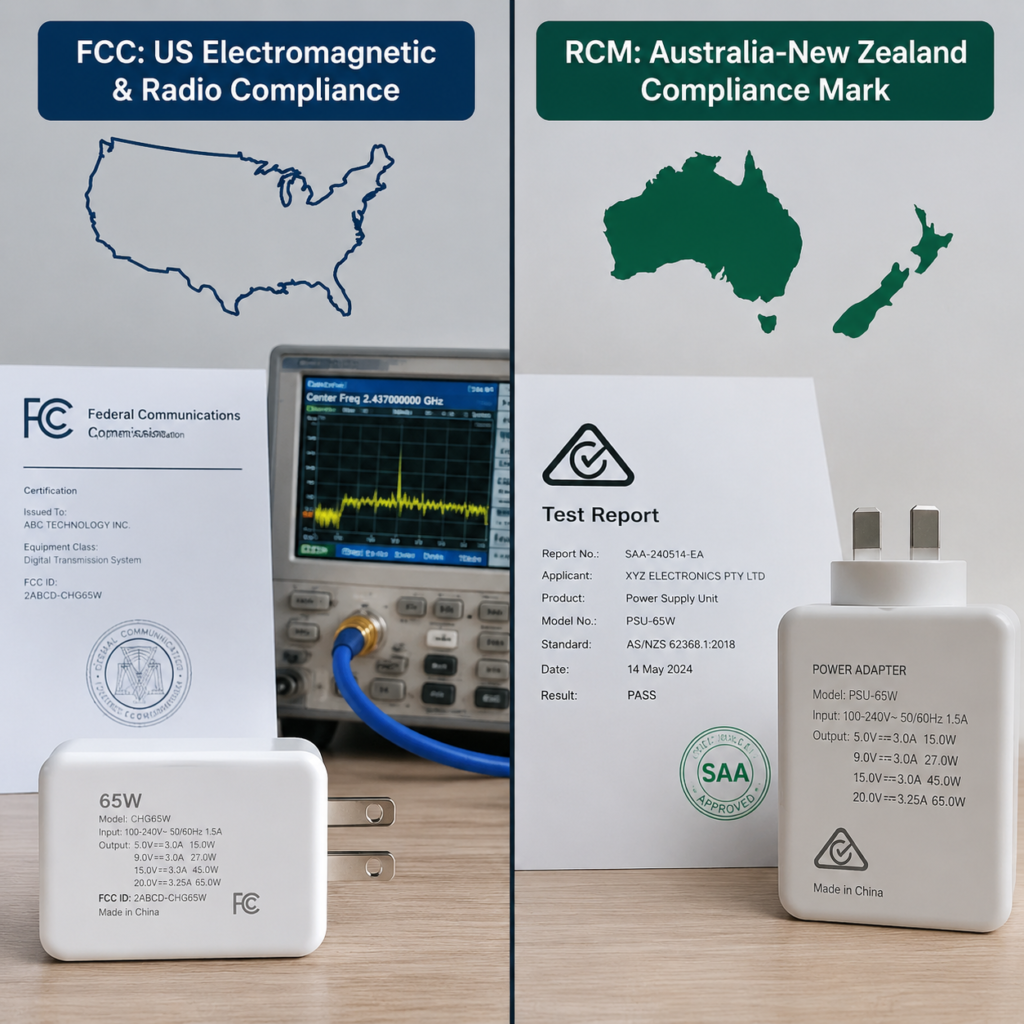
Many people’s first impression of “certification” is “a stamped certificate”, but neither of these two systems is simply a single certificate. Clarify the basic concepts first, so you won’t get confused later.
FCC Compliance System
What we often call “FCC certification” is actually the radio frequency and electromagnetic compliance system established by the Federal Communications Commission of the United States, not a specific fixed certificate. Its core directions include electromagnetic emission control, and wireless emission/radio frequency compliance.
For most unintentional radiators, the FCC mainly regulates conducted emissions and radiated emissions, that is, interference transmitted by the product through power cords or other conductors, and electromagnetic energy radiated by the product into space. Whether there are other test or technical requirements shall be determined according to applicable FCC rules, equipment categories, and specific product structures. It cannot be generally understood that the FCC universally assesses immunity items identical to those in Australia-New Zealand EMC standards.
The FCC has two common compliance paths, corresponding to different types of products:
- SDoC (Supplier’s Declaration of Conformity): Applicable to some unintentional radiation products, such as ordinary wired chargers. No separate government certification is required, but compliant test and technical documentation must be available, and a declaration of conformity, responsible party information, and corresponding label, packaging, or manual content must be prepared for inspection in accordance with FCC rules. SDoC is not just writing a declaration casually; having no test documentation to support it may constitute a violation.
- Certification: Applicable to devices that need to go through the certification procedure, commonly found in products with intentional wireless transmission functions such as Bluetooth and Wi-Fi. After the product completes the corresponding review, it will obtain a unique FCC ID and be entered into the FCC’s official database for public inquiry.
Take the most common example: a 20W wired PD charger without wireless function usually follows the SDoC path under applicable FCC Part 15 rules; a smart wireless charger with Bluetooth usually needs to go through Certification and obtain an FCC ID because it has active wireless transmission. The specific situation shall still be subject to product functions and applicable rules.
A clear boundary must be drawn here: The FCC is mainly responsible for federal requirements related to radio frequency and electromagnetic emissions, and is not responsible for electrical safety. Electrical safety requirements in the US market may be jointly covered by NRTL (third-party certification bodies such as UL and ETL) certification, state electrical codes, product liability laws, and e-commerce platform rules. Do not assume that passing FCC compliance meets all US regulatory requirements.
RCM Compliance Mark
Many people think RCM is an “official certificate” issued by the Australian and New Zealand governments, which is another common misconception. RCM is a compliance mark used in Australia and New Zealand. It can only be legally used for market launch after the product has completed its applicable local compliance obligations. It is not a single certificate issued by the government itself.
RCM does not automatically prove that a product has completed all three types of obligations: EMC, radiocommunications, and electrical safety. A specific product may involve only one of these modules, or two or more modules at the same time, which must be judged separately based on product category, function, and local regulations. Applicable obligations may include:
- Electromagnetic Compatibility (EMC);
- Radiocommunications or wireless transmission;
- Electrical safety.
Australia and New Zealand each apply their own regulations and liability systems. For equipment included in the scope of EESS, the EESS will specify responsible suppliers, equipment classification, and corresponding registration requirements according to the rules; whether equipment registration is required shall be confirmed according to the equipment level and the latest EESS rules. New Zealand also has its own electrical safety management rules, but it cannot be simply understood as being completely unrelated to EESS in all cases.
Non-compliant products entering the Australian and New Zealand markets may face regulatory actions, customs or import-related issues, and e-commerce platforms may also require supplementary materials or take removal measures. Commercial sales cannot automatically be exempted from compliance obligations just by using cross-border direct mail methods.
Why Specifically Compare Charging Products?
The US and Australia are the most mainstream cross-border e-commerce markets in the English-speaking world. Products such as chargers, charging cables, and wireless chargers are high-frequency regulated categories in both regions because they have electronic circuits, many are connected to mains power, or have wireless functions. Many sellers will lay out the US and Australian markets at the same time. If they cannot figure out the differences between the two systems, they will either spend unnecessary money or miss compliance items and fall into pitfalls. It is particularly important to note that FCC and RCM are completely non-interchangeable. If the same product wants to enter both markets, it must complete corresponding compliance separately.
To help everyone quickly build an understanding, we have sorted out the core differences between the two systems in the table below:
| Comparison Dimension | FCC (United States) | RCM (Australia and New Zealand) |
|---|---|---|
| Core Regulatory Modules | Mainly involves electromagnetic emission control and wireless transmission/radio frequency compliance | May involve EMC, electrical safety, and/or radiocommunications, depending on applicable product regulations |
| Compliance Path Classification | SDoC (applicable non-wireless products), Certification (some wireless products, require FCC ID) | Complete corresponding obligations according to applicable regulatory modules, and use the RCM mark after completion |
| Applicable Regions | Mainland US and some US territories | Relevant rules apply to Australia and New Zealand respectively |
| System Nature | Federal compliance system, not a single certificate | Compliance mark, not a single certificate issued by the government |
How to Judge the Applicable Scope? Follow These Steps
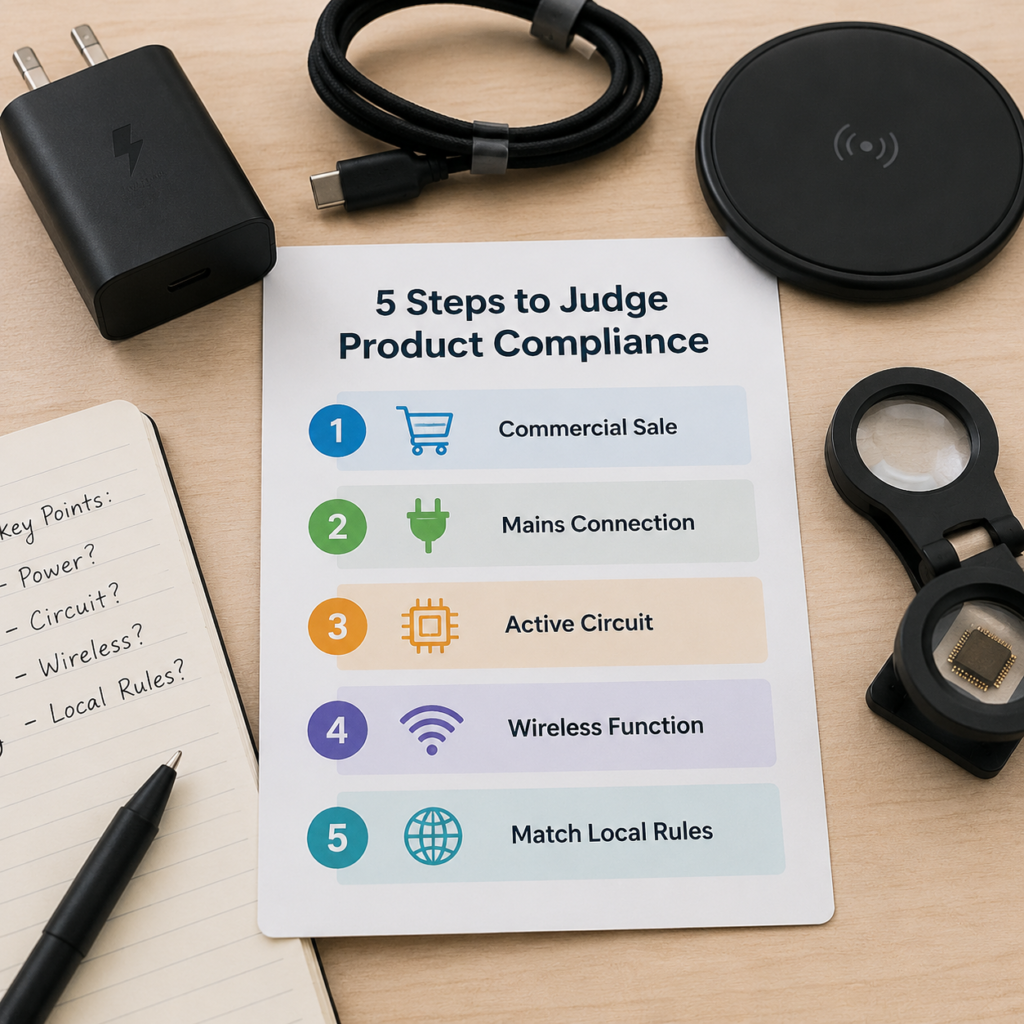
After understanding the basic concepts, what everyone is most concerned about is definitely “Does my product need to do this?”. You don’t have to memorize the rules by rote, just judge step by step logically.
First, clarify the geographical coverage: FCC only applies to the mainland US and some US territories (such as Puerto Rico, Guam); RCM is used for relevant compliance scenarios in Australia and New Zealand, but the regulations, registration, and liability systems of the two places are not completely the same. You cannot assume that all processes in the two countries are completely consistent just because they share the RCM mark.
General Logic for Product Compliance Judgment
No matter what type of charging product it is, you can judge according to these five steps:
- First confirm whether it is sold commercially in the target market — even if it is cross-border direct mail, sending packages directly from China to consumers, as long as it is commercial sales, it falls within the regulatory scope. Do not think that direct mail does not require compliance.
- Check whether the product is connected to mains power, or belongs to local regulated electrical equipment — for example, a wall-mounted charger connected to mains power is a mains product that requires key evaluation; ordinary passive charging cables are not connected to mains power, so other conditions need to be considered.
- Check whether the product has active electronic circuits — for example, those with fast charging chips, LED indicators, and control boards all count as having active circuits; those with pure wires and no electronic components are passive products.
- Check whether the product has intentional wireless transmission or wireless power transmission functions — for example, those with Bluetooth and Wi-Fi are intentional transmitters, and Qi wireless chargers belong to wireless power transmission, both of which require additional evaluation of wireless regulatory requirements.
- Based on the previous judgments, match the regulatory modules and compliance paths of the corresponding country.
Specific Judgment Rules for Different Categories
Wired Charging Products
Mains-connected products such as wall-mounted chargers and power adapters are regulated in both regions, but the regulatory modules and specific regulations are different. On the FCC side, applicable electromagnetic emission requirements usually need to be evaluated; on the RCM side, it is necessary to judge whether electrical safety is involved based on whether the product belongs to local regulated electrical equipment, and at the same time evaluate EMC and other applicable modules.
Ordinary passive charging cables (no chips, no active circuits), such as the most basic USB-A to Micro USB cables, usually do not trigger the FCC’s active EMC requirements, because completely passive products do not actively generate electronic switching activities or wireless emissions.
For charging cables with E-Marker or fast charging chips, you cannot draw a direct conclusion, and need to evaluate in combination with sales form, power supply status, and interface parameters — for example, independently sold high-power USB-C cables with E-Marker may require FCC SDoC because they have active digital circuits; but if they are sold together with chargers and do not have active circuits that work independently, the judgment result may be different.
Wireless-Related Charging Products
Products with intentional transmission modules such as Bluetooth and Wi-Fi must be included in wireless regulation in both regions, without exception.
Qi-type wireless power transmission (wireless chargers) needs to be judged whether to be included in wireless regulation according to operating frequency, power, coupling method, and local rules. Not all wireless chargers can be handled with the same path.
Ordinary wired charging products with no wireless function at all do not need to undergo wireless item evaluation.
Exemption and Boundary Judgment Logic
There is a common exemption scenario in both systems: simple accessories that are completely passive and have no electronic components or circuits, such as pure wire adapters and ordinary charging cables without chips. Such products usually do not involve relevant requirements for active electronic devices. But “usually” does not mean that direct conclusions can be drawn for all sales forms and product combinations, and judgment should still be made in combination with target market rules.
Conversely, as long as a product has active circuits, LED indicators, fast charging protocol chips, wireless transmission, or wireless power transmission functions, it cannot be simply treated as a passive accessory.
A common misconception must be particularly clarified here: the random inspection probability of small packages for personal use is indeed low, but as long as it is commercial sales (including cross-border direct mail), compliance is required. Do not take chances. In addition, compliance requirements are not static. Changes in product power, power supply methods, sales forms, or updates to target market regulations may lead to adjustment of requirements, which require re-evaluation.
Comparison of Core Regulatory Requirements (Based on 20W Single-Port Wired PD Charger)
To make the comparison more intuitive, we uniformly use the most common 20W single-port ordinary wired wall-mounted PD charger (no wireless/smart functions) as the benchmark product, and compare from dimensions such as regulatory modules and technical requirements. If your product has wireless functions, changes in power or ports, modified circuits or plugs, or updated regulations, the conclusions will change. Do not apply them directly.
Overall Regulatory Module Differences (The Most Core)
This is the most essential difference between the two systems:
- FCC (United States): Mainly involves EMC emissions and wireless transmission/radio frequency compliance; electrical safety is not the responsibility of the FCC. Electrical safety in the US is jointly covered by NRTL (UL/ETL, etc.) certification, state regulations, product liability laws, and platform rules. For example, when selling chargers on Amazon US, UL/ETL safety certification may be required in addition to FCC, which is the reason.
- RCM (Australia and New Zealand): It is not a single certification that fixedly covers three types of tests, but indicates that the product has completed its applicable Australia-New Zealand compliance obligations. For different products, applicable obligations may include one or more modules of EMC, electrical safety, and radiocommunications.
Comparison of Electromagnetic Compatibility (EMC) Requirements
EMC standards applicable to Australia and New Zealand may usually include emission and immunity items; however, the FCC mainly specifies conducted emission and radiated emission limits for most Part 15 unintentional radiators, and specific requirements shall be confirmed according to applicable FCC rules and equipment categories. Therefore, it cannot be simply said that the basic items assessed by the two systems are completely consistent, nor can it be generally compared “which is stricter”.
When checking EMC reports, focus on four points: applicable standard number, test environment, sample configuration, and whether data limits meet target market requirements.
If the report complies with IEC basic standards, it can be used as a technical reference for another market, but local difference items need to be supplemented and cannot be directly reused.
Comparison of Electrical Safety Requirements (The Biggest Difference)
This is the part of the two systems that is most likely to confuse beginners:
- FCC side: FCC rules do not involve electrical safety, but this does not mean that chargers sold to the US do not need safety testing — it is just that safety requirements are not under the FCC’s jurisdiction, and sellers still need to meet federal or state safety regulations and platform rules.
- RCM side: Products involving electrical safety must meet applicable electrical safety regulations and technical requirements in Australia or New Zealand, which can usually be proven through applicable AS/NZS standards and recognized conformity evidence. The specific applicable standards and forms of evidence shall be confirmed according to product category, sales country, and local regulations.
The core content of safety assessment includes electric shock protection, pin strength, overheating protection, insulation performance, etc., all of which are directly related to electricity safety. Also note the voltage difference: US mains power is 120V/60Hz, Australia is 230V/50Hz. Wide-voltage products need to be tested according to the nominal voltage of the target market, and the same set of data cannot be directly used universally.
Comparison of Wireless-Related Requirements
Wireless-related requirements are divided into two situations, do not confuse them:
Intentional Radio Transmission (Bluetooth/Wi-Fi, etc.)
The common requirement of both markets is: charging products with such modules must comply with their respective radio frequency specifications, without exception.
The difference lies in: the usage rights and transmission power limits of some wireless frequency bands in the two countries are different, which need to be checked according to corresponding standards, which will also lead to a significant increase in compliance costs and cycles.
Wireless Power Transmission (Qi Wireless Chargers, etc.)
- FCC side: Wireless power transmission equipment needs to be judged whether it belongs to FCC Part 15 or Part 18 according to operating frequency, transmission or coupling method, and applicable rules, and complete equipment authorization according to the corresponding rules. You cannot judge that SDoC is applicable or that no FCC ID is required solely based on low power.
- RCM side: Evaluate whether it is included in regulation according to Australian and New Zealand radio rules, and products with different powers, frequencies, and operating methods have different requirements.
Special attention should be paid: if a wireless charger also has smart functions such as Bluetooth and Wi-Fi, in addition to the evaluation of wireless power transmission, it also needs to additionally meet intentional transmission requirements, and cannot only do one of them.
Comparison of Compliance Processes and Responsible Entities
Many sellers still fail to pass customs or platform reviews after testing. Most of the problems lie in the responsible entity, document content, or product classification not meeting requirements. This part is the key to avoiding pitfalls.
Responsible Entity Requirements (Key to Avoiding Pitfalls)
Each market usually requires a responsible supplier or responsible party that can bear local regulatory responsibilities, accept regulatory contacts, or accept legal service; whether overseas enterprises can act as applicants or suppliers, and whether local agents or importers are required, shall be confirmed according to specific regulations and product categories. It cannot be simply said that overseas sellers cannot be compliance subjects at all.
- US side: SDoC products need to prepare a declaration of conformity and responsible party information in accordance with applicable FCC rules. Foreign applicants for Certification products usually need to designate a US-based agent for service of process and provide relevant information in the FCC application. Applicants and responsible parties must still retain test, application, and compliance documents in accordance with FCC rules.
- Australian side: For equipment included in the scope of EESS, the responsible supplier, equipment level, and whether registration is required need to be determined in accordance with EESS rules; EMC or radio products also need to implement the corresponding responsible party according to applicable regulations.
- New Zealand side: The obligations of manufacturers, importers, or other responsible suppliers need to be determined in accordance with New Zealand’s own regulations. Compliance in the New Zealand market cannot be judged solely based on whether registration has been completed in Australia.
Simply put, a product must have a responsibility arrangement that can bear local regulatory responsibilities, accept regulatory contacts, or accept legal service. The specific form of the subject cannot be summed up in the sentence “all products must be registered by a local company”.
Common FCC Compliance Paths
- SDoC (Supplier’s Declaration of Conformity): Applicable to eligible non-wireless transmission products such as ordinary wired chargers. No separate government certification is required, but a declaration of conformity, test materials, and responsible party information must be prepared, and applicable equipment labeling, packaging, or manual requirements must be met. Again, SDoC is not a random declaration; it must be supported by qualified test materials, otherwise it is a violation.
- Certification: Applicable to intentional wireless transmission products that require certification. A unique FCC ID must be obtained and entered into the FCC’s official database, which is accessible to the public.
Typical RCM Compliance Process
The compliance logic of RCM is “complete all applicable requirements first, then use the mark”, which generally involves four steps:
- Confirm the regulatory modules involved in the product (EMC, electrical safety, radiocommunications) to avoid over-testing or missing tests.
- Complete the corresponding module tests, and the report must meet the standards or technical requirements applicable to the target market.
- Implement corresponding responsible supplier, registration, and document requirements according to Australia, New Zealand, and specific product categories; whether EESS equipment registration is required shall be confirmed according to equipment level and the latest rules.
- Sign the declaration of conformity, and launch the product after using the RCM mark in accordance with current marking specifications.
It must be emphasized again: RCM is not a certificate issued by the government, but a mark that can only be used after completing all applicable compliance obligations. Do not be misled by claims of “guaranteed RCM certification” on the market.
Test Report Reuse Rules (Basis for Cost Reduction)
The answer to the question that dual-market sellers are most concerned about — “can reports be reused” — is yes, but with strict prerequisites:
- Prerequisites for reuse: Product model, hardware version, and core configuration are completely consistent, and the report meets the general requirements of the corresponding standards.
- Reusable content: EMC test data that complies with IEC basic standards and some general safety test items can be used as technical evidence for another market, without the need for full retesting.
- Items that cannot be directly reused: Local administrative registration processes, local responsible entity declarations, local voltage or plug-specific tests, and local differences in wireless frequency bands must be completed separately.
Whether it can be reused in the end and what the reuse ratio is shall be subject to the regulatory requirements of the target market and the laboratory’s evaluation. Do not make judgments on your own.
Marking Requirements and Authenticity Verification
After compliance is completed, how to affix the mark correctly? How to check if other people’s products are really compliant? This part is practical skills.
Differences in Mark Styles
- FCC marks are divided into two categories: Wireless Certification products need to be marked with a unique FCC ID, which is a mandatory requirement. SDoC products usually do not require the printing of the FCC logo, but must provide an FCC compliance declaration and responsible party information in accordance with applicable rules, and meet corresponding label and instruction requirements on the equipment, packaging, or manual. Merely retaining declaration documents cannot replace these information requirements.
- RCM mark: The officially specified triangular mark with a tick should be used, and the requirements for pattern, proportion, minimum size, durability, and placement in current marking specifications must be complied with. Common specifications include a minimum height requirement of no less than 3 mm, and the specific situation shall be subject to the current ACMA or EESS marking guidelines.
Mark Usage Rules
- The position of the FCC label shall be determined according to applicable equipment authorization rules. Eligible devices with a display screen can use the electronic labeling scheme allowed by the FCC; electronic labeling cannot be generalized as a universal option for all very small products. Small devices without a display screen usually still need to use physical labels according to specific rules, or place them on packaging or manuals according to rules when it is not feasible.
- The RCM mark shall be placed in an appropriate position in accordance with current official guidelines, and meet the requirements of pattern, size, clarity, and durability. Whether it can be placed outside the product body shall be confirmed according to product size, structure, and applicable rules.
The common requirement for marks in both systems is: clear, durable, and not easy to wear.
Common Mark Violations
- FCC violations: Forging FCC IDs, wireless products that require Certification only marking the word “FCC” to muddle through, or lacking the required declaration of conformity and responsible party information.
- RCM violations: Forging the RCM mark, having no corresponding responsible supplier or responsibility arrangement, the mark not meeting the officially specified style, proportion, or size requirements.
Authenticity Verification Methods
- FCC wireless products (with FCC ID): You can query the filing information by entering the ID through the FCC’s official database, and check the applicant, product model, and authorization information.
- FCC SDoC products: Usually cannot be directly verified on the official website through a number like FCC ID products. You can require suppliers to provide a declaration of conformity, test report, responsible party information, and materials corresponding to the product model.
- RCM products: On the Australian side, you can query supplier registration and high-risk equipment filings through relevant ACMA channels and the EESS database; for New Zealand, supplier responsibilities and relevant compliance materials should be verified through local regulatory channels.
Compliance Cycle, Cost, and Change Management
This part is the practical issue that sellers are most concerned about. All estimates are common industry ranges without rectification or report reuse, not legal commitments. The specific situation shall be subject to actual conditions.
Cycle Estimation
- FCC (SDoC): 2-4 weeks is a common industry range.
- RCM (including safety + EMC + Australian local responsible entity): 3-6 weeks is a common industry range.
There are many variables that affect the cycle: product power or number of ports, whether it has wireless functions, whether there are reusable reports, number of rectifications, and laboratory scheduling will all make the cycle longer or shorter. If the product also involves EESS classification, equipment registration, or New Zealand local responsibility arrangements, the corresponding processes should also be included in the plan.
Cost Estimation
The general industry rule is: the overall cost of RCM is usually higher than that of FCC SDoC, and the difference mainly comes from additional safety tests, applicable regulation evaluation, and possible registration or responsible supplier fees.
Common scenarios for cost increases: with wireless functions, multi-port high power, multi-model series, no reusable reports, requiring multiple rectifications.
Cost reduction reference: For products that have completed FCC testing and UL safety certification, if the report meets the requirements when switching to RCM, some test costs can be reduced, but it is still necessary to evaluate Australia-New Zealand voltage, plugs, safety standards, responsible entities, and other local differences.
There is no unified official pricing for compliance. When quoting, be sure to confirm these variables: number of product models, power or ports, type of wireless module, plug version, existing report status, and rectification expectations. Do not only look at low prices and end up missing items.
Product Change Management Matrix (Model Change Judgment)
Do you need to redo compliance when the product is remodeled? It is divided into three categories according to risk level:
- Changes that usually do not require retesting: Only when technical evaluation confirms that they do not affect the safety structure, key components, EMC or wireless characteristics, and rated parameters, changes such as changing packaging and modifying non-technical explanatory text usually do not require retesting, but relevant documents and labels should still be updated.
- Changes requiring technical review: Only changing the model name (need to update the association between documents and marks), replacing non-core components (with consistent parameters), and changing the responsible entity.
- Changes with a high probability of requiring retesting or filing: Replacing power chips or wireless modules, increasing rated power, adding ports.
Changing only the appearance cannot be generally considered as not requiring evaluation. If the appearance change affects the housing, heat dissipation, creepage distance, shielding, antenna characteristics, or internal structure, it may affect safety, EMC, or wireless compliance. Changes in appearance, structure, or materials require a change evaluation first.
Also note two easily overlooked situations: when the core hardware remains unchanged but regulations or standards are updated, or when actual production is inconsistent with the filed sample, the effectiveness of compliance also needs to be re-evaluated. Compliance is not a one-time thing that lasts forever.
Compliance Decision Reference for Typical Charging Products
The following are references for common scenarios. The specific situation shall be subject to the actual product parameters and the latest rules of the target market, for everyone to match their own situation:
20W Single-Port Wired Wall-Mounted PD Charger
- United States: Usually evaluate FCC Part 15 Subpart B and follow SDoC; platforms usually require UL/ETL safety certification.
- Australia: Evaluate applicable EMC and electrical safety requirements under RCM, and confirm the responsible supplier, equipment level, and whether equipment registration is required in accordance with EESS rules.
- New Zealand: Implement applicable local responsibility arrangements, and electrical safety complies with applicable New Zealand regulations and technical requirements.
- Factors to be confirmed: whether it is wide voltage, plug form, whether it has additional functions such as LED.
USB-C Fast Charging Cable with E-Marker Chip (Independently Sold)
- United States: Evaluate whether it is a digital device regulated by FCC Part 15, usually follow SDoC; no mandatory FCC safety requirements.
- Australia: Evaluate whether it is a regulated electrical device and whether it triggers EMC requirements. It cannot be judged that RCM is mandatory just because it “has a chip”.
- New Zealand: Evaluate regulatory requirements according to local electrical equipment classification rules.
- Factors to be confirmed: rated power or current, whether it is sold independently, interface circuit design, whether it has additional functions such as LED.
Ordinary Qi Wireless Charger (No Bluetooth/Wi-Fi)
- United States: It is necessary to judge whether it belongs to FCC Part 15 or Part 18 according to operating frequency, transmission or coupling method, and applicable rules, and complete equipment authorization according to the corresponding rules; it cannot be judged that SDoC is applicable or that no FCC ID is required solely based on low power.
- Australia: Evaluate applicable EMC and electrical safety requirements under RCM, and judge whether wireless power transmission is included in radio regulation.
- New Zealand: Evaluate wireless power transmission regulatory requirements according to local radio rules.
- Factors to be confirmed: wireless charging power, operating frequency, coupling method, whether it has additional circuits such as foreign object detection.
Smart Wireless Charging Station with Bluetooth
- United States: With Bluetooth intentional transmission module, usually requires FCC Certification and obtaining an FCC ID.
- Australia: Evaluate applicable EMC, electrical safety, and radiocommunications requirements under RCM, and confirm responsible supplier, equipment level, and registration matters in accordance with EESS rules.
- New Zealand: Implement applicable local responsibility arrangements, and the radio module complies with New Zealand radio frequency requirements.
- Factors to be confirmed: Bluetooth version, transmission power, whether it has Wi-Fi or other wireless functions.
Car Charger (12V/24V Input, Single Port)
- United States: Usually evaluate FCC Part 15 Subpart B and follow SDoC.
- Australia: Evaluate EMC requirements. The applicable safety regulations are different from those for wall-mounted mains products, and exemption cannot be directly judged based on “low voltage”.
- New Zealand: Evaluate regulatory requirements according to local low-voltage electrical equipment rules.
- Factors to be confirmed: input voltage range, output power, whether it has a fast charging chip, whether it has wireless charging function.
Common Misconception Pitfall Avoidance and Capability Summary
Common Misconception Pitfall Avoidance
We have sorted out the 7 most common pitfalls, you can check against them yourself:
- Can you directly convert to RCM if you have FCC compliance? No. RCM requirements depend on the applicable Australia-New Zealand compliance modules of the product. General test data can only be used as a reference and cannot be directly converted.
- All charging cables do not require certification / charging cables with chips must be certified? Both are wrong. Whether compliance is required depends on whether there is an active circuit and whether it is a regulated device. You cannot draw a conclusion just by looking at “whether there is a chip”.
- Is RCM an official certificate uniformly issued by the Australian and New Zealand governments? No. RCM is a mark that can be used after completing applicable compliance obligations, not a single certificate issued by the government.
- Is compliance valid for life after completion? No. Product remodeling, core component changes, and regulation or standard updates all require re-evaluation of effectiveness.
- Can you enter the US market if you meet the minimum FCC requirements? No. FCC is only federal radio frequency or EMC emission requirements, and there are other requirements such as safety, state regulations, and platform rules.
- Small cross-border direct mail packages do not need compliance at all? No. Commercial sales (including cross-border direct mail) are still subject to regulations, only the random inspection probability for personal use is low.
- All wireless chargers require an FCC ID? No. Ordinary Qi wireless chargers need to be judged according to frequency, coupling method, and applicable rules. You cannot determine whether an FCC ID or SDoC is required solely based on low power.
Optimal Compliance Path for US-Australia Dual Markets (Cost Reduction Decision)
If you are laying out both markets at the same time, a common cost-saving path is: first complete FCC compliance and UL/ETL safety certification → organize test reports that comply with IEC or international standards → evaluate RCM and local Australia-New Zealand requirements.
The cost reduction logic is: reuse general test items to reduce repeated test costs. It should be noted that plugs, packaging, manuals, and model marks for different markets need to be separated and cannot be mixed; the final reuse ratio is subject to laboratory evaluation.
Compliance Document Verification Checklist (For Self-Inspection)
After getting the supplier’s compliance materials, you can quickly verify according to these points:
- FCC side: Applicable rule parts (Part 15/18, etc.), test report (including standard number, sample information), declaration of conformity, responsible party or applicant information.
- RCM side: List of applicable Australia-New Zealand regulations and AS/NZS standards, EMC/safety/radio test reports, declaration of conformity, responsible supplier, and applicable registration materials.
- General points: Laboratory qualification, consistency between product model and sample, current validity of standard version, whether label and manual information are consistent with compliance documents.
After reading this article, you should be able to independently judge whether your charging products (chargers, charging cables, wireless chargers, car chargers) require FCC or RCM compliance, master the core differences between the two systems, choose a more cost-effective dual-market compliance path, and also be able to identify mark compliance, verify compliance materials, and judge whether re-evaluation is needed after product remodeling — these are all essential compliance capabilities for cross-border charging product sellers operating in the US and Australian markets.