
If you are in the business of selling chargers and power adapters in the US market, you have most likely heard of terms like “Level VI Energy Efficiency” and “DOE Certification”. However, many people run into pitfalls when they first encounter these requirements: they think sticking a Level VI label means compliance, that having UL/FCC certification means they don’t need to worry about DOE, or that low-power chargers don’t need to comply. In the end, their products are either removed from platforms, inspected by customs, or even face enforcement risks. To make the content easier to understand, we will use three common products as recurring examples throughout this guide:
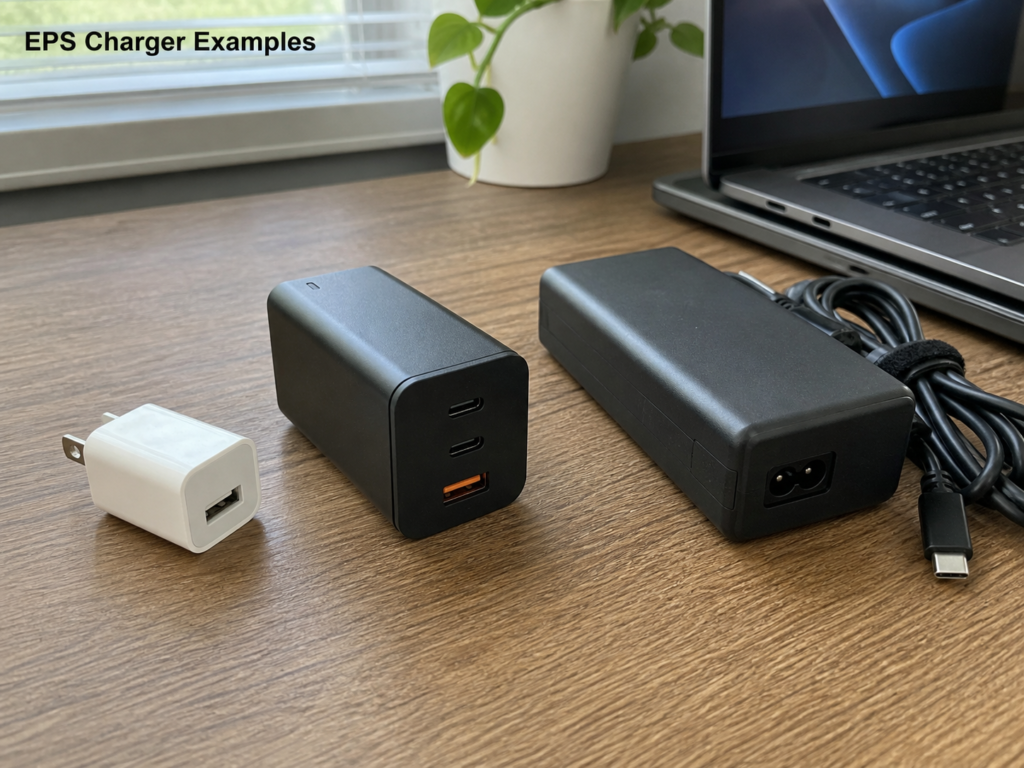
1. Case 1: 5W USB-A mobile phone charger (may be classified as an indirectly operated EPS, subject to judgment based on the specific regulatory version)
2. Case 2: 65W 2C1A USB-C PD multi-port charger (a typical multi-port fast charger)
3. Case 3: 120W laptop power adapter (a typical directly operated EPS, which can power devices without being connected to a battery)
I. First, Understand: What Exactly Are DOE Energy Efficiency Regulations?
The external power supply energy efficiency requirements issued by the U.S. Department of Energy (DOE) are mandatory access rules at the U.S. federal level. Their core purpose is to reduce standby power waste of power supplies and lower electricity costs for the whole society. The industry’s common term “Level VI Energy Efficiency” is a common alias for this set of rules.
Core Regulatory Framework
The formal regulations consist of three parts, corresponding to different requirements:
• **10 CFR Part 430**: Part 430 of Title 10 of the Code of Federal Regulations of the United States, which specifies the minimum energy efficiency limits for external power supplies, i.e., “what standards must be met”;
• **10 CFR Part 429**: Specifies the obligations for compliance submission and recordkeeping, i.e., “how to report and what materials to keep”;
• **10 CFR Part 430 Appendix Z**: The statutory test procedure, i.e., “what steps must be followed for testing, and testing cannot be done arbitrarily”.
Here we must clarify one of the most easily misunderstood points: **The DOE generally does not issue official certification certificates for EPS similar to UL certificates, but this does not mean that submitting to CCMS once fulfills all obligations.** The responsible party must still submit a Certification Report in accordance with 10 CFR Part 429, and retain test, certification, and supporting records as required. A CCMS submission confirmation only proves that the submission was made; it does not prove that the DOE has approved it, nor can it replace test data, product classification, and basic model coverage requirements.
The U.S. federal government previously established energy efficiency requirements for external power supplies. 2016 mainly corresponds to the application of Level VI requirements to the manufacturing dates of relevant products, not the year when the U.S. federal government first implemented energy efficiency regulation of external power supplies. Products should be verified in combination with the manufacturing date, applicable regulatory version, effective date, and compliance date; if there are subsequent revisions, they shall be implemented in accordance with the new effective time and applicable transition rules.
Key Basic Terms You Must Understand
Readers who are encountering this for the first time can first memorize these core concepts, which will be used later:
• **External Power Supply (EPS)**: Commonly known as chargers and power adapters, they have an independent enclosure, with one end connected to mains power (alternating current, AC) and the other end outputting low-voltage power (direct current, DC, or AC that meets the definition) to power or charge devices;
• **Active Mode**: The “specified load” state defined by statutory testing, which is not equivalent to daily actual usage scenarios, and is the basis for calculating average efficiency;
• **No-Load Mode**: The standby state where the input is energized and the output end has no effective load, i.e., the state of being plugged into the wall but not connected to a device, which is a key power consumption scenario regulated by the DOE;
• **Basic Model**: Does not simply refer to products with “the same appearance” or “the same series”, but requires judgment based on regulations as to whether the products have the same energy source, and the same or equivalent electrical, physical, and functional characteristics that affect energy consumption or efficiency. When components, firmware, ports, or enclosures change, an impact assessment should be conducted, and shared test data cannot be directly determined solely based on “complete consistency” or “same series”;
• **CCMS (Compliance Certification Management System)**: The DOE’s official system for submitting and maintaining compliance information. The responsible party needs to submit the certification information required by regulations and continuously maintain relevant records; it is not a one-time submission.
Three Common Regulatory Scenarios
DOE energy efficiency regulation is not limited to a single link, and mainly covers three scenarios:
1. **DOE Enforcement**: Random market spot checks and compliance information verification; non-compliance found will be handled in accordance with regulations;
2. **Import Link**: Customs will cooperate in verification, but this is not a statutory pre-approval, nor is every batch inspected; passing customs does not mean that the product is necessarily compliant;
3. **Platform Review**: E-commerce platforms such as Amazon and Walmart may require merchants to submit compliance materials; specific requirements are subject to the platform’s current category policies.
Differences from Other U.S. Compliance Requirements
Many beginners tend to confuse DOE with other certifications. In fact, they have different regulatory directions, and none can replace the other:
| Compliance Item | Regulatory Direction | Mandatory or Not | Can It Replace DOE? |
| FCC | Electromagnetic Compatibility (EMC/EMI) | Mandatory | No, the regulatory direction is completely different |
| UL/ETL | Electrical safety standards and NRTL certification | Whether it is mandatory depends on applicable federal, state/local regulations, place of use, product category, platform or buyer requirements | Cannot replace DOE energy efficiency obligations |
| ENERGY STAR | High energy efficiency grade certification | Voluntary | No, it is a voluntary requirement higher than DOE, and cannot replace the mandatory minimum standard |
| California CEC | State-level energy efficiency requirements | Mandatory (only applicable in California) | No, federal requirements are the nationwide foundation, and state-level requirements require separate compliance |
II. First Step of Judgment: Does Your Product Need to Comply with DOE Requirements?
Many people immediately ask “Does my charger need DOE compliance?” In fact, you just need to verify step by step according to the statutory process, no need to guess.
Three-Step Statutory Applicability Verification Method
In accordance with the provisions of 10 CFR Part 430, to determine whether a product falls within the jurisdiction of DOE EPS, you must follow three steps in order; only if all are met do the corresponding energy efficiency requirements need to be satisfied:
1. **Step 1: Confirm the product manufacturing date**, match it with the corresponding effective version of the regulations; not all products are judged based on the current latest version;
2. **Step 2: Verify the statutory definition of EPS**, the following conditions should be confirmed item by item:
• Structure: Has an independent enclosure, is not a power supply built into the device, nor is it a bare-board power supply;
• Input and output: Input is mains AC, output is low-voltage DC or AC that meets the definition;
• Output type: Whether single-voltage or multi-voltage output meets the applicable definition;
• Power: Rated output power is an important screening condition, but cannot alone determine whether it is subject to jurisdiction;
• Operation type: Meets the statutory definition of directly operated or indirectly operated EPS;
• Intended use and product category: Verify whether it falls within the applicable scope or exclusion categories in combination with the specific use;
3. **Step 3: Verify exclusions**, confirm that the product is not a statutorily exempt product.
Ultimately, a conclusion cannot be drawn solely based on the conditions of “independent enclosure + USB port + no more than 250W”. Instead, you should compare item by item with the EPS definition in 10 CFR 430.2 and the scope of application and exclusions in 10 CFR 430.32(w).
How to Judge Exempt and Boundary Products
Some products are clearly not subject to EPS jurisdiction, and some require separate verification; do not make a sweeping generalization:
• **Products clearly not subject to jurisdiction**: Built-in power supplies, bare-board power supplies (no independent enclosure, do not meet the EPS definition); power bank itself (belongs to energy storage products, not regulated by EPS, but the wall adapter included with it or sold separately needs to be judged separately).
• **Boundary products that require separate judgment**:
• External power supplies with output power >250W: The ordinary EPS Level VI rules do not apply, and other DOE equipment standards need to be verified;
• Medical, industrial, and security power supplies: Exemption conditions and end use need to be verified item by item; some may be exempt;
• AC-AC output transformers: Need to be judged whether they are subject to regulation based on output specifications and use;
• Devices with battery charging function: According to the definition of the final product, determine whether EPS rules or battery charger rules take precedence.
Charging Products That Are Easily Misjudged
Combined with our three cases, special attention should be paid to several high-frequency judgment errors:
• Multi-port fast chargers (Case 2): **Based on the product’s true and consistent nameplate rated output power, design configuration, and actual operating capability, the power of a single port cannot be split and calculated separately**. For example, a 65W 2C1A charger should be judged in combination with its total output configuration, not just based on the power of a single port;
• Adapters with replaceable plugs: As long as they meet the EPS definition, they may be subject to regulation, which has no direct relationship with the plug type or whether the plug is replaceable;
• Low-power chargers (Case 1, 5W): Low-power products may also be subject to DOE requirements, but the power boundaries specified in regulations, EPS definition, and exclusions should be verified; it cannot be generally asserted that all low-power products are applicable;
• Laptop power adapters (Case 3, 120W): If they are classified as directly operated EPS, they need to meet both core indicators of average efficiency and no-load power consumption.
One-Minute Preliminary Screening Card (For Prediction Only)
If you just want a quick prediction, you can first check three conditions:
1. It is an independent wall-plug/desktop AC to low-voltage power supply (including DC or AC that meets requirements);
2. The nameplate rated output power does not exceed 250W;
3. The product’s use, output structure, and category do not fall within the known exemption scope.
Meeting all conditions is only a preliminary screening; ultimately, the statutory verification process must be followed to avoid misjudgment of boundary products. The USB-A or USB-C port itself is neither a sufficient condition for inclusion in jurisdiction nor an exclusion condition.
III. Level VI Energy Efficiency Requirements: What Exactly Needs to Be Tested and What Standards Must Be Met?
Many people think that Level VI energy efficiency is just “sticking a label”, but in fact, the core is two hard indicators, plus strict testing rules.
Two Core Assessment Indicators
The core assessment of DOE energy efficiency usually includes two indicators, both measured under statutory test conditions:
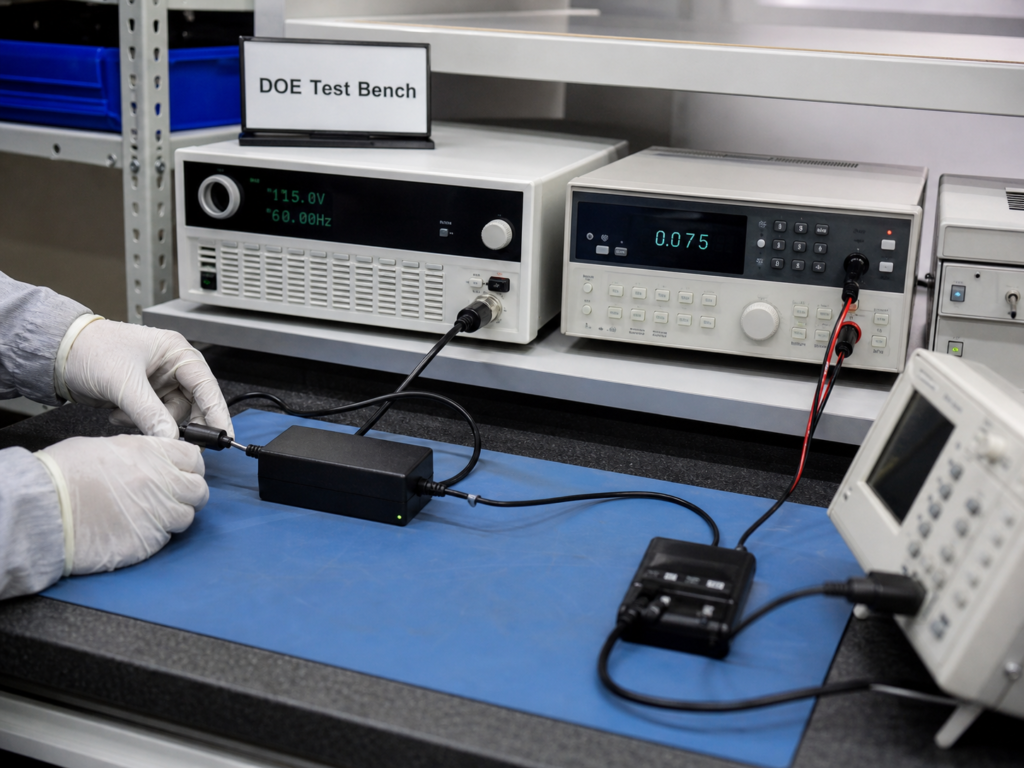
• **Average Efficiency**: The ratio of electric energy utilization in active mode, calculated as the average value at several load points specified by statute, not just based on full-load efficiency;
• **No-Load Power Consumption**: The standby power consumption in no-load mode, i.e., the power consumed when plugged into the wall but not in use, which is a key power consumption scenario regulated by the DOE.
DOE EPS statutory testing is usually conducted with **115V, 60Hz input**; specific tolerances and test conditions are implemented in accordance with 10 CFR Part 430 Appendix Z. Data obtained from testing at 220V/50Hz cannot directly replace the statutory test data specified by the U.S. DOE.
How to Check the Limits
Energy efficiency limits are not fixed numbers; they are calculated according to official formulas or segmented tables corresponding to the product’s rated output power and product type (direct/indirect operation), and must also comply with statutory rounding rules.
• **Official Query Path**: Subject to the latest version of 10 CFR 430.32 on the eCFR (Electronic Code of Federal Regulations), do not casually trust old tables found online;
• Two introductory examples (for reference only, not for product release): If the 5W product in Case 1 is verified to be an applicable indirectly operated EPS, it should correspond to the average efficiency and no-load power consumption requirements of the corresponding power segment; the 120W directly operated EPS in Case 3 corresponds to the requirements of another power segment, with limits different from those of indirect operation.
Limits will vary with product type, regulatory version, and test procedures; ultimately, they must be subject to the latest official text.
How to Judge Product Categories
To determine which type of limit applies to a product, **it must be based on the statutory definition, not marketing names**. The corresponding rules for five common types of products are as follows:
1. **Directly Operated EPS** (such as the 120W laptop adapter in Case 3): Can drive the main function of the device without being connected to a battery, and is subject to direct operation type limits;
2. **Indirectly Operated EPS** (such as the 5W charger in Case 1 and the 65W multi-port charger in Case 2): The main use is to charge batteries, and is subject to indirect operation type limits, but still needs to be judged in combination with specific statutory definitions and scope of application;
3. **Independent Battery Chargers**: Subject to separate battery charger energy efficiency regulations, not EPS rules;
4. **Power Bank Body with Built-in Battery**: Not subject to EPS jurisdiction, other applicable rules need to be verified;
5. **AC Adapter Included with Power Bank**: Jurisdiction is judged separately according to EPS.
Mandatory Requirements for Statutory Testing
Testing must strictly follow the procedures of 10 CFR Part 430 Appendix Z, and several key points should be noted:
• Rated power should be determined in combination with the product’s true and consistent nameplate rated output power, design configuration, and actual operating capability, and in accordance with the statutory definition; conclusions cannot be drawn solely by referring to promotional parameters;
• **USB-C/PD multi-port products (such as Case 2)**: Fixed output power levels (PDO), maximum single-port power, total power, and dynamic derating rules must be clarified. Multi-port products must be tested in accordance with the test points and configurations specified in the current Appendix Z for their output voltage, number of ports, maximum output power, and available configurations;
• All user combinations not required by regulations can be used as enterprise extended testing, but “representative testing” cannot replace the configurations explicitly required by Appendix Z;
• Basic model coverage requirements: In accordance with the statutory definition of basic model, verify whether the product has the same or equivalent electrical, physical, and functional characteristics that affect energy consumption or efficiency. When the main controller, transformer, power devices, firmware, ports, or enclosure change, it cannot be judged that test data can be shared solely based on “same series” or “same component name”.
Procurement Side Extended Testing Recommendations (Non-statutory, for Risk Control)
Statutory testing is the minimum requirement. If you are running your own brand and want to reduce risks, you can additionally test these items:
• All PD voltage levels and multi-port full-combination load scenarios;
• Extreme usage scenarios such as low load and abnormal derating;
• Efficiency performance under 110V~130V input fluctuations (U.S. mains power actually has fluctuations, and statutory testing is usually conducted under 115V/60Hz conditions).
Notes on Standard Updates
DOE rule revisions follow a fixed process: proposed rule → public comment → final rule → effective date → compliance deadline, and each stage has different legal effect.
The commonly mentioned “Level VII” in the industry is usually just an informal term for potentially stricter requirements, and does not mean that a unified official DOE standard already exists. Before a final rule is issued and the corresponding effective and compliance dates are reached, Level VII cannot be used as a basis for mandatory compliance. Enterprises that export for a long time can pay attention to updates on the DOE official website, Federal Register, and official eCFR text, and leave some margin in product design to avoid the need for board redesign after rule changes.
IV. Full Compliance Process: What Needs to Be Done from Product Development to Market Launch
After clarifying the requirements, compliance implementation must follow steps, and the responsible party must also be clarified.
Who Is the Responsible Party?
Different roles bear different responsibilities, so don’t confuse them:
• **Manufacturers and private labelers as defined by the rules**: Usually the main responsible parties for submitting DOE certification reports, and shall bear corresponding obligations according to their legal identity and product arrangements;
• **Overseas manufacturers, U.S. importers, and brand owners**: Shall determine their obligations for certification, recordkeeping, and cooperation in verification according to their specific legal identities in product manufacturing, private labeling, import, and sales;
• **Distributors/cross-border sellers**: Must ensure that the products they sell are compliant, and bear corresponding supply chain and sales responsibilities according to the sales model.
If a third party is entrusted to submit, a formal entrustment agreement must be signed, but entrusted submission does not automatically transfer statutory liability; the responsible party is still responsible for the certification information, test data, and product consistency.
5-Step Compliance Process (From Product to Market Launch)
1. **Step 1: Scope Confirmation**: First confirm whether the product falls within the DOE EPS regulatory scope, and match it with the corresponding version of the regulations;
2. **Step 2: Arrange Testing**: Test according to the statutory test procedure. The DOE does not mandate designated third-party laboratories; capable laboratories or manufacturers can conduct testing, but the responsible party is responsible for the authenticity of the data and compliance with procedures;
3. **Step 3: Submit Certification Report**: Based on the test results, the responsible party shall submit the Certification Report required by the DOE, and organize and retain test and certification supporting records;
4. **Step 4: System Reporting**: The responsible party submits certification information in the CCMS system and retains the submission confirmation. The submission confirmation only proves the submission act, is not DOE approval, and cannot replace product classification, test data, and basic model coverage requirements;
5. **Step 5: Retain Documents**: Retain test, certification, and supporting documents as required by regulations, and continuously update them to respond to spot checks.
Compliance Document Package Checklist
Documents can be divided into two categories: statutory core materials and procurement risk control supplementary materials:
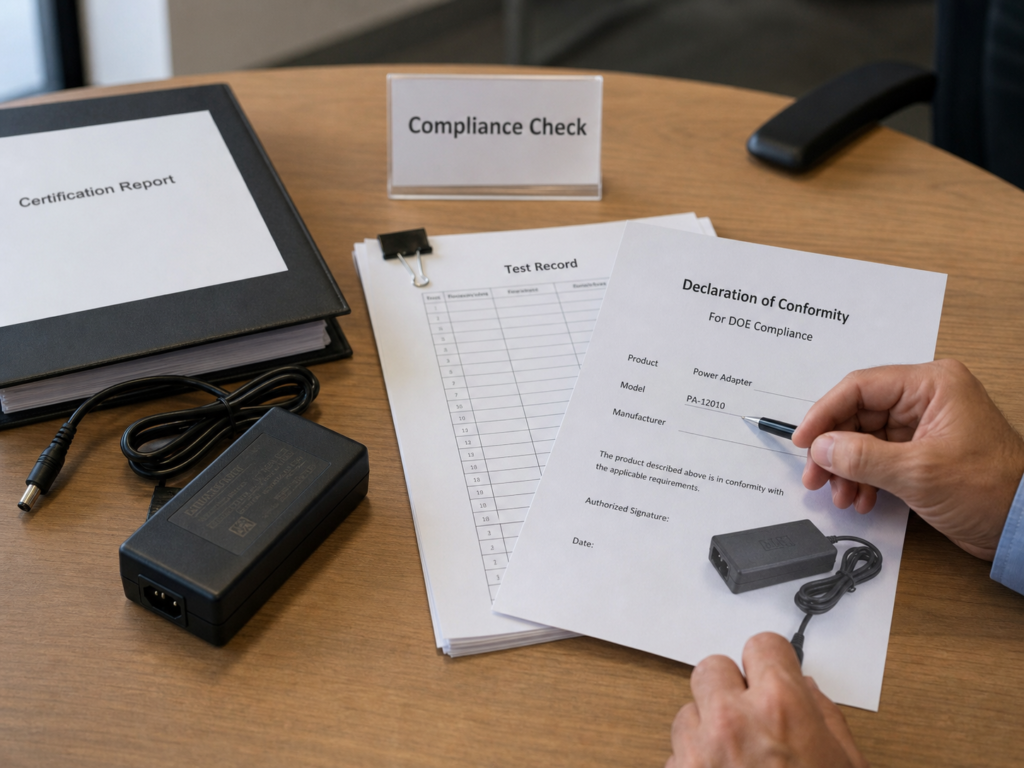
• **Statutory Core Materials**: Certification Report, test records formed in accordance with Appendix Z, as well as test, certification, and supporting records required to be retained by regulations;
• **Supporting or Procurement Risk Control Documents**: Product specifications, nameplate/label photos, basic model coverage description, Declaration of Conformity (DoC), CCMS submission confirmation, product change evaluation/test records (if any);
• **Procurement Risk Control Supplementary Documents**: Test laboratory capability certificate (including EPS energy efficiency test scope), core BOM list (main control chip, transformer, firmware version).
Product specifications, nameplate photos, and DoC help prove that the actual product is consistent with the certified model, but cannot replace the Certification Report, test records, and other statutory retention materials required by the DOE. Whether a separate DoC needs to be issued also depends on the responsible party, platform, or procurement requirements.
How to Verify Authenticity: Product-Report-CCMS Matching Matrix
Many people don’t know if the report corresponds to their own product when they get it. They can verify it using the following dimensions:
| Matching Dimension | Verification Content | Consequence of Inconsistency |
| Subject Information | Manufacturer, brand, basic model | The document may not correspond to the product, and the responsible party and coverage scope need to be reconfirmed |
| Product Parameters | Rated output power, input range, output levels, port configuration, plug version | The actual product parameters are inconsistent with the certification information, posing compliance risks |
| Core Characteristics | Characteristics that affect energy consumption or efficiency, such as main control chip, transformer, power strategy, firmware version, etc. | Basic model coverage cannot be confirmed solely based on the same series or same name |
Note: Products of the same series cannot automatically share reports; the coverage scope must be verified based on the basic model definition. For example, 65W and 45W chargers with the same enclosure cannot share test data solely based on the same appearance if their electrical or functional characteristics that affect energy efficiency are different.
How to Judge the Validity of Compliance Documents
• **Statutory Mandatory Verification Content**: Whether the regulatory version corresponds to the product manufacturing date; whether the product type, rated output power definition, and basic model are correct; whether the testing complies with Appendix Z; whether the test input is 115V/60Hz; whether all applicable test conditions, load points, and configurations specified in Appendix Z are covered; whether the test sample is representative and consistent with the certified model;
• **Result Verification**: Compare the average efficiency and no-load power consumption with the limits of the corresponding product type, power segment, and regulatory version respectively, and confirm that the relevant rounding rules have been correctly applied;
• **Recommended Requirements for Procurement Risk Control**: The testing party has relevant capabilities for EPS energy efficiency testing, and the test report includes complete original data and equipment calibration records.
Reminder again: The capability of the testing laboratory is not equivalent to official DOE recognition. The DOE does not mandate designated third-party laboratories, but testing procedures, data authenticity, product classification, and recordkeeping must still comply with the rules.
Official Regulation Verification Portals
When checking regulations and policies, you must use official channels, and do not trust second-hand information online:
• eCFR 10 CFR Part 430/429: Official text of federal regulations;
• DOE Appliance and Equipment Standards official website: Latest policies and test procedures;
• DOE CCMS system: Compliance submission and query portal;
• Federal Register: Regulation revision announcements;
• California CEC official website: Query for the scope of application of state-level requirements.
When verifying, you must pay attention to the corresponding relationship between the regulation effective date, product manufacturing date, and compliance date, and subject to the latest official text.
Common Process Pitfalls
These are the most common mistakes beginners make, and they must be avoided:
1. Non-standard testing: Using 220V/50Hz data to replace the 115V/60Hz test conditions required by the DOE;
2. Incomplete coverage: Only testing full-load efficiency, omitting no-load and other applicable load points or configurations specified in Appendix Z;
3. Changes not updated: No re-evaluation, re-testing, or update of certification information after product modification;
4. Missing records: Not retaining a full set of test, certification, and supporting documents, which cannot be provided during spot checks;
5. Subject mismatch: The relationship between the reporting subject and the actual manufacturer, private labeler, or other responsible parties is unclear, and no entrustment agreement is retained.
V. How to Control Risks on the Procurement Side: From Authenticity Verification to Change Management
For cross-border procurement and sellers, the most practical thing is how to review suppliers’ compliance materials and how to avoid pitfalls.
4-Step Supplier Compliance Authenticity Verification Method
When you get the supplier’s materials, check them according to these four steps, and you can basically avoid most fake compliance:
1. **Check Subject Qualifications**: Verify the identity and capability of the responsible party and the testing party. The DOE does not mandate third-party laboratories, but the purchaser can conduct reviews according to its own requirements;
2. **Check Document Matching**: Use the matching matrix above to verify the subject, product parameters, and core characteristics that affect energy consumption or efficiency;
3. **Check Result Compliance**: Verify that both indicators of average efficiency and no-load power consumption meet the limits of the corresponding product type, power segment, and regulatory version;
4. **Check Filing Status**: Verify that the CCMS submission information is consistent with the purchased product, and confirm that the certification information and supporting records are continuously maintained.
Consistency Verification of Labels and Technical Documents
The rated power and test configuration should be determined based on the product’s true and consistent nameplate rated output power, design configuration, and actual operating capability, combined with the DOE definition. You cannot only look at promotional pages, nor can you use lower nameplate numbers to evade applicable requirements.
The following information on the nameplate needs to be verified: input range, output levels, total output power, manufacturer/brand, model, version, plug configuration, and whether the actual product can operate according to these parameters.
A common problem is that the promotional power is higher than the nameplate rated power, the output levels are inconsistent with the nameplate, or the actual output capacity enabled by the firmware is higher than the declared materials. For example, if the detail page says 100W fast charging and the nameplate is marked 65W, if the actual product can indeed reach 100W, it cannot simply use 65W as a basis for evasion, and may also involve issues with model, rated value, certification coverage, and label authenticity.
Risk Control for Different Procurement Scenarios
• **Spot Procurement**: Prioritize suppliers that can provide complete certification reports, test records, supporting documents, and CCMS submission confirmations. Do not buy products with no certification, otherwise you will not be able to provide materials during spot checks;
• **Customized Procurement**: Compliance requirements must be clearly stated in the contract, and terms for return/exchange of non-conforming products, compensation, and responsible parties must be agreed upon to avoid disputes later;
• **Small-Batch Trial Sales**: You can first take samples for testing, and then purchase in large quantities after confirming compliance, so that the loss is small if it is non-compliant.
True or False Identification of Common Supplier Statements
Many suppliers use rhetoric to fool beginners, so these must be clearly distinguished:
• ❌ “Passing CE/UL means compliance with DOE”: False. CE is a European Union compliance mark, and UL involves safety standards or certification; they are not the same requirement as DOE energy efficiency;
• ❌ “Sticking a Level VI label means compliance”: False. Labels can be printed by yourself; you must verify the Certification Report, test records, product matching information, and CCMS submission confirmation;
• ❌ “Low-power chargers don’t need DOE”: Cannot be generalized. Low-power products may also be subject to DOE requirements, but the power boundaries specified in regulations, EPS definition, and exclusions must be verified;
• ❌ “For sales in California, only federal DOE is needed”: False. You must first verify the scope of CEC application, and if applicable, separate compliance is required;
• ❌ “CCMS filing has a 10-year validity period”: False. CCMS records and certification materials need to be continuously maintained, and product changes must be evaluated and updated in a timely manner; there is no fixed validity period applicable to all products.
Boundaries of Federal, State, and Platform Requirements
Many people can’t figure out the relationship between federal DOE, California CEC, and platform requirements. In fact, they are three layers of independent requirements, and none can replace the other:
• **California CEC Verification Order**: First step: Check the current CEC covered product catalog and registration requirements to confirm whether the product is subject to CEC jurisdiction (not all EPS need CEC); Second step: Verify the differences between federal and state requirements, and confirm whether there are federal preemption rules; Third step: If CEC is applicable, complete the state-level filing separately, and federal documents cannot replace it;
• **Other State Requirements**: Some states may issue their own energy efficiency rules, which need to be verified one by one according to the sales destination; you cannot default to referring to California;
• **E-commerce Platform Requirements**: Platforms may require uploading compliance materials, and may even have stricter requirements than statutory ones; specifics are subject to the platform’s current category policies.
Product Change Management Rules
Not all product modifications require re-testing, but they must be evaluated. Let’s look at it combined with the three cases:
• **Changes that require re-evaluation**: Changes to the main control chip, transformer, power devices, firmware power strategy, output protocol, number of ports, enclosure/plug, etc., must first be evaluated for their impact on energy efficiency, model, and test configuration;
• **Handling of Evaluation Results**: If the change affects energy efficiency indicators, product configuration, or basic model coverage, re-testing or supplementary proof is required, and relevant certification information must be updated;
• Case Reference: After replacing the transformer of the 5W charger in Case 1, re-evaluation is required, and re-testing if necessary; if a 65W multi-port charger in Case 2 adds one C port, the basic model coverage must be re-evaluated, and the original data cannot be defaulted to continue to be shared; when the 120W adapter in Case 3 only replaces the enclosure silk screen and the parameters and actual electrical functions remain unchanged, re-testing is usually not necessary solely due to the silk screen change, but the change evaluation record should still be retained.
All change evaluation and test documents must be filed for future reference.
Key Points for Responding to Spot Checks in Different Scenarios
• **DOE Enforcement Verification**: Retain a full set of test, certification, and supporting documents in advance, and submit supplementary materials as required;
• **Import Link Verification**: Ensure that product parameters are consistent with certification information and test records, and cooperate in providing supporting materials;
• **Platform Review**: Upload corresponding compliance documents as required by the platform to ensure that the information matches the actual sales model.
VI. Pitfall Avoidance Reminder: Common Misconceptions and Violation Consequences
Clarification of 10 High-Frequency Cognitive Misconceptions
Here we summarize the most easily misunderstood points to avoid pitfalls:
1. ❌ Misconception: Level VI is the only current EPS energy efficiency standard of the DOE
→ Correct Answer: The U.S. previously had energy efficiency requirements for external power supplies. Level VI mainly corresponds to the applicable requirements for products after a specific manufacturing date; it should be matched with the manufacturing date, regulatory version, effective date, and compliance date;
2. ❌ Misconception: Power supplies with rated power ≤250W must be subject to DOE EPS jurisdiction
→ Correct Answer: 250W is only one of the screening conditions; it must also meet the EPS definition, use, output structure, and exclusions;
3. ❌ Misconception: FCC/UL/ENERGY STAR can replace DOE
→ Correct Answer: They have different regulatory directions and cannot replace each other at all;
4. ❌ Misconception: The entire power bank does not need DOE EPS
→ Correct Answer: The power bank body is usually not judged as EPS, but the AC adapter included with it or sold separately needs to be verified separately;
5. ❌ Misconception: Multi-port chargers are judged for compliance based on single-port power
→ Correct Answer: The test configuration should be judged in combination with the product’s true and consistent nameplate rated output power, design configuration, and actual operating capability, and in accordance with the provisions of Appendix Z;
6. ❌ Misconception: California CEC and federal DOE are the same thing, and all EPS need CEC
→ Correct Answer: State-level requirements have different scopes of application and need to be verified separately;
7. ❌ Misconception: Compliance is achieved as long as the no-load power consumption meets the standard
→ Correct Answer: The average efficiency requirement and other applicable test and certification requirements must be met at the same time;
8. ❌ Misconception: Multi-port products can choose several representative combinations for testing by themselves
→ Correct Answer: Testing must be performed according to the test points specified in Appendix Z for specific output voltage, number of ports, maximum output power, and available configurations; full combinations not required by regulations belong to enterprise extended verification;
9. ❌ Misconception: Once submitted to CCMS, it is done once and for all
→ Correct Answer: Certification information, test materials, and product changes need to be continuously maintained; when changes occur that affect energy efficiency or model coverage, they should be evaluated and updated in a timely manner;
10. ❌ Misconception: Power supplies with output power >250W do not need any U.S. energy efficiency compliance
→ Correct Answer: Other DOE equipment standards and related requirements need to be verified.
Violation Risks and Possible Consequences
There is no fixed standard for DOE penalties. The specific consequences depend on the facts of the violation, law enforcement agencies, platform rules, and import situations, and are roughly divided into three categories:
• **Document-related issues** (inconsistent parameter labeling, incomplete records): The DOE may set a deadline for correction, and the platform may require supplementary materials;
• **Compliance deficiency issues** (test failure, failure to submit certification reports or certification information as required): The platform may remove the product, and the DOE may require a stop to sales;
• **Intentional violation issues** (false labeling, deliberate concealment, batch non-compliance): The DOE may impose civil fines, and the products may be recalled.
Don’t take chances. Compliance is the foundation for long-term business in the U.S. market.
VII. Practical Tools and Frequently Asked Questions
Summary of Core Implementation Tools
The tools mentioned throughout this article can be directly used for implementation:
1. One-minute preliminary screening card: Quickly predict whether a product may be subject to DOE jurisdiction;
2. Compliance document package checklist: Full summary of statutory core materials, test records, and procurement risk control documents;
3. Product-report-CCMS matching matrix: Core tool for authenticity verification;
4. EPS applicability judgment form: Covers ordinary adapters, USB-C fast chargers, multi-port chargers, power banks, industrial/medical power supplies, etc.;
5. Comparison table of DOE and other U.S. compliance requirements: Clarify regulatory direction, whether mandatory, and whether they can replace each other;
6. Compliance document relationship table: Document name, issuing subject, legal function, and matters that cannot be replaced;
7. Full compliance flow chart: Full process from product classification to post-market change management.
Abilities You Can Master After Learning
After reading this guide, you should be able to:
• Preliminary screen whether USB/USB-C chargers and power adapters may require DOE compliance, and know the official regulation query paths;
• Understand the core indicators, test conditions, and limit query methods of Level VI energy efficiency;
• Use the matching matrix to review the authenticity and product matching degree of suppliers’ Certification Reports, test records, and CCMS submission information;
• Avoid common compliance pitfalls and reduce the risks of customs clearance and platform listing;
• Judge whether product changes require re-evaluation of compliance;
• Distinguish the boundaries between federal DOE, state-level requirements, and platform rules.
Frequently Asked Questions (FAQ)
**1. Does a 5W mobile phone charger need U.S. DOE Level VI compliance?**
A conclusion cannot be drawn solely based on “5W”. If the product has an independent enclosure, inputs mains power, and outputs low-voltage power, it must also be judged in combination with the statutory definition of EPS, the power boundaries specified in regulations, the product’s use, and exclusions. 5W products may fall within the applicable scope. Ultimately, verification should be based on the specific manufacturing date and regulatory version. It cannot be generally asserted that all low-power products must comply, nor can it be asserted that none of them need to.
**2. Is DOE energy efficiency compliance still needed if there is UL/FCC certification?**
They need to be judged separately. UL/ETL usually involves electrical safety standards and NRTL certification. Whether it is mandatory to obtain depends on applicable regulations, place of use, product category, platform or buyer requirements; FCC regulates electromagnetic compatibility, and DOE regulates energy efficiency. The three have different regulatory directions and cannot replace each other.
**3. How is the rated power of a multi-port USB-C charger calculated?**
It should be determined in combination with the product’s true and consistent nameplate rated output power, design configuration, and actual operating capability. The power of a single port cannot be split and calculated separately, nor can promotional power be used as the sole basis for judgment. The test configuration must also comply with the provisions of Appendix Z for specific multi-port products.
**4. Must U.S. DOE EPS testing use 115V/60Hz?**
DOE EPS statutory testing is usually conducted with 115V/60Hz input, and specific tolerances and test conditions are implemented in accordance with 10 CFR Part 430 Appendix Z. Data measured at 220V/50Hz cannot directly replace the statutory test data.
**5. Cross-border sellers only operate on Amazon US, how to prepare DOE/CCMS documents?**
First, confirm whether the product falls within the DOE EPS jurisdiction scope, complete the testing according to the statutory process, submit the Certification Report by the responsible party defined by the rules, retain test and certification supporting records, and then retain the CCMS submission confirmation. Product specifications, nameplate photos, and DoC can be used as supporting or platform review documents, and finally upload the corresponding materials according to Amazon’s current category requirements.
**6. Can California CEC and federal DOE share test reports?**
If the test procedures and conditions meet the requirements of both parties, the test report itself may be shared, but CEC requires separate state-level registration or filing, and federal CCMS submission cannot replace CEC filing.
**7. Do all power adapters need California CEC registration?**
No. You need to first verify the current CEC covered product catalog and scope of application. Only products that are in the catalog and applicable need to complete CEC registration. You cannot default to all EPS needing it.
**8. Is there a validity period for DOE CCMS filing?**
It cannot be simply understood that there is a unified fixed validity period. The responsible party needs to continuously maintain certification information, test, and supporting records as required; when the product undergoes changes that affect energy efficiency, model, or basic model coverage, relevant information should be evaluated and updated in a timely manner.
**9. Are USB-C power adapters subject to DOE EPS jurisdiction?**
It cannot be judged solely based on the USB-C port. The EPS definition in 10 CFR 430.2 and the scope of application and exclusions in 10 CFR 430.32(w) should be verified item by item, including input and output forms, output power, output voltage structure, intended use, and product category. The USB-A or USB-C port itself is neither a sufficient condition for inclusion in jurisdiction nor an exclusion condition.
**10. How to read a DOE Level VI test report?**
First verify the regulatory version, product manufacturing date, EPS category, rated output power definition, and basic model coverage scope; then check whether the test input is 115V/60Hz, and whether it meets all applicable test conditions, load points, and configurations specified in Appendix Z; finally, compare the average efficiency and no-load power consumption with the limits of the corresponding power segment and product type respectively.
**11. Does a 65W USB-C charger need DOE compliance?**
If it is an AC to low-voltage power supply with an independent enclosure, it may be classified as EPS, but it cannot be directly judged solely based on “65W” and “USB-C”. It is also necessary to verify the EPS definition, applicable regulatory version, output structure, intended use, and exclusions. After confirming that it falls within the applicable scope, it is necessary to comply with the corresponding DOE energy efficiency requirements and fulfill obligations such as certification reports and recordkeeping.
**12. What is the difference between DOE EPS and CEC?**
DOE is a mandatory minimum energy efficiency requirement at the U.S. federal level, and the scope of application is subject to federal regulations; CEC is a California state-level energy efficiency requirement, only applicable to the California market, and the covered product scope and requirements may be different from those of the federal government. The two cannot replace each other. If products sold in California are subject to both, corresponding compliance must be completed separately.
Overall, the U.S. DOE energy efficiency regulations seem to have many entries, but in fact the core logic is very clear: first judge whether the product falls within the jurisdiction scope based on the regulations, then confirm the results according to the corresponding regulatory version and Appendix Z test procedures, and finally submit the Certification Report by the appropriate responsible party and retain complete records. As long as you don’t take chances, verify step by step according to the process, don’t trust the verbal promises of suppliers, and take official regulations, test data, and the actual state of the product as the basis, you can minimize compliance risks.