
If you run an overseas business for products like charging cables and chargers, you have most likely heard terms such as “self-declaration”, “third-party certification”, “DoC”, and “FCC ID”, and you have probably wondered: since both are for compliance, why can some products just be accompanied by a self-signed declaration, while others must spend tens of thousands of yuan to get certified by an institution? If a third-party laboratory conducts testing, does that count as third-party certification? Is CE self-declaration the same as CE certification?
These questions may seem trivial, but making a mistake can be costly: at best, your goods will be removed from the platform; at worst, they will be detained by customs, fined, or even held accountable by market regulators. In this guide, we will start with the most basic concepts, thoroughly explain the boundary between self-declaration and third-party certification, and provide you with a set of directly applicable judgment methods combined with the rules for charging products and major overseas markets.
Basics: Core Concepts and Prerequisites for Judgment
Before discussing the boundary, let’s first clarify the most easily confused basic concepts, which are the prerequisite for all subsequent judgments.
Three-Tier Overall Framework for Conformity Assessment
Many people think that “compliance” just means meeting legal requirements, but that is not the case. All conformity assessment requirements can be divided into three tiers, with binding force decreasing from top to bottom:
The first tier is the mandatory regulatory tier, which refers to the rules explicitly required by the laws of the target market. Failure to meet these rules means the product cannot be legally marketed, and violations may result in penalties; this is the bottom line.
The second tier is the market/contract tier, which refers to access requirements higher than regulations put forward by sales channels and key customers, such as the platform rules of Amazon and Walmart, or the procurement requirements of brand owners. These are not necessarily legally mandatory, but you must meet them if you want to enter the channel or take the order.
The third tier is the voluntary industry tier, which includes certifications launched by industry organizations, such as USB-IF certification. Obtaining such certification can enhance consumer trust, but it is usually not a legal mandatory requirement.
Let’s clarify a common misunderstanding in advance: CE is not a type of “certification”, but the EU’s conformity marking system, which itself includes two paths: self-declaration and participation of a notified body under specific circumstances; FCC (Federal Communications Commission of the United States) and PSE (Japan’s Electrical Appliance Safety System) also have different assessment tiers, and not all products require third-party certification issuance.
First Understand Your Product: Boundary Definition Checklist
To determine the compliance path, the first step is to “thoroughly understand” your own product, that is, to clarify the boundary definition of the product, mainly from four aspects.
First is basic attributes: Is your product a finished product or an accessory? What category does it belong to? What are the rated input and output parameters? These are the most basic classification criteria.
Second is hardware characteristics: Does the product contain electronic components? For example, a USB-C cable with an E-Marker chip is different from a pure copper cable; does it have wireless transmission function? Wireless chargers may involve additional requirements for electromagnetic compatibility, wireless power transmission, or human exposure.
Third is functional attributes: Does it only support charging, or does it have data transmission and signal conversion? Does it have intelligent control functions? The more functions there are, the more regulations may be involved.
Finally, usage scenarios: Is the product sold independently or bundled with other products? Is the target audience ordinary consumers or industrial users? Is it wall-plugged or desktop? Different scenarios may correspond to different regulations and technical requirements.
Two Core Concepts: Self-Declaration vs. Third-Party Certification
The core difference between the two compliance paths we often talk about lies in “who makes the conformity decision”.
- Self-declaration: Simply put, it means “self-confirmation and self-responsibility”. The manufacturer judges whether the product meets the requirements based on applicable regulations and evidence, and bears the manufacturer’s responsibilities under the relevant system. Its core output is the Declaration of Conformity (DoC) signed by the enterprise. However, this is not a casually written declaration; technical documentation and sufficient conformity evidence must be established in accordance with specific regulations, such as testing, calculation, inspection, risk assessment, or other applicable materials.
- Third-party certification: An independent certification body with corresponding accreditation or authorization makes a certification decision on the product and related evidence based on a specific certification scheme and issues a certificate. Whether testing must be completed by a third-party laboratory, whether factory inspection or post-certification supervision is required, and whether the use of certification marks is allowed all depend on the specific certification scheme.
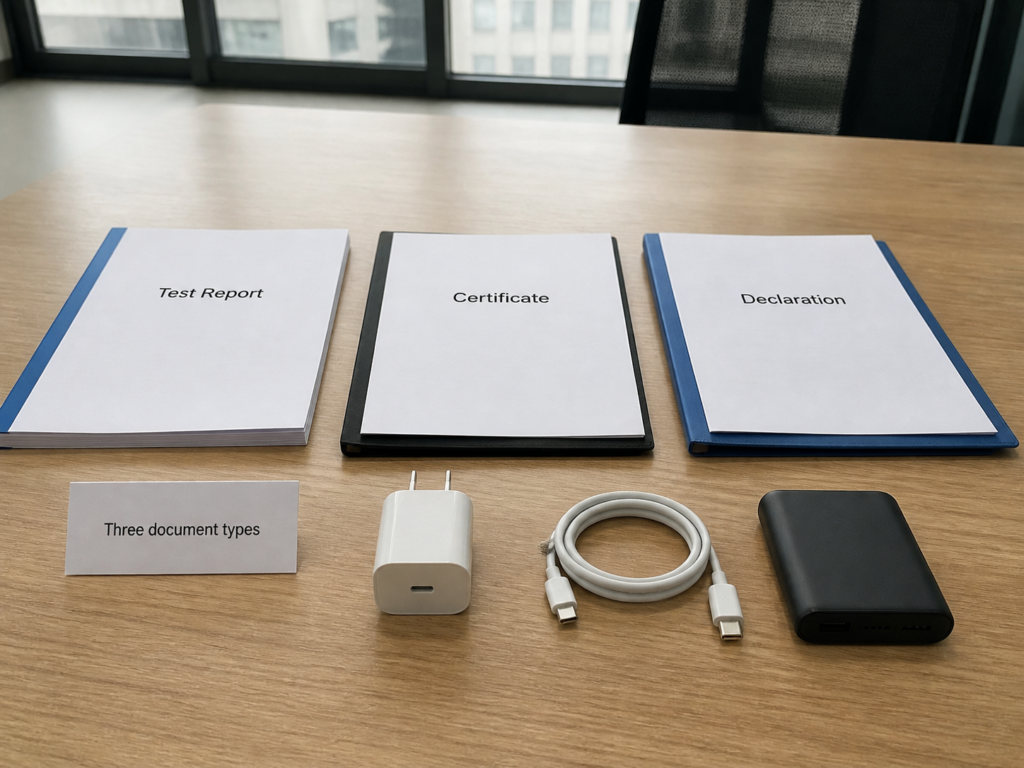
Don’t Confuse the Three Types of Core Documents
Many people cannot distinguish the boundary, essentially because they confuse three different types of documents. These three types of documents have different functions and cannot replace each other:
| Document Type | Issuing Entity | Core Function | Scope of Validity |
|---|---|---|---|
| Test Report | Issued by a testing laboratory, or by other permitted testing entities under specific schemes | Records the actual test results of samples or products | Mainly proves the samples, items, and conditions covered by the report; does not equal a certification decision |
| Declaration of Conformity (DoC) | Responsible entities such as manufacturers that have the obligation to declare in accordance with the law | Important legal document for self-declaration | The responsible entity bears corresponding responsibility for the content of the declaration |
| Certification Certificate | Independent certification body | Proves that the certification body has made a certification decision in accordance with a specific scheme | Only covers the content listed in the certificate, scheme, and certification scope |
What Are the Responsibilities of the Four Core Roles?
There are four completely different roles in the compliance chain. Don’t confuse laboratories with certification bodies:
- Manufacturer: Responsible for product design and production. Whether through self-declaration or third-party certification, the manufacturer must ensure that the actual product continuously meets applicable requirements and bear the responsibilities that the manufacturer should bear in accordance with the law.
- Testing Laboratory: Tests samples according to agreed standards or methods and issues test reports. A laboratory report itself does not equal a certification decision.
- Certification Body: Reviews test data and other evidence based on a specific certification scheme and independently makes a certification decision. Whether it includes factory inspection, supervision, or mark authorization depends on the provisions of the scheme.
- Regulatory Authority: Responsible for formulating or implementing regulations, conducting market spot checks and law enforcement, such as the market regulatory authorities of EU member states and the FCC in the United States.
What Is the Use of Clarifying the Boundary?
Many people think that compliance is “spending money to buy peace of mind”, but clarifying the boundary can solve three practical problems:
First, avoid compliance risks, and avoid goods being detained, fined, or stores being removed from the platform due to failure to do what should be done;
Second, control compliance costs: don’t waste money on unnecessary certifications, and don’t skimp on necessary ones, as skimping will lead to greater losses later;
Third, match market requirements: rules vary across countries and channels, and choosing the right path is necessary for smooth market entry.
5 Key Dimensions for Core Boundary Division
After clarifying the basic concepts, we can distinguish the boundary between self-declaration and third-party certification from 5 core dimensions. Each dimension has clear judgment criteria, as well as some variable influencing conditions.
Boundary of Responsible Entity: Who Bears the Ultimate Responsibility
This is the most core boundary:
- When adopting self-declaration, the manufacturer usually bears primary responsibility for product design, production consistency, and the declaration of conformity. Importers, authorized representatives, and distributors may also bear their respective obligations such as verification, information provision, labeling, archiving, and recall in accordance with the law, depending on the regulations of the target market. Importers cannot sign the DoC on behalf of the manufacturer under all systems.
- When adopting third-party certification, the manufacturer still must ensure that the bulk goods are consistent with the certified configuration and fulfill the responsibilities stipulated by relevant regulations. The certification body is only responsible for the scope of assessment it makes based on the certification scheme. For example, if the certification only covers 3 models, you cannot directly treat other models as certified products; if the bulk goods are inconsistent with the certified samples, the certification certificate cannot replace the manufacturer’s responsibility.
It should be noted here that the coverage of third-party certification is limited. Specifically, it may include activities such as type testing, factory inspection, and post-certification supervision, or other assessment methods may be adopted. Certification usually only applies to the models, configurations, production locations, and usage conditions listed in the certificate and certification scheme, and not all products are automatically covered.
Boundary of Verification Process: Who Determines Conformity
The second dimension is “who judges whether the product is compliant”:
- For self-declaration, testing can be done by oneself or entrusted to a third-party laboratory; however, the responsible entity makes the final judgment on whether the product meets applicable regulations based on evidence and signs the DoC. Whether it is necessary to use an accredited laboratory depends on specific regulations, standards, and assessment procedures.
- For third-party certification, the certification decision must be made by an independent certification body with corresponding authorization or accreditation. Whether testing, factory inspection, and supervision must be completed by a third party should be confirmed in accordance with the specific certification scheme and the regulations of the target market. Some schemes allow the use of manufacturer test data, accredited laboratory reports, or other assessment activities.
The core dividing point between the two is: whether an independent certification body has made a formal certification decision and issued a certification certificate. Having only a test report usually does not count as third-party certification.
Boundary of Acceptance Validity: Who Recognizes the Result
The third dimension is the degree of recognition of the two paths by the authorities and the market:
- In terms of legal validity: Self-declaration is only valid within the scope permitted by regulations, and not all products can be self-declared. Third-party certification also does not inherently have universal legal validity; it only has corresponding effect when specific regulations, competent authorities, or applicable systems require or recognize the certification.
- In terms of market acceptance: For self-declaration, the enterprise must bear the responsibility for the declaration on its own, and some channels may require more evidence; third-party certification usually provides additional independent assessment evidence, so it may be more easily accepted by customers, platforms, or channels, but it still cannot replace the manufacturer’s legal responsibility.
Taking wireless products in the United States as an example, whether FCC Certification and FCC ID are required depends on whether the device is an intentional radiator that requires certification, the applicable FCC Part, and whether exemptions or other device authorization procedures apply. It cannot be assumed that all wireless charging devices must obtain an FCC ID.
Boundary of Applicable Scenarios: When to Use Which Path
The two paths correspond to different applicable scenarios, but conclusions cannot be drawn solely based on “risk level”:
- Self-declaration is suitable for products or scenarios where regulations allow internal production control or other self-assessment procedures and there is no mandatory third-party participation, such as some ordinary passive charging cables. The specifics still depend on the target market and product classification.
- Third-party certification is suitable for scenarios where the target market’s regulations explicitly require third-party participation, customers or channels explicitly require it, or enterprises hope to enhance market trust through independent assessment.
- For high-risk products, the mandatory conformity assessment procedure should first be determined based on the target market’s regulations and product category, and then whether to voluntarily adopt third-party certification should be decided in combination with product risk, customer and channel requirements.
Of course, there is also flexibility: low-risk products can also voluntarily undergo third-party certification to enhance consumer trust or meet the requirements of higher-end channels. Here we specifically remind you of a common misunderstanding: an increase in product power does not automatically change the conformity assessment path. Changes in power may affect applicable safety and performance tests, but whether to conduct third-party certification is still determined by regulations, product categories, certification schemes, and channel requirements.
Boundary of Cost and Cycle: How Much Time and Money to Invest
The cost and cycle of self-declaration and third-party certification vary greatly, but there is no unified figure applicable to all charging products and markets.
The cycle and cost need to be confirmed on a case-by-case basis based on the following factors:
- The complexity of the product’s circuit and structure;
- Target market and applicable regulations;
- Test items and number of samples;
- Laboratory scheduling;
- Number of rectifications and supplementary tests;
- Whether factory inspection or post-certification supervision is required;
- Specific requirements of the certification scheme and body.
Therefore, it is inappropriate to uniformly state that self-declaration takes 1–4 weeks, or that third-party certification takes 4–12 weeks. For formal projects, the scope, quotation, scheduling, and delivery conditions should be confirmed with the laboratory or certification body.
The Boundary Is Not Static: 5 Variable Conditions
The above comparison conclusions are not once and for all. When the following situations occur, the compliance boundary should be re-evaluated:
- The regulations or standard versions of the target market are updated;
- The product adds new functions such as wireless, high-power, and intelligent control;
- Key safety or performance components are replaced;
- Sales channels or customers put forward higher requirements;
- The qualifications or scheme rules of the certification body change.
Detailed Rules for Boundary Judgment of Charging Products
General dimensions alone are not enough. For common products such as charging cables and chargers, we can directly correspond to specific judgment rules, and you can match them with your own products.
Passive Charging Cables/Ordinary Data Cables (No Electronic Components)
These are ordinary charging cables or data cables that only have copper wires inside and no electronic components. Such products usually do not require independent mandatory third-party certification in most markets, but compliance assessment still needs to be carried out based on the target market, specific use, product standards, and customer requirements.
You still need to prepare corresponding evidence in accordance with applicable requirements, such as safety and performance items like conductor resistance, insulation performance, and flame retardant performance. You also need to confirm whether environmental regulations such as RoHS and REACH apply, and retain corresponding documents.
Platforms or customers may require third-party assessment, and certain terminal equipment, construction, or special application specifications may also put forward additional requirements. However, it should be noted that the so-called “special high load” itself does not automatically generate a third-party certification obligation. High load mainly changes the applicable safety and performance tests, as well as product design and usage conditions.
USB-C Cables with Electronic Components/High-Power Data Cables
If your USB-C cable has an E-Marker chip, supports high-power transmission, or has signal conversion functions (such as USB-C to HDMI), it belongs to a data cable with electronic components.
For such products, requirements for basic safety, environmental protection, electrical performance, and interface protocols need to be evaluated separately. USB-IF certification is a voluntary industry certification, and many high-end channels or brand customers may regard it as an access threshold, but whether it must be obtained depends on specific channel and contract requirements.
Special attention should be paid: the rated power of the product must be consistent with the design, test results, and actual usage conditions, and must not be falsely marked. Otherwise, even if the self-declaration path is adopted, it may constitute a non-conforming or misleading declaration.
Wired Chargers/Power Adapters
Because wired chargers and power adapters are directly connected to the mains, they usually involve relatively strict requirements for electrical safety, EMC, and energy efficiency.
It should be emphasized again here: the assessment path is determined by the target market’s regulations, product category, and conformity assessment procedure, and there is no simple direct binding with power. It is not that a 65W charger necessarily requires third-party certification, and a 10W charger definitely does not. Changes in power may affect the test scope and risk assessment, but cannot alone determine the certification method.
The triggers for third-party certification mainly include: the target market’s regulations require third-party participation, or channels, customers, workplaces, building and electrical codes put forward certification or listing requirements. For example, some retail, workplace, or local acceptance scenarios in the United States may require NRTL certification or listing such as UL and ETL.
Wireless Chargers/Charging Products with Wireless Functions
Wireless charging products cannot simply be all classified as radio transmitting equipment, nor can it be assumed that all must obtain wireless certification. Specific requirements depend on the operating frequency, transmission method, power, whether they include communication transmission modules such as Wi-Fi or Bluetooth, and the target market’s classification of wireless power transmission equipment.
During assessment, the following should be confirmed separately:
- Electrical safety requirements;
- Electromagnetic compatibility requirements;
- Transmission characteristics of wireless power transmission;
- Human exposure requirements;
- Radio requirements for integrated communication modules;
- Whether third-party certification, supplier’s declaration of conformity, device authorization, or other procedures are required.
Ordinary electrical safety reports cannot replace wireless, electromagnetic compatibility, or human exposure assessments, but whether wireless charging devices require an FCC ID or other wireless certification must also be judged based on specific parameters and market rules.
Boundary Rules of Major International Markets
Regulations vary greatly across countries and regions. We have sorted out the specific boundary rules of the three most mainstream overseas markets for your direct reference.
EU Market (CE System)
First of all, it must be clarified that CE is the EU’s conformity marking system, not third-party certification. Whether a product requires the participation of a Notified Body (NB for short, a third-party compliance body officially designated by the EU) should be judged based on applicable regulations and conformity assessment modules.
- Scenarios where self-declaration is allowed:
- Passive USB/USB-C cables: It is necessary to first confirm whether the product is an electrical and electronic equipment subject to RoHS, whether it triggers REACH obligations, and whether it is a consumer product subject to GPSR. RoHS, REACH, and GPSR cannot be unconditionally listed as the same set of requirements applicable to all passive cables;
- Wired chargers: If applicable regulations allow the use of internal production control and the relevant harmonized standards are fully adopted, self-assessment and signing of the EU DoC are usually possible;
- Wireless chargers: Whether RED applies and whether an NB is required should be judged based on the wireless power transmission characteristics, communication module, operating frequency, and specific classification of RED. Even if RED applies, the assessment path cannot be determined solely by the term “wireless charger”.
- Scenarios where NB participation is required: An NB is only required when the applicable specific EU regulations and conformity assessment modules require the participation of a notified body. For example, RED may require an NB under specific conditions such as failure to fully adopt relevant harmonized standards; but this rule of “not fully adopting harmonized standards” or “no corresponding harmonized standards” cannot be extended to all CE products. Regulations such as LVD and EMC can be assessed through internal production control in many cases.
- Supporting requirements: For self-declaration, technical documentation, conformity evidence, and DoC that match applicable regulations must also be established. Relevant documents should usually be kept for at least 10 years from the date the product is placed on the EU market. The specific starting point and document retention period should still be confirmed in accordance with applicable regulations, rather than calculated from the date the product is discontinued.
The EU also has common voluntary safety certifications, such as TÜV GS. Obtaining such certification can enhance consumer trust, but it is not a mandatory requirement for all products.
US Market (FCC + NRTL System)
The US compliance system is divided into two parts: RF/EMC device authorization and electrical safety access. The specific path depends on the product’s circuit, function, operation mode, and usage scenario.
- RF/EMC compliance:
- Whether wireless charging devices must undergo FCC Certification and obtain an FCC ID depends on their operating frequency, transmission characteristics, whether they are FCC Part 18 or Part 15 regulated devices, whether they include communication transmission modules, and whether exemptions or other authorization procedures apply. It cannot be generalized;
- Devices with digital circuits that are FCC Part 15 Subpart B unintentional radiators can usually adopt FCC SDoC (Supplier’s Declaration of Conformity) under applicable conditions. However, whether SDoC, Certification, or exemption applies should be judged based on the specific device category and FCC rules;
- “Charger with data transmission” is not an FCC device classification that can be directly applied. Whether a charger is a digital device, unintentional radiator, or other regulated device should be judged based on its circuit and function; data cables themselves do not naturally belong to digital devices that require SDoC;
- Passive cables usually do not take FCC SDoC as the main compliance path, but should still be confirmed based on whether they contain regulated electronic circuits and the specific usage method;
- Judgment basis: It mainly depends on which category of FCC regulated devices your product belongs to, whether it is within the exemption scope, and which part of the FCC rules applies.
- Electrical safety access:
- UL and ETL are common NRTL certification marks or certification services. For general consumer chargers, there may not be a unified federal UL mandatory requirement in the United States;
- However, specific workplaces, state and local regulations, building or electrical codes, occupational safety requirements, and acceptance by local enforcement agencies (AHJ) may require devices to obtain certification or listing from an OSHA-recognized NRTL;
- Retailers, e-commerce platforms, and customer contracts may also put forward additional requirements;
- Whether NRTL certification or listing is required should be verified by checking applicable regulations, workplace and building electrical requirements, and the current written policies of the channel at the same time.
Japanese Market (PSE System)
For Japan’s PSE system, it is first necessary to determine whether the product is a regulated item under the Electrical Appliance and Material Safety Act (DENAN). Products not in the catalog are not subject to PSE rules.
- Classification of regulated products:
- Specified electrical appliances: These are high-risk regulated products that must undergo conformity inspection by a registered conformity inspection body and obtain the corresponding certificate before they can use the diamond PSE mark in accordance with regulations;
- Non-specified electrical appliances: Operators need to complete the required conformity inspection in accordance with DENAN, keep records, bear the responsibility for labeling and sales, and use the circular PSE mark. It is not possible to market the product just by signing a declaration.
- Judgment tips for charging products:
- Ordinary USB data cables are usually not PSE regulated products, and the circular or diamond PSE classification does not apply;
- For power adapters, it is necessary to confirm whether they are regulated products and which category they belong to based on the product structure, rated input and output specifications, and catalog requirements.
- Supporting requirements: Specified electrical appliances require a registered conformity inspection body to conduct conformity inspection and issue the corresponding certificate; non-specified electrical appliances also need to complete inspection, keep records, and fulfill operator obligations in accordance with regulations.
How to Check Rules for Other Markets
If your target market is not among the above three, you don’t need to memorize them by rote. It is more reliable to check in this order:
- First check the official website of the target market’s regulatory authority, which is the most authoritative source of information;
- Second, check the compliance policy page of the sales platform you want to enter. Platform requirements are usually more direct than regulations;
- If you are really unsure, consult a qualified compliance service provider. Don’t guess blindly to avoid pitfalls.
Judgment of Ambiguous Scenarios and Compliance Decision-Making Process
In actual operation, you will always encounter some ambiguous scenarios. At this time, you can follow the judgment process below instead of relying on guesswork.
Clarify 3 Prerequisites Before Judgment
Before making any judgment, first clarify the three basic pieces of information, otherwise all judgments may lose their basis:
- Product attributes: The product’s category, function, parameters, and whether it has wireless or intelligent functions;
- Target market: What are the mandatory regulatory requirements of the corresponding country;
- Sales channel: Whether there are additional requirements from offline channels, platforms, or key customers.
3 Priority Criteria for Core Judgment
After clarifying the prerequisites, judge the compliance path according to the following priorities:
- First priority: Whether regulations require third-party participation or specific certification procedures — this is the legal bottom line and must be met;
- Second priority: Whether channels/customers have clear requirements higher than regulations — if you want to enter this channel, you must meet them;
- Third priority: Product risk level — if there are no clear requirements for the first two, then evaluate whether to voluntarily conduct certification based on product risk, brand positioning, and customer trust needs. The risk level itself does not automatically determine the assessment path.
Judgment of 4 Common Ambiguous Scenarios
We have sorted out the four most easily confused ambiguous scenarios and give you the conclusions directly:
- If a third-party laboratory conducts testing and the test report is used for self-declaration, does that count as third-party certification?
Not necessarily. If the final conformity judgment and DoC are still completed by the manufacturer, and the laboratory only provides test results, it usually still belongs to self-declaration; only when an independent certification body makes a certification decision based on the certification scheme and issues a certificate does it belong to third-party certification. - If third-party certification does not include factory audit, does it count as third-party certification?
It may. Different certification schemes have different rules, and some certifications do not require factory audits. As long as an independent certification body with corresponding accreditation or authorization makes a formal certification decision and issues a certificate according to the specific scheme, it may belong to third-party certification. - Which category does claiming compliance with a certain industry standard belong to?
If it is claimed by the manufacturer itself, it belongs to self-declaration; if it is officially certified by an industry organization or independent certification body in accordance with its rules, it belongs to third-party certification. Simply quoting the standard name does not mean that certification has been obtained. - The modules in the product already have certification, does the whole machine still need certification?
It depends on the certification coverage of the modules. Even if the modules are certified, the whole machine still needs to undergo an overall compliance assessment to confirm that the power supply, housing, antenna, software, interface, and installation method of the whole machine have not changed the applicable requirements. Having a certificate for the module does not mean the whole machine is automatically compliant.
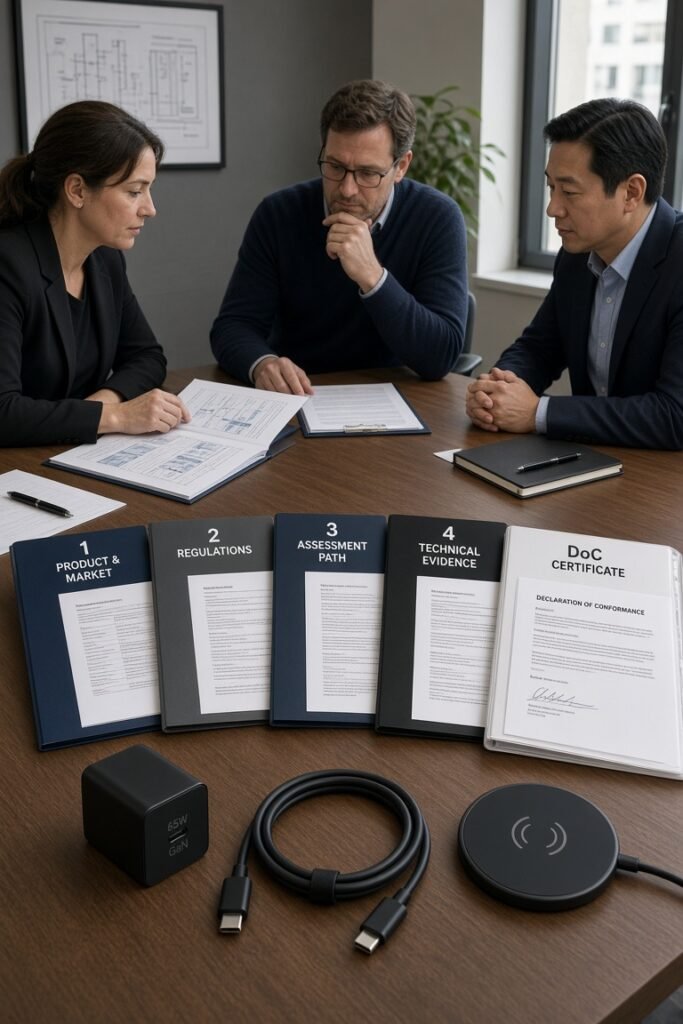
5-Step Decision-Making Process Before Launch
You can follow this process step by step to determine the appropriate compliance path:
Step 1: Clarify basic information, including target market, sales channel, product parameters and functions;
Step 2: Identify the applicable regulations for the product and the mandatory assessment requirements in the regulations;
Step 3: Preliminary judgment of the compliance path, whether it is pure self-declaration, requires third-party certification, or a combination of both;
Step 4: Prepare testing, calculation, inspection, risk assessment and other technical documents that match specific regulations and assessment procedures;
Step 5: Sign the DoC or obtain the certification certificate, and keep all records completely.
Do You Need to Re-Evaluate After Product Changes?
Many people think that doing compliance once is enough, and changing a component or modifying the structure is fine. This is a big misunderstanding. After product changes, you must re-evaluate according to this process:
Step 1: First identify the content of the change, whether it is replacing components, modifying the structure, adding functions, or changing the production factory;
Step 2: Evaluate whether this change has an impact on regulatory requirements, certification validity, and key component control;
Step 3: Handle according to the rules, such as notifying the certification body, conducting difference testing, applying for certificate expansion, or re-certifying;
Step 4: Update technical documents, DoC, product labels, and production consistency records.
The core principle is very simple: as long as the change may affect the compliance of the product, it must be re-evaluated, and you cannot make changes secretly.
Common Boundary Misconceptions and Document Verification Methods
Many people stumble in compliance because they confuse boundary concepts or do not know how to verify the authenticity of documents. We have sorted out the 5 most common misconceptions and practical document verification methods.
The 5 Most Common Boundary Misconceptions
Misconception 1: Self-declaration does not need test support, just sign a DoC casually
Truth: Self-declaration must have technical documents and evidence sufficient to prove that the product meets applicable regulatory requirements, but it does not mean that a third-party test report must be obtained, nor does it mean that all tests of all possibly applicable standards must be completed. The specific tests required, who will implement them, and whether an accredited laboratory is needed should be determined based on specific regulations, standards, product categories, and risk assessment.
Pitfall avoidance method: Establish a complete evidence chain based on applicable regulations, reasonably use materials such as testing, calculation, inspection, risk assessment, and internal production control, and organize and retain the documents to be ready for spot checks at any time.
Misconception 2: A third-party test report is third-party certification
Truth: A test report can only prove the test results of the samples and items covered by the report. It does not mean that the certification body has made a certification decision, nor does it automatically come with the right to use the certification mark. It is a different thing from third-party certification.
Pitfall avoidance method: To judge whether it is third-party certification, you must check whether there is a formal certification certificate, certification body information, certification scope, and corresponding certificate verification methods. It cannot be judged solely by a test report or laboratory logo.
Misconception 3: After obtaining third-party certification, the manufacturer has no responsibility
Truth: The manufacturer still needs to ensure that the bulk goods are consistent with the certified configuration and fulfill the responsibilities stipulated by applicable regulations. The certification body is only responsible for the assessment within the scope of its certification scheme and certificate. If the bulk goods are shoddy or key components are replaced without authorization, the certification certificate cannot replace the manufacturer’s responsibility.
Pitfall avoidance method: Establish a bulk goods consistency control process. When key components or structures are changed, the impact on certification and regulatory compliance must be evaluated in a timely manner.
Misconception 4: The compliance boundary of the same product is globally applicable
Truth: Regulations, standards, and certification requirements vary greatly across countries and regions. For example, a product that can adopt self-declaration in the EU may face FCC device authorization, NRTL, state and local regulations, or channel requirements in the United States. You cannot use one set of documents for all markets.
Pitfall avoidance method: Before exporting to a new market, be sure to check the latest regulations of the target market one by one, and don’t take things for granted.
Misconception 5: Voluntary third-party certification is useless and unnecessary
Truth: Voluntary third-party certification may meet channel or customer requirements, improve market trust, and provide additional compliance evidence. However, it does not exempt the manufacturer from responsibility, market spot checks, or recall obligations, nor can it be concluded that the probability of the product being subject to market spot checks will be reduced.
Pitfall avoidance method: Evaluate the input-output ratio in combination with the requirements of the target channel and your own brand positioning. You don’t have to do all certifications, nor do you have to reject all of them.
Detailed Rules for Verifying the Authenticity of Compliance Documents
Whether it is your own compliance documents or documents given to you by suppliers, you must know how to verify their authenticity. Otherwise, you will be the one to suffer if you get fake documents.
General Rules for Basic Verification
No matter what type of document it is, first check these four points:
- Verify product identity: Are the model, parameters, and brand on the document consistent with the actual product? Don’t use the certificate of model A for model B;
- Verify document scope: Are the standard version, covered functions and scenarios in the document matching the product? For example, if the test report only tests the charging function, but the product also has data transmission, it is necessary to confirm whether the data transmission part has been evaluated;
- Verify institutional qualifications: Laboratories and certification bodies should be verified separately and cannot be confused;
- Verify status and conditions: Don’t just look at whether “validity period” is written. Many certification certificates do not have a unified fixed expiration date, and their status may also be affected by supervision audits, standard changes, product changes, factory status, and certification schemes. It should be confirmed whether the certificate has been suspended or revoked, whether supervision has been completed, and whether the standards and product configurations on which the certificate is based are still applicable. The inquiry channel shall be subject to the official database of the certification body, the designated database of the target market, or the certificate verification document.
Key Points for DoC Verification
A unified template applicable to all markets and products cannot be applied to the DoC; it should be verified in accordance with specific regulations. Usually, attention should be paid to:
- Product identification information;
- Manufacturer’s name and address;
- Authorized representative information when necessary;
- Conformity declaration made by the responsible entity;
- Applicable regulations and standards and their versions;
- Notified body information when necessary;
- Place of signing, date, and the name, position, and signature of the authorized signatory.
Contact person, serial number, batch information, and whether the importer is included in the DoC should be determined based on specific regulations and product traceability requirements. Notified body information is not an optional “extra” when required by regulations.
Verification of Technical Document Composition
Technical documents are not just a few pieces of paper gathered casually, but must be able to prove that the product meets applicable regulatory requirements. Usually, they can include:
- Product description;
- Design and manufacturing materials;
- Identification of applicable regulations and basic requirements;
- Risk assessment or risk analysis;
- Testing, calculation, inspection and other conformity evidence;
- Samples of product labels and instructions.
BOM lists, circuit schematics, key component materials, and production consistency materials should be provided based on the product structure and applicable regulations. Some regulations require risk assessment and technical documentation, but do not necessarily require these materials to appear under the names of “risk analysis report” or independent “production consistency control document”.
Verification of Third-Party Certification Certificate Coverage
After obtaining the certification certificate, confirm the following points:
- The models, configurations, and parameters covered by the certificate are completely consistent with the actual product;
- The production factory listed on the certificate is consistent with the actual production factory;
- The scope of use of the certification mark meets the requirements of the certificate and certification scheme, and cannot be used on uncovered products casually;
- Whether the certificate still meets the valid conditions of the certification scheme, including whether supervision has been completed, whether it has been suspended or revoked, and whether the standards and product configurations are still applicable;
- The inquiry channel shall be subject to the official database of the certification body, the designated database of the target market, or the certificate verification document. Not all certificates can be queried on the regulatory platform, nor do all certificates have a unified fixed validity period.
How to Choose a Reliable Laboratory and Certification Body
When looking for an institution, don’t just look at the price. First verify the qualifications, otherwise you may spend money but still fail to meet the target market requirements:
- Verification of testing laboratory qualifications: First, confirm whether it has ISO/IEC 17025 accreditation. Second, check whether the accreditation scope covers your product, test standards, and items. It should be noted here that 17025 proves that the laboratory’s specific testing capabilities are accredited, which does not mean that its reports can definitely be directly used for all market access, nor does it equal the right to use certification marks.
- Verification of certification body qualifications: It is necessary to confirm whether the body has corresponding accreditation or authorization such as ISO/IEC 17065, whether it is accredited or designated by the target market’s regulatory authority, and whether the certification scheme scope covers your product and applicable standards. For example, FCC Certification usually involves requirements for FCC-accredited testing and certification entities. Be especially wary of institutions that advertise “guaranteed pass” or “ultra-low price fast certification”. First verify the nature of the certificate, applicable rules, and official verifiability.
Frequently Asked Questions
Is CE self-declaration the same as CE certification?
CE is the EU’s conformity system, and self-declaration (DoC) is a compliance path in the CE system, which is not equivalent to third-party CE certification. Whether the participation of a notified body is required should be determined based on specific regulations and conformity assessment modules.
What is the difference between FCC SDoC and FCC ID?
FCC SDoC is the Supplier’s Declaration of Conformity, which belongs to the self-declaration category and applies to eligible FCC Part 15 Subpart B unintentional radiator devices. FCC ID usually corresponds to FCC Certification, which belongs to the device certification category and is common for intentional radiator devices that require certification. Whether to adopt SDoC, Certification, or exemption should be determined based on the device category and FCC rules.
Can a UL test report replace UL certification?
No. A UL test report only proves the test results of the submitted sample in specified items, does not have a certification certificate, and cannot automatically use the UL certification mark; UL certification is a third-party certification made based on a specific certification scheme, and whether it includes the right to use the mark depends on the certificate and scheme conditions.
Is certification mandatory for USB-C cables?
It should be determined based on the target market’s regulations, product functions, and sales channel requirements. Passive USB-C cables do not have mandatory third-party certification requirements in most markets, but it is still necessary to check applicable regulations, product standards, specific uses, and customer requirements. USB-C cables with E-Marker, signal conversion, or other electronic functions require more specific assessment.
Do chargers need to be re-tested/re-certified after changing chips?
It is necessary to evaluate whether the chip is a key safety or performance component, and whether the change will affect the product’s compliance, certificate scope, and production consistency. The specifics should be determined based on applicable regulations and the rules of the certification scheme. It may only require difference testing, or it may require re-certification.
What is the difference between diamond PSE and circular PSE?
Diamond PSE corresponds to specified electrical appliances. Products must undergo conformity inspection by a registered conformity inspection body and obtain the corresponding certificate before they can use the diamond PSE in accordance with regulations; circular PSE corresponds to non-specified electrical appliances, and operators need to complete the required conformity inspection in accordance with DENAN, keep records, and bear the responsibility for labeling and sales. The premise is that the product is an electrical appliance regulated by DENAN; products not in the catalog are not subject to this classification.
Summary
After learning this guide, you should be able to independently complete three core judgments:
First, accurately distinguish the core boundary between self-declaration and third-party certification, and identify easily confused documents, roles, and certification nature;
Second, for charging products, select the appropriate compliance path in combination with the target market and sales channel;
Third, identify common boundary misconceptions, verify the authenticity of compliance documents, and evaluate the compliance impact of product changes.
Finally, here is a quick judgment mnemonic for you. You can look it up when you can’t remember:
First look at market regulations, then look at product risks;
Channel requirements take priority, testing must be solid;
Reports do not equal certification, boundaries are updated at any time.