
Those of you working with charging products for the European market have most likely heard of the Cyber Resilience Act (CRA) recently. Some say it is another new certification, some say only internet-connected smart products are subject to it, and others say ordinary charging cables don’t need to be considered at all — in fact, none of these statements are entirely accurate.
To understand the CRA, you first need to step out of several common cognitive misconceptions. Many people think the CRA is a new independent certification, but it is not — it is part of the EU’s existing CE compliance system, not a separate “CRA certification”. As a set of mandatory cybersecurity regulations for products with digital elements, its core logic is very different from traditional CE directives: most traditional directives focus on whether products meet corresponding requirements when placed on the market, while the CRA requires cybersecurity to be built in from the product design stage, covering the entire life cycle from research and development, production to decommissioning.
The most easily overlooked point is that the CRA does not simply judge based on whether the product is connected to the internet. Usually, it is first necessary to confirm whether the product contains digital elements such as software or hardware, and can establish data connections with devices or networks directly or indirectly, and then make a judgment combined with the product’s intended use and the CRA’s exclusions. Even if a product is not connected to the internet, it may still be subject to the CRA as long as it has relevant digital connection or interaction capabilities. The mere presence of programmable chips or firmware itself does not automatically determine that a product falls within the scope of the CRA.
For practitioners working with charging products, the CRA is a rule that must be taken seriously — products that do not meet applicable EU requirements may not be able to legally enter the EU market, and serious violations may also face high fines. For violations of the CRA’s basic cybersecurity requirements and related core obligations, member states shall provide for administrative fines of up to at least 15 million euros or 2.5% of the enterprise’s global annual turnover in the preceding financial year, whichever is higher; the specific amount also depends on the type of violation and the implementation rules of the member states. More importantly, the CRA’s responsibilities are distributed among different entities in the product chain, from brand owners, contract manufacturers to importers, and sellers, each link may have corresponding obligations, and it is not only the manufacturer that is responsible.
Many friends who have worked in the European market will ask: I have already complied with CE directives such as LVD (Low Voltage safety), EMC (Electromagnetic Compatibility), RED (Radio Equipment), and RoHS (Restriction of Hazardous Substances), does that mean I automatically comply with the CRA? The answer is no. LVD, EMC, and RoHS have different regulatory focuses from the CRA, and compliance with other regulations does not automatically replace the CRA; however, some regulations such as RED already include specific cybersecurity, privacy, or cyber abuse protection requirements. Therefore, specific products must still be evaluated separately in accordance with all applicable EU regulations, and relevant requirements can apply cumulatively and cannot replace each other.
How to Determine If Your Charging Product Requires Compliance
Since the CRA’s regulatory scope is so easy to misjudge, how do you determine if your charging product needs to comply? Let’s start with the core determination logic.
The core premise of CRA determination is not just to see whether the product has built-in programmable chips or firmware, but to first judge whether the product is a “product with digital elements”: whether its software or hardware can establish data connections with devices or networks directly or indirectly. Common related digital functions include data transmission, smart power adjustment, fast charging-related information interaction, internet or Bluetooth connection, firmware updates, etc. Even if a product is not connected to the internet, it may be subject to the CRA because it has the ability to establish data connections with other devices or networks. Conversely, products with purely mechanical, purely hardware structures, and no relevant digital connection or interaction capabilities usually do not fall within the scope of the CRA, but final confirmation still needs to be made in combination with the product’s intended use and CRA exclusions.
To facilitate your comparison, we have compiled the determination status of common charging products:

| Product Type | Subject to CRA Regulation | Basis for Determination |
| Smart chargers with APP/Bluetooth/WiFi | Usually yes | Capable of digital connection and interaction with devices or networks |
| USB-C fast charging cables with E-Marker | Usually require further assessment | Contain digital electronic components, may be products with digital elements; further confirmation required in combination with connectivity capabilities and exclusions |
| Pure copper core charging cables without chips | Most likely no | Usually do not have digital processing or data connection capabilities, belong to pure hardware structure |
| Traditional 5V1A chargers without smart adjustment | Need verification | Whether there is digital control, communication or related connection capabilities cannot be judged solely by output specifications |
| Pure physical adapters | Most likely no | Usually only perform physical adaptation, have no digital functions |
| Basic fast charging protocol recognition chargers | Need verification | Depends on whether the internal electronic solution has relevant digital connection or interaction capabilities, and whether exclusions apply |
Two easily overlooked details need to be reminded here: first, even for products of the same series, as long as the chips used, firmware versions or connection functions are different, their regulatory status may be different. For example, the same PD charger uses different control solutions in earlier and later versions, so you cannot directly apply the same conclusion just based on the product name or appearance; second, accessory products cannot be automatically excluded just because they are small in size or belong to accessories. For example, adapters or cables with digital functions require further evaluation in combination with the CRA’s definitions and exclusions.
USB-C cables with E-Marker usually contain digital electronic components and should be further judged as products with digital elements. However, E-Marker is mainly used to report cable capabilities, rated current and related identity information to the device, and it cannot be generally said that it is responsible for the complete USB PD power negotiation. Whether the CRA ultimately applies also needs to be confirmed in combination with whether the product can establish data connections with devices or networks directly or indirectly, the product’s intended use, and exclusions.
If you are still unsure whether your product counts, you can use these 3 steps for quick self-check:
First step: First ask the supplier for the product specification sheet to confirm whether there are digital electronic components inside, the chip model, firmware version, and whether the product can perform data connections with other devices or networks. BOMs, chip specification sheets, USB-IF related materials and product protocol descriptions are usually more reliable than appearance. For USB-C cables, compliance cannot be judged by whether you can see the chip when holding the connector up to the light, nor can you confirm the presence of E-Marker, whether the chip is programmable, or whether the product falls within the CRA scope solely based on appearance.
Second step: Sort out all functions of the product, and check whether there are digital processing, data transmission or device interaction capabilities, such as whether it can transmit data, exchange information with other devices, connect to APPs, upgrade firmware, and whether the product belongs to exclusion or special application scenarios already specifically covered by other EU regulations.
Third step: Make a final confirmation against the CRA definitions, exclusions and related product categories officially released by the EU. You cannot draw a conclusion based only on the two conditions of “has a chip” or “not connected to the internet”.
If you encounter products with blurred boundaries that you are unsure about, be sure to keep written judgment records, such as chip specification sheets, BOMs, functional analysis descriptions and scope of application judgments. When subsequent EU official guidelines or harmonized standards are updated, conduct timely re-verification to avoid being unable to explain the basis for judgment during regulatory inspections.
Full Chain Responsibility Division: What Responsibilities You Bear
After confirming that the product is subject to regulation, the next thing to figure out is: what responsibilities do you bear in the entire compliance chain? The CRA does not impose a uniform “joint liability” on all participants, but allocates obligations according to different roles such as manufacturers, authorized representatives, importers, distributors and fulfillment service providers.
First are brand owners or manufacturers, which are the core responsible entities for CRA compliance. You need to be responsible for implementing cybersecurity requirements at the design stage, conducting risk assessments and testing; preparing compliance technical documentation, and signing the EU Declaration of Conformity (DoC, which is a document formally signed by the manufacturer declaring that the product meets the requirements of applicable EU regulations); you also need to establish vulnerability management, security update and security incident reporting mechanisms. If you place a product on the market under your own name or trademark, or make substantial modifications to the product that affect its CRA compliance, you may also be regarded as a manufacturer and need to bear corresponding manufacturer obligations.
Second are economic operators such as authorized representatives, importers, distributors and fulfillment service providers. Non-EU manufacturers shall set up corresponding EU-based economic operators or authorized representatives in accordance with CRA requirements, but these roles are not the same concept, and their legal obligations are also different.
Importers usually need to verify whether the manufacturer has completed the corresponding compliance assessment, whether the EU Declaration of Conformity and technical documentation are prepared, and check whether the product labeling and instruction information meet the requirements. Authorized representatives perform corresponding document preservation, communication and cooperation obligations within the scope of the manufacturer’s authorization. Distributors also need to check product and responsible party information in accordance with their legal obligations before selling products. When a product is found to be non-compliant or has serious risks, relevant entities shall take appropriate measures such as suspending sales, rectification, notification or recall, and cooperate with market supervision investigations.
Therefore, EU-based partners cannot just be a nominal address. You should confirm whether they can complete legal obligations such as document preservation, regulatory communication and market rectification based on their actual role and contract scope. However, if there is no EU economic operator, the seller does not automatically become a manufacturer and bear all responsibilities; specific responsibilities need to be judged based on their actual role, sales method and behavior.
Then there are cross-border sellers or distributors. You need to request compliance certificates from suppliers to confirm whether the product responsible party and document information are clear; before listing products for sale, you need to check whether the CE marking, manufacturer and applicable economic operator information are complete; you cannot sell products that are known to have serious cybersecurity risks or are obviously non-compliant.
Two key points need to be noted here: first, whether a seller bears manufacturer obligations depends on whether the product is placed on the market under its own name or trademark, or whether it has made substantial modifications to the product that affect CRA compliance; second, you cannot assume that your verification obligations are fully completed just because the supplier provides a test report. Different entities shall respectively perform verification, labeling, documentation and cooperation obligations in accordance with CRA regulations.
Finally, there are ODM or OEM contract manufacturers. You need to provide product technical materials, chip and firmware information to the brand owner in accordance with the contract, and cooperate with the brand owner to complete safety testing and rectification. If a contract manufacturer participates in product design or makes substantial modifications to the product, it may need to bear corresponding compliance obligations based on its actual role. However, a contract manufacturer will not automatically become a manufacturer under the CRA just because it provides test reports, or simply replaces a certain component. Actual responsibilities still need to be judged based on the product placement method, brand identification, modification content and the roles of all parties.
It should be clarified that test reports provided by suppliers or contract manufacturers can be used as part of compliance materials, but they cannot replace the manufacturer’s final compliance assessment and documentation responsibilities completed in accordance with the law under all circumstances.
Core CRA Compliance Requirements
With responsibilities clarified, next we will talk about the core compliance requirements of the CRA, divided into three stages: pre-market, at market launch, and post-market, as well as content that charging products need to focus on.
Pre-Market: Security Must Be Built in at the Design Stage
First are the design stage requirements before market launch, which is the core part of the CRA — security must start from the design source. Basic security design requirements include: avoiding the use of known serious vulnerabilities, closing unnecessary interfaces and functions, and not having default weak passwords, such as the default background account and password of a smart charger both being admin; it is also necessary to support secure firmware upgrades, that is, the upgrade process must have appropriate integrity and authenticity protection, so that the upgrade package cannot be easily tampered with.
For charging products, attention should also be paid to the security of fast charging protocols and digital interaction processes. For example, information exchange and power control related to protocols such as PD cannot be improperly tampered with, to avoid overheating, abnormal power supply or other safety hazards. For USB-C cables with E-Marker, the protection mechanism of the chip and related information should be confirmed to avoid unauthorized modification or false reporting of information such as cable capabilities and rated parameters. Here, E-Marker cannot be simply described as a chip that independently completes complete fast charging power negotiation.
In addition, you also need to do a good job in third-party component management: establish a complete list of chips, firmware, and open-source components, and keep track of supplier vulnerability notifications at any time. Once a vulnerability occurs in a chip or code used, promptly assess the impact and take repair, mitigation or notification measures.
At Market Launch: Complete Documentation and Labeling
When a product is launched on the market, it needs to meet the requirements of documentation and labeling. Manufacturers must prepare technical documentation required by the CRA and sign the EU Declaration of Conformity (DoC). If EU harmonized standards are used as the conformity assessment path, the applicable basis, test records and other conformity evidence of the relevant standards shall also be retained.
It should be noted that harmonized standard test reports are not unified mandatory independent documents for all products. Harmonized standards are a path to prove that products meet relevant basic requirements; if the standards have not been issued, do not fully cover the product, or the manufacturer chooses other compliance assessment methods, conformity can also be proved through technical documentation and other appropriate technical evidence. Whether a notified body is required to participate depends on the product category and the specific conformity assessment procedure.
Labeling on the product body, packaging or accompanying documents shall be arranged separately in accordance with specific CRA provisions. Usually, it is necessary to mark the manufacturer’s name, registered trade name or trademark, postal address and electronic contact information, as well as product identification information such as model, batch or serial number. Where applicable, information on relevant economic operators such as importers shall also be marked. Whether specific information should be placed on the product, packaging or accompanying documents shall be judged in accordance with the CRA’s requirements for different roles and product situations, and cannot be generally understood as all EU responsible party information must be uniformly printed on the product body or the smallest packaging.
You can pay attention to the bottom label of compliant chargers, which usually has the CE marking, product model and responsible party information printed at the same time. However, the specific labeling form shall still be subject to applicable regulations and the actual situation of the product.
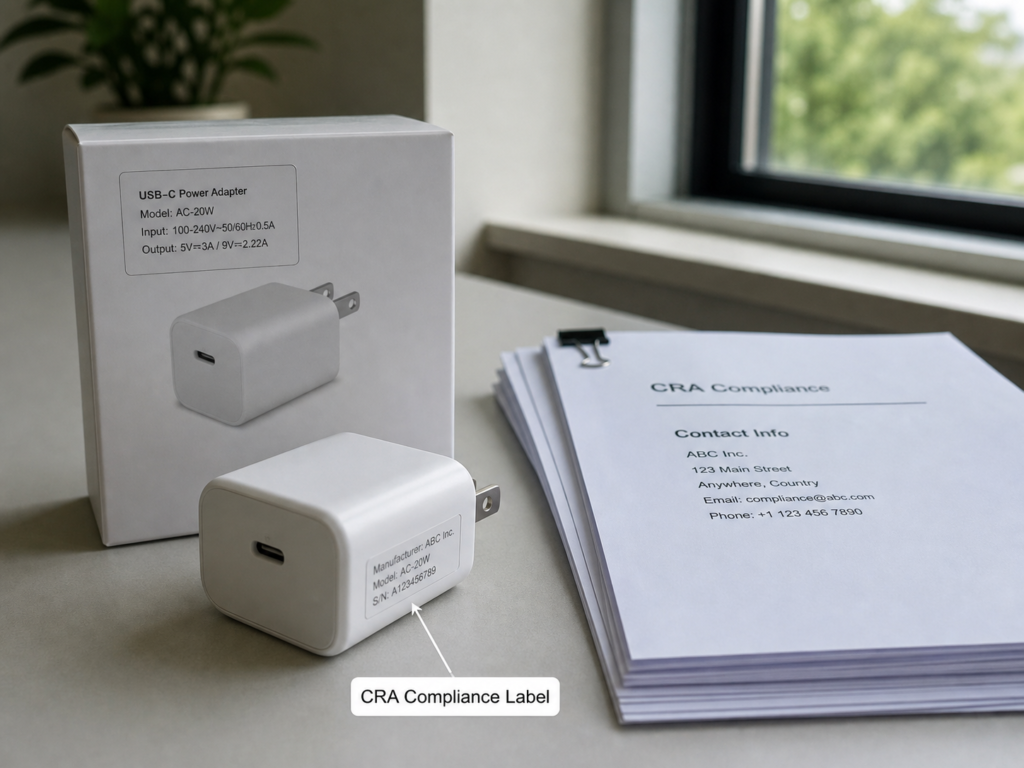
Manufacturers shall preserve technical documentation, EU Declaration of Conformity and related records in accordance with CRA regulations. Generally speaking, relevant documents shall be preserved for at least 10 years after the product is placed on the market, or at least 5 years after the end of the security support period, whichever longer period applies. Other economic operators shall preserve the documents they are legally required to hold and provide them when required by regulatory authorities, and it cannot be generally required that all full sets of technical documentation be uniformly stored at a certain economic operator in the EU.
Post-Market: Continuous Compliance Is Not a One-Time Effort
Unlike traditional CE directives, CRA compliance obligations do not end when the product is launched, but continue throughout the entire product life cycle.
First is the security update obligation, that is, within the “security support period” announced by the manufacturer, necessary security updates must be provided to users free of charge, and the updates must not affect the normal use of the product. The manufacturer shall determine and announce the security support period based on the nature of the product, its intended use and reasonable user expectations. In principle, this period shall not be less than 5 years; if the expected service life of the product is longer, the security support period shall cover that expected service life. Industry presumptions such as “2-3 years for ordinary charging products, 3-5 years for smart products” cannot replace regulatory requirements.
Second is vulnerability management: you need to establish a dedicated vulnerability receiving channel, such as a security email or feedback page on the official website, record, assess and fix vulnerability feedback in a timely manner after receiving it, and notify affected users according to the actual impact. Vulnerability handling obligations are not exactly the same as incident reporting obligations, and ordinary high-risk vulnerabilities are not automatically equivalent to incidents that must be reported.
Third is incident reporting: manufacturers shall, in accordance with CRA regulations, report actively exploited vulnerabilities and incidents that have a serious impact on product security through the single reporting platform designated by ENISA, and comply with the specific time limits for early warning, formal notification and final report. You cannot generally regard all “major security incidents” or all “high-risk vulnerabilities” as the same type of reporting matter.
Fourth is change assessment: if the product is redesigned, chips are replaced, or firmware is upgraded, compliance must be re-evaluated, and you cannot think that it is just a minor change and launch it directly. As long as the change affects digital functions, connectivity capabilities or cybersecurity, it may be necessary to update risk assessments, test records and technical documentation.
Many friends will ask, what exactly should the compliance technical documentation include? The core content falls into several categories: first, basic product description, software and hardware structure and intended use; second, cybersecurity risk assessment report and corresponding protection measures description; third, test records, firmware version description, list of all third-party components; fourth, description of vulnerability management and security update mechanisms, as well as records of previous product changes. The specific content shall also be determined according to the product category, the conformity assessment path adopted and the requirements of the CRA annexes.
5-Step Practical Guide to Compliance Implementation
After talking about the requirements, many friends may still not know where to start. We have compiled 5 practical steps, which can be advanced in order to avoid confusion.
Step 1: Product Inventory and Applicability Determination
First conduct product inventory and applicability determination. Sort out all SKUs you sell in the EU one by one by model, hardware version, and firmware version, and clearly mark what digital functions each SKU has — for example, whether there are digital electronic components, what data or protocol interactions it supports, whether it can connect to the internet, and whether it can upgrade firmware. Then judge one by one whether the product is a product with digital elements as defined by the CRA, check the connectivity capabilities, product intended use and CRA exclusions, and then prioritize by sales volume and risk level.
For example, products such as smart chargers and high-power power adapters may involve more digital functions or security risks, and compliance can be initiated first; but you cannot automatically determine their CRA category solely based on “internet connectivity” or “high power”.
Step 2: Select Compliance Path and Service Provider
Select an appropriate compliance path and service provider. Whether the CRA requires the participation of a notified body is not automatically determined by whether the product is connected to the internet, but shall first determine the product category in accordance with CRA Annex III and Annex IV, and then judge according to the applicable conformity assessment procedure.
Products not listed in relevant important or critical categories can usually adopt internal production control when conditions are met; if the product belongs to a specific category specified in the CRA, or the assessment path adopted requires third-party participation, a qualified notified body is required to conduct the corresponding assessment. Internet-connected smart chargers, ordinary PD chargers and E-Marker cables cannot directly determine their risk category or assessment path solely by product name.
When choosing a service provider, pay attention to two criteria: first, it must have EU accreditation qualifications matching the specific conformity assessment procedure, and second, it must be familiar with charging digital products — after all, charging product protocol interaction, cable identification chips, etc. have industry particularities. Also a reminder: do not easily trust promises of “guaranteed pass”, the core of CRA compliance is that the product itself must meet the standards, not buying a certificate with money, and product vulnerabilities cannot be covered up by a report.
Step 3: Product Rectification and Testing
Conduct product rectification and testing. First, prepare basic materials: product schematics, chip specification sheets, firmware descriptions, software component lists — these are the basis for assessment. Core assessment directions include digital interface security, firmware update security, vulnerability protection, data or protocol interaction security, etc., which shall be judged in combination with product functions.
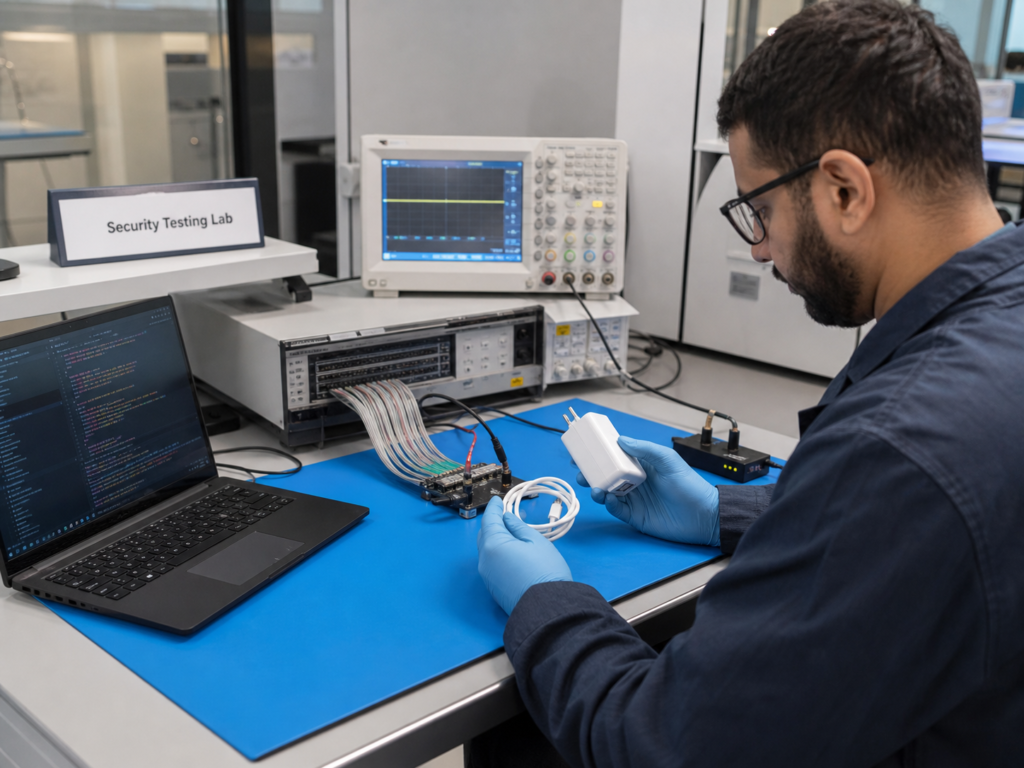
Appropriate conformity assessment methods shall be selected based on the basic requirements of the CRA. When adopting harmonized standards, evidence of standard application and testing shall be retained; if harmonized standards are not adopted, or harmonized standards do not fully cover the product, conformity can also be proved through technical documentation and other appropriate assessment evidence. Whether ordinary laboratory reports are usable depends on the specific conformity assessment procedure; the CRA does not require all products to use external institutions, nor does it require all products to involve a notified body.
Step 4: Document Preparation and Market Launch Readiness
Prepare documents and make market launch preparations. Prepare complete compliance technical documentation as required, and sign the EU Declaration of Conformity (DoC); affix the CE marking on the product or appropriate carrier in accordance with specifications, and improve user information in the manual — such as how long the security support period is, how to obtain security updates, and what the vulnerability feedback channel is.
At the same time, the name, address and electronic contact information of the manufacturer and applicable economic operators, as well as product identification information such as model, batch or serial number, shall be arranged in accordance with CRA requirements. Finally, each responsible entity shall separately preserve the documents it is legally required to hold, and ensure that they can be provided in a timely manner when required by regulatory authorities.
Step 5: Post-Market System Establishment
Build a continuous compliance system after market launch. You need to set up a dedicated vulnerability feedback channel and designate an internal responsible person to handle security matters; establish a security update push and user notification mechanism, so that users can be reached in a timely manner when there is a vulnerability; you also need to formulate a compliance review process for product changes, so that when you change chips, modify firmware, or redesign products in the future, you first go through a compliance assessment before launching for sale.
For manufacturers, it is also necessary to prepare in advance the vulnerability and incident reporting process specified by the CRA, clarify which situations need to be reported through the single reporting platform designated by ENISA, and how to complete early warning, formal notification and final reports.
Timeline and Consequences of Non-Compliance
Many friends are most concerned about the timeline and what happens if they violate the rules, so we will explain them clearly here.
The CRA entered into force on December 10, 2024. Reporting obligations apply from September 11, 2026; unless otherwise specified, the main substantive obligations apply from December 11, 2027. Different provisions may also set transitional arrangements for existing products or specific obligations, so they shall be checked item by item according to specific provisions and product categories, and cannot be generalized as a unified 24-month transition period for ordinary charging products or critical products.
Although there is still preparation time before the main obligations apply, in practice it is recommended to start compliance work at least 6-12 months in advance — because a large number of enterprises will concentrate on assessments later, laboratories and professional service institutions may have queues, and product rectification and document preparation also take time, so preparing in advance will not leave you in a panic.
As for the consequences of violations, they are more serious than many people think:
First are economic penalties. For violations of the CRA’s basic cybersecurity requirements and related core obligations, member states shall provide for administrative fines of up to at least 15 million euros or 2.5% of the enterprise’s global annual turnover in the preceding financial year, whichever is higher. Other types of violations may apply lower fine caps, and the actual penalty depends on the type of violation and the implementation rules of the member states.
Second are market penalties, including customs detention of goods, removal from e-commerce platforms, prohibition of sale in the EU market, mandatory recall, etc.;
Third is responsibility implication. Manufacturers, importers, distributors, authorized representatives and other relevant entities may be required to rectify, provide materials or bear corresponding responsibilities in accordance with their respective legal obligations, not only the brand owner will be held accountable;
There are also hidden losses, such as damage to brand reputation and user claims, which are invisible costs.
From the perspective of charging products, EU regulatory inspections mainly have two scenarios: first, customs entry inspections, which mainly check whether the product has the CE marking affixed, whether the responsible party and product identification information are complete, and whether corresponding compliance documents can be provided; second, e-commerce platform inspections, which mainly check whether the compliance description on the product detail page is true, whether the documents or declarations correspond to the product, and whether the responsible entity information is complete. Products such as smart chargers, USB-C fast charging cables with E-Marker, and high-power power adapters should be carefully evaluated based on actual digital functions and applicable regulations, and cannot be judged solely by product name.
Common Misconceptions and Decision-Making Recommendations
Finally, we have compiled the most common compliance misconceptions and decision-making recommendations for different products to help you avoid detours.
High-Frequency Compliance Misconceptions
Let’s first talk about high-frequency compliance misconceptions, which many people have fallen for:
• **Scope-related misconceptions**: Thinking that complying with other CE directives equals passing the CRA (the two have different regulatory focuses and need to be evaluated separately according to applicable regulations); thinking that no internet connection means no compliance is needed (whether connected to the internet is not the only standard, it still depends on whether the product has the ability to establish data connections with devices or networks); thinking that all cables are not regulated (USB-C cables with E-Marker require further assessment); thinking that small size or no screen means no compliance is needed (determination has nothing to do with size or screen, the key depends on digital elements, data connection capabilities, intended use and exclusions).
• **Responsibility-related misconceptions**: Thinking that compliance is entirely the supplier’s business and sellers don’t need to care (different sales entities have corresponding verification, labeling or cooperation obligations); thinking that economic operators are just nominal (different economic operators bear different legal obligations and cannot just provide an address); thinking that if the contract manufacturer tests, the brand owner doesn’t need to be responsible (the manufacturer still needs to complete the final compliance assessment and documentation work in accordance with the law).
• **Process-related misconceptions**: Thinking that compliance is done once and valid for life (compliance is required throughout the life cycle, redesigns and chip replacements require re-evaluation); thinking that old model documents can cover new models (different hardware, firmware or digital functions require separate evaluation); thinking that the transition period is long so there’s no need to rush (later assessment, rectification and document preparation all take time, and it’s easy to miss the deadline).
• **Documentation-related misconceptions**: Thinking that compliance reports just need to be kept by yourself (each entity shall preserve the documents it is legally required to hold in accordance with CRA regulations and provide them when required by regulators); thinking that documents can be destroyed after products are sold out (manufacturers still must preserve technical documentation, DoC and related records in accordance with regulations, and the period shall be judged based on requirements such as the time the product is placed on the market and the security support period).
Quick Self-Check List
You can quickly check your preparation progress against the following items:
• Have confirmed whether the product has digital electronic components, software or other digital functions
• Have judged whether the product can establish data connections with devices or networks directly or indirectly
• Have clarified whether the product falls within the scope of CRA regulation, and checked the exclusions
• Have clarified your own responsible role in the compliance chain
• Have confirmed the specific role, qualifications and cooperation capabilities of the EU economic operator or authorized representative
• Have sorted out the chip, firmware and function information of core SKUs
• Have reserved the time and budget required for compliance
• Have initially judged the conformity assessment path based on CRA Annex III and Annex IV
Decision-Making Recommendations for Different Products
For different types of charging products, we have also compiled decision-making recommendations, which you can directly apply to your situation:
If it is a product with pure hardware, no digital functions or related data connection capabilities, such as ordinary charging cables with pure copper cores, and adapters with pure physical structure, such products usually do not fall within the scope of the CRA, but you must retain relevant specification certificates and functional descriptions, so that you can explain the actual structure and functions of the product later. For traditional 5V1A chargers, you also cannot draw a conclusion solely based on output specifications, and you should still verify whether there is digital control, communication or other related connection capabilities inside.
If it is an ordinary digital charging product, such as ordinary PD fast charging chargers, USB-C fast charging cables with E-Marker, such products should be further evaluated based on actual digital functions, data connection capabilities, intended use and CRA exclusions. You cannot classify them into low-risk categories solely by product name, nor can you decide whether a notified body is needed solely based on whether they are connected to the internet. After confirming the scope of application and assessment path, you should complete compliance assessment and document preparation as planned during the transition period, and do not leave it until the last minute.
If it is a smart charging product with internet, Bluetooth or APP control, such products usually involve more obvious digital connection and continuous security management requirements, and it is recommended to start compliance work in advance. Not only must you complete pre-market risk assessment, technical documentation and declaration of conformity, but you also need to build vulnerability management, security update and incident reporting systems in advance. As for whether it belongs to the category requiring the participation of a notified body, it shall still be judged based on CRA Annex III and Annex IV and the applicable conformity assessment procedure.
Overall, although the CRA is a new set of compliance requirements, it is not as complicated as imagined as long as you sort out the logic clearly. First determine whether the product contains digital elements and related data connection capabilities, then check the intended use, exclusions and product category; then clarify your own responsible role, advance product rectification, assessment and document preparation step by step, and avoid common misconceptions, then you can enter the European market more steadily. Planning in advance and advancing by priority can not only reduce unnecessary cost losses, but also avoid missing opportunities in the European market due to compliance issues.