
Almost everyone in the cross-border charging product business has encountered this problem: when a 65W gallium nitride (GaN) charger is to enter the EU, Southeast Asia, and Australia at the same time, for some product and target market combinations, repeated testing may be required due to applicable standards, certification paths, or designated laboratory requirements, which increases costs and lead times. The specific cost and lead time need to be confirmed item by item based on the product, target market, testing institution, and certification scheme. The ILAC-MRA mutual recognition system is one of the important international cooperation arrangements that help reduce such repeated testing.
This article is a beginner to advanced guide for charging product practitioners. All content is for popular science reference only and does not replace the official opinions of regulatory authorities in the target market.
Beginner Basics: Core Logic and Industry Value
To understand ILAC-MRA, we first need to look at it in two parts.
The first part is ILAC, the full name of which is the International Laboratory Accreditation Cooperation, a global non-profit organization. ILAC issues international accreditation and mutual recognition policy documents, and together with international standards such as ISO/IEC 17025 and regional cooperation organization mechanisms, supports the international mutual recognition of laboratory accreditation results. Its core concern is: how to judge whether a laboratory has the ability to carry out testing, calibration or inspection activities stably and reliably.
The second part is ILAC-MRA, which is the ILAC Mutual Recognition Arrangement. Simply put, eligible accreditation bodies can be signatories to ILAC-MRA. For testing, calibration or inspection results within the accreditation scope of a signatory, other signatories undertake to promote their acceptance. However, this mutual recognition is limited to the specific activities and accreditation scope of the signatories, and does not replace the legal, regulatory or certification acceptance decisions of the target market. Whether a specific report can be used is still determined by the competent authority, certification body, platform or customer of the target market in accordance with applicable rules.
Its operating logic is a clear chain: international standards, ILAC policy documents and regional cooperation mechanisms together form the accreditation framework → eligible accreditation bodies become ILAC-MRA signatories after evaluation → accreditation bodies evaluate the technical capabilities of laboratories → laboratories issue testing, calibration or inspection reports within the accreditation scope → finally the user of the report decides whether to accept it. The core goal of the entire system is to reduce the cost of repeated testing in cross-border trade on the premise of meeting the requirements of the target market.
For charging product practitioners, the value of ILAC-MRA is mainly reflected in two aspects.
The first is cost reduction and efficiency improvement. When testing standards, methods, samples and accreditation scope meet the requirements of each target market, and relevant users accept the report, ILAC-MRA accreditation results may reduce repeated testing. How much cost can actually be saved, how much lead time can be shortened, and whether one report can support multiple markets need to be confirmed market by market, and cannot be regarded as an automatically guaranteed result of ILAC-MRA.
The second is to improve the credibility of the report’s capability. Behind the mutual recognition report are mechanisms for laboratory capability evaluation, supervision and re-evaluation, which can be used as one of the evidences for regulatory compliance materials, procurement quality evaluation materials or technical documents for certification applications. However, mutual recognition does not automatically prove that the product is qualified, nor does it mean that the report will be accepted in all markets or for all purposes.
Many beginners tend to confuse ILAC-MRA with other concepts when they first come into contact with it. Here we first clarify the 4 most common groups of misunderstandings to help you avoid basic cognitive pitfalls:
| Easily Confused Concept | Actual Meaning of ILAC-MRA | Core Difference from the Comparison Object |
|---|---|---|
| Product certification | Only proves that the relevant testing, calibration or inspection activities have corresponding capabilities and credibility within the accreditation scope | CE, FCC, etc. involve product regulatory compliance, equipment authorization or market access requirements; ILAC-MRA itself does not directly determine whether a product is qualified |
| Qualifications that laboratories can apply for directly | Laboratories need to apply for capability accreditation from eligible accreditation bodies | ILAC does not directly accept accreditation applications from individual laboratories, nor does it directly issue accreditation certificates to laboratories |
| ISO/IEC 17025 | An important basic standard for laboratory capability accreditation, and also one of the important standards used by the mutual recognition system | Self-compliance or declared compliance with ISO/IEC 17025 does not mean that accreditation has been obtained; the laboratory must also be formally accredited by an accreditation body, and it must be confirmed that the accreditation body and related activities are within the scope of ILAC-MRA signatories |
| ISO 9001 system certification | Technical capability accreditation for specific testing and calibration items | ISO 9001 is a general quality management system certification for enterprises, which cannot alone prove that a laboratory has the capability to measure specific items such as 240W fast charging temperature rise and USB-C plug-in life |
Core Participants and Mutual Recognition Credibility Mechanism
The entire ILAC-MRA system is not managed by a single institution from start to finish, but operates through layered collaboration with division of labor.
At the top level is ILAC. It is responsible for issuing and maintaining policy documents, rules and signatory information related to the mutual recognition arrangement. It neither directly evaluates individual laboratories nor directly issues accreditation certificates to laboratories.
The middle layer is regional cooperation organizations, such as APAC in the Asia-Pacific region, EA in Europe, and IAAC in the Americas. These regional cooperation organizations organize peer reviews of accreditation bodies in accordance with corresponding regional arrangements and connect with the ILAC mutual recognition system. Peer reviews are usually participated by experts from different economies, and are used to evaluate the evaluation capability and audit quality of accreditation bodies, ensuring that relevant accreditation activities comply with applicable international standards, policy documents and regional requirements.
Then there are accreditation bodies (AB) of various economies, which are the main entities that directly interface with laboratories. Their core function is to evaluate the technical capabilities of laboratories, and carry out regular supervision and re-evaluation. After applying to ILAC and undergoing evaluation, an accreditation body can become an ILAC-MRA signatory for its approved scope of accreditation activities. The commonly heard CNAS of China, A2LA of the United States, and UKAS of the United Kingdom are all well-known signatories. However, the specific list of signatories, signing status and mutual recognition scope shall be subject to the information published in real time on the official website of ILAC and the official websites of relevant accreditation bodies.
It should be noted here that the essence of accreditation is third-party technical capability evaluation, which is not equivalent to government administrative authorization. It focuses on whether the laboratory has the ability to carry out specific testing, calibration or inspection activities in accordance with prescribed methods, standards and procedures.
Further down are accredited laboratories and report users. Laboratories that have passed the evaluation of the accreditation body can only issue testing or calibration reports with corresponding accreditation statements within the accreditation scope. Items beyond the accreditation scope cannot claim mutual recognition in the name of ILAC-MRA accreditation activities. Whether the report can be used for R&D, procurement or other purposes as a non-accredited report is determined by the specific user.
The final acceptance right of the report is in the hands of the user, including customs, market regulatory authorities, product certification bodies, cross-border platforms and purchasers. Even if the report complies with the ILAC-MRA framework, the user has the right to decide whether to accept it based on local laws, technical rules, certification schemes or contract requirements.
The credibility of the entire system is supported by three core mechanisms, not by a “paper agreement”.
The first is unified international basic requirements. Signatories must evaluate laboratories in accordance with applicable international standards, ILAC policy documents, regional evaluation requirements and their own accreditation procedures, and accept peer reviews. Laboratory accreditation also involves specific technical standards, testing methods and procedures of accreditation bodies, and cannot be simply understood as being based solely on a set of rules formulated by ILAC alone.
The second is cross-border peer supervision. The audit quality of accreditation bodies is subject to regular peer reviews. For example, regional cooperation organizations will organize experts from different economies to inspect the management system, evaluation process and technical capabilities of accreditation bodies, so as to reduce the risk of regional deviations and inconsistent audit quality.
The third is dynamic qualification management. Mutual recognition qualifications are not for life. The accreditation status and accreditation scope of an accreditation body or laboratory may be suspended, revoked, narrowed or changed. In such cases, the applicability of the report should be judged in combination with the report issuance date, specific activity scope and relevant transition rules, rather than making a simple conclusion based only on the current status.
Mutual Recognition Coverage: Applicable Fields for Charging Products
For charging product practitioners, what they are most concerned about is definitely which tests related to themselves are covered by this mutual recognition system, and which are not within the scope.
First is the core covered laboratory testing field. ILAC-MRA can cover testing activities within the scope approved by the accreditation body. Whether specific testing items for products such as chargers, cables, power banks and wireless chargers are accredited must be checked item by item against the testing objects, methods, standards, parameters and restrictive conditions in the laboratory accreditation certificate and scope annex.
Therefore, it is impossible to judge that a certain item must be within the scope of mutual recognition solely by the product name. Items such as electrical safety, temperature rise, flame retardancy, electromagnetic compatibility (that is, the equipment does not cause excessive interference to other equipment and can work normally in the specified environment, referred to as EMC), plug-in durability, on-resistance, rated current, fast charging protocol negotiation and data transmission performance all need to be checked separately. Some laboratories may accredit part of them, and some items may be non-accredited activities. The specific situation shall be subject to the scope document.
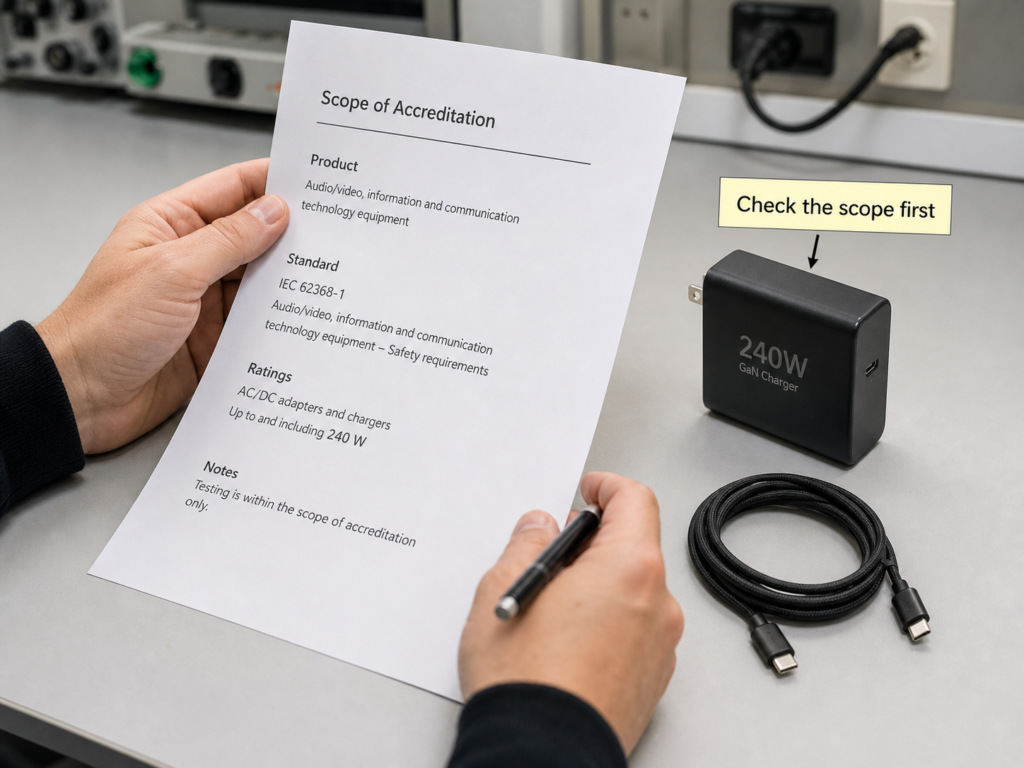
Here is a very critical reminder: the accreditation scope is not equal to the full testing capability of a certain standard. For example, a laboratory’s accreditation scope states “IEC 62368-1 Safety of audio/video, information and communication technology equipment”, but it is limited by rated power, equipment type or testing method. Then if you take a 240W GaN charger for testing, you need to confirm whether the product and power are indeed covered by the scope. Even if the same standard is used, activities beyond the accreditation scope cannot claim mutual recognition as ILAC-MRA accreditation activities.
Second is the calibration field.
In addition to testing, ILAC-MRA also covers calibration activities within the scope approved by the accreditation body. Many people may not know what calibration is. Simply put, calibration is to determine the relationship between the indicated value of an instrument and the reference value by comparing with a standard with metrological traceability, and provide deviation and measurement uncertainty when applicable, so as to support the metrological traceability of test and measurement results.
Calibration instruments related to charging product testing may include multimeters, power meters, temperature testers, signal generators and fast charging protocol testers, etc. However, the specific instruments, ranges and calibration parameters still need to be checked against the accreditation scope of the calibration laboratory. The function of the calibration certificate is to support the metrological credibility of test and measurement results. It does not directly prove that the product is qualified, nor does it guarantee that the instrument is suitable for all tests.
Finally, there are other covered and non-covered matters.
In addition to testing and calibration, ILAC-MRA also involves inspection body accreditation, such as on-site goods inspection, factory inspection, etc. However, inspection is an independent mutual recognition category, separate from testing mutual recognition. It cannot be presumed that an organization has inspection mutual recognition scope just because it has testing mutual recognition scope.
There are also some activities that cannot be directly included in the effectiveness of ILAC-MRA accreditation, such as product certification issuance itself, patent verification, and customized testing not included in the accreditation scope. It should be specially noted that non-standard methods, laboratory self-made methods or customer customized methods are not necessarily excluded just because they are “non-standard”. As long as the relevant methods have been verified or confirmed and are clearly included in the accreditation scope after evaluation by the accreditation body, they cannot be excluded in general.
For product regulatory compliance activities such as CE and FCC, ILAC-MRA itself is not responsible for issuing certificates or making product qualification judgments; testing reports from accredited laboratories can be used as one of the technical evidences when applicable. Some economies may also have additional requirements such as local energy efficiency, special wireless testing, or designated local laboratories, all of which shall be judged in accordance with local rules.
If you want to confirm the specific scope of mutual recognition, you must be subject to the list of signatories on the official website of ILAC and the official accreditation scope announced by each accreditation body, and do not judge based on experience.
Report Validity Verification Methods
Since mutual recognition has so many boundaries, when you get a testing report for a charging product, how do you judge whether it has the basis for mutual recognition under the ILAC-MRA framework? This is a core skill that practitioners must master.
Beginner Level: 6-Step Quick Verification Method
For most scenarios in daily work, these 6 steps can quickly determine whether the report may be used as an accreditation result and avoid common risks.
Step 1: Check the mutual recognition signing qualification. First, go to the official website of ILAC to check whether the accreditation body (AB) corresponding to the laboratory that issued the report is a signatory published by ILAC and covering relevant testing or calibration activities. Only signatories covering relevant activities and scopes can provide the basis for mutual recognition under the ILAC-MRA framework. Reports from non-signatories are not ILAC-MRA mutual recognition reports, but it does not mean that the report is invalid for all purposes. Whether it can be used is determined by the specific user.
Step 2: Check the laboratory status. Find the official website of the corresponding accreditation body, and check whether the report issuance location, legal entity, laboratory name and accreditation number are clearly covered by the same accreditation certificate and scope. It cannot be presumed that branch offices automatically share qualifications just because the brand or group is the same. Some accreditation certificates may clearly cover multiple locations, or allow accredited on-site activities. Therefore, it cannot be simply required that all report addresses be completely consistent with the certificate address in text, but shall be subject to the coverage relationship of official certificates and scope documents.
Step 3: Check the accreditation scope. This is the step where it is easiest to make mistakes. Be sure to check whether the test items, product types, power levels, test methods and standard versions are within the accreditation scope of the laboratory. Items beyond the accreditation scope are not ILAC-MRA accreditation activities, and cannot be used for purposes requiring accreditation results in the name of mutual recognition reports; whether the report can be used as a non-accredited report must be determined by the specific user.
For example, if you want to test the charging efficiency of a 15W magnetic wireless charger, but the laboratory’s accreditation scope only covers the safety items of ordinary wired chargers, then the wireless charger related tests in this report cannot be used as mutual recognition results within the accreditation scope.
Step 4: Check the authenticity of the report. Through the official channels of the accreditation body or the laboratory, check whether the report number, issuance date, issuer and report version are real, so as to avoid encountering forged, tampered or expired reports.
Step 5: Check samples and standards. Check whether the test standard and version, sample model, parameters and structure on the report are consistent with the product you actually want to ship. For example, if the report tests a 1-meter-long USB-C to C cable, but you ship a 2-meter-long one, or the report uses an E-Marker chip but the shipped product does not, this first means that the report cannot directly prove that the actual shipped product or the entire batch of products meets the requirements. Whether supplementary testing is required shall be determined based on differences, target market requirements and risk assessment.
Step 6: Check the acceptance rules. Finally, be sure to confirm with the regulatory authority, certification body or cross-border platform of the target market whether they accept overseas accredited reports and whether there are additional requirements. The mutual recognition arrangement provides the basis for mutual recognition of accreditation results, and does not automatically replace local laws, certification procedures or platform audit rules.
Here is another common misunderstanding: the use of the ILAC-MRA mark must comply with the policies of ILAC and relevant accreditation bodies. The absence of the ILAC-MRA mark does not necessarily invalidate the report, but it must be confirmed that the report is indeed an activity within the accreditation scope through the accreditation mark, accreditation statement, accreditation number or official verification in accordance with the rules of relevant accreditation bodies. Conversely, having the mark affixed does not necessarily mean it is genuine, and must be subject to official verification results.
Advanced Level: Key Points for In-Depth Verification
For important projects, such as large-volume procurement or first export of new products, a deeper level of verification is also required.
The first is standard version matching. Carefully check the name, version, test object and test method of the test standard to confirm that they are consistent with the description in the accreditation scope. The accreditation scope of some accreditation bodies may adopt a flexible scope. The specific determination shall be subject to the rules and scope documents of the corresponding body. Whether the standard version is accepted by the target market also requires separate checking of local regulations, lists of harmonized standards and transition arrangements.
The second is validity and use restrictions. If the report is marked with words such as “for R&D only” or “internal reference”, it shall be regarded as having use restrictions. Whether it can be used for specific conformity assessment, customs clearance or platform audit must be confirmed by the relevant user, and cannot be directly used as formal acceptance materials.
The third is sampling representativeness verification. If it is a batch sampling inspection report, check whether the sampling rules, sampling base, sampling location and batch definition meet the requirements. Whether the sample size is sufficient cannot be concluded solely based on the number of samples or batch size, but also needs to be evaluated in combination with applicable standards, statistical sampling schemes, risk levels, product consistency and sampling purposes.
Common Invalid Report Scenarios for Charging Products
Combined with the characteristics of charging products, common report use risks fall into the following categories.
First, out-of-scope testing. For example, if you want to test the performance of 240W PD3.1 fast charging and the energy efficiency of 15W magnetic wireless charging, but the laboratory only accredits basic safety items. Such items are not within the ILAC-MRA accreditation scope of this laboratory, and cannot be used for purposes requiring accreditation results in the name of mutual recognition reports; whether the report can be used as a non-accredited report must be determined by the specific user.
Second, sample inconsistency. The sample power, cable length, connector type, core components (such as chips, transformers) or product version on the report are inconsistent with the actual shipped product. In this case, it cannot be directly proved that the actual shipped product or the entire batch of products meets the requirements, and it is necessary to judge whether supplementary evaluation or retesting is required based on the differences.
Third, changes in qualification status. It is necessary to check whether the laboratory and relevant accreditation scope were valid at the time of report issuance, and judge in accordance with the accreditation body’s handling rules for suspension, revocation, scope change and historical reports. It cannot be concluded that all previously issued reports are invalid just because the laboratory’s current qualification has expired, been revoked, or the relevant accreditation body later lost its ILAC-MRA signing qualification.
Fourth, standard non-compliance. It is necessary to check the currently applicable EN/IEC standards in the target market, the official EU list of harmonized standards and the transition period. Whether a standard version is usable is determined by specific regulations, product categories and certification or conformity assessment schemes. For example, it cannot be simply summarized that the EU has uniformly implemented IEC 62368-1:2023, nor can it be asserted that reports using the 2014 version will “definitely” not be accepted.
For the convenience of everyone’s checking, here is a verification checklist for charging product mutual recognition reports, which can be checked against in daily work:
| Verification Category | Specific Content |
|---|---|
| Required Documents | Full text of the testing report, laboratory accreditation certificate and accreditation scope annex, photos/specifications of the submitted sample, description of the test standard version |
| Mandatory Check Fields | Report number, full name of the laboratory and accreditation number, test items, test standard and version, sample parameters (model/power/structure, etc.), report issuance date, product change statement |
Official Query Portals
All verifications must be carried out through official channels. Do not only listen to the explanations of third parties or the laboratory itself. The commonly used official query portals are as follows:
- ILAC official website: You can query the list of ILAC-MRA signatories, signing status and scope of mutual recognition activities.
- Official website of accreditation bodies (AB): You can query the qualification status, accreditation scope, report authenticity and relevant marking rules of laboratories.
- Official website of regulatory/certification bodies in the target market: You can query local acceptance rules, applicable standard versions and transition period requirements.
- Cross-border platform rule center: You can query the audit report requirements for corresponding sites and corresponding categories.
It should be noted that this information is dynamically updated. It is best to re-verify before each use of the report, and keep the query date and query results to avoid pitfalls due to outdated information.
Typical Application Scenarios for Charging Products
Now that we understand how to verify reports, let’s take a look at where ILAC-MRA can be used and what boundaries it has in the actual work of charging products.
Regulatory Compliance and Certification Applications
Mutual recognition reports can be used as one of the evidences for CE conformity assessment and technical documents when applicable. For example, when a power adapter enters the EU market, relevant safety or EMC testing reports issued by accredited laboratories may be used for the manufacturer’s technical documents and conformity assessment.
However, the CE mark is usually the result of the manufacturer completing the conformity assessment and making the EU declaration of conformity in accordance with applicable EU regulations, and is not a unified “CE-LVD certification issuance” system. Manufacturers still need to prepare complete technical documents in accordance with applicable regulations, European harmonized standards and conformity assessment procedures, and handle relevant requirements such as low voltage, EMC, and RoHS depending on the product situation. It cannot be stated that a certificate can be issued directly after submitting an IEC 62368-1 report.
Customs and Import Clearance
Some regulatory authorities or customs may take accredited laboratory reports as one of the compliance materials. For example, when USB-C data cables are exported to some Southeast Asian countries, the report may become part of the import or market supervision materials.
However, ILAC-MRA does not guarantee automatic customs clearance, nor does it guarantee a reduction in the probability of goods being detained or retested. Whether to accept the report, whether to require retesting and the required document format shall be subject to the official rules of the specific country, product category and import procedure.
Cross-Border Platform Audit
The charging category audit of some platforms may require or accept accredited laboratory reports. For example, when a wireless charger enters a certain platform, the platform may require testing materials for EMC and safety items.
However, it cannot be concluded that many mainstream platforms will uniformly require or accept ILAC-MRA reports. Platform policies are dynamically adjusted with sites, categories and regulatory requirements. Whether to accept, whether a specific accreditation body or designated format is required shall be subject to the list of rules officially released by the platform.
Procurement Quality Verification
For purchasers, accredited laboratory reports can be used as one of the evidences for procurement quality evaluation, which helps to understand the test results of submitted samples on specific items. For example, when purchasing car chargers in batches, you can first verify the report, sample specifications and production information, and then decide whether to add sampling inspection based on product risks, supplier performance, batch consistency, contract requirements and sampling schemes.
Whether to reduce sampling inspection cannot be decided solely based on the report having the ILAC-MRA accreditation basis. Mutual recognition reports do not automatically prove the quality of specific procurement batches, nor do they assume guarantee responsibility for untested products. The consistency of batch products still needs to be verified through sampling inspection, factory inspection, change management and historical quality data.
R&D and Multi-Market Layout
If the product is still in the R&D stage, you can consider finding a laboratory with the corresponding accreditation scope to conduct tests in accordance with general standards that may be accepted by the target market. In this way, some test results may be reused in subsequent certification or conformity assessment.
However, for IEC or other general standard reports, some test results may be reused only when the target market regulations, applicable standards, test methods, certification schemes and samples all meet the requirements. The applicable regulations, standard systems and conformity assessment procedures for EU CE and US FCC are different, and official requirements must be checked separately. An IEC safety test report is not automatically equivalent to the US technical rule test or equipment authorization materials required by FCC.
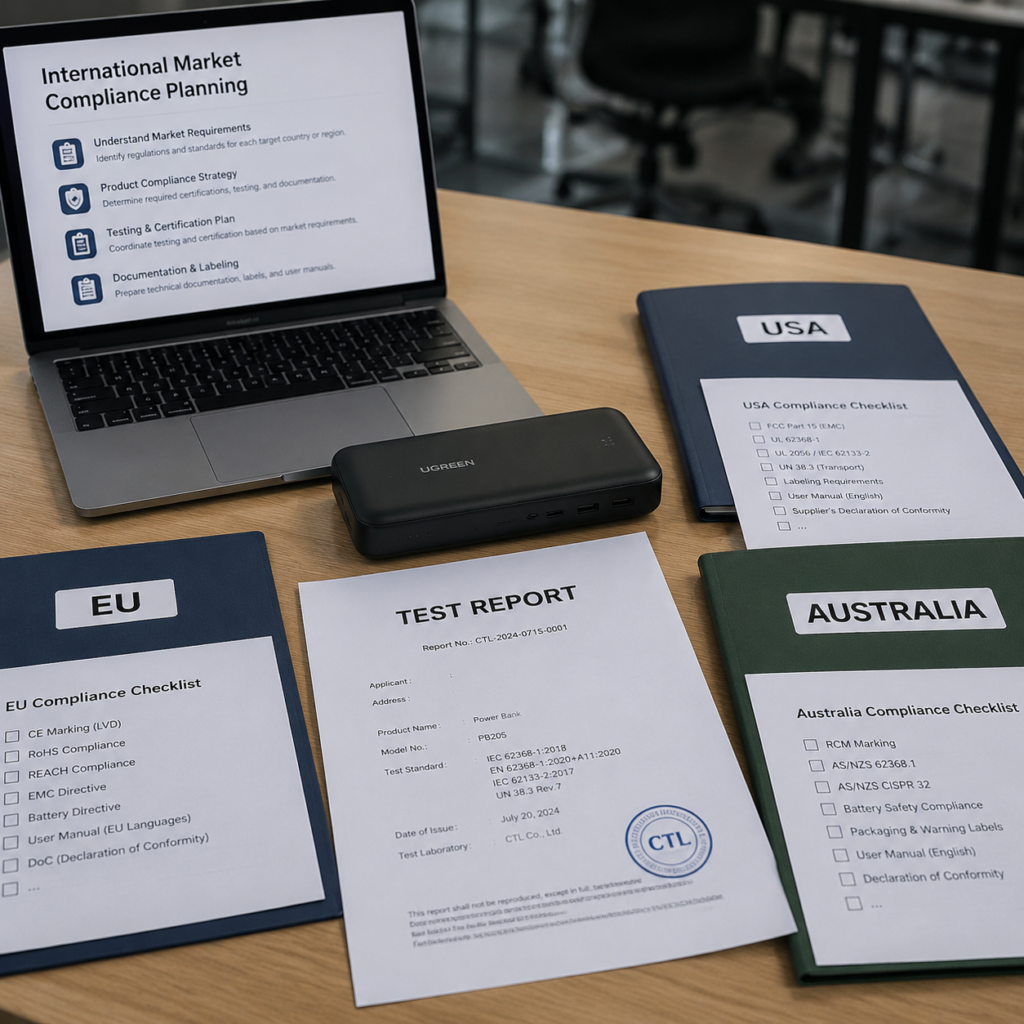
Therefore, if a power bank is deployed in both European and American markets at the same time, it cannot be simply assumed that one IEC standard mutual recognition report can complete both EU CE and US FCC applications at the same time. You should first confirm the applicable regulations, standards, test items, sample consistency and certification procedures of the two markets separately, and then judge which data can be reused.
Common Misunderstandings and Use Boundaries
Although ILAC-MRA is very useful, it is not omnipotent. Many practitioners have fallen into bigger pitfalls due to cognitive misunderstandings.
4 High-Frequency Cognitive Misunderstandings
Misunderstanding 1: Having the ILAC-MRA mark means the product is qualified.
Incorrect. The mutual recognition mark or accreditation statement mainly indicates that the relevant laboratory has corresponding capabilities within a specific scope, the testing activities are carried out in accordance with applicable requirements, and the results have a corresponding accreditation basis. It does not directly determine whether the product is qualified, nor is it responsible for the quality of untested products or entire batches of products.
Misunderstanding 2: ILAC-MRA is globally universal.
Incorrect. ILAC-MRA only involves formal signatories and their specific signing activities and accreditation scopes. Even if an accreditation body is a signatory, it cannot be inferred that all items, all laboratories and all reports it accredits can be used automatically around the world. The target market may still have local regulations, designated laboratories, specific standards or additional procedural requirements.
Misunderstanding 3: All reports issued by mutual recognition laboratories are valid.
Incorrect. Only items within the accreditation scope can claim ILAC-MRA mutual recognition as accreditation activities. For example, if a laboratory only has the accreditation scope for electrical safety items, but issues a fast charging protocol negotiation test report, then the fast charging item is not within its accreditation scope and cannot be used for purposes requiring accreditation results in the name of a mutual recognition report. Whether it can be used in other scenarios as a non-accredited report is determined by the specific user.
Misunderstanding 4: A report with the ILAC-MRA mark is a genuine report.
Incorrect. Both the mark and the report may be forged. The laboratory status, accreditation number, accreditation scope and report authenticity must be verified through official channels. Conversely, the absence of the ILAC-MRA mark does not necessarily invalidate the report, but it must be confirmed that the report is indeed an activity within the accreditation scope through the accreditation mark, accreditation statement, accreditation number or official verification in accordance with the rules of relevant accreditation bodies.
Use Restrictions for Charging Products
Specific to charging products, there are three clear use restrictions.
First, it cannot replace regulatory compliance obligations such as CE conformity assessment, FCC equipment authorization and RoHS. All the above matters must be completed in accordance with their respective applicable rules, and ILAC-MRA reports can only be used as part of the technical evidence at most.
Second, some exclusive requirements are not included in mutual recognition. For example, local energy efficiency requirements in some countries, special testing requirements for wireless charging, or items that clearly require testing in local laboratories cannot be replaced solely by mutual recognition reports.
Third, the report only reflects the submitted sample and its test conditions. Mutual recognition reports cannot automatically prove that the quality of mass-produced products is consistent, and batch products still need to be verified through sampling inspection, factory inspection, production change control and other methods.
Scenarios Where It Is Not Recommended to Rely Solely on ILAC-MRA
In the following situations, do not rely solely on mutual recognition reports. Prepare in advance as required to avoid delays:
First, if the target market clearly requires testing by a local designated laboratory, be sure to follow local requirements.
Second, the test items are not within the accreditation scope, or belong to content that is not part of laboratory conformity assessment accreditation activities such as patent verification. For customized non-standard testing, it is also necessary to first confirm whether the method has been verified, confirmed and clearly included in the accreditation scope.
Third, the buyer clearly requires a report issued by a specific accreditation body or local laboratory. For example, if the customer contract clearly specifies a certain accreditation body, it shall be implemented in accordance with the customer’s requirements.
Fourth, if the product undergoes major changes, such as power upgrade, core component replacement, or structural adjustment, the applicability of the old report needs to be re-evaluated, and supplementary testing shall be carried out if necessary.
Trigger Conditions for Retesting of Charging Product Reports
Many people don’t know when retesting is required. A more prudent approach is not to automatically retest all items when a certain change occurs, but to first conduct applicability and difference assessments, and then decide the scope of testing.
First, updates to regulations or standards. When the standard version or regulatory requirements of the target market change, you should check the differences between the old and new versions, the transition period, the target market’s acceptance policy and the requirements of the certification body, and then judge whether partial or full retesting is required.
Second, core product changes. For example, power adjustment, chip or transformer replacement, connector replacement, product structure modification, version upgrade, etc., if they may affect the test results, whether to conduct supplementary testing or retesting shall be determined based on the change assessment.
Third, production changes. In cases such as relocation of production sites, major adjustments to production processes, and resumption of production after long-term shutdown, you should first assess product consistency and quality risks, and then decide whether to retest based on target market rules, certification schemes and enterprise change management procedures.
Fourth, risk triggers. For example, in case of batch quality complaints, unqualified market sampling inspections, etc., investigations and verifications should be carried out for the problematic items, and retesting should be carried out if necessary to confirm whether the problem is solved.
Practical Decision-Making Suggestions for Practitioners
Having talked about so many rules and boundaries, finally we have sorted out several practical operational suggestions for you to help you make good use of the mutual recognition system in actual work and truly reduce costs and increase efficiency.
Decision Logic for Selecting Laboratories for Export Charging Products
When looking for a laboratory, don’t just look at the price. Choose according to these four steps, which can not only ensure the applicability of the report, but also avoid detours.
Step 1: First confirm the requirements of the target market. Confirm whether the accreditation body issuing the report is an ILAC-MRA signatory covering relevant testing activities, and separately confirm whether the target market accepts such overseas accredited reports, as well as the required test standards, versions, formats and procedures.
Step 2: Match the accreditation scope. Prioritize laboratories that can cover the test items you need, and there is no need to split testing among multiple laboratories when unnecessary, which saves time and communication costs. At the same time, be sure to check that the product type, power level, test method and restrictive conditions are all within the accreditation scope, so as to avoid mistaking non-accredited items for mutual recognition items.
Step 3: Meet additional requirements. Confirm that the report language, sample quantity, test cycle, report format, etc. meet the requirements of the certification body or platform in the target market. For example, some platforms require the report to be in English, and some require sample photos, specifications or disassembly photos to be attached.
Step 4: Adapt to preferences. If the buyer or certification body has a designated accreditation body (AB) preference, prioritize laboratories accredited by the corresponding body. However, this preference is a specific requirement of the customer or user, and cannot be interpreted in reverse that a certain AB has automatic priority in all markets.
Optimization Scheme for Procurement Charging Product Verification
As a purchaser, how to use the mutual recognition system to optimize the verification process, control risks and reduce costs? It can be distinguished by procurement scale and risk.
For small-batch procurement, after confirming that the samples, models, batches, production conditions and report purposes are consistent, and combining with product risks and contract requirements for evaluation, repeated testing may be reduced. However, whether to send for inspection is still determined by the purchaser’s risk control plan, and a general conclusion cannot be made solely based on “small batch” or “having a report”.
For large-batch procurement, on the basis of verifying the validity of the report and sample consistency, it is best to supplement sampling inspection of several core items, such as temperature rise, plug-in life, and fast charging power. Whether these items are suitable for sampling inspection, as well as the sampling proportion and method, shall be determined based on product risks, applicable standards, supplier’s historical performance and batch situation.
For long-term cooperative suppliers, there is no need to mechanically set a fixed report update cycle, but regular evaluations should be carried out according to risk levels, product changes, regulatory update rhythm and quality complaints. No change does not mean that rechecking is never needed. When standard changes, product changes or quality abnormalities occur, re-evaluation should be carried out in a timely manner.
In addition, it is recommended to add document and change management clauses in the procurement contract, requiring suppliers to provide documents such as test reports, laboratory accreditation certificates and scope annexes, sample specifications, product change statements, etc., so that there is a basis in case of problems.
Practical Tips for Cost Reduction and Efficiency Improvement
Here are three practical ideas to help you maximize the value of the mutual recognition system.
First, prioritize mutual recognition laboratories that cover multiple types of related test items, such as having accreditation scopes for safety, EMC and some performance items at the same time. But don’t just look at the service list advertised by the laboratory. You must check the official accreditation scope item by item to confirm that the required items are indeed accreditation activities.
Second, connect with suitable accredited laboratories at the R&D stage, and conduct tests in accordance with standards and methods that may be accepted by the target market. In this way, when doing certification or conformity assessment later, some items may directly reuse the data from the R&D stage, but it is still necessary to confirm the consistency of regulations, standard versions, test methods, certification schemes and samples.
Third, for multi-market layout, prioritize evaluating test items and standards that can cover the common requirements of multiple target markets. However, whether IEC or other general standard reports can be accepted by specific markets in the EU, the United States, Australia or Southeast Asia is not automatically determined by ILAC-MRA. Each market must separately check official regulations, standards and certification requirements, and it cannot be simply assumed that one test can complete all access work for multiple markets.
Core Summary
At this point, the core content of the ILAC-MRA mutual recognition system is finished. Mastering these contents, you can already clearly explain the definition and operating logic of ILAC-MRA, as well as its applicable scenarios in the field of charging products; you can also use the 6-step verification method to check the signatory, accreditation scope, sample consistency and use conditions of a report, avoiding using non-accredited items, forged reports or mismatched samples as the basis for mutual recognition; when exporting and purchasing charging products, you can also more reasonably use the mutual recognition system to reduce the risk of repeated testing.
Finally, let’s emphasize several core conclusions:
First, ILAC-MRA is an important arrangement for the international mutual recognition of testing, calibration and inspection results. On the premise of meeting the requirements of the target market and being accepted by users, it may help reduce repeated testing for charging products, but it does not guarantee fixed cost savings or shortened time to market.
Second, mutual recognition has clear boundaries of signatories, activities and accreditation scopes. It cannot replace regulatory compliance obligations such as CE conformity assessment, FCC equipment authorization and RoHS, nor is it a globally automatically universal product certification.
Third, when using mutual recognition reports, be sure to verify the signing status of the accreditation body, the specific accreditation scope of the laboratory, the report statement, sample consistency and the target market’s acceptance rules. Items beyond the accreditation scope cannot be used in the name of mutual recognition reports; whether they can be used in other scenarios as non-accredited reports is determined by the specific user.
Fourth, standards, regulations, accreditation status and platform rules may change. All dynamic information shall be subject to the real-time published content on the official website of ILAC, the official website of accreditation bodies, the competent authorities of the target market and the official channels of relevant platforms.