
If you do business in the European market with products like chargers, USB-C charging cables, and charging adapters, you have most likely heard the term “CE technical documentation” — some say it is the “entry ticket” to the EU market, while others say it is the trigger for customs detention or platform delisting. Many new sellers either think that getting a third-party “CE certificate” means everything is fine, or cobble together a pile of documents that cannot stand up to verification when spot-checked. In fact, CE technical documentation is not that mysterious; it is a package of technical evidence used to prove that a product meets EU CE requirements. As long as you understand the rules, ordinary sellers can sort it out by themselves and avoid a lot of unnecessary costs. This article focuses on charging products, and explains everything step by step from basic concepts to practical preparation, archiving and response.
First, Understand the Basics: What is CE Technical Documentation, and Who Needs to Prepare It
Product Scope of This Guide
This content is specifically for three types of charging-related products: chargers and power adapters, USB/USB-C charging cables/data cables, and charging connectors/adapters. Products of other categories can refer to the logic, but specific rules may differ.
Core Definition and Functions
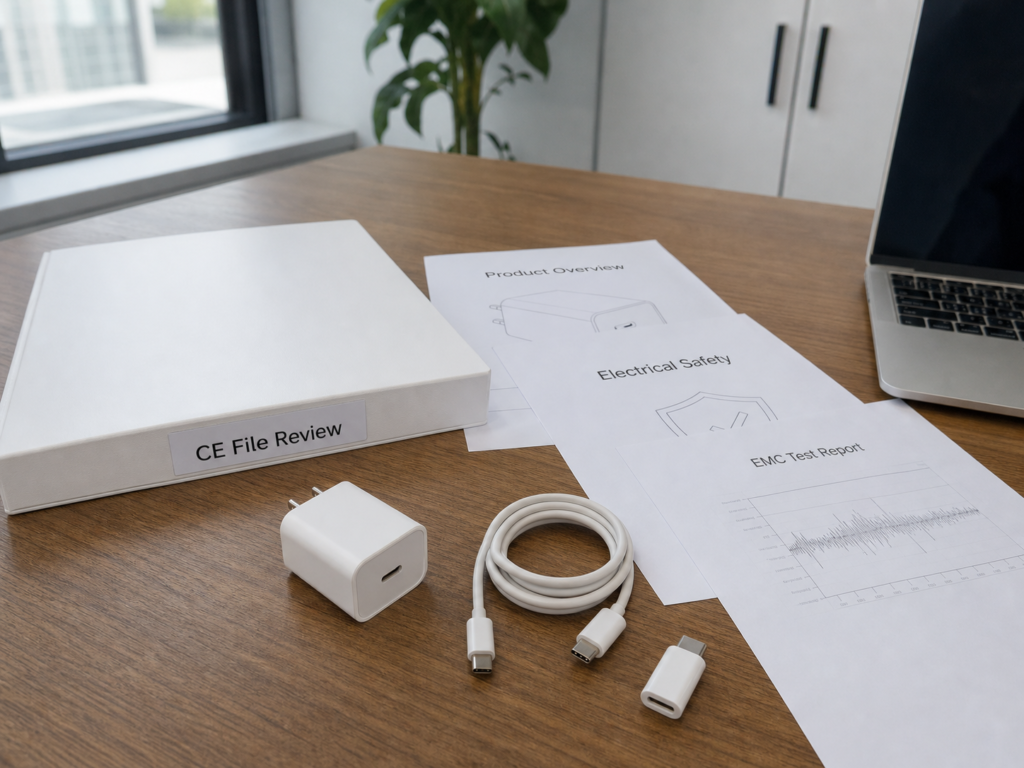
Simply put, CE technical documentation is the “compliance file” you prepare for a product, containing all technical materials that can prove the product meets EU CE requirements. It has two core functions: first, it serves as the basis for you to affix the CE mark — you must complete the preparation of documentation and sign the Declaration of Conformity (DoC) before you can affix the CE mark to the product and place it on the EU market; second, it is used to respond to compliance inspections.
Technical documentation is mainly used for inspections by competent authorities such as market surveillance authorities and customs. E-commerce platforms may require submission of partial compliance proofs; consumer complaints may also trigger regulatory investigations, but consumers generally do not have the right to directly request the full technical documentation.
7 Most Easily Confused Concepts
Many new sellers make mistakes because they do not understand the concepts, wasting money while still failing to be compliant. We will clarify them one by one in plain language:
• **Regulations/Directives**: Mandatory legal frameworks formulated by the EU, equivalent to “bottom-line requirements”, for example, “chargers must not present electric shock risks”, which must be complied with.
• **Harmonized Standards**: Technical standards officially recognized by the EU. Applicable harmonized standards that have been published in the , when correctly applied within their scope, can give rise to a presumption of conformity with the corresponding essential requirements, but cannot automatically prove the overall compliance of the product. They are usually not mandatory; you can also use other methods to prove compliance with essential requirements, but you need to prepare sufficient technical evidence.
• **CE Mark**: A “self-declaration of compliance” affixed to the product, not a certification mark issued by a third-party institution — as long as you can produce complete technical documentation to prove compliance, you can affix it yourself.
• **Test Report**: A “score sheet” issued after testing samples, which is only part of the technical documentation and does not equal the full compliance proof.
• **DoC (Declaration of Conformity)**: A “compliance guarantee letter” signed by the manufacturer, which is a mandatory item in the technical documentation; without it, CE compliance is not considered complete.
• **Notified Body (NB Body)**: A third-party conformity assessment body authorized by the EU. A notified body is only required when the applicable regulations or the conformity assessment procedure chosen by the manufacturer require third-party participation; ordinary chargers can usually adopt the manufacturer’s internal production control procedure, but this should be confirmed according to specific regulations and product risks. Certain RED application scenarios may also require the participation of notified bodies or other designated assessment bodies.
• Key reminder: **There is no unified “CE certificate” officially issued by the EU. Most charging products do not need the so-called “CE certification certificate” issued by a third party**; the core is that your own technical documentation must be complete and able to support the compliance declaration.
How to Determine If Your Product Requires CE
Not all charging-related products fall within the scope of CE. You can check item by item from three dimensions:
The first dimension is **product type and function**: Most chargers and power adapters require CE, but this should be judged in combination with voltage; fast charging cables with electronic components and adapters with circuits need to be assessed; purely passive ordinary charging cables (only copper wires, no chips) and adapters with purely mechanical structures need to be checked against other dimensions item by item, and no direct conclusion can be drawn.
The second dimension is **input or output voltage**: When the rated voltage for which the product is designed falls within the range of 50–1000V AC or 75–1500V DC, the Low Voltage Directive (LVD) usually applies. Here, you cannot only look at the general “operating voltage” of the product, but also combine the rated input or output voltage for which it is designed, and whether the product falls within the scope of the directive. Being above or below this range only means that LVD may not apply, and you still need to continue assessing EMC, RED, RoHS and other applicable requirements.
The third dimension is **radio function**: If the product has radio transmission and reception functions such as Bluetooth, Wi-Fi, or cellular network, the Radio Equipment Directive (RED) needs to be assessed; purely wired products generally do not apply to RED.
Finally, a supplementary note: Even if a product does not apply to a certain CE requirement, it must still comply with applicable EU regulations such as RoHS, REACH, WEEE, etc. Do not think that if you do not need a certain CE assessment, you do not need to take care of anything.
Who Is Responsible for CE Technical Documentation
Many people think that once they find an EU importer or an EU authorized representative, they no longer have to bear responsibility. In fact, different entities bear their own independent regulatory obligations:
• **Overseas manufacturers**: Usually responsible for product design, conformity assessment, technical documentation, DoC and CE marking.
• **EU importers**: Need to verify the markings on the product, whether the declaration of conformity has been completed, etc., keep relevant documents, and cooperate in providing them during regulatory inspections.
• **EU Authorized Representative (EU AR)**: Its responsibilities are subject to written authorization and specific regulations. After being designated, it shall perform the obligations of preservation, provision or cooperation as stipulated in the regulations, but this does not exempt the manufacturer itself from liability.
• **Distributors**: Need to verify the identification information of the product, immediately stop selling non-compliant products, and notify the manufacturer or importer.
How to Determine Which CE Regulations Your Product Must Comply With
After clarifying the basic concepts, what you care most about must be “which regulations do my products need to comply with”. You can sort it out with a 3-step quick judgment method. Finally, you should also store the list of applicable regulations and the reasons for non-applicability in the technical documentation. If you are unsure, you can check the EU official database or consult a reliable service provider.
3-Step Quick Judgment Method
Step 1: First check the product type and rated input and output voltage to determine whether the Low Voltage Directive (LVD) applies;
Step 2: Check whether the product has electronic components, whether it generates or is susceptible to electromagnetic interference, to determine whether the Electromagnetic Compatibility Directive (EMC) applies;
Step 3: Check whether the product has radio functions and whether it falls within the energy efficiency coverage, to determine whether it needs to comply with additional regulations such as the Radio Equipment Directive (RED), Ecodesign Regulation (ErP), Universal Charging Regulation (UCR), etc.
General Core Regulations (Involved in Most Charging Products)
These three are the most common CE-related regulations for charging products. We have sorted out the core information for your comparison:
| Regulation Name | Core Applicability Conditions | Core Evidence to Be Preserved |
| Low Voltage Directive (LVD) | Relevant electrical products whose designed rated input or output voltage is within the range of AC 50–1000V / DC 75–1500V | Safety test report, risk assessment, key safety component documentation |
| Electromagnetic Compatibility Directive (EMC) | Electronic and electrical products that generate electromagnetic interference or are susceptible to electromagnetic interference | EMC test report, anti-interference/interference suppression design description |
| RoHS Directive | Products that fall within the scope of electrical and electronic equipment (EEE) and are not subject to statutory exclusions | Hazardous substance test report, BOM compliance declaration, material breakdown description |
Special attention should be paid here: RoHS is a requirement in the CE regulatory system. When applicable, it should be included in the conformity assessment, technical documentation and DoC, and the scope of application should be confirmed according to the EEE category to which the product belongs, as well as the exclusions in Article 2, Article 2a and Annexes III and IV of RoHS. RoHS materials can be placed in the same set of CE technical documentation as evidence of other regulations, but must correspond to the product model, BOM and test samples.
Whether purely mechanical passive products, specific industrial or military equipment are excluded from LVD and EMC should be judged in combination with specific regulations and product attributes; RoHS cannot be simply summarized as “basically all must comply”, and product categories and statutory exclusions must be checked.
Additional Special Regulations (Only Required If Conditions Are Met)
Not all products need these; they only need to be included if specific conditions are met:
• **Ecodesign Regulation (ErP, formerly Energy Efficiency Regulation)**: Whether external power supplies are subject to ecodesign requirements depends on the definition of external power supplies in current regulations, rated input/output parameters, intended use and exclusions. It should be judged model by model according to current regulations, and data on efficiency, no-load power consumption and standby/off mode should be saved according to the applicable version. It cannot be generalized solely by product names such as “ordinary mobile phone charger” or “laptop power supply”, nor can it be generally asserted that all industrial or medical dedicated power supplies are excluded.
• **Radio Equipment Directive (RED)**: Applies to products with radio transmission or reception functions, such as chargers with Bluetooth, charging accessories with Wi-Fi. Purely wired products generally do not apply to RED; however, inductive wireless charging devices need to be confirmed model by model whether they are radio equipment as defined by RED, and cannot be absolutely excluded solely based on “wireless charging” or “no communication function”. Even if RED does not apply, they may still be subject to EMC, LVD or other regulations. Radio frequency test reports, spectrum compliance certificates, and corresponding safety and EMC data need to be preserved.
• **Universal Charging Regulation (UCR)**: Essentially a charging interface requirement for specific radio equipment categories under the RED Directive. From December 28, 2024, UCR applies to relevant radio equipment of the categories listed in the annex of the revised directive; laptop computers apply from April 28, 2026. You should first confirm that the product is a RED radio equipment and falls under the categories listed in the annex, then judge the requirements for USB-C, charging protocols and included chargers. Independently sold chargers, charging cables and ordinary adapters cannot be directly subject to UCR just because they have a USB-C interface. When applicable, evidence such as USB-C interface compliance test reports and compatibility descriptions need to be preserved.
Boundary Between CE and Non-CE Obligations
Note that not all EU compliance requirements belong to the same type of obligation. REACH, WEEE, packaging and battery regulations usually also give rise to independent registration, information, recycling or producer responsibility obligations; their relevant evidence for materials, substances, batteries and components can be included in or cross-referenced to the technical documentation when applicable. RoHS is a CE-applicable regulation and should be directly included in the CE conformity assessment and DoC. Whether the General Product Safety Regulation (GPSR) applies depends on the product and sales method.
The judgment principle is very simple: check whether this requirement falls within the scope of conformity assessment covered by a certain CE regulation. Requirements that do not fall under it may still need to be fulfilled separately, but the relevant evidence does not necessarily have to be stored completely separately from CE documents.
Minimum Content of CE Technical Documentation for Charging Products
Many people think that technical documentation is just a pile of test reports, but that is not the case. The specific content of the technical documentation should be determined according to each applicable regulation and product situation, and the core is to be able to prove that the product meets the essential requirements of applicable regulations.
Minimum Evidence Framework
The following materials should usually be prepared:
1. **Product information**: Product model or series, manufacturer and (if applicable) authorized representative information, product intended use and main technical parameters.
2. **Product technical materials**: Technical description, design drawings or circuit block diagrams, BOM (bill of materials), key component documentation, and documents that can explain the product design and manufacturing methods.
3. **Compliance verification materials**: Risk analysis, adopted harmonized standards or other technical specifications, calculation and test results, as well as necessary production consistency and change control evidence.
4. **Declaration documents**: DoC (Declaration of Conformity), as well as records related to product versions and changes.
For excluded regulations or requirements, you should also retain well-founded applicability analysis and judgment reasons, so as to explain why a certain assessment was not included in the future.
Exclusive Supplementary Materials for Charging Products
In addition to the general framework, different types of charging products also need to supplement exclusive technical materials to facilitate regulatory verification of risks:
| Product Type | Exclusive Supplementary Materials |
| Charger/Power Adapter | Insulation class, supported fast charging protocols, plug specifications, heat dissipation design description, list of key safety components |
| Charging Cable/Data Cable | Whether it has an E-Marker chip, maximum power/transmission rate, cable length, conductor/insulation material specifications |
| Charging Kit (combination of charger + cable, etc.) | Model of each component, combination method during testing, division of compliance responsibility for each component |
How to Check Compliance Verification Evidence Reliably
When you get the test report or sort out the verification materials, do not just stuff them into the file. You need to check several core points, otherwise it is easy to have problems when you are really inspected.
First, the **core inspection items of the test report**: The configuration of the test sample must be consistent with the representative model of your mass production; the key components in the BOM must match those in the test sample; the test items must cover all applicable regulations, for example, for products with fast charging, you cannot only test the ordinary 5V gear; the laboratory’s capability must match the test items — of course, it is not necessary to use a third-party laboratory, but reports issued by laboratories with matching capabilities and experience are more credible and easier to explain the testing process.
For harmonized standards, it is necessary to check whether the standard has been cited in the relevant list of the , the date of citation and the date of revocation or transition, and confirm that the standard covers all relevant essential requirements of the product. You cannot only look at the latest version on the standards body’s website: the latest published version may not have been cited by the Official Journal, and the old version may still give rise to a presumption of conformity during the transition period.
If there are deviations or rectifications in the test, relevant explanations and records must be completely preserved.
Second, the **risk assessment requirements**: You cannot just list a bunch of risk names. You need to identify all possible risks and correspond to specific control measures. For example, the key risks of chargers are overheating, short circuit, electric shock, insulation failure, so there must be corresponding measures such as over-temperature protection, short-circuit protection, double insulation, etc.; the key risks of charging cables are bending fracture, poor contact, terminal overheating, misplugging, so there must be corresponding solutions such as bending test, terminal tensile test, anti-misplugging design, etc.
How to Save Compliance Costs for Products of the Same Series
Many sellers have several models of the same series. Do they need to do a full set of tests for each? Not necessarily. As long as the core design, risk level and applicable requirements of the products are sufficiently consistent, you can consider sharing some materials through series assessment, but you must supplement the difference analysis, and you cannot directly merge just because the product names are similar.
For example, for chargers of the same series, if the core circuit and insulation design are the same, only the appearance or silk screen is different, it is usually easier to demonstrate the commonality of materials. But if there is a power difference, it is necessary to further analyze its impact on safety, EMC, energy efficiency, temperature rise, component stress and other applicable requirements. Only when the difference analysis is sufficient and the test coverage is reasonable can some test materials be shared.
If charging cables of the same series have the same conductor, interface and material, but only different lengths or appearances, you also need to analyze the impact of length changes on resistance, temperature rise, power and transmission performance, and explain why it does not affect compliance.
If it is a change that affects compliance, such as core circuit replacement, power adjustment involving core components, interface change, key component replacement, fast charging protocol or firmware change, you must re-assess and cannot directly use old materials.
In series assessment, you cannot simply stipulate that “the model with the highest power” is the representative model. The most unfavorable configuration should be determined for each applicable requirement, multiple representative models should be tested if necessary, and model differences, coverage and representativeness arguments should be retained. Different models may constitute the most unfavorable conditions in terms of temperature rise, insulation, short circuit, EMC, energy efficiency, connectors or software functions respectively.
You Must Make an Evidence Chain Correspondence Table
Many people think that making a correspondence table is unnecessary, but it is a practical tool for responding to regulatory spot checks. Its core logic is to correspond “regulatory requirements → design control measures → test/certification documents” one by one, clearly mark the models, versions and configurations covered by each report, and also mark missing or expired materials.

When regulators come to request documents, you take out the correspondence table, and they can see your compliance logic at a glance, without rummaging through documents for a long time, and it is less likely to have problems where evidence cannot correspond to each other.
Preparation from Scratch: Full Practical Process and Checkpoints
After knowing what to prepare, the next step is how to do it step by step. Each stage has corresponding checkpoints to help you avoid going back.
Pre-Preparation: Sort Out Products and Determine Regulations
Step 1: Sort out the parameters, functional differences, BOM, and design drawings of all models you want to export clearly, and do not miss any difference points of any model.
Step 2: According to the 3-step judgment method mentioned earlier, confirm the applicable regulations for each model or series, and form an official list. For non-applicable regulations, you should also write down the reasons for exclusion clearly, and you cannot say “not needed” based on feeling.
Step 3: According to the serialization rules, classify models that can be grouped into the same series, determine representative models, and minimize compliance costs.
✅ Checkpoint: Model differences are fully sorted out, regulations cover all functions (for example, products with fast charging cannot be calculated only as ordinary charging), and non-applicable items have clear regulatory basis.
Mid-Term Organization: Supplement Compliance Materials
Step 1: Complete compliance testing or assessment, and after getting the report, check item by item according to the inspection items mentioned earlier, and rectify problems in time.
Step 2: Prepare self-made documents such as product description, risk assessment, instruction manual, and DoC. Note that the risk assessment must be combined with the actual risks of the product, and you cannot copy templates.
Step 3: Sort out the compliance materials of key components, such as safety certifications of fuses and optocouplers, RoHS reports of chips, but note: **component compliance cannot replace the compliance of the whole machine**. It is not that if each component has certification, the whole machine must be compliant; the whole machine assessment still needs to be done.
✅ Checkpoint: There are no unqualified items in the test, the test configuration, samples, and BOM can be traced and corresponded to the mass-produced products, and the differences of series products are fully demonstrated.
Final Assembly: Sorting and Version Confirmation
Step 1: Sort all documents logically. The recommended order is: basic information → product description → compliance verification materials → risk assessment → declaration documents → supporting materials, which is convenient to find and clear for regulators.
Step 2: Mark the version number for the whole set of documents. The DoC shall be signed by the manufacturer or a person in its legal authorized representative who has the right to make a declaration on its behalf and assume responsibility; the enterprise shall retain internal authorization records that can prove the signing authority, and the specific form shall be determined according to corporate governance and applicable regulations.
Step 3: Make an evidence chain correspondence table, corresponding regulations, measures, and documents one by one.
✅ Checkpoint: The information of all documents is consistent (for example, model, parameters, company name cannot be inconsistent before and after), and there are no missing mandatory materials.
What to Do If the Product Changes
Product iteration and material replacement are common, but not all changes require redoing the full set of documents. You can judge according to this step:
First, check whether the change will affect compliance: if it is only a minor change that does not involve safety, electromagnetic compatibility, or energy efficiency, such as changing the packaging color or changing the silk screen font, you only need to update the corresponding materials; if it is a major change that affects compliance, such as core circuit replacement, fast charging protocol upgrade, key component replacement, you need to re-test and assess, and update the full set of documents.
All changes must be recorded and archived together with the old version to ensure version traceability. You cannot delete old files after making changes.
Timing Requirements for Placing on the Market
Before placing the product on the market, the manufacturer shall complete the conformity assessment and technical documentation required by applicable regulations, sign the DoC, and affix the CE mark and other necessary marks as required; if the assessment procedure requires the participation of a notified body, the corresponding procedure shall also be completed. You cannot sell the product before completing the applicable compliance requirements and then make up the documents afterwards.
Don’t Fall into the Consistency Trap: All External Information Must Be Aligned
Many sellers have no problem with their technical documentation itself, but are judged non-compliant because the information in external publicity, packaging, and physical products does not match the documents. This trap can be completely avoided.
The core rule is: **In technical documentation, test reports, DoC, physical products, packaging and sales pages, content related to product identity, key parameters, manufacturer or importer information and compliance declarations must not contradict each other.** Marketing information can vary according to page needs, but must not make performance or compliance claims that cannot be supported by technical documentation. Differences between series products must also be clearly explained and cannot be lumped together.
Requirements for DoC
The DoC is a mandatory declaration document, which shall be listed according to the applicable regulation template:
• Manufacturer and, if applicable, authorized representative;
• Product model, series or other product identification information;
• Applicable EU regulations;
• Adopted harmonized standards or other technical specifications;
• Place and date of signing;
• Name, position and signature of the person authorized to sign.
Whether the importer’s information needs to be included in the DoC shall be subject to specific regulations, and the importer’s name and address cannot be listed as a unified mandatory content for all CE regulations. If a notified body is involved (not required for most charging products), the corresponding body information shall be provided in accordance with applicable regulations. In addition, the DoC must be provided in the corresponding language according to the requirements of the member state where you place the product, for example, a German version that meets the requirements must be prepared for sale in Germany.
Rules for the Use of the CE Mark
The CE mark cannot be affixed casually. It must meet several basic requirements: clear and visible, durable and not easy to fall off, not deformed, not mixed with other marks to make people confused, and must meet the legal minimum size requirements. The placement priority is on the product; if the product is too small to be affixed, it can be placed on the packaging or accompanying documents.
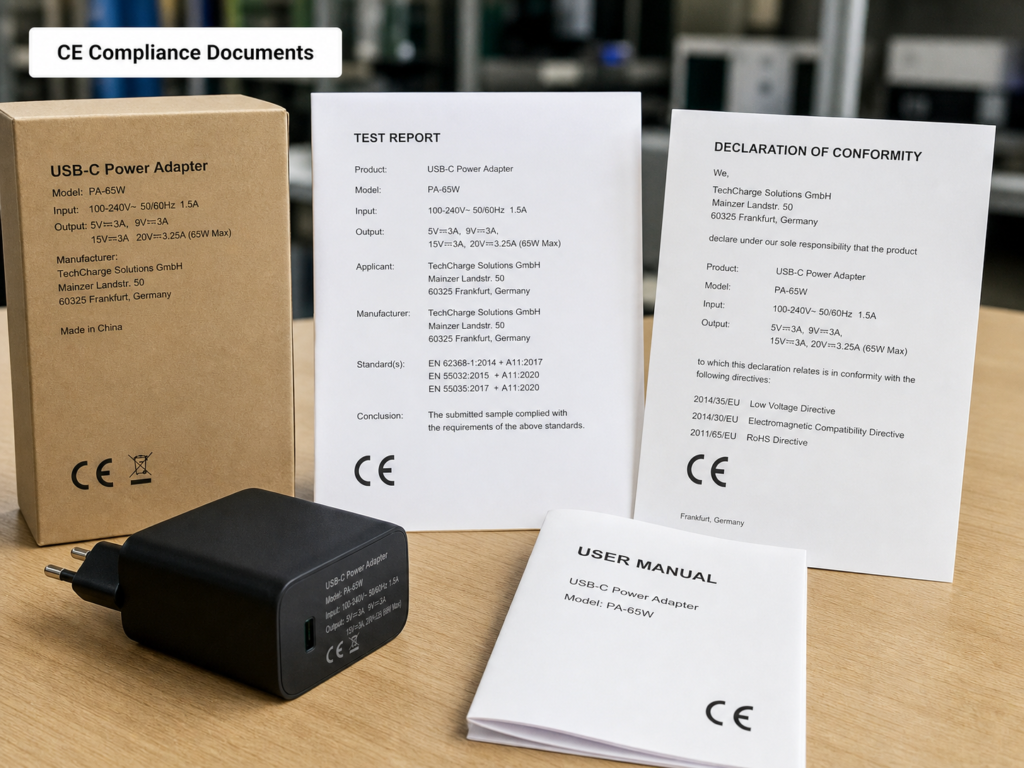
Only products with notified body participation need to mark the notified body’s identification number in accordance with applicable regulations. Ordinary charging products should not mark it randomly, otherwise it will be questioned instead.
Common mistakes include: promoting the CE mark as a certification mark (for example, writing “CE certified product”, when in fact CE is self-declaration), deformed or stretched mark, randomly printing a non-existent notified body number.
Requirements for Instructions and Labels
Necessary rated values, instructions for use, safety information and warnings shall be provided in accordance with each applicable regulation and the requirements of the member state where the product is placed. The specific content depends on applicable regulations, product risks, product types, and the language and implementation requirements of the member state. You cannot take a certain set of content as a unified mandatory label list for all chargers, charging cables and adapters.
For the power, rate, protocol and compatibility range claimed by the manufacturer, it is necessary to ensure that there is corresponding technical evidence and accurately express it in labels, instructions and pages. You cannot mark performance that is not covered by test materials for the sake of publicity.
Compliance Requirements for E-Commerce Pages
Sellers engaged in cross-border e-commerce should pay special attention that e-commerce pages are also the focus of regulatory verification: the product identity, key parameters, manufacturer or importer information and compliance declarations on the page must not contradict the technical documentation and physical products. For example, if your page says 65W fast charging, but the document tests 45W, you need to complete the corresponding compliance assessment first, and you cannot directly use 65W publicity.
You cannot just put a CE mark on the page without actual compliance documents to support it. Sites in different countries should correspond to local plug specifications, languages, and warning information. For example, the UK site should show UK plugs, and the Polish site should have Polish safety warnings.
Where to Store Documents? What to Do When Faced with Regulatory Inspection
After compiling the documents, it is not over. Archiving and responding to inspections are also important parts of compliance.
Archiving Period and Responsibilities
Manufacturers are usually required to keep technical documentation and DoC for at least 10 years from the date the last relevant product is placed on the market, but the specific requirements of each applicable regulation should be checked. The starting point here should correspond to the specific product model or product, rather than being generally understood as all products sharing a “last date of placing on the EU market” date.
Archiving responsibilities are also divided by entity:
• **Manufacturer**: Usually needs to keep the full set of technical documentation and DoC, ensuring that they can be provided within the legal period.
• **Importer**: Shall keep the DoC and relevant documents in accordance with applicable regulations, and cooperate with regulatory retrieval.
• **Authorized Representative**: Its responsibilities are subject to written authorization and specific regulations. After being designated, it shall perform the obligations of preservation, provision or cooperation as stipulated in the regulations, and cannot be generalized as “the EU AR can choose whether to keep the documents”.
Usually, they can be stored in paper or electronic form, but it must be ensured that the documents are complete, readable, traceable, and can be provided within the period specified by the competent authority. The storage location and document provision arrangement shall be determined in combination with applicable regulations, the obligations of authorized representatives, importers and other EU responsible economic operators, and cannot be simply asserted that “any location is acceptable”.
Practical Archiving Management Tips
It is easy to get messy when there are many documents. Here are some practical tips:
First, establish a searchable folder structure by “model-version-regulation”, such as “Charger A20-V1.0-LVD”, which can be found with a search;
Second, unify the file naming rules. The file name includes model, version, date, and file type, such as “A20-V1.0-20240501-LVD Test Report”;
Third, set up backup and permissions to prevent file loss and protect trade secrets such as BOM;
Fourth, documents of different versions should be archived separately, retaining a complete change history. Do not delete the old version when the new version comes. If they check the batches you sold before, you will be in trouble if you cannot produce them.
How to Respond to Regulatory Document Requests
Regulatory requests are usually triggered by several scenarios: customs spot checks, market surveillance department inspections, consumer complaints or accident investigations. The other party will require you to provide documents within a specified period. You can submit the electronic version first, and then submit paper documents or other specified forms of materials if necessary.
When responding, follow these three steps: first confirm the institutional identity of the other party and the scope of documents requested, do not give out all materials; then provide complete and consistent documents, do not cobble them together; finally keep the submission records, such as emails, courier tracking numbers, to prove when and what you submitted.
If the initial verification fails, you will usually be given a chance to make corrections within a time limit. In serious cases, sales may be suspended or entry may be prohibited, so you must take it seriously.
Common Pitfalls to Avoid and Quick Self-Check List
Finally, we have sorted out the most common pitfalls for charging products, as well as a quick self-check list to help you find problems in advance.
High-Frequency Practical Pitfalls for Charging Products
• **Document content pitfalls**: Changed the product power or circuit solution, but did not update the technical documentation; the power advertised for fast charging cables exceeds the range covered by the test, for example, the test is 30W, but the advertisement is 100W.
• **Evidence chain pitfalls**: The tested model is inconsistent with the mass-produced one, for example, the tested is the high-end version with fast charging, but the sold is the reduced version; only the standards used are listed, without corresponding risk analysis and test results.
• **Archiving pitfalls**: Without clear authorization and responsibility arrangement, thinking that the EU AR will automatically save the documents for you; the product is updated, but the archived documents are not updated simultaneously.
• **Publicity pitfalls**: The power and fast charging protocol advertised on the page are inconsistent with those in the technical documentation, for example, it says it supports PD3.1, but actually only PD3.0 has been tested.
Common Consequences of Non-Compliance
If the CE technical documentation is non-compliant, in mild cases, you will be required to make corrections within a time limit, suspend sales or entry, or have goods detained; in serious cases, you will be required to delist, recall, or withdraw from the market, and there may be fines; in particularly serious cases, it will also affect your subsequent market access for similar products, such as being included in the regulatory key list.
Quick Self-Check List
You can quickly check your compliance status against these items:
1. **Scope of application self-check**: The regulation list is complete, and non-applicable items have clear exclusion reasons.
2. **Document content self-check**: There are no missing mandatory materials, and the evidence chain corresponds completely.
3. **Consistency self-check**: The content related to product identity, key parameters, subject information and compliance declarations in technical documentation, test reports, DoC, physical products, packaging, and e-commerce pages do not contradict each other.
4. **Archiving self-check**: The archiving period meets the requirements, the responsible person is clear, and the documents can be quickly retrieved within the specified period.
5. **Charging product special self-check**:
• Chargers: Complete energy efficiency reports, risks such as insulation and overheating are covered, and all fast charging modes have been tested;
• USB-C products: If the product falls under the applicable categories listed in RED and UCR, there must be a corresponding interface compliance report, and pay attention to the applicable time;
• Charging cables: The claimed parameters are consistent with the test results, and common risks such as bending and tension are covered.
After reading this article, you should be able to independently determine the CE scope of application and corresponding regulations for charging products, prepare technical documentation in accordance with the actually applicable regulations of the product, and avoid common beginner mistakes; you can also apply serialization rules to reduce compliance costs, properly manage document archiving, version control and change assessment, and respond in a standardized manner to regulatory inspections; you can also use the self-check list to verify issues in advance and reduce compliance risks for exporting to Europe.