
Many sellers of chargers, USB-C cables, and power adapters often focus all their attention on CE compliance and USB-C port requirements when first entering the EU market. It is not until they are required by e-commerce platforms to fill in “EU Authorized Representative (AR)” information, or when they are asked about the responsible entity within the EU during customs clearance and market supervision, that they discover there is still this process to be verified.
But in fact, not all charging products entering the EU must separately find an authorized representative. The core logic is: first confirm which EU regulations apply to the product, what obligations the manufacturer and importer each bear, and whether there is already a qualified responsible economic operator within the EU, then decide whether to additionally appoint an AR. If you reverse the order, you will either waste money for nothing, or have an incomplete responsibility arrangement without knowing it.
First, Understand: Do You Actually Need an AR?
Before talking about ARs, we need to first understand a more basic concept: **responsible economic operator**.
In plain terms, for products subject to relevant EU product regulations and market surveillance rules, there needs to be a qualified EU-based entity on the EU market that can contact regulatory authorities and perform specified tasks. This entity is not a unified “chief compliance officer” role, nor does it necessarily bear all compliance responsibilities for the product.
Depending on specific regulations and sales arrangements, the responsible economic operator may be:
• Manufacturers established within the EU;
• Importers who place products from third countries on the EU market;
• Authorized representatives appointed in writing by non-EU manufacturers;
• Fulfillment service providers that meet requirements under specific conditions.
Therefore, **an AR is only one of the possible arrangements for a responsible entity, is not equivalent to a responsible economic operator, and does not automatically replace the statutory obligations of manufacturers, importers, or other entities**. Which set of rules applies specifically must be verified item by item in combination with product type, sales method, time of placing on the market, and applicable regulations.
Whether an AR is Needed Depends on Three Aspects Simultaneously
You cannot draw a direct conclusion using a set of “three conditions” applicable to all products. Whether it is necessary to appoint an AR usually depends on the following three aspects first:
1. **Manufacturer’s location**: Whether the manufacturer is established within the EU, and whether specific product regulations accept entities from other European countries as responsible entities. You cannot directly treat “EU” and “EEA” as completely identical in all regulations; whether Norway, Iceland, and Liechtenstein apply must be confirmed in combination with specific regulations and local implementation rules;
2. **Market and sales method**: Whether the product is actually placed on the EU market, including offline sales, e-commerce platforms, independent websites, and shipping from EU overseas warehouses to local consumers, etc.;
3. **Whether a suitable responsible entity already exists**: Whether there is already an EU manufacturer, an importer that assumes importer obligations in accordance with the law, a written authorized representative, or a fulfillment service provider in applicable cases.
For products subject to Article 4 of the Market Surveillance Regulation (EU) 2019/1020, if a non-EU manufacturer does not have another eligible responsible economic operator within the EU, it is usually necessary to meet the responsible entity requirements through an EU importer, a written authorized representative, or a fulfillment service provider in applicable cases. But this does not mean that all products must separately appoint an AR.
Exclusive Applicable Rules for Charging Products
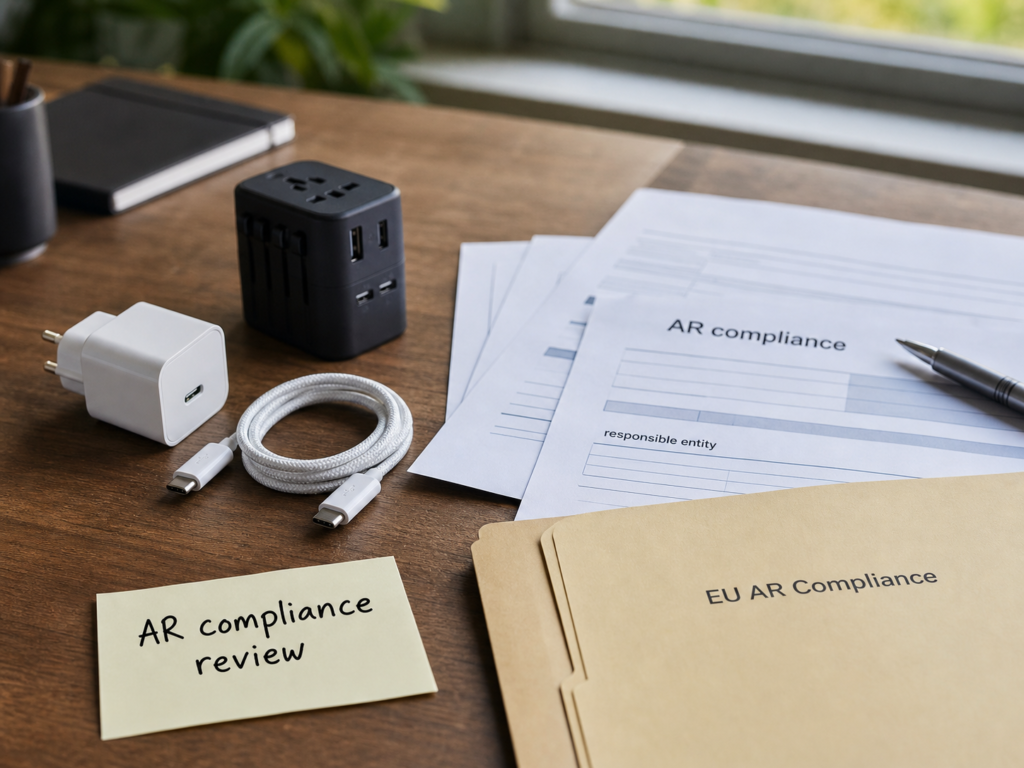
Many sellers struggle with this question: Does my USB cable need an AR? Here, you cannot only look at whether the product has a chip, nor can you automatically apply all electrical and electronic product regulations just because the product is called a “charging cable”. The key depends on the product’s circuit, rated voltage, whether it has active electronic functions, and the definition and scope of each specific regulation.
• **Chargers and power adapters**: Usually need to verify regulations such as Low Voltage, EMC (Electromagnetic Compatibility), and RoHS separately. Whether a notified body is required to participate also depends on the conformity assessment procedure of the specific regulation;
• **USB cables with E-Marker chips**: E-Marker is an electronic device or identification function in USB Type-C cables. It alone cannot determine whether the cable is subject to the Low Voltage Directive, EMC Directive, or all electrical and electronic product regulations. It needs to be judged item by item in combination with the cable’s circuit, rated voltage, and active functions;
• **Purely passive charging cables without electronic components**: If there are no chips or circuits, only wires and connectors, you cannot simply say that an AR is definitely needed or definitely not needed; it should be verified separately according to the target market and applicable regulations.
For example, the Low Voltage Directive usually covers equipment within the range of 50–1000 V AC or 75–1500 V DC, and many USB cables do not automatically fall within the scope of this directive. RoHS, EMC, and other requirements also need to be judged separately. Only after the product is indeed subject to relevant harmonized regulations will the EU responsible economic operator be further arranged.
These Situations May Not Require Separate Appointment of an AR
If any of the following situations apply, you may not need to spend extra money to find an AR, but you still need to check specific regulations and sales arrangements:
• Products brought into the EU in small quantities for personal use, such as tourists carrying a few chargers for their own use;
• The manufacturer itself has an entity in the EU and performs corresponding responsibilities on its own in accordance with the law;
• There is an importer legally established in the EU. Importers usually assume corresponding importer obligations because they import from third countries and place products on the EU market, and may meet the requirements of a responsible economic operator, but this does not replace the manufacturer’s assumption of full product compliance responsibility;
• Only sold to non-EU European markets such as Switzerland and the United Kingdom. EU AR arrangements usually do not cover the UK, and Northern Ireland needs to be confirmed separately according to applicable UK and Northern Ireland rules;
• Goods that are purely in transit and not sold on the EU market, such as those only transshipped through EU ports to other countries.
If you already have an importer, don’t just look at whether the other party has signed a confirmation letter “willing to assume responsibility”. The importer’s identity and corresponding statutory obligations usually come from their actual import and market placement behavior, and you cannot transfer all the manufacturer’s obligations to the importer solely through contractual declarations.
Literacy: Don’t Confuse the 7 Types of Roles in EU Compliance
When many sellers first come into contact with EU compliance, they confuse the responsibilities of importers, distributors, logistics providers, and ARs. In the end, either no one takes responsibility, or they spend money on useless services. The table below clarifies the 7 most common roles in EU compliance to help you avoid responsibility confusion:
| Role Name | Core Identity | May Assume Responsibilities Related to Responsible Economic Operator? | Core Responsibility Boundaries |
| Responsible Economic Operator | Category of EU-based entities that assume specified market surveillance contact, documentation and other obligations under applicable regulations | Depends on its identity and applicable regulations | May be an EU manufacturer, importer, written authorized representative, or fulfillment service provider under specific conditions |
| Authorized Representative (AR) | A third party appointed in writing by a non-EU manufacturer | May assume specific tasks stipulated by regulations within the scope of authorization | No need to own the product’s title; specific obligations depend on applicable regulations and the scope of written authorization |
| Importer | An EU-based entity that places products from third countries on the EU market | Usually assumes importer-related obligations in accordance with the law and may meet the requirements of a responsible entity | Responsible for fulfilling importer obligations stipulated by applicable regulations, and the establishment of this role is not conditional on owning the product’s title |
| Distributor | An EU-based merchant involved in the sale or supply of products | Will not automatically become an AR just because of sales | Mainly performs verification and cooperation obligations in the distribution link; may only assume AR tasks if there is separate written authorization |
| Fulfillment Service Provider (Overseas Warehouse/Logistics Provider) | An entity that provides warehousing, packaging, or delivery services | May become a responsible entity under specific regulations and conditions, but does not automatically become an AR | Usually only responsible for agreed warehousing and delivery work; whether it assumes regulatory responsibilities depends on actual services and applicable rules |
| Producer Responsibility Organization (PRO) | An institution responsible for producer responsibility matters such as environmental recycling | Usually does not assume AR responsibilities | Mainly handles environmental recycling such as WEEE and extended producer responsibility, which is different from AR tasks |
| Notified Body (NB) | An institution that conducts third-party assessment in the conformity assessment procedures of specific regulations | Whether it can undertake other services must be judged according to specific regulations, designated scope, and independence requirements | Not all charger or adapter CE compliance must go through an NB, and an NB is not equivalent to a general “testing and certification institution” |
The Three Most Common Responsibility Misconceptions
We need to emphasize this point specifically: many sellers fall into pitfalls because they get these logics reversed:
1. **An AR is not a substitute for product manufacturing responsibility**: The manufacturer still bears the main obligations for product design, manufacturing, conformity assessment, and product liability. An AR usually does not assume the manufacturer’s product manufacturing responsibility, but may be liable in accordance with applicable laws and contracts for unfulfilled statutory or contractual obligations within the scope of its authorization;
2. **Having an AR does not mean the product is compliant**: An AR only undertakes compliance tasks within the scope of authorization, and cannot replace processes such as conformity assessment, technical document compilation, and Declaration of Conformity (DoC). The CE mark is also not a unified “CE certification certificate”;
3. **Distributors and logistics providers will not automatically become ARs**: Even if the other party helps you sell goods or ship goods, without formal written authorization and actual performance arrangements, they cannot be directly regarded as your AR.
Don’t Misunderstand the CE Mark and Notified Bodies Either
Notified Bodies (NBs) only intervene when specific regulations and conformity assessment procedures require third-party participation. Taking the Low Voltage Directive as an example, manufacturers can usually use internal production control without needing an NB to issue a certificate.
The CE mark usually indicates that the manufacturer has completed the applicable conformity assessment and signed the DoC, and does not mean that the EU has uniformly issued a “CE certification certificate”. Therefore, the responsibilities of ARs, testing laboratories, notified bodies, and manufacturers cannot be confused.
How to Choose an AR for Charging Products? Complete Guide to Selection and Due Diligence
After confirming that you need or plan to appoint an AR, the biggest headache is how to choose a reliable one. After all, the AR’s contact information may appear on the product, packaging, or accompanying documents; if you find an entity that cannot actually perform its duties, regulatory notifications may not be conveyed in a timely manner, and platform reviews may also have problems.
Basic Qualifications and Capabilities That Should Be Verified
First, the following basic conditions must be verified:
1. Whether the AR is established in the jurisdiction required by applicable regulations;
2. Whether it has a real postal address and electronic contact information that can receive regulatory notifications;
3. Whether it has a compliance contact person who can actually perform the authorized tasks and corresponding capabilities;
4. Whether it can save or provide required documents such as DoC and technical documents in accordance with applicable regulations;
5. Whether it agrees to sign a formal written authorization agreement with you.
Regulations usually focus on whether the AR can truly perform the authorized tasks. There is no general requirement that the AR must have its own office space, nor is there a unified regulation that it must be equipped with “full-time” personnel. Whether a virtual address is qualified depends on whether it is a real and valid legal contact address, and whether the service provider can indeed receive notifications, retrieve documents, and cooperate with supervision.
The document retention period cannot also be uniformly written as “10 years after the last batch of all charging CE products is placed on the market”. Different regulations may have differences in document types, retention periods, and starting points. For products subject to Article 4 of the Market Surveillance Regulation, required documents such as technical documents and DoC usually need to be retained for 10 years after the product is placed on the market in accordance with relevant regulations; the specific period shall still be subject to the regulations applicable to the product.
Exclusive Evaluation Dimensions for Charging Products
Meeting basic conditions is only the foundation. To find an AR suitable for the charging category, you also need to look at these points:
• Familiar with charging-related compliance requirements, such as Low Voltage, EMC, RoHS, and rules related to the USB-C unified interface;
• Has practical experience in regulatory random inspections and complaint handling for consumer electronics and charging categories, and can cooperate in a timely manner when encountering platform reviews or regulatory investigations;
• Can understand test reports, Declarations of Conformity (DoC), and technical documents of charging products;
• Understands the CE compliance document upload requirements of mainstream e-commerce platforms, and can distinguish between platform rules and EU regulatory requirements;
• Can clearly state which regulatory tasks it undertakes, and which matters are still the responsibility of the manufacturer, importer, or other entities.
How to Choose Among the Three Common Types of AR Service Providers?
There are three main types of AR service providers on the market, each with advantages and disadvantages. You can choose according to your own situation:
| Type of AR Service Provider | Advantages | Disadvantages | Suitable For |
| Third-Party Compliance Consulting Firm | Professional, flexible, highly independent, usually rich in experience in the charging category | Moderate cost, requires time to screen reliable institutions | Small and medium-sized sellers, brand owners who want stable and independent services |
| Local European Importer/Distributor | May waive separate service fees, familiar with channel situations | Poor independence; after cooperation ends, responsibility arrangements and information need to be reconfirmed | Sellers who are long-term bound to importers and have a single channel |
| European Law Firm | Strong compliance, good ability to handle legal risks | High cost, familiarity with technical details of charging products may vary | Large brands, scenarios involving complex legal disputes |
Three Types of High-Risk ARs Must Be Avoided
When choosing an AR, avoid these three types directly, don’t be greedy for cheap prices:
1. **Shell AR**: Only has an address that cannot effectively receive notifications, has no actual performance capability, or uses the address of an unauthorized distributor;
2. **Ultra-low-price counterfeit AR**: Charges far below the normal market level, but cannot clearly explain document retention, regulatory notifications, and scope of responsibility;
3. **AR with unfair terms**: Requires you to bundle their certification services, and even requires the transfer of product intellectual property rights; don’t sign such contracts lightly.
Reference for Fees and Timelines
AR fees and timelines are mainly based on commercial agreements, and there is no statutory unified price. Here is a market reference range for you:
• **Fees**: The annual fee for a single model of charging product is generally between several hundred to several thousand euros, depending on the number of products, complexity, and service content. For example, if you have 10 models, it usually requires more management than 1 model; if you also need to handle complaints, random inspections, or additional documents, the fee may also increase;
• **Timeline**: If documents are complete, written appointment or issuance of commercial confirmation documents can generally be completed within 1–5 working days; if supplementary materials are needed, the time will be extended accordingly;
• **Hidden cost check**: Before signing, be sure to ask clearly: Is there an extra fee for regulatory inquiries? Do you charge extra for new models? Do you need to pay separately for document translation? Is platform document assistance included in the annual fee?
Core AR Due Diligence Checklist
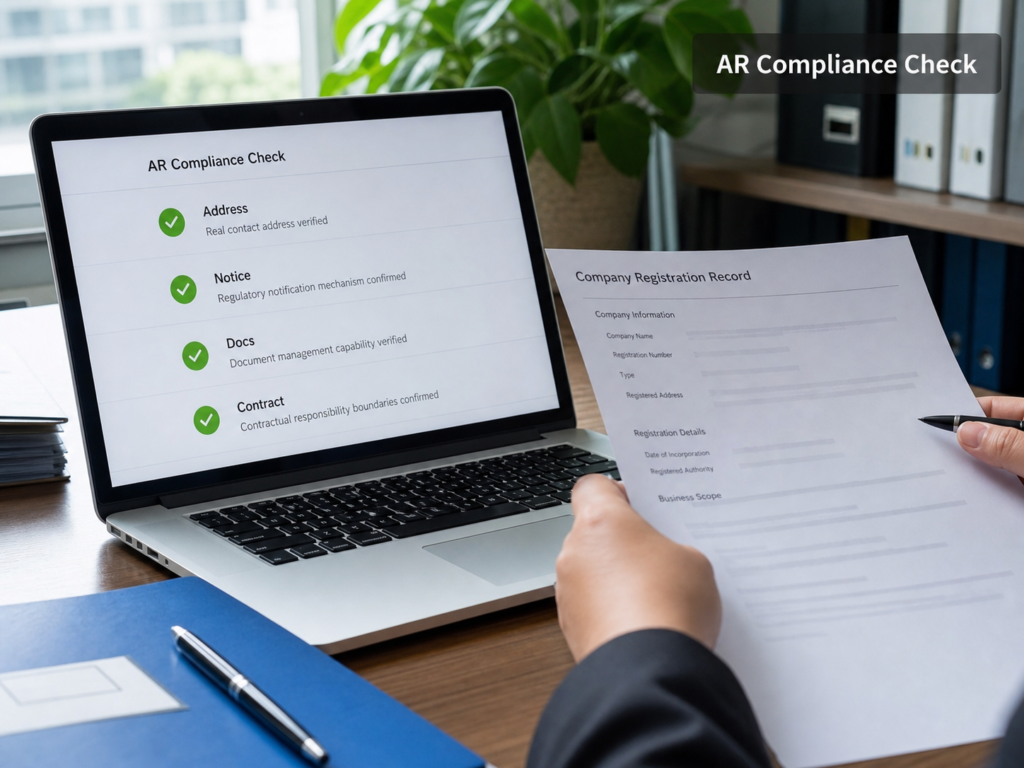
When choosing an AR, you can check item by item according to the following 8 items:
1. **Enterprise registration verification**: Go to the public enterprise registration system of the relevant country, such as the German Commercial Register or the French INSEE enterprise database, to check the authenticity and registration status of the other party’s entity;
2. **Actual office and contact person**: Verify whether the other party has a real address that can receive regulatory notifications, and obtain the contact information of a dedicated liaison person, not just a public email address;
3. **Authorization document specification**: Confirm that the other party can sign a formal written authorization agreement and issue authorization confirmation documents when needed;
4. **Document custody process**: Ask clearly how compliance documents are archived, retrieved, and kept confidential, and confirm the retention period according to specific regulations;
5. **Regulatory notification forwarding mechanism**: Understand how regulatory notifications, complaints, and random inspection information are forwarded, and whether there are fixed contacts and traceable records;
6. **Technical capability**: Require the other party to provide 3–5 AR service cases for similar charging products, and ask the liaison to explain their basic understanding of the regulations and documents applicable to your product;
7. **Professional liability insurance**: Ask whether there is compliance service liability insurance. Insurance cannot replace due diligence, but can be used as part of risk management;
8. **Termination and handover rules**: When cooperation expires or is terminated early, how documents are handed over, how to cooperate during the transition period, and how confidential materials are handled must all be clearly written in advance.
Complete AR Processing Flow: Practical Steps for Charging Product Sellers
After choosing an AR, the processing flow is actually not complicated, just follow these four steps:
Step 1: Sort Out the Materials Before Processing
Don’t rush to talk to the AR. First sort out your own situation, which can save a lot of back-and-forth communication time:
• Organize the product list: Classify by model, brand, and category, for example, list chargers, data cables, wireless chargers, and battery-powered charging devices separately, as different categories have different compliance requirements;
• Sort out compliance documents: Organize CE-related test reports, Declarations of Conformity (DoC), technical document summaries and other materials by product type;
• Clarify requirements: For example, which countries you want to sell to, whether you need to cover e-commerce platforms, and how many new models you expect to add later. All these must be clearly stated in advance to facilitate the other party’s accurate quotation.
Incomplete documents may result in products not being legally placed on the market, but this does not mean that the AR authorization agreement itself cannot be signed. After the written authorization agreement takes effect, the AR can collect, verify, and retain materials such as DoC and technical documents in accordance with specific regulations and contract requirements.
Step 2: Screening and Verification of Candidate ARs
Find 2–3 candidates through channels such as industry association recommendations, compliance service provider platforms, and reliable peer recommendations, then verify them one by one according to the due diligence checklist mentioned above. Focus on confirming the authenticity of the entity, experience with similar products, service scope, and fee details. Only proceed to further discussions if there are no issues.
Step 3: Signing the Contract and Submitting Materials
After reaching an agreement, first sign a written authorization agreement. Be sure to clearly write the scope of authorization, term, and responsibility boundaries; do not sign a blank contract. Then submit the processing materials, which generally include your company’s business license, product model list, CE-related compliance documents, power of attorney, etc.
After receiving the materials, the AR can review the completeness in accordance with the contract and inform you of the content that needs to be supplemented. The core of the written authorization relationship is the appointment document and the scope of authorization between the manufacturer and the AR, not a single official certificate in a unified format.
Step 4: Authorization Implementation and Pre-launch Verification
After completing the written appointment, the authorization agreement and necessary authorization confirmation documents should be retained. There is no unified official AR authorization certificate in the EU; the confirmation letter required by the platform is a commercial or platform document and cannot replace the written authorization, DoC, and other compliance documents required by regulations.
You can do a final check before launch:
• Whether the AR’s name, address, and electronic contact information are consistent with the agreement and applicable regulatory requirements;
• Whether all product models to be sold are within the scope of written authorization;
• Whether the information between the manufacturer, importer, and AR matches each other;
• Whether product labeling, packaging, accompanying documents, and online pages comply with specific regulations and platform requirements.
Core Boundaries That Must Be Clarified in the AR Contract (To Avoid Disputes)
Many sellers only look at the price when signing an AR contract, and only find out that nothing is stipulated in the contract when problems arise later, making it impossible to resolve disputes. These core points must be written into the contract:
Clear Division of Responsibility Scope
First clearly write “what to do and what not to do” to avoid mutual blame later:
• **What an AR usually does**: Save or provide documents required by regulations within the scope of authorization, forward regulatory inquiries, cooperate with random inspections, corrective measures, and recalls, and forward safety complaints as agreed;
• **Work that an AR usually does not replace**: Product design and manufacturing, conformity assessment, product quality and product liability, customs clearance and tax payment, title management, and environmental recycling, etc.
Manufacturers cannot transfer their obligations for product design, manufacturing, conformity assessment, and product liability by appointing an AR. On the other hand, an AR is not completely without responsibility: if the AR fails to perform statutory obligations within the scope of authorization, fails to forward regulatory notifications in a timely manner, fails to provide documents that should be retained, or breaches the contract, it may be liable in accordance with applicable laws and the contract. The specific scope of compensation cannot be generalized and should be determined in combination with applicable laws, contract terms, and insurance arrangements.
Response Timelines and Document Management Rules
• **Response timeline**: Agree on the response time for general inquiries and emergency incidents, but note that the statutory regulatory deadline takes priority. When the regulator requires a response within 7 days, you cannot delay it just because the contract stipulates 10 days;
• **Document retention**: Clarify which documents need to be retained or provided by the AR, and confirm the retention period and starting point in accordance with each specific regulation. For products subject to relevant market surveillance rules, required documents such as technical documents and DoC usually need to be retained for 10 years after the product is placed on the market;
• **Update and handover**: When the product is redesigned, parameters are changed, or applicable regulations change, notify the AR in advance to confirm whether the authorization and documents need to be updated. When cooperation ends, the AR shall hand over relevant documents as agreed and assume confidentiality obligations.
Fee and Change Rules
• Clearly write the specific service items included in the annual fee, so that you don’t end up being told that this is not included and that is charged separately;
• Clarify the charging standards for new models, new sales countries, additional services, and document translation;
• Agree on transition arrangements for replacing the AR, such as how to handle old inventory packaging, how to update platform information, and how to switch regulatory docking, to avoid a gap in responsibility during the replacement period.
Confidentiality and Accountability
• Clarify the AR’s confidentiality obligation regarding the manufacturer’s technical documents and business information;
• Agree on the responsibility determination and compensation scope when losses are caused by the AR’s negligence, which can be determined in combination with the other party’s professional liability insurance;
• Clearly write that the manufacturer bears the main responsibility for the product’s quality and compliance, but this does not affect the AR’s corresponding responsibility for its own authorized tasks and contractual obligations.
Post-launch AR Compliance Maintenance and Risk Response
Many sellers think that everything is fine once they have an AR, but that’s not the case. Inadequate post-launch maintenance can also lead to problems such as platform reviews, regulatory inquiries, sales restrictions, or recalls.
Where Should AR Information Be Labeled?
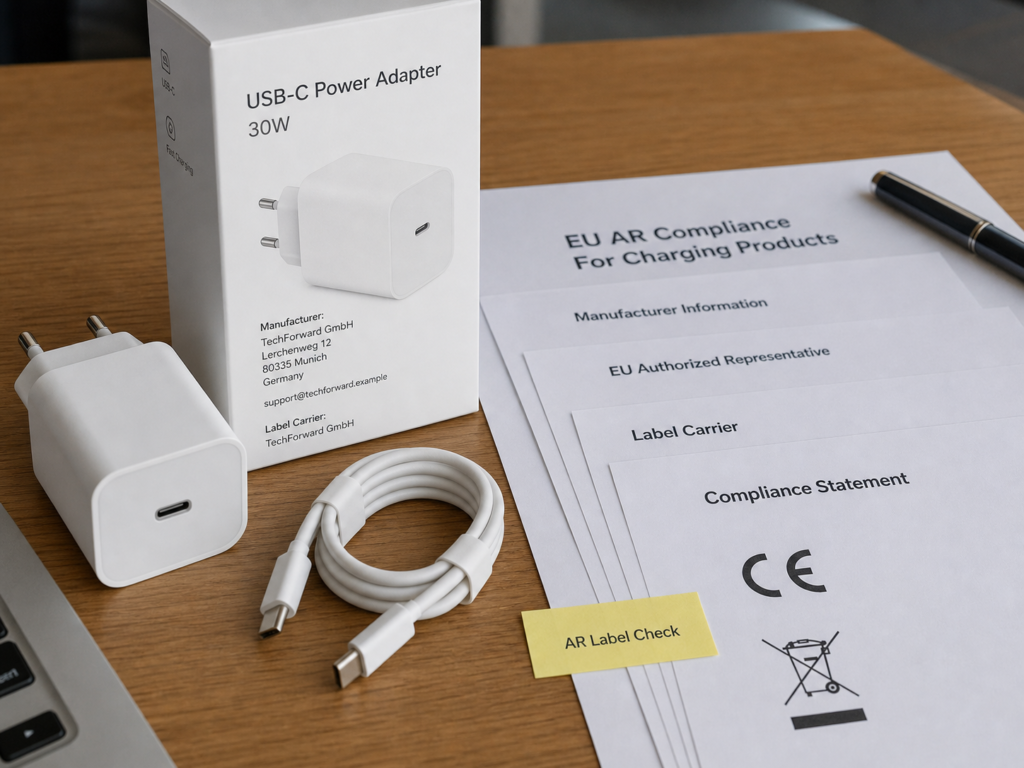
The carrier and format of AR information are not the same for all charging products. In accordance with each specific regulation applicable to the product, you should verify the name, registered trade name or trademark, postal address, electronic contact information, and allowed labeling carriers that the manufacturer, importer, and other responsible entities need to provide.
Generally, the following locations need to be checked with emphasis:
• **Product itself**: Some regulations may require information such as the manufacturer or importer to be labeled on the product; whether smaller products can provide the information on the packaging or accompanying documents instead must be confirmed according to specific regulations;
• **Product packaging**: May be an alternative carrier when the product itself cannot be labeled, but you cannot generally say that all products must have the full AR name and the words “Authorized Representative (AR)” labeled on the packaging;
• **Accompanying documents**: Whether manuals, warranty cards, etc. need to provide responsible entity information must be checked according to specific regulations and product conditions;
• **Declaration of Conformity (DoC)**: The DoC needs to include the content required by applicable regulations, but not all CE products uniformly require AR information to be listed separately;
• **Online product pages**: For online display obligations, distinguish between EU regulations and platform rules. For online sales subject to the General Product Safety Regulation (EU) 2023/988, the information requirements for manufacturers and responsible persons must also be verified in accordance with Article 19; information additionally required by the platform belongs to platform rules.
Therefore, you cannot treat “all products must have AR labeled on the product itself, packaging, manual, DoC, and online product page” as a unified rule. Regulations also do not require all products to use the fixed label “Authorized Representative (AR)”.
Mistakes to avoid include:
• Only leaving an email address or phone number, but no address information required by regulations;
• Using a false or invalid address that cannot effectively receive regulatory notifications;
• The labeled name and address are inconsistent with the written authorization or other responsible entity information;
• Labeling product models that exceed the scope of written authorization;
• Treating the AR confirmation letter required by the platform as an official compliance certificate.
These Situations Require Reconfirmation of AR Arrangements
If you encounter the following situations, you should promptly check whether the authorization scope and labeling are still accurate:
• Replaced the AR service provider;
• Added new product models, or the core redesign of the product exceeds the original scope of written authorization;
• The AR’s own legal name or address has changed, making the existing labeling no longer accurate;
• Added new sales countries, but the original AR’s authorized territory, local regulations, or platform requirements have not been confirmed.
Adding new sales countries does not necessarily require replacing the AR. If the original authorization scope, applicable regulations, and AR’s performance territory already cover that country, you may only need to confirm and update the internal product list. Whether a change is needed should be judged based on the authorization agreement, specific regulations, and national implementation requirements.
When changes occur, authorization documents and related labeling must be updated in accordance with specific regulations and transition requirements. There is no unified deadline by which all products must immediately update all carriers at the same time.
High-Frequency AR Compliance Risks and Consequences for Charging Products
Charging products often need to provide compliance materials during platform and market supervision processes. These risks must be noted:
• **AR cannot be contacted or loses performance capability**: May lead to blocked platform reviews, poor regulatory contact, and products facing measures such as sales restrictions;
• **Incomplete retention of compliance documents**: May trigger corrections, restrictions or suspension of sales, market withdrawal, recalls, or administrative penalties;
• **Incorrect AR information labeling**: May lead to platform link removal, regulatory rectification requirements, or sales restrictions;
• **Delayed handling of safety complaints**: May expand risks and increase the possibility of corrective measures, recalls, or penalties.
The specific consequences depend on the nature of the violation, the product risk level, the member state’s implementation laws, and the decision of the competent authority. It cannot be generalized that a fine will definitely be imposed based on the sales amount involved, nor can it be said that incomplete documents or labeling errors will definitely lead to direct mandatory recall.
What to Do When Encountering Regulatory Random Inspections or Safety Complaints?
Don’t panic if you actually encounter random inspections or complaints. The key is to establish a collaboration process, rather than simply pushing everything to the AR:
1. **Notify relevant entities in a timely manner**: The party that actually receives regulatory inquiries, consumer complaints, or safety incident information shall promptly notify the AR, manufacturer, importer, distributor, and platform;
2. **Provide materials**: Provide DoC, technical documents, test materials, and samples of the corresponding products as required by the regulatory authority or collaborating party;
3. **Fulfill respective obligations**: Report to the competent authority in accordance with specific regulations, and formulate and implement rectification, corrective measures, or recall plans;
4. **Retain records**: Keep records of communication, rectification, verification, and recalls, and update technical documents and internal compliance files when needed.
The AR can assist in contacting regulatory authorities and forwarding documents within the scope of authorization, but cannot automatically become the only window for all regulatory inquiries and consumer complaints, nor can it replace the reporting, correction, and recall obligations that manufacturers, importers, distributors, or platforms bear in accordance with the law.
Three-Stage Compliance Checklist and Core Summary
Three-Stage Compliance Checklist
You can check item by item at different stages according to the list below to ensure that AR arrangements are error-free:
Pre-launch Preparation Stage (Including AR Selection and Processing)
□ The requirements for responsible economic operators have been confirmed according to product type, sales model, and applicable regulations
□ The identities and statutory obligations of manufacturers, importers, and other EU-based responsible entities have been verified
□ It has been confirmed whether an additional AR needs to be appointed, as well as the specific regulations and scope of AR authorization
□ The authenticity, address, contact information, and actual performance capability of the AR entity have been verified through due diligence
□ It has been confirmed that the AR has the service capability for the charging category, and the contract terms are clear
□ A written authorization agreement has been signed, with clear product models and authorization scope
□ Compliance documents (test reports, DoC, technical documents, etc.) are complete and consistent with the mass production version
□ The information requirements for products, packaging, accompanying documents, and online pages have been verified in accordance with specific regulations
□ The information of the manufacturer, importer, and AR matches each other without contradictions
Post-launch Daily Maintenance Stage
□ The AR and other relevant responsible entities have been synchronized before product redesign or new model addition
□ It has been confirmed whether the redesign or new model exceeds the original authorization scope
□ After regulatory inquiries, safety incidents, or complaints occur, relevant entities have notified each other in a timely manner
□ Obligations of reporting, document provision, rectification, or recall have been fulfilled in accordance with specific regulations
□ After compliance documents are updated, archiving has been completed in accordance with contract and applicable regulatory requirements
□ When the AR’s name, address, or authorization scope changes, relevant information has been checked and updated
AR Replacement Transition Stage
□ A written authorization agreement has been signed with the new AR, and necessary document handover has been completed
□ Relevant product, packaging, manual, or online information has been updated in accordance with specific regulations and transition requirements
□ AR change information has been synchronized with e-commerce platforms and relevant regulatory docking parties
□ The old AR has completed document handover, confidential processing, or destruction as agreed
□ It has been confirmed that there is no gap in responsible entities or omission of regulatory notifications during the replacement period
Core Summary
Finally, we extract the most critical content to facilitate your quick mastery:
• **Must-know for beginners**: For charging products that are actually placed on the EU market and subject to relevant product safety and market surveillance rules, it should be confirmed that there is a responsible economic operator within the EU that meets the requirements of applicable regulations. This entity may be an EU manufacturer, importer, written authorized representative, or fulfillment service provider under specific conditions;
• **AR is not an automatically mandatory option**: Whether an AR needs to be appointed should be judged in combination with specific product regulations, manufacturer’s location, importer identity, product sales model, and scope of written authorization;
• **AR is not equivalent to CE certification**: An AR cannot replace the manufacturer in fulfilling obligations such as product design, manufacturing, conformity assessment, DoC, and technical documents. The CE mark is also not equivalent to a unified CE certification certificate;
• **Advanced judgment**: The authenticity of the AR entity can be verified through the public enterprise registration system of the relevant country, focusing on confirming its real contact address, regulatory notification mechanism, document management capability, and contractual responsibility boundaries. Special caution is needed for ARs whose prices are far below the market level and cannot explain the scope of services;
• **Labeling must be checked according to regulations**: There is no rule that all charging products must uniformly label AR on the product itself, packaging, manual, DoC, and online product page. Platform requirements and EU regulatory requirements must also be judged separately.
After reading this article, you should be able to independently judge whether your product needs a separately appointed AR, screen and verify suitable service providers, complete the written appointment according to the process, and establish post-launch collaboration mechanisms for notifications, documents, and rectification. EU compliance seems complicated, but in fact, as long as you first clarify the regulations applicable to the product, and then sort out the responsibilities between the manufacturer, importer, AR, and platform, you can avoid many detours.