
Have you ever had this experience: when your phone is charging with a charger, the nearby WiFi suddenly slows down, the Bluetooth headset cuts in and out, or even touchscreen devices have random touch jumps? This may be related to electromagnetic disturbance generated by the charger or charging cable, but it may also be caused by network congestion, device compatibility, software faults, or other electromagnetic sources, which needs to be confirmed through device replacement and professional testing. The most core underlying reference for global electromagnetic compatibility testing is the IEC 61000 series of standards issued by the International Electrotechnical Commission. Many merchants print “compliant with IEC 61000” on their promotional pages, but how much value does this statement actually have? What practical impact does it have on our daily chargers, charging cables, and fast charging devices? In this article, we will start from the most basic concepts and move on to advanced pit-avoidance tips, helping you thoroughly understand this set of standard systems closely related to charging products.
Beginner’s Understanding: First Figure Out What IEC 61000 Is
First, let’s talk about the two core concepts. We’ll explain them in plain language first and then mention the terminology, to avoid getting confused by professional terms at the very beginning. The first is electromagnetic compatibility, commonly known as EMC. To put it simply, it is two rules set for all electronic products: first, do not randomly emit electromagnetic interference that affects the normal operation of other nearby devices; second, do not easily malfunction due to external electromagnetic interference, and must have a certain degree of resilience. The second is IEC 61000 itself. It is not a single standard, nor is it a certification that directly issues certificates. It is a complete set of EMC basic standard collections issued by the International Electrotechnical Commission. Its role is more like a globally universal “EMC rule dictionary”. Official certifications of various countries and product standards of different categories mostly reference the test methods and limit requirements in this set of basic standards, and then adjust them in combination with local conditions.
Next, you may ask: charging products are not precision instruments, why pay attention to EMC? In fact, charging devices are precisely high-incidence areas of electromagnetic interference. First of all, ordinary wall-mounted chargers are essentially switching power supplies, which need to convert high-voltage mains power into low-voltage direct current. The internal high-frequency switching action is very easy to generate conducted and radiated interference. In mild cases, it affects wireless devices such as WiFi and Bluetooth, and in severe cases, it may even interfere with surrounding precision electronic devices. Secondly, the commonly used USB-C fast charging cables with E-Marker chips are not only a path for interference propagation, but also easily affected by external interference, leading to fast charging handshake failure and unstable charging. More importantly, low-quality charging products that do not meet EMC standards may even cause safety hazards in scenarios sensitive to electromagnetic interference such as hospitals and airplanes, which is why countries include EMC in mandatory certifications.
When first coming into contact with such standards, many people fall into three common cognitive boundary pitfalls. Let’s clarify them in advance to avoid getting more confused as you read on. First, EMC is not equal to safety standards. It only deals with issues related to electromagnetic interference. Safety requirements such as electric shock prevention and fire prevention are specified by applicable product safety standards. For example, some information technology power supplies apply IEC 62368-1, depending on the product category and target market. Second, IEC 61000 is not a standard exclusive to charging products. It is a general EMC basic standard covering all electronic products, from earphones to industrial equipment, which may reference this set of standards. Third, compliance with IEC 61000 does not mean global universal applicability, because different countries and regions have their own certification systems and localized adjustments. For example, the EMC requirements of the US FCC are different from the IEC system, and cannot be directly equated.
Core Logic: Two Directions of EMC and Interference Paths of Charging Products
After understanding the basic concepts, let’s break down the core logic of EMC. In fact, it is the two rules mentioned just now, corresponding to two professional directions: electromagnetic emission (EMI) and electromagnetic immunity (EMS).
Let’s first talk about electromagnetic emission, that is, the interference emitted by the product itself, which is divided into two types according to the propagation path. One is called conducted emission, which means interference propagates along wires such as power cords and USB charging cables. For example, the interference from a charger runs along the wire into the power grid, affecting other devices on the same power strip. The other is called radiated emission, which means interference propagates through the air like radio waves. For example, placing a charger next to a router and causing WiFi signal deterioration is a typical manifestation of radiated interference. For charging products, the main interference sources usually include the switching power supply power loop, rectifier/PFC circuit, and common-mode current. The switching tubes inside the switching power supply will switch on and off at high speed to change voltage, which may bring out clutter; load changes during fast charging power switching may also generate interference. USB-PD communication and its high-speed data path require appropriate signal integrity and EMC design, but it cannot be generally classified as the main high-frequency EMI source of chargers. Most of the above interferences can be directly perceived by users. For example, static noise on radios, scrolling stripes on screens, Bluetooth audio disconnections, and random jumps of touchscreen phones during charging are all manifestations that may be related to EMI.
Next, let’s talk about electromagnetic immunity, that is, the ability of a product to resist external interference, abbreviated as EMS. There are many common interference sources in daily life: static electricity on the human body after taking off a sweater in winter, surge high voltage induced in the power grid during thunderstorms, radio frequency signals from mobile phone base stations, and electric sparks generated when switching home appliances on and off. All of these will interfere with charging devices. If the immunity of the charger is insufficient, in mild cases, there will be charging interruption, fast charging degradation, and unstable output voltage; in severe cases, it will be directly burned out, and even damage terminal devices such as mobile phones and tablets. The core requirements for immunity are, first of all, no safety risks, such as no fire or electric leakage due to interference; second, if functional abnormalities occur, it is best to automatically recover after the interference disappears, without manual plugging and unplugging to restart.
For charging products, there are three main key channels for interference to enter and exit. First are the USB-C interface and charging plug. These exposed metal parts are channels through which interference such as static electricity can easily enter. When you get an electric shock touching the charging port in winter, static electricity may be coupled into the interior of the charger. Second is the charging cable. Cable length, shielding structure, connectors, and terminal device layout all affect EMC; longer cables may increase coupling risk, but whether a shielding layer is needed should be determined by interface specifications, product design, and test results. Finally, there is the internal circuit of multi-port high-power chargers. Because multiple power circuits are close to each other, they will also generate interference with each other. If the design is poor, the interference when two ports are fast charging at the same time will be much greater than when using a single port.
Overall Structure of the IEC 61000 Series: What the 6 Major Divisions Manage
The IEC 61000 series has dozens of specific standards, divided into 6 major divisions according to their responsibilities. Each division manages a piece of content, and the degree of relevance to charging products is also different. To help you sort it out quickly, we have organized it into a comparison table:
| Standard Division | Core Responsibility | Relevance to Charging Products |
|---|---|---|
| IEC 61000-1 General | Specifies general terms and definitions in the EMC field, as well as the relationship of the entire standard system, equivalent to a “terminology dictionary” | It is the underlying language basis for all EMC tests. Ordinary users do not need to delve into it, nor do they need to conduct separate tests for this part |
| IEC 61000-2 Electromagnetic Environment | Describes different electromagnetic environments and compatibility levels, providing a basis for selecting test levels and product standards | The applicable environment category and level for specific charging products are determined by the corresponding product standards, general standards, and target market requirements |
| IEC 61000-3 Emission Limits | Specifies the maximum allowable value of low-frequency interference on the grid side when products are connected to the power grid | It is the core assessment item for AC input chargers. For example, requirements such as harmonic current and voltage fluctuation all come from this part |
| IEC 61000-4 Test Methods | Uniformly specifies the operation rules, level classification, and result criteria of many common EMC immunity tests | It is the most frequently referenced part of the entire series. The specific test items and methods are still subject to applicable product standards or general standards |
| IEC 61000-5 Installation and Mitigation | Provides reference for engineering design methods to reduce interference such as grounding, shielding, and wiring | Mainly for reference by charger designers. Ordinary users and general consumers do not need in-depth understanding |
| IEC 61000-6 Generic Standards | Specifies general emission and immunity requirements when there is no dedicated EMC product standard, classified by environment | For charging products, dedicated standards are prioritized when available, and the fallback requirements in this part are only referenced when there are no dedicated standards |
In short, the most closely related to ordinary charging products are the 3rd and 4th divisions. One manages the upper limit of external interference emission, and the other manages the methods of many anti-interference tests. The core assessment items we will talk about next basically come from these two divisions.
Core Assessment Items for Charging Products: Corresponding Specific Requirements of IEC 61000
Knowing the overall structure, let’s take a look at the specific items that charging products actually need to be assessed on, all of which are directly related to daily use.
First are the requirements for emission and power quality, mainly from the IEC 61000-3 series, that is, the part that manages low-frequency interference transmitted by products to the power grid. The first core item is harmonic current, corresponding to standard IEC 61000-3-2. In plain language, the mains current is originally a perfect sine wave, but when the charger draws power, due to the working characteristics of the switching power supply, the drawn current is not a standard sine wave, and the extra components of different frequencies are harmonics. Harmonics will pollute the power grid and affect other devices in the same power grid.
IEC 61000-3-2 is mainly applicable to equipment with input current per phase not exceeding 16 A, and specifies limits according to Class A, B, C, D and each harmonic. Chargers should be judged based on their equipment category, input conditions, and applicable version, and cannot be simply judged by 65 W or 600 W whether they are applicable or whether the limits are strict or lenient. Higher-power chargers or multi-port chargers may bring more complex power quality problems, so the test should cover applicable input conditions and working modes, instead of only testing low-power modes.
The second item is voltage fluctuation and flicker, corresponding to standard IEC 61000-3-3. Under specified power supply impedance and test conditions, equipment start-stop, load changes, etc. may cause voltage changes and flicker; whether it exceeds the limit needs to be judged according to the applicable conditions and test results of IEC 61000-3-3. The core indicators of this item are the short-term flicker value Pst and the long-term flicker value Plt. The higher the value, the more obvious the flicker. For charging products, when a multi-port high-power charger fast charges multiple devices at the same time, the total power change is greater, and more attention may need to be paid to relevant limits.
Here we need to specifically mention a boundary that is easy to confuse: what the IEC 61000-3 series controls is the low-frequency interference of products to the power grid, while the radio frequency disturbance that we often say interferes with wireless devices such as WiFi and Bluetooth is specified by the CISPR series of standards. Charging products usually need to meet the requirements of these two types of standards at the same time, and do not confuse the two.
Next are immunity tests, mainly from the IEC 61000-4 series, that is, items that test the anti-interference ability of chargers. Each item corresponds to a scenario that we may encounter in daily life. The first is the electrostatic discharge test, corresponding to IEC 61000-4-2, which simulates the scenario of electrostatic shock when the human body carries static electricity in winter and touches the USB-C interface or metal charging plug. 4 kV contact discharge and 8 kV air discharge are common test settings in some product standards and environment levels, but cannot be used as a unified requirement for all civilian charging products. The actual level also depends on the port, environment category, product standard, and target market. If the immunity is insufficient, in mild cases, charging interruption and fast charging handshake failure will occur, and in severe cases, the port chip will be directly burned out.
The second is the electrical fast transient/burst test, corresponding to IEC 61000-4-4. The name sounds very complicated, but in fact, it simulates the sparks when we plug in a plug, and the fast spike interference generated when switching home appliances (such as hair dryers, electric lights) on and off. 1 kV for power terminals and 0.5 kV for signal terminals are common test settings in some product standards and environment levels, but cannot be used as a unified requirement for all civilian charging products. This type of interference is characterized by short duration but high frequency, which easily causes problems such as charger restart, intermittent charging, and fast charging degradation.
The third is the surge test, corresponding to IEC 61000-4-5, which simulates the instantaneous high voltage induced in the power grid during thunderstorms, or the surge voltage generated when large loads in the power grid are switched. 1 kV line-to-line and 2 kV line-to-ground are also common test settings in some product standards and environment levels. The actual level also depends on port configuration, environment category, product standard, and target market. The energy of surges is much larger than the previous static electricity and transient pulses. If the immunity is insufficient, in mild cases, the fuse will blow, and in severe cases, the charger will be directly broken down, and even damage connected terminal devices such as mobile phones and tablets. This is one of the reasons why it is best not to charge during thunderstorms.
The fourth is the radio frequency immunity test, corresponding to two standards IEC 61000-4-3 and 4-6, which simulates the interference of electromagnetic signals emitted by devices such as mobile phone base stations, WiFi routers, and walkie-talkies. Among them, 4-3 is radiated immunity, which tests the radio frequency interference coming from space; 4-6 is conducted immunity, which tests the radio frequency interference transmitted along power cords and charging cables. If the immunity is insufficient, the charger will have problems such as unstable output voltage, failure to reach fast charging power, and interruption of USB communication.
The fifth is the voltage dip and interruption test, corresponding to IEC 61000-4-11, which simulates the scenario of instantaneous power failure of the power grid, or voltage drop caused by starting large home appliances (such as air conditioners, refrigerators). IEC 61000-4-11 includes tests that reduce the supply voltage to a specified ratio or interrupt it. Common test points include 0%, 40%, and 70%, but the specific voltage level, duration, and number of times shall be subject to applicable standards; equipment with larger input current may apply IEC 61000-4-34. Common failure manifestations are charging stop, failure to automatically recover after interference disappears, and abnormal output voltage.
Of course, there are many other test items in the IEC 61000-4 series, such as power frequency magnetic field, damped oscillatory wave, etc. Whether these items are applicable should be determined according to product standards, installation environment, and target market; some consumer chargers may not require these items, but they cannot be uniformly excluded based on this.
Advanced Interpretation: How to Understand EMC Test Results and Compliance Publicity
If you want to further judge the EMC level of a charging product and not be fooled by the merchant’s promotional rhetoric, you must understand the following advanced knowledge points.
First is the performance criterion of test results. Here we must first emphasize an important premise: as a basic standard, IEC 61000 usually specifies the test method, test level, and performance criterion framework, but the specific state that counts as qualified is determined by the corresponding product standard or the regulations of the target market. Common performance criteria include A, B, and C. The specific definitions and allowed functional degradation are specified by the corresponding product standards. Generally speaking, Class A means that the equipment works normally as expected during the test; Class B usually means that temporary functional or performance degradation is allowed during the test, and it can recover on its own after the test; Class C usually means that function recovery through manual operation is allowed, but whether it is acceptable must be checked against the applicable product standard. Permanent damage is usually not accepted, nor can it be generally referred to as Class D uniformly specified by IEC 61000. Whether charging products are allowed to have short-term abnormalities during the test must be checked against their applicable product standards and the performance criteria in the report.
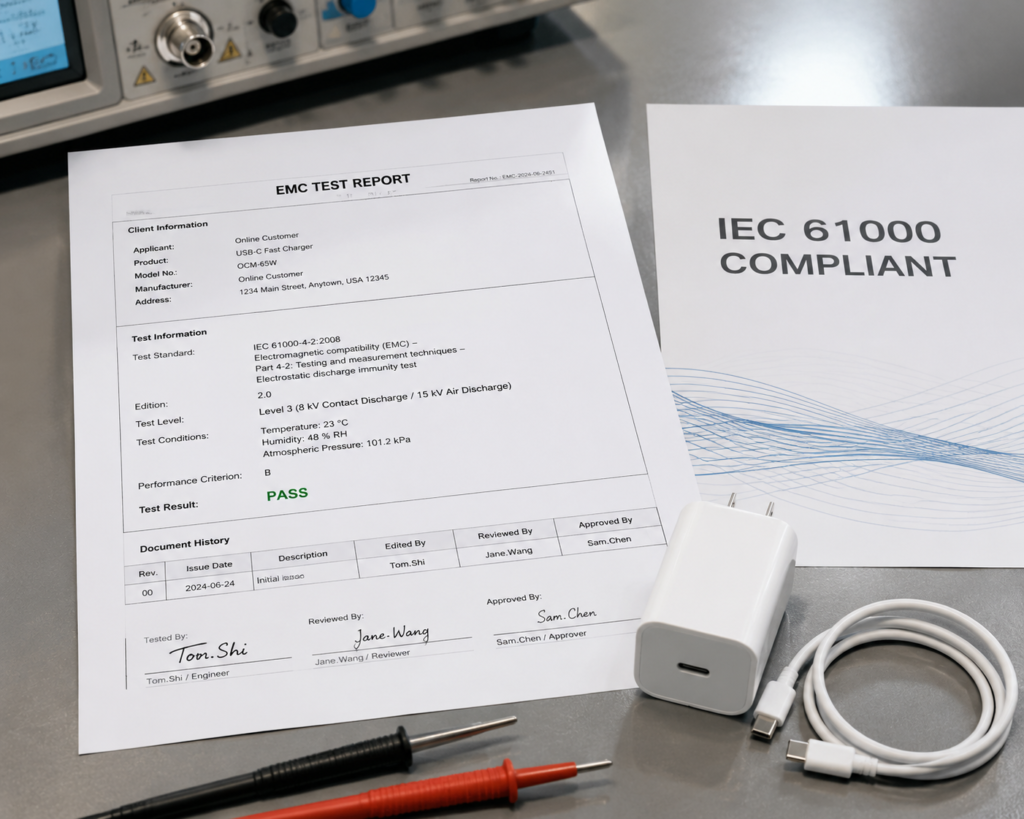
Second are 5 pit-avoidance points when looking at EMC publicity or test reports, each of which can help you filter out most false publicity. First, look at the test object: was the charger tested alone, or the entire system including the charging cable and terminal device? Because the charging cable is also part of the interference path, a single charger being qualified does not mean that the entire system can still meet the standard after you match it with a low-quality cable. Second, look at the standard details: it must be specific to the division and version number. For example, “compliant with IEC 61000-4-2:2008” is valid. Only writing “compliant with IEC 61000” is basically equivalent to saying nothing, after all, the entire series has dozens of standards, who knows which one it complies with. Third, look at the test conditions: for example, whether the input voltage is 110V or 220V, what the test power is, whether the fast charging mode is enabled, and what charging cable is used. If these conditions are different from your actual use, the test results will have no reference significance. Fourth, look at the test level: whether the interference intensity, duration, and covered ports meet civilian scenarios. For example, using industrial-grade test results for publicity is actually unnecessary for ordinary users. Fifth, look at the failure manifestations: if the abnormalities that occur during the test require manual intervention to recover, or even have safety risks, even if the merchant says “passed the test”, the actual use experience will be very poor.
Next, we need to figure out the applicable boundaries of IEC 61000 and not deify it. First, it mainly covers conventional electromagnetic environments such as civilian, commercial, and industrial specified in the standard. Extreme scenarios such as direct lightning strikes or being close to high-voltage transmission towers are not within the scope of the standard. Second, it only assesses EMC performance and does not involve other indicators such as safety, energy efficiency, and fast charging protocol compatibility. Passing the EMC test does not mean that the charger is perfect, and other indicators must also be considered. Third, whether passive charging cables require independent EMC testing and which items to test should be determined according to applicable product standards and market regulations; it cannot be presumed that they only need partial testing or no testing at all just because they have no chip or no shielding layer. In many cases, EMC evaluation is for chargers or complete systems, rather than applying the full set of IEC 61000 tests to cables alone.
Finally, pay attention to regional and version differences. Many EN 61000 standards are based on the corresponding IEC standards, but the specific EN version and its European deviations should be checked; the US FCC mainly relies on FCC Part 15 and designated ANSI test methods, and IEC 61000 compliance cannot directly replace FCC compliance. The specific number, version, and applicable date of the referenced standards should be checked separately; limits, classifications, test methods, or applicable scopes may change in different versions, but they cannot be generally referred to as the “2020 version”, nor can it be asserted that all new versions are stricter for high-power fast charging. IEC 61000-3-2 mainly involves low-frequency harmonics and is not a radiated emission standard. The versions of IEC 61000 referenced by common certifications such as CE, FCC, and CCC may be different. When purchasing, pay attention to the specific requirements of the corresponding target market.
Practical Guide for Ordinary Users: Quick Judgment and Daily Pit Avoidance
Having said so much professional content, ordinary users do not have laboratory equipment, how to quickly judge the EMC performance of charging products? Here are three simple methods. Although they are only preliminary references, they can help you avoid most pitfalls. First, don’t just look at the certification marks on the product. The CE mark only indicates that the manufacturer declares that the product complies with applicable EU regulations, and you need to further check the applicable standards and EU declaration of conformity; for FCC compliance, you should check the applicable FCC rules, test reports, and corresponding compliance procedures, not just the mark. Specific products may apply different standards such as EN 55032, EN 55035, EN 61000-3-2, EN 61000-3-3, etc.
Second, you can do a simple phenomenon check: place the charger next to the WiFi router, charge the phone or tablet at full power fast charging, and observe for a few minutes. If there is no obvious change in Wi-Fi, it only means that no obvious impact is observed under this distance, frequency band, and use conditions, and you cannot judge whether the radiated emission of the charger meets the standard based on this. Home Wi-Fi observation cannot replace standardized conducted emission, radiated emission, or immunity tests. Whether it is compliant must be based on laboratory tests and reports according to applicable standards.
Finally, you can look at the details of the charging cable. Cable shielding and magnetic components may improve EMC in specific frequency bands when designed correctly and matched with terminations, but you cannot judge the quality of the product solely by its appearance. The shielding effect also depends on structure, grounding, common-mode current, connectors, and operating frequency. You cannot simply think that a USB-C cable with a metal braid or magnetic rings at both ends must be much better than an ordinary cable.
Many people have several common misconceptions about the EMC of charging products, let’s clarify them all at once. The first misconception is “if it can charge, it meets EMC requirements”. In fact, even if a low-quality charger can charge, the interference may be very large. In mild cases, it causes WiFi disconnection and Bluetooth lag, and in severe cases, it affects the safety of sensitive devices. “Able to charge” cannot replace compliance. The second misconception is “as long as the charger is qualified, the cable is not important”. In fact, low-quality unshielded fast charging cables will amplify interference and are more likely to receive external interference. Even if the charger itself is qualified, matching it with a poor cable may cause the entire system to fail to meet the standard. This is also the reason why many people still have interference problems after buying expensive chargers.
The third misconception is “the EMC requirements for wireless charging and wired charging are the same”. The coupling mechanisms, applicable frequency bands, and regulatory requirements of wireless charging and wired charging are different, and they should be evaluated separately according to their specific product standards. You cannot simply assert that the radiated emission of wireless charging must be greater, the requirements must be stricter, or there must be more test items, nor can you directly apply the standards of wired charging to wireless charging. The fourth misconception is “if it is marked as compliant with IEC 61000, it has passed all items”. Many merchants may only test one or two of the items and then use the name of the entire series for publicity. Be sure to check the specific test items and standard numbers.
In daily use, there are also several simple tips to reduce the impact of EMC problems. First, try to avoid unbranded products or products that cannot provide compliance documents. The EMC and safety compliance of such products is difficult to confirm, and the use risk is relatively uncontrollable. Second, high-power fast charging is best matched with a reliable charging cable that matches the device. Do not plug several high-power chargers into the same small power strip, otherwise it is not only easy to interfere with each other, but also may increase safety risks. Finally, try to place the charger far away from devices sensitive to electromagnetic interference such as routers, Bluetooth speakers, and hearing aids to reduce the impact of radiated interference.
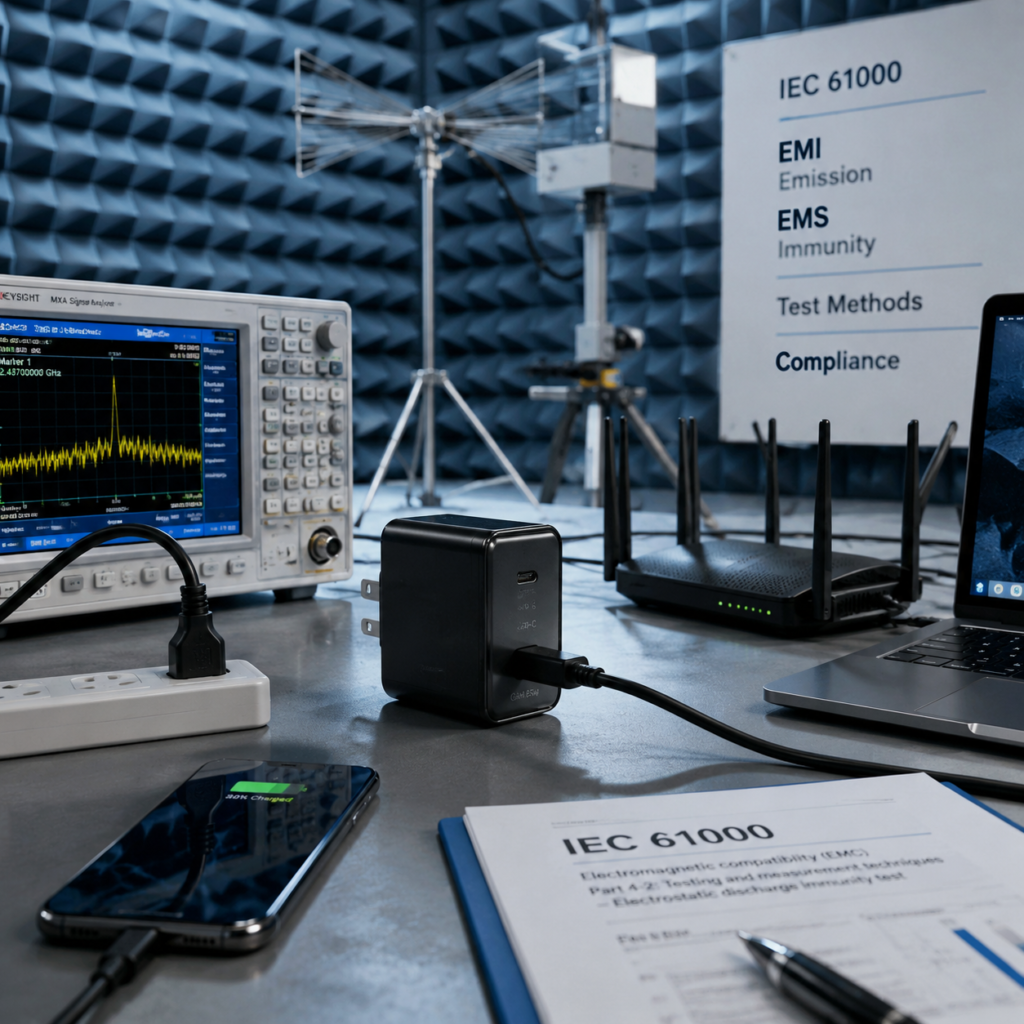
In general, IEC 61000 is the most basic and universal standard collection in the global EMC field, and also the underlying reference for charging product certification in various countries. After reading this article, you can at least independently judge three things: first, you can clearly state the positioning, core composition of IEC 61000, and its relevance to charging products, and will no longer regard it as a single certification; second, you can correspond common EMC problems with the corresponding test items, know where the interference comes from and what impact it will have on charging, and can roughly judge the cause when encountering charging disconnection or WiFi lag; third, you can preliminarily judge the EMC performance of a charging product through certification marks, test materials, and product details, and avoid the merchant’s promotional traps. For ordinary users, understanding these is enough to help you choose more reliable charging products and reduce electromagnetic interference problems in daily use.