
Have you ever encountered this situation: after plugging in a cheap fast charger, your home WiFi suddenly lags so badly it’s like a slideshow, there’s a buzzing static noise in your Bluetooth earphones, or even your phone’s touchscreen operates erratically for no apparent reason? These frustrating problems are most likely related to the product’s failure to meet EMC requirements. For products we use every day, such as chargers, external power supplies, and consumer electronics with digital or wireless functions, EMC not only affects the user experience but is also a common compliance requirement when entering the global market. Passive charging cables generally do not undergo separate whole-device EMC certification, but their combination with chargers and terminal devices may affect the overall test results. Today, we will clearly explain global EMC testing standards from daily use to cross-border compliance — one article is all you need to go from beginner to being able to read reports yourself and avoid pitfalls.
First, Let’s Understand: What Exactly is EMC?
EMC stands for Electromagnetic Compatibility. Simply put, it is the characteristic of a product that, when operating, neither interferes with other external devices nor malfunctions due to external interference. It has two core aspects: one is EMI (Electromagnetic Interference), which means “not disturbing others” — the electromagnetic signal leaked outward by the product must not exceed the allowed limit; the other is EMS (Electromagnetic Immunity), which means “not being disturbed” — when there is external electromagnetic interference, the product must not be damaged or experience functional abnormalities.
Many people think EMC requires products to generate no electromagnetic signals at all, which is a common misunderstanding. Just like cars are not required to make no noise, but their noise must not exceed the legal decibel limit, EMC regulates “not exceeding the limit”, not “complete absence”. EMC requirements commonly apply to chargers, external power supplies, consumer electronics with charging ports, and products with digital circuits or wireless communication functions. Passive USB/USB-C charging cables are usually not independent electronic devices subject to EMC testing, but as accessory cables for chargers or terminal devices, they may affect the overall test results. Whether they are regulated and what requirements apply depends on whether the product contains active electronic circuits, whether it is sold as part of a device, and the regulations of the target market.
Why is EMC Compliance So Important?
First, it is a precondition for market sales: whichever country or region a product is sold in, it must meet local EMC requirements. Non-compliant products may be detained by customs, removed from platforms, or even face fines. Second, it directly determines the user experience: many seemingly unrelated small problems like WiFi speed drops, earphone static, and touchscreen drift may be related to excessive EMI. Finally, it helps ensure charging stability: when a product’s EMS performance is poor, problems such as fast charging handshake failure, abnormal output, and charging interruption may occur.
Concepts Easily Confused with EMC
Many people confuse EMC with other compliance requirements, but they actually cover different matters:
- Difference from electrical safety (UL/LVD/CCC safety part): EMC covers electromagnetic interference and immunity, not safety issues like electric shock or fire, just like a house’s sound insulation standard and fire protection standard are two different things.
- Difference from fast charging protocols (PD, QC, etc.): EMC is not responsible for judging charging power or speed; it only focuses on whether interference is generated during charging or whether the product is affected by interference. Fast charging protocol certification and statutory EMC compliance are different requirements; passing PD/QC certification does not mean EMC compliance, and vice versa, but the fast charging circuit and operating mode will affect EMC results.
- Difference from certification marks (CE, FCC, KC, etc.): These marks are labels used after the product completes the relevant compliance process, not separate EMC test items, just like a graduation certificate is proof of completing studies, not the exam itself.
What Exactly Does EMC Testing Measure?
EMC testing is divided into two major categories: electromagnetic emission (EMI) and electromagnetic immunity (EMS). Both usually need to be evaluated according to applicable regulations and product standards. Testing only emissions may not cover the full EMC requirements, which is a common pitfall for many people.
Category 1: EMI Electromagnetic Emission Testing
The core of this type of testing is to control the interference emitted by the product outward, ensuring that the leaked electromagnetic signal does not exceed the limit and does not affect the normal operation of other devices. There are three common test items:
- Conducted interference: Interference propagates through wires such as power cords and charging cables. For example, if a low-quality charger is plugged into the same power strip, a speaker may produce a humming current noise.
- Radiated interference: Interference propagates directly through space. For example, placing a poorly designed charging cable or charger next to a router may affect the wireless communication of nearby devices.
- Harmonic current / voltage fluctuation: Evaluates the impact of adapters or power supply equipment on the grid waveform during operation. Not all products need to be tested; the specific requirement depends on the product’s power, category, and the requirements of the target region.
Common test ranges roughly include 150 kHz to 30 MHz for conducted disturbances, and higher frequency bands for radiated disturbances; the actual start and end frequencies and test methods are still subject to the provisions of the corresponding standards. There are many factors that affect EMI results, such as the operating frequency of the switching power supply, the design of the internal filter circuit, whether the charging cable has a shielding layer, and the size of the load connected to the port, all of which will change the interference intensity.
Category 2: EMS Electromagnetic Immunity Testing
This type of testing is the opposite: it simulates scenarios where various electromagnetic interferences exist in the outside world, to see if the product can withstand them, and whether it will be damaged or experience functional abnormalities. Common test items include:
- Electrostatic Discharge (ESD) immunity: Simulates the electrostatic shock generated when fingers touch the charging port or plug in dry winter weather, to see if the charger will be damaged or stop charging.
- Radiated immunity: Simulates when the product is close to signal-emitting devices such as routers and mobile phones, to see if it can work normally, and whether problems such as fast charging speed reduction or handshake failure will occur.
- Electrical Fast Transient / Burst (EFT/B) immunity: Used to simulate fast pulse interference generated by operations of relays, switches, etc., such as transient pulses that may occur when household appliance switches are toggled.
- Surge immunity: Used to simulate high-energy transients caused by lightning strikes or power system switching. It is not the same as the inrush current generated when the device is plugged in; the latter is mainly the product’s own input characteristic.
- There are also some optional test items, such as power frequency magnetic field immunity. Whether to test specifically depends on the product’s function, usage environment, and applicable standards; not all products require it.
Immunity performance criteria usually include A, B, and C. The specific criteria and qualification conditions are specified by the applicable product standards, test items, and the manufacturer. For simple understanding: A usually means normal function during the test; B usually allows temporary performance degradation but recovery after the test; C may allow recovery through manual operation. Different test items may have different requirements, and it cannot be uniformly judged that Class A or B must be met solely based on the “consumer” category; D is also not a universal judgment level for all EMC immunity tests.
Special Influencing Factors for Charging Products
Compared with ordinary electronic products, the EMC performance of charging products has several influencing points that are particularly easy to overlook:
- USB-C PD fast charging: Products supporting USB-C PD include protocol communication and dynamic power control, and certain operating states may increase noise sources or cause changes in operating modes. Whether it is more likely to generate radiated interference depends on the specific circuit and structural design, and cannot be judged solely by the PD function.
- Charging cable: Many people think cables have nothing to do with EMC, but in fact, cables without good shielding or with poor structural design may increase radiated interference. It should be noted here that ordinary passive charging cables usually do not need separate whole-unit EMC certification, but they will affect the overall test results of chargers, terminal devices, or kit products.
- Multi-port chargers: When multiple ports operate simultaneously, the port combination, power distribution, and control mode will all affect the interference intensity. Full load is usually one of the representative states that need to be evaluated, but it cannot be simply concluded that it is definitely much higher than the single-port state, nor can it be inferred that all multi-port modes are qualified solely based on single-port results.
- Products with wireless charging / data functions: Products with wireless communication functions such as Bluetooth, Wi-Fi, and NFC usually also need to meet applicable radio equipment regulations and radio frequency requirements; whether a simple wireless power supply function adds specific regulations or test items depends on the product’s function, frequency, power, and target market regulations.
The Hierarchical Logic of Global EMC Standards
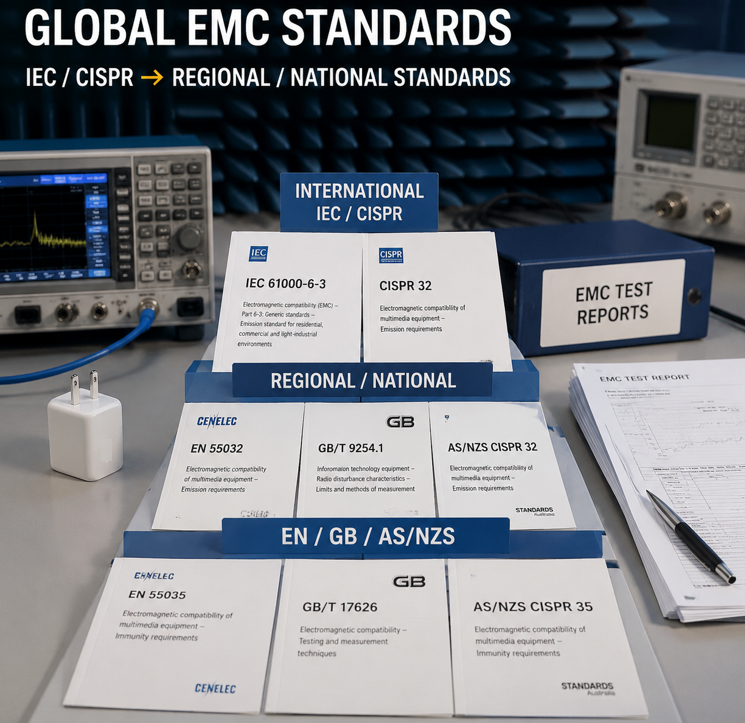
Many people feel overwhelmed when they see a bunch of standard numbers like EN, GB, IEC, CISPR. In fact, global EMC standards can be roughly understood as international basic standards, regional or national standards, and then specific regulations and conformity assessment procedures.
Top Level: International Basic Standards
These are the basis referenced by many countries and regions when formulating local standards, and mainly involve two international organizations:
- IEC (International Electrotechnical Commission): Responsible for formulating EMC test methods and immunity frameworks, with the IEC 61000 series of standards being the most core.
- CISPR (International Special Committee on Radio Interference): Mainly formulates radio disturbance emission requirements and related product standards. For example, CISPR 32 specifies emission requirements for multimedia equipment, and CISPR 35 specifies immunity requirements for multimedia equipment.
The biggest advantage of international standards is their strong universality: EMC standards in many countries and regions will adopt IEC/CISPR content identically or with modifications. Some international test reports or specific mutual recognition mechanisms can also be used to support conformity assessment in multiple markets, but this does not guarantee direct conversion to national certifications, nor does it guarantee that no additional testing is required. In actual use, it is necessary to verify target market regulations, laboratory accreditation scope, national deviations, and report acceptance rules.
Middle Level: Regional / National Standards
Various countries and regions will issue locally numbered standards based on international standards, which may adjust versions and add additional requirements. For example, the EU’s EN series, China’s GB series, and Australia/New Zealand’s AS/NZS series are all such local standards.
A special reminder here: when the same product is exported to multiple markets, you cannot assume that two standards are universal just because their names look similar. You must verify local differences — for example, some regions have added test items, some have different limits or product classifications, so you cannot take things for granted.
Several Core Concepts Easily Confused
Many people cannot distinguish between standards, regulations, certification, and marks. Let’s clarify them all at once:
- Standard: A technical document that specifies test methods, limits, and judgment criteria, equivalent to the “exam syllabus and scoring standard”.
- Regulation: Mandatory legal requirements formulated by regulatory authorities, equivalent to “the law stipulates that you must take the exam, and you cannot sell if you fail”.
- Certification / Conformity Assessment: The process of proving that a product meets requirements, equivalent to “taking the exam and getting the score”.
- Market Mark: A label affixed to the product to indicate completion of compliance, such as CE and FCC, equivalent to “pasting the pass certificate on the product”.
Impact of Standard Versions
EMC standards are not static. Just like mobile phone systems are updated, standards are also revised regularly, which may adjust limits, test frequency bands, and product classification rules. Therefore, a valid test report should be marked with the complete standard number, version, and test date. After the standard is updated, it is necessary to verify the effective date, withdrawal date, transition period, and certification body acceptance rules of the target market. Old version reports may require supplementary testing or updating, but it cannot be generally concluded that they will definitely be invalid or definitely rejected.
EMC Compliance Requirements in Major Global Regions
The EMC regulatory systems of different countries and regions are different. Below, we sort out the most common compliance requirements for charging products according to market popularity.
European Union and United Kingdom (CE/UKCA)
The core rule of the EU is EMC Directive 2014/30/EU. After Brexit, the UK corresponds to the EMC requirements of UKCA, and the core content of the two is basically the same.
If the product is an information technology or multimedia device within the scope of EN 55032 and EN 55035, these two standards can be used to evaluate emission and immunity respectively. Independent external power supplies also need to verify applicable standards such as EN IEC 61204-3 according to product classification, and cannot uniformly apply EN 55032 and EN 55035. Pay attention to the version here: the old version EN 55024 has been largely replaced by EN 55035, so be sure to check the latest valid version and transition arrangements before declaration.
Compliance requirements in the EU and UK usually include conformity assessment, self-declaration, and retention of technical documentation, which does not mean that all products must be uniformly tested by a designated third party. However, manufacturers still need to be able to prove that their products meet applicable requirements, and may face risks such as removal from shelves, recall, or penalties if they are actually non-compliant.
Products with wireless communication functions usually need to additionally meet the RED and its harmonized standards; products with only wireless power supply functions should be judged according to specific functions and applicable standards, and cannot be uniformly classified as radio equipment.
North America (US FCC + Canada ISED)
EMC regulation in the US is under the responsibility of the FCC, based on FCC Part 15B. Ordinary chargers usually belong to “unintentional radiators”, that is, products that are not themselves designed to actively emit wireless signals. Common paths include FCC SDoC self-declaration.
Regulation in Canada is under the responsibility of ISED. Digital devices within the applicable scope usually need to comply with ICES-003 and be marked with “CAN ICES-003” or corresponding compliance information according to current ISED labeling requirements. If the product additionally contains radio functions that require certification, it may involve wireless device identifiers such as IC certification numbers. IC numbers should not be regarded as a unified requirement for all ICES-003 digital devices.
There is a detail to note in the North American market: the compliance judgment logic may be different for chargers sold separately and chargers sold together with a complete set of equipment. The specific situation should be confirmed according to product category, sales configuration, and applicable regulations, and cannot be inferred solely based on the sales form.
China (CCC Mandatory Certification)
China’s EMC requirements may be part of CCC mandatory certification. Chargers and power adapters covered by CCC shall undergo safety and EMC evaluation in accordance with the current CCC catalog, implementation rules, and applicable product standards.
The GB/T 17626 series mainly provides immunity test methods and cannot directly replace product EMC limit standards. The specific standards and versions applicable to information technology, multimedia equipment, and other power products cannot be summarized by just one GB 9254 or GB/T 17626 series; they must be subject to the current official catalog, implementation rules, and product standards.
Ordinary passive charging cables usually do not undergo separate CCC EMC certification; if they are used as supporting components of a complete machine or kit, whether they are included in the test and how to select representative configurations shall be determined in accordance with the corresponding CCC catalog, implementation rules, and certification body requirements, and a unified conclusion cannot be drawn solely based on “whether they are sold with the complete machine”.
Other Mainstream Regions (Japan, South Korea, Australia and New Zealand)
- Japan: For information technology equipment and other products within the scope of VCCI application, voluntary conformity management is usually carried out in accordance with VCCI technical requirements. Whether it applies, the VCCI version to be used, and the labeling or declaration method shall be confirmed according to product category and current VCCI rules; not all chargers automatically fall within the VCCI scope.
- South Korea: EMC requirements are included in the KC-related compliance system, managed by the relevant South Korean regulatory system, and are mandatory compliance requirements.
- Australia and New Zealand: EMC is part of RCM compliance, and common bases include the AS/NZS CISPR series of standards. Specific requirements shall be confirmed according to product category and current rules.
Niche Market Reference
Markets such as Gulf countries, Southeast Asia, and Latin America mostly adopt IEC/CISPR basic standards or convert them into local standards. Specific requirements need to be verified against local regulatory catalogs, and results from other regions cannot be directly applied.
How to Read an EMC Test Report?
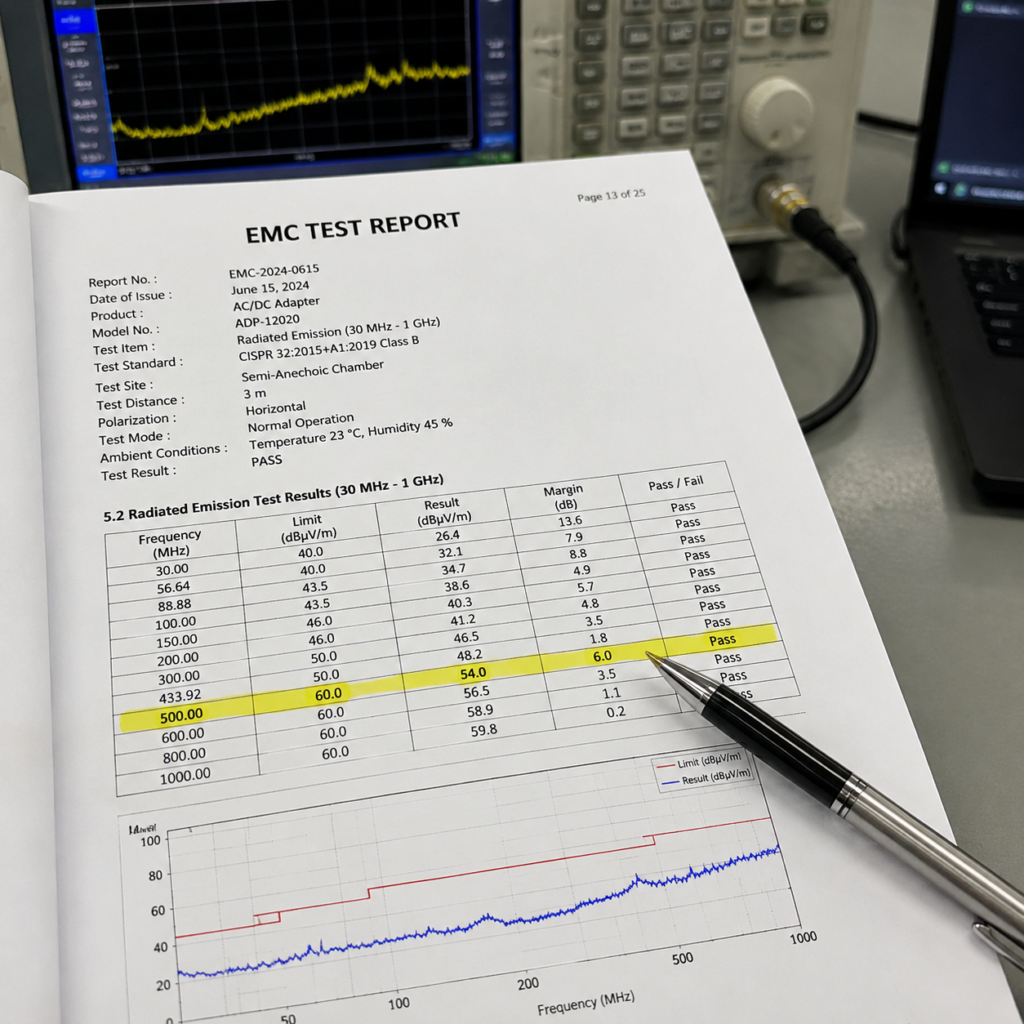
When you get an EMC test report, you don’t have to be intimidated by the dense numbers. As long as you grasp a few core points, you can quickly judge whether the report has reference value and how the product performs.
Step 1: Check Basic Information First to Avoid Reports with Unclear Coverage
Many reports look formal, but they may not cover the products you actually sell. First look at these three pieces of information:
- Product information: Are the product name, model, and hardware version consistent with what you want to sell? Is the status of the test sample clearly stated, such as what charging cable and what plug are included? Different accessories may lead to very different results.
- Standard information: Is there a complete standard number, version date, and test item list? If the complete standard number, version, test configuration, or item list is missing, the applicable scope of the report cannot be reliably confirmed, and it may not be accepted by the target market or certification body. It should be supplemented or reconfirmed, rather than generally concluding that the report is legally invalid.
- Test configuration: Is the input voltage 110V or 220V? Is the load single-port or multi-port, full load or light load? What is the specification of the supporting cable? If the test uses single-port light load, but the actual sales are multi-port full load, the report results cannot directly cover the actual product.
Step 2: Understand Core Indicators
If the basic information is correct, then look at the core test results:
- EMI indicators: Mainly look at conducted disturbance (unit: dBμV) and radiated disturbance (unit: dBμV/m). The lower the value, the smaller the interference usually is. However, the conducted disturbance limit must be read according to specific standards, equipment class, frequency range, and detection method; 60 dBμV cannot represent the entire 150 kHz to 30 MHz frequency band.
- EMS indicators: The provisions on performance criteria and recovery conditions in the product standards cited in the report shall be checked item by item. It cannot be uniformly considered that only Class A or B is qualified for consumer products.
Step 3: Practical Judgment Skills
In addition to checking whether it is qualified, you can also see whether the product’s EMC design is stable from the report:
- Test margin: It is the gap between the test result and the limit. The larger the margin, the more able it is usually to withstand mass production and environmental changes. For example, if the limit at a certain frequency point is 60 dBμV and the test result is 54 dBμV, the margin is 6 dB; if the margin is only 1 dB, a slight change may approach or exceed the limit.
- EMI peak position: Looking at which frequency band the peak appears in can help determine the source of interference — for example, if the peak is exactly a harmonic of the switching frequency, it may be related to the switching power supply; if the peak in the high frequency band is high, it may also be necessary to check factors such as the charging cable, housing, and layout.
- EMS results: Don’t just look at the class; also look at the specific abnormal performance — for example, whether it’s just the indicator light flashing, or direct charging interruption and fast charging handshake failure; the latter has a much greater impact on actual use.
Special Note: The Coverage Boundary of the Report Cannot Be Arbitrarily Expanded
The applicable scope of an EMC test report has boundaries and cannot be extended arbitrarily:
- Single-port test results cannot automatically cover multi-port full load or other port combinations;
- One version of cable, housing, or plug cannot automatically cover all configurations;
- EMC reports of internal components cannot replace the test results of the whole machine;
- If the cable is part of the product’s sales configuration or will significantly affect EMC, the cable used in the test shall be clearly stated in the report, and it shall be confirmed that the report covers the actual sales configuration. When configurations are inconsistent, the report conclusions cannot be directly extended to the actual product.
Even if every internal component has an EMC report, the assembled whole machine may still be unqualified due to changes in layout, cables, load, and operating mode.
How to Determine Which EMC Standard Applies to a Product?
Many people don’t know which standard to choose or which items to test when doing compliance. In fact, following these three steps will basically not go wrong.
Step 1: Clarify the Core Attributes of the Product
First, get a clear understanding of your own product:
- Function type: Is it a pure charging adapter, or a USB-C device with data transmission? Does it have functions like wireless charging, Bluetooth, or Wi-Fi? The more functions, the more requirements may need to be covered.
- Hardware parameters: Is the input AC mains or vehicle low voltage? What is the rated power? How many ports are there? Is there grounding? These parameters will affect the choice of standards.
- Supporting accessories: What is the specification of the included charging cable? What type of plug is it? Is it sold together with terminal equipment? Accessories will affect test results and must be clarified in advance.
Step 2: Clarify the Target Market and Sales Form
- Target country/region: Different regions correspond to different regulatory and standard systems. First determine where to sell, then find the corresponding requirements.
- Sales form: Is it sold separately, sold with a complete machine, or sold as an accessory kit? Different sales forms may have different compliance responsibilities and test requirements. Whether it can be evaluated together with the complete machine shall be confirmed according to local regulations, product category, and certification scheme.
- Usage environment: Is it for household or commercial use, or for industrial use? Industrial environments may require higher immunity levels, but the final judgment still depends on equipment function, installation method, and applicable standards.
Step 3: Match Corresponding Standards and Test Items
- First determine product classification: Different markets may have different definitions of “power supply equipment”, “digital equipment”, and “multimedia equipment”. Different classifications lead to different applicable standards.
- Then match test items: Determine which items to test for EMI and EMS respectively, and whether additional tests such as harmonics and voltage fluctuation are needed.
- Selection principle: If there are multiple standards to choose from, prioritize the path recognized by local regulators that can cover all functions of the product. If you are unsure, be sure to check the official catalog of local regulators, the list of recognized standards, or consult a formal compliance agency; don’t guess blindly.
Applicable Boundaries and Exceptions
1W cannot be used as a universal EMC exemption threshold. Only when the target market regulations or applicable standards clearly specify exemptions for equipment category, purpose, or technical conditions can the judgment be made according to that specific provision.
Industrial environment equipment also cannot be generally excluded from consumer or product-specific standards just because of custom or industrial use. Applicable standards shall be selected according to the usage environment, equipment function, and whether there are more specific product standards; only when there are no product-specific standards shall evaluation be carried out according to the corresponding general standards for industrial environments.
But there is a general rule: as long as it is a charging product for ordinary consumers, the vast majority of regions require compliance with corresponding EMC regulations. Don’t take chances.
Common Misconceptions and Pitfall Avoidance Guide
Common Misconceptions for Consumers When Purchasing
- Misconception 1: Chargers with high prices or big brands must have qualified EMC. Not necessarily. Some internet-famous brands and even individual big brands may only have done safety certification, not complete EMC compliance, or the product batches are not completely consistent with the test samples.
- Misconception 2: Wired charging and wireless charging have the same EMC requirements. This cannot be generalized. Products with wireless communication functions usually involve additional radio regulations and radio frequency requirements; simple wireless power supply products shall be judged according to their specific functions, frequency, power, and target market.
- Misconception 3: Charging cables do not affect EMC performance. Wrong. The shielding layer and structural quality of the charging cable may affect radiated interference. Using poorly designed cables with a qualified charger may also lead to changes in the overall performance of the combined product.
- Misconception 4: Having CE/FCC marks equals EMC compliance. The marks only indicate that the manufacturer has declared or completed the corresponding compliance process, and do not mean that the product actually meets the standards. Especially in regions with self-declaration, it is even more necessary to verify technical documents and test configurations.
Compliance Pitfalls for Cross-Border Merchants
- Pitfall 1: Only doing safety certification and ignoring EMC. Many novice merchants think that passing UL or LVD safety certification is enough, but in fact EMC may also be a mandatory requirement, which shall be confirmed according to target market regulations.
- Pitfall 2: Using old reports directly without checking the standard version. After the standard is updated, it is necessary to verify the effective date, withdrawal date, transition period, and certification body acceptance rules of the target market. Old version reports may require supplementary testing or updating, but it cannot be generally concluded that they will definitely be invalid or definitely rejected.
- Pitfall 3: Multi-port chargers only test single-port operating state. Multi-port products shall cover representative port combinations, power distribution, and the most unfavorable operating states according to applicable standards and risk analysis. It is usually necessary to evaluate the full load configuration, but full load cannot be regarded as the only mandatory test state, nor can it be inferred that all multi-port modes are qualified solely based on single-port results.
- Pitfall 4: Only testing the charger itself and ignoring the impact of supporting charging cables and terminal equipment. If the cable is part of the product’s sales configuration or will significantly affect EMC, the cable used in the test shall be clearly stated in the report, and it shall be confirmed that the report covers the actual sales configuration; when configurations are inconsistent, the report conclusions cannot be directly extended to the actual product.
- Pitfall 5: Only focusing on EMI emissions and ignoring EMS immunity requirements. EMC requirements in many markets include both emission and immunity. Specific test items and judgment conditions shall be confirmed according to applicable standards.
Common Invalid / Misleading Statements
- “Globally universal EMC certificate”: There is no single EMC certificate that can cover all countries. Requirements in each region may vary. Be sure to verify the applicable region, product scope, and acceptance conditions of the report or certificate.
- “Component EMC report = whole machine qualified”: EMC reports of internal components cannot replace whole machine testing. Qualified components do not mean that the assembled whole machine is still qualified.
- “Low-power products do not need EMC”: Whether exemption applies cannot be judged solely by power. Whether it is necessary to meet EMC requirements depends on the specific provisions of the target market on equipment category, function, and purpose.
Final Summary
After reading this article, you should be able to master three practical abilities: first, you can quickly correspond to the EMC compliance requirements of major global regions, and know the regulations and standards that need to be verified for products to enter the local market; second, you can understand the core parameters and applicable boundaries of basic EMC test reports, and preliminarily judge the electromagnetic compatibility performance of products; third, you can avoid common EMC cognitive and compliance pitfalls, whether you are buying charging accessories yourself or doing cross-border e-commerce compliance, you can avoid many mistakes.
EMC may seem like a professional technical topic, but in essence, it is to make our use of electronic products more worry-free — no sudden WiFi lag during use, no abnormal device behavior while charging, and no product detention, removal from shelves, or fines due to non-compliance. Whether you are an ordinary consumer or a cross-border merchant, knowing a little more about EMC will always save you a lot of detours.