
If you often buy electronic accessories from Australia and New Zealand, or run a cross-border business targeting the ANZ market, you must have seen the connected-letter “RCM” mark on USB chargers. Many people only know it as “Australian certification”, but they neither know which products must have it, nor can they tell the real from the fake, and some even think that having it means the charger is of good quality. Today we will thoroughly explain RCM certification for USB chargers from basic concepts to authenticity identification, so that ordinary consumers and small merchants can easily understand it.
Beginner’s Knowledge: What Is RCM and Which Chargers Require It
Let’s start with the most basic definition: the full name of RCM is Regulatory Compliance Mark, which you can think of as the “access pass” for electrical products common to both Australia and New Zealand. It is not a single test, but a unified declaration that the product meets both ANZ safety requirements and electromagnetic compatibility requirements. The most convenient point is that Australia and New Zealand fully recognize each other’s RCM; as long as you complete one compliance filing, you can legally sell in both countries without applying for certification from each country separately.
Some people may ask: It’s just a charging head, why must it have RCM? Because USB chargers that are directly plugged into ANZ household mains power are within the mandatory scope of electrical safety supervision in both countries, and are a prerequisite for legal sale. For merchants, products without RCM may be detained by customs or fined by market supervision departments; for ordinary users, chargers that have not undergone compliance verification may pose electric shock and fire hazards, and there is no local after-sales guarantee to fall back on if problems arise.
In fact, to judge whether a USB charger is within the mandatory scope of RCM, you don’t need to memorize complex rules, you can get the conclusion in 10 seconds: as long as it meets two conditions at the same time, it belongs to the mandatory supervision category — first, it is directly plugged into an ANZ 220-240V household wall socket (that is, mains input); second, it is an independently sold USB charging or power supply device.
Specifically, common USB charging products that require RCM include: wall-mounted and desktop USB chargers (whether single-port or multi-port), USB-C power adapters for laptops, and ANZ-standard household power strips with USB charging ports — note that for this type of power strip, not only the power strip itself must be compliant, but the USB charging part also needs to meet RCM requirements.
There are also many products that do not need RCM, don’t be fooled by merchants: for example, car USB chargers without mains input, ordinary power banks; non-civilian or non-commercial products, such as industrial-specific charging modules, built-in charging boards for equipment, and personal idle second-hand chargers (but if it is commercial second-hand sales, compliance is still required); in addition, ordinary USB charging cables sold separately are low-voltage accessories and are not within the mandatory scope of RCM.
What Exactly Does RCM Certification Check?
After figuring out which products need RCM, you may be curious: what exactly does this certification check? Is it just a matter of sticking a label? In fact, RCM has clear standards for its verification content, which can be divided into four core categories.
The first category is the core safety requirement that everyone cares about most, mainly centering on the principles of “no personal injury and no equipment burnout”. First is electric shock protection: the prongs and internal insulation structure of the charger must meet standards, so there is no risk of electric leakage during normal use. Second is fire prevention: the charger must have built-in overcurrent, overvoltage, and short-circuit protection, so that even if a short-circuited device is connected, it will not catch fire on its own. Third is equipment burnout prevention: the output voltage and current must be stable, and the charging head must not damage mobile phones or tablets due to its own faults. Finally, there is prong compliance: the size and hardness of ANZ-standard V-shaped flat prongs have clear requirements; they must not be loose and prone to falling off when plugged into a wall socket, to avoid overheating caused by poor contact.
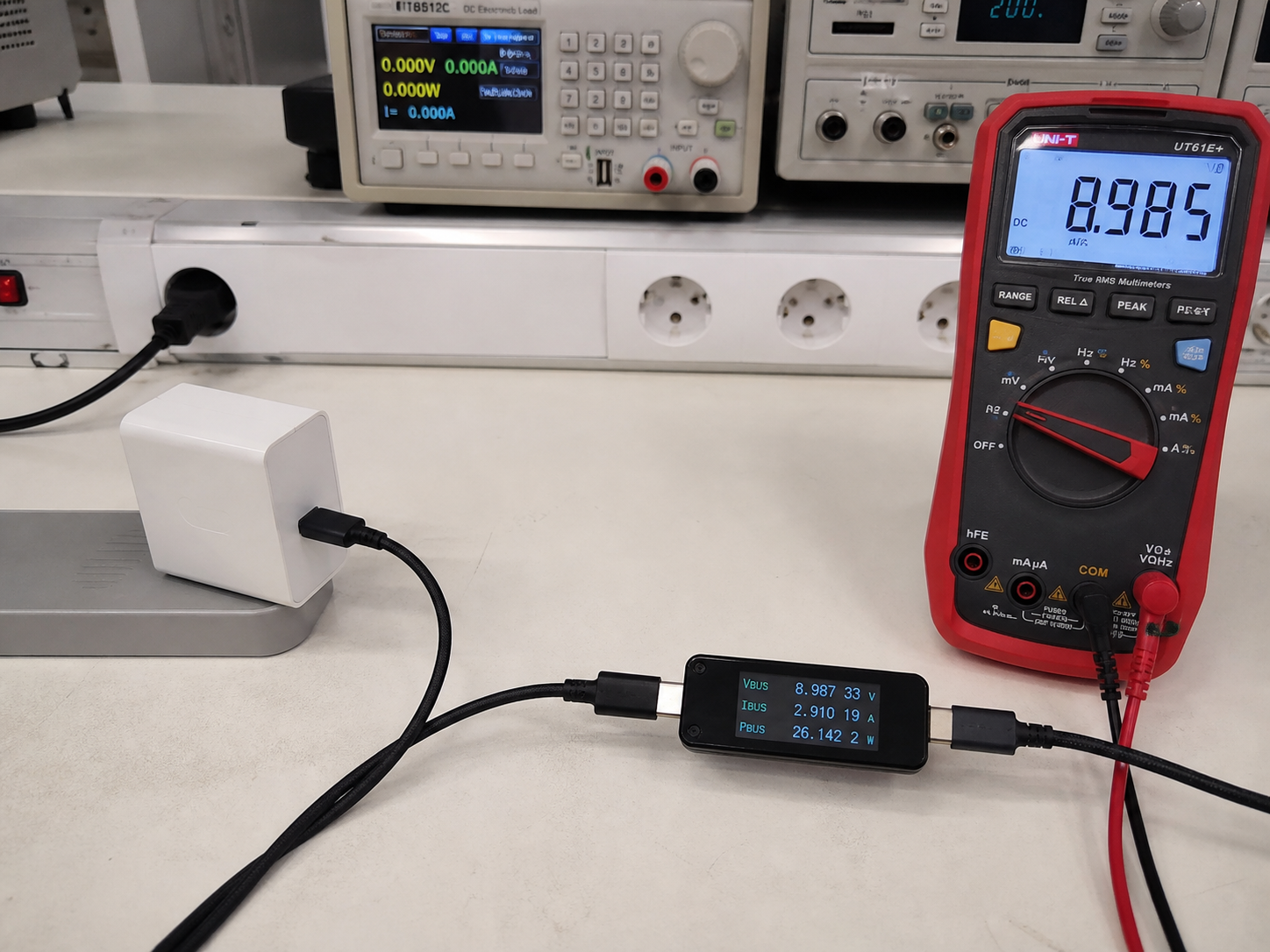
The second category is electromagnetic compatibility requirements, which simply means “the charger does not interfere with other devices, and other devices do not interfere with it”. For example, a qualified RCM charger will not slow down home WiFi, cause snow on TV screens, or disconnect Bluetooth earphones; at the same time, when a microwave oven or hair dryer is running nearby, it will not suddenly stop charging. The requirements in this regard are stricter for fast-charging and multi-port high-power products, because the higher the power, the more likely electromagnetic interference is to occur.
The third category is labeling requirements, which many people tend to ignore, but are actually the basis of compliance. The RCM mark must not only be printed on packaging or promotional materials; it must be clearly marked on the charger body, along with clear input and output parameters, product model, and responsible party information. In addition, the parameters on the packaging and manual must be completely consistent with those on the product body; contradictions such as the product being marked 65W and the manual being marked 20W are not allowed.
Finally, let’s talk about the difference in requirements for different chargers: whether it has a USB-A or USB-C interface, whether it is for regular charging or fast charging, the core safety requirements are unified, and standards will not be lowered just because the interface is newer. The only difference is that products with higher power and more interfaces will undergo more rigorous test scenarios; the interface type and whether fast charging is supported only affect the simulation scenarios during testing, and do not change the mandatory attribute of requiring RCM.
Don’t Be Fooled: RCM Is Not a Certificate
Speaking of this, we must first correct a common misconception held by many people: RCM is not a “certificate” issued by a laboratory. Many merchants present a “RCM certificate” stamped with a laboratory seal to deceive people, but it is actually completely non-compliant.
The essence of RCM is a compliance declaration mark, not a certification issued by a laboratory. Its legal use has two indispensable prerequisites: first, there must be a qualified test report issued by a laboratory recognized by Australia and New Zealand; second, a local responsible party in Australia and New Zealand (usually the importer or brand owner) must complete the filing in the official system. If there is only a test report and no official filing, no matter how impressive the report is, it is not considered a compliant RCM product.
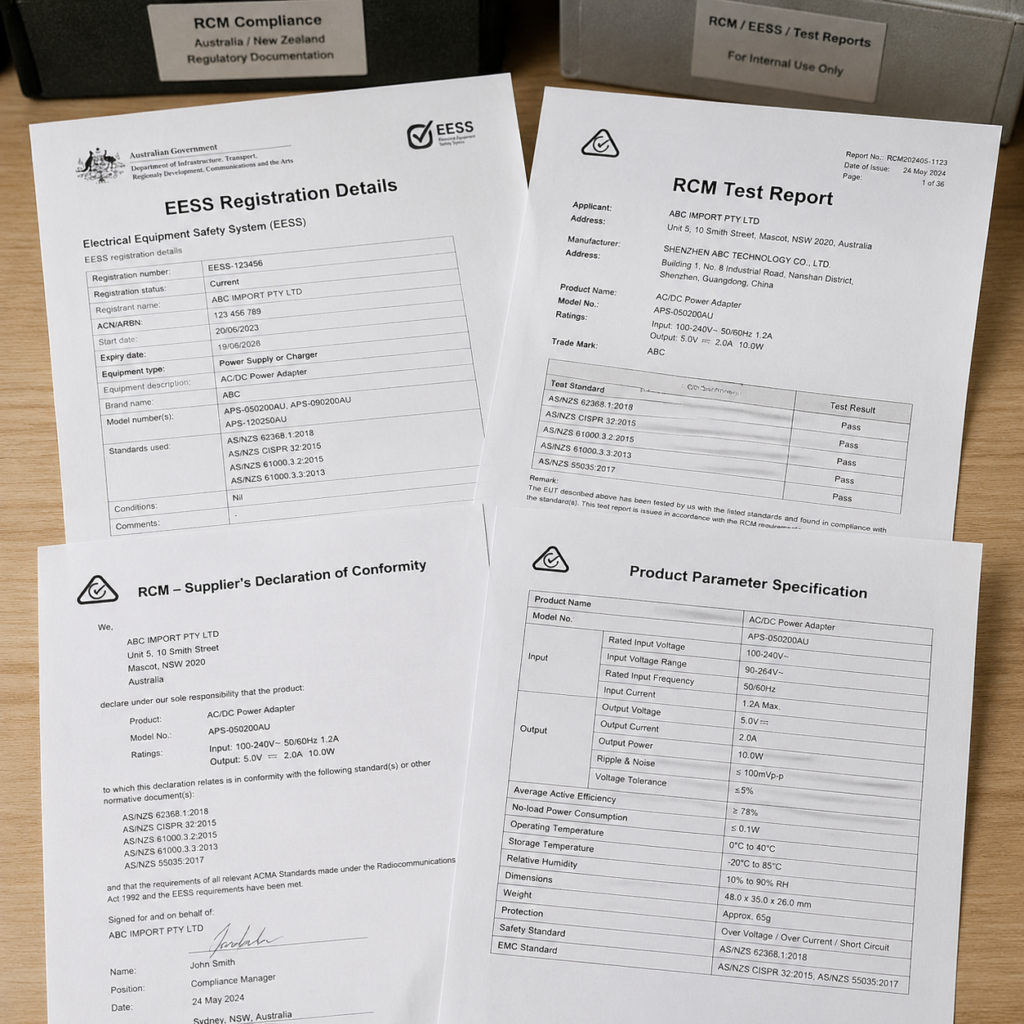
In addition, RCM does not have a fixed validity period, but this does not mean “one filing for life” — as long as the product is modified, it must be re-tested and re-filed. What counts as a modification? Changes in power, changes in the number or type of interfaces, modifications to the core circuit, changes to the housing or prongs — all of these count. Even for products in the same series, those with different power ratings or different models cannot share the same RCM filing, which is a common pitfall for many small merchants.
Another very important point: the primary responsible party for RCM is the local importer or brand owner in Australia and New Zealand, not the overseas factory. Even for products sold on cross-border e-commerce platforms, there must be a local responsible party to assume compliance obligations; if problems arise, the local responsible party is held accountable first, not the factory located overseas.
Finally, it should be clarified that certifications from other countries or regions such as CE, FCC, and UKCA cannot replace RCM. No matter how many overseas certifications you have, you still need to obtain RCM to sell legally in Australia and New Zealand. In addition, interface or performance-related certifications such as USB-IF certification and PD fast charging certification are completely separate from RCM and have no relation to it.
3 Steps to Identify Real and Fake RCM
After understanding the essence and rules of RCM, the next step is the practical issue that everyone cares about most: how to judge whether the RCM mark on your charger is real or fake? In fact, you don’t need to go to a professional institution; you can filter out the vast majority of fake certifications by yourself in three steps.
The first step is initial visual inspection. When you get the product, first check several key points. First, check the style of the RCM mark: the official RCM is three connected letters. If the text on the mark is wrong, deformed, or printed blurrily, it is most likely problematic. Second, check the required information on the product body: input and output parameters, model, and responsible party information. If any of these are missing, the probability of non-compliance is very high. Third, check the prongs: they must be standard ANZ-standard V-shaped flat prongs. If the prongs are loose or their size is obviously different from ordinary ANZ plugs, they must be fake. If it is a multi-port or fast-charging charger, you need to additionally verify: multi-port products must be marked with both total power and maximum power per port, and fast-charging products must be marked with corresponding PD, PPS, and other power profiles. Finally, remember a hard and fast rule: if the RCM mark only appears on the packaging or promotional materials but not on the product body, it is uniformly considered non-compliant.
If the initial visual inspection passes and you want further confirmation, you can take the second step: check the official filing records. The Electrical Equipment Safety System (EESS) of Australia and New Zealand has a public free database, which can be searched by entering the product’s model, brand, or filing number. When querying, note that all filed information must be completely consistent with the product. For example, if the model or power does not match, it is a fake certification that misappropriates another product’s filing. Of course, there are exceptions: some newly filed products may not have their information updated yet, so not being able to find a record does not necessarily mean it is fake, but if the information matches, it is definitely more reliable.
The third step is to learn about common fake certification tricks in advance, and avoid them directly when you encounter them. The first trick is using overseas certifications to impersonate RCM. For example, merchants say “We have CE certification, which is the same as RCM” — this is pure deception, as the two are completely non-interchangeable. The second trick is using the filing of a low-power model for a high-power product. For example, using the filing of a 20W charger on a 65W product is a typical violation. The third trick is having only a “RCM certificate” printed by the factory itself, with no filing in the official system. This kind of certificate has no legal effect whatsoever. The fourth trick is merchants claiming that “certification is in progress” and selling the product in advance before the filing is completed. This type of product is also non-compliant, so do not buy it.
5 Most Common RCM Misconceptions
In addition to fake certifications, there are many widespread misconceptions about RCM. Today we will clarify the 5 most common ones in one go.
Misconception 1: Chargers with RCM are universally usable worldwide. This is wrong. RCM is only valid in Australia and New Zealand, and is not recognized by other countries and regions. It cannot replace local compliance certifications such as CE and FCC. If you are a merchant operating in the global market, you need to apply for separate certifications for each region, and you cannot use RCM as a global pass.
Misconception 2: RCM only inspects the charging head and has nothing to do with the matching charging cable. This idea is incorrect. If the charger and cable are sold as a set, the matching cable also needs to meet safety requirements. You cannot just pair it with a low-quality cable and sell it as a set. After all, if the cable has a problem, it can also lead to safety accidents.
Misconception 3: Chargers with USB-C interfaces do not need RCM certification. Completely wrong. RCM’s regulatory classification is based on input type. As long as a charger is connected to ANZ mains power, it needs RCM certification regardless of whether the output interface is USB-A, USB-C, or another type. The interface type does not affect the mandatory requirement, only the specific test items.
Misconception 4: RCM represents fast charging speed and good quality. This is the misconception most easily exploited by merchants. RCM only verifies whether a product’s safety and electromagnetic compatibility meet standards, and does not involve performance indicators at all — how fast the fast charging is, how long the service life is, how good the interface compatibility is, none of these are within the scope of RCM inspection. Don’t assume a product is high-end just because it has RCM. It is only a “safety pass line”, not a “proof of excellence”.
Misconception 5: All power banks and car chargers need RCM certification. This depends on the situation. Ordinary power banks and car chargers have no mains input and are not within the mandatory supervision scope of RCM; but if it is a 2-in-1 power bank with ANZ-standard prongs, that is, the type that can be directly plugged into a wall socket for charging, its mains input charging part needs to meet RCM requirements.
At this point, you have a complete understanding of RCM certification for USB chargers, from beginner knowledge to pit avoidance. Finally, we have sorted out the core skills for your quick use:
Beginner-level skills can be used immediately after learning: first, use the 10-second judgment method to quickly determine whether a USB charger is within the mandatory scope of RCM; second, understand the safety and user experience requirements corresponding to RCM, and know that products with this mark have at least passed the pass line in terms of safety and anti-interference.
If you want to master more advanced pit avoidance skills: you can learn to use the 3-step method to initially identify the authenticity of RCM, and avoid 5 common cognitive misconceptions. Whether you are buying chargers via overseas shopping yourself, or purchasing goods for the ANZ market, you can put forward correct compliance verification requirements and avoid many unnecessary pitfalls.