
If you are in the Southeast Asian market for charging products, you will most likely be confused by “TISI certification” when you first enter Thailand: some say all chargers need it, some say low-voltage products do not, and there are mixed requirements from NBTC and customs. If you are not careful, you may encounter import obstacles, cargo detention or penalties.
This article focuses on charging products, and explains Thailand TISI certification from the most basic “what it is” to how to judge whether you need it and how to go through the process. Beginners can understand it, and business practitioners can also find practical points to avoid pitfalls.
First, Understand: What Exactly Is TISI, and What Is Its Purpose?
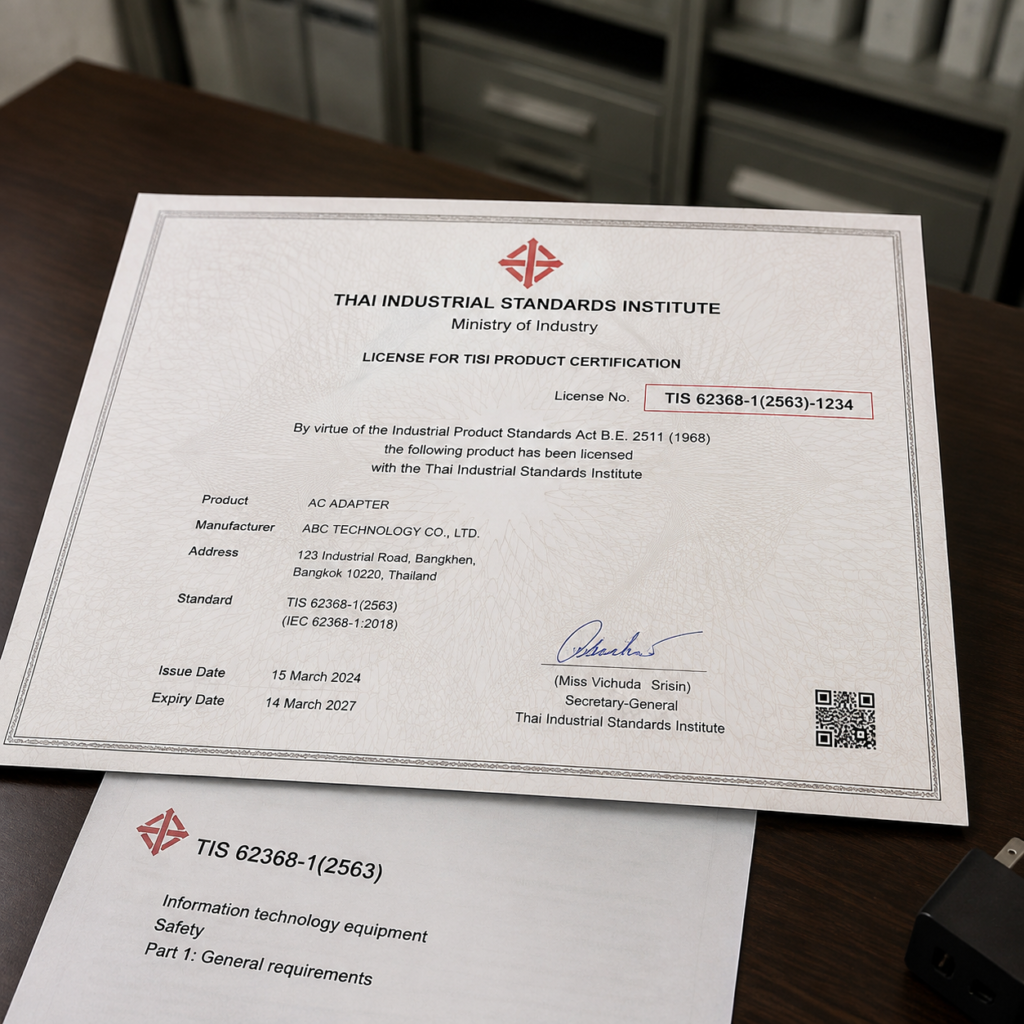
TISI is the Thai Industrial Standards Institute under the Ministry of Industry of Thailand, which is commonly translated into Chinese as “Thai Industrial Standards Association” or “Thai Industrial Standards Research Institute”. It is responsible for formulating and managing Thai industrial standards, and implementing licensing and supervision for products included in the mandatory control scope. Only products that apply mandatory standards and fall within the mandatory control scope must obtain corresponding licenses; whether a license is required shall be judged according to the TIS standard applicable to the product and the latest mandatory product list.
For charging products, TISI-related requirements usually involve electrical safety risks such as electric shock and fire, as well as local applicable electrical and product requirements in Thailand. For products subject to mandatory TIS standards and requiring a license, failure to obtain the required license may result in obstacles to import and sales, and may face seizure, recall, fines, license revocation or other statutory penalties; the specific consequences shall be subject to applicable laws and law enforcement decisions.
Many people confuse several concepts when they first come into contact with them. Let’s first clarify the three most easily confused groups:
The first group is the difference between TISI standards, licenses, and marks. You can analogize it to an exam: TISI standards (also called TIS standards) are the exam paper, which specifies specific technical requirements, such as the required withstand voltage and the maximum allowable temperature rise; a license is an official access certificate issued after meeting the corresponding licensing conditions; the TISI mark is a compliance mark used on products or related materials in accordance with regulations. Not all TIS standards mean that products must obtain a mandatory license; the key depends on whether the product falls within the mandatory control scope.
The second group is the division of labor among TISI, NBTC, and customs. TISI is responsible for the standards, licensing, and market supervision of related industrial products, covering not only electrical safety but also other product quality and technical requirements; NBTC is responsible for wireless regulatory matters such as radio frequencies and telecommunications equipment, such as smart charging devices with wireless transmission functions such as Bluetooth and Wi-Fi; customs is responsible for import and export declaration and inspection, and may verify documents in accordance with the licensing requirements of relevant competent authorities. Whether a TISI license is required and whether the product meets the corresponding standards are usually judged by TISI and relevant competent authorities based on product categories, and cannot be generalized as customs uniformly reviewing all certifications and necessarily refusing customs clearance.
The third group is the relationship between overseas certifications and TISI. Many people ask: I have CE, FCC, CB, CCC certifications, can they be used directly as TISI? The answer is no. The standards of these overseas certifications are not necessarily completely consistent with Thailand’s TIS standards, so they cannot directly replace TISI licenses. However, if there are internationally recognized test documents such as CB reports, they can be submitted to laboratories within the TISI recognition scope to evaluate whether they can be accepted or reduce some repeated tests, saving some time and cost. But whether they are accepted and to what extent shall be subject to specific procedures and evaluation results.
There are also three common misunderstandings that must be corrected in advance, otherwise it is easy to fall into pitfalls:
First misunderstanding: All charging products need TISI certification. This is not the case. Only specific products included in Thailand’s official mandatory list must be processed. For products not falling within the mandatory control scope, whether to apply for voluntary certification depends on the enterprise’s own needs and corresponding procedures. Not all charging products can be directly classified into the TISI mandatory certification scope.
Second misunderstanding: Low-voltage and low-power products definitely don’t need to be considered. That’s wrong. The applicability of TISI cannot be judged only by power or voltage. It should be judged in combination with product structure, rated parameters, purpose, the applicable scope of corresponding standards, and the latest official mandatory list. Some low-voltage products may involve other standards or regulatory requirements, and some products do not fall within the scope of TIS standards. Conclusions cannot be drawn solely based on the word “low voltage”.
Third misunderstanding: One TISI number can cover all brands and models. Not at all. TISI licenses usually correspond to specific license holders, manufacturers or production plants, as well as clear product models and parameter ranges. Changing the brand, changing the factory, or adding models not within the license scope cannot directly use the original license.
How to Judge Whether My Charging Product Needs TISI Certification?
The supervision of charging products cannot be summarized only by the term “charging products”. Separately sold chargers, power adapters, charging cables, charging docks, power strips, power banks, car chargers and wireless chargers may involve TISI, NBTC, battery transportation or other regulatory requirements, but not every category is naturally subject to TISI. Power adapters and charging cables included with electronic products such as mobile phones and tablets, as well as built-in charging modules of electronic products, shall also be verified item by item in combination with product structure, rated parameters, functions, applicable TIS standards and the latest mandatory list.
We have sorted out the key judgment points for 8 types of the most common charging products, which you can use for preliminary screening first:
| Product Type | Core Judgment Basis | Additional Notes |
| Wall charger/external USB power adapter (sold separately) | Check TIS standards for power adapters and the official mandatory list | Mains input models are key verification targets |
| Multi-port charging dock/desktop charging station with mains input | Check potentially applicable TIS standards and mandatory list based on the overall structure, rated input and output, whether it has socket functions, and product purpose | It cannot be preset as power adapter or socket standards; the specific classification shall be subject to the judgment of TISI or accredited laboratories on product specifications |
| Wall socket/power strip with USB port | Check TIS standards for sockets and mandatory list | It shall be judged in combination with the overall structure, rated parameters and product definition |
| Thai standard plug/power cord | For separately sold models, check relevant standards for plugs or wires and cables and mandatory list | The plug of an integrated charging cable shall be judged in combination with the overall product definition |
| Pure USB/USB-C low-voltage charging cable (sold separately) | First confirm whether it falls under a certain TIS wire and cable standard based on conductor structure, insulating material, rated voltage and purpose, then check whether the standard is under mandatory control | The USB-C interface itself is not equal to a certain TIS cable standard; if it is included with the main product, it shall also be judged in combination with the main product and import method |
| Car charger/low-voltage input wireless charger | Check specific TIS standards and mandatory list based on input method, overall function, output purpose and whether it has wireless transmission function | Before confirming the specific standards and mandatory status, it should not be directly judged as voluntary certification; those with wireless transmission functions also need to check NBTC requirements |
| Power bank | Check product definition, potentially applicable TIS standards and mandatory list | Attention shall also be paid to requirements related to lithium battery transportation and import |
| Smart charging devices with wireless transmission function | Judge TISI applicability based on the overall product definition and applicable standards | The wireless transmission part needs to be checked separately for NBTC requirements |
Special reminder here: three types of information cannot be used alone to judge TISI applicability, and many people stumble on this:
First, don’t just look at the interface type. Products with the same USB-C interface, such as mains-connected wall chargers, non-mains low-voltage charging cables, 12V car chargers, and smart wireless chargers with Wi-Fi, have completely different regulatory paths. They cannot be classified as the same category just because they all use USB-C.
Second, don’t just look at the HS code. HS codes are mainly used for customs commodity classification and related declarations. Products with different structures may fall under the same HS code. The applicability and mandatory nature of TISI cannot be determined solely by HS code, which can only be used as an auxiliary reference.
Third, don’t just look at the product name. For example, both are called “wireless chargers”: a simple Qi inductive wireless charger (only has charging function, no wireless data transmission such as Bluetooth or Wi-Fi) usually does not involve NBTC’s wireless transmission license; but smart wireless chargers with Bluetooth, Wi-Fi or other wireless transmission functions need to additionally check NBTC requirements, and conclusions cannot be drawn just by the name.
So how to judge reliably? You can follow this 4-step decision tree, which can basically cover most situations:
Step 1: First clarify the product boundaries. Figure out three core pieces of information: first, the structure — whether the product is directly connected to mains power, or uses low-voltage input, such as car input or USB input; second, the function — whether it has wireless transmission functions such as Bluetooth and Wi-Fi; third, the sales form — whether it is sold separately, included with the host device, or built into other electronic products.
Step 2: Match the corresponding TIS standards. Based on the product’s structure, rated input and output, purpose and function, find potentially applicable TIS standards. For example, for wall chargers, check the standards for power adapters or related power equipment; for wires, first confirm whether they fall under specific wire and cable standards, and cannot be classified solely by the interface name.
Step 3: Check the mandatory status. Go to the official TISI website to check the latest mandatory product list and confirm whether the product falls within the mandatory control scope under the corresponding standard.
Step 4: If the boundary is ambiguous, seek official confirmation. For combined products or products that are difficult to classify, the applicant or authorized agent shall submit complete product specifications, photos, structural materials and rated parameters to TISI to obtain written opinions from TISI or the competent authority. The opinions of accredited laboratories and consultants can be used as technical references, but cannot replace official decisions.
What Is the Difference Between Mandatory Certification and Voluntary Certification?
Many people are unclear about the difference between mandatory and voluntary certification. Let’s compare them from several core dimensions.
First is the necessity for market entry. Products that fall within the mandatory control scope and require a license must meet the applicable licensing conditions before they can be imported or sold; failure to obtain the required license may result in obstacles to import or sales. For products not included in the mandatory list, whether enterprises actively apply for voluntary certification depends on the corresponding product procedures and business needs. Common purposes include proving that the product meets a certain standard, enhancing customer trust, or meeting channel requirements.
Then is the audit mode. The requirements for testing, factory audit, sampling supervision and license maintenance are determined by specific TIS standards, product licensing procedures and current TISI rules. Mandatory products must meet applicable licensing conditions; the audit and supervision requirements for voluntary applications shall also be subject to corresponding procedures, and cannot be simply summarized as one category definitely requiring factory audit and another category definitely not requiring factory audit.
Cost and cycle are also affected by many factors. In terms of cost, it mainly depends on the type of certification, the number of applicable standards, the number of samples, test items, whether factory audit is required, agency service fees and rectification costs. The processing cycle is related to the completeness of materials, test pass rate, factory audit arrangement, laboratory scheduling, correction status and official approval progress.
The processing cycle shall be confirmed by TISI or laboratories within the recognition scope in combination with the actual schedule after determining the specific standards, test items and whether factory audit is required. Material correction, rectification and approval may all extend the cycle, so “2-3 months” should not be regarded as the unified processing time for all charging products.
Combined products cannot simply apply the rule of “all treated as mandatory components”. If a product contains a power module, socket, USB interface or other functions at the same time, the product definition and applicable standards of the whole machine shall be determined first, and then it shall be judged whether the whole machine and its components are respectively subject to mandatory control. For example, what kind of license a power strip with USB port needs shall be subject to the specific structure, rated parameters and TISI’s classification result for this model, and cannot be directly presumed just by the combination form of “power strip plus USB”.
Full TISI Certification Process: How Many Steps from Preparation to Obtaining the Certificate
After talking about how to judge whether to do it, let’s talk about the specific process and the points to note in each link.
First are the pre-steps: product characterization and confirmation of the applicant entity.
Product characterization means using the 4-step decision tree mentioned above to first figure out what standards your product may apply to, whether it is mandatory or voluntary, and whether you need to do NBTC at the same time. Don’t submit the application in a daze, only to be rejected and waste time.
Then there are the roles of the applicant entities, which many people confuse: the applicant is the entity that submits the certification application; the license holder is the entity that ultimately holds the license; the manufacturer is the factory that actually produces the product; the Thai importer is the entity responsible for import declaration or customs clearance; the authorized agent is the institution that assists in handling procedures in Thailand based on authorization. These are different legal and business roles, and the specific responsibilities shall be subject to the application documents, license conditions and applicable procedures, which shall be clarified in advance.
Next is preparing application materials, which are mainly divided into four categories:
The first category is basic materials: product specifications, model and variant relationship table (for example, how many models are in the same series and what are the differences), draft nameplates or labels, product physical photos and exploded views.
The second category is technical materials: circuit schematic diagram or block diagram, list and specifications of key safety components (such as transformers, electrolytic capacitors and other components that affect safety), and product manual.
The third category is entity materials: qualification documents of the applicant, manufacturer and Thai importer, factory quality control records, and authorization documents of the local Thai agent or importer.
The fourth category is supplementary materials: if there are CB reports or other overseas test reports, they can be submitted together for TISI or laboratories within the recognition scope to evaluate whether they can be accepted or reduce some tests. However, the final acceptance shall be subject to specific procedures and evaluation results.
After the materials are prepared, enter the core process. The actual steps will vary depending on the product, license type and applicable standards:
The first node is preliminary review of materials. The qualified applicant entity or its authorized agent shall submit the application to TISI in accordance with the specific licensing procedures. Some materials may be technically reviewed by laboratories within the recognition scope or relevant institutions, but not all cases are subject to unified preliminary review by agents or laboratories. If the materials are incomplete or do not meet the requirements, correction is required.
The second node is sample testing. The required tests shall be carried out in laboratories within the TISI recognition scope. The test items, number of samples and report acceptance methods shall be subject to the corresponding TIS standards, product licensing procedures and laboratory test plans. “Full test” cannot be regarded as a fixed process for all cases.
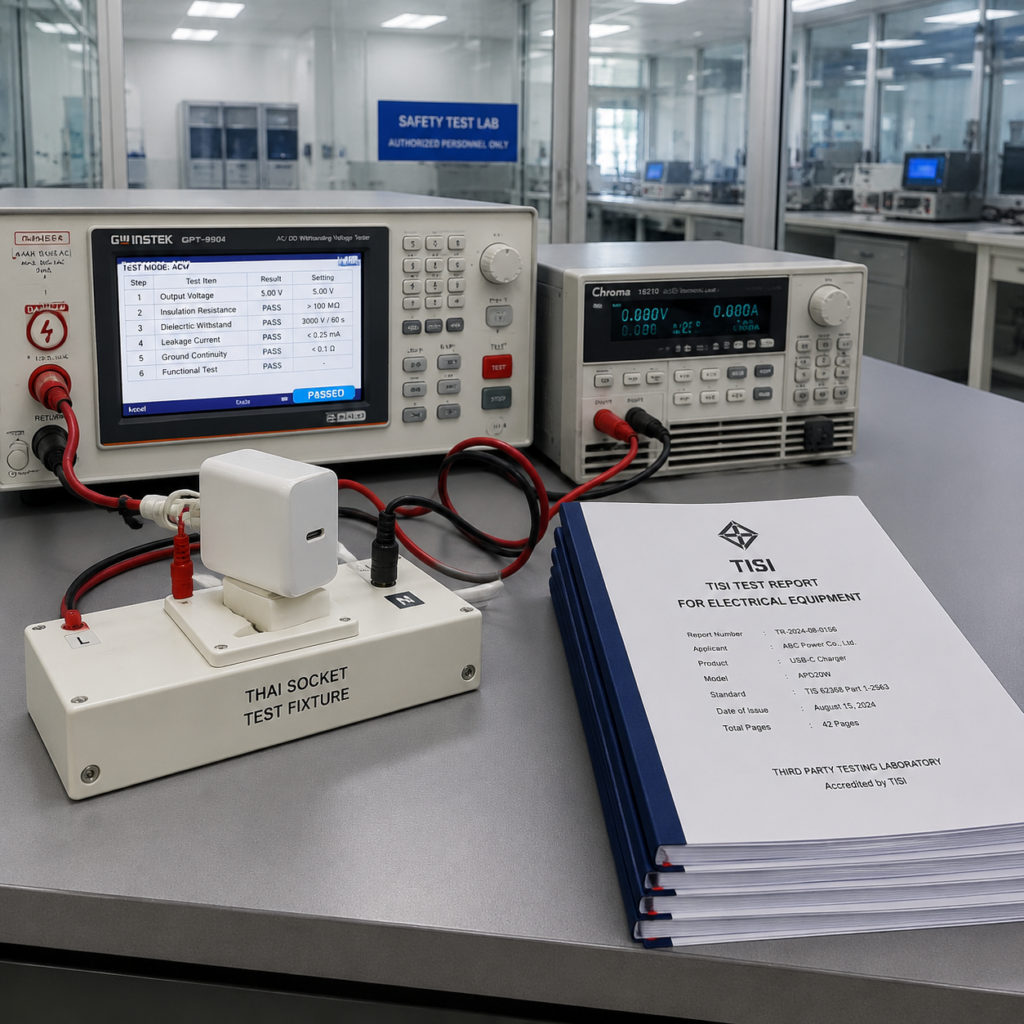
The third node is factory audit (as needed). Whether a factory audit is required depends on the specific standards, license type and current procedures. When an audit is required, attention is usually paid to production consistency, incoming material control of safety components, production process and quality inspection records, etc.
The fourth node is rectification and retesting. If non-conformities are found in testing or factory audit, rectification is required, and retesting, rechecking or resubmission of materials shall be carried out in accordance with procedures. The rectification time will be included in the total cycle, so it is best to do pre-testing in advance to minimize repetitions.
The fifth node is license issuance. After the relevant tests, audits and material reviews are passed, TISI shall issue the corresponding license or make a licensing decision in accordance with applicable procedures, and authorize the use of the corresponding TISI mark in accordance with regulations.
Product Change Management Rules
Many people think that products can be modified freely after obtaining the certificate. In fact, any change involving model, brand, manufacturer, production plant, rated parameters, interface, key safety components or circuits shall be submitted to TISI or an accredited institution for evaluation before the change.
TISI or relevant accredited institutions shall determine whether filing, supplementary testing, item expansion, license renewal or re-application is required based on specific standards, license conditions, series product rules and the impact of changes on safety testing. Some changes may only require document updates, while others may trigger retesting or new licensing procedures. Fixed classifications cannot be applied on one’s own.
Common Process Bottlenecks and Pitfall Avoidance
The first pitfall is being rejected due to non-conforming materials. It is recommended to find a local Thai agent familiar with charging products in advance, or check product parameters, documents and applicable procedures with laboratories within the recognition scope, to reduce corrections caused by inconsistent materials.
The second pitfall is failing the test. Charging products may encounter problems in terms of withstand voltage, temperature rise, insulation, structure or plug size. It is recommended to do pre-testing in advance and check the safety design according to applicable Thai standards. You cannot assume that the product meets Thai requirements just because it meets the standards of other countries or regions.
The third pitfall is failing the factory audit. If the specific procedure requires a factory audit, common problems may include no incoming inspection records for key safety components, incomplete production consistency materials or insufficient quality control records. It is recommended to sort out the quality inspection documents of charging products in advance, such as incoming inspection records and production process records of components such as transformers and capacitors.
The fourth pitfall is obstructed import declaration. Be sure to confirm the product category and required documents in advance to ensure that the information such as model, brand, manufacturing factory, rated parameters in the license or relevant compliance documents is consistent with the import declaration materials and actual goods. When encountering boundary products, do not arrange shipment based solely on verbal promises.
Obtaining the Certificate Is Not the End: What to Pay Attention to for Post-Marketing Compliance
After obtaining the TISI license, there are also post-marketing compliance requirements to pay attention to. After the product is sold, if the mark, parameters or actual product are inconsistent with the license scope, problems may still arise in market supervision.
First is the compliance of marks and labels. The mark, license number, rated parameters, manufacturer or importer information, language and marking position shall be strictly implemented in accordance with applicable TIS standards, TISI mark use regulations and license documents, and shall not be applied based on the label rules of other categories.
Some information may be required to be marked on the product itself, and some may be allowed to appear on the packaging, manual or accompanying documents; whether such arrangement is allowed shall be subject to specific standards and license conditions. Do not default that all products have exactly the same requirements for Thai language, size, position or number.
There are three taboos in the use of the mark, which must never be touched:
First, do not confuse mark types. For example, using the voluntary certification mark as a mandatory certification mark will cause misunderstanding by consumers or regulators.
Second, do not use the mark beyond the scope. For example, if you only certified the 5V2A basic charger, you cannot directly use the same mark on the 65W fast charging model, unless that model is also clearly covered by the license scope.
Third, do not forge or alter the TISI mark and certification number. Such acts may result in product seizure, recall, fines or other statutory liabilities, and the specific consequences shall be subject to law enforcement decisions.
The Thai market may carry out market spot checks, which usually focus on two aspects:
One is the validity of certification or license, such as whether the license is still valid, whether it covers the current product model and production plant, and whether the product parameters are consistent with the license or filing materials.
The other is the compliance of marks and labels, such as whether the mark style, content and position meet applicable TIS standards, TISI mark use regulations and license conditions.
In addition to responding to spot checks, daily maintenance of the license must also be done well:
First, the validity period of the license, conditions for continued validity, supervision and inspection, and handling methods after standard changes shall be subject to the specific license, applicable regulations and the latest TISI procedures. The license holder shall handle maintenance, change or update in accordance with TISI requirements, and cannot assume that all licenses have the same fixed term and renewal method.
Second, comply with supervision requirements. If the specific licensing procedure requires regular supervision, sampling or cooperation with market inspections, the license holder shall provide samples, records and relevant materials as required. If unqualified, rectification, suspension, revocation of license or other treatments may occur.
There are also standard updates. If the corresponding TIS standard is revised or the mandatory status changes, the product compliance shall be re-evaluated in accordance with TISI requirements, and material updates, supplementary testing, changes or other licensing procedures shall be handled according to the actual situation. It cannot be directly assumed that old documents are always valid.
Advanced: How to Make Good Certification Decisions and Reduce Risks
If you want to plan TISI certification more reliably and avoid pitfalls, you can master these advanced key points.
First, you must be able to verify official information by yourself, don’t just listen to the agent, and keep good query records. Important channels include:
First, the official TISI website, where you can check mandatory standards, product lists, accredited laboratory directories, license query entrances and standard update announcements.
Second, the official NBTC website, where you can check relevant wireless equipment certification and licensing requirements for products with Bluetooth, Wi-Fi or other wireless transmission functions.
Third, official channels of Thai Customs, where you can check the document requirements for import declaration and customs clearance inspection rules.
When verifying, pay attention to recording the query date, standard number, and announcement release date, because the mandatory list and standards may be updated. Don’t use old information from half a year ago to make decisions.
Then, do a good job of evidence retention to avoid the risk of verbal promises. These documents must be kept well: screenshots of the TISI mandatory list, texts of corresponding standards, written replies from TISI or the competent authority, laboratory test plans, and written confirmation letters from the agent. For products with unclear boundaries, the applicant or authorized agent shall submit complete materials to TISI to obtain written opinions from TISI or the competent authority. The opinions of laboratories and consultants can only be used as technical references and cannot replace official decisions.
Absolutely do not draw conclusions just based on the agent’s verbal statement “this doesn’t need to be done” or peers saying “I sold it before and it was fine”. All important judgments should try to have official documents or formal written records.
Many sellers have products of multiple models and want to do series certification to save costs. It should be noted here that you cannot randomly merge models by yourself. Whether series models can be merged, how to determine the series boundaries, and how to select representative models must be confirmed item by item based on applicable TIS standards and the series certification rules of TISI accredited laboratories.
Models cannot be merged on the grounds of similar circuits, components or power, nor can it be preset that only the highest power or most complex model is tested. Which models need to be tested and how samples are selected shall be subject to the specific test plan and certification procedures.
We have sorted out 7 common charging product judgment cases, which you can refer to against your own products:
1. 65W USB-C wall charger (sold separately): Mains input, no radio frequency function. Initially, check the standards for power adapters or related power equipment, and further confirm whether it falls within the mandatory certification scope.
2. 5V USB-C low-voltage charging cable (sold separately): No mains plug, no radio frequency function. It is still necessary to confirm whether it falls under a certain TIS wire and cable standard based on conductor structure, insulating material, rated voltage and purpose, and cannot be directly judged as voluntary certification.
3. 12V car charger (sold separately): Low-voltage input, no radio frequency function. TISI requirements shall be checked based on input method, overall function, output purpose and specific standard scope. It cannot be directly classified into the unified “low-voltage charging category” or judged as voluntary certification.
4. Qi wireless charger (no radio frequency): Potentially applicable TIS standards and mandatory list shall be checked based on input method, overall structure and specific functions; if it does not have wireless transmission functions such as Bluetooth and Wi-Fi, it usually does not involve NBTC’s wireless transmission license.
5. Smart charging dock with Wi-Fi (sold separately): Mains input. TISI applicability shall be judged based on the overall structure, rated input and output, whether it has socket functions and product purpose. The wireless transmission part also needs to be additionally checked for NBTC requirements.
6. USB-C charger included with mobile phone: Whether a separate license is required shall be confirmed with TISI based on whether the adapter itself falls within the mandatory TIS scope, its model and manufacturing factory, packaging and sales method, and import declaration method; it cannot be assumed that it can be covered by the mobile phone’s whole machine certification just because it is included with the whole device.
7. Power strip with USB port (sold separately): Mains input. Specific TIS standards and mandatory list shall be checked based on the overall structure, rated parameters, socket function and combination method of the USB charging module. The certification path cannot be directly presumed solely by the product name.
It must be emphasized again: these are only preliminary judgments, and the final shall be subject to the latest official mandatory list of Thailand, applicable standards, and written opinions from TISI or the competent authority.
Core Summary: Remember These and You Won’t Make Big Mistakes
Finally, we condense the core content into 4 red lines that beginners must remember, and 3 judgments that can be completed independently after learning, for your quick review.
4 red lines that beginners must remember, which must never be touched:
First, the mandatory nature of TISI cannot be judged solely by product name, voltage, or HS code. It must be verified in combination with product structure, applicable standards and the latest official mandatory list.
Second, overseas certifications such as CE, FCC, CB, and CCC cannot directly replace TISI licenses, and can only be used as technical references or part of application materials in accordance with specific rules.
Third, NBTC mainly targets products with wireless transmission functions. Simple inductive wireless chargers usually do not involve NBTC’s wireless transmission license, but still need to check other applicable requirements based on specific structure and function.
Fourth, when changes occur in product models, key components, production plants, etc., compliance evaluation shall be carried out before the change based on specific TIS standards and license conditions, and filing, retesting, item expansion, license renewal or re-application shall be handled in accordance with TISI requirements. Without confirmation, do not directly use the original license to cover the changed product.
After reading this article, you should be able to independently complete these 3 judgments:
First, preliminarily judge whether your charging product may be subject to TISI, and know which official documents need to be verified.
Second, understand the general process of TISI certification, core influencing factors and common bottlenecks.
Third, preliminarily plan the Thailand TISI compliance plan for charging products, and know how to prevent and control risks in product classification, materials, testing, labeling and changes.
For charging products in the Thai market, TISI compliance is an important market access issue. It seems complicated, but in fact, as long as you first clarify the product boundaries, then match the applicable standards and the latest mandatory list, and keep key judgments as written records, you can avoid many detours. Don’t take chances just to save a little cost or rush for time. Confirming the requirements first, then arranging testing, application and shipment is usually more reliable than dealing with import obstacles or market penalties afterwards.