
Sellers of charging products in Southeast Asia will most likely encounter the term “NBTC certification” when first entering the Thai market. Some say all chargers require it, others say only wireless ones do. With all sorts of conflicting claims, if you get it wrong, you might either waste money on unnecessary certifications, or have your goods detained at the port and your e-commerce listings taken down, resulting in significant losses.
In fact, NBTC’s regulatory logic is very clear, but many people don’t understand what it does and does not regulate. This is especially true for charging products, which come in various forms such as wired, wireless, smart, and shared, making them easier to confuse. This article will focus specifically on charging products to thoroughly explain the scope of application of NBTC, from basic quick judgment to avoiding pitfalls in complex boundary cases. After reading it, you will be able to conduct a preliminary screening on your own.
1. Introductory Basics of NBTC Compliance (Exclusive for Charging Products)
Let’s first clarify the most basic concept: NBTC is the abbreviation of the National Broadcasting and Telecommunications Commission of Thailand, which is equivalent to the official competent authority in charge of radio and communication equipment in Thailand. NBTC compliance is a mandatory access requirement for radio and communication terminals in Thailand. Simply put, as long as a product falls within its regulatory scope, it cannot be formally cleared through customs nor legally sold online or offline without completing compliance procedures.
Many people think NBTC is just “a type of certification”, but that’s not the case. NBTC mainly regulates the use of radio frequencies, radio transmitting and receiving equipment, integrated transceiver equipment, and telecommunication terminal equipment. Products may involve type approval, class approval, equipment registration, or other designated procedures; frequency allocation or frequency use permits belong to another category of spectrum regulatory requirements, and whether they are needed should be verified separately based on the frequency band and method used by the equipment.
For charging products, there is a very important premise to remember: NBTC mainly focuses on whether the product has radio or telecommunication functions, and whether it complies with Thailand’s frequency, technical standards, and licensing requirements. It is not responsible for covering all electrical safety of charging products—for example, electric shock risk, overheating or fire hazards. These usually fall under the regulatory scope of another Thai certification system such as TISI.
Why Charging Product Sellers Should Pay Special Attention to NBTC
Some people may say, I just sell ordinary charging heads, which have nothing to do with wireless, so do I not need to worry about it? Indeed, most pure wired charging products do not involve NBTC, but in recent years, there have been more and more smart charging products with wireless charging, Bluetooth, and Wi-Fi, such as fast charging heads with Bluetooth, power banks with wireless charging, and shared charging cabinets. These products can easily fall into regulatory blind spots, and many sellers only find out they need NBTC after their goods are detained.
The consequences of non-compliance are also very direct: in mild cases, goods are detained and fines are imposed; in severe cases, e-commerce platforms directly take down listings, which has a great impact on sellers operating formal stores.
Differences Between NBTC and TISI (Charging Product Scenarios)
Here we must clearly distinguish NBTC from another common Thai certification, TISI, which many beginners easily confuse. Simply put:
TISI is Thailand’s electrical safety certification, which regulates safety risks such as electric shock, overheating, and fire. For example, whether the insulation of a charging head is sufficient, or whether it will short-circuit and catch fire, are matters that electrical safety regulations such as TISI may focus on.
NBTC regulates the use of radio frequencies, and the compliance of radio equipment and telecommunication terminal equipment, which is not the same thing as electrical safety.
These two certifications cannot replace each other. For example, a smart charging head with wireless charging has both wireless functions and involves electrical safety, so it may require both certifications. As for whether TISI is mandatory, it depends on whether the specific product type and parameters are in TISI’s mandatory standard catalog; not all charging products require it.
Core Judgment Principle for Beginners
For charging products, the entry-level judgment principle can be understood as follows: Pure wired charging products without radio or telecommunication functions usually do not involve NBTC; however, you cannot exclude all NBTC requirements solely based on the fact that there is “no active transmission”.
A boundary that needs to be clearly drawn is: wired data transmission usually does not fall into the category of radio transmission. For example, a charging cable that can transmit data usually has nothing to do with NBTC; wired fast charging protocols such as PD and PPS usually do not determine NBTC applicability either; the USB interface itself is also not a radio device, whether it is USB-A or USB-C, you cannot conclude that NBTC is required solely based on the interface type.
However, if the product has wireless reception, reverse modulation, wireless power transfer, cellular communication, or other telecommunication functions, it must still be verified according to NBTC’s equipment categories, frequency bands, technical standards, and specific catalogs. You cannot only check whether the product actively transmits signals outward.
When making a specific judgment, you can follow this logic instead of guessing blindly:
Step 1: Check core functions first—whether the product has radio or telecommunication functions, including wireless transmission, wireless reception, wireless power transfer, reverse communication, or the function of accessing public communication networks; pure wired products without these functions can usually be preliminarily excluded from NBTC requirements.
If yes, proceed to Step 2 to check details: what wireless technology is used, what frequency band it operates in, what the power is, what wireless module is used, and whether it involves specific reception or communication mechanisms.
Step 3: Combine with your own actual scenario: whether you need to formally import the product to Thailand and conduct commercial sales locally.
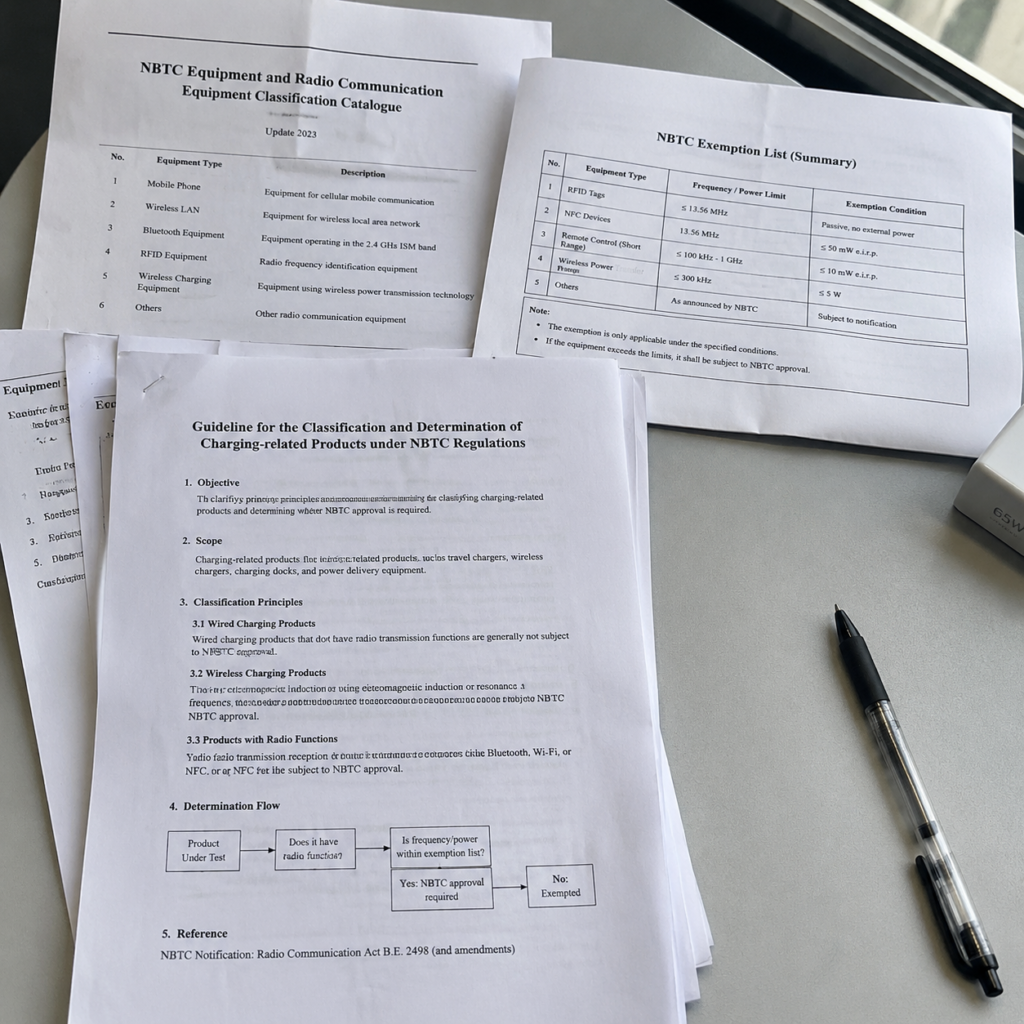
Step 4: Check against NBTC’s official public catalog to confirm which type of compliance procedures are required, or whether the product meets clear exemption conditions.
2. Charging Products That Require Key Verification of NBTC Compliance Requirements
Now that we understand the basic logic, let’s go through specifically which charging products require key verification of NBTC requirements. You can first screen your own product inventory against this list.
Wireless Charging Transmitter Devices
The first category is wireless charging transmitter devices—that is, the end that actively transmits wireless charging energy outward. For example, commonly used desktop magnetic wireless chargers, power banks with wireless charging modules, and multi-port charging power strips with wireless charging all fall into this category.
It should be noted here that you cannot directly say “all wireless chargers require NBTC”. Whether it is required and which type to apply for ultimately depends on the product’s operating frequency, field strength or power, specifications of the coil or transmitter module, intended use, and device form, and then confirmed against NBTC’s special rules for Wireless Power Transfer (WPT). Wireless charging cannot be directly equated with general short-range wireless communication devices. Specific requirements must be based on the latest official rules; do not make decisions on your own.
Smart Charging Products with Short-Range Wireless Communication Functions
The second category is smart charging products with short-range wireless communication functions. As long as they have active wireless communication functions, even if the function is only auxiliary, such as connecting to a mobile phone to check charging status or for remote control, they must be included in the verification scope.
The most common are products with Bluetooth, 2.4G/5G Wi-Fi, Zigbee, or wireless remote control, such as smart PD fast charging heads with Bluetooth, smart charging power strips with Wi-Fi, and power banks with Bluetooth anti-loss function. These are all short-range communication devices and usually require NBTC compliance procedures.
There is also a category of charging devices with NFC. Here, pay attention to the boundary: NFC devices with active transmission and active read/write functions require verification, such as paired charging bases with active NFC read/write functions.
Passive NFC or RFID tags usually do not have independently powered transmitters, but may return information to the reader through load modulation or backscatter. Therefore, whether NBTC procedures are required cannot be judged solely by the fact that they “have no battery” or “do not actively transmit on their own”. You also need to check whether there is load modulation, reverse communication, and whether they meet NBTC’s exemption conditions for the corresponding frequency band and equipment category.
Charging Devices with Cellular/IoT Modules
The third category is charging devices with cellular or IoT modules, that is, products that can insert a SIM card or have a built-in eSIM to use data traffic, such as shared power banks and shared charging cabinets with 4G/5G/NB-IoT.
When judging this type of product, you should first confirm whether the device has cellular wireless communication functions, as well as the standard, frequency band, and radio frequency link it uses, then check against the frequency bands allowed for use in Thailand, technical standards, and operator network access requirements. Whether it supports Thai operator frequency bands is not a prerequisite for judging whether it is regulated by NBTC; if the device uses a frequency band not authorized in Thailand, it usually means higher compliance risk, rather than being exempt from verification.
A detail to note here: if the communication module is only installed inside the shared charging cabinet, usually NBTC requirements should first be verified based on the actual model and functions of the cabinet. Whether the power banks inside the cabinet need to be handled separately depends on whether they are imported separately, sold separately, have wireless or telecommunication functions, and whether the NBTC certificate or application scope clearly covers this combination. You cannot generally conclude that no separate verification is needed just because the power banks are inside the cabinet.
This type of cellular-enabled product belongs to telecommunication terminal equipment or radio equipment, and usually requires key verification with more requirements.
Wired Communication Charging Devices with Public Network Access Functions (Rare)
There is another very rare category, which is wired communication charging devices with public network access functions, such as smart charging cabinets with public network access functions.
This should be understood as: if the device is directly connected to or accesses public telecommunication networks, including fixed or mobile public networks, it is necessary to check the requirements of NBTC for telecommunication terminal equipment. The scope cannot be limited to public fixed telecommunication networks.
If the device only connects to an ordinary local area network, enterprise backend, or connects to the network indirectly through another certified gateway, further judgment is needed based on the actual interface, communication functions, and the role of the device in the system. This type of product accounts for an extremely low proportion. If you are unsure, you can directly check the latest NBTC catalog.
3. Common Charging Products That Usually Do Not Involve NBTC
After talking about products that require verification, let’s talk about what everyone is most concerned about: which charging products usually have nothing to do with NBTC, with relatively clear boundaries, so you don’t have to worry unnecessarily.
Pure Wired Charging Heads/Power Adapters Without Active Wireless Transmission
The first category is pure wired charging heads and power adapters without radio or telecommunication functions—that is, products that only perform AC-DC power conversion, or only perform wired power distribution. For example, ordinary USB-A/USB-C fast charging heads, PD power adapters for laptops, multi-port charging docks with only wired interfaces, and ordinary car chargers all fall into this category.
No matter how high the power of these products is, how many ports they have, or what fast charging protocols they support, as long as they have no radio or telecommunication functions, they usually do not involve NBTC. Of course, this type of product may involve other requirements such as TISI safety certification and energy efficiency certification, which need to be verified separately according to TISI and other applicable catalogs, and are not the same set of requirements as NBTC.
Passive Charging Accessories (No Power Supply/No Wireless Transmission)
The second category is passive charging accessories—that is, accessories that do not have power conversion functions themselves, nor do they have radio or telecommunication functions. For example, ordinary charging cables, USB-C adapter cables, ordinary power plugs, charging port sockets, and physical adapters all fall into this category.
Even if these accessories support wired data transmission, it doesn’t matter—wired data transmission usually does not fall into the category of radio transmission, and will not trigger NBTC requirements solely for this reason.
Charging Accessories That Only Passively Receive Wireless Signals
The third category is charging accessories that appear to only passively receive wireless signals—that is, products without independently powered transmitters, such as wireless charging receiver patches without built-in communication chips, and purely passive NFC charging tags.
However, you cannot simply say that “passive reception definitely does not involve NBTC”. Passive NFC/RFID tags may return information through load modulation or backscatter; wireless charging receiver patches may also have load modulation or other communication functions. Therefore, it is necessary to check whether the product is a receiving device covered by NBTC’s wireless power transfer rules, whether there is reception, reverse communication, or other radio frequency functions, and whether it meets the corresponding exemption conditions.
Only after confirming that its actual circuit and radio frequency behavior do not fall within the regulated scope, or clearly meet NBTC exemption conditions, can a conclusion be made that relevant procedures are not required.
Correct Understanding of Exemption Situations
Finally, we must clearly explain the correct way to understand “exemption”: only products that meet the exemption clauses clearly written by NBTC officially can be exempted from corresponding compliance procedures. You absolutely cannot find reasons for exemption on your own, such as “my product has low power”, “I sell few units”, or “these are samples”—none of these count. If you are unsure, be sure to consult NBTC officials or a formal compliance agency, do not draw conclusions on your own and end up falling into a pit.
4. Boundary Judgment Rules for NBTC Scope of Charging Products
All the above are basic judgments, suitable for most ordinary products. But if you deal with combination sets, smart products, or multi-version products, you will encounter some situations with blurred boundaries. Next, we will talk about these advanced judgment rules to help you understand complex scenarios.
Judgment Rules for Complete Devices and Included/Individually Sold Accessories
The first common boundary question: if the complete device has NBTC certification, does that mean the included charger and accessories are automatically compliant?
The answer is: no. The NBTC compliance of the complete device only covers the complete device itself, and does not extend to included accessories such as chargers and charging cables. Accessories must be judged independently based on their own functions. For example, if you sell a smart speaker with Wi-Fi, the speaker itself has NBTC certification, but the 20W USB-C fast charging head included in the box needs to be evaluated separately—it is pure wired, so it usually does not involve NBTC, but if it is in TISI’s mandatory catalog, it needs TISI certification.
The same applies to third-party charging accessories sold separately—just judge independently based on their own functions. If sold as a combination set, each accessory in the set must be judged separately. You cannot say that because one product in the set is certified, the others do not need to be.
Judgment Rules for Complete Devices with Built-in Approved Wireless Modules
The second common question: the wireless module I use already has NBTC approval, so does the complete device not need to apply?
The answer is also: no. The fact that the module is approved does not mean the complete device is automatically compliant, because changes in the complete device’s antenna, casing, and power design may change the product’s radio frequency characteristics. For example, if you replace it with a higher-gain antenna or use a metal casing, it will affect the transmission of wireless signals, so you cannot directly use the module’s certification to replace the complete device’s compliance.
When judging, several core points need to be checked: the approval scope of the module, the type and gain of the antenna, radio frequency parameters, firmware restrictions, and whether the model and label meet the requirements. If you use an approved module and you have not changed any radio frequency-related design, you may be able to go through a simplified application process, but you absolutely cannot directly assume that “no application is needed”. If you later change the module, antenna, or wireless configuration, you must re-judge, and everything must be based on the actual hardware version you sell in Thailand.
Judgment Rules for Devices with Disablable/Hidden Wireless Functions
The third boundary where it’s easy to fall into a pit: if the wireless function can be turned off, or even hidden in the software, does that mean no application is needed?
No. As long as the product has a built-in wireless module when it leaves the factory, and this function can be enabled, even if it is off by default, or the merchant hides the function in the firmware, it must be included in the scope of NBTC judgment.
Only pure wired versions that are not equipped with a wireless module at all can be individually judged as usually not involving NBTC. For example, the same charging head has two hardware versions: a Bluetooth version and a pure wired version. The pure wired version does not need to worry about NBTC, but the Bluetooth version, even if Bluetooth is off by default, must go through or verify the corresponding compliance procedures.
Judgment Rules for Products of Different Versions/Models
The fourth boundary: the same product looks the same, but only has different configurations—does one application suffice?
No. Even if the appearance is exactly the same, as long as the configurations are different—for example, Wi-Fi version and cellular version, wired version and wireless charging version—they must be judged separately. Different model suffixes, different hardware versions, and different regional versions may all change the NBTC application scope of the product. You cannot take the easy way out and use “one certification for the entire series”.
5. Practical Methods for Quickly Judging NBTC Applicability of Charging Products
After talking about so many rules, you may ask: what exactly should I do to quickly judge whether my product needs NBTC? In fact, with just four steps, you can conduct a preliminary screening on your own.
Step 1: Check for Active Wireless/Public Network Access Functions
First, check whether the product has wireless or telecommunication functions, including active wireless, wireless reception, wireless charging, reverse communication, and public network access functions.
You can check from two places: first, look at the product’s manual, detail page, and specification sheet to see if functions such as wireless charging, Bluetooth, Wi-Fi, NFC, wireless remote control, and cellular module are marked; second, look at the product’s structure to see if there are external antennas, hidden antennas, or SIM card slots.
When checking, remember to exclude the non-regulated function items we mentioned earlier, such as fast charging protocols, wired data transmission, and the USB interface itself—these usually do not need to be used as a basis for NBTC judgment. However, if the product has wireless reception, load modulation, or wireless power transfer functions, you cannot directly exclude it just because there is no obvious active transmitter.
Step 2: Check the Type and Core Parameters of Wireless Functions
If relevant functions are found in the first step, the second step is to check the type and core parameters of the wireless functions.
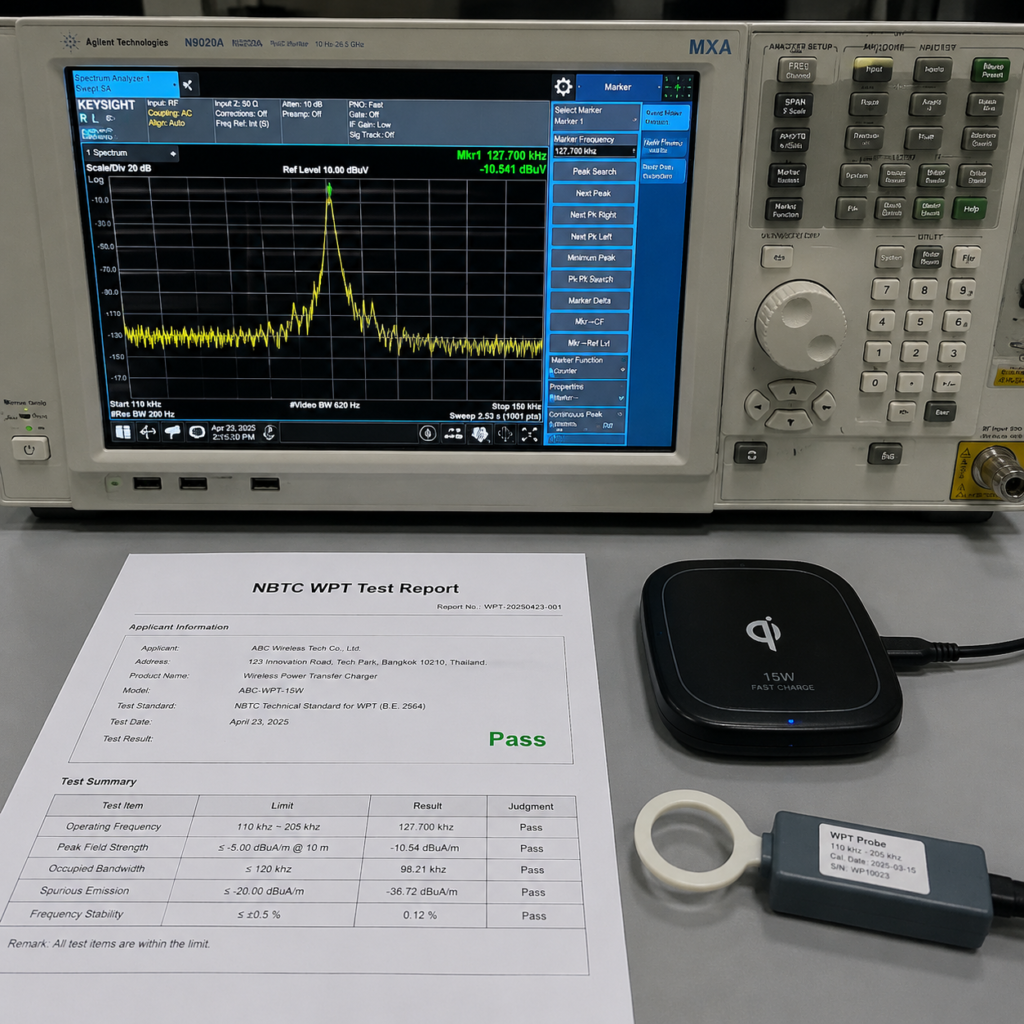
You need to ask the supplier for these materials: the model of the wireless module or chip, operating frequency band, bandwidth, transmitter conducted output power, antenna specifications and antenna gain or loss, as well as EIRP (Effective Isotropic Radiated Power) calculated or measured according to applicable standards. EIRP is derived from combining transmission power, antenna gain, and loss. You cannot treat “maximum radio frequency transmission power” and EIRP as the same parameter.
If it is a cellular device, you also need to additionally check the cellular standard, frequency band used, and whether it meets the frequency and operator network access requirements allowed in Thailand.
After getting these parameters, you can have a preliminary reference: products with active short-range communication, such as Bluetooth and Wi-Fi types, usually require procedures; wireless charging products need to be verified according to NBTC’s special rules on wireless power transfer. If the supplier does not provide parameters, it’s best not to guess blindly, and it’s safer to directly find a compliance agency for evaluation.
Step 3: Confirm the Sales/Import Scenario in the Thai Market
Step 3: Confirm your sales and import scenarios in the Thai market.
If the product falls within the NBTC regulatory scope, before formal commercial circulation, such as opening a store on an e-commerce platform, selling in offline physical stores, or local warehousing and distribution, the applicable NBTC certification, registration, or licensing procedures should be completed in accordance with regulations.
However, commercial sales, import, or warehousing themselves do not mean that all charging products must go through NBTC procedures. For products that do not fall within the NBTC regulatory scope, or meet the official clear exemption conditions, they should be handled according to the corresponding non-regulated or exemption rules.
If they are display samples or test prototypes, you cannot assume exemption by default. You need to verify the import path and corresponding approval requirements in advance. Don’t think that “just a few samples” will be fine.
If they are personal imports or after-sales replacement parts, they need to be verified in combination with the import purpose and specific customs rules. There is no general saying that “small quantities can be exempted”, so don’t take chances.
Step 4: Verification Channels When Unsure
If you are still unsure after the first three steps, the fourth step is to find formal channels for verification, don’t tough it out on your own.
The most authoritative is NBTC’s official public query system, where you can check the category catalog and latest rules; you can also find NBTC-recognized testing laboratories or compliance agents for pre-evaluation, who have more experience and can help you avoid detours; in addition, you should also confirm the qualification requirements for local importers or certificate holders in advance, because some NBTC compliance applications may require a local certificate-holding entity.
6. Common Misconceptions in Judging NBTC Scope for Charging Products
Finally, let’s take stock of several common misconceptions in judging the NBTC scope for charging products, which many sellers have fallen for. You can use this to avoid pitfalls.
Misconception 1: All Chargers/Charging Cables Require NBTC
This is the most common misunderstanding. In fact, pure wired products without radio or telecommunication functions usually do not involve NBTC. For example, ordinary 20W USB-C fast charging heads and ordinary braided charging cables do not require it. When verifying, first check whether the product has wireless transmission, wireless reception, wireless power transfer, reverse communication, or public network access functions—don’t panic right away.
Misconception 2: Low-Power Wireless Charging Can Be Exempted
Many people think “my wireless charger is only 5W, with such low power, it definitely doesn’t need certification”—this is wrong. Whether it can be exempted depends on the official clear exemption clauses of NBTC, and you cannot judge it on your own with the reason of “low power”. If you really need to verify, you need to check the frequency, field strength or power of the wireless charger, device form, and NBTC’s latest wireless power transfer rules—don’t make decisions on your own.
Misconception 3: CE/FCC Wireless Certification Can Replace NBTC
No. NBTC is a local mandatory compliance requirement in Thailand, and certifications from other countries or regions cannot directly replace it.
However, if you already have CE or FCC wireless test reports, they may be used as technical materials or for corresponding simplified paths when they meet NBTC’s applicable standards, report format, and laboratory recognition conditions. Whether additional testing, certification, registration, or supplier’s declaration of conformity is required ultimately depends on the NBTC procedures applicable to the specific device. You cannot generally promise that less testing will definitely be possible, nor can you generally say that all products must go through the same complete procedures.
Misconception 4: If the Wireless Module Is Approved, the Complete Device Is Automatically Compliant
We talked about this before, let’s emphasize it again: NBTC approval of the module only covers the module itself, and does not automatically cover the complete device, because changes in antenna, casing, and power design may change the radio frequency characteristics. When verifying, be sure to check the approval scope of the module and the radio frequency configuration of the complete device to confirm whether a new application is needed—don’t take it for granted.
Misconception 5: If the Complete Device Has NBTC, the Included Charger Is Compliant
Many sellers think that since the main product they sell has NBTC, the included charger gets a free pass—but that’s not the case. The NBTC compliance of the complete device only covers itself, and the included charger must be judged separately based on its own functions. For example, a pure wired included charger usually does not involve NBTC, but may involve other requirements such as TISI, which also need to be verified separately—you cannot just ignore it.
7. Practical Tools for Judging NBTC Applicability of Charging Products
For your quick reference, we have compiled a quick reference table for NBTC applicability of common charging products. You can save it and quickly screen your own product inventory:
| Product Type | Preliminary Judgment | Final Conclusion Requirements |
| Ordinary USB-C fast charging head | Usually not involved | Need to verify other regulatory requirements such as TISI |
| Ordinary charging cable/physical adapter | Usually not involved | Can be confirmed if there are no special wireless functions |
| Magnetic wireless charger | Requires verification | Check frequency, field strength/power, intended use, and device form according to WPT special rules |
| Bluetooth smart PD charging head | Usually required | Confirm according to short-range communication device category |
| Smart charging power strip with Wi-Fi | Usually required | Confirm according to short-range communication device category |
| 4G shared power bank/charging cabinet | Usually required | Confirm according to telecommunication terminal equipment, and check the cabinet, power bank, and certificate coverage scope |
| Wireless charging receiver patch without communication chip | Cannot be excluded solely based on this | Need to confirm whether it is a receiving device covered by WPT rules, and whether there is load modulation, reverse communication, or other radio frequency functions |
Note that this table is only for preliminary judgment, and the final conclusion still needs to be confirmed in combination with the actual parameters of the product and the latest official rules.
There are also two practical small tools you can use directly:
One is a wireless function checklist, which you can check one by one: Does the product have wireless charging transmission function? Does it have active wireless communication functions such as Bluetooth, 2.4G/5G Wi-Fi, Zigbee? Does it have active read/write NFC or wireless remote control function? Does it support cellular networks and access public telecommunication networks? Does it have external or hidden antennas, SIM card slots? Is there wireless reception, load modulation, or reverse communication function? As long as one answer is “yes”, further verification is required.
The other is a document preparation list for compliance judgment. If you need to find an agency or official for verification, preparing these documents in advance can save a lot of time: complete product model plus hardware version, wireless module/chip model, radio frequency parameter table (including frequency band, bandwidth, transmitter conducted output power, antenna gain or loss, and applicable EIRP), antenna specifications. If it is a cellular device, you also need standard description, frequency band used, and whether it meets Thai operator network requirements, as well as the product’s functional manual, specification sheet, and packaging, promotional pages, and product photos of the Thai sales version.
Summary
In general, the core logic for judging whether a charging product needs Thailand NBTC compliance is to first check whether the product has radio or telecommunication functions, and then judge the applicable NBTC procedures based on the device’s transmission, reception, wireless power transfer, reverse communication, frequency band, and technical standards. Pure wired products without radio or telecommunication functions can usually be preliminarily excluded, but you cannot exclude all special wireless devices solely based on “no active transmission”.
Remember this core point, and you can quickly distinguish most products. Combined with the boundary rules and pitfalls we talked about, you can basically complete the preliminary screening on your own, without worrying as soon as you hear NBTC.
Finally, it should be reminded that NBTC’s equipment catalog, frequency band rules, and application paths may be updated with policy changes. This content is only for preliminary screening and does not constitute formal compliance advice. Before formal import and sales, be sure to follow the latest official documents of NBTC and the professional opinions of recognized institutions, and verify clearly in advance to avoid unnecessary losses.