
If you’ve bought power banks, 2-in-1 chargers with built-in batteries overseas, or paid attention to the parameters of mobile phones and wireless earbuds, you’ve most likely seen the “IEC 62133” mark. Many people only know it’s related to battery safety, but few clearly explain what it covers, what it doesn’t, and how to read the markings so you don’t get misled by merchants.
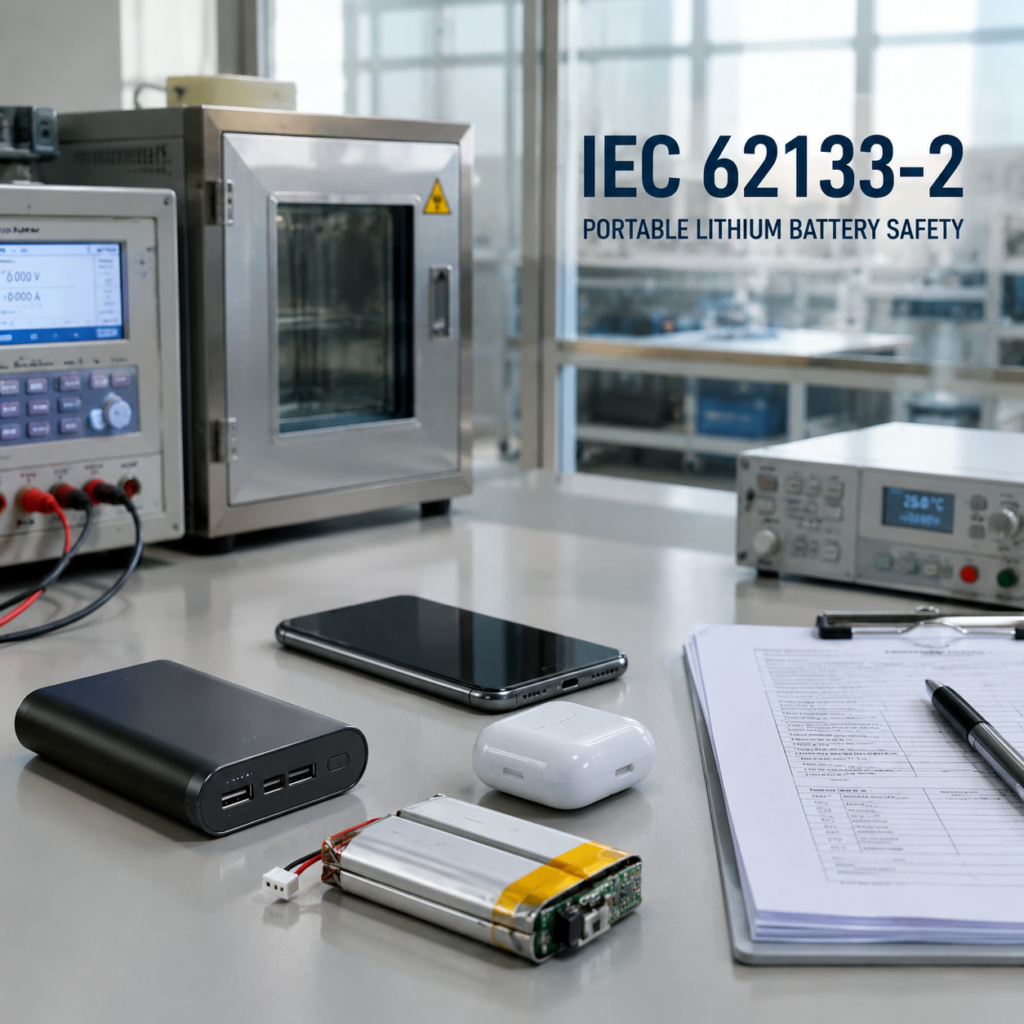
First, Understand: What Exactly Is This Standard?
The International Electrotechnical Commission (IEC for short) is an important international body that develops safety rules for electrical products worldwide. IEC 62133-2 is an international safety standard for portable sealed secondary lithium cells and batteries, mainly focusing on the safety performance of lithium-ion batteries and lithium-polymer batteries under specified conditions. It is not a globally unified “pass line”, nor is it the direct basis for certification in all regions; however, the regulations, certification or testing systems of many countries and regions will reference IEC 62133-2, or adopt equivalent or modified local standards.
It should be noted that it only assesses the safety performance of batteries, and does not involve usage performance such as battery life, fast charging speed, or actual capacity at all.
For ordinary charging users, this standard is directly related to your daily safety: the core safety performance of power banks and 2-in-1 chargers with built-in lithium batteries basically depends on whether the built-in batteries meet the standard. Many portable electronic products such as mobile phones, tablets, and TWS earbuds will evaluate their built-in batteries in accordance with IEC 62133-2 or equivalent standards of the corresponding country or region, but the actual applicable standards and certification requirements also depend on the product category and sales region.
Here we need to clarify three of the most common misunderstandings first, to prevent you from getting it wrong from the start:
First, it is not a standard for chargers or charging cables. Pure charging accessories have their own independent safety standards. If the charger or charging cable you buy is marked with IEC 62133, it is clear false publicity.
Second, it does not mean “absolute safety”. Complying with the standard only means that it has passed the safety requirements of the specified test items under laboratory controlled conditions. If it is intentionally abused, such as throwing it into fire or hitting it with a heavy object, there are still safety risks.
Third, it is not a global mandatory standard. It is one of the important international references. The mandatory requirements of each country and region are different. Some adopt equivalent versions, some adjust according to local conditions, and may also superimpose other regulations and testing requirements.
Clarify the Applicable Boundaries: What It Covers and What It Doesn’t
To truly understand the role of this standard, you must first clarify its coverage, as well as the several levels of battery products we often come into contact with.
Covered Batteries and Products
This standard is mainly aimed at rechargeable sealed lithium cells and batteries, including lithium-ion batteries and lithium-polymer batteries. Whether they are cylindrical, prismatic, or pouch-shaped, they may fall within its applicable scope. There are three types of corresponding common products: power banks, 2-in-1 chargers with built-in lithium batteries, and built-in batteries of USB-charged digital products such as mobile phones and tablets.
Three Battery Levels You Must Know for Beginners
Many people can’t tell the difference between “cell”, “battery pack” and “complete device”. In fact, the safety requirements for these three levels are completely different, and this is also where merchants often confuse concepts:
- Cell: It is the smallest unit for storing electricity, such as the 18650 cylindrical cell that people often hear about, or the thin pouch cell in mobile phones. It is equivalent to the “core energy storage block” of the battery, with no additional protection circuit.
- Battery pack: It is a finished product assembled from cells plus a protection board, casing, and interface. The replaceable batteries we come into contact with daily and the battery assemblies in power banks are basically battery packs. The protection board is a key component to prevent overcharging and short circuits, and directly affects the safety of the finished product.
- Complete device: It is a complete product with a battery, such as the entire power bank or the entire 2-in-1 charger. In addition to the battery itself, it must also meet requirements such as casing strength, interface firmness, and charging circuit safety. You can’t just look at whether the battery meets the standard.
Clearly Excluded Categories
There are three types of products that are completely outside the scope of this standard, don’t confuse them:
The first type is chargers and devices with power supply functions. Such products usually need to comply with IEC 62368-1 or other applicable electrical safety standards according to the specific product category. Charging cables, connectors and USB interfaces should be evaluated in accordance with the corresponding cable, connector, USB specifications and sales region requirements, and IEC 62368-1 cannot be applied indiscriminately.
The second type is non-consumer grade batteries, such as power batteries for electric vehicles and household fixed energy storage batteries, which have their own specialized industry standards.
The third type is other batteries, such as disposable dry batteries, nickel-metal hydride, nickel-cadmium and other nickel-based rechargeable batteries, which are not within its management scope.
Safety Division of Labor with the Charging System
Charging safety is a complete chain. Batteries, chargers, and interfaces/cables are three independent safety links, each with corresponding standards, and cannot replace each other. IEC 62133-2 only tests the safety performance of batteries under specified, applicable charging conditions, and does not assess the quality of the charger itself at all. Only when all links meet the corresponding requirements can the risk of charging safety be minimized.
Core Tests: Corresponding to the Risks You Encounter Daily
Many people are curious about what this standard actually tests. In fact, the relevant test items are mainly designed around the safety performance of batteries during use, charging, and when subjected to mechanical or environmental influences, and are not a comprehensive score for battery life or fast charging performance.
First, let’s clarify the core logic of the test: the standard controls risks such as fire, explosion, and dangerous leakage through the specific judgment conditions of each test item. The qualification criteria for different tests are not exactly the same. Swelling, leakage, rupture or functional abnormality cannot be generally regarded as normal, and shall be subject to the judgment requirements of the corresponding clause.
In addition, the specified items of IEC 62133-2 do not include the commonly referred to general nail penetration test, but other standards, regulations or specific certification schemes may require abuse tests such as nail penetration separately. Laboratory tests do not mean that all man-made damage or extreme abuse scenarios are covered.
Cell-level Tests: Testing Intrinsic Safety
This part of the test is directly aimed at the cell, to see if the cell itself will be dangerous under specific conditions, corresponding to the most basic safety bottom line:
- External short circuit test: Simulates the situation where the positive and negative electrodes of the cell are connected by an external conductor and a short circuit occurs.
- Thermal abuse test: Simulates the safety performance of the cell when it is under specified high temperature conditions, such as being close to a heat source or in a high temperature environment.
- Mechanical damage related tests: According to different levels of cells or battery packs, the standard specifies specific tests such as external short circuit, crush, vibration, and mechanical shock; these items cannot be collectively referred to as a single cell test that simulates both crush and drop.
- Abnormal electrical condition test: Simulates abnormal charging conditions such as overcharging, to verify whether the cell will cause danger under specified abnormal conditions.
Battery Pack-level Tests: Testing the Overall Safety of the Finished Product
A qualified cell does not mean that the finished battery is safe. The quality of the protection board and whether the assembly process is up to standard will affect the final safety performance. This part of the test is aimed at the finished battery pack:
- External short circuit test: Verify the safety performance of the battery pack during external short circuit according to the battery pack terminals and short circuit conditions specified in the standard; USB interface and dustproof capability also need to be evaluated according to the requirements related to the complete device or interface.
- Overcharge protection test: Verify whether the protection circuit can cut off power in time when the charging voltage exceeds the safety value, to prevent the cell from being overcharged and causing accidents.
- Environmental and mechanical endurance test: The battery pack shall undergo safety tests such as vibration, mechanical shock, and temperature in accordance with the standard. These tests only represent risk assessment under specified conditions, and cannot guarantee that the product can withstand all daily drops or environmental abuse.
A special reminder here: a qualified cell does not mean that the battery pack must be qualified. If a good cell is used but matched with a poor-quality protection board, or the assembly process is poor, the battery pack will still fail the test.
The test results mainly reflect the performance of the submitted samples and their design and manufacturing consistency under specified conditions. Dropping, hitting, crushing, water ingress and long-term aging may change the battery state, and it cannot be inferred from the original test results that the damaged battery is still safe.
Versions and Easily Confused Standards: Don’t Let Merchants Ride the Popularity
The markings on the market are varied, and some merchants deliberately mix irrelevant standards together. Only by learning to distinguish versions and easily confused standards can you judge whether the product is truly compliant.
Version Identification Key Points
IEC 62133 is published in separate parts. The -1 part is for nickel-based batteries and has nothing to do with lithium batteries, and the -2 part is specifically for lithium batteries. When buying, be sure to check clearly whether there is a “-2” suffix.
For lithium batteries, it should be confirmed that IEC 62133-2 is applicable, and the specific version should be checked. Current IEC publications include IEC 62133-2:2017 and its A1:2021 amendment. Whether it meets the requirements also needs to be confirmed according to the sales region and specific certification scheme.
Differences from Easily Confused Standards in the Charging Field
There are many charging-related standards, and ordinary users can easily confuse them. Here is a table to clarify the division of labor:
| Standard Number | Core Scope of Jurisdiction | Division of Labor with IEC 62133-2 |
|---|---|---|
| IEC 62619 | Safety requirements for secondary lithium cells and batteries for industrial use | IEC 62619 is for industrial use, and IEC 62133-2 is mainly for portable applications. The two cannot be simply distinguished as “battery vs. complete device” |
| IEC 62368-1 | Safety of audio/video, information and communication technology equipment and their power supply equipment | IEC 62133-2 mainly evaluates portable lithium batteries, and IEC 62368-1 applies to the electrical safety of chargers or complete devices that fall within its product scope; specific charging cables, connectors, etc. may also be subject to other requirements |
| UN 38.3 | Test and judgment requirements for lithium batteries before transportation | IEC 62133-2 mainly evaluates the safety of portable batteries under specified use conditions; UN 38.3 specifies the test and judgment requirements that lithium batteries must meet before transportation. The two have different purposes and cannot replace each other |
Association with Common Global Certifications
Various certifications you commonly see on products may be related to this standard, but they cannot be simply understood as the same certification:
- CB Certification: The CB Scheme is operated by IECEE in the IEC conformity assessment system. CB test reports and certificates can be used as an important basis for applying for local certification in many member economies. However, whether repeated testing is exempted, whether national differences and factory inspections are required shall be determined by the certification body of the target market.
- Regional Mandatory Certification: CE is a conformity mark under the applicable regulations of the European Union, and PSE and KC are subject to the local regulations and certification systems of Japan and South Korea respectively. Some portable lithium battery requirements may adopt national equivalent or modified versions of IEC 62133-2, but the requirements must be checked according to the specific product and market.
- North American UL Certification: UL 62133-2 is related to IEC 62133-2 and includes US national differences, but the applicable standards for battery products in North America may also include UL 1642, UL 2054, UL 2271, etc. You cannot judge full compliance solely by “UL 62133”.
How to Read Compliance Information: Avoid False Publicity
After knowing the basic information of the standard, you also need to learn how to read the merchant’s publicity and certificates to avoid common pitfalls.
Three Must-check Items for Compliance Statements/Certificates
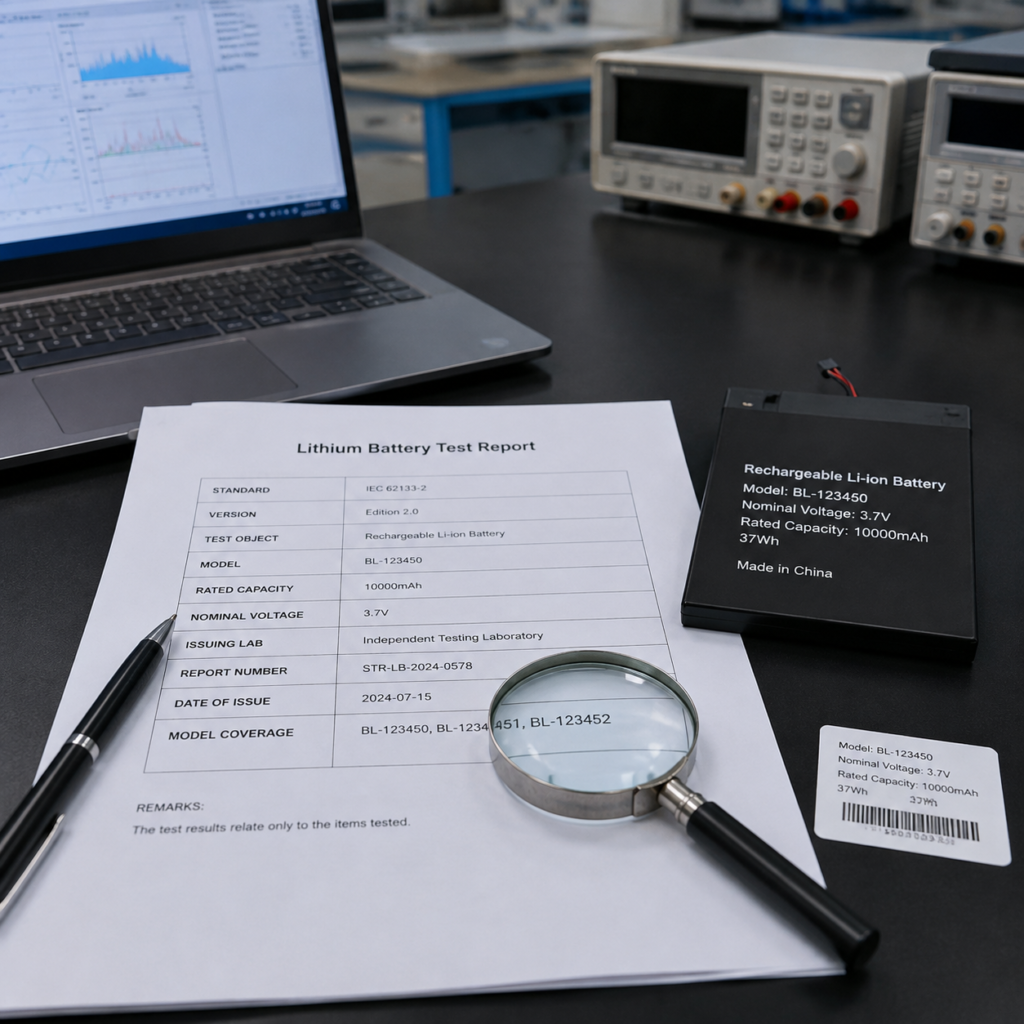
Whether you are looking at product packaging, detail pages or documents provided by merchants, you must check these three key points:
First, check whether the standard information is complete: You should request to provide verifiable information such as the complete standard number, version, test object, model and issuing agency. Only writing “compliant with IEC 62133” only means that the information is incomplete, and you cannot conclude that no test has been conducted based solely on this point.
Second, check the test object: Confirm whether the test is for the cell, battery pack or complete device. A qualified cell does not mean that the finished battery is qualified, let alone that the entire product is qualified. When buying products such as power banks, you need to look at the test or certification status of the battery pack and the applicable requirements of the complete device.
Third, check the model coverage: Confirm that the actual purchased model, cell/battery structure, key protection scheme and capacity are within the model series or scope clearly covered by the certificate or report. Documents cannot be applied to uncovered models or products with different structures.
How to Judge Supporting Documents
The probative effect of different documents cannot be sorted solely by name. The focus should be on verifying the document type, qualification of the issuing agency, standard version, test object, model coverage, validity period and manufacturing consistency requirements.
Third-party certification, third-party laboratory reports and manufacturer’s declarations each have applicable scenarios. CB, UL, and PSE should not be lumped together as the same type of certification without distinction; under some regulatory systems, the manufacturer’s declaration of conformity itself is a formal compliance document for which the manufacturer bears legal responsibility. What really matters is whether the document is applicable to the target market and whether it accurately covers the product you purchase.
Identification of Common False Publicity
There are three situations that require special vigilance:
The first is that pure chargers and charging cables are marked with IEC 62133, which is a clear misapplication;
The second is that only “compliant with IEC 62133 standard” is mentioned, but the standard version, test object, product model and verifiable documents are not provided, which means insufficient information and compliance cannot be confirmed based on this;
The third is publicity of “absolute safety” and “never explodes”, which are exaggerated publicity. The standard only controls risks within specified conditions and reasonable ranges, and it is impossible to achieve 100% absolute safety.
Purchase and Use: Put Safety into Practice
After understanding the standard knowledge, it must ultimately be applied to actual purchase and use, to help you choose safer products and avoid daily risks.
Purchase Points for Different Charging Products
- Power banks: Prioritize products whose battery packs clearly meet IEC 62133-2 or the applicable requirements of the sales region. At the same time, check the regional mandatory certification of the complete device (such as CE, PSE, etc.), and don’t just look at the cell brand;
- 2-in-1 chargers with lithium batteries: It is necessary to confirm the compliance of both parts at the same time: the charger part must comply with applicable charging accessory safety standards such as IEC 62368, and the built-in battery must also comply with IEC 62133-2 or local applicable requirements. Neither is dispensable.
Safety Boundaries for Daily Charging
Even batteries that meet the standards must be used within a reasonable range. Exceeding the boundary will also have risks:
Use regular chargers and cables that meet the equipment requirements and have the correct output voltage and protocol. Compliant USB chargers with higher rated power usually do not force the device to charge at a higher power, but power supplies with mismatched voltages, modified or of unknown quality should not be used.
Do not charge or discharge in extreme temperature environments such as in a car exposed to the sun or in a severely cold outdoor environment. Too high or too low temperature may affect the battery state and increase safety hazards;
Batteries that have been dropped, hit, crushed, or exposed to water, even if they look intact on the outside, may have been damaged internally. It cannot be inferred from the original test results that they are still safe, and it is best not to continue using them.
Judgment and Handling of Battery Abnormalities
First, distinguish between normal phenomena and abnormal situations: when charging, the battery is slightly hot, feels warm to the touch, and does not burn your hand, which is usually a normal phenomenon; if there is severe swelling, so hot that it cannot be held, liquid leakage, or pungent odor, it is an abnormal situation.
If you encounter an abnormal battery, stop using it immediately and keep it away from people and combustibles. If the battery is heating, smoking, leaking or showing signs of fire, do not handle it with bare hands or dispose of it by yourself. Evacuate and contact the local fire or emergency department. Only when the battery is stable and safe to handle, hand it over to a battery recycling point or hazardous waste agency in accordance with local regulations. Do not disassemble it by yourself, and do not throw it into ordinary garbage.
Final Summary
IEC 62133-2 is an important international safety standard for portable sealed secondary lithium cells and batteries, mainly evaluating the safety performance of batteries under specified conditions, and does not cover chargers, cables and other charging accessories. Understanding its version, scope of application, test objects and compliance documents can help you avoid a lot of false publicity and choose products such as power banks and 2-in-1 chargers that meet safety requirements.
At the same time, standards do not equal absolute safety. You also need to match chargers and cables that meet the equipment requirements, confirm the regulations and certification requirements of the sales region, and avoid extreme usage scenarios. When encountering battery abnormalities, remember to stop using it in time, stay away from danger, and contact the emergency department or formal recycling agency according to the situation. Don’t take chances.