
If you export charging products to Thailand, or sell chargers and wireless chargers on Shopee and Lazada, you have most likely heard of “NBTC certification” — either customs requires you to supplement compliance documents for Bluetooth-enabled charging heads, or the platform requires you to upload NBTC-related documents to keep your listings. Many people are confused about this certification: Do all charging products need it? Is it mandatory for wireless chargers? Can FCC/CE certificates be used directly?
In this article, we will thoroughly explain Thailand’s NBTC wireless certification from the perspective of charging products, covering everything from basic judgment to key pitfall avoidance tips. After reading it, you will be able to conduct an initial screening on your own.
Basic Understanding: NBTC is the Market Access Threshold for Wireless Products in Thailand
First of all, make it clear that NBTC is not a charging safety certification. Its full name is the National Broadcasting and Telecommunications Commission of Thailand, a statutory body responsible for the regulation of broadcasting, telecommunications, and radio spectrum in Thailand. For relevant radio equipment, NBTC implements type approval, registration, declaration of conformity, or other regulatory requirements based on equipment category, frequency band, power, intended use, and applicable announcements.
What is commonly referred to in the market as “Thailand wireless certification”, “type approval”, “wireless registration”, and “declaration of conformity (commonly known as SDoC)” are actually different compliance paths that may be involved under the NBTC regulatory framework. Which one applies specifically depends on the product category and the latest announcements, and you cannot assume all wireless products follow the same certification method.
Regulatory Scope and Exclusions
Many people think NBTC regulates all charging products, but in fact, judgment needs to be made in combination with specific rules. NBTC focuses on radio communication equipment and specific wireless power transmission equipment managed under its announcements; whether wireless charging products need to go through NBTC-related procedures must be confirmed item by item in combination with operating frequency, power, communication control functions, and the latest technical standards.
To determine whether a product is regulated, it depends on its actual wireless functions, operating frequency bands, transmit power, intended use, and NBTC’s official announcements, and has nothing to do with its name or main featured functions.
For charging products, NBTC is not responsible for the safety and performance of general wired charging, nor for wired fast charging protocols. For example, if you sell an ordinary 65W PD fast charging head, as long as it does not have any wireless functions or wireless transmission functions regulated by NBTC, no matter how high the fast charging power is, it usually does not fall within the scope of NBTC certification for wireless equipment; however, other applicable safety and product compliance requirements still need to be evaluated.
Full-Chain Risks of Non-Compliance
If charging products with wireless functions fail to complete NBTC certification, registration, or declaration of conformity in accordance with applicable requirements, they may be required to supplement documents, have sales suspended, be detained, returned, or be punished according to law during import, sales, or market supervision. The specific consequences depend on the equipment category and law enforcement decisions.
On the sales side, whether it is an e-commerce platform or a local offline distributor, once non-compliant products are found, the lightest consequence is listing removal and link deletion, and the heaviest is fines.
Even if they are sold by luck, non-compliant wireless products may interfere with surrounding mobile phones, WiFi, and even public communication signals. Non-compliance may also lead to product removal, recall, or administrative and civil liability, and will also increase the risks of malfunctions, complaints, and after-sales handling.
Rules Are Dynamically Updated
It should be mentioned first here: NBTC’s product classification and technical requirements are not static, and will be dynamically adjusted in line with official announcements. Therefore, whether you rely on old experience or what others say, the final standard shall be the written confirmation from NBTC’s official database, local Thai license holders, or NBTC-recognized laboratories. Do not apply rules from several years ago to current products.
Quick Judgment: Does Your Charging Product Need NBTC Assessment?
For people who make charging products, the most concerned question must be: Does my product need NBTC certification? In fact, you don’t need to memorize everything by rote. Just collect a few key pieces of information first, and then judge according to the core principles.
Collect These Types of Information Before Judgment
Don’t just guess based on the product name. First gather these real pieces of information:
First is basic information: brand, model, SKU, and sales form — whether it is sold separately or as a set with other products.
Second is wireless hardware parameters: what wireless module is used, what type of antenna it is, which frequency band it operates in, and what the maximum transmit power is. These are hard indicators, much more reliable than marketing copy.
Third is operating mode: does this wireless function actively transmit signals, only passively receive, or is it just an auxiliary function? For example, for a charging head with Bluetooth, Bluetooth is an auxiliary active transmission function.
Core Judgment Principles to Remember for Beginners
The core judgment principle can be remembered as follows: As long as there is active wireless transmission, an NBTC applicability assessment should be conducted first; ultimately, exemption, registration, SDoC, type approval, or other requirements may apply, subject to NBTC classification and the latest announcements.
That is to say, active transmission is the starting point for triggering assessment, but it does not mean that all equipment must go through the same NBTC certification, nor does it mean that all must apply for type approval separately.
Pay attention to the boundary of pure receiving products: receiving accessories that are purely passive, have no active radio frequency transmission, and are not NBTC-listed equipment usually do not need wireless transmission equipment certification; but passive NFC and wireless charging receiving ends still need to be confirmed according to specific circuits and the latest announcements, and cannot be excluded solely based on the product name.
Remember: judgment is always based on actual hardware and operating mode. Don’t trust the names on marketing pages — for example, a “smart fast charging head” may not have wireless functions, and a “wireless receiving patch” may also have a hidden transmission module.
Charging Product Judgment Matrix
For your convenience in comparison, we have divided common charging products into four categories and organized them into a judgment matrix:
| Product Category | Is NBTC Assessment Required? | Exceptions | Typical Products |
| Charging equipment with active wireless communication | Usually requires initial assessment | If the equipment falls into the license-exempt or simplified conformity categories specified in NBTC announcements, type approval may not be required, but corresponding frequency band, power, technical standard, labeling, and import requirements must still be met; subject to applicable announcements | Fast charging heads with WiFi remote control, charging adapters with Bluetooth, power banks with active NFC function |
| Wireless power transmission equipment (e.g. Qi wireless chargers) | Needs to be verified according to the latest classification, cannot be directly determined | Needs comprehensive judgment based on operating frequency, power, and whether it has communication control functions | Desktop wireless chargers, car wireless chargers, magnetic wireless charging pads |
| Charging-related products that only passively receive | Usually do not need wireless transmission equipment certification | Need to confirm that the product is purely passive, has no active radio frequency transmission, and is not an NBTC-listed equipment; passive NFC and wireless charging receiving ends still need to be confirmed according to specific circuits and the latest announcements | Wireless charging receiving patches, passive NFC charging accessories |
| Pure wired charging products/accessories | Usually do not need NBTC certification for wireless equipment | Need to confirm that there are no wireless functions or wireless transmission modules regulated by NBTC, and evaluate other mandatory Thai compliance requirements | Ordinary fast charging heads, wired car chargers, charging cables, adapters |
Special Judgment for Boundary Cases
There are always ambiguous boundary cases in actual products, and special attention should be paid to the following scenarios:
The first is wireless power transmission equipment, commonly known as wireless chargers. Don’t directly judge whether it is needed or not as soon as you see the Qi logo or the words “wireless charger”. You must check the classification and technical requirements in NBTC’s latest announcements — if the wireless charger itself also has communication functions such as Bluetooth and WiFi, the communication part must also be separately verified for compliance, and cannot be calculated only as wireless power transmission.
The second is sets and series products. Whether sets, charging cases, and models of the same series can be declared jointly or included in the same certificate shall be subject to submitting model difference descriptions in accordance with the specific NBTC path and official rules, and obtaining confirmation from NBTC or the accepting agency; series coverage shall not be assumed on your own.
If you are really unsure, don’t guess blindly. Either find an NBTC-recognized agent or laboratory for pre-assessment, or directly check the latest official NBTC product classification list, which is the safest way.
Distinction Between Easily Confused Certifications: Don’t Mix Up NBTC with Other Certifications
Many people mix up NBTC with other certifications, especially cross-border sellers who have a bunch of certifications and think they are universal, only to end up falling into pitfalls. We will clarify a few of the most easily confused ones.
NBTC vs TISI: Two Different Compliance Lines
These are the two most common product compliance requirements in Thailand, but they belong to different regulatory scopes:
NBTC mainly involves wireless frequencies, transmission parameters, spectrum use, and interference prevention and control. Whether it applies depends on whether the product is a regulated wireless equipment and the corresponding official classification.
TISI only implements corresponding industrial standard and safety compliance requirements for products covered by its mandatory standard list. Wireless products must also meet the applicable radio frequency, spectrum, and possible EMC requirements of NBTC, which are specifically determined by product category and rules of relevant competent authorities.
It is easy to understand when applied to charging products: smart chargers with wireless functions may need to be assessed for both NBTC and TISI or other applicable safety compliance requirements; pure wired chargers usually do not need NBTC certification for wireless equipment, but still need to check safety compliance requirements.
NBTC vs CE/FCC/SRRC: Cannot Be Directly Replaced
Many sellers think that with EU CE, US FCC, or China’s SRRC certification, they can sell directly in Thailand, which is inaccurate.
CE, FCC, or SRRC certificates cannot automatically replace Thai requirements; whether their test reports are acceptable depends on laboratory qualifications, test standards, frequency bands, and current NBTC rules. Active transmission equipment shall go through type approval, registration, SDoC, or other applicable procedures according to classification.
For charging products, you cannot directly assume that Thai requirements are met just because you have overseas wireless certifications. Whether existing materials can be used specifically still needs to be confirmed by the applicable procedures and the accepting agency.
NBTC vs Fast Charging Protocols: Completely Unrelated
Many people are also confused: Is NBTC related to fast charging protocols? The answer is completely unrelated.
USB-PD, QC, etc. are all wired charging protocols, which govern how power is negotiated during charging. They belong to the category of wired charging and are not within NBTC’s wireless regulatory scope at all.
For example: a 120W PD fast charging head, as long as it does not have any wireless transmission module, no matter how complex the fast charging protocol is or how high the power is, usually does not need NBTC certification for wireless equipment. Conversely, fast charging protocol certifications (such as USB-IF’s PD certification) also cannot replace NBTC certification at all; they are two different things.
Three-Step Method for Quick Judgment of Charging Product Compliance Requirements
After clarifying the above distinctions, you can use these three steps to quickly judge the Thai compliance requirements for charging products:
Step 1: First confirm whether the product has active wireless transmission function. If yes, conduct an NBTC applicability assessment first, and then confirm whether it is exemption, registration, SDoC, type approval, or other procedures according to the classification.
Step 2: Check TISI’s mandatory certification list to confirm whether the product needs safety certification.
Step 3: Then check whether your cooperating sales platforms and customs clearance companies have additional document requirements, such as the format of qualification documents required by the platform.
Core Rules of NBTC Certification
If it is determined that the product needs NBTC certification, you must first understand these core rules to avoid pitfalls.
Certification Path Shall Be Determined According to Official Classification
There are several certification paths under NBTC, such as type approval, registration, declaration of conformity (SDoC), etc. Different paths have different requirements, and costs and cycles may also vary.
Which path to take specifically is not up to the agent, nor is it up to you to choose. Instead, you must first check NBTC’s product classification and determine it based on the product’s wireless functions, frequency bands, power, and the latest announcements. Here is a pitfall to avoid: don’t trust the agent’s verbal promise that “SDoC can definitely be done”. Everything shall be subject to NBTC’s official classification. Otherwise, even if you get the so-called documents, it is useless if the official cannot find them.
The Applicant Entity Shall Meet the Requirements of the Corresponding Procedure
Most wireless equipment procedures for the Thai market need to be handled by local Thai applicants, importers, license holders, or authorized representatives that meet NBTC requirements; specific applicant entity and authorization document requirements are subject to equipment category and current NBTC procedures.
This entity usually needs to bear corresponding compliance responsibilities, so when looking for a license holder or agent, you must find a reliable one, and don’t randomly affiliate with an unfamiliar company.
Certificate Validity and Renewal
For different categories of equipment, the validity and subsequent requirements of certificates, registration records, or declarations of conformity are different, and cannot be generalized. Specifically, it shall be subject to the markings on the corresponding documents, records in the NBTC system, and the latest official notices.
Graded Judgment of Certification Changes
Many sellers don’t know whether they need to redo the certification after modifying the product. In fact, first of all, it depends on whether the radio frequency-related parts have been changed:
Any change that affects radio frequency functions, parameters, antennas, enclosures, power supply, or model identification shall first be evaluated in accordance with NBTC change rules. Software upgrades cannot be ruled out either, as they may change radio frequency protocols, channels, power, or modulation.
Whether changes that do not affect radio frequency do not need re-evaluation, difference materials shall also be retained and confirmation from the accepting agency shall be obtained. For example, only changing the product interface or the color of the charging indicator light usually does not directly change wireless parameters, but change records shall still be retained according to applicable procedures.
New models must be declared in accordance with official series rules. You cannot assume on your own that they can be added to existing certificates or records just because the wireless hardware looks the same.
Division of Responsibilities of All Parties
Don’t think that everything is fine once certification is obtained. All parties have their own responsibilities:
Manufacturers shall ensure that the wireless parameters of the product meet the requirements, provide real technical materials, and shall not commit fraud.
Thai applicants, importers, license holders, or authorized representatives are responsible for submitting applications or documents in accordance with applicable procedures, ensuring that the actual shipped products are consistent with the declared materials, and bearing corresponding compliance responsibilities.
Sellers, whether e-commerce sellers or offline distributors, shall also verify relevant compliance documents and product information, and shall not sell products that they know do not meet the requirements.
Practical Application Process for NBTC Certification of Charging Products
Many people do NBTC for the first time and don’t know what the process is. We have organized four steps according to the common situation of charging products. After reading it, you will know roughly what to do.
Step 1: Pre-Audit and Preparation
If this step is done well, you can avoid a lot of detours later:
First, conduct a product classification pre-audit to confirm which NBTC category the product belongs to and which certification path applies. Don’t send it for testing right away; sending it to the wrong category is a waste of money.
Then is entity preparation: confirm a local Thai applicant, importer, license holder, or authorized representative that meets NBTC requirements, or find a formal agency. It is best to find one with experience in charging product certification, as they are familiar with the process and less likely to make mistakes.
Next is material preparation: gather all the technical materials of the product, such as specifications, wireless module parameters, antenna information, user manuals, label design drafts, etc. The more complete, the better.
Finally, sample preparation: first confirm that the product’s wireless solution meets the applicable frequency bands and technical requirements of Thailand. For example, check whether WiFi uses frequency bands allowed in Thailand. Don’t take a sample that only supports domestic frequency bands for testing; it will definitely not pass. If possible, you can self-test core parameters such as transmit power in advance to have a clear idea.
Step 2: Testing and Report Review
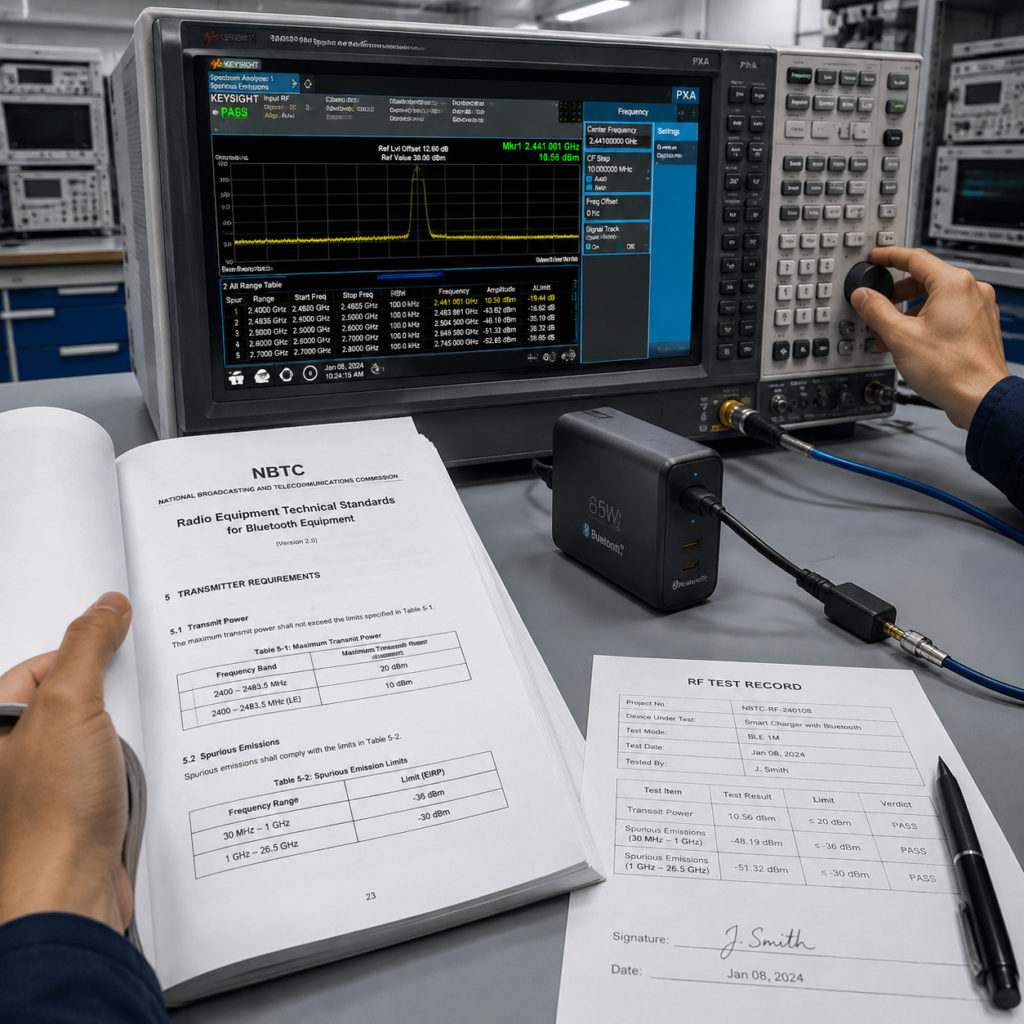
When testing is required, NBTC-accepted laboratories and applicable standards shall be used; whether overseas reports are acceptable shall be verified against laboratory qualifications, recognition scope, report format, and current NBTC requirements. For the registration or SDoC path, test and declaration documents shall be prepared in accordance with the provisions of that path.
If you have already done testing in an overseas laboratory, whether the report can be used depends on the laboratory’s qualifications and recognition scope, and whether the test standards meet Thai requirements. Ultimately, it shall be subject to the confirmation of current NBTC procedures or the accepting agency. Don’t assume that an overseas report will definitely be usable.
Test items shall be determined according to wireless technology, frequency band, power, antenna, and applicable NBTC standards, which may include frequency, bandwidth, transmit power, spurious or out-of-band emission, EMC, and field strength or power density items related to wireless power transmission.
Step 3: Submit Application and Obtain Certification
Note that the applicant entity and submission method shall meet the requirements of specific NBTC procedures. Usually, test reports, technical materials, and relevant declaration documents need to be submitted. The specific materials depend on the product category and applicable path.
The review cycle has no fixed number of days and is affected by many factors: for example, whether the test passes at one time, whether the materials are complete, and whether the product is complex. Simple products are faster, while complex products with multiple wireless functions are slower.
In terms of cost, it mainly includes testing fees, agency fees, applicant or license holder service fees, etc. The more complex the wireless functions, the more test items, and the higher the cost. Here is a special pitfall to avoid: don’t trust propaganda like “ultra-low price, get certificate in one week”. NBTC-related procedures have fixed classification and document requirements. Too cheap and too fast solutions need to be carefully verified. If customs clearance fails then, the loss will be greater.
Step 4: Archiving and Labeling After Obtaining Certification
Don’t think it’s over once you get the documents. There are two more things to do later:
First, keep the certificate, registration record or declaration of conformity, test report, and other application materials properly, so that they can be produced whether it is customs inspection or market supervision inspection.
Then, use the specified labels, numbers, and labeling positions in accordance with the applicable NBTC path and announcements. Some equipment can be labeled at specified positions on the product body, packaging, or instructions. Specifically, it shall be subject to the official requirements of that equipment category, and cannot be arbitrarily simplified on your own.
Verification Methods for Certificates and Labels
Whether it is the certification you did yourself or the certification provided by your supplier, you must learn to verify the authenticity, otherwise you won’t know if you get a fake certificate.
Key Points for Checking Certification Labels
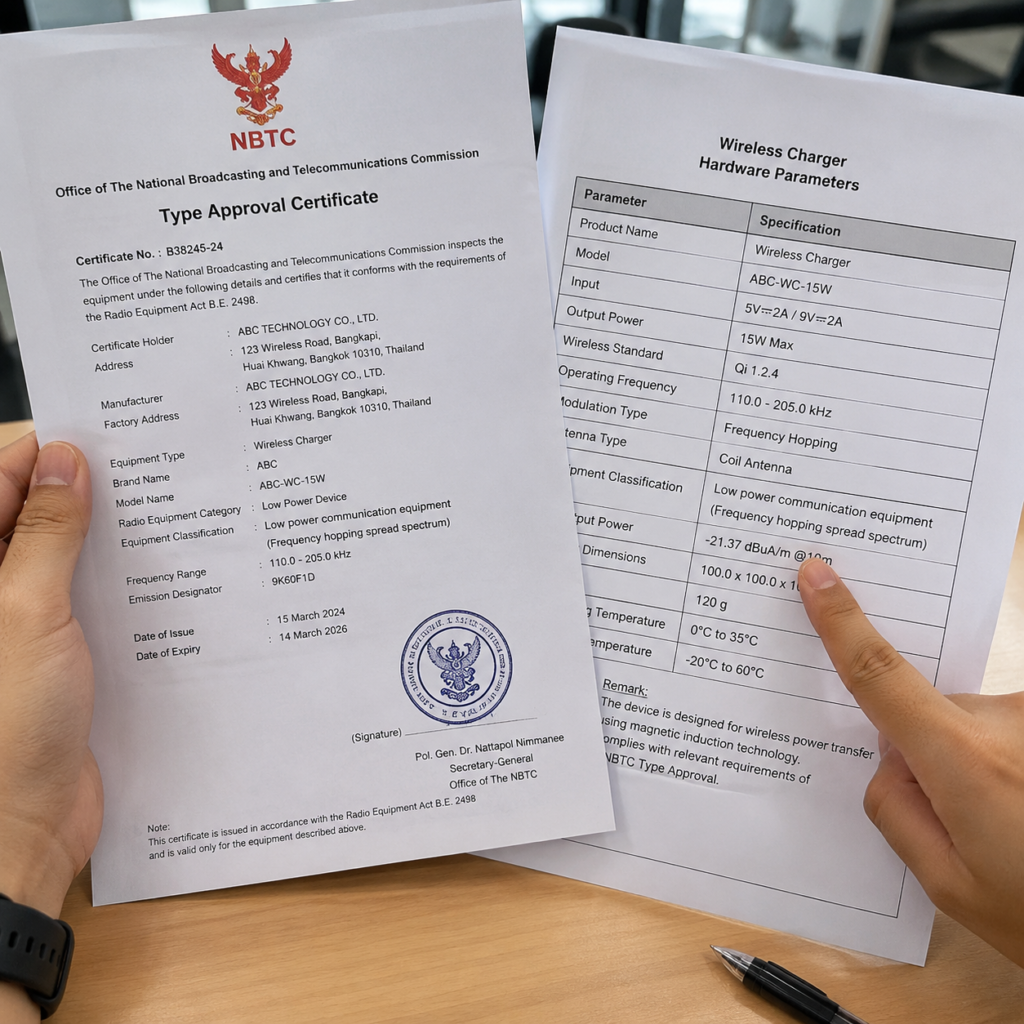
Formal NBTC labels and numbers shall be used in accordance with the requirements of the specific certification, registration, or conformity assessment path. The number format and labeling requirements of different paths may vary.
The specified labels, numbers, and labeling positions shall be checked in accordance with the applicable NBTC path and announcements. Some equipment can be labeled at specified positions on the product body, packaging, or instructions, specifically subject to the official requirements of that equipment category.
Also pay attention to consistency: the product model and brand on the label must be consistent with the relevant certification, registration, or declaration information, and cannot be mismatched.
Official Authenticity Query Method
The most reliable verification method is to verify through the corresponding database or official channel currently published by NBTC. The public fields, query methods, and validity period information of different NBTC records may vary, and you cannot assume that all certifications or SDoC can be queried through the same system.
When checking, focus on: product model, brand, applicant, equipment category, certification or registration number, and record status. If the path does not disclose the complete certificate or validity period field, further verification shall be made with NBTC or the applicant entity.
Review Steps for Query Abnormalities
If you can’t find it or the information doesn’t match, you can review it according to the following steps:
Step 1: First check the format of the certification or registration number to see if it is entered incorrectly, such as mixing up letters and numbers, or missing digits.
Step 2: Use the official query entry currently published by NBTC to confirm that you are querying the corresponding equipment category and record type.
Step 3: Contact the applicant entity, license holder, or agency that provided you with the documents, and ask them to provide the complete certificate, registration record or declaration of conformity, as well as necessary official acceptance or submission materials.
If you still have questions, you can directly consult and verify with NBTC official when necessary, which is the safest way.
Common Violations for Charging Products
There are several common NBTC violations for charging products, and everyone should pay attention to avoiding them:
The first is directly forging or fabricating certification numbers, not doing certification at all, and just printing a label and sticking it on.
The second is multiple models sharing the same certification number that does not comply with specific NBTC paths and official rules. For example, two models use different wireless chips but share the same certificate, which is a violation.
The third is pure wired charging products, in order to appear high-end, pretending to have wireless functions and sticking fake NBTC labels, which is also a violation.
The fourth is that the wireless hardware of the product is different from the certified record. For example, module A is used for the record, but module B is used for actual shipment. Even if the functions are similar, it is non-compliant.
High-Frequency Misconception Pitfall Avoidance and Self-Check List
Finally, we have sorted out 8 pitfalls that people are most likely to fall into, as well as real cases and a self-check list, to help you quickly avoid pitfalls.
8 High-Frequency Misconceptions to Avoid
1. Misconception: All charging products need NBTC certification
Correct: Pure wired products without any wireless functions or radio transmission functions regulated by NBTC usually do not need NBTC certification for wireless equipment; it is still necessary to check the actual product configuration and other mandatory Thai compliance requirements.
Risk: Either wasting money on useless certification, or missing the required certification leading to goods detention.
2. Misconception: Wireless charging definitely needs NBTC certification
Correct: Wireless chargers are wireless power transmission equipment that require specific verification, and judgment shall be made according to NBTC’s latest classification, frequency, power, and related technical requirements, and cannot be generalized.
Risk: Misjudgment leading to goods detention, or fines for illegal sales.
3. Misconception: If a certified wireless module is used, there is no need for whole-machine certification
Correct: Module certification only means that the module itself meets the corresponding requirements. The antenna, enclosure structure, power supply, and installation method of the whole machine may affect radio frequency performance, and the whole machine still needs to be evaluated according to the applicable NBTC path.
Risk: Whole-machine test fails, certification fails, and time is delayed.
4. Misconception: Having CE/FCC/SRRC can exempt NBTC certification
Correct: CE, FCC, or SRRC certificates cannot automatically replace Thai requirements; whether their test reports are acceptable depends on laboratory qualifications, test standards, frequency bands, and current NBTC rules. Active transmission equipment shall go through type approval, registration, SDoC, or other applicable procedures according to classification.
Risk: Customs clearance detention, product removal, heavy losses.
5. Misconception: NBTC regulates charging safety, and passing NBTC means no electric shock risk
Correct: NBTC mainly handles applicable wireless equipment, spectrum, and radio frequency compliance. The electrical safety of charging depends on TISI’s mandatory standard list and other applicable safety requirements.
Risk: Ignoring safety certification, products have electric shock hazards, and you have to bear responsibility if problems occur.
6. Misconception: Charging heads supporting PD/QC fast charging need NBTC certification
Correct: PD and QC are both wired fast charging protocols, which have nothing to do with wireless. When there are no wireless functions regulated by NBTC, usually no NBTC certification for wireless equipment is needed.
Risk: Wasting money on useless certification.
7. Misconception: Pure receiving charging products definitely do not need NBTC certification
Correct: Receiving accessories that are purely passive, have no active radio frequency transmission, and are not NBTC-listed equipment usually do not need wireless transmission equipment certification; but passive NFC and wireless charging receiving ends still need to be verified according to specific circuits and the latest announcements.
Risk: Missing the assessment of hidden transmission functions, leading to violations.
8. Misconception: If the agent says SDoC can be done, it must be compliant
Correct: The certification path must be determined according to NBTC’s official classification, and you cannot listen to the agent’s verbal promise.
Risk: Getting non-compliant certification, being inspected during customs clearance or sales, which is equivalent to doing it for nothing.
Real Scenario Judgment Cases
Talking only about theory may be a bit abstract. Let’s take a few common charging products to practice:
• Ordinary USB-C PD charger plus charging cable: No wireless transmission function regulated by NBTC, usually no need for NBTC certification for wireless equipment, just check safety compliance.
• Smart fast charging head with WiFi remote control: Has active WiFi transmission function, shall undergo NBTC applicability assessment, and then confirm applicable procedures according to equipment classification.
• Qi standard desktop wireless charging base: Belongs to wireless power transmission equipment that requires further verification, cannot be directly determined, and needs to be verified according to NBTC’s latest classification requirements.
• Multi-port charging station with Bluetooth speaker: Has active Bluetooth transmission function, needs NBTC applicability assessment, and shall go through applicable procedures according to classification.
Beginner Quick Self-Check List
You can also do a quick self-check of your products against the list below:
□ Real parameters of the product’s wireless hardware and operating mode have been collected (not marketing copy)
□ The product does not have any wireless functions or radio transmission functions regulated by NBTC → Usually no need for NBTC certification for wireless equipment, but other mandatory Thai compliance requirements still need to be evaluated
□ The product has active wireless communication or wireless power transmission functions → Needs further NBTC assessment
□ NBTC product classification and applicable certification path have been confirmed
□ A local Thai applicant, importer, license holder, or authorized representative that meets NBTC requirements has been determined
□ It has been verified that the wireless solution meets the applicable frequency bands and technical requirements of Thailand
After reading this article, you should be able to quickly judge whether charging products need NBTC assessment, understand relevant labels and documents, verify records and documents through official channels, distinguish the differences between NBTC and other certifications and fast charging protocols, avoid the most common pitfalls, and have a general understanding of the basic process and preliminary preparation.
Finally, we would like to remind everyone: NBTC’s rules are dynamically updated with official announcements. This content is only an introductory reference to help you establish basic understanding. When actually doing projects, you must take the latest official NBTC announcements, information from the official database, and written confirmation from local Thai applicant entities, authorized representatives, or NBTC-accepted laboratories as the final basis, so as to truly achieve compliance.