
If you have bought USB chargers or laptop power adapters overseas, you may have seen the words “IEC 61558” on the product packaging or the nameplate on the bottom. Many people think this is a standard related to fast charging, or that having this mark means the product is of good quality, but neither is correct. IEC 61558 is one of the important safety standard series for transformers, switch-mode power supply units and related power products, but it does not apply to all consumer charging products. Which standard to apply specifically depends on the product structure, purpose, certification path and target market regulations. Today, we will explain clearly from entry to advanced level: the scope of application of this standard, core test requirements, and how ordinary people can use it to select safe products, all in one go.
First, Understand: What Exactly is IEC 61558?
First, the most basic definition: IEC 61558 is a series of safety standards for transformers, chokes, switch-mode power supply units and related power products, issued by the International Electrotechnical Commission (IEC, an international body that develops globally applicable electrical safety rules). It mainly focuses on safety risks such as electric shock, insulation failure, overheating, fire and mechanical structure. It is generally not responsible for judging charging speed or fast charging protocol compatibility, nor is it equivalent to energy efficiency or electromagnetic compatibility standards. For overseas consumer charging products, it may be one of the important safety technical bases, but not all chargers and power adapters must adopt this series.
For ordinary users, the value of this standard is very practical: some markets or certification schemes may take the IEC 61558 series as the applicable safety technical basis, but whether it is mandatory and which version to adopt must be checked against local regulations. Compliance with the standard does not guarantee that the product will never fail; it only means that it meets the corresponding safety requirements within the specified conditions, samples and test scope. Actual safety also depends on product design, mass production consistency, use environment and whether the user uses it correctly.
However, there are several very common misunderstandings about this standard that we must correct first to avoid misunderstanding later:
First, it is not a universal charging standard for all categories, and not all charging cables, chargers and power banks are automatically under its jurisdiction; it depends specifically on whether the product is a transformer, choke, switch-mode power supply unit or related combination defined in the IEC 61558 series.
Second, it is not mandatory in all countries around the world. Whether certification is required and which version to pass depends on local regulatory provisions.
Third, it is not a guarantee that “the product will not break”, but only means that it meets safety requirements within the corresponding evaluation scope – even products that meet the standard may be damaged if intentionally dropped, smashed or misused, but the design and testing will minimize the risk of safety accidents such as electric shock and fire.
Fourth, it is mainly a safety standard, and is not the same as fast charging speed, PD or QC protocols, electromagnetic compatibility, or energy efficiency level. Do not confuse it with fast charging protocols.
Which Products Are Subject to It? The Scope of Application Explained Clearly
Many people are unclear about the boundary of this standard, thinking that anything related to charging counts. A more accurate judgment method is: First confirm whether the product is a transformer, choke, switch-mode power supply unit or related combination defined in the IEC 61558 series, then determine the applicable Part 2 according to the product’s purpose, structure and rated parameters.
“Converting mains voltage to low voltage with isolation” is a common structure of many charging power supplies, but it is not the only condition for judging the applicability of IEC 61558. The IEC 61558 series covers many types of power supply and transformer products, and does not require all products to convert mains voltage to the so-called low voltage, nor does it require all products to adopt the same isolation structure.
To facilitate quick comparison, we have organized common products into a table. The “may be subject to” or “generally not subject to” in the table cannot replace the verification of specific models and certification documents:
| Products that may be subject to IEC 61558 | Products that are generally not subject to IEC 61558, or need to be evaluated according to other standards |
|---|---|
| Some wall-plug USB power adapters, PD chargers | Pure passive charging cables |
| Some external laptop power adapters (desktop or wall-plug) | Pure passive plugs, sockets or mechanical converters |
| Multi-port charging power strips with power conversion function, desktop charging stations | Complete power banks cannot be simply classified just because they contain batteries |
| Other products that are switch-mode power supply units or related combinations | Adapters containing active circuits, power conversion or special functions shall be evaluated according to their actual structure |
Some wall-plug USB power adapters and PD chargers may be subject to IEC 61558-2-16, but this must be confirmed in combination with whether they are switch-mode power supply units defined in that part, rated conditions and certification requirements of the target market. Gallium nitride is only a feature in terms of components or power topology, and PD is an output protocol; neither can alone determine which safety standard applies. Some products may also be evaluated according to IEC 62368-1 or other product standards.
Power banks also cannot be simply said to be “controlled by battery standards”. Their cells or batteries may involve battery safety standards such as IEC 62133, and the complete power bank may also involve overall product safety, charge-discharge circuits, EMC, USB interfaces and local regulations; if the external charger paired with it is a switch-mode power supply unit, that charger may also be separately subject to IEC 61558-2-16.
Pure passive plugs, sockets or mechanical converters are generally not subject to IEC 61558, but if the adapter contains fuses, switches, power conversion or other active circuits, it shall be evaluated according to the actual structure and corresponding standards of the target market. IEC 60884 also only applies to household and similar plugs and sockets within its specified scope, and not all plug and socket products can be indiscriminately classified into this standard.
If you are still unsure, you can use several methods to assist in judgment. First, look at the product label. If it is marked “power adapter” or “switching power supply”, this can only be used as a preliminary clue, and you cannot confirm that it must be subject to IEC 61558 based on this. Second, verify the product category, internal structure, rated input and output parameters, applicable Part 2 and certification documents of the target market.
The consumer-grade charging products we buy daily, with power of 5W-240W and input voltage marked 100-240V, do not automatically fall under IEC 61558. IEC 61558 does not take this power or input voltage range as the general applicable boundary for consumer chargers. Products with the same name and power may also adopt different safety standards according to purpose, structure and target market.
The IEC 61558 series itself has corresponding rated voltage and frequency ranges. Common general ranges in standard materials include input not exceeding 1100V AC, frequency not exceeding 500Hz, output not exceeding 1100V AC or 1500V DC – this range is very wide, and ordinary users basically cannot encounter products that exceed it. But these values are part of the series’ applicable scope, and cannot in turn alone determine which part of the standard a certain charger must be subject to.
What Do the Suffixes After the Standard Mean? The Division of the IEC 61558 Family
Many people see “IEC 61558-2-16” or “EN 61558” written on products and are confused about their relationship with IEC 61558. In fact, this is the division of labor within the standard series, but it cannot be simply understood as the standard being divided into only two documents.
The IEC 61558 series usually consists of the general requirements IEC 61558-1 and multiple IEC 61558-2 parts targeting different product categories. IEC 61558-1 provides more general safety requirements; different Part 2 sections add special requirements for specific types of transformers, power supply units or related products. Products shall adopt the corresponding version according to the applicable part and its reference relationship, and cannot indiscriminately apply all Part 2 sections to the same product.
For switch-mode power supply units and their related transformers within the scope of IEC 61558-2-16, they shall be used in combination with IEC 61558-1. Some USB power adapters may fall within this scope, but this cannot be directly determined solely by names such as “small charger”, “PD charger” or “gallium nitride”. Products may also adopt other safety standards such as IEC 62368-1, which ultimately depends on product category, certification scheme and target market requirements.
A special reminder here: many manufacturers will actively print the standard number on the product, but this does not mean that the product has actually passed certification; it may only be the manufacturer’s self-declaration of conformity, without third-party testing or complete conformity assessment.
In addition, various countries and regions will convert IEC standards into local versions. For example, Europe may adopt EN 61558, and Australia and New Zealand may adopt AS/NZS 61558. These versions are usually based on the IEC series, but it is still necessary to verify the specific version, national differences, revision status and local regulatory requirements. Certification or conformity assessment procedures in different markets may also be different, and it cannot be simply considered that only the prefix and issuing body are different.
What Do the Core Tests Measure? Corresponding Daily Risks
Many people find safety standards like heavenly scripts, but in fact, test items are all designed around risks that may be encountered in daily use. We don’t need to memorize test steps, just know what safety problems each type of test corresponds to.
Electric Shock Protection and Insulation Isolation Test (Most Critical)
This is an important safety item for power supply products, focusing on preventing users from coming into contact with dangerous voltages, and preventing insulation failure between the high-voltage side and the low-voltage side.
The standard checks the insulation system and electric shock protection according to specified normal, abnormal, humidity resistance, withstand voltage and structural conditions, and judges through specified test limits such as withstand voltage, insulation, creepage distance, clearance, earth continuity and touch current. You cannot use “whether you feel a tingle when touching it” to replace standardized testing, because tingling is not a standard judgment indicator, and some dangers exist before the human body can feel them.
For charging products, the key points usually include: whether the insulation between the high-voltage input part and the USB output part is reliable; whether accessible metal parts have appropriate grounding or insulation protection; whether dangerous high voltage may appear at the USB output port. Whether to adopt grounding, double insulation or other protection methods shall be judged according to the product structure and applicable standards.
Temperature Rise and Heat Resistance Test
This is to test whether the heating of the product is within the allowable range under specified rated input, rated load, installation method, operating mode and environmental conditions. There is no uniform “25°C, full power” test condition applicable to all products, nor can the accessible parts of the enclosure be generally said to have a general limit of 60-75°C.
The actual limits shall be determined according to the specific accessible parts, materials, winding insulation system and applicable part. Products may also involve requirements such as material heat resistance, abnormal heating and long-term operation.
A reminder here: you cannot judge whether a product is safe only by feel. Feel is affected by ambient temperature, contact time and individual differences; real compliance must be based on quantitative tests completed according to applicable standards.
Abnormal Operating Condition and Protection Test
This test simulates specified product faults or abnormal use conditions, such as output short circuit, overload, and certain internal component faults required by the standard. The test will verify that the product does not produce unacceptable electric shock, fire or other hazards according to the fault conditions and judgment criteria specified in the applicable standard.
The requirement here is not an infinitely generalized guarantee for “any conceivable abnormality”, but an evaluation for the specific abnormal conditions listed in the standard. Products may reduce risks through current limiting, shutdown, power reduction or other protection methods, but the specific protection method depends on the design.
For USB-C PD chargers, the function and protection of each PD output level also need to be confirmed in combination with the USB Power Delivery specification and applicable complete product or power supply standards. It cannot be simply assumed that IEC 61558 testing will automatically cover every PDO level of USB PD, nor can it be inferred that all modes are qualified just because a certain level passes.
Mechanical Strength Test
Mechanical safety focuses on parts such as enclosures, terminals, pins, fixing structures and flexible cords, and whether they can still maintain electric shock protection and insulation protection under applicable mechanical stress.
The specific test items depend on the product type and applicable standards, and may involve requirements such as mechanical strength, impact, terminal or pin fixation, and flexible cord stress. Desktop drops, repeated USB interface plugging and unplugging, and cable bending life cannot be regarded as items uniformly specified by IEC 61558 for all chargers.
Among charging products, foldable pins, enclosure joints, input cord fixation points and the root of output cords are indeed parts that are easily subjected to force in daily use. However, items such as USB interface durability and USB cable bending may also belong to corresponding interface or cable specifications, which need to be verified separately.
Flame Retardancy and Material Heat Resistance Test
This type of test focuses on whether materials will cause dangerous combustion and spread under high temperature, abnormal heating or internal faults.
According to the location of the material, its function and applicable clauses, the evaluation may involve different items such as heat resistance, flame retardancy, glow wire, fireproof enclosure or flame spread prevention, and shall be judged according to specified criteria for burning time, dripping, damage and spread. Not all materials are evaluated by the single method of “whether it self-extinguishes after being ignited”.
Therefore, “flame retardant” does not mean “completely non-flammable”, but it also cannot be simply said that as long as it does not spread into a large fire, it meets the requirements. Ultimately, it still depends on the test methods and limits specified in the corresponding standards.
Marking and Parameter Inspection
This is the most basic entry-level item: products should usually be clearly marked with input and output parameters, model, manufacturer or responsible entity and other information. The specific marking content shall be checked according to applicable regulations and standards.
If the product marking is blurry, the model cannot be confirmed, or the input and output parameters are seriously missing, it is difficult for consumers to verify whether it matches the certification documents, and they should be more vigilant. However, just because the marking is complete does not prove that the product has passed IEC 61558 certification.
Why Do Problems Still Occur After Certification? Key Conditions Affecting Safety
Many people ask: since the product has passed safety tests, why does it still get very hot during actual use? The reason is that standard testing has clear rated conditions and evaluation scope, while actual use may exceed the product’s design conditions. Understanding these conditions can help you better judge risks.
Input and Load Conditions
Wide-input products usually need to be evaluated according to the input range and operating conditions specified in the applicable standards, but the loss and temperature rise under different input voltages depend on the specific power supply design, and it cannot be directly asserted that it will be hotter at 240V than at 110V.
Similarly, when all ports of a multi-port charger are working at the same time, the overall load may be higher than when using a single port, and the temperature rise may also increase; but the actual heating still depends on the power topology, heat dissipation design, control strategy and load distribution. The 20V level of a PD charger is not necessarily hotter than the 5V level; at the same output power, the current of the 20V level is usually lower, and the specific loss depends on the actual design.
Therefore, wide-input products and all rated output modes shall be tested according to applicable standards. Just because there are no obvious problems when using low power or a single port, you cannot automatically infer that it must be safe at high power or multi-port full load.
Environment and Usage Method
The higher the ambient temperature and the smaller the heat dissipation space, the easier it is for the product to accumulate heat. If the charger is covered by fabric, storage boxes or other items, heat is not easily dissipated, which may increase the risk of overheating.
The heat dissipation conditions of wall-plug chargers and desktop adapters may also be different, but the specific performance depends on the enclosure, installation direction and surrounding space. When exceeding the altitude, humidity, pollution degree or protection conditions specified by the product, the insulation and heat dissipation margin may be insufficient.
When using, you should comply with the environmental conditions marked on the product and local installation requirements. Do not use chargers that do not have the corresponding protection level in environments where water may enter, splash or condensation may occur. Wet places such as bathrooms also involve water, condensation and local low-voltage electrical installation regulations, and you cannot judge safety only by looking at a standard number.
In a word: standard testing is carried out under specified conditions. The more extreme the actual use conditions, the smaller the safety margin of the product may be.
Product-Specific Variables
There are also several variables related to the product itself that many people don’t know about:
First, the certification scope of products with different powers in the same series is not necessarily universal – for example, a brand’s 20W, 30W, 65W gallium nitride chargers look the same, but may adopt different internal structures, components and certification paths. You cannot assume that the entire series applies to the same certification.
Second, if the manufacturer replaces key components, materials or structures that affect safety, such as enclosure materials, main control chips, transformers, it must first conduct a change evaluation according to the certification body and applicable scheme. Whether supplementary testing, change filing or re-certification is required depends on the specific certification scheme and change content. It cannot be generally assumed that the certificate is automatically invalid, nor can it be directly replaced without evaluation.
Third, “same style” products with exactly the same appearance may have vastly different internal structures – for example, counterfeit products imitate the appearance of genuine products, but the internal components and insulation structure are completely different. You cannot assume compliance just because the appearance is the same.
Fourth, even if the certification sample is qualified, it does not mean that mass production can be completely ignored. Some certification schemes also include factory inspections, follow-up testing or production consistency control. The continuous compliance of batch products still needs to be supported by corresponding production quality and supervision mechanisms.
How Can Ordinary People Use This? Pitfall Avoidance and Practical Judgment Methods
After talking about so much standard content, it ultimately comes down to “how ordinary people can use it to avoid pitfalls”. Let’s explain step by step from quick screening to accurate judgment, and then to risk identification during use.
10-Second Quick Screening
When you get a product, you don’t need to look up information. You can make a preliminary judgment in 10 seconds:
First, look at the nameplate: whether there is complete input and output parameters, model, manufacturer or responsible entity information. Products with seriously missing information are difficult to verify later, so you should be cautious;
Second, look at certification marks: CE means the manufacturer declares that the product complies with applicable EU regulations, and does not indicate which IEC standard it adopts; marks such as UL and SAA should also be verified against specific certificates, standards and models, and you cannot infer that IEC 61558 is adopted solely by the mark;
Third, check the appearance: if the product has particularly large gaps, loose pins, obviously skewed interfaces or a structure that looks like an empty shell, the risk is high, so try not to use it.
Accurate Judgment Methods
If you want to confirm that the product is truly compliant, you can’t just look at the promotion. You need to do these things:
First, verify the third-party certification report or certificate. The standard number, version, product model and rated parameters in the report must correspond to the product in your hand. Also pay attention to the scope of application of the certificate, manufacturer and factory information; don’t just look at a standard number.
Second, note that: a manufacturer’s promotion of “complying with IEC 61558 standard” does not mean there is third-party certification. Many products only have self-declared conformity. Whether testing has been completed and which version is adopted need further verification.
There is also a very easy pitfall to step into: the CE mark is not a specific third-party safety certification. For products subject to the Low Voltage Directive, manufacturers can usually implement internal production control and sign an EU Declaration of Conformity according to regulations. Whether a Notified Body is required depends on the applicable regulations. Whether or not a third-party body is involved, the manufacturer must complete technical documentation, necessary testing and production consistency responsibilities, and be responsible for the declaration. Therefore, having the CE mark does not mean that the product has necessarily passed third-party testing, nor does it mean that it necessarily adopts IEC 61558.
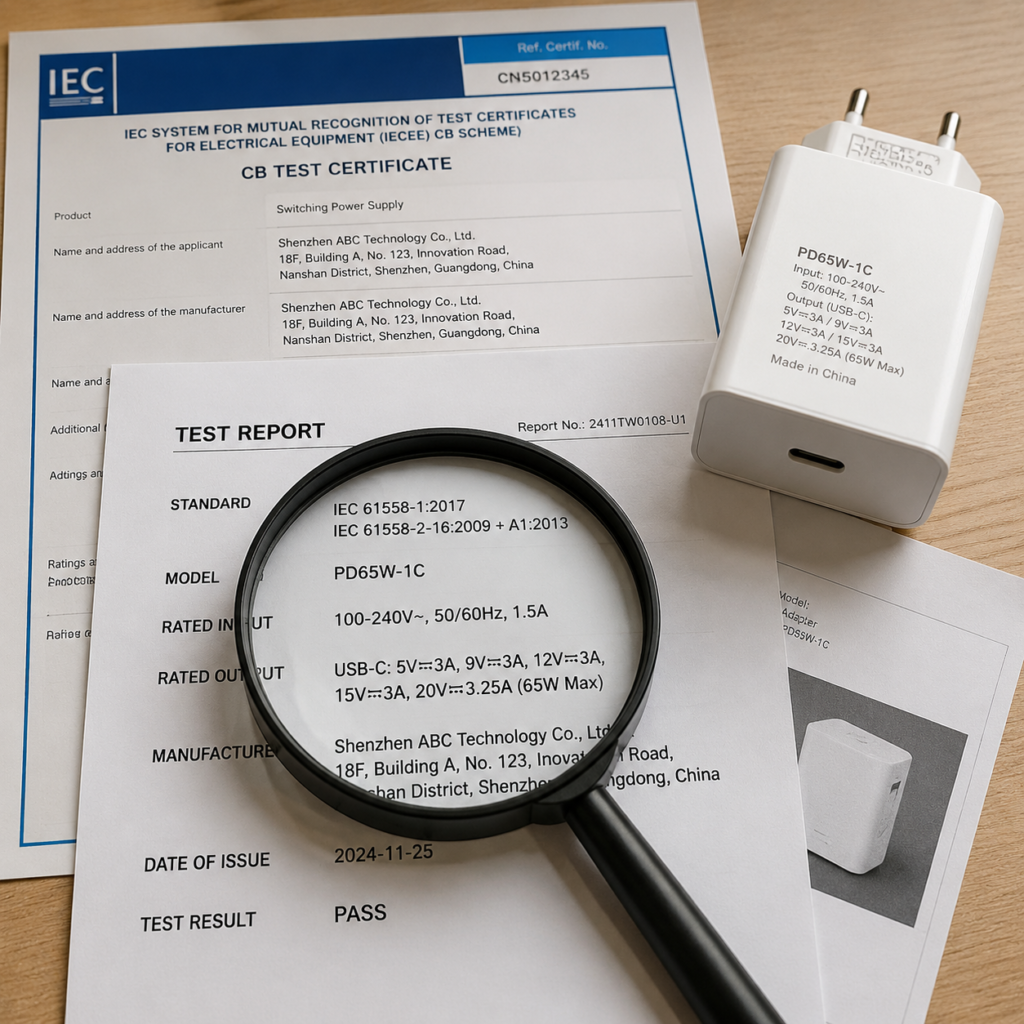
Common Counterfeiting Pitfalls
When buying, pay special attention to these common counterfeiting situations:
First, falsely marking the standard number: the corresponding safety test has not been done at all, and IEC 61558 is directly printed on the packaging;
Second, using certification of other models: for example, Model A has passed certification, and Model B has a similar appearance, so the report of Model A is used to impersonate;
Third, only passing part of the test items: for example, only temperature rise was tested, and insulation, withstand voltage or abnormal condition evaluation was not completed, but it is claimed to comply with the complete standard.
Judging Abnormal Conditions That Require Stopping Use During Use
Even if you buy a compliant product, if the following situations occur during use, you must stop using it immediately, don’t force it:
If the enclosure is cracked, pins are loose, interfaces are deformed, or there are burn marks, stop using it immediately;
If it is continuously abnormally hot during charging, has peculiar smell or abnormal noise, or repeatedly disconnects charging, unplug it immediately and stop using it;
If you feel a tingling sensation when touching the metal enclosure, there may be leakage or grounding problems. Stop using it immediately and do not touch it repeatedly to confirm.
A special reminder here: never disassemble a charger or power adapter by yourself for repair. The internal high-voltage capacitors may still hold an electric charge even after power is cut off, which is very dangerous.
Easily Confused Related Standards, Clarified All at Once
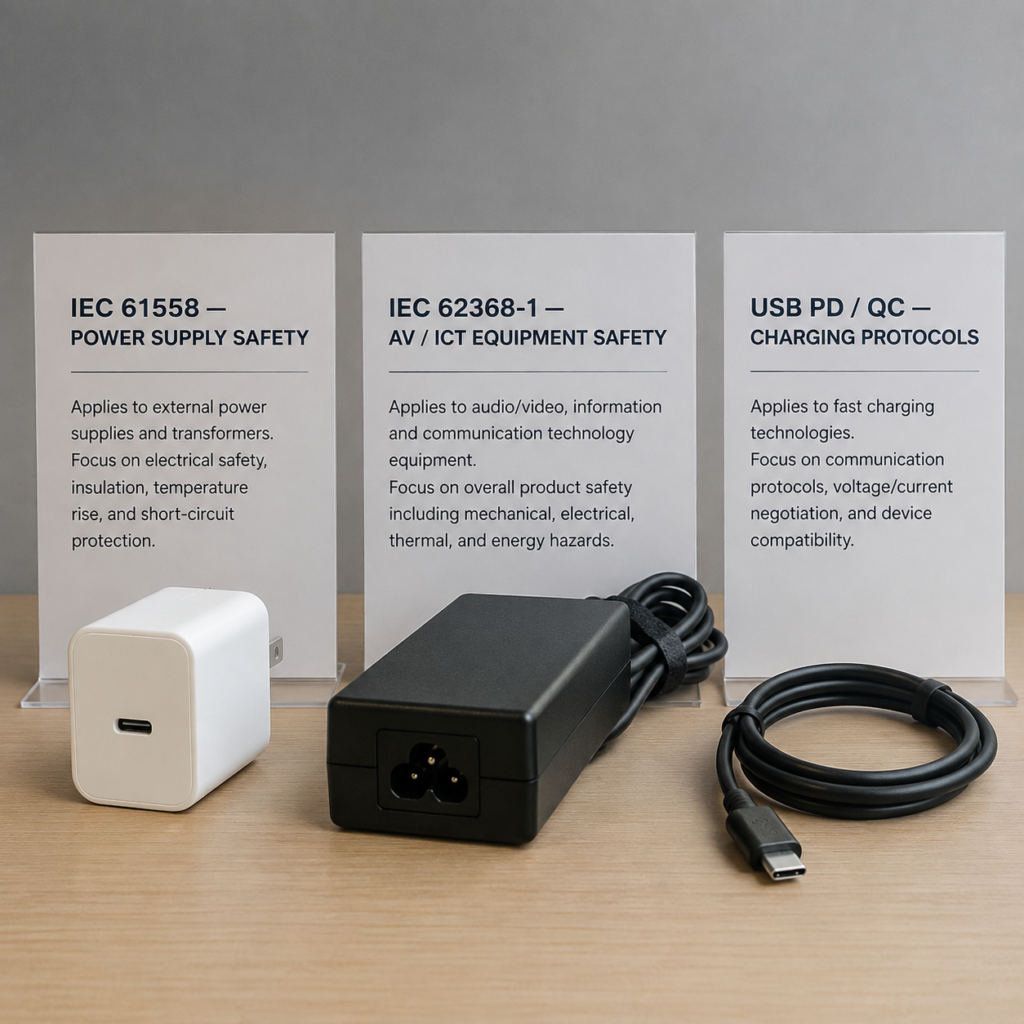
Many people confuse IEC 61558 with other common charging-related standards. Let’s explain the differences clearly once and for all, so you won’t be confused in the future.
Differences from IEC 62368
IEC 62368-1 is mainly used for safety assessment of audio/video, information and communication technology equipment and related power supply units, with different applicable objects and assessment methods from IEC 61558. IEC 61558 is oriented to transformers, switch-mode power supply units and related products within the scope defined by its series.
The two are not a simple either-or choice. An IEC 61558 report can be used as one of the component bases for the safety assessment of end products, but it will not automatically replace the system-level assessment of IEC 62368-1 or other complete product standards. After the power supply is installed in a specific device, it must also be judged in combination with actual installation, load, grounding, insulation, temperature rise and single fault conditions, and supplementary testing is still required if necessary. Whether an existing report can be recognized is determined by the certification body and specific application.
Differences from USB PD/QC Fast Charging Protocol Standards
This is the most easily confused: IEC 61558 is a safety standard, which manages risks such as insulation, electric shock protection, overheating and fire; fast charging protocols such as PD and QC mainly involve how devices negotiate voltage, current and charging mode.
The two are independent of each other. PD or QC certification cannot replace safety certification. Products that support PD fast charging may still have problems in safety design or compliance; similarly, meeting a certain safety standard does not mean that it necessarily supports a certain fast charging protocol.
Differences from Other Charging Accessory Standards
Charging cables may involve USB-IF specifications or other special cable standards, and are not within the scope of IEC 61558 for power supply units;
Pure plug and socket products are usually evaluated according to their product type and special standards of the target market. IEC 60884 only applies to household and similar plugs and sockets within its specified scope;
The cells or batteries of power banks may involve battery safety standards such as IEC 62133, and the complete product and its charge-discharge circuits may also need to be evaluated according to IEC 62368-1, EMC standards and other regulations and standards of the target market.
Summary
By now, you should have an entry-level to advanced understanding of IEC 61558: you can initially judge whether the charging product in your hand may be within the scope of this standard, and understand the daily risks corresponding to various safety tests; you can do preliminary screening through nameplates, certification marks and certificates, and also distinguish the differences between it and IEC 62368-1, USB PD, QC, battery and plug/socket standards; you can also identify common false certification pitfalls and know which situations during use require immediate stop of use.
For products that are within the scope of IEC 61558 and have completed conformity assessment according to regulations, IEC 61558 can be used as one of the important electrical safety bases. But it does not replace other applicable standards, nor can it guarantee that the product will never fail or cause injury under all use conditions. When buying a charger or power adapter, you should verify the specific model, standard version and certification scope; when using, keep it ventilated, do not cover the product, and do not use it in unsuitable humid environments or environments where water may enter.