
If you are engaged in Southeast Asian trade of charging products, the Indonesian market will inevitably involve the topic of SNI certification. Some people say that all products with plugs need it, some say that a CB report can be directly converted, and others say that you can buy a ready-made certificate for customs clearance with some money — there are all kinds of statements, and many people have fallen into pitfalls.
First of all, a premise must be clarified: Indonesia’s mandatory product catalog, technical regulations, and SNI standard versions are dynamically updated, and all compliance judgments shall be subject to the latest effective documents of the competent authorities. Combined with the actual scenarios of charging products (chargers, charging cables, fast charging adapters, etc.), this article explains SNI certification thoroughly from basic definitions to practical pitfall avoidance, helping you from getting started to being able to independently judge compliance risks.
I. Basic Understanding of SNI Certification
The official full name of SNI is , which is the Indonesian National Standard. You can understand it as Indonesia’s “national standard system”. SNI is first and foremost the Indonesian national standard. Only products included in mandatory technical regulations need to complete conformity assessment in accordance with the corresponding regulations and meet the requirements for import, circulation and labeling; products that are not mandatory can voluntarily adopt or apply for relevant conformity certificates.
It is not a quality gold award, nor a factory management system certification. Whether a product falls within the mandatory access scope cannot be judged only by whether the product has a corresponding SNI standard, but by whether the competent authority has included such products in mandatory management through the currently effective mandatory technical regulations.
Difference Between Mandatory and Voluntary SNI
Many people tend to confuse mandatory SNI with voluntary SNI, but in fact, the two are completely different in nature:
Mandatory SNI is a statutory access requirement, and only products listed in Indonesia’s mandatory technical regulations need to obtain it. Products must also complete certification, labeling, registration or other applicable procedures in accordance with the corresponding regulations before they can be imported, circulated and sold.
Voluntary SNI means that enterprises voluntarily adopt relevant standards or apply for conformity certificates, which is equivalent to “I voluntarily prove that my products comply with Indonesian national standards”. It is usually not a prerequisite for selling goods, nor can it be used to impersonate mandatory SNI.
It should be particularly noted that there is no general conclusion that “all charging products need SNI”. The judgment must be made comprehensively in combination with the product’s structure, parameters and corresponding regulations, and cannot be concluded only by whether there is a plug.
Four-Level Logic: Do Not Confuse Standards with Mandatory Certification
Many people think that “if there is an SNI standard, certification must be done”. In fact, these are different things and cannot be confused:
The first level is the SNI standard itself: this is a technical document issued by the Indonesian government, which, for example, specifies the safety requirements for chargers. Its function is similar to IEC standards and GB standards, serving as a technical basis, but the standard itself does not automatically mean that certification is mandatory.
The second level is mandatory technical regulations: issued by competent authorities such as the Indonesian Ministry of Industry, which clarify that certain types of products must comply with the corresponding SNI standards and complete certification, labeling or other conformity assessment procedures in accordance with regulations. The source of mandatory obligations is the currently effective technical regulations, not the separately existing standard text.
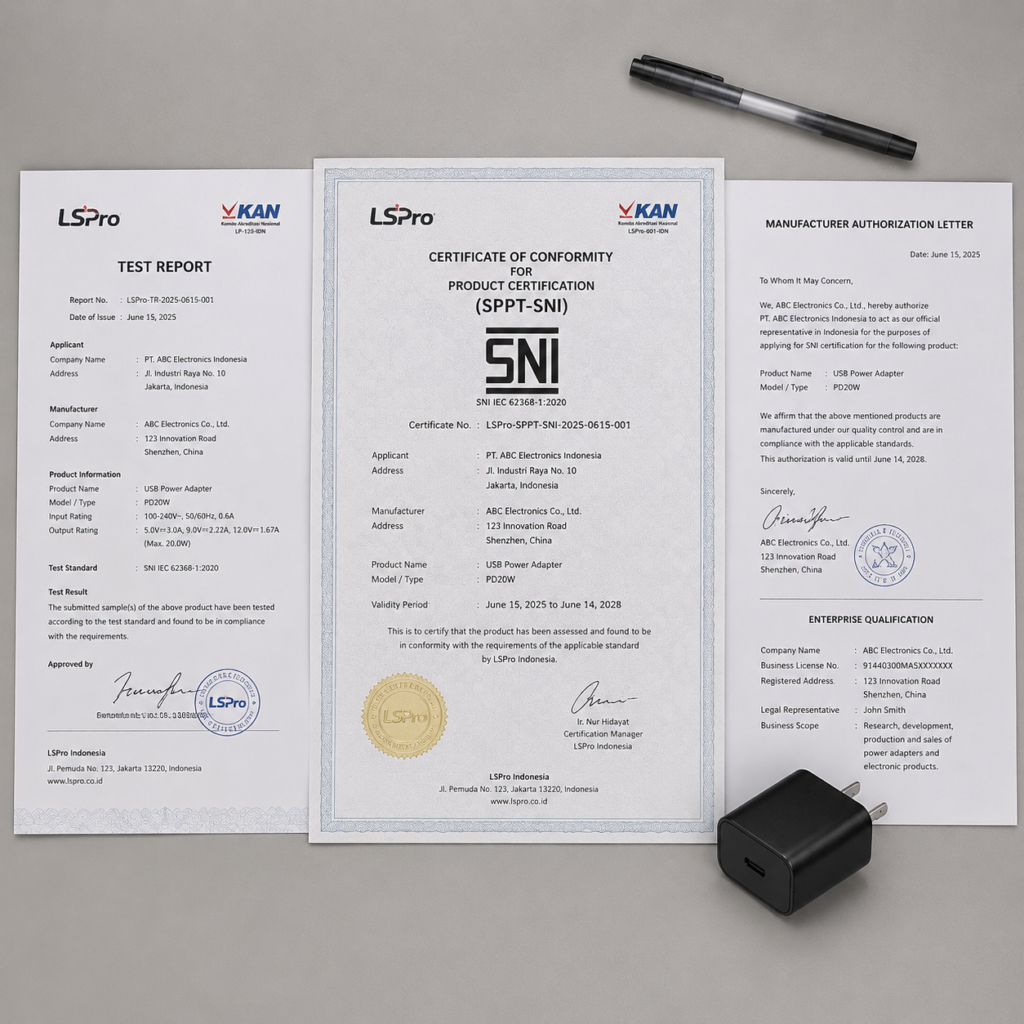
The third level is product certification: conformity assessment is carried out by certification bodies with corresponding accreditation scopes. It is usually called LSPro in Indonesian. After passing the test, audit or other assessment procedures, LSPro will issue corresponding product certification documents, such as SPPT-SNI or relevant certificates.
The fourth level is use of the SNI mark: obtaining certification documents does not mean that the mark can be used indiscriminately. Certified enterprises must also use the mark in accordance with BSN’s regulations on the SNI mark, as well as specific regulations, certification schemes and certificate requirements; where applicable, they must also complete the corresponding mark license or registration procedures.
Competent Authorities and Search Paths
After understanding the logic, you also need to know what each department is in charge of, so that you can find the right person to avoid detours:
• Ministry of Industry (Kemenperin): responsible for formulating part of the mandatory product catalog and technical regulations. To check the latest mandatory list, usually first look at the current documents issued by the Ministry of Industry.
• National Standardization Agency (BSN): manages the SNI standard system, including standard texts and official regulations related to the SNI mark.
• National Accreditation Committee (KAN): responsible for accrediting the competence scopes of certification bodies (LSPro) and laboratories. To check whether an institution is formal and has the corresponding product scope, you can check the accreditation information published by KAN.
• Certification Body (LSPro): implements product certification within its accreditation scope and issues corresponding certification documents, and may also carry out follow-up supervision in accordance with the certification scheme.
• Customs: responsible for import declaration, HS code verification and related customs clearance requirements. For products under mandatory management, the customs may need to verify the corresponding qualifications or documents.
• Wireless/Telecommunications Competent Authority: if the product has Bluetooth, Wi-Fi or other radio transmission modules, in addition to applicable SNI requirements, the compliance requirements for Indonesian radio and telecommunications equipment must also be checked. The specific department name and system shall be subject to the current Indonesian regulations.
Overview of Compliance Boundaries
Several important boundaries need to be drawn here. Many people fall into pitfalls because they are unclear about the boundaries:
First, overseas certifications such as CE, FCC, CB and CCC cannot directly replace SNI, and can only be used as technical references at most. Whether some tests can be reduced or materials simplified shall be evaluated by LSPro with the corresponding scope in accordance with the specific certification scheme, and there is no such thing as “automatic certificate conversion”.
Second, SNI only covers the standard conformity and applicable requirements such as safety and quality of the corresponding products. Import licenses, customs declarations, product registration, labeling and other market access procedures may need to be handled separately. It is not that you can directly clear customs and sell goods after obtaining SNI.
Third, for charging products with Bluetooth, Wi-Fi or other radio transmission modules, such as Wi-Fi-enabled charging power strips, in addition to SNI requirements, the Indonesian radio and telecommunications equipment regulations must also be checked separately. Simple inductive wireless charging functions such as Qi should not be automatically equated with radio communication transmission; whether additional approval is required depends on specific technical parameters, operating frequency bands, power and current Indonesian regulations.
Fourth, pure wired fast charging products, such as PD and QC fast chargers, will not trigger radio compliance requirements due to the use of fast charging protocols. Fast charging protocols such as PD and QC themselves do not need separate SNI certification, but the product’s output performance, abnormal protection and other requirements must still be confirmed in accordance with applicable product standards and certification schemes.
Fifth, passing customs does not mean full compliance. Even if it is not found during customs clearance, the certification status, product consistency, labeling and other market access conditions may still be verified during subsequent market supervision spot checks and e-commerce platform verifications.
II. How to Judge the Mandatory Scope
After understanding the basic logic, what everyone is most concerned about must be — does the charger or charging cable I sell need mandatory SNI? Don’t guess, follow the method step by step.
5-Step Applicability Judgment Method
This is a commonly used preliminary judgment method in the industry, but the final conclusion shall be based on current regulations and the official confirmation of the competent authority:
1. Clarify basic product information: including product structure, such as wall-mounted or vehicle-mounted, whether there is an AC plug, whether there is a wireless module; also confirm the rated input and output voltage and power, product use, sales method, and whether it is a finished product or an accessory. If the information is wrong, all subsequent judgments may be wrong.
2. Check the latest mandatory product catalog: check the latest mandatory catalog through official channels of competent authorities such as the Indonesian Ministry of Industry to see if your product category is listed, and do a preliminary check first.
3. Match standards and HS codes: find the possibly corresponding SNI standard, and then assist in verification combined with the product’s HS code. The HS code is only a reference, you cannot use the HS code alone to judge whether SNI is required. The same HS code may correspond to multiple products, some of which are within the mandatory scope and some are not.
4. Confirm import and sales scenarios: whether it is batch commercial import, or brought in for personal use; whether it is samples, gifts, repaired products, or prepared for formal sale. Requirements may vary in different scenarios.
5. Obtain official confirmation and professional assessment: the final basis shall be the current mandatory technical regulations, as well as the official interpretations, permits or decisions of the competent authorities. At the same time, you can obtain a written applicability assessment from LSPro with the corresponding product scope as certification preparation and internal filing materials.
In addition, a common misunderstanding should be added: products shall be designed, labeled and tested in accordance with the nominal voltage and frequency applicable in Indonesia, usually checked against the 230V, 50Hz system; the “220V” statement may still be seen in the actual market. Plugs shall comply with applicable Indonesian plug, socket and product standards, and it cannot be generally stated that all products must use “two-pin round plugs”. These are product adaptation and testing requirements, not the basis for independently judging whether they fall within the mandatory SNI scope.
Judgment Directions for Common Charging Product Categories
For the charging products that everyone often sells, we have sorted out the common judgment directions. Note that these are all empirical references, and the final confirmation must be made according to the previous judgment method:
• Wall-mounted chargers for mobile phones, tablets, laptops and PD/QC fast charging adapters: most likely included in the mandatory scope, and the latest catalog and corresponding safety standards need to be checked.
• Independently sold external power adapters (with AC input): most likely included in the mandatory scope, depending on the power range and the applicable range of the corresponding standard.
• Pure USB-A/USB-C charging cables without AC plugs: cannot be directly judged as needed or not. It is necessary to check whether there are pure cable requirements in the latest catalog, and then judge combined with the product structure and HS code.
• Finished charging cable sets with AC plugs (the cable and AC plug are integrated): also cannot be directly judged. It is necessary to check the applicable scope and parameter requirements of cable sets in the mandatory catalog.
• Wireless chargers: if it is only inductive wireless charging such as Qi, it should not be assumed that radio communication equipment approval is required just because of the words “wireless charging”; it must still be confirmed according to specific technical parameters and current regulations. If it also has radio transmission modules such as Bluetooth and Wi-Fi, the Indonesian radio and telecommunications equipment requirements must be checked separately.
• Car chargers: since they are not directly connected to the mains, they cannot be directly judged, and the mandatory catalog and corresponding standards need to be checked.
• Devices with built-in charging modules, or charging accessories in sets: if the charger is sold independently, it needs to be judged separately; if it is sold together with the whole machine, it depends on whether the certification of the whole machine already covers the accessory.
Special Import Scenarios (Not Directly Exempted)
Many people ask “do I need SNI for a few chargers I bring for my own use” or “do samples need it”. These are special import scenarios, not directly exempted from SNI, but must comply with the corresponding customs and competent authority regulations:
• A small number of charging products brought into the country for personal use: must comply with the quantity limit regulations of customs for personal items, the specific requirements shall be subject to customs requirements, and cannot be used for sale.
• Samples and gifts that comply with customs regulations (for non-commercial sales purposes): must meet the sample import conditions and cannot be sold in the market.
• Repaired and second-hand charging equipment: must comply with the special regulations of customs on the import of repaired and second-hand products, and cannot be directly sold as new products.
• Products for display and testing that enter the country temporarily: shall be handled in accordance with the temporary import procedure, and shall be disposed of in accordance with regulations after the display or testing, and cannot be directly sold locally.
Special reminder: all the above scenarios need to check the latest customs and competent authority regulations, and cannot be directly equated with “no need for SNI”. If the special import conditions are not met, it may still be required to handle in accordance with mandatory requirements.
Examples of Common Product Judgment
Let’s take a few common products as examples to help you better understand how to judge:
• 65W USB-C wall-mounted fast charger: first check whether there is a power adapter or charger category in the mandatory catalog, then find the corresponding safety standard, and confirm whether it is within the mandatory scope combined with the HS code.
• 1.5m USB-C pure data cable without AC plug: first check whether the latest catalog includes mandatory requirements for pure cables, and then confirm combined with the product structure and HS code.
• Finished charging cable set with Indonesian plug (cable + AC plug integrated): check the applicable scope of cable sets in the mandatory catalog to see whether parameters such as rated current and power fall within the required range, and at the same time check whether the plug complies with applicable standards.
• 15W wireless charging base: for the safety part, check the SNI requirements of related products; if the product also has Bluetooth, Wi-Fi or other radio transmission functions, then check the radio and telecommunications equipment requirements separately. Simple inductive wireless charging should not be automatically equated with radio communication equipment.
• Bluetooth speaker set with charging base: first check whether the whole machine (Bluetooth speaker) needs SNI, then see whether the charging base is covered by the whole machine certification; the Bluetooth function also needs to check the Indonesian radio and telecommunications equipment requirements separately. If the charging base is sold separately, it needs to be judged separately.
Compliance Conclusion Filing Template
Regardless of whether the final judgment is that SNI is required or not, it is recommended to file the judgment basis to avoid being unable to explain clearly when problems arise later. You can use the following template to organize:
| Category | Information Items to Be Filed |
| Basic Product Information | Product description, rated input/output parameters, whether it contains an AC plug, whether it contains a wireless module, use, brand, model |
| Compliance Basis Information | Source of regulations, applicable SNI standard version, LSPro written applicability assessment, official interpretation or decision of the competent authority, certificate coverage scope, labeling requirements |
This template can not only help you sort out your ideas, but also be useful when docking with certification bodies, applying for permits from competent authorities, or responding to regulatory spot checks later.
III. Core Requirements of SNI Certification
If it is determined that the product needs mandatory SNI, what are the specific requirements? We will talk about it from several aspects: product testing, labeling, and applicant subject.
Core Product Safety Test Items
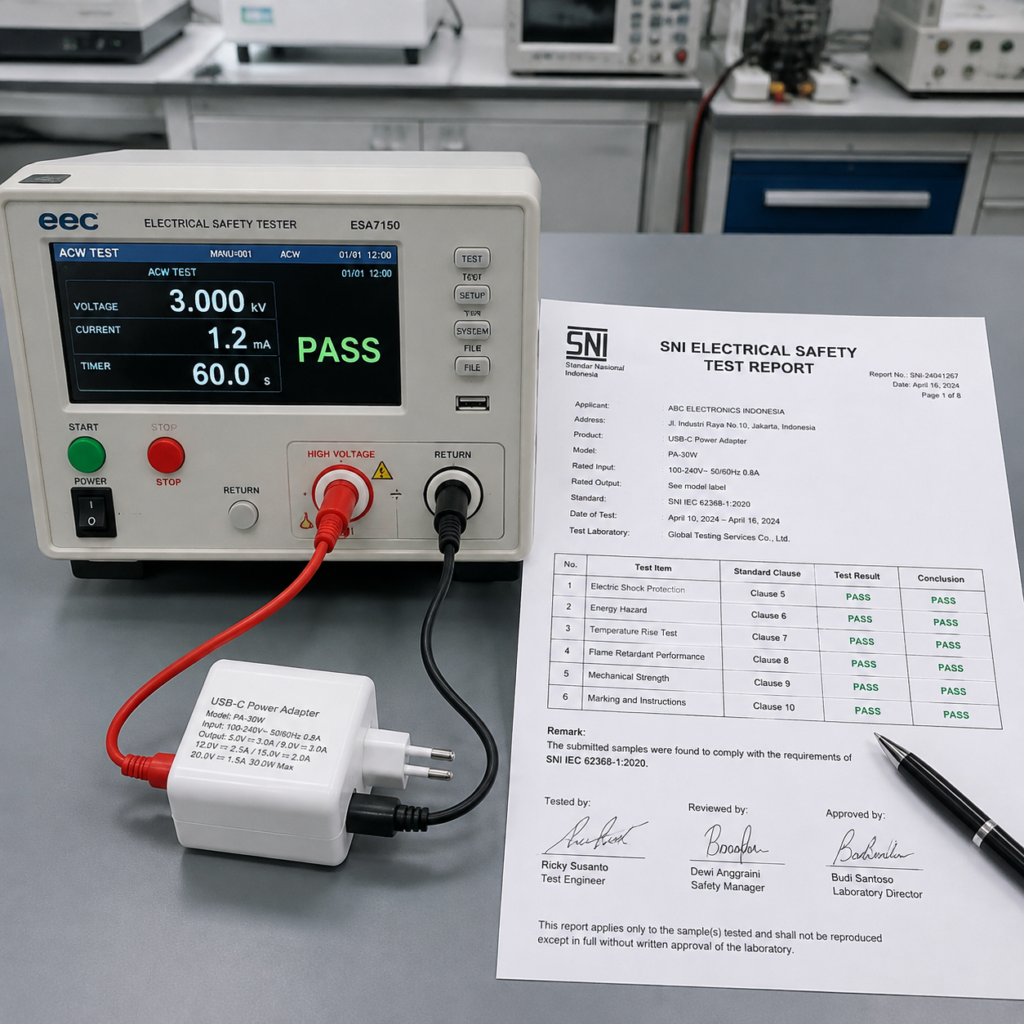
Charging products usually focus on safety, but the specific test items and judgment criteria shall be subject to applicable product SNI/IEC standards, mandatory technical regulations and certification schemes. A certain scheme cannot be generalized as the unified requirement for all charging products:
• Electric shock and leakage protection: usually focus on insulation performance, protective structure and whether users may come into contact with live parts, to avoid the risk of electric shock when plugging in.
• Overheating and fire protection: may involve requirements such as temperature rise, material flame retardancy, overload or short circuit protection, depending on applicable standards and test schemes.
• Plug and interface adaptation: plugs, sockets and interfaces shall comply with applicable Indonesian requirements and product standards, and USB/USB-C interfaces shall also maintain reliable connections to avoid safety hazards caused by structural or contact problems.
• Output performance and abnormal protection: the rated input and output, output error, load and abnormal working condition protection requirements shall be checked in accordance with applicable product standards. The test items in a certain certification scheme cannot be generalized as applicable to all charging products, nor can an absolute guarantee that “it will never cause damage to all terminal devices such as mobile phones and tablets” be made accordingly.
Here is a supplement: fast charging protocols such as PD and QC themselves do not need separate SNI certification, but whether the product can work according to nominal parameters and how to protect under abnormal conditions must still be evaluated in accordance with applicable standards and certification schemes.
Labeling and Packaging Requirements
After obtaining the certification, the product labeling and packaging cannot be done casually, and must meet the requirements:
• Product nameplate: usually requires marking product parameters, safety warnings, and information of the certificate holder or responsible subject. The style, proportion, position and additional information of the SNI mark shall comply with BSN regulations, specific regulations, certification schemes and certificate requirements.
• Packaging and instructions: what to mark specifically depends on product regulations, and usually involves brand, model, origin, importer or responsible subject information.
• E-commerce display page: the platform may require clear display of the SNI mark and certification information, which cannot be blocked, tampered with or forged by photo editing.
It should be noted that there are no general mark layout, marking position and number requirements for all products. The SNI mark graphic, proportion, certification body identification information and additional information specified by regulations shall be checked. The marking position and whether marking on packaging or accompanying documents is allowed shall be subject to specific regulations, certification schemes and certificate requirements. A unified conclusion cannot be drawn directly just because the certificate number is not seen or the mark is found on the packaging.
Basic Logic of Test Items
In addition to core safety tests, test items for different categories will be different. The basic logic is as follows:
• Electrical safety: usually an important test direction for charging products, which may cover electric shock protection, fire protection, temperature rise, insulation, flame retardancy, etc.
• Electromagnetic Compatibility (EMC): some categories need to be tested. Simply put, the product cannot produce unacceptable interference to other electrical appliances when working, nor can it work dangerously or abnormally due to external interference.
• Other special items: such as energy efficiency requirements, depending on whether the mandatory regulations and certification schemes of specific products stipulate.
All tests are based on the latest effective SNI standards and technical regulations of the corresponding category, and old version standards cannot be used for granted. Specific items shall be confirmed by laboratories and LSPro with corresponding scopes.
Rules for Applicant Subjects
Many overseas manufacturers will ask “can I directly apply for SNI certification”. This cannot be generalized. The qualifications and document requirements of the applicant, certificate holder, overseas manufacturer, Indonesian importer or authorized representative depend on the specific mandatory regulations, certification scheme and LSPro procedures.
Most mandatory product certifications for the Indonesian market require the participation of Indonesian enterprises, importers or authorized representatives that meet the requirements of Indonesian regulations, and they shall bear local compliance responsibilities. Whether an overseas manufacturer can be an applicant or a party related to the certificate shall be confirmed in accordance with specific regulations, certification schemes and LSPro requirements.
In actual operation, several roles still need to be distinguished:
• Certificate holder: the subject that bears certification and continuous compliance responsibilities in accordance with specific regulations and certification schemes.
• Manufacturer: the factory that actually produces the product, which can be an Indonesian enterprise or an overseas factory, depending on the certification scheme.
• Brand owner: the subject that holds the product trademark or is responsible for brand authorization, which can be an overseas enterprise or an Indonesian enterprise.
Therefore, it cannot be simply asserted that all overseas manufacturers are absolutely unable to be applicants or parties related to the certificate, nor can the responsibilities that may be borne by local Indonesian importers, authorized representatives and other subjects be ignored.
IV. Full Process of SNI Certification Handling
Now that you know the requirements, how to handle it specifically? We will talk about it step by step from preparation to obtaining the certificate.
Startup Preparation Checklist
Before formally submitting the application, prepare these things first, which can save a lot of detours:
• Subject confirmation: first implement the applicant or certificate-holding subject that meets the requirements of specific regulations, and confirm that it has legal business qualifications. If import is involved, the corresponding import-related qualifications shall also be confirmed.
• Technical data preparation: including product specifications, parameter tables, circuit or structure schematics, BOM (Bill of Materials), list of key safety components, such as transformers, fuses, control chips, etc.
• Qualification data preparation: prepare the business information of the applicant subject, brand authorization letter (if the brand owner is not the applicant subject), basic factory information, existing overseas test reports (such as CB and IEC reports) and change records. Overseas reports are only technical references, and whether tests can be reduced shall be evaluated by LSPro in accordance with specific schemes.
• Sample preparation: prepare representative samples that are completely consistent with mass production. Samples shall be designed, labeled and tested in accordance with the nominal voltage and frequency applicable in Indonesia, usually checked against the 230V, 50Hz system; plugs shall comply with applicable Indonesian plug, socket and product standards, and it cannot be generally stated that all products must use “two-pin round plugs”.
Core Handling Steps
After preparation, you can handle it according to the following steps:
1. Submit application: find an LSPro that is accredited by KAN and has the corresponding product certification scope to submit the application and materials. Be sure to confirm the accreditation scope of the institution. Finding the wrong institution will not only fail to handle it, but may also increase risks.
2. Preliminary data review: LSPro will first review whether the data is complete and meets the requirements of the certification scheme. If there are problems, it will put forward rectification requirements.
3. Sample testing: after the preliminary data review is passed, send the samples to a laboratory accredited by KAN and with the corresponding test scope for testing.
4. Factory audit: some categories require factory quality consistency audit, that is, to verify whether the factory can stably produce products that meet the requirements. Whether factory audit is required depends on the specific category regulations and certification scheme.
5. Rectification and re-examination: if the test or audit fails, rectification shall be carried out as required, and re-examination shall be carried out after the rectification is completed.
6. Obtain certification documents and complete follow-up procedures: after passing the test and audit, obtain the corresponding certification documents according to the specific scheme, and handle or complete the use of the SNI mark, product registration or NPB (if applicable), import license, labeling and other market access procedures in accordance with the law. Import and sale are allowed only after all applicable conditions are met.
Cycle, Validity Period and Cost
Regarding the cycle and cost that everyone is most concerned about, it should be noted here that there is no unified official standard, and only empirical references can be given:
• Handling cycle: the empirical range is 2-4 months, which is not an official commitment. The actual time is affected by many factors, such as how long it takes to confirm the applicability of regulations, how fast sample preparation is, how many test items there are, whether factory audit is required, how many times the data needs to be rectified, and how high the cooperation between the two parties is. If it is slow, it may take longer.
• Certificate validity period: there is no unified three-year rule for all products. The validity period and supervision frequency must be checked in the specific SPPT-SNI or certification certificate, product mandatory regulations and certification scheme. Some schemes may adopt a four-year validity period and set up annual supervision, and other periods may also apply.
• Cost composition: there is no unified official pricing, which usually includes test fees, certification body service fees, factory audit fees (if any), data translation or sorting fees, label modification fees, annual supervision fees (if any), etc. For specific details, please inquire with LSPro.
Model Family/Series Coverage Rules
Many people will ask “I have several models of chargers, can they share one certificate?” The answer is not necessarily. You can’t share it just because the appearance is the same.
Whether series certification can be done and one certificate can be shared shall be finally determined by the issuing LSPro in accordance with the specific certification scheme, mainly evaluating these factors:
• Whether the product structure is the same or has sufficient consistency;
• Whether the rated input and output parameters fall within the allowed series range;
• Whether the key safety components are consistent;
• Whether the PCB board, key circuits and safety design are consistent.
What must never be done is to use the certificate of a low-power model to cover high-power products, or to apply the same certificate to models with different structures. Such practices will cause the certificate scope to be inconsistent with the actual product, which may lead to the suspension or revocation of the certificate and other compliance consequences.
V. Continuous Compliance Requirements After Certification
Getting the certificate is not the end of the story. You need to maintain compliance later, otherwise the certificate may become invalid.
Rules for Handling Product and Subject Changes
Many factories or sellers will modify products at will and continue to use the original certificate after modification, which is a great risk. Different changes are handled differently:
• Changes that may affect conformity, such as circuits, structures, rated parameters and key safety components: must be declared to LSPro in advance, and LSPro shall decide whether supplementary testing, certificate change or re-certification is required.
• Changes in factory address, brand and model: shall also be changed in accordance with the specific certification scheme, which may involve supplementary audit, certificate update or re-certification. It cannot be generally asserted that all cases must be re-applied.
• Changes with lower risk but still need to be confirmed: such as outer packaging color adjustment and instruction manual layout changes, under the premise that parameters, labels and warning words remain unchanged, usually have relatively small impact, but it is still recommended to confirm with LSPro first.
The general principle is: before any change, consult the issuing LSPro first, and do not continue to use the certificate after private adjustment.
Supervision Audit and Production Consistency
During the validity period of the certificate, it is not that no one is in charge. LSPro will carry out regular supervision in accordance with applicable rules:
• Regular supervision: may include sample spot testing or factory inspection. The specific frequency and form depend on the product category, regulations and certification scheme.
• Production consistency requirements: mass-produced products shall be consistent with the submitted samples and certification materials, and key safety components cannot be replaced without permission.
• Supervision sample submission requirements: spot test samples shall be drawn from mass production batches, and “special supply samples” that are different from the mass production version cannot be specially made.
Handling of Abnormal Certificate Status
If you do not comply with the regulations, the certificate may have problems, and different abnormal states are handled differently:
• Certificate suspension: common reasons include failure to pass supervision, failure to notify changes, failure to accept supervision after the deadline, etc. Enterprises need to rectify within the specified period, and whether to resume depends on the rectification results and the decision of the certification body.
• Certificate revocation: common reasons include unqualified rectification, certification fraud or serious violations. After revocation, the original certificate and related marks cannot be used continuously, and if you need to sell later, you may need to re-apply.
• Certificate renewal: prepare in advance before expiration. It is recommended to contact LSPro 3 months in advance to complete renewal assessment, testing or factory audit as required.
• Factory transfer, model expansion, brand change: all these need to submit a change application to the issuing LSPro, and the certificate can be updated only after the assessment is passed. The content of the certificate cannot be modified without permission.
Compliance Responsibilities in Import and Sales Links
Finally, the responsibilities of each role must be clarified, so that no one can be found when problems arise:
• Responsibilities of certificate-holding or responsible subjects: must meet the requirements of current Indonesian regulations and have corresponding business and import qualifications; whether documents such as NIB are required shall be confirmed according to specific import and product requirements.
• Import customs clearance requirements: SNI is one of the requirements for product conformity. Customs clearance also needs to meet other requirements such as customs declaration, import license, product registration or NPB (if applicable). It is not that you can definitely clear customs with SNI.
• Responsibilities in the sales link: importers, manufacturers, brand owners and other responsible subjects may respectively bear the responsibilities of product labeling, certification authenticity and product quality, which shall be subject to applicable regulations and actual roles.
• Responsibilities of brand owners: shall provide legal brand authorization, ensure that the certificate or certification document covers the corresponding brand, model and production information, and cannot use certificates of other brands or models.
VI. SNI Mark Identification and Authenticity Query
Whether you apply for certification yourself or purchase goods from suppliers, you must be able to identify the SNI mark and certification documents to avoid pitfalls.
Key Points for Checking Formal SNI Marks
When checking the mark, it is mainly based on BSN’s current SNI mark regulations, mandatory regulations for the corresponding product, certification scheme and certificate requirements of the issuing LSPro:
• The mark graphic and proportion shall comply with the regulations, and the font, shape or proportion cannot be changed at will.
• The certification body identification information, as well as the number, code, QR code or other additional information required by specific regulations shall be checked.
• The marking position shall comply with applicable regulations, certification schemes and certificate requirements.
For charging products, the mark may be located on the charger shell, the plug of the charging cable, the product label, the packaging or the accompanying documents, etc., but a certain position cannot be regarded as a unified requirement for all products. Products may have different marking arrangements due to different sizes, structures or certification schemes.
Therefore, it cannot be directly judged as a fake mark just because the certificate number is not seen or the mark is found on the packaging. The specific requirements and certificate coverage scope shall be checked through BSN, the competent authority and the issuing LSPro.
Official Authenticity Query Method
Just looking at the mark is not enough. You also need to check whether the certificate is real. How to check it?
• Query channel: use the official Indonesian SNI certification query system. The specific channel shall be subject to the formal channels announced by BSN, KAN or the competent authority. Do not click on unfamiliar links.
• Query input items: you can query with information such as certification registration number, name of the certificate holder, product model, etc.
• Core checking logic: after finding it, don’t just look at “having a certificate” and finish it. You also need to check the following information:
1. Certificate status: whether it is within the validity period, and whether there is a suspension or revocation record.
2. Product information: whether the model, brand and applicable standards are consistent with the actual product.
3. Subject information: whether the production factory, certificate holder or other responsible subjects match the actual information.
4. Coverage scope: whether the certificate scope includes the product model, brand and parameters currently sold or imported.
The query result is mainly used for checking, and the final applicability shall still be based on the official requirements of the competent authority or the confirmation of the issuing LSPro. If the certificate has just been suspended or changed, there may be a time difference in the update of system information, and you cannot rely on only one query page.
Common Fraud Routines for Charging Products
There are the following common fraud routines for charging products:
• Certificate misappropriation: one certification number is applied to multiple products of different models and brands, for example, the certificate of a 20W charger is used for a 65W product, or for other brands.
• Impersonation: using voluntary SNI or other conformity certificates to impersonate mandatory SNI.
• Expired certificate: the certificate has expired, been suspended or revoked, but is still used for sales and promotion.
• Fake mark: printing the SNI mark without permission, without corresponding valid certification documents, or the mark style and certification body identification information do not meet the requirements.
VII. Common Misunderstandings and Pitfall Avoidance Guide
Finally, we have sorted out common misunderstandings and pitfall avoidance methods to help you avoid pitfalls.
High-Frequency Cognitive Misunderstandings
1. Misunderstanding: A CB report can automatically convert to SNI.
Correction: The CB report is only a technical reference. It still needs to be evaluated by LSPro with the corresponding scope in accordance with applicable Indonesian regulations and certification schemes. Only after meeting the requirements can the corresponding certification documents be obtained. There is no such thing as “automatic certificate conversion”.
2. Misunderstanding: Charging cables with AC plugs must need SNI.
Correction: Whether it falls within the mandatory scope must be comprehensively judged in combination with the mandatory catalog, applicable standards, product structure, parameters and HS code, etc. It cannot be concluded only by whether there is a plug.
3. Misunderstanding: SNI certificate is valid for life once handled.
Correction: There is no unified three-year rule for the validity period and supervision frequency of all products. You must check the specific certificate, product mandatory regulations and certification scheme. During the validity period, regular supervision is usually also possible, and it is not a once-and-for-all matter.
4. Misunderstanding: The original certificate can still be used when changing the brand or factory.
Correction: When the brand, model, factory or key design changes, it must be declared to LSPro in accordance with the specific certification scheme to evaluate whether supplementary testing, certificate change or re-certification is required, and cannot be directly used.
5. Misunderstanding: With SNI, you can normally clear customs and sell.
Correction: SNI is only part of the product conformity and safety access requirements. After that, you may also need to complete the use of the SNI mark, product registration or NPB, import license, labeling and other market access procedures; products with radio transmission functions such as Bluetooth and Wi-Fi also need to check the radio and telecommunications equipment requirements.
Common Consequences of Non-Compliance
What are the possible consequences of non-compliance? Mainly include:
• Customs clearance stage: if the product falls within the mandatory scope but does not have valid certification or other necessary documents, it may be detained, returned, and incur storage, logistics and other costs.
• Sales stage: e-commerce platforms may remove products from shelves, offline products may be recalled or confiscated, and enterprises may also face administrative penalties.
• Accident stage: if the product has safety accidents such as electric leakage and fire, it may face civil or criminal liability. The specific responsibility depends on the illegal act, the responsible subject, product risk, damage result and applicable regulations.
• Certificate stage: if the SNI mark is abused, the certificate is inconsistent or there is fraud, the certificate may be suspended or revoked, which may also affect subsequent certification applications.
The specific consequences are not fixed, and must be subject to the applicable regulations of the competent authority and the actual law enforcement decision.
Entry-Level Pitfall Avoidance Action List
Finally, we have sorted out an entry-level pitfall avoidance action list for you. Following it can avoid most risks:
1. Before shipment, use the 5-step judgment method to confirm whether the product needs mandatory SNI. The final basis shall be the current mandatory technical regulations and the official confirmation of the competent authority, and at the same time obtain a written applicability assessment from LSPro.
2. Choose a formal LSPro accredited by KAN and with the corresponding product certification scope, and do not buy so-called “ready-made certificates” or “guaranteed pass certificates”.
3. The submitted samples shall be completely consistent with the mass production version, and do not make “special supply versions for submission”.
4. After obtaining the certification documents, regularly check the status, and prepare for renewal or supervision audit in advance according to the specific certificate and certification scheme.
5. Before mass production, check the product labeling, packaging and instruction manual requirements to ensure compliance with specific regulations, certification schemes and certificate provisions.
6. Before any change to the product, consult the issuing LSPro first, and do not continue to use the original certificate after private adjustment.
7. In addition to SNI, also confirm other applicable conditions such as product registration or NPB, import license, customs declaration, labeling, and radio and telecommunications equipment requirements.
Competency Summary
Finally, let’s sort out what level you can reach after learning these contents:
Entry Level (Can Understand and Use)
• Can clearly explain the basic definition of SNI, the four-level logical relationship, and the responsibilities of each competent authority.
• Can use the 5-step judgment method to preliminarily judge whether a charging product may need mandatory SNI.
• Can identify common suspicious SNI marks and certificate misappropriation behaviors, and know how to query certification document information through official channels.
• Can state the basic process of SNI certification, cycle influencing factors and main cost composition.
• Can understand the differences between SNI and product registration, import licenses, and radio and telecommunications equipment requirements.
Semi-Proficient Level (Can Judge and Avoid Pitfalls)
• Can distinguish between mandatory SNI and voluntary SNI, and avoid 5 high-frequency cognitive misunderstandings.
• Can judge whether it is necessary to apply to LSPro for assessment, change the certificate or re-certify when the product or subject changes.
• Can distinguish between simple Qi inductive wireless charging and radio transmission functions such as Bluetooth and Wi-Fi, and sort out the corresponding compliance path.
• Can distinguish the differences between SNI certification, mark use, product registration, import license and sales conditions, and avoid treating a single certificate as all market access documents.
• Can use the compliance conclusion template to sort out the SNI compliance basis of products, and smoothly dock with certification bodies and competent authorities.
In general, Indonesian SNI certification is not a “one-size-fits-all” threshold, nor is it a procedure that can be dealt with by buying a certificate casually. For sellers of charging products, first confirm whether the product falls within the mandatory scope in accordance with the current mandatory technical regulations, then find a formal institution to handle the certification, maintain the consistency of the product, labeling and production information after obtaining the certificate, and complete other applicable import and market access procedures, so as to reduce compliance risks in customs clearance and sales links.