
If you often buy fast chargers via cross-border online shopping or purchase charging products from niche brands, you have most likely seen marketing claims like “CB certification” or “globally accepted safety certification”. Many people think that with CB certification, charging products can be sold and used freely anywhere in the world, and some even believe CB is more authoritative than national certifications such as CE and UL — but this is the biggest misunderstanding of the IECEE CB Scheme.
The CB Scheme is an important mutual recognition mechanism for safety testing in the global consumer electronics field, and is closely related to the safety of products we use daily such as chargers, power adapters, wireless chargers, and power banks. However, the vast majority of ordinary users have a biased understanding of it. In this article, we will explain the CB Scheme clearly from the perspective of daily use: what it is, what it can be used for, how to verify its authenticity, and what common pitfalls exist.
Basic Understanding of the CB Scheme (Must-Know for Beginners)
First, here is the most straightforward explanation: the CB Scheme is a “multinational safety test mutual recognition mechanism” operated by the IECEE, an organization under the International Electrotechnical Commission (IEC). Simply put, within the scope of CB Scheme members, the National Certification Body (NCB) of the target market can usually accept CB test reports and certificates issued by other NCBs within their recognition scope and applicable conditions, and decide whether supplementary testing or assessment is required based on national differences. Therefore, CB can usually reduce repeated testing, but it cannot guarantee that all member states will automatically waive subsequent assessments.
We must first clarify several most easily confused concepts here, otherwise the more you read later, the more confused you will be:
First, CB is not a “globally accepted certification”. It is essentially a mutual recognition mechanism for test results, not a market access permit. That is to say, having CB does not mean you can directly sell products in a certain country. To sell legally, you still need to obtain local access certification; but with CB, the target authority can usually reduce some repeated testing based on it.
Second, you must distinguish between a “CB test report” and a “CB certificate”: the report is a detailed document issued by the laboratory that records every test detail and result, equivalent to the product’s “safety physical examination form”; the certificate is a voucher issued by a member state’s certification body proving that the report meets the requirements of the CB Scheme, equivalent to the “official seal on the physical examination form”.
Third, the CB Scheme is not a consumer-facing market access product mark. A product cannot be proven to be certified just by having the word “CB” printed on it. Any use of the CB Scheme mark must comply with IECEE regulations; it cannot be self-made, nor can it imply that the product has obtained global market access. When you see the large word “CB” printed on the casing or packaging of a charger, you cannot judge that the product is legitimate just by this mark; you should also verify the certificate and registration information.
Some people may ask: since CB cannot be used directly for sales, and the mark cannot be affixed arbitrarily, what’s the use for us ordinary users to understand it? In fact, it has quite a few uses, especially for people who often buy charging products cross-border:
First, when shopping via cross-border e-commerce, if the product does not have official certification from your country, a valid CB certificate that covers the purchased model and configuration can be used as a reference that the product has completed relevant electrical safety assessments, and has more reference value than products with no test data at all. However, it cannot replace local legal requirements, nor can it absolutely guarantee that every mass-produced product or all usage scenarios are safe.
Second, when encountering charging products from niche brands, many small brands do not obtain certifications for all countries in the world due to cost reasons, but may first obtain CB certification. At this time, you can check the CB registration information to confirm whether the product has actually completed relevant safety assessments, instead of only relying on the merchant’s marketing claims.
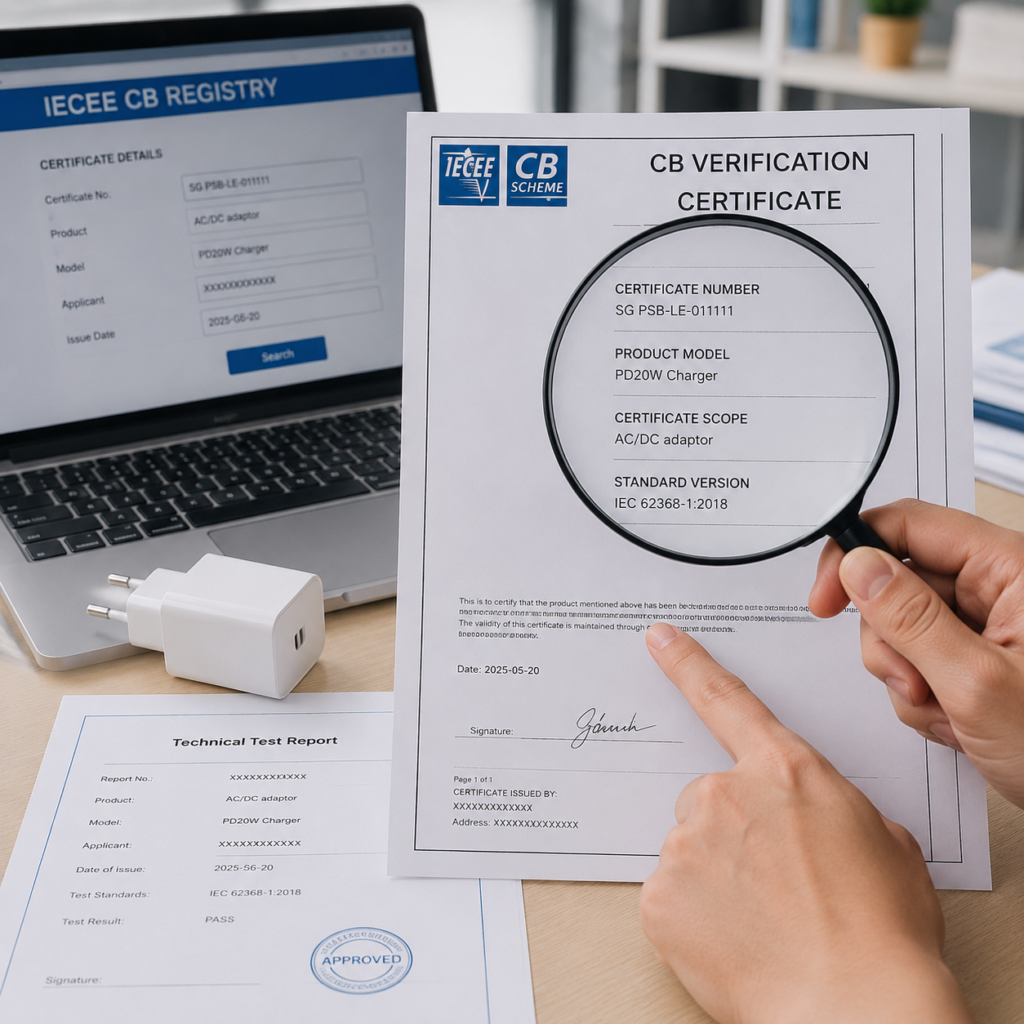
Third, if you suspect that the local certification of the product you bought is fake — for example, the CE and UL marks affixed by some small brands are self-printed — you can ask the merchant for CB materials for cross-verification. CB certificates and their registration information can be verified through the official IECEE CB Registry; the full CB test report is usually not publicly downloadable by ordinary users directly from the database, so you should request it from the merchant or certificate holder, and verify the correspondence between the report and the certificate.
Applicable Boundaries of CB for Charging Products
Not all charging-related products can obtain CB certification. Let’s first clarify the scope to avoid being fooled by merchants’ “full series CB certification” claims.
First, products that may be covered: many chargers, power adapters, wireless charging devices, and power banks can apply for testing and certificates under the CB Scheme in accordance with applicable IEC standards. However, whether a product falls within the CB scope must be confirmed based on the specific product, rated parameters, intended use, and applicable standards; it cannot be simply understood as “any product with electronic circuits automatically falls under CB”.
Then, scope that requires specific judgment: whether purely passive cables can apply for CB depends on their specific structure, intended use, rated values, applicable IEC standards, and CB product categories. It cannot be generally asserted that all ordinary charging cables are outside the CB scope. The USB 2.0 or USB Type-C specifications themselves are not equivalent to a CB safety standard that covers all cable safety aspects.
Some industrial or electric vehicle charging equipment may be subject to special standards such as IEC 61851, and there may be corresponding CB or other conformity assessment paths. Whether it is applicable depends on the equipment type, intended use, and specific standards; it cannot be asserted that it does not fall within the CB scope just because its power is relatively high.
In addition, there are three basic prerequisites for a product to obtain a CB certificate, all of which are indispensable:
First, it must comply with the corresponding IEC international safety standards; it is not enough to just test a few items randomly;
Second, testing must be completed by a laboratory officially recognized by the IECEE; tests conducted by the company’s own laboratory or an unqualified third-party laboratory are not valid;
Third, the test sample must be representative of the intended mass-produced product; engineering prototypes that are inconsistent with the final design cannot be used to evade testing. After mass production, the product must remain consistent with the CB assessment sample in terms of design, key components, and structure, and comply with applicable production consistency and change control requirements.
Core Roles and Operating Logic of the CB Scheme
Many people think that IECEE directly issues CB certificates, but that is not the case. The entire CB Scheme has three core roles with clearly defined division of labor:
The first is the IECEE Secretariat, which is equivalent to the “rule-maker and referee” of the entire scheme. It is responsible for formulating mutual recognition rules and reviewing the qualifications of laboratories and certification bodies, but it does not conduct testing itself, nor does it directly issue CB certificates.
The second is the CB Testing Laboratory (CBTL for short), which is the “physical examination center” that actually conducts testing. It must be officially recognized by the IECEE before it can test products in accordance with applicable IEC standards and issue CB test reports.
The third is the National Certification Body (NCB), which is a certification body recognized by the IECEE and responsible for reviewing CB test reports and issuing CB certificates. It can be a nationally designated or recognized body, but not necessarily a government department; a country or economy may also have multiple NCBs.
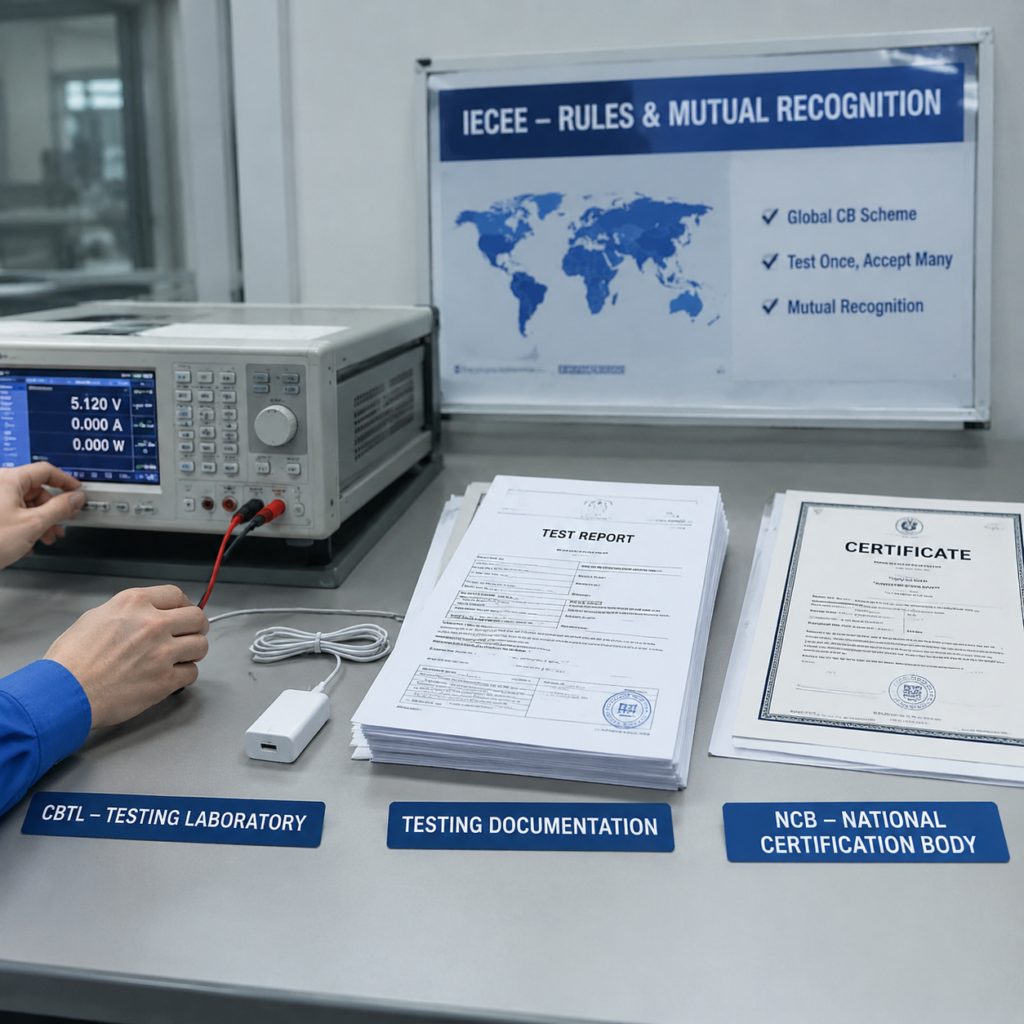
Then how is a CB certificate issued? In fact, the process is very clear: the manufacturer first prepares samples that can represent the intended mass-produced product, and finds a qualified CBTL to conduct testing in accordance with applicable IEC standards. The CBTL will record test results and non-conformities, and the applicant must make rectifications and complete verification as required; after confirming that the report content meets CB rules, the NCB decides whether to issue a CB certificate.
Here we need to focus on a point that many people are confused about: since it is mutual recognition, why do you need to convert to local certification with CB? Because the electricity environments and requirements vary from country to country, and there are “national differences”. Different countries or regions may have different plug, socket, grounding, and grid requirements; for example, the United States commonly uses two-prong ungrounded plugs and three-prong grounded plugs, and Europe does not have only one unified plug standard. Specific differences shall be subject to the national difference documents and regulations of the target market.
CB reports can usually be used as the technical basis for target market certification. The target authority will decide the scope of supplementary testing or assessment required based on national differences, report content, standard version, product changes, and factory requirements, which may go beyond national difference items. This is also the main value of the CB Scheme: it reduces duplicate work when conditions are appropriate, but does not guarantee complete exemption from subsequent assessments.
For charging products, common differences may include plug type, input voltage range, label text, fuse specifications, etc. The specific details shall still be subject to the regulations of the target market.
Core Test Content of CB for Charging Products
What everyone is most concerned about is definitely: what exactly does CB test? What safety aspects of chargers can it guarantee? Let’s first talk about two frequently mentioned IEC standards or standard series. You don’t need to memorize them, just know what they roughly correspond to:
One is IEC 62368-1, which is a general safety standard for information technology and audio-visual equipment. Many consumer chargers and power adapters are subject to safety assessments based on its applicable scope. It can be understood as one of the common basic safety standards for consumer electronic power supply products.
The other is the IEC 62680 series. It mainly involves technical specifications such as USB interfaces, connectors, cables, and USB Power Delivery. The electrical, mechanical, and fire safety of chargers and cables still need to be assessed based on the IEC safety standards applicable to their specific products. Not all products with USB-C interfaces or E-Marker chips must complete CB safety certification under the same IEC 62680 standard.
Many people get a headache when they see test standards. In fact, you don’t need to understand so many professional terms. The core test items that we ordinary users can perceive are just these few, all of which are directly related to daily use safety:
First is electric shock protection and mechanical robustness: the standard will assess electric shock protection, structural strength, and necessary connector durability under specified conditions, focusing on whether plugs, interfaces, and casings will expose dangerous parts. However, the test results only represent the specified samples and test conditions, and cannot guarantee that the product will not loosen or be damaged under all usage methods and after long-term use.
Second is overheat protection and flame retardancy: the product must meet temperature rise, safety distance, and fire protection requirements under normal and abnormal conditions specified in applicable standards. For example, during high-power charging, the product must not pose unacceptable hazards due to normal operation or specified abnormal conditions, but this does not mean that it will never heat up or catch fire in any usage environment.
Third is overcurrent/short circuit protection: the product must meet safety limits and fire protection requirements under overload, short circuit, and abnormal operating conditions specified in applicable standards, and the implementation of protection circuits can vary. This cannot be equated with guaranteeing that any external device will not be damaged under all fault conditions.
Fourth is clear marking: parameters such as power, voltage, model, and warning information printed on the charger must meet the requirements of applicable standards for marking durability and clarity, and cannot be easily worn to the point of being unrecognizable.
A key premise to remind here: CB assessment must cover the rated input, output, operating modes, and most unfavorable conditions declared in the certificate. Whether to adopt item-by-item testing, or testing with representative configurations or most unfavorable conditions, is determined by applicable standards and the CBTL. Users should check the rated range in the certificate and report, rather than assuming that every power level advertised by the product has been tested separately.
Methods for Querying and Reading CB Certificates/Reports
Since CB certificates and related registration information can be queried publicly, how can we ordinary users check them? How to judge whether a certificate is real or fake?
First, the official query channel is the IECEE’s official CB Registry database, where relevant registration information can usually be queried publicly. Do not trust those third-party query websites, as their data may be inaccurate or fake.
When you get a CB certificate, you don’t need to read the dense professional content. Just focus on verifying three key pieces of information, which is enough for ordinary users to make a preliminary judgment:
First, verify the product model: check the complete model, trademark, rated parameters of the purchased product against the model range listed in the certificate. Confirm that the model is explicitly included in the certificate or report, or belongs to model variants explicitly allowed by the document. You cannot judge solely based on appearance or the claim of “same series”.
A CB certificate can list multiple models, trademarks, series models, or model variants. When the structure, key components, and rated parameters meet the assessment conditions, there does not have to be only one model, and the commercial name of the product purchased by consumers does not have to be identical character by character to the certificate model. However, if the purchased model is not included in the coverage of the certificate or report, it cannot be automatically applicable just because the appearance is the same.
Second, verify the test standard: the test standard on the certificate must be applicable to the product, and at the same time, confirm whether the version is still accepted by the target market and target NCB. You cannot conclude that a CB certificate is invalid just because it does not use the latest version; the transition period of the standard version, the adoption status of the target market, national differences, and NCB procedures will all affect whether the old version of the standard is still acceptable.
Third, verify the coverage: check whether the test scope in the certificate includes the accessories you care about, such as the matching charging cable, replaceable plugs, etc. The vast majority of CB certificates only cover the charger itself. If the merchant says “the set has CB certification”, you must check whether the cable and other accessories are included in the certificate or related reports, otherwise the accessories may not be covered by the same scope at all.
Then how to judge whether the certificate is valid? It can be judged from several aspects:
First, the CBTL that issued the report and the NCB that issued the certificate should both have their qualifications verifiable in the relevant directories on the IECEE official website;
Second, the certificate status should be valid, and confirm that it has not been cancelled or suspended;
Third, the validity of a CB certificate cannot be simply judged by a fixed three-year or five-year term. It also depends on whether the target market accepts the listed standard version, whether the product has undergone design changes, and whether the certificate coverage is still applicable.
For example, after the standard is updated, you should confirm the transition period and acceptance policy of the target market and NCB; only when the old version is no longer accepted, the certificate is revoked, or product changes make the coverage no longer applicable, may it be necessary to upgrade the standard or conduct a re-assessment.
Relationship Between CB and Mainstream Charging Certifications in Various Countries
Many people are confused about the relationship between CB and certifications such as CE, UL, and PSE. In fact, it can be explained in one sentence: CB is a stepping stone, not a pass.
CB is a globally recognized foundation for safety testing. Its role is to reduce repeated testing, but it cannot replace the statutory access certifications of various countries. To sell products legally in a certain country, you still need to meet local requirements such as regulations, certifications, plug specifications, and voltage adaptation; it’s just that the CB report may become part of the technical basis for subsequent assessments.
We have compiled the corresponding rules for several mainstream markets for your quick reference:
| Market Region | Mainstream Safety/Access Certification | Relationship Between CB and Local Requirements |
|---|---|---|
| European Union | CE (safety part) | CB reports can support technical documentation and safety assessments under EU regulations within the applicable scope, but cannot replace the manufacturer’s conformity assessment of applicable regulations; it is also necessary to meet applicable electrical safety, EMC, RoHS and other requirements as well as local plug, socket and labeling conditions respectively. Finally, the manufacturer shall sign the EU Declaration of Conformity in accordance with the law and use the CE mark |
| United States | UL / ETL | US certification bodies such as UL or ETL may use CB reports as part of the testing basis within the scope permitted by their procedures, but still need to complete assessments in accordance with applicable US standards and national differences, and fulfill factory inspection or subsequent supervision requirements in accordance with specific certification schemes |
| Japan / South Korea / Australia | PSE / KC / RCM | Whether CB reports can be used for PSE, KC and RCM, and what supplementary testing, factory inspections or documents are required, shall be confirmed in accordance with the applicable regulations and certification body procedures of Japan, South Korea, and Australia/New Zealand respectively; CB can usually only be used as part of the technical basis, and cannot be generalized as only needing to supplement plugs and labels to convert the certificate |
For ordinary users, the scenario where CB has the most reference value is when buying universal travel chargers for multi-country business trips, or charging products purchased cross-border for cross-regional use. A valid CB certificate that covers the purchased model and configuration can be used as a reference that the product has completed relevant electrical safety assessments, but it cannot replace the legal requirements of the target market, nor can it absolutely guarantee that every mass-produced product or all usage scenarios are safe.
Common Misconceptions and Pitfall Avoidance Guide for CB
Finally, we have compiled several of the most common misconceptions about CB, all of which are pitfalls that many people have fallen into. You must avoid them:
Misconception 1: Having CB means you can sell globally
Wrong. CB is only a test mutual recognition mechanism, not a market access permit. To sell legally in a certain country, you must meet local statutory certification requirements, plug specifications, voltage adaptation and other conditions; having CB alone is not enough.
Misconception 2: CB can prove fast charging speed or protocol compatibility
Wrong. CB mainly focuses on electrical safety, structure, fire protection and other requirements specified in applicable standards, and is not equivalent to performance or fast charging protocol compatibility testing. It is not responsible for proving charging speed, nor does it automatically prove support for protocols such as PD and QC. Don’t think a product is a fast charging miracle just because it has CB.
Misconception 3: Chargers with the same appearance share the same CB certificate
Wrong. CB certificates are related to specific models, designs, and assessment scopes. Even if the appearance is exactly the same, as long as the internal circuit, transformer, USB-C control chip, or casing flame-retardant material changes, you must declare to the NCB or CBTL and conduct a change assessment. Depending on the content of the change, supplementary testing, report revision, or re-certification may be required, and you cannot continue to reference the original certificate on your own.
Misconception 4: CB certificates are permanently valid
Wrong. CB certificates cannot be understood independently from the product, standard version, and target market. After the standard is updated, you should confirm the transition period and acceptance policy of the target market and NCB; only when the old version is no longer accepted, the certificate is revoked, or product changes make the coverage no longer applicable, may it be necessary to upgrade the standard or conduct a re-assessment.
In fact, to quickly check CB materials, you can first remember four steps: check the certificate number, match the product model, check the coverage, verify the standard version. After that, you should also verify the qualifications of the NCB and CBTL, certificate status, report correspondence, and regulatory requirements of the target market; relying solely on these four items cannot guarantee that all problems will be found.
Summary of Learning
Overall, the IECEE CB Scheme is an important “common language” in the field of global consumer electronics safety. It is not a “globally accepted certification”, but it is an important reference for us to judge whether charging products have completed relevant basic safety assessments.
For ordinary users, it is enough to remember three points: First, distinguish the difference between CB and market access certification, and don’t be fooled by merchants’ “globally accepted” marketing claims; Second, learn to check CB certificates and registration information on the IECEE official website by yourself, and don’t fully believe the merchant’s one-sided story; Third, when purchasing charging products cross-border, you can use CB as a basic safety reference, but also confirm that the product meets your local legal use conditions, and verify whether the certificate covers the specific model and configuration you have.
After all, charging products are used every day, and safety is always the top priority.