
Sellers who export charging products to Indonesia have most likely encountered these situations: a Bluetooth-enabled wireless charger is seized by customs as soon as it arrives at the Port of Jakarta, and an SDPPI certificate is required; the e-commerce platform backend suddenly sends a notice requiring an SDPPI certificate for smart chargers, otherwise the product will be directly delisted; a product that has finally started selling well is found to have unqualified RF parameters in an official spot check and faces a fine. Many people are confused when they first hear about SDPPI. Today, we will thoroughly explain the requirements of Indonesia’s SDPPI RF testing for charging products from basics to practical operation. After reading this, you will be able to judge most issues by yourself and avoid common pitfalls.
Basics: Fundamental Concepts and Boundaries
First, let’s clarify a few most easily confused basic concepts, otherwise the content later will get more and more confusing.
Indonesia’s current competent authority is the Ministry of Communication and Digital Affairs (Komdigi). The specific institution names, responsibilities, and processing systems shall be subject to the latest releases from Komdigi and DJID. The current telecommunications equipment certification is handled by the competent units under the Komdigi system in accordance with current regulations; the names of SDPPI, DJID, etc., and their specific responsibilities shall also be subject to the latest organizational structure and certification system displays. Many veteran sellers may have heard of the term “Postel certification”, which was the common name for Indonesia’s telecommunications certification in the past. Now this system has been updated, so do not apply the old Postel rules to current requirements. All rules shall be subject to the latest regulations, product classifications, and certification system information released by Komdigi/DJID. If you are unsure about the rules or product classification, you should inquire through the current official product classification catalog, certification database, and processing system, and confirm with the competent authority or accredited laboratory if necessary.
Many people think that passing the RF test means they can sell the product directly, which is completely wrong. SDPPI RF testing is only one part of the entire compliance chain. The complete process is: first identify the product and classify it, then conduct RF testing, use the test report to apply for certification, affix the label as required after passing the certification before going on the market, and accept official spot checks and management after listing. The test report is only one of the materials for applying for certification, not a pass for customs clearance. This point must be kept in mind.
If non-compliant, charging products may involve three links. First is customs clearance: if the product is classified into a category that requires telecommunications equipment certification, corresponding certification or import compliance materials may be required during the import process; whether inspection, temporary detention, or return shipment is required depends on product classification, import declaration, and specific law enforcement circumstances. Second is the market link: some platforms or categories may require submission of compliance materials such as certification; failure to meet platform rules may lead to sales restrictions or delisting, and administrative penalties depend on specific illegal acts and the law enforcement basis of the competent authority. Third is post-listing spot checks: the official may sample products on the market to verify whether the actual RF parameters are consistent with the certification information; if the product is inconsistent with the certification materials, further processing may be triggered.
Quick Judgment: Does Your Charging Product Need RF Testing?
After clarifying the basic concepts, the question everyone is most concerned about must be: does the charging product I sell need SDPPI RF testing? Here is a three-step judgment method for you. Note that this is only a preliminary screening, there is no absolute exemption, and the final conclusion shall be subject to official classification.
Step 1: First, search in the current official product classification catalog of Komdigi/DJID to confirm whether the product falls within the scope of regulated telecommunications or wireless equipment.
Step 2: Confirm whether the product has active RF transmission function, wireless power transfer (WPT) function, or regulated passive reception/NFC function. Note here that not only active transmission devices need to be regulated; passive reception and pure identification NFC/RFID cannot be directly exempted either. They must be confirmed in combination with frequency band, purpose, equipment category, and official requirements. In addition, wireless modules that can be turned off via software cannot be directly excluded either. It is necessary to verify whether the transmission function is really completely disabled, whether the same model has different configurations, and whether the firmware will enable the wireless function. All these need to be confirmed.
Step 3: Even if it is determined that SDPPI RF testing is required, it is also necessary to simultaneously check whether other requirements such as SNI safety regulations, EMC, and energy efficiency need to be met. Many products need to meet multiple compliance requirements at the same time.
Here we will separately talk about how to judge the most frequently asked wireless power transfer (WPT) devices. For Qi, magnetic resonance, and other WPT products, whether SDPPI is required cannot be judged solely by the name “wireless charging”. It shall be confirmed item by item based on current product classification, operating frequency, power, transmission method, communication link, and applicable technical requirements.
For inductive wireless chargers, such as common Qi magnetic suction chargers and desktop wireless charging pads, it is necessary to check coil parameters, operating frequency, power level, and communication link during charging. The rules for magnetic resonance wireless chargers may be different, so it is also necessary to separately check Indonesia’s spectrum classification and testing requirements. If the product also has functions such as Bluetooth and Wi-Fi, additional evaluation shall be carried out in accordance with the requirements of corresponding wireless devices.
Therefore, Qi wireless chargers can be regarded as products that require further verification, and cannot be directly determined as requiring SDPPI, nor can they be directly determined as not requiring certification. There is no unified “test/no test” conclusion for wireless chargers. You must find a laboratory that is accepted within the scope of relevant equipment categories and standards, and confirm in accordance with current rules. Do not make a decision on your own.
For everyone’s convenience of understanding, we list several types of products in the charging industry that require further verification of SDPPI applicability: wireless charging products such as Qi magnetic suction chargers, desktop/car wireless charging pads, and shared power banks with wireless charging; smart charging products such as chargers, charging docks, and smart power strips with Bluetooth, Wi-Fi, or APP control; accessories with wireless functions such as charging cables with active NFC/RFID transmission, docking stations with wireless screen casting, and car chargers with FM transmission. Whether testing and certification are ultimately required shall be confirmed in accordance with official classification and applicable technical requirements.
Conversely, there are two types of common products that do not belong to SDPPI wireless equipment: one is ordinary wired chargers, such as wired chargers and power adapters with only PD and QC fast charging. Even with LED digital display, they usually do not require SDPPI due to the wired charging function; the other is ordinary USB/USB-C charging cables, conversion plugs, and wall charging port panels. These products usually do not belong to SDPPI wireless equipment, but SNI, electrical safety, plug and socket, and other applicable requirements shall still be verified according to product type.
If your product is just on the borderline and you are unsure, there are three solutions: first, self-check: review the product specification sheet, list all wireless functions, transmission/reception types, and frequency band parameters, and compare them one by one; second, verify through the current official product classification catalog and certification system of Komdigi/DJID; third, find a laboratory that is accredited by Komdigi/DJID within the relevant scope or whose accreditation scope is accepted, or find a local agent to make a judgment in advance to avoid detours later.
Core Content: RF Test Items and Rules
After confirming that testing is required, many people will ask: what exactly is tested? Why are these tests conducted? In fact, the core logic of SDPPI RF testing is very simple: it is to ensure that the wireless signals emitted by the device comply with Indonesia’s spectrum rules and do not interfere with public communications and the normal operation of other legal devices. You can think of the spectrum as public roads: each device can only drive in its own lane, cannot speed, and cannot change lanes randomly to affect others.
The specific test items are selected according to product category, not all products need to take the full set of tests. The general items are as follows:
First is frequency/spectrum occupancy, which is to check whether the signal emitted by the device is within the spectrum range allowed by Indonesia, and whether it occupies someone else’s lane.
Second is transmission power/EIRP. EIRP is Equivalent Isotropically Radiated Power, which is usually calculated or measured from conducted power, antenna gain, and feeder loss, and is used to represent the equivalent transmission power in the maximum radiation direction. This item is to check whether the power limit of the corresponding equipment category is exceeded.
Third is bandwidth and modulation, which is to check whether the signal format meets the requirements of the corresponding equipment category. For example, Bluetooth signals cannot be transmitted in Wi-Fi format.
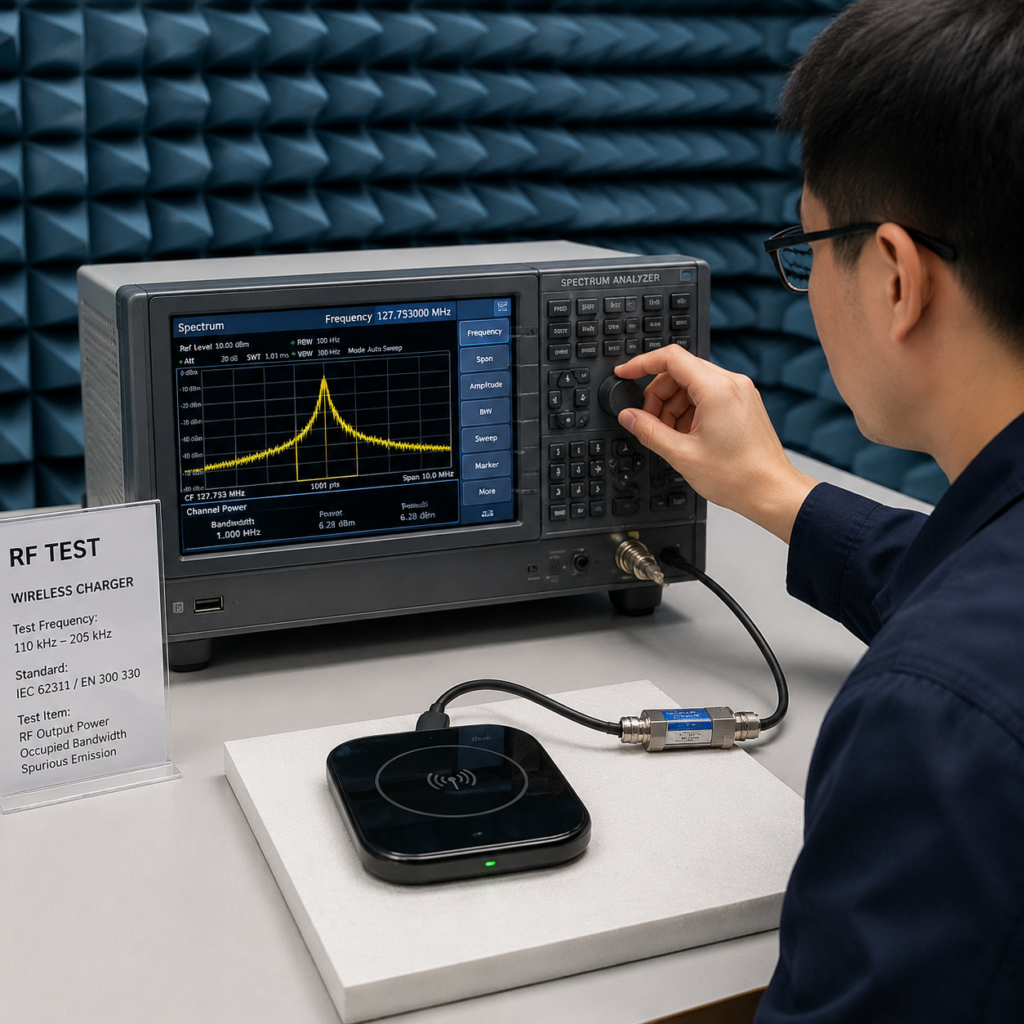
Fourth is spurious/out-of-band emission, which you can understand as “excess signals” leaked out when the device is working. For example, circuit noise during charging may bring out some signals that are not in the specified frequency band. If these signals are too strong, they will interfere with other devices, so they also need to be tested.
Fifth is occupied frequency band/duty cycle, which is to check whether the time and range of spectrum occupied by the signal are compliant, and the channel cannot be occupied all the time.
In addition to these general items, there are some special tests that are conducted as needed. For 5GHz Wi-Fi devices using applicable DFS frequency bands, DFS shall be verified and conducted in accordance with Indonesia’s current spectrum rules; TPC shall also be verified when necessary. DFS cannot be generalized as a mandatory test item for all 5GHz Wi-Fi devices, because the specific requirements depend on the actually used frequency band, bandwidth, power level, and device conditions.
Before sending for testing, you need to provide a set of RF parameters to the laboratory to facilitate the laboratory in arranging the test. They are mainly divided into several categories: basic parameters such as center frequency, frequency range, bandwidth, and modulation method; power parameters such as maximum conducted power, antenna gain, maximum EIRP, and duty cycle; functional parameters such as operating mode, whether DFS/TPC is supported, and what wireless communication protocol is used; if it is a wireless charger, coil parameters, charging power level, and communication link type shall also be additionally provided. Here we would like to remind everyone that there is no universal fixed limit. All limits are matched with current regulations according to equipment categories. Do not apply limits from other countries or other categories.
Many people also confuse the relationship between SDPPI and other compliance requirements. Here we clarify the boundaries.
First is the relationship with SNI safety regulations: SNI is the Indonesian National Standard. Whether it is mandatory depends on whether the product is included in relevant mandatory regulations and applicable standards. It may involve requirements such as electrical safety and performance, but it cannot be simply understood that all products must obtain SNI safety certification. Ordinary wired chargers usually do not require SDPPI due to their wired function, but their specific requirements such as SNI, electrical safety, EMC, and energy efficiency shall still be verified.
Then is the relationship with EMC: radio parameter testing mainly focuses on frequency, power, bandwidth, spurious and out-of-band emissions; electromagnetic compatibility testing focuses on items such as emission and immunity. The two have different technical purposes, but the SDPPI certification or supporting compliance solutions for some charging products may require submission of both types of test results at the same time. In other words, the noise generated by switching power supplies usually falls within the cross-concern of EMC or spurious/out-of-band emission testing, and it cannot be absolutely said that it is completely outside the scope of SDPPI certification testing.
Then is the relationship with CE and FCC RF: Indonesia’s regulations are independent. CE and FCC RF reports can only be used as reference and cannot be directly used to apply for SDPPI certification. Whether overseas reports can be accepted shall be confirmed according to current rules, laboratory accreditation scope, standards used in the report, and certification system requirements.
For everyone’s convenience of understanding, we have sorted out the compliance combinations of several common charging products:
| Product Type | SDPPI RF Testing | Other Common Compliance Requirements |
| Ordinary PD Wired Charger | Usually not within the scope of SDPPI, still needs to be confirmed according to product classification | SNI, electrical safety, EMC, energy efficiency, etc., verified according to applicable requirements |
| Bluetooth Wireless Charging Dock | Needs to be confirmed based on WPT and Bluetooth functions, frequency band, power, and official classification | SNI, electrical safety, EMC, etc., verified according to applicable requirements |
| Wi-Fi Smart Charger | Needs to be confirmed based on Wi-Fi frequency band, power, and official classification | SNI, electrical safety, EMC, energy efficiency, etc., verified as needed |
| Passive USB-C Charging Cable | Usually not an SDPPI wireless device | Conduct other special certifications as needed, and verify requirements such as SNI and electrical safety |
Finally, let’s talk about the pre-test requirements exclusive to charging products. Unlike ordinary consumer electronics, charging products have several special requirements during testing: first is the test state, which shall cover the nominal grid conditions of 230V and 50Hz applicable in Indonesia, and the test voltage shall be determined according to the product’s rated input range and applicable standards at the same time. Wireless chargers shall also be equipped with analog loads to simulate real charging situations; second is the coverage scope, which shall cover representative and most unfavorable wireless modes, power levels, and simultaneous transmission combinations according to applicable standards and laboratory test plans; third is that if the product has multiple wireless modules, each transmission module and its coexistence state shall be evaluated separately according to applicable standards and test plans, rather than requiring all modules and all levels to be tested one by one.
Rule Differences: Which Product Characteristics Affect Test Requirements
Even for SDPPI RF testing, the requirements for different products may vary greatly, mainly affected by three aspects of characteristics.
First is the type of wireless technology. For example, Bluetooth and Wi-Fi products are tested according to the rules for short-range devices. Among them, special attention should be paid to 5GHz Wi-Fi, as different sub-bands have different usage permits and restrictions. Devices using frequency bands subject to DFS shall test DFS according to applicable rules, while other frequency bands and devices shall be judged according to their specific conditions. TPC is also not a universal mandatory test item for all devices.
Wireless charging products shall be classified and judged according to type, power level, operating frequency, and communication link, and there is no unified standard. For relatively niche technologies, such as NFC/RFID and Sub-GHz, it is necessary to separately check frequency band licenses and product classifications, and cannot apply the rules of Bluetooth and Wi-Fi.
Second is hardware configuration. First is the antenna: the requirements for built-in, external, and replaceable antennas are different. The gain of the antenna will directly affect the calculation of EIRP. The higher the gain, the easier it is to exceed the power limit; then is the wireless module: if a wireless module that has obtained relevant accreditation is used, some tests may be simplified, but the reference must meet the requirements of the module certificate, for example, the installation method, usage conditions, and final product configuration cannot be changed at will; there is also the shell and structure: for example, the metal shell and the position of the coil will affect the RF performance, so usually the final finished product or a representative final configuration shall be used for testing, and bare boards cannot be used to replace the whole machine.
Third is working state and accessories. In terms of charging state, representative or most unfavorable scenarios such as no-load, normal charging, full load, and fast charging switching shall be covered according to applicable standards and test plans, because the RF performance may be different in different states. For example, during fast charging, the circuit current is large, and there may be more spurious signals.
In terms of wireless state, modes such as standby, network configuration, and data transmission may all need to be evaluated. For example, Wi-Fi power may be higher during network configuration. Attention should also be paid to accessories: the laboratory may require testing according to the sales set, because different adapters and charging cables may affect the interference level. For example, using an adapter with poor filtering may cause spurious emissions to exceed the limit.
Practical Process: From Test Preparation to Compliance Listing
After talking about the rules, let’s go through the complete practical process again, from test preparation to compliance listing, what to do and what to pay attention to at each step.
First is pre-confirmation. Doing this step well can save a lot of trouble. First is the verification of the applicant entity, that is, who applies for certification. The division of responsibilities, application qualifications, and liability assumption of all parties shall be subject to current rules and processing systems. Do not randomly find an unqualified entity to apply, which will fail in the end.
Second is pre-confirmation of report acceptability. If you already have an ILAC report issued by an overseas laboratory, do not use it directly. Be sure to confirm with the certification competent authority or relevant accredited laboratory in advance whether the accreditation scope, standards used, and format of the report meet the requirements, and whether supplementation or retesting is needed. Reports from overseas accredited laboratories that meet current conditions are not necessarily invalid, but whether they can be accepted must be confirmed in advance.
Third is pre-check of product classification: match the current classification of Komdigi/DJID in advance to avoid classification errors. For example, classifying a smart charger with wireless function as an ordinary charger may eventually lead to incorrect testing and application directions.
Next is pre-test preparation. The core is that “the samples sent for testing must be exactly the same as the final sold products”. The samples shall be finished products consistent with the final sales version, including firmware, antennas, and supporting accessories, all of which must be identical; the materials to be prepared include specification sheets, RF parameter tables, user manuals, and label drafts. If an accredited wireless module is used, the qualification documents of the module shall also be provided.
Here we will specifically talk about the sample configuration matrix, that is, you need to cover all scenarios that need to be tested, and cannot just send one sample to test one mode. It is specifically divided into four dimensions: hardware dimension: the final motherboard, antenna, shell, and charging coil shall be used, and engineering version parts cannot be used; accessory dimension: the adapter and charging cable in the sales set shall be included, because these will affect RF performance; firmware dimension: mass production version firmware shall be used, and it shall be confirmed that the regional settings will not enable inapplicable frequency bands or power; working mode dimension: representative charging levels, wireless working modes, and necessary simultaneous transmission states shall be covered according to applicable standards and laboratory plans to ensure that the most unfavorable situation is evaluated.
Then is laboratory selection and test execution. A laboratory that is accredited by Komdigi/DJID within the scope of relevant equipment categories and test standards, or whose accreditation scope is accepted by current certification rules, shall be selected, and the report format and applicability shall be confirmed before sending for testing. Even for local laboratories, it cannot be generalized that all their reports can be directly used for application; whether reports from overseas accredited laboratories that meet current conditions are acceptable shall also be pre-confirmed with the certification competent authority or the laboratory.
There is no fixed test cycle, which is affected by factors such as regulation updates, product category, laboratory scheduling, and number of rectifications. Simple Bluetooth products may take one or two weeks, complex smart wireless chargers may take one or two months, and the time will be longer if rectification is needed. If the test fails, rectification is allowed. The rectified sample must be consistent with the mass production version, and then the affected items shall be re-evaluated, not all items need to be retested.
After passing the test and getting the report, you can apply for certification. The application materials include test reports, product materials, entity qualifications, etc., which shall be submitted in accordance with the current requirements of Komdigi/DJID. After passing the certification, the product shall be labeled as required. The style, position, and size of the label shall comply with current labeling rules, subject to official requirements, and cannot be printed randomly by yourself.
The validity period and renewal rules of the certificate are stipulated by the current telecommunications equipment certification regulations, and the validity period will also be stated on the certificate. Subject to current regulations and certificate information, renewal shall be processed before expiration, or continuation, change, or re-certification shall be processed according to changes.
Many people think that getting the certificate means everything is fine, but that’s not the case. If there are changes after the product is launched, re-evaluation is required. Whether retesting is needed and whether to re-apply for certification must be confirmed with the laboratory or the competent authority, and cannot be changed secretly by yourself. We have sorted out common change types and corresponding processing methods:
| Product Change Type | Processing Method |
| Only modify the text of packaging and manual | If it does not affect the certified model, technical parameters, usage conditions, and label information, it can usually be treated as a data change; it should still be confirmed whether the certificate data needs to be updated, and usually does not involve RF retesting |
| Modify shell/structure (without touching RF components) | Data evaluation, supplementary testing of some items as needed |
| Replace charging coil, antenna, wireless module | Partial or full retesting of RF items |
| Modify firmware (adjust power/frequency band) | Re-evaluate affected items, retest if necessary |
| Replace adapters/cables in the sales set | Evaluate RF impact, supplementary testing if necessary |
| Add new wireless functions | Full machine retesting, re-apply for certification |
It should be noted here that all changes cannot be decided by yourself. Be sure to confirm in advance, otherwise if a spot check finds that it is inconsistent with the certification information, it may be deemed non-compliant.
Result Verification and Pitfall Avoidance Guide
After getting the test report and certificate, how to quickly judge whether it is valid? Here are several quick verification methods for you.
First, look at the conclusion page of the report to confirm whether the final judgment meets the current corresponding requirements. Do not take test data as a proof of passing; then check the core items: whether the three most problematic items, frequency, transmission power/EIRP, and spurious emissions, are all within the limits; if it is a charging product, it is also necessary to specifically check whether the test covers the representative or most unfavorable charging modes required by applicable standards, and whether the accessories used in the test are consistent with the sales version; finally, verify the qualifications: check whether the laboratory is accredited or accepted within the scope of relevant equipment categories and test standards, and whether the numbers and applicable standards of the report and certificate meet current requirements.

If you want to verify the authenticity of compliance, you should verify the product model or certificate number through the current official certification database of Komdigi/DJID, and at the same time check the certificate entity, model, hardware/software version, validity period, and scope of application. If it cannot be queried, further verification shall be made with the competent authority or the issuing agency, and the authenticity cannot be determined based on a single query. Product identification, model, hardware version, and validity period shall also be consistent with official information. Common invalid reports or certificates have the following characteristics: parameters are inconsistent with the actual product, the laboratory does not have corresponding qualifications, the number cannot be verified through official channels, and only the wireless module is tested without covering the whole machine configuration required by certification.
Many new sellers are prone to pitfalls. We have summarized the five most common cognitive misconceptions that must be avoided:
First misconception: All chargers need SDPPI. Wrong. Whether SDPPI is required depends on whether the product falls into the current regulated telecommunications/wireless equipment category and its applicable technical requirements. Active transmission, WPT, reception or identification functions shall all be verified in combination with frequency band, power, purpose, and official classification; ordinary wired chargers usually do not fall into this scope, and the final decision is still subject to official classification.
Second misconception: Passing CE and FCC RF tests means passing SDPPI. Wrong. Indonesia’s regulations are independent. Overseas reports can only be used as reference. Whether they can be accepted must be confirmed according to current rules and cannot be directly used for application.
Third misconception: The charging power of a wireless charger is the RF transmission power. Wrong. These are two completely different concepts. Charging power is the power for charging the mobile phone, and RF transmission power is the strength of the wireless signal. Even if the charging power is only 15W, the RF transmission may exceed the limit and still be unqualified.
Fourth misconception: Testing and certification are valid for life once done. Wrong. If the product is changed, it needs to be re-evaluated. When the certificate expires, it shall be renewed, continued, or re-certified according to current rules. After regulations are updated, it may also be necessary to re-comply with new requirements.
Fifth misconception: Turning off the wireless module with software means no compliance is needed. Wrong. It must be confirmed that the transmission function is really completely disabled, and all products of the same model must comply, not some on and some off. It must also be confirmed according to current rules and official requirements, not just saying it’s turned off by yourself.
So what are the common reasons for non-conformity? We have also sorted out several most common pitfalls for charging products: first is power exceeding the limit, exceeding the RF power limit of the corresponding category. For example, some manufacturers adjust the Bluetooth power too high for more stable connection of wireless chargers; second is frequency band non-conformity, using frequency bands not opened in Indonesia, or using frequency bands of proprietary protocols, and 5GHz sub-bands that do not meet the usage conditions; third is spurious emissions exceeding the limit, mostly due to noise interference from switching power supplies and fast charging circuits, resulting in out-of-band spurious signals exceeding the limit. This is a particularly common problem for charging products; fourth is configuration non-conformity: the samples sent for testing are optimized, and the parameters of the mass production version are different, which will cause problems during spot checks.
In order to pass the test at one time as much as possible, you can do a self-check before sending for testing: first is function inspection: list all active transmission and wireless charging modules, do not miss any. For example, some smart power strips have Wi-Fi, Bluetooth, and NFC, and missing any one is not allowed; second is parameter verification: compare with Indonesia’s current spectrum rules, confirm in advance whether the frequency band and power are compliant, and fix problems in advance; third is module selection: give priority to wireless modules that have been accredited under relevant equipment categories and usage conditions, and also confirm the reference scope of the module in advance; fourth is state verification: check representative and most unfavorable charging levels, wireless modes, and simultaneous transmission states according to applicable standards and laboratory test plans; fifth is consistent configuration: the samples, accessories, and firmware sent for testing must be completely consistent with the mass production sales version, do not make special versions.
Summary
Reading this far, you should have a relatively comprehensive understanding of Indonesia’s SDPPI RF testing requirements. In summary, you can gain these core capabilities: first, you can quickly judge whether a charging product needs SDPPI RF testing and certification; second, you can distinguish the boundaries between SDPPI and SNI, EMC, CE/FCC RF, and will not confuse them; third, you can understand the core conclusions of test reports and certificates, and identify invalid documents; fourth, you can judge whether retesting or re-certification is needed after product changes; fifth, you can complete the basic self-check before sending for testing, and avoid common reasons for non-conformity.
The compliance requirements of the Indonesian market are constantly being updated. Only by clarifying the rules and making preparations in advance can unnecessary losses such as goods being detained and links being delisted be avoided. If you are unsure about something, be sure to confirm with a laboratory within the current accreditation or acceptance scope of Komdigi/DJID, or a professional agent. Do not make decisions based on experience.