
If you have ever bought chargers or USB-C charging cables via cross-border online shopping, or run a small-batch cross-border business of charging products, you have most likely seen claims like “compliant with IEC standards” or “CB global certification”. Many people think that products with the IEC mark can be used globally, but in the end, either the plug does not fit the local socket, or the product cannot be sold due to the lack of compliance documents required by the local authority, and there are even hidden dangers such as overheating and electric leakage during use. In fact, IEC standards are not the same as the market access compliance requirements of various countries, and the conversion between the two cannot be completed simply by “changing a mark”. Understanding this set of rules can help you avoid many pitfalls whether you are buying charging products or doing cross-border sales.
First of all, it should be clear that all the conversion rules we are talking about today only apply to commonly used chargers, power adapters, USB-C/USB charging cables, charging interfaces and plugs, and do not involve other categories such as toys, large home appliances, and industrial equipment — the compliance systems of different categories vary greatly, so do not apply these rules directly to other categories. Many people wonder “why can’t products with IEC reports be sold directly globally?”. The core reason is that IEC standards are only general technical standards, and each country or region may have its own requirements for regulations, certification, registration, declaration of conformity, marks, and responsible entities.
First, Understand 4 Core Terms That Are Most Easily Confused
People who are new to certification are most likely to be confused by various abbreviations. Let’s explain these four terms in plain language first, so that the subsequent rules will be easier to understand:
- IEC standards: These are general safety technical standards formulated by the International Electrotechnical Commission, equivalent to a “globally recognized examination syllabus for charging product safety”. IEC standards themselves are usually voluntary, with no unified global certification mark, and they are not a market access permit for any country — just like saying you “meet the requirements of the college entrance examination syllabus” does not mean you can directly enter any university. They may become part of local compliance assessment only when a country or region adopts them through regulations, technical rules or certification schemes.
- CB test report/certificate: These are test documents issued under the IECEE CB Scheme (a cooperation mechanism involving certification bodies and testing laboratories from countries around the world), equivalent to a “transcript that can be referenced by institutions participating in the scheme” after you take the exam according to the IEC syllabus. It is an important bridge for converting IEC standards into local compliance documents in some countries or regions.
- National certifications: The market access compliance requirements of each country or region may include mandatory certification, registration, declaration of conformity, test reports, compliance marks, and obligations of manufacturers, importers or other responsible entities. Whether certification is mandatory and what documents are required depend on the product category and local regulations. For example, the EU CE mark is usually a declaration by the manufacturer that the product complies with applicable regulations and the mark is affixed accordingly; it is not a “global certification certificate” issued by a unified EU certification body. For some products or usage scenarios in the US, assessment by an NRTL (Nationally Recognized Testing Laboratory) may be required, but it is not uniformly mandatory for all products at the federal level.
- Certification marks: These are marks such as CE, UL, and PSE printed on the product housing, indicating that the product has completed the compliance procedures required by the corresponding market, or that a specific assessment has been completed by the corresponding institution. However, it should be noted that a mark only corresponds to the models and configurations listed in the applicable regulations, certificates or conformity documents, and not all products of the same brand can use it — for example, if a 20W charger of a brand has completed a certain UL assessment, it does not mean that its 65W product is automatically covered.
Many people think that certification conversion is just replacing the IEC mark with the local mark, but this is not the case. Product safety standards in many countries reference or adopt IEC standards, so CB reports can sometimes help reduce duplicate testing. However, whether a CB report can be used and whether only national difference tests need to be supplemented must be confirmed item by item in accordance with the target country’s regulations, product category, standard version and certification body rules. Some markets may require retesting, local assessment, registration or other compliance procedures.
3 Most Common Pitfalls for Beginners
Let’s clarify the most common misunderstandings first to avoid detours later:
- Misconception 1: IEC standards are mandatory, and products with reports can be sold globally. The truth is: IEC standards themselves are usually voluntary and are not a market access permit for any country — even if a product has been tested in accordance with IEC standards, it must still comply with the regulations and market requirements of the place of sale.
- Misconception 2: CB report = national certifications. The truth is: CB documents are test and certification documents used for mutual reference among institutions participating in the CB Scheme, but they are not equivalent to the final certification, registration or declaration of conformity of the target country. To enter the market of a certain country, it still depends on whether the local authority accepts the document, and whether national differences, document review or other procedures need to be supplemented.
- Misconception 3: National certifications are just different names for IEC. The truth is: each country formulates or adopts local rules according to its own power grid conditions, plug specifications and regulatory requirements. Some differences are small, while others are relatively large, so they cannot be directly equated.
Core of Conversion Speed: Different Countries Adopt IEC in Different Ways
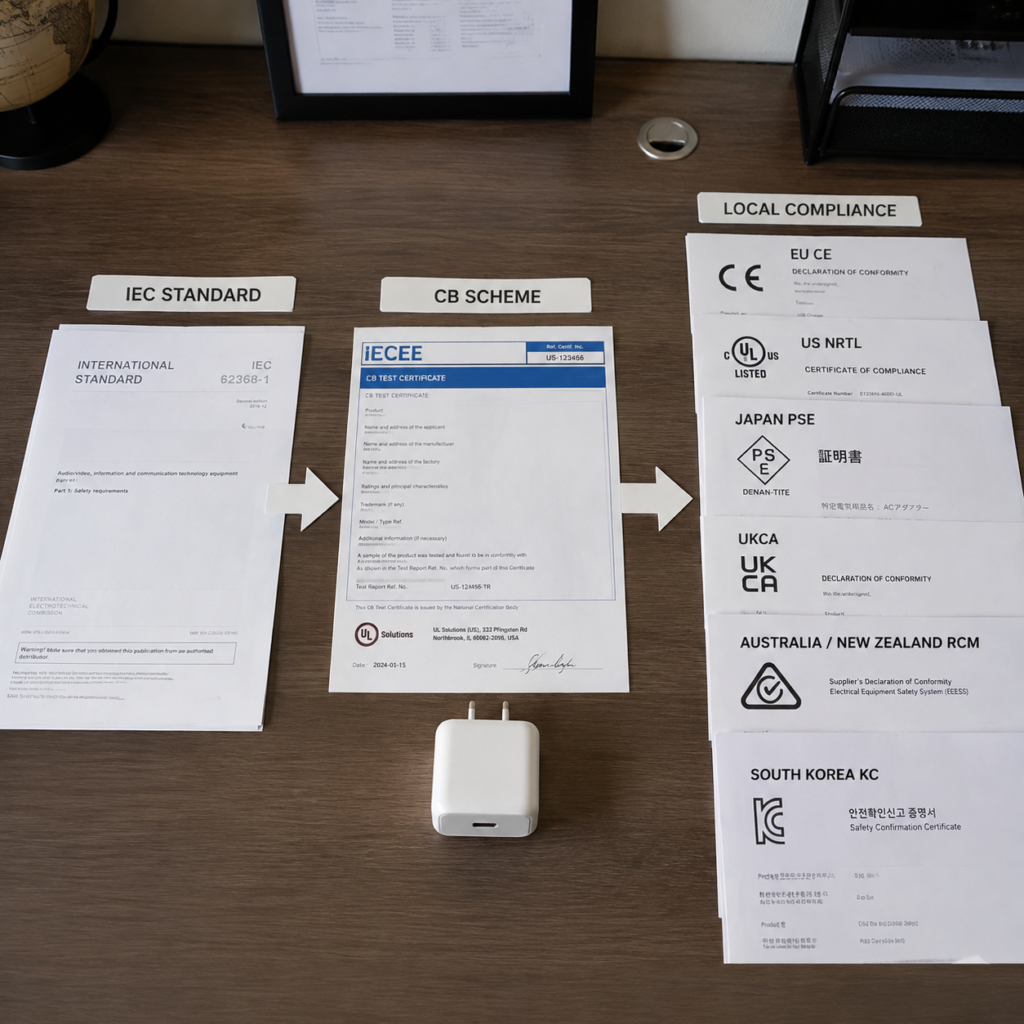
Why do some certification conversions require less supplementary work, while others require retesting, document review and even factory inspection? The core reason is that countries adopt IEC standards in different ways, coupled with differences in local requirements and certification modes.
3 Modes of IEC Adoption by Countries
These three modes can help with a preliminary understanding of the conversion difficulty, but the actual judgment shall still be subject to the target country’s regulations and certification body requirements:
- Identical adoption: Basically copies IEC standards with small differences, equivalent to most of the local exams using the IEC syllabus, with only a few adjustments to form or rules. In such markets, it is usually easier to use existing test data when the product and documents match.
- Modified adoption: Retains the core requirements of IEC and adds some local differences, equivalent to most of the exam syllabus adopting IEC content while adding local-specific test questions. For some PSE technical requirements in Japan and some KC requirements in South Korea, local differences need to be confirmed under specific product categories.
- Dominated by local versions and regulations: Some markets use national or regional versions formulated on the basis of IEC, and add more local differences and regulatory procedures. US UL 62368-1 and Canadian CSA C22.2 No. 62368-1 are both based on IEC 62368-1 and include local differences, so they cannot be simply classified as completely independently formulated. Whether supplementary testing is required shall be subject to the target standard and certification body review.
3 Common Sources of Local Differences
These differences do not come out of thin air; most are directly related to the actual usage scenarios of charging products:
- Power grid differences: The grid voltage, frequency and test conditions of each country may be different. For example, the common voltage in the US is 120V/60Hz, in Japan it is 100V, and in many parts of the EU it is 230V/50Hz. The corresponding assessment conditions for temperature rise, abnormal operation and overload may therefore be different.
- Physical differences: For example, the shape of plugs, power cord specifications, grounding methods and mechanical structures are all different. UK plugs commonly have three square pins with a fuse, and US plugs commonly have two flat pins or a round grounding pin. These configurations must be confirmed in accordance with the requirements of the target market.
- Regulatory differences: For example, what language is used for labels, whether to mark the local importer or responsible entity, what technical documents are required, and whether factory inspection or product registration is required, are all local requirements at the regulatory level.
A special reminder: IEC-related safety test data usually only covers part of the product safety assessment. Electromagnetic compatibility (EMC), energy efficiency, wireless regulations, environmental regulations, and battery transportation requirements may need to comply with local regulations separately, and a single IEC safety report cannot replace all compliance documents.
3 Prerequisites for Conversion
You cannot convert certification with just any IEC report; at least the following three aspects must be confirmed:
- Qualification prerequisite: First confirm whether the CB test report is issued by an IECEE-recognized CB Testing Laboratory (CBTL), whether the CB certificate is issued by the corresponding National Certification Body (NCB), and confirm whether the competent authority or certification body of the target country accepts the CB document. ILAC-MRA qualification cannot alone replace IECEE CB Scheme recognition.
- Matching prerequisite: The product category, applicable standard version and product configuration corresponding to the report must match the current certification requirements of the target country. You cannot just look at the “IEC” in the report title; you must also check the national standard version adopted by the target country, national differences and transition period.
- Validity prerequisite: You cannot simply assume that all CB reports and certificates have a unified fixed validity period. You should confirm the current status of the CB certificate, whether the standard version is still accepted by the target country, whether there is a standard transition period or certificate maintenance requirement, and check whether the product has undergone changes that affect safety. When product components or structures change, a change list should be submitted, and the laboratory or certification body will judge whether supplementary testing or re-assessment is required.
CB Scheme: The Core Bridge for Converting IEC to National Certifications
Since IEC reports cannot be directly converted into market documents for all countries, what is used to achieve mutual recognition of test results among multiple countries? In many cases, the core tool is the CB Scheme.
The CB Scheme is a cooperation mechanism involving certification bodies and testing laboratories from various countries. Simply put: within the scope permitted by the scheme rules, test data issued by one recognized body can be reviewed and used by other participating bodies. In this way, when enterprises export products, they do not have to redo a complete set of basic safety tests for each country they enter.
Its applicable product scope covers many electrical consumer products, including some chargers, power adapters and devices with USB-C interfaces. But remember: the core value of the CB Scheme is to reduce duplicate testing and review work, not to be a “global automatic pass”. Whether the target country accepts it and which items can be waived still need to be confirmed item by item.
CB Test Report and CB Certificate Are Not the Same Thing
Many people cannot distinguish between the two. In fact, they are supporting documents with different functions:
- CB Test Report (CBTR for short): It is a detailed test record, which usually includes test results, product photos, list of key components and applicable difference requirements, and is an important technical basis for subsequent reviews.
- CB Certificate: Issued by an IECEE-recognized National Certification Body (NCB), it is used to indicate that the relevant test documents meet the certificate requirements of the CB Scheme.
Whether it is a report or a certificate, it must clearly state the covered product models, power, interface types and configurations. Products beyond the listed scope cannot automatically use the same document — for example, the CB document for a 20W single-port charger cannot be directly used for a 65W multi-port product.
What Can Be Saved and What Cannot Be Saved in CB Conversion?
Converting to local compliance documents using CB may save the time and cost of basic safety tests that have been completed and accepted by the target party. But not all items can be waived.
Difference tests, labeling and manual requirements, product registration, obligations of responsible entities, factory inspections, etc. that are not covered by CB documents but are required by the target country’s regulations may still need to be supplemented. Specifically, which items can use existing data and which items need to be re-reviewed shall be subject to the implementation rules of the target country and the audit results of the certification body. Some difference items may already be included in the CB report and may not need to be tested again.
Specific Reasons for Failed CB Conversion of Charging Products
For charging products, there are several common reasons why CB documents cannot be smoothly used in the target market:
- The target country does not accept the CB conversion path for this type of charging product — a few markets may require local testing, registration or other procedures, and do not recognize direct conversion of CB documents.
- The institution issuing the CB certificate or the laboratory issuing the report does not meet the recognition requirements of the target country — you cannot just see the word “CB”; you must also check the CBTL, NCB and the acceptance scope of the target country.
- The product has wireless or battery functions, but the original CB document only covers basic electrical safety — for example, for a fast charger with Bluetooth function, if the wireless part has not completed the assessment required by the local authority, relevant compliance procedures still need to be supplemented.
- The report does not cover the national difference items required by the target country — for example, if the relevant US differences were not covered when doing the CB, supplementary testing or document review may be required when converting to US assessment.
Examples of Conversion in Major Overseas Markets
Having talked about so many rules, it may be a bit abstract. Let’s take several major overseas markets as examples to see what needs to be confirmed in different markets. The following table is for beginner reference and does not mean that all products apply to the same certification path.
| Market | Corresponding Charging Products | Standard Matching Degree | Core Supplementary Requirements | Conversion Difficulty | Cost and Cycle |
|---|---|---|---|---|---|
| EU/EEA (CE-LVD, Low Voltage Directive) | Chargers, power adapters; USB-C charging cables need to be confirmed separately | Assessed in accordance with applicable EN standards and EU regulations | For products falling within the scope of LVD, prepare the EU Declaration of Conformity; labeling, manuals, responsible entities and product configurations shall be confirmed according to the selling member state; USB cables cannot be judged to be subject to LVD solely based on “USB-C” | No unified grade judgment | Determined by product, regulations and assessment mode |
| US (UL/ETL, NRTL Nationally Recognized Testing Laboratory System) | Chargers, power adapters, USB-C interface devices | Assessed in accordance with applicable US standards and national differences | Confirm US-standard plugs, applicable standards, NRTL assessment, and state and local requirements; UL and ETL correspond to assessments by their respective institutions | Determined by product and usage scenario | Quoted and scheduled by the certification body based on testing, review and registration items |
| Japan (PSE, Electrical Appliance and Material Safety Law) | Chargers/power adapters need to be judged by specific product items; USB charging cables also need to be judged by product structure | Assessed in accordance with Japan’s Electrical Appliance and Material Safety Law and related technical requirements | First confirm whether the product belongs to specified electrical appliances or other electrical appliances, then determine the diamond/circular PSE mark, inspection institution, obligations of manufacturers or importers, as well as Japanese labeling and plug requirements | Determined by product classification and assessment mode | Determined by specific product items, testing and responsible entity requirements |
| UK (UKCA, UK Conformity Assessed) | Chargers, power adapters; USB-C charging cables need to confirm applicable regulations | Assessed in accordance with UK regulations and recognized standards | Confirm UK regulations, recognized standards, UK-standard plugs, English labels and UK responsible entity requirements; within the scope where CE is allowed, CE may still be used | Determined by current transition arrangements and product category | Determined by product and assessment mode |
| Australia and New Zealand (RCM Compliance Mark) | Chargers, power adapters; USB charging cables need to confirm applicable regulations | Assessed in accordance with the applicable requirements of Australia and New Zealand respectively | Confirm electrical safety, EMC and other requirements respectively; for products falling within the scope of Australia’s EESS, the eligible responsible supplier shall complete the corresponding registration and compliance obligations; plugs and labels shall be confirmed according to the market | Judged separately by product and market | Determined by responsible supplier, testing, registration and document requirements |
| South Korea (KC Electrical Product Safety Certification) | Chargers, power adapters | Assessed in accordance with applicable South Korean standards and local differences | Confirm Korean-standard plugs, Korean labels, product classification, and whether there are factory inspection or quality management requirements | Determined by product classification and certification mode | Quoted and scheduled by the certification body based on specific items |
In addition to the above major markets, there are other common markets, such as India’s BIS, Brazil’s INMETRO, Saudi Arabia’s SABER system, etc. It cannot be simply summarized as “most accept CB reports and only require supplementary local representatives, plugs and labels”. It is necessary to separately check whether the target product is included in the mandatory scope, as well as the requirements for local certification bodies, testing, registration, factory inspection, responsible entities and import documents. CB reports can at most serve as part of the technical basis; whether they are accepted and which items can be waived need to be confirmed on a case-by-case basis.
China’s CCC certification also cannot be generalized. You should first confirm whether the product belongs to the CCC catalog and the corresponding implementation rules, and then determine the designated laboratory testing, factory inspection, certification mode and the scope in which CB reports can be used in accordance with the rules. The CB report itself cannot directly replace the CCC certificate, but it may be used as technical data or conversion basis under some rules. Some markets may require full local testing or other procedures, so be sure to verify the rules clearly before proceeding.
Practical Steps for Judging the Convertibility of IEC/CB Reports
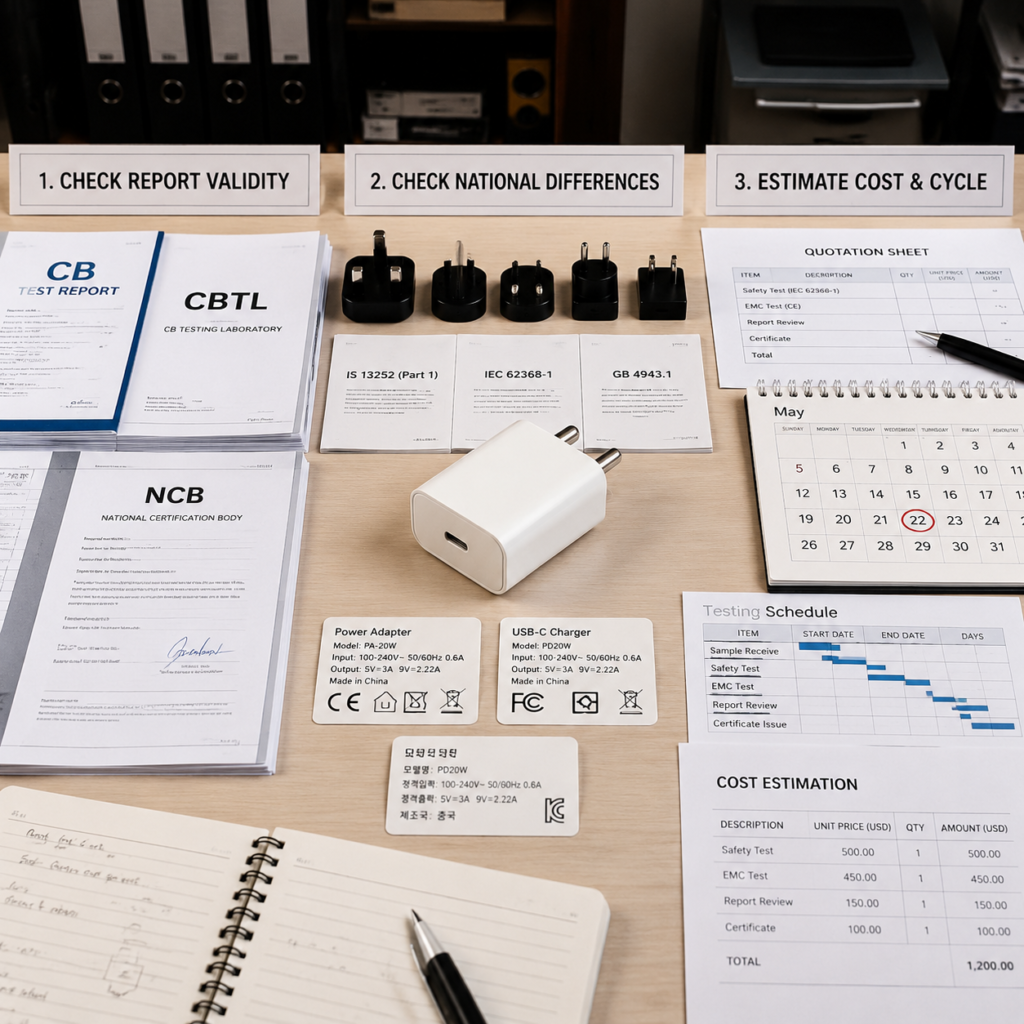
If you have a CB report now, how do you judge whether it can be used for certification or compliance assessment in the target country? You can check in three steps.
Step 1: Check the Basic Validity of the Report
First check the CB Scheme qualification: confirm whether the report is issued by an IECEE-recognized CB Testing Laboratory (CBTL) and whether the certificate is issued by the corresponding NCB. Also confirm whether the competent authority or certification body of the target country accepts this CB document. If there is no corresponding CB Scheme qualification, or the target party does not accept the document, you cannot judge solely based on the “IEC” wording on the report.
Then check the standard version: confirm the IEC standard version used in the report, as well as the national or regional version adopted by the target country, national differences and transition period. Different countries may update standards at different times. Whether an old version of the report can still be used shall be evaluated by the target certification body, and you cannot directly conclude that it will definitely pass or definitely expire based solely on the year.
Finally, check product consistency: whether the product model, power, and interface type stated in the report are consistent with the actual product. If the power chip, PCB, charging port or other components change, a change list should be compiled, and the laboratory or certification body will judge whether these changes affect the safety test results and whether supplementary testing or re-certification is required.
Step 2: Check the Coverage of Target Country’s Difference Items
First check plugs and charging cables: are the plugs and cables in the report and the actual sales configuration of the target country’s specifications? For example, if you want to enter the UK market but the report only has EU-standard plugs, you need to confirm whether supplementary assessment of UK-standard configurations is required, or even whether the product structure needs to be adjusted.
Then check the voltage: do the test conditions of the report cover the grid voltage and frequency of the target country, as well as the input range declared by the product? For example, to enter the Japanese market, you need to confirm whether the relevant safety assessment under 100V conditions is applicable, rather than just looking at whether the product says “100-240V”.
Finally, check special requirements: for example, the applicable housing materials and NRTL assessment requirements in the US, product classification under Japan’s Electrical Appliance and Material Safety Law, and RoHS outside the EU’s LVD, all need to be judged separately. RoHS is an environmental compliance requirement independent of LVD. It usually requires preparation of material data, supply chain information, technical documents and declarations of conformity, and targeted material testing if necessary. It cannot be regarded as an ordinary national difference item in the LVD safety report.
Step 3: Estimate Conversion Cost and Cycle
Conversion cost and cycle cannot be applied to all markets with a fixed ratio or unified number of days. The factors that truly affect the results include:
- Product category and rated power;
- Regulations, standard versions and certification modes adopted by the target country;
- Product configurations covered by existing CB documents;
- National difference tests that need to be supplemented;
- Document review, sample modification and retesting situations;
- Whether factory inspection, registration or responsible entity arrangement is required.
Therefore, only after confirming the product, target regulations and existing reports can the certification body conduct specific evaluation, quotation and scheduling. When there are few difference items, complete documents and no product modification is required, it is usually easier to shorten the cycle; if structural adjustments, additional testing, factory inspection or registration are involved, both time and cost may increase significantly.
Predict High-Frequency Risk Points of Conversion Failure
There are several high-frequency risk points that are almost the main causes of conversion failure. Checking them in advance can help you avoid most pitfalls:
- Excessive changes to product structure — for example, after converting the original EU-standard charger to US-standard, if the internal PCB or key components are significantly adjusted, the laboratory or certification body should be asked to re-evaluate, and the original report cannot be directly used.
- The USB-C charging cable is not listed in the charger report, and you want to directly use the charger’s certification report — the charger report does not automatically cover unlisted cables. Whether the cable needs independent testing, certification or registration depends on the target market regulations, cable structure and certification scope.
- The laboratory issuing the report does not have the corresponding CB qualification, or the target country does not accept the institution’s documents — you cannot just look at whether IEC is written on the report.
- The report only covers basic safety and does not include additional items required by the target country — for example, if the product also involves wireless, energy efficiency, EMC, environmental regulations or specific registration requirements, the corresponding compliance procedures need to be completed separately.
Conversion Differences for Different Charging Products
Many people think that the certification conversion rules for all charging products are the same, but this is not the case — different charging products have very different applicable standards and conversion priorities.
Chargers/Power Adapters: Core Reference Category
This is the most common category, and applicable safety standards may include IEC 62368-1. Some products may also use the IEC 61558 series or other applicable standards. Which standard to use specifically depends on the product’s purpose, structure, input and output characteristics and target market regulations.
During conversion, focus on checking the rated power, input voltage range, plug specifications and actual configurations covered by the report. This information must be consistent with the sold product; if the product has multiple output modes, wireless functions or battery functions, it is also necessary to confirm whether existing documents cover these functions.
USB-C/USB Charging Cables: Cannot Automatically Use Charger Certification
It should be particularly emphasized here: Charger certification does not automatically cover cables not listed in the charger report. Whether independently sold USB cables require independent safety certification, performance testing or registration depends on target market regulations, cable structure, rated voltage, terminals and certification scope; not all USB cables must obtain independent CB reports in all markets.
The IEC 62680 series is mainly used for USB interfaces, protocols and related technical requirements. When applicable, it can be used as a technical basis for interfaces or protocols, but it cannot replace all safety compliance requirements. USB-IF compliance programs are another set of requirements, and whether to participate depends on product declarations, markets and sales channels.
If the charging cable is included with the charger, confirm whether it is included in the charger’s assessment scope as a complete machine configuration or component. Many reports only cover the main unit, which does not mean that the included cable has automatically obtained compliance qualifications in all markets.
Multi-Port/Fast Chargers: More Complex Conversion Requirements
The conversion requirements for multi-port or fast chargers are usually more complex than ordinary single-port chargers. The CB report must cover the rated output of each port, allowed port combinations and most unfavorable operating conditions declared by the product. It does not necessarily mean that all ports must reach their respective theoretical maximum power at the same time; rather, various operating states shall be evaluated in accordance with the product’s actual declaration and applicable safety standards.
If fast charging protocols such as USB PD are supported, it is also necessary to confirm protocol functions, abnormal operation and possible interoperability test requirements in accordance with applicable safety standards and target certification schemes. It cannot be simply assumed that all fast charging products must undergo exactly the same additional testing.
It should be noted that the certification documents for single-port chargers cannot be directly used for multi-port products. Even if the total rated power is the same, it is necessary to confirm whether the number of ports, output combinations and internal structure are consistent.
Travel Chargers with Replaceable Plugs: All Configurations Must Be Included in the Assessment
For travel chargers with replaceable plugs, all plug configurations to be sold or provided with the product need to be included in the certification assessment of the target country. For example, if a travel charger has three plugs: EU-standard, US-standard and UK-standard, it should be confirmed whether these three configurations meet the requirements of the corresponding markets for plugs, mechanical interlocking, contact, mis-insertion prevention and electrical safety.
Different countries have different classification and certification methods for replaceable plugs, travel adapters and power cord assemblies. Whether independent testing or independent certificates are required shall be determined in accordance with the target country’s regulations, plug standards and certification body requirements, and it cannot be generally required that each plug obtain a separate “plug certification”.
Common Misconceptions and Practical Pitfall Avoidance Guide
Having talked about so many rules, finally we have sorted out some of the most common pitfalls that people encounter when buying charging products daily or doing small-batch cross-border business, as well as practical pitfall avoidance methods.
4 Certification Misconceptions Easily Made by Consumers/Purchasers
- Misconception 1: If a merchant marks “compliant with IEC standards”, the product is compliant and worth buying. The truth is: IEC is only the technical basis and cannot alone prove that the product has met all the regulatory requirements of the place of sale — for example, a plug that meets a certain IEC technical requirement may still not be suitable for sockets in your country.
- Misconception 2: A product with a certification mark must be compliant. The truth is: certification marks or conformity marks only correspond to the models, configurations and requirements listed in applicable regulations, documents or assessments. Also pay attention to counterfeit marks, incorrect use of marks or out-of-scope use — for example, using a certain assessment mark for a 20W charger on a 65W product.
- Misconception 3: All charging products have the same certification rules. The truth is: the applicable standards and conversion requirements for chargers, charging cables, and charging interfaces are completely different and cannot be confused — for example, a charger that has completed a certain assessment does not mean that the included cable is automatically covered.
- Misconception 4: Having safety certification means fast charging and good quality. The truth is: safety certification mainly evaluates safety risks such as electric shock, fire, energy and mechanics, and usually cannot be used to infer charging speed, full protocol compatibility and long-term durability. The specific test scope shall still be subject to applicable standards and certification schemes.
3 Methods to Identify Fake Conversion Certification
How to judge whether the “global certification” claimed by merchants is credible? You can use the following three methods for cross-verification:
First, check whether the market requires a certification body number, registration number or other identification information, and then query through official databases or certification body channels. Not all legal and compliant marks require the certification body number to be printed on the product, so you cannot judge authenticity solely based on “whether there is a number”.
Second, if the merchant only mentions “globally applicable IEC certification” but cannot produce the compliance documents, declaration of conformity, registration information or certification materials required by the target market, you should be vigilant. IEC standards themselves are not a global sales permit that can replace local regulations.
Third, check whether the product model, power, interface type and configuration on the document are consistent with the actual product. If they do not match, it may be a fake document or out-of-scope use. If it cannot be found in the public database, you cannot immediately conclude that it is fake, because some declarations of conformity or registration information do not have a unified public query platform. You should continue to verify with the manufacturer, importer, certification body or the competent department of the target market.
Safety Inspection Steps for Cross-Border Online Shopping of Charging Products (For Ordinary Users)
If you are an ordinary user who wants to buy chargers or charging cables via cross-border online shopping, following three steps of inspection can reduce the risk of buying unsuitable products:
Step 1: Check basic information: Does the product provide the compliance mark or document required by your country or region? Does the input voltage cover the local grid voltage? Can the plug fit into the local socket? These three are the most basic; if any one is not met, you should be cautious about buying.
Step 2: If the merchant says the product only has an IEC or CB report, confirm whether it also meets the regulatory and configuration requirements of your country — for example, whether the plug is of local specification, whether the product has been assessed under local voltage conditions, and whether the labels and manuals meet local requirements. Whether CB documents can be accepted locally also needs to be judged according to the rules of the target market.
Step 3: If you are unsure about the authenticity of the certification, first query with the target market’s competent department, certification body or relevant official database; for declarations of conformity or marks that do not have a public database, you can ask the merchant to provide the manufacturer’s declaration of conformity, relevant information in technical documents or confirmation from the certification body. The absence of public records only means that further verification is needed, and it cannot be deemed fake solely based on this point.
Certification Decision Logic for Small Cross-Border Merchants (For Entry-Level Practitioners)
If you are a small merchant doing cross-border business of charging products and don’t know how to plan certification at the beginning, you can follow this logic:
Step 1: If you choose the CB route, the corresponding CB documents shall be issued by an IECEE-recognized CB Testing Laboratory (CBTL) and National Certification Body (NCB) in accordance with applicable standards. ILAC-MRA qualification cannot replace CB Scheme recognition. If you do not choose the CB route, you should also plan testing and compliance documents directly in accordance with target market regulations.
Step 2: First check the product classification and mandatory requirements of the target market, and then decide which markets to enter first. Markets such as the EU, Australia and New Zealand, and the UK do not mean that all products can use the same set of documents, nor should decisions be made solely based on “low conversion cost”.
Step 3: When expanding into markets such as the US, Japan and South Korea, focus on confirming local standards, product classification, certification bodies, responsible entities and registration requirements, and then decide whether to use existing CB data or re-conduct part or all of the assessment.
A special reminder: if your USB-C charging cable is sold separately, you should first confirm whether the target market requires independent safety certification, registration or performance compliance, and then decide whether to prepare an independent CB report. You cannot default that all USB-C cables must have separate CB reports, nor can you default that the charger report can cover the cable.
Core Summary
So far, we have almost covered the conversion rules for IEC and national charging product certifications. After learning these contents, you can at least judge four things:
First, you can distinguish the differences between IEC standards, CB reports, and local compliance requirements of various countries, and will not be fooled by claims such as “globally applicable IEC certification”.
Second, you can compare the regulations, product classification and certification rules of the target market to judge whether the IEC/CB documents you have can be used, and what procedures still need to be supplemented.
Third, you can identify fake certifications, out-of-scope documents and configuration inconsistency issues of charging products, and faster check whether products are suitable for local use and sale when shopping cross-border.
Fourth, you will know that conversion cost and cycle cannot be estimated with a fixed ratio, and you can judge the complexity of certification work in advance based on the different configurations of chargers, charging cables, multi-port products and products with replaceable plugs.
In fact, the basic idea of certification conversion can be summarized as: whether existing test data can be accepted by the target market, and then make up for differences and other compliance procedures in accordance with regulatory requirements. Grasping this essence will help you sort out your thinking faster no matter what market’s certification requirements you encounter.