
Sellers who export charging products to Vietnam have most likely heard of the CR Mark. Some say all chargers connected to mains electricity must bear it, some say low-voltage charging cables do not need it, and others directly use CE certification as CR certification. In the end, their goods are either detained by customs or removed from the market.
This article focuses on charging products such as chargers, power adapters, and charging cables, clarifying the scope of application, judgment logic, and compliance key points of Vietnam’s CR Mark, helping you from beginner to being able to independently conduct preliminary screening. Let me make it clear in advance: this article provides a general judgment framework, which does not replace the latest official catalog of Vietnam or legal verification of specific models. The final compliance conclusion must be subject to the verification result of the competent authority.
Core Positioning and Basic Judgment Logic
Let’s first thoroughly explain what the CR Mark is: its plain-language definition is a conformity mark under Vietnam’s mandatory technical regulations, proving that the product meets statutory technical requirements. Many people have misunderstandings about it: some think it is exclusive to low-voltage electrical appliances, some think bearing it means good charging performance and high brand quality, but neither is correct. It is not a single certification certificate; it is only valid when bound to the official mandatory control catalog, corresponding conformity assessment procedures, conformity documents, and usage rules. Only products included in the mandatory catalog and that have completed conformity assessment can bear the mark, and you must never print and affix it arbitrarily on your own.
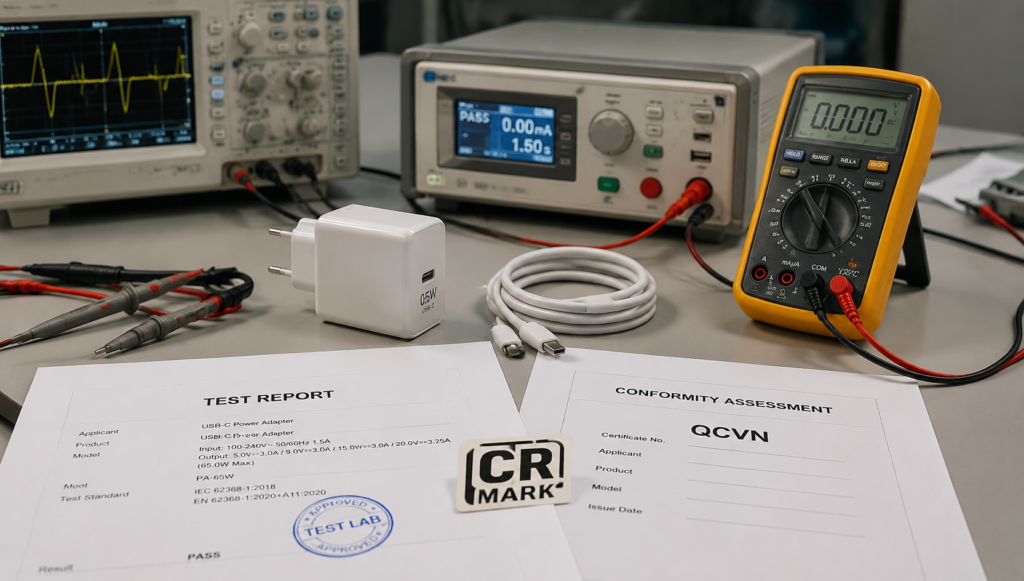
To judge whether a product needs CR, you must never only look at a single condition such as power, whether it is connected to mains electricity, or whether it has a chip. You must follow a three-layer sequence: the first step is product classification, the second step is to check the official mandatory catalog, and the third step is to match the corresponding conformity assessment procedure. No step can be disordered.
Basic Regulatory Concepts That Must Be Understood First
Before formally explaining the judgment method, let’s clarify several frequently occurring Vietnamese regulatory terms, otherwise it is easy to get confused later:
• QCVN (Vietnam National Technical Regulation): Mandatory and effective. As long as the product is within the control scope, it must comply, and violation is non-compliance.
• TCVN (Vietnam National Standard): Usually voluntary. It will only become a compliance basis that must be followed when cited by QCVN, laws, rules, or contracts.
• Mandatory Product Catalog: A list issued by the Vietnamese competent authority, which clearly states which products need to bear the CR Mark and the corresponding applicable conditions.
Conformity Assessment Is Not Limited to “Certification”
Many people think CR is just “getting a certification”, but that is not correct. There are several types of conformity assessment procedures. The specific one to use shall be subject to the clear requirements of the corresponding QCVN, product catalog, and competent regulations. There is no unified “charger category assessment path”. The most common three types are:
The first type is conformity certification, which shall be implemented by a conformity assessment body that has statutory designation, registration, or approval qualification within the scope of applicable products and QCVN. The second type is declaration of conformity, which is issued by the responsible subject based on the conformity assessment results specified in applicable regulations. If Vietnam’s declaration of conformity system applies, the declaration registration or acceptance procedures shall be completed in accordance with regulations, and corresponding conformity assessment and technical documents shall be retained. The third type is other procedures such as registration and inspection, which are implemented in accordance with the regulatory requirements for specific products.
Regardless of which procedure is used, several core points must be verified: the qualification of the domestic responsible subject, the statutory qualification of the conformity assessment body within the applicable scope, the qualification of the testing laboratory, and the retention requirements for technical documents. None of these can be missing. It should be noted that “accreditation” itself is not automatically equivalent to the qualification to issue statutory conformity assessment results within the corresponding QCVN scope.
The Boundaries of Responsibilities for Each Link Shall Not Be Confused
CR compliance is not the matter of a single party. The responsibility boundaries of subjects with different identities are different and cannot replace each other: overseas manufacturers shall ensure that products comply with applicable QCVN and provide complete compliance technical documents and test materials; Vietnamese importers are the main responsible persons for domestic compliance, responsible for import declaration, document retention, and handling relevant procedures for conformity assessment; sellers shall verify the compliance marks and supporting documents of products on sale, and shall not sell products that they know are non-compliant. The specific division of responsibilities shall ultimately be subject to Vietnam’s regulations related to product quality and conformity assessment.
Product Classification and Official Verification Methods
The first mistake many people make when judging CR applicability is only looking at the product name or HS code. For example, if the product is called “charger”, they think it needs CR; if the HS code is not in the catalog, they think it does not. These are all incorrect. The HS code can only be used as a reference for customs declaration and cannot replace classification under technical regulations.
To achieve accurate classification, you must first collect all the following information: basic information includes product name, actual use, model, manufacturing factory, whether it is sold separately or as a matching set; technical parameters include input and output voltage and current, whether there is an AC-DC conversion module, whether it has an isolated structure, and what the rated power is; functional features include whether there is wireless transmission or data transmission function, and whether it has a built-in battery. Only after collecting all this information and checking it against the product definitions in the mandatory catalog can you avoid mistakes.
Preliminary Judgment Comparison of Common Charging Products
For your convenience in rapid screening, we have sorted out the preliminary judgment conclusions of 9 types of common charging products, but please note: for all products that “require case-by-case confirmation”, you cannot draw a conclusion directly, and must check against the specific provisions of the official catalog:
| Product Type | Preliminary Judgment Conclusion | Core Judgment Basis | Common Misjudgment Basis | Next Verification Direction |
| Wall-plug USB charger | Requires case-by-case confirmation | With AC-DC conversion, connected to mains electricity, supplies power to civil low-voltage equipment | Connected to mains electricity, a certain power value, product name contains “charger” | Corresponding product definition in the mandatory catalog, clauses on rated parameter range |
| Desktop power adapter | Requires case-by-case confirmation | With AC-DC conversion, mains input, supplies power to specific equipment | Power level, whether it is an original accessory | Scope of adapter category in the mandatory catalog, applicable clauses of corresponding QCVN |
| Laptop power adapter | Requires case-by-case confirmation | With AC-DC conversion, mains input, supplies power to laptops | Power threshold, sold as a matching set with laptops | Control rules for matching components in the mandatory catalog |
| Passive USB charging cable / adapter | In principle, not included in CR as charger category | No power conversion / active control function, only transmits low-voltage electricity | With USB-C interface, supports fast charging | Control scope of cable category in the mandatory catalog |
| USB-C fast charging cable with E-marker chip | Requires case-by-case confirmation | Need to check according to structure (passive / active / with power conversion), rated voltage, and use | With E-marker chip, supports high-voltage fast charging | Product schematic diagram, BOM, scope of electronic accessories in the mandatory catalog |
| 12V car charger | Requires case-by-case confirmation | Need to confirm in combination with product classification and regulations related to automotive electrical appliances | 12V low-voltage input, automotive use is directly exempt | Scope of automotive electrical appliance category in the mandatory catalog, corresponding special regulations |
| Wireless charging base with mains input | Requires case-by-case confirmation | Need to judge separately according to AC-DC power module, wireless charging function, and complete machine definition | With wireless charging, connected to mains electricity; Qi inductive charging = requires radio / ICT compliance | Scope of complete machine / charger category in the mandatory catalog, EMC related requirements |
| Power bank / portable charger | Requires case-by-case confirmation | Need to check the catalog separately; battery safety and transportation requirements are independent compliance dimensions | Contains battery, directly judged as CR applicable because it belongs to charging products | Scope of power bank category in the mandatory catalog, regulations related to battery safety / transportation |
| Docking station / hub with AC-DC module | Requires case-by-case confirmation | Need to confirm whether it is controlled as charger category or complete machine category | Directly classified because it has data function and charging function | Product function description, schematic diagram, scope of complete machine category in the mandatory catalog |
You may have noticed that the preliminary judgment conclusion of most charging products is “requires case-by-case confirmation”. This is not ambiguity, but because Vietnam’s mandatory catalog is divided according to product definition, parameter range, and use, not a one-size-fits-all approach based on the “charger” category. For example, for the same wall-plug charger, only those with rated power within a certain range may be included, and those above or below are not included; for the same adapters sold as matching sets, those sold separately may be included, and those matched with complete machines follow the rules of complete machines. Therefore, you must never draw a conclusion based on a single condition.
Core Points of QCVN Verification
After checking the catalog, if the product is within the scope, the next step is to verify the corresponding QCVN. At least 5 core pieces of information must be checked one by one: the specific QCVN number, full name, issuance or revision document, applicable product annex, test items and limits.
In addition, there are two types of regulations that are only for directional reference and cannot be directly applied: for low-voltage electrical safety category, you need to check item by item whether it covers the structure, parameters, and use of the target product; for electromagnetic compatibility (EMC) category, you need to distinguish whether the product is included in the EMC control scope.
Special reminder here: you must never deviate from the current mandatory catalog and the latest version of QCVN and directly apply old regulations or general series numbers, otherwise you may find after a long time that the rules you used have been invalidated.
Official Verification Path and Special Exemption
General systems related to CR usually involve the Ministry of Science and Technology of Vietnam and its competent authorities for standards, metrology, and quality; the catalog, QCVN, conformity assessment acceptance, and law enforcement authorities for specific products shall be subject to the current institutional setup and clear provisions of corresponding regulations.
The core documents you need to verify include the current mandatory product catalog, the latest version of the corresponding QCVN and its revision or transition clauses, and the usage rules of the CR mark.
Many people ask if there are exemption situations? For small-batch samples used for testing, R&D, display, and maintenance, special import purpose exemption may apply, but please note: you must first verify the current regulations to see if prior application or filing is required, if there are quantity limits, and what supporting documents are needed. Most importantly, exempt samples must never be sold as ordinary commodities, and mass-produced goods still need to go through compliance procedures in accordance with normal procedures.
Technical Requirements and Test Report Evaluation
Many sellers ask: what items need to be tested for CR? Does higher power mean more tests? Let’s first explain the core logic: all statutory technical requirements are based on applicable QCVN, and TCVN is only the cited testing technical support. There is no unified “charger test list”. Test items, limits, abnormal conditions, and sample quantity are all determined by the corresponding QCVN; the test scope is related to the product category, structure, and rated parameters, and does not increase linearly with power.
Possible Risk Dimensions
If required by the corresponding QCVN, it generally involves risks in the following dimensions, but note that this is not a unified statutory test list:
• Electrical safety category: Common risk points include electric shock protection, insulation withstand voltage, temperature rise protection, mechanical strength, and flame retardant performance, which are directly related to product safety.
• Electromagnetic compatibility (EMC) category: Simply put, it means that the product will not interfere with surrounding electrical appliances when charging, nor will it be damaged by interference from other electrical appliances.
• Material and structure category: For example, the flame retardant grade of the shell, and the selection requirements for key safety components.
Special attention should be paid here: passing electrical safety does not mean that EMC is automatically compliant. All requirements shall be subject to applicable QCVN, and you cannot take it for granted.
For different types of charging products, the determining conditions for the test scope are also different: for chargers and power adapters, it mainly depends on the input voltage range, output power, isolation method, plug type, and key safety components such as transformers and protection chips; for charging cables and interface products, it mainly depends on whether it is a passive or active structure, whether it has power conversion, rated voltage and current, and connector type; for products with wireless charging or data functions, it also depends on the attributes of the wireless transmission or data transmission module, rated power, and whether it has radio frequency communication function.
Can International Test Reports Be Used
Many sellers have certification reports from CE, CB, or other Southeast Asian countries. Can they be directly used for CR? The answer is: they can only be used as a reference for the application, and cannot directly replace the compliance requirements of Vietnam’s CR.
You can evaluate the reference value of the report from the following dimensions: the standard version of the report, product model and key components, rated parameters and plug, manufacturing factory, and qualification of the testing laboratory. Remember: CE, CB, and certifications from other countries cannot directly replace CR. Only some technical standards may have corresponding relationships. The specific usability and required supplementary tests shall be subject to the requirements of Vietnam’s accreditation body.
After getting the test report, you also need to verify three points to confirm its validity: first, whether the report has a validity period specified by law or the institution; an expired report is definitely useless; second, whether the product model, key components, manufacturing factory, and standard version on the report are completely consistent with the actual mass-produced product — even just changing the supplier of the protection chip may affect the validity of the report; third, the test items covered by the report match the requirements of applicable QCVN, and missing items are definitely not acceptable.
Compliance Requirements for CR Mark and Product Labels
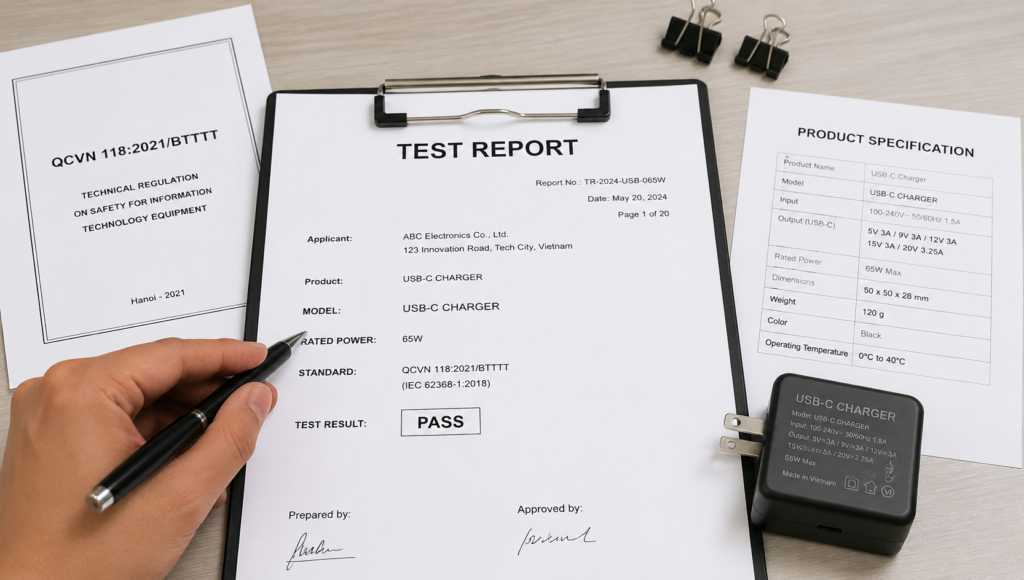
Many people think that CR compliance is just affixing a CR mark, but that is not the case. For charging products sold in Vietnam, at least four different types of label requirements must be distinguished. Many sellers fall into traps because they confuse them:
| Label Type | Trigger Condition | Responsible Subject | Core Content | Affixing Position | Regulatory Basis |
| CR mark | The product is included in the CR control scope and has completed the corresponding conformity assessment procedure | Affixed by the manufacturer / importer in accordance with official requirements | CR mark with official unified style; some products need to be marked with the conformity assessment number at the same time | Shall be marked in a clear and easily identifiable position on the product, commodity packaging, or attached label in accordance with applicable rules; specific alternative positions and conditions shall be subject to applicable QCVN and CR mark rules, and being only included in the instruction manual shall not be regarded as automatic compliance | Vietnam CR Mark Usage Management Specification |
| Vietnam general commodity label | In principle, commodities circulating in the Vietnamese market shall be labeled in accordance with commodity label regulations; the scope of application, exemption situations, and specific mandatory content shall be confirmed in accordance with commodity label regulations and revision documents | The importer / manufacturer is responsible for the authenticity of the label content | Product name, model, manufacturer name, country of origin, technical specifications, safety warnings (according to product category requirements) | On the product body or minimum sales package, subject to the requirements of label regulations | Vietnam’s regulations related to commodity labels |
| Supplementary label for imported commodities | Commodities imported to Vietnam for sale whose original labels do not contain Vietnam’s statutory mandatory content | Vietnamese importers are responsible for supplementing domestic information | Supplement the statutory mandatory content missing from the original label in Vietnamese, and translate the relevant content of the original label in accordance with regulations; the name and address of the import responsible subject and other content shall be determined according to commodity categories and label regulations | At the same position as the general label, and shall not cover core information | Vietnam’s management rules for labels of imported commodities |
| Rated parameter label for charging products | Shall be determined in accordance with commodity label regulations, applicable QCVN, and special rules, and shall not be judged only by whether it is included in the CR scope | Manufacturer / importer | Technical specifications such as input voltage / frequency, output voltage / current / total power; for multi-port products, whether it is mandatory to mark the maximum output of a single port and power distribution shall be checked against applicable QCVN, product standards, or provisions of the competent authority | Prominent position on the product body | Commodity label regulations, corresponding QCVN or special rules |
Regarding the CR mark itself, several general rules must be followed: the proportion and color of the style shall be subject to the latest official specifications of Vietnam, it shall be clear, identifiable, firm and scratch-resistant, and you must never modify the style on your own. It is prohibited to use other international marks to replace CR, affix the mark on a protective film or plastic seal that is easy to tear off, or use it beyond the compliance scope of the product.
Common label errors are divided into three categories: first, mark errors, such as modifying the style of the CR mark on your own, using CE or other international marks to replace CR, or the affixing position or alternative method does not meet the specifications; second, content errors, such as false parameter marking, lack of core information in Vietnamese, missing importer information, or failure to mark safety warnings or specifications according to category requirements; third, quality errors, such as blurred printing, or the mark comes off when scratched by hand. Even if the mark is affixed, it may be judged as unqualified in such cases.
Overlapping Compliance Requirements and Common Misconceptions
Many people think that CR compliance is everything, but that is not the case. For charging products exported to Vietnam, other compliance requirements may be superimposed. Some of these requirements are related to CR, and some are completely independent, and cannot be confused:
1. CR technical regulations (safety / structure category): Belong to the core control scope of CR, triggered when the product is included in the mandatory catalog. The competent authority and specific acceptance and law enforcement arrangements shall be subject to the current institutional setup and corresponding regulations. A common misconception is “all low-voltage electrical appliances need CR”.
2. EMC compliance: Triggered when the product is included in the EMC control catalog. The competent authority is determined according to the ownership of the corresponding QCVN. It may be included in the CR control scope or be an independent requirement. A common misconception is “products with charging function necessarily need EMC testing”.
3. Radio / ICT compliance: For products with wireless communication or other radio functions, it shall be verified whether certification, declaration of conformity, or other procedures are required in accordance with the current radio or ICT product catalog and corresponding QCVN. The name and functions of the competent authority shall be subject to the current government institutional setup and the signature of specific regulations. Common misconceptions are “wireless charging = requires radio compliance” and “no antenna = no verification needed”. In fact, Qi inductive power supply itself is not automatically equivalent to wireless communication equipment.
4. Battery safety compliance: The battery safety requirements for products containing lithium batteries shall be confirmed item by item according to battery type, product category, applicable catalog, and QCVN. It is an independent control requirement and is not automatically satisfied by CR compliance. A common misconception is “the battery requirements for power banks belong to the CR scope”.
5. Energy efficiency requirements: Triggered when the product is included in Vietnam’s energy efficiency control catalog. The competent authority is the Ministry of Industry and Trade of Vietnam, which is completely independent of CR. A common misconception is “CR compliance = meeting energy efficiency requirements”.
6. Plug and socket compliance: Triggered when the product has a Vietnam mains input plug. It may be included in CR control, and the plug category QCVN also needs to be checked separately. A common misconception is “charger CR compliance = plug meets requirements”.
7. Transportation compliance: Triggered when the product contains special goods such as batteries and magnetic components. It is the responsibility of the transportation regulatory authority and is completely independent of CR. A common misconception is “CR compliance = meeting transportation requirements”.
6 Most Common Judgment Errors
We have sorted out the six most common wrong judgments, and you can check whether you have made them:
1. All charging cables need CR: Wrong. Only cables included in the mandatory catalog that have electronic modules or power conversion may need CR. Passive low-voltage cables are usually not controlled as charger category, which can be verified through the cable category scope in the mandatory catalog and product schematic diagram / BOM.
2. Chargers connected to mains electricity need CR for all power ranges: Wrong. It needs to be comprehensively judged in combination with the mandatory catalog, product classification, and applicable QCVN. You cannot only look at whether it is connected to mains electricity or the power level. It can be verified through the product definition in the mandatory catalog and applicable clauses of the corresponding QCVN.
3. International certification can directly replace Vietnam’s CR: Wrong. The marks and statutory procedures of the two are different and cannot be directly replaced. Only some technical standards may have corresponding relationships. It can be verified through the acceptance rules of Vietnam’s accreditation body for international reports and the standard differences of corresponding QCVN.
4. Industrial charging equipment is automatically exempt from CR: Wrong. Industrial use is not directly exempt. It needs to be confirmed in combination with the catalog, use, and import method. It can be verified through the industrial product exemption clauses in the mandatory catalog and import use certificates.
5. Car chargers do not need any compliance because the input is 12V: Wrong. It needs to be confirmed in combination with product classification and applicable regulations, and may involve other special requirements. It can be verified through regulations related to automotive electrical appliances and the scope of the mandatory catalog.
6. Products with wireless charging function must need radio / ICT compliance: Wrong. For products with wireless communication or other radio functions, it is necessary to verify whether certification, declaration of conformity, or other procedures apply in accordance with the current product catalog and corresponding QCVN; Qi inductive power supply does not necessarily trigger it, which can be verified through the current radio or ICT product catalog and product radio parameters.
Common Pitfalls in Compliance Applications
Many people fall into pitfalls when applying for CR, mainly for three reasons: first, they do not verify the latest catalog and QCVN version, apply by applying old rules, and are directly rejected; second, the test samples are inconsistent with the mass-produced products — for example, replacing key safety components, adjusting rated power, or changing the manufacturing factory usually requires change assessment in accordance with applicable QCVN, certificate conditions, and requirements of the conformity assessment body, and may require notification, supplementary testing, certificate modification, or re-conformity assessment; third, they directly use international reports to replace Vietnam-accredited tests, without doing difference assessment and official confirmation, and finally are not recognized.
Consequences of Violation and Product Change Rules
What many people care about most is “what happens if CR is not affixed”. In fact, the consequences of violation depend on the link and cannot be generalized: at the customs link, it may trigger goods detention and return, which depends on the product category, violation situation, and customs supervision rules; at the market circulation link, it may trigger removal from shelves, rectification, and administrative penalties, which are implemented by the market supervision department in accordance with regulations; if safety or EMC indicators are unqualified, penalties such as fines and confiscation will be imposed in accordance with product quality regulations; if the product has systematic safety risks, it may be required to be recalled, which shall be subject to the determination of the competent authority. It should be noted that the absence of CR does not necessarily directly lead to goods detention or recall. It needs to be judged in combination with specific scenarios and regulations. There is no need to panic excessively, but you should not take chances either.
In addition, getting CR is not a once-and-for-all solution. If the product is changed, you need to judge whether to re-evaluate compliance: core changes such as input specifications (such as plug type, voltage range), core output parameters (such as power, number of ports, fast charging protocol), and replacement of key safety components usually require immediate change assessment in accordance with applicable QCVN, certificate conditions, and requirements of the conformity assessment body; notification, supplementary testing, certificate modification, or re-conformity assessment may be required. Before the change is confirmed, you should not assume that existing documents automatically cover the changed mass-produced products. For non-core changes such as minor adjustments to label text and model suffix changes with completely consistent hardware, you can first conduct a change impact assessment without directly going through the complete compliance process again.
Implementation Tools and Operation Procedures
1-Minute Rapid Preliminary Judgment Method
Suitable for rapid screening when you just get the product:
Step 1: Classification judgment. First clarify whether your product belongs to chargers, charging accessories, or other complete machines (for example, a docking station with charging function may be a complete machine category);
Step 2: Feature screening. Civil products with AC-DC modules and connected to mains electricity shall be prioritized for CR verification, and others (such as passive charging cables, car chargers) require case-by-case confirmation;
Step 3: Official verification. Final confirmation shall be made against the latest mandatory catalog of the Ministry of Science and Technology of Vietnam and the corresponding QCVN. You must never judge only by product name or HS code.
Complete Six-Step Compliance Process
Suitable for sellers who want to formally conduct compliance:
Step 1: Product information collection. Collect all basic information, technical parameters, and functional features required for classification, without missing any items;
Step 2: Lock product definition. Clarify the statutory classification in combination with the structure, function, and use of the product, and eliminate misjudgments based solely on product name and HS code;
Step 3: Catalog and QCVN verification. Check against the verification requirements of the mandatory catalog and QCVN to confirm whether the product is within the scope and which requirements apply;
Step 4: Determine the conformity assessment path. In accordance with the requirements of the corresponding QCVN, clarify the type of assessment procedure and implement the responsible subjects for each link;
Step 5: Verify tests and labels. Evaluate the validity of the test report, prepare marks in accordance with the requirements of the four types of labels, and at the same time confirm whether there are other superimposed compliance requirements, such as radio or ICT, energy efficiency, etc.;
Step 6: Mass production change management. Establish a change assessment mechanism to ensure that mass-produced products are completely consistent with the compliance-verified status.
Practical Examples of Preliminary Judgment for Typical Products
We use three common products as examples to help you better understand the judgment logic:
The first one is a 65W USB-C wall charger, with 220V mains input and an AC-DC conversion module, belonging to wall-plug chargers. First, you should prioritize verifying the scope of low-voltage electrical appliances or charger category in the mandatory catalog, and find the corresponding QCVN to see if the parameters meet the requirements;
The second one is a passive USB-C charging cable, which has no electronic module and only transmits low-voltage electricity. In principle, it is not included in CR as charger category. You only need to check whether there are cable category control requirements in the mandatory catalog;
The third one is a smart charging base with WiFi, with 220V mains input. First, you need to verify the CR requirements according to charger or complete machine category. At the same time, because it has WiFi, you also need to superimpose and verify whether relevant compliance requirements apply in accordance with the current radio or ICT product catalog and corresponding QCVN.
Pre-Export Compliance Self-Check List
You can check against it before shipment to avoid low-level mistakes:
1. Product attributes: Confirm whether it belongs to the CR mandatory scope, and whether there are other superimposed compliance requirements, such as radio or ICT, battery, energy efficiency;
2. Compliance documents: The validity of the test report or conformity assessment document has been verified, and the model and parameters are completely consistent with the actual product;
3. Responsible subjects: Clarify the responsibilities of each link of production, import, and sales, and implement the requirements for import declaration;
4. Marks and labels: The style and position of the CR mark comply with official rules, the label contains core information in Vietnamese, and there is no false parameter marking.
Content Summary and Validity Note
By now, you should have a complete understanding of the applicable rules of Vietnam’s CR Mark. Now you can independently complete the following things: you can preliminarily judge whether chargers, power adapters, and charging cables need priority verification of the CR Mark according to the three-layer logic; you know the Vietnamese competent authorities and core verification documents, and can sort out all the information required for product classification; you can distinguish the different requirements of the four types of labels and identify common label errors; you can judge whether it is necessary to superimpose verification of other compliance requirements such as radio or ICT, battery, and energy efficiency; you can use the 1-minute preliminary judgment method and self-check list to complete basic pre-export inspections, and know which product changes require compliance assessment.
Finally, it should be reminded that this article is sorted out based on general rules and is not targeted at specific models or specific versions of regulations. Vietnam’s mandatory product catalog, QCVN versions and revisions, conformity assessment procedures, label rules, and functional adjustments of competent authorities are all dynamically changing, and you need to review them regularly. Specific compliance requirements must be subject to the latest official documents of the Ministry of Science and Technology of Vietnam and relevant competent authorities.