
Friends who export charging products to India have most likely heard of “WPC certification”, but many people’s first reaction is to confuse it with the Qi Wireless Power Consortium — the industry organization that formulates the Qi wireless charging standard, whose abbreviation is also WPC. In fact, the two are completely different: one is a regulatory authority of the Indian government, and the other is a global industry standard organization, with completely different responsibilities. Today, we will thoroughly explain the scope of application of India’s WPC certification specifically for charging and USB products, from entry-level quick judgment to pitfall avoidance in boundary situations. After reading this, you can make a preliminary judgment by yourself, without having to consult a certification agency right away.
First, Get the Basics Right: What WPC Regulates and What It Does Not
India’s WPC, whose full name is the Wireless Planning and Coordination Wing, is subordinate to the Ministry of Communications of India. Its core function is to regulate all products with wireless transmission functions within the country to avoid mutual interference of wireless signals from different devices that affects public communication order. Most consumer charging products applying for WPC certification follow the ETA (Equipment Type Approval) route, which is the mainstream type of WPC certification people usually refer to.
Let me emphasize again: India’s WPC is a government regulatory authority, and has no connection with the Wireless Power Consortium (WPC) that formulates the Qi standard. Do not confuse the two.
From the perspective of charging products, the regulatory boundary of WPC is very clear: it only regulates compliance of wireless frequency use, and import and sales qualifications of wireless equipment; as for charging safety, fast charging protocols, interface types, plug sizes and other matters, they are not under the jurisdiction of WPC, but are handled by other departments such as BIS (Bureau of Indian Standards).
Some people may ask: I make charging products, why should I care about wireless regulation? This is because more and more charging accessories are now adding wireless functions — such as power adapters with wireless charging, smart fast chargers supporting APP control, and charging cables with Bluetooth cable-finding function. All of these fall within the regulatory scope of WPC. If they are not compliant, in mild cases, goods will be detained by customs and removed from e-commerce platforms; in severe cases, you will be fined by market supervision authorities.
For entry-level users, you can first remember one core judgment: Pure wired charging products without active wireless transmission functions usually do not require WPC certification; as long as they have any active wireless transmission function, applicability needs to be evaluated.
Core Judgment Logic: 3 Mandatory Trigger Conditions
To accurately judge whether a product needs WPC certification, three conditions must be met at the same time. If any one is missing, there is no need to enter the certification process.
Condition 1: Having Active Wireless Transmission Function
The so-called active wireless transmission means that the product has a built-in radio frequency module that can actively transmit wireless signals outward. Common active transmission functions in charging products include: wireless charging transmission, Wi-Fi, Bluetooth, NFC/RFID, radio frequency remote control, and FM transmission.
Many products do not directly label “built-in Bluetooth/Wi-Fi”, but only promote “intelligent control” and “remote management”. At this time, pay attention to checking hidden functions: as long as the product supports APP control, remote switch, or wireless synchronization, it most likely has an active wireless transmission module. Do not miss this.
There is a point that is easy to confuse: if the product only receives wireless energy or signals and does not actively transmit outward by itself, it does not belong to active transmission. For example, ordinary wireless charging receiver battery cases only receive electric energy from the transmitter to charge the mobile phone, and do not send signals by themselves, so they usually do not count as active transmission. However, it should be noted that if the receiver has a weak return handshake signal (such as communicating with the transmitter to adjust power), it must be checked against the actual design, and cannot be directly regarded as pure reception.
Condition 2: The Wireless Frequency Band Is Within the Regulatory Scope of WPC
WPC only regulates the frequency bands officially announced, not all wireless signals. Common unlicensed regulated frequency bands for charging products include 2.4GHz, 5GHz, and the 100-205kHz frequency band used by Qi wireless charging, all of which are covered by conventional ETA certification.
If the product uses a non-unlicensed frequency band, an additional frequency license is required, which is not within the scope of conventional ETA certification, and the process will be much more complicated. If you are not sure whether the frequency band used by the product is within the regulatory scope, the safest way is to check the latest official frequency band list of WPC, or find a WPC-authorized certification body for pre-evaluation.
Condition 3: The Product Enters the Indian Market for Use or Sale
WPC is a local certification in India, which is only required when products are to enter the Indian market. Scenarios requiring certification include: sales, gifting, commercial use in India, direct shipping to India via cross-border e-commerce, and even samples for sales and promotion are within the scope — do not think samples are exempt; as long as they are used for commercial promotion, they must be compliant.
Conversely, if the product is only exported to other countries and only used overseas, there is no need to consider India WPC certification at all.
If Conditions Change, the Conclusion Will Also Change
As long as one of these three conditions changes, the conclusion of WPC applicability may change. There are several common situations that require special attention:
- For products with the same appearance, if one has wireless functions and the other does not, even if they look exactly the same, the WPC requirements are completely different;
- If the product replaces the wireless module, adjusts the antenna design or transmission power, or adds new supported frequency bands, the applicability must be re-judged;
- Even if the wireless module used has itself passed WPC certification, the finished product will not be automatically exempted, and still needs to be evaluated as a whole machine.
List of Charging Products: Which Need WPC and Which Do Not
For your quick comparison, we have sorted common charging and USB products into a table according to “need WPC” and “do not need WPC”, and you can directly match your product accordingly.
| Charging/USB Products That Require WPC | Charging/USB Products That Do Not Require WPC |
|---|---|
| Wireless charging transmitter category (core: built-in transmitter coil for active energy transmission) • Desktop/car/all-in-one wireless charging stands (Qi transmitter, no power limit) • Power adapters, charging power strips, and charging port panels with integrated wireless charging transmitter • Power banks with wireless charging transmission function | Pure wired basic charging products (core: no wireless transmission module) • Ordinary wired power adapters/fast chargers (no wireless module) • Ordinary USB/USB-C charging cables (only charging + wired data transmission) • Ordinary charging plugs, adapters, charging port panels, wired charging power strips |
| Smart charging products with Wi-Fi/Bluetooth (additional wireless functions also trigger the requirement) • Smart fast chargers/power adapters supporting APP control • USB charging power strips and smart plugs with wireless remote control/monitoring • Power banks and portable energy storage power supplies with Wi-Fi/Bluetooth monitoring • Car chargers with Bluetooth/FM transmission function | Charging accessories with only wireless reception function • Pure reception charging battery cases, receiver patches, accessories that only receive control signals ⚠️ Note: If the receiver has a weak return handshake signal, it needs to be checked against the design |
| Charging accessories with wireless functions (both main and secondary functions fall within the scope) • USB/USB-C charging cables with Bluetooth cable-finding/power control • USB-C charging adapters and docking stations with Wi-Fi amplification • Charging bases and charging cabinets with NFC/RFID identification | Special situations that meet official exemption (exemption shall not be presumed on one’s own) • Accessories with extremely low power and in exempt frequency bands (very rare, subject to the official list) • Samples only used for domestic R&D and testing (exemption qualification needs to be applied for in advance) |
| Multi-functional integrated charging products (certification is required if any regulated transmitter module is included) • Integrated charging products with wireless functions such as Bluetooth speakers/Wi-Fi (such as wireless charging power adapters, smart charging hubs) | Non-regulated scenarios that are easily misjudged • USB interfaces and wired fast charging protocols (both have nothing to do with wireless regulation) • Pure magnetic adsorption function: magnetic charging products that only rely on magnets for fixation and have no wireless transmission • Wired data transmission: data transmission through metal wires, which does not fall under wireless regulation |
Advanced Pitfall Avoidance: Judgment Rules for Boundary Situations
Most conventional products can be judged by comparing with the table above, but when encountering some boundary situations, many people are prone to fall into pitfalls. Here we clarify the common boundary rules.
How to Judge Products with Detachable Wireless Modules
If the wireless module of the product is detachable, the key to judgment is whether the module is standard-equipped at the factory, and whether the product is promoted as having wireless functions. If the wireless module is standard-equipped at the factory, then WPC certification is required for the whole machine with wireless functions; if the module is installed by the user later, the original basic product does not need WPC, but if you sell the whole machine after installation, you must ensure that the whole machine is compliant.
Coverage Rules for Pre-certified Wireless Modules
Many people think that if a wireless module that has passed WPC certification is used, the finished product does not need certification. This is a very common misunderstanding. In fact, the WPC certification of the module is only supporting material for the finished product certification, and the whole machine still needs to apply for ETA (Equipment Type Approval).
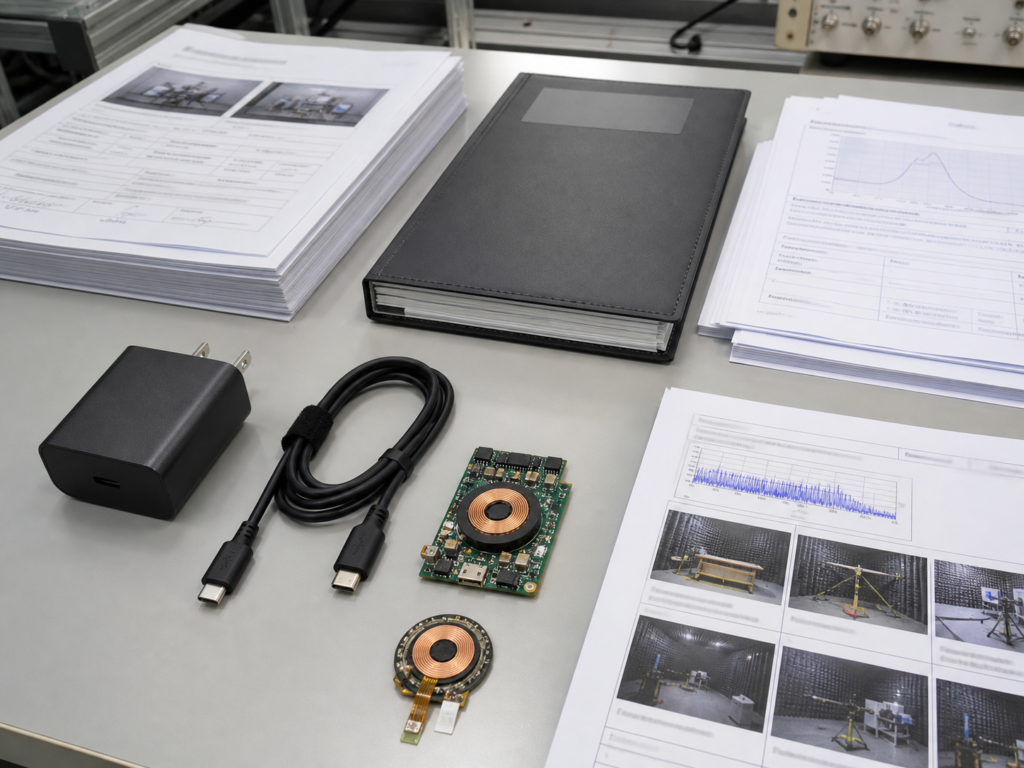
There are several situations that must be re-evaluated: replacing the module model, changing the antenna design, adjusting the transmission power, or adding new supported frequency bands. In addition, it should be noted that the brand, model, and importer of the finished product must be completely consistent with the information on the WPC certificate. If the brand of an ODM/OEM product is changed, it is necessary to reconfirm whether the certificate can be used, and the original certificate of the factory cannot be directly applied.
Special Judgment for Low-power and Magnetic Products
Low power is one of the most common pitfalls: many people think that “wireless chargers below 5W do not need WPC”, which is wrong. WPC exemption requires meeting three conditions at the same time: frequency band, power, and equipment category. You cannot presume exemption just by looking at the power level.
As for magnetic products, do not confuse “magnetic” with “wireless transmission”. If it is a wired product that only relies on magnets for fixation, such as a magnetic wired charging cable, it does not need WPC at all; but if it is a magnetic wireless charging transmitter (such as a MagSafe-compatible wireless charger), because it has a wireless transmission function itself, it still needs WPC certification.
Overseas Certifications Cannot Replace WPC
Most people engaged in export have overseas wireless certifications such as CE and FCC, but none of these can replace India’s WPC certification. The reason is simple: India has local requirements for the scope of open frequency bands, importer qualification, and certificate information. Overseas certifications can only be used as reference materials, and cannot be directly used as WPC certificates.
Practical Tool: 4-Step Quick Self-Check Method
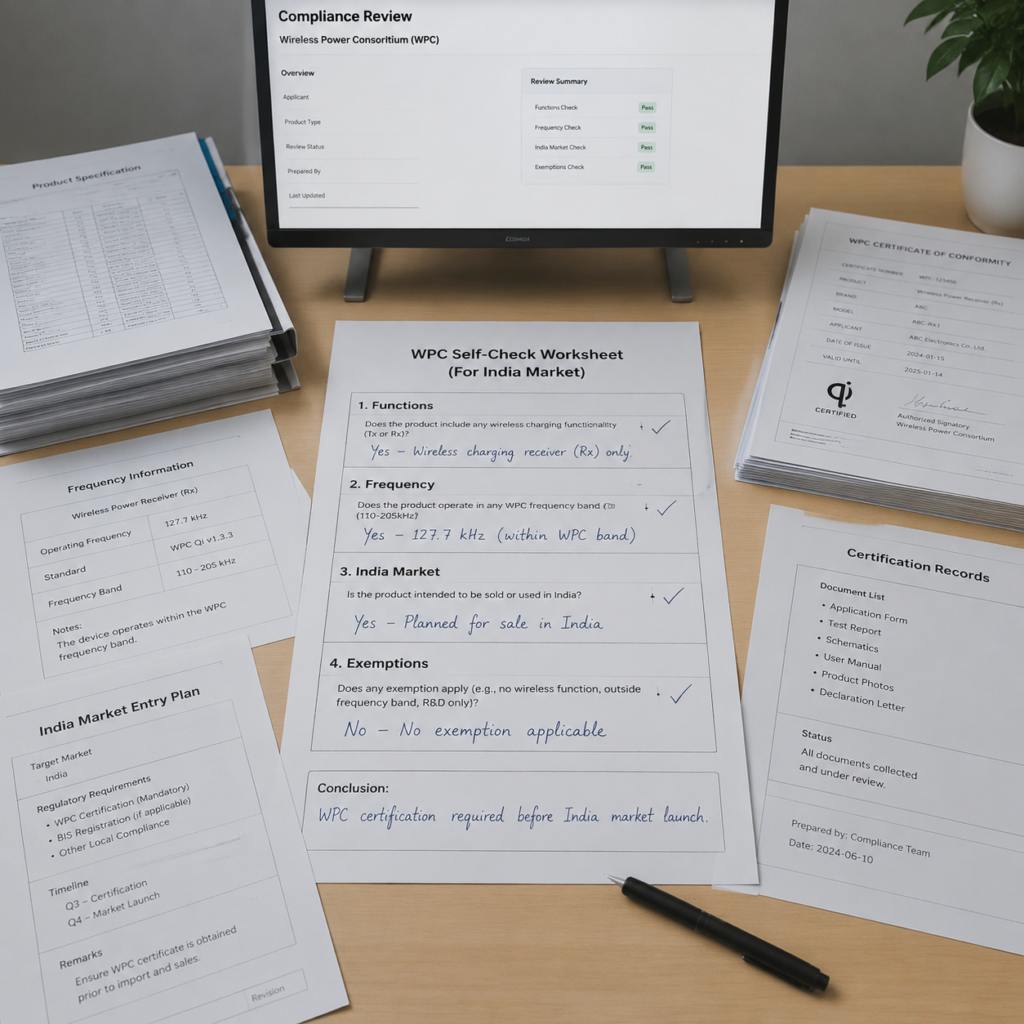
If you want to make a preliminary judgment by yourself first, you can follow these 4 steps, which can basically cover most conventional situations:
Step 1: Check functions and investigate active wireless transmission. First list all functions of the product, and mark clear active wireless functions such as wireless charging transmission, Wi-Fi, Bluetooth, NFC, radio frequency remote control, and FM transmission; also pay attention to hidden functions. If there are descriptions such as “APP control”, “remote switch”, “wireless synchronization” in the promotional pages or manuals, it most likely has a transmitter module. Do not miss this. If you cannot find clear hardware information, be sure to confirm with the supplier, and cannot directly default to no wireless function.
Step 2: Verify the frequency band and confirm the regulatory scope. You can find the wireless frequency band, implementation standard or module model from the product specification sheet and the bottom nameplate, and then compare it with the latest official regulated frequency band list of WPC; if the frequency band is unclear, do not guess by yourself. It is safer to find a WPC-authorized certification body for pre-evaluation.
Step 3: Look at the scenario and confirm whether it enters India. First clarify whether the product is to be sold, gifted, used commercially in India, or directly shipped to India via cross-border e-commerce — even promotional gifts and wireless charging accessories bundled with the main unit need to be evaluated. If it is only exported to other countries, or is a R&D and test sample for which exemption qualification has been applied for, there is no need to consider it.
Step 4: Exclude exemptions and draw a preliminary conclusion. First exclude situations such as pure wired, pure reception, and those clearly listed in the official exemption list; if you have already obtained a WPC certificate before, you also need to check whether the brand, model, and wireless configuration on the certificate are consistent with the current product. Do not think that having a certificate means it can definitely be used. If you are still unsure after completing these 4 steps, never presume exemption by yourself. Finding an authorized body for formal pre-evaluation is the safest way.
Summary of Common Misconceptions
Many people have several fixed misunderstandings about the scope of application of WPC. We will clarify them all at once to avoid pitfalls:
The first misconception is “all charging products exported to India need WPC”. In fact, pure wired charging products without active wireless transmission functions do not need WPC certification at all. The second misconception is “products with USB-C port or supporting PD fast charging need WPC”. In fact, interface types and wired fast charging protocols have nothing to do with wireless regulation. These fall under the jurisdiction of other certifications such as BIS, and have nothing to do with WPC. The third misconception is “as long as it is related to wireless charging, it needs WPC”. In fact, only the transmitter of wireless chargers needs to be evaluated. Pure reception accessories such as charging battery cases and receiver patches, which do not actively transmit signals by themselves, usually do not need it, unless the receiver has an active return handshake signal.
The fourth misconception is “with CE and FCC certifications, there is no need to do WPC”. This is also wrong. India has local requirements for frequency band opening, importer entity, and certificate information. Overseas certifications can only be used as reference and cannot replace local WPC certification. The fifth misconception is “finished products using pre-certified wireless modules do not need WPC”. In fact, module certification is only supporting material for finished product certification, and the whole machine still needs to apply for ETA. The last misconception is “low-power wireless products are automatically exempt from WPC”. For example, some people think that wireless chargers below 5W do not need it. In fact, exemption requires meeting multiple conditions such as frequency band, power, and equipment category at the same time, and you cannot presume exemption just by looking at power.
Summary
After reading this article, you should be able to distinguish the different regulatory scopes of India’s WPC (government wireless regulatory authority), the Qi Wireless Power Consortium (industry standard organization), and BIS (responsible for charging safety, etc.), quickly identify ordinary wired charging products (no WPC required) and wireless/smart charging products that need evaluation, and also use the 4-step self-check method to independently judge whether charging and USB-C products are within the scope of WPC certification. When encountering boundary situations such as multi-functional integration, detachable modules, magnetism, and low power, you can also make a preliminary judgment and will not fall into common pitfalls right away. If you still have doubts in the end, remember to verify through formal channels: either check the latest official list of WPC, or find a WPC-authorized certification body for pre-evaluation. Do not draw conclusions casually by yourself.