
If you manufacture wireless-enabled products such as smart chargers and wireless charging pads and plan to enter the Indian market, you will most likely hear the term “WPC RF testing”. However, many people fall into a very basic pitfall at the very beginning: confusing two completely different “WPCs”. Today, starting from the actual scenarios of charging products, we will thoroughly explain everything from basic judgment to understanding reports and avoiding pitfalls.
First, Get This Straight: The Two “WPCs” Are Completely Different
There are two commonly mentioned WPCs on the market, with vastly different regulatory bodies and governance scopes. This article only covers India’s official WPC RF testing requirements:
- India’s WPC: its full name is the Wireless Planning and Coordination Wing, which is India’s official regulatory authority for spectrum and wireless equipment market access. It governs “whether the radio waves emitted by products will interfere with legitimate local wireless services in India” and falls under the category of mandatory regulation.
- Wireless Power Consortium (WPC): it is an industry organization that mainly promotes Qi wireless charging certification, governing “whether wireless chargers and devices of different brands are compatible for charging”, and is a voluntary compatibility certification.
In short: one is the Indian government body in charge of spectrum, and the other is an industry organization in charge of charging compatibility. They are completely different things, so do not confuse them.
What Exactly is WPC RF Testing For?
Put simply, WPC RF testing verifies whether signals emitted by products with wireless transmission functions comply with India’s frequency band division and interference control requirements. Its core purpose is to prevent the wireless signals of products from interfering with legitimate local wireless services in India such as mobile phones, broadcasting, and aviation. After passing the test, you can apply for an ETA (Equipment Type Approval Certificate), which is the access threshold for wireless products to enter the Indian market.
Currently, WPC has two compliance models, and different products apply to different paths:
- Formal certification mode: It requires submitting test reports to WPC for review, and a formal ETA certificate will be issued after approval. It is applicable to products with high power and special frequency bands.
- Self-declaration/simplified path: It is usually applicable to products that meet India’s license-exempt frequency band and SRD (Short Range Device, low-power short-distance equipment) requirements. Enterprises need to complete ETA applications or compliance declaration requirements in accordance with WPC’s currently applicable procedures based on qualified RF test reports, and retain the full set of documentation for WPC’s random inspection. Whether this path is applicable shall be subject to the product’s operating frequency band, transmit power, and the latest WPC regulations. Most consumer-grade Bluetooth, WiFi, and NFC charging products we encounter daily fall into the SRD category and relatively often adopt this path.
3 Most Common Misconceptions for Beginners
Almost everyone who is new to this will fall for one or two of them, so we will clarify them in advance:
- Misconception 1: All chargers need WPC testing → Correct answer: Only products with active wireless transmission functions need WPC RF testing. Ordinary wired chargers do not need this test, but still need to evaluate other Indian access requirements such as BIS.
- Misconception 2: Passing Qi certification equals WPC compliance → Correct answer: The two have completely different regulatory bodies and core contents. Qi is an industry compatibility certification and cannot replace India’s official WPC spectrum compliance requirements.
- Misconception 3: If the wireless module has a WPC certificate, the whole product does not need testing → Correct answer: The product’s antenna, enclosure, and power supply all affect the final RF performance; even if the module has a certificate, the whole product needs to be re-evaluated.
Does Your Charging Product Need Testing? The Judgment Boundary Is Clear
There is only one core criterion for judging whether WPC RF testing is needed: whether the product has an active wireless transmission function. Active transmission means the product itself emits radio waves — whether it is used to transmit data (such as Bluetooth, WiFi) or transmit energy (such as intentional transmission for wireless charging); if it only receives signals or works by passive induction, it is not within the mandatory scope.
Typical Charging Products That Definitely Need Testing
As long as the product has any of the following wireless functions, WPC RF testing is required:
- Smart chargers, power banks, and smart power strips with Bluetooth or WiFi
- Shared power banks and paired charging accessories with NFC
- Wireless charging pads and magnetic charging heads with communication functions
- USB-C docking stations and car chargers with built-in wireless modules
Typical Charging Products That Definitely Do Not Need Testing
The following products have no active wireless transmission function at all and usually do not need WPC RF testing, but still need to separately evaluate other Indian access requirements such as BIS, safety, and EMC:
- Ordinary wired chargers and power adapters without wireless functions
- Passive charging cables, adapters, plugs, and charging port components
- Products that only support wired fast charging protocols such as PD and QC
- Charging accessories with only LED indicators and no wireless functions
Quick Judgment Method for Gray Areas
If you are unsure whether the product has wireless functions, you can quickly check in three steps:
- Check the product specification sheet for keywords such as Bluetooth, WiFi, NFC, and RF;
- Check the hardware structure for exposed or built-in antennas and wireless modules;
- Check the product functions for functions that require signal transmission such as APP network configuration, remote control, and wireless pairing.
If you are still unsure, prioritize preparing documentation as “needs assessment” and consult a professional institution for verification. Do not take chances, otherwise the loss will be greater if the product is detained at Indian customs.
What Are the Core Test Indicators?
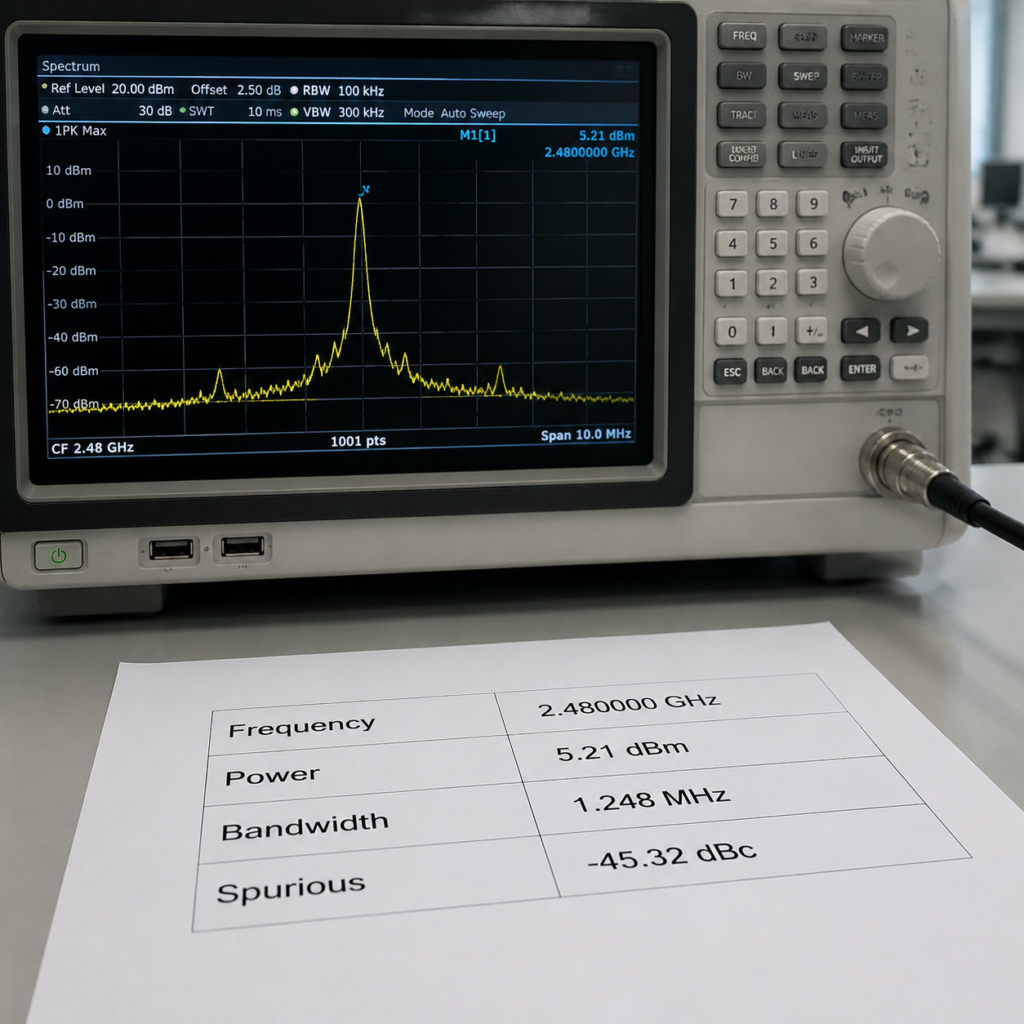
WPC RF testing may seem to have many items, but the core is actually four categories: whether the frequency is correct, whether the power exceeds the limit, whether the occupied bandwidth is too wide, and whether there are redundant interfering signals. We will explain them one by one in combination with the scenarios of charging products:
| Indicator Category | Core Assessment Points | Common Scenarios for Charging Products | Pass Judgment Logic |
|---|---|---|---|
| Frequency Category | Whether the signal falls within the legal frequency band, and whether it drifts during temperature/voltage changes | Bluetooth 2.4GHz, NFC 13.56MHz, WiFi 2.4G/5G | The center frequency offset is within the allowable error range and does not exceed the frequency band boundaries |
| Power Category | Whether conducted transmit power (output strength directly measured at the RF port) and EIRP (actual over-the-air radiation strength including antenna gain) comply with the limits | Wireless charger transmit power, Bluetooth charging head signal strength, WiFi smart power strip maximum power | Both power values do not exceed the maximum allowable limits for the corresponding frequency band, among which EIRP is a key assessment item of WPC |
| Bandwidth Category | Whether the occupied spectrum width is compliant, and whether the edge overflows into adjacent channels | 20M/40M bandwidth of WiFi smart chargers, edge channels of Bluetooth frequency hopping | The occupied bandwidth does not exceed the upper limit, and there is no overflow at the frequency band edges |
| Spurious Emission | Whether there are extra interfering signals outside the main frequency band (the most common non-conformity item) | Wireless charger noise leaking into the WiFi band, Bluetooth charging heads interfering with nearby headphones | The strength of all extra signals in non-operating frequency bands is below the WPC limit |
Here we need to specifically mention the two dimensions of power indicators: conducted transmit power is the output power directly measured from the product’s RF port, which is applicable to module or whole product testing with accessible RF ports; EIRP (Equivalent Isotropically Radiated Power) is the equivalent radiated power after adding antenna gain on the basis of conducted power, which can better reflect the actual over-the-air transmission intensity of the product in use, and is also a key verification item for report judgment.
We also need to specifically mention spurious emissions, which is the most common non-conformity item for charging products. Because all charging products have switching power supplies, if the power supply has poor filtering and insufficient circuit shielding, the noise of the switching power supply will be carried out by the wireless module and become interfering signals outside the main frequency band, which can easily exceed the limit.
Testing Priorities for Different Charging Products
Even for charging products, different wireless functions lead to different testing priorities, so you don’t have to focus on all items:
- Charging accessories with Bluetooth/NFC
They are SRD devices in 2.4GHz (Bluetooth) and 13.56MHz (NFC) bands. The core tests are frequency tolerance, spurious emission, and transmit power. Note that Bluetooth testing needs to cover both Classic Bluetooth and BLE modes, and NFC testing needs to distinguish between active transmission and passive transmission. - Smart charging products with WiFi
They involve 2.4GHz/5GHz WiFi bands. Special attention should be paid that some channels of 5GHz in India are prohibited. The core tests are EIRP transmit power, occupied bandwidth, band edge emission, and spurious emission. Only channels allowed by India are tested, and the firmware version sold to India must never enable prohibited channels. - Charging products with wireless power transfer
That is, products such as wireless chargers. Only those using intentional transmission frequency bands under WPC’s jurisdiction need testing. For pure near-field products without communication functions, you need to first check WPC’s exemption list. The core tests are operating frequency band, transmit power, and spurious emission. Qi only proves charging compatibility and cannot replace India’s WPC RF judgment. - Pure wired/passive charging products
They have no active wireless transmission function and do not need WPC RF testing, but still need to evaluate other Indian certification requirements such as BIS safety and EMC.
Test Preparation and Basic Process
After confirming that testing is needed, adequate preparation in advance can save a lot of trouble, especially since charging products have some unique requirements:
Test Samples and Documentation Preparation
- The test samples must be the final finalized version with complete functions, and must be able to switch to maximum transmission and continuous transmission modes — if the sample cannot reach the maximum transmission state, the test results will be meaningless.
- Basic documentation to prepare: product specification sheet, appearance and label photos, firmware version description.
- Wireless-related documentation to prepare: wireless module model, antenna specifications (gain, type), modulation method description.
- Special preparation for charging products: two power supply states, full load and no load, must be prepared. Because switching power supplies generate more noise under full load, which directly affects spurious emission test results, testing only under no load can easily miss problems.

Test Environment and Laboratory Requirements
- Testing must be carried out in a shielded room or anechoic chamber to avoid external wireless signals interfering with test data.
- Test instruments need to be calibrated in advance, and the power supply must remain stable.
- The laboratory must be officially recognized by WPC, or an institution with ISO/IEC 17025 accreditation whose accreditation scope covers the corresponding RF test items and meets WPC’s current acceptance conditions.
- Note: For reports issued by overseas laboratories, it is necessary to verify in advance whether WPC accepts the laboratory’s qualifications, test standards, signatures and seals, and report format. Any foreign test report cannot be directly used to replace a qualified Indian locally recognized report.
Basic Test Steps
The testing process is actually very clear:
- First confirm the type of wireless function and applicable frequency band of the product, and match the corresponding WPC test requirements;
- Set up the test environment and debug the sample to the specified state of maximum transmit power;
- Complete core indicator tests item by item, and record the measured data of each frequency point;
- Organize the data to issue a formal report, marking the Pass/Fail result of each item.
How to Judge Whether a Test Report is Qualified
When you get the report, you can’t just look at the Pass result. You also need to confirm that the report is valid for your product and whether there are risks in subsequent mass production. Judge in three steps:
Step 1: Verify the Basic Validity of the Report
- Check product information: whether the model, hardware version, and antenna configuration are completely consistent with the model you sell in India. If not, the report is invalid for your product.
- Check laboratory qualifications: whether the laboratory is within WPC’s recognition scope, and whether the report’s signatures, seals, and validity period are compliant.
- Check test basis: whether the latest frequency band and limit requirements of India’s WPC are used, and do not use reports with old standards.
Step 2: Verify the Qualification of Core Indicators
- Frequency category: the operating frequency is within the allowable frequency band, and the offset is within the tolerance range.
- Power category: both the maximum conducted transmit power and EIRP are below the limit. Note that dBm and mW are different power units, so they must be converted to the same unit before comparison.
- Bandwidth category: the occupied bandwidth does not exceed the upper limit, and there is no overflow of band edge emission.
- Spurious category: the signal strength of all non-operating frequency bands is below the limit. Focus on the frequency points corresponding to power supply noise — this is where charging products are most prone to problems.
A special reminder here: if the margin between the measured value and the limit is very small (for example, only 0.2dBm difference), it is very easy to exceed the limit during mass production due to component variations, which carries high risk. It is best to reserve sufficient margin in advance.
Step 3: Evaluate the Applicable Scope of the Report
- The report only covers the listed wireless functions, frequency bands, and antenna configurations. If new wireless functions are added, retesting is mandatory.
- If the chip, wireless module, or antenna is changed, or the PCB layout is modified, the original report will be directly invalidated.
- Even if the wireless module itself has a WPC certificate, the whole product still needs to confirm whether the enclosure, power supply, and antenna have changed the RF performance, and the module’s certificate cannot directly replace the whole product test.
Common Causes of Non-Conformity and Pitfall Avoidance Guide
For charging products undergoing WPC RF testing, the causes of non-conformity are actually very concentrated. Most pitfalls can be avoided with advance attention:
4 Most Common Non-Conformity Items
- Excessive spurious emission: It accounts for the highest proportion, mostly due to poor filtering of the switching power supply and insufficient circuit shielding, which is a unique high-incidence problem for charging products.
- Excessive transmit power: Either the firmware sets the power too high, or the antenna gain is higher than the design expectation.
- Excessive frequency tolerance: Mostly due to poor selection of crystal oscillators, resulting in excessive frequency drift during temperature changes.
- Excessive band edge emission: Mostly due to incorrect WiFi channel settings or bandwidth configuration exceeding the regulations.
Why Test Results Are Sometimes Inaccurate
In addition to the product’s own problems, some factors in the testing process can also lead to distorted results:
- Poor shielding of the test environment, where external wireless signals mix in, leading to inaccurate spurious emission data;
- The sample is not adjusted to the maximum transmit power mode, resulting in more lenient test results than actual, which may exceed the limit in mass production;
- Unstable power supply for testing, leading to fluctuations in transmit power;
- Unique pitfall for charging products: not testing under full load, missing the spurious noise of the switching power supply, which will exceed the limit when actually used under full load.
How to Conduct Self-Inspection Before Submission for Testing
Do these four steps before submitting for testing, which can greatly reduce the probability of non-conformity:
- Function self-inspection: The wireless operating frequency band is in WPC’s legal list, and there are no hidden undeclared wireless functions;
- Configuration self-inspection: Set the WiFi country code to India, disable prohibited channels, and the firmware is completely consistent with the mass production version;
- Parameter self-inspection: Compare the power and bandwidth parameters with similar compliant charging products. If the difference is too large, you should be vigilant;
- Special self-inspection: Check whether there are obvious defects in the shielding and filtering design of the power supply circuit, such as whether there is a shielding cover and whether filter capacitors are installed.
What to Do If Testing Fails
If the test fails, don’t rush to retest. Handle it according to this logic:
- First identify the cause: whether it is a problem with hardware design, firmware configuration, or an error in the test environment;
- Carry out targeted rectification: such as adding shielding layers, adjusting power parameters, replacing with better crystal oscillators or filtering components, and modifying the firmware;
- Resubmit for testing after the rectification is completed. Do not directly retest with unrectified samples, as they will most likely still fail.
Don’t Mix Them Up: Differences Between WPC and Other Common Certifications
Many people confuse WPC with BIS, Qi, EMC, FCC/CE, etc. In fact, they govern completely different things. We will clarify them in the context of charging products:
| Certification/Test Name | Regulatory Body | Core Content | Applicable Scope for Charging Products | Mandatory Status |
|---|---|---|---|---|
| WPC RF | India’s official WPC | Wireless spectrum compliance to avoid interference with other wireless services | Charging products with active wireless transmission functions | Mandatory |
| BIS Certification | Bureau of Indian Standards (BIS) of India | Electrical safety, EMC, energy efficiency, etc. | Most charging products | Mandatory (for some categories) |
| Qi Certification | Wireless Power Consortium | Wireless charging compatibility | Qi-enabled wireless chargers/powered devices | Voluntary |
| EMC Testing | Regulatory bodies of various regions | Overall electromagnetic interference and immunity of equipment | Most electronic charging products | Mandatory (mostly included in BIS/CE/FCC) |
| FCC/CE RF | US/EU regulatory bodies | RF compliance for the US/EU regions | Wireless-enabled products sold to the US/EU | Mandatory (for corresponding regions) |
Here we emphasize a few common misconceptions:
- Smart chargers with WiFi need both WPC and BIS certification, while pure wired chargers only need to evaluate other access requirements such as BIS;
- Spurious noise from switching power supplies may affect both WPC RF and EMC tests, but the two reports cannot replace each other;
- Having FCC or CE RF reports can only be used as a reference and cannot directly replace WPC testing, because India’s frequency bands and limits are different from those of Europe and the US.
Quick Summary
3-Step Judgment on Whether WPC RF Testing is Needed
- First confirm whether there is an active wireless transmission function: such as Bluetooth, WiFi, NFC, intentional wireless power transfer; if yes, testing may be required;
- Then confirm whether the frequency band used is within the jurisdiction of India’s WPC and whether it is on the exemption list;
- If you are unsure, prioritize preparing documentation as “needs assessment” and consult a professional institution for verification; do not take chances.
4 Quick Self-Inspection Items Before Submission for Testing
- The product model, firmware, and antenna configuration are completely consistent with the mass production version;
- The wireless frequency bands and channels comply with Indian requirements, and there are no hidden undeclared functions;
- The test sample can enter the maximum transmit power test mode;
- There are no obvious defects in the shielding and filtering design of the power supply.
Overall, WPC RF testing may seem professional, but its core revolves around the principle of “preventing wireless signals from causing arbitrary interference”. For charging products, as long as you first clarify whether your product has an active wireless transmission function, and then focus on high-incidence issues such as spurious emissions and power, you can avoid many detours.