
Sellers of charging products in the Indian market often encounter the following situation: after finally obtaining BIS certification, the goods are detained by customs upon arrival at the port due to incorrect labeling, or e-commerce listings are directly removed due to non-compliant labels. Many people think that having a certificate means everything is fine, but in fact, the usage rules of the BIS mark are the most likely part to cause pitfalls — especially since charging products are a high-risk category under BIS mandatory control, the mark is a mandatory requirement for customs clearance, listing, and sale, and even a small mistake can cause considerable losses.
First, understand: What is the BIS mark, and which charging products need to be labeled
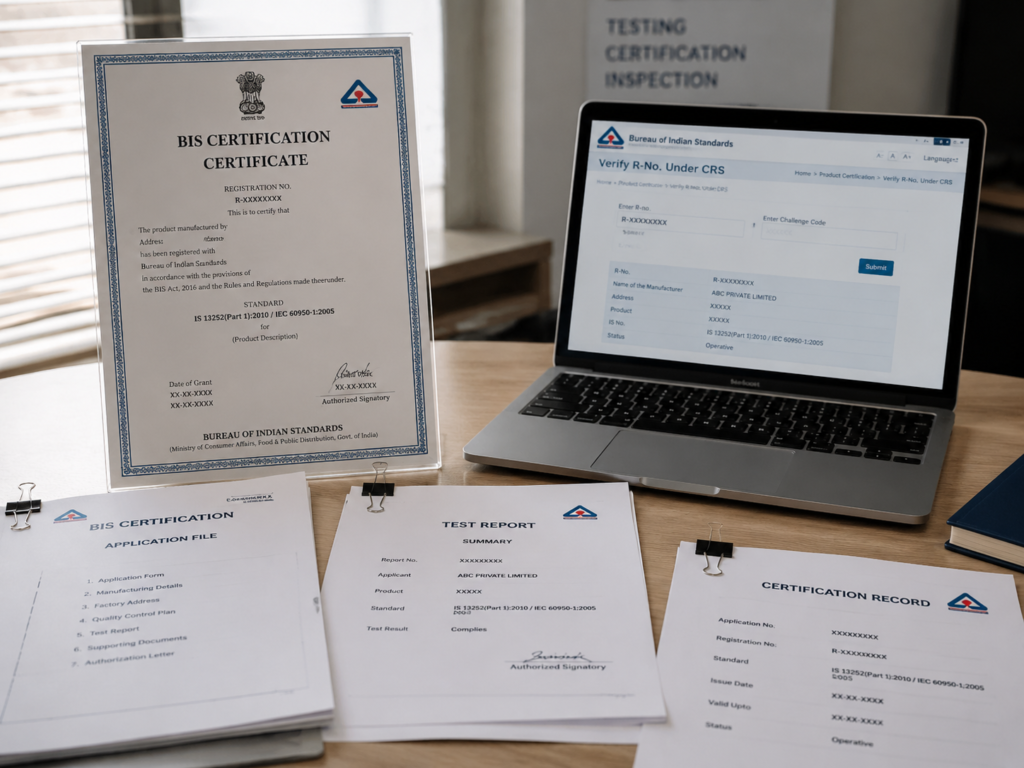
BIS is the abbreviation of the Bureau of Indian Standards, which is equivalent to the official agency in India responsible for product standard formulation and market access supervision, and the BIS mark is the conformity mark issued by it. It should be noted that this mark is not a promotional logo that can be printed at will, it only corresponds to specific product models that have passed BIS mandatory certification/registration, one model corresponds to one exclusive number, and it cannot be used universally.
People who are new to this can easily confuse the BIS certificate with the BIS mark: the certificate is a qualification document held by the enterprise, equivalent to the enterprise’s “access qualification certificate”; the mark is a physical mark affixed to the product, equivalent to the “conformity stamp” of each product — the two are bound, but cannot replace each other. In addition, it should be clear that all charging products on sale are subject to mandatory BIS marking, and voluntary marks cannot be used.
Charging products that must be labeled
As long as they are finished charging products sold separately to Indian consumers, they are basically within the mandatory scope, common ones include:
- Wall chargers, car chargers, power adapters (including mobile phone and laptop fast charging adapters)
- Finished charging cables and data cables with USB/USB-C interfaces sold separately
- Indian standard charging plugs, extended charging docks with USB ports
The specific scope shall be subject to the latest mandatory list issued by BIS India. The list is updated from time to time, so it is best to check it before shipment.
Special situations that do not require labeling
Not all charging-related products need to be labeled, and the following three situations are exempt:
- Bulk USB-C interface parts sold separately and unassembled charging module parts (non-finished products, not directly sold to consumers)
- Built-in charging modules imported with the whole machine (such as the built-in charging board of a laptop, which is not sold separately, only the whole machine needs to meet the certification requirements)
- Small quantities of test samples that comply with customs regulations (only for testing, not allowed to enter the market for sale)
Common misconceptions about the scope of application
These three misconceptions are the most common pitfalls for beginners, so be sure to avoid them in advance:
- Misconception 1: Low-power charging cables/low-wattage chargers do not need to be labeled — Correct answer: As long as they are finished products sold in India, regardless of power, they need to be labeled if they are on the mandatory list.
- Misconception 2: CE/UL/FCC certification can replace the BIS mark — Correct answer: Products on India’s mandatory list only recognize BIS requirements, and certifications from other countries or regions cannot replace it.
- Misconception 3: Having a BIS mark means the best quality — Correct answer: It only means that the product meets the corresponding Indian safety standards (for example, no electric leakage, no overheating and fire), and does not represent the performance level. Both 20W and 100W chargers can have the BIS mark, which has nothing to do with performance strength.
Two types of BIS marks for charging products, must not be mixed
Many people think there is only one type of BIS mark, but in fact, for different charging products, there are two completely independent marking systems, and using the wrong one is directly considered a violation. You can quickly distinguish them through the table below:
| Mark Type | Applicable Charging Products | Number Format | Corresponding Certification Mode |
|---|---|---|---|
| CRS Registration Mark | Chargers, power adapters, finished USB/USB-C charging cables | R-XXXXXXXXXX (starting with R) | Compulsory Registration Scheme (CRS, a common access channel for electronic products) |
| ISI Certification Mark | Indian standard plugs, power cables, fixed charging sockets | CM/L-XXXXXXXXX (starting with CM/L) | License-based certification (focused on production system control) |
Quick distinction and mixing taboos
The logic for judging which mark to use is very simple: first confirm the category of the product in the BIS mandatory list, then correspond to the mark type. The most intuitive distinction method is to look at the beginning of the number — starting with R is CRS, starting with CM/L is ISI. Cross-use is strictly prohibited. For example, printing the CRS R number on a plug, or printing the ISI CM/L number on a charger, are both serious violations.
Here are some examples of common products for easy matching:
- USB-C fast charger → CRS mark (R number)
- Indian standard three-pin plug → ISI mark (CM/L number)
- Charger + charging cable set → Each accessory uses the corresponding mark respectively, and the same registration number cannot be shared.
Compliant BIS marks must meet these content and process requirements
Knowing which mark to use, you also need to confirm that the content and process of the mark meet the requirements. Missing even one element may be judged as invalid.
Required elements of the CRS mark
For the CRS mark commonly used for electronic charging products, three elements are indispensable:
- Official unified BIS logo (cannot be designed, reshaped or recolored without authorization)
- Self-declaration text:
Self Declaration – Conforming to IS [standard number]:(the Indian standard number of the corresponding product needs to be filled in) - Unique registration number starting with R (exclusive to each model, cannot be shared)
Special reminder: It is forbidden to only mark text with no verifiable information such as “BIS Approved”. Consumers and regulators cannot query the corresponding certificate, which is equivalent to an invalid mark.
Required elements of the ISI mark
The required content of the ISI mark used for plugs and cables includes:
- Standard ISI graphic (cannot be stretched, deformed, or changed in direction)
- Unique license number starting with CM/L
- Corresponding Indian standard number (the position can be adjusted according to product standards, but must be clearly visible)
General requirements for size, color and process
The core of the general requirements for the two types of marks is “clear, durable, and recognizable”:
- Size: There is no unified minimum value, but it must be ensured that the registration number/standard number can be clearly recognized by the naked eye; small accessories (such as charging cable connectors) must meet the minimum size requirements of the corresponding product standards.
- Color: Form a strong contrast with the product background color (usually black or white), gradient colors or blurred color matching are prohibited.
- Process: Printing, laser engraving, molding or durable self-adhesive can be used; it must meet the requirements of wear resistance, temperature resistance, and moisture resistance, and is not easy to fall off under normal use.
- Prohibited use: Temporary hang tags, erasable stickers, and easy-to-tear plastic seal labels are not considered compliant marks.
In addition, the BIS mark is usually printed together with the product nameplate. Although this information is not a required element of the mark itself, it is also part of the compliance requirements: brand, model, product name, input/output voltage, current, power (multi-port fast charging needs to indicate single-port/total output), manufacturer, Indian importer, and country of origin information.
Where to affix the BIS mark to be correct?
Many people think that as long as there is a mark, it doesn’t matter where it is affixed. In fact, non-compliant position is also a common reason for detention.
Core principle: Product body first, packaging cannot replace
The mark must be marked on the product body. It is non-compliant to mark only on the outer packaging or e-commerce detail page. At the same time, the mark must not be obscured, and consumers can see it directly during normal use. If the body space of small-sized products is insufficient, compliant alternative solutions (such as fixed nameplates, qualified hang tags) must be adopted in accordance with the corresponding product standards, and cannot be casually affixed to the packaging as a perfunctory measure.
Standard placement positions for different charging products
- Chargers/power adapters: On the side or bottom of the body, it is forbidden to affix on the contact surface of the pins or areas with severe heat generation (to avoid the mark falling off or blurring due to high temperature)
- Finished charging cables/data cables: On the cable body near the USB/USB-C connector or the connector shell, must not be only affixed to the packaging plastic seal (if consumers cannot see it after unpacking, it is equivalent to no mark)
- Indian standard plugs/charging sockets: On non-conductive outer surfaces, it is forbidden to affix on metal pins or conductive parts
- Extended charging docks: On the main nameplate area of the body or near the interface for easy viewing
Supplementary rules for marks on outer packaging and manuals
The mark can be enlarged and printed on retail packaging and color boxes, but the model and registration number of the corresponding product must be marked at the same time, and the information on the packaging must not be inconsistent with the product body. If it is a multi-piece package, the certification information of each accessory must be marked separately, and consumers must not be misled into thinking that one certification covers all accessories. The manual can print the registration number (must be consistent with the body), but it also cannot replace the mark on the product body.
Not all certified products can be labeled: The legal authorization boundary of the BIS mark
Many sellers think that with a BIS certificate in hand, they can label all similar products. In fact, there are strict authorization boundaries for labeling, and crossing the boundary is a violation.
3 core prerequisites for legal labeling
All three are indispensable:
- The corresponding model of the product has obtained a valid BIS certificate (within the validity period, not suspended/revoked)
- The actual parameters of the product are completely consistent with the parameters declared for certification (for example, if 20W is declared, the same mark cannot be affixed to a 65W product)
- The production factory is in the qualified production list filed with BIS, and there is no unrecorded factory change or production condition adjustment
High-risk situations where labeling is absolutely prohibited
These are the red lines strictly investigated by supervision, never touch them:
- Labeling and shipping in advance while the certification is still under review
- “Number borrowing” between different models: for example, products with the same appearance but different powers share the same registration number
- OEM/ODM fraudulent use of qualifications: the fact that the foundry has a certificate does not mean that the brand can use it directly. When changing the brand, it is necessary to confirm whether the certification scope covers it
- Still producing/importing products with the mark after the certificate expires, is suspended or revoked
Authorization boundary for sets/combined products
- Set of charger + charging cable + plug: Each accessory must meet BIS requirements separately, and “one certificate covers all” is not allowed. If only the charger has a certificate and the cable and plug do not, it is non-compliant even if sold as a set
- Built-in charging module of the whole machine (not sold separately): No need to label separately, as long as the whole machine meets the certification requirements
- Multi-model series products: Each registered model corresponds to an exclusive registration number, and uncertified derivative models (such as models that only change color or interface) must not be labeled
Handling rules after certificate status changes
The validity period of the BIS mark is completely synchronized with the corresponding certificate. The certificate must be renewed in time before expiration, otherwise products with the mark cannot be produced after expiration. If the certificate is suspended/revoked, the produced labeled products must be recalled or removed from the shelves in accordance with BIS requirements, and cannot continue to be sold. If the certification information changes (such as the manufacturer’s name change, standard version change), the mark on the product must be updated simultaneously, and the old information cannot continue to be used.
Common violations and consequences
There are mainly 5 types of BIS mark violations for charging products, and the corresponding impacts cover the entire chain from customs clearance to brand:
- Style violation: Graphic deformation, missing core information, mixed types, only marking “BIS Approved”
- Position violation: Only packaging is labeled, product body has no mark, mark is obscured
- Authorization violation: Fake numbers, number borrowing, fraudulent use of others’ qualifications
- Status violation: Still selling labeled products after the certificate expires/is suspended
- Parameter inconsistency: The power/current of the certification corresponding to the mark is inconsistent with the actual marking of the product
Common consequences after violations include:
- Customs clearance link: Customs detention of goods, return or destruction, resulting in additional warehouse rent and logistics costs
- Sales link: E-commerce platforms remove listings, freeze accounts, offline channels reject or return goods
- Regulatory penalties: BIS fines, confiscation of goods, and revocation of all certification qualifications in serious cases
- Brand impact: Damaged consumer trust, resulting in recall costs
There are also several easily confused gray area misconceptions to note:
- Misconception: Small quantities of samples can be labeled and sold — Correct answer: Compliant samples are only for testing, and entering the market for circulation is treated as a violation
- Misconception: For online sales, it is enough to put the mark on the detail page — Correct answer: The product body must be labeled, and the mark on the detail page cannot replace it
- Misconception: Mislabeling and fake labeling have the same punishment — Correct answer: Mislabeling (such as wrong position, small information error) is mainly rectified, while fake labeling (unauthorized forgery, fraudulent use of qualifications) is punished more severely
How to quickly judge whether the BIS mark is compliant?
Whether you are purchasing charging products to sell to India or shipping under your own brand, you can use this set of methods from initial visual screening to official verification to quickly judge.
3-step quick visual inspection (for charging products only)
- Check elements: First confirm the mark type, then check whether there is a corresponding graphic, registration number/license number, and standard number. Missing any one is suspicious
- Check position: Whether the mark is on the product body. Be vigilant if only the packaging/detail page has the mark
- Check process: Whether the mark is clear and not easy to fall off. Blurred stickers and easy-to-tear plastic seal labels are most likely non-compliant
Verify the authenticity of the registration number through official channels
Visual inspection can only see the surface, and the authenticity must be verified through the public query channel on the BIS official website (no need for a VPN). After entering the registration number/license number, focus on checking whether the product model, manufacturer, certificate validity period, and standard number are consistent. Note: Only the query results on the BIS official website are valid, and information on third-party platforms is for reference only and cannot be used as a basis for compliance.
Exclusive judgment skills for charging products
- Fast chargers: The output power/current of the certification corresponding to the mark must be completely consistent with the product nameplate
- USB-C charging cables: The mark must be on the connector or cable body; it is non-compliant to only affix it on the packaging plastic seal
- Indian standard plugs: Must use ISI mark + CM/L number; using CRS R number is a type mix-up
- Multi-port chargers: Need to check whether the single-port output and total output parameters are consistent with the certification declaration
BIS mark compliance self-check list for charging products
Before shipment or procurement, you can conduct a self-check according to the following four dimensions, which can basically avoid more than 80% of marking problems:
- Certification scope self-check: Whether the product is in the latest BIS mandatory list, whether the corresponding CRS/ISI type matches, whether the certificate covers the current brand, model, production factory, standard number, and whether the certificate status is valid
- Mark content self-check: Whether the mark graphic complies with the specification without deformation, whether the registration number/license number, standard number, and declaration text are complete and accurate, and whether the product nameplate parameters are consistent with the certification declaration
- Placement and process self-check: Whether the product body has a clear and durable mark, whether the position meets the requirements without obstruction, and whether the mark information on the retail packaging and manual is consistent with the body
- Final self-check before shipment: Whether the certification and mark of new models/modified models/factory-changed products have been updated, whether the marks of inventory packaging and mass-produced products are consistent with the latest certificate information, and whether the certification marks of each accessory of multi-piece products are compliant respectively
The BIS mark may seem like just a small mark on the product, but it is the first checkpoint for market access in India. Especially for high-risk categories such as charging products, regulatory inspections will only become stricter. Understanding the scope of application, distinguishing between the two types of marks, avoiding common violation pitfalls, and combining the methods of visual inspection + official verification can basically ensure mark compliance and reduce unnecessary losses.